On this page
- Key takeaways
- Green coffee bean extract vs green tea extract: what's the difference?
- What is green coffee bean extract, and how does it differ from coffee?
- How is green tea extract different from the green tea you brew?
- Which extract has more caffeine, and how does each compare with a cup?
- How is green coffee bean extract different from caffeine anhydrous?
- What do our label's standardizations tell you, and what don't they?
- How do you take each product, according to its label?
- When don't you need green coffee or green tea extract?
- Who should check with a healthcare provider first?
- FAQ: green coffee bean vs green tea extract
- Sources
The short answer: Green coffee bean extract vs green tea extract is a contrast between two plants and two families of compounds. Green coffee extract comes from unroasted coffee beans and is known for chlorogenic acids. Green tea extract comes from the leaves of Camellia sinensis and is known for catechins, including EGCG. Both carry caffeine. On our capsule's label, only the tea side says what its numbers measure: 45% EGCG and 6% caffeine.
Key takeaways
- Green coffee bean extract is made from unroasted coffee beans, and it's known for chlorogenic acids, a kind of polyphenol.
- Green tea extract is a concentrate of tea leaves, and its best-known compounds are catechins, among them EGCG (epigallocatechin gallate).
- Both extracts contain caffeine, and a percentage printed beside an extract describes that ingredient's makeup without giving you a milligram dose.
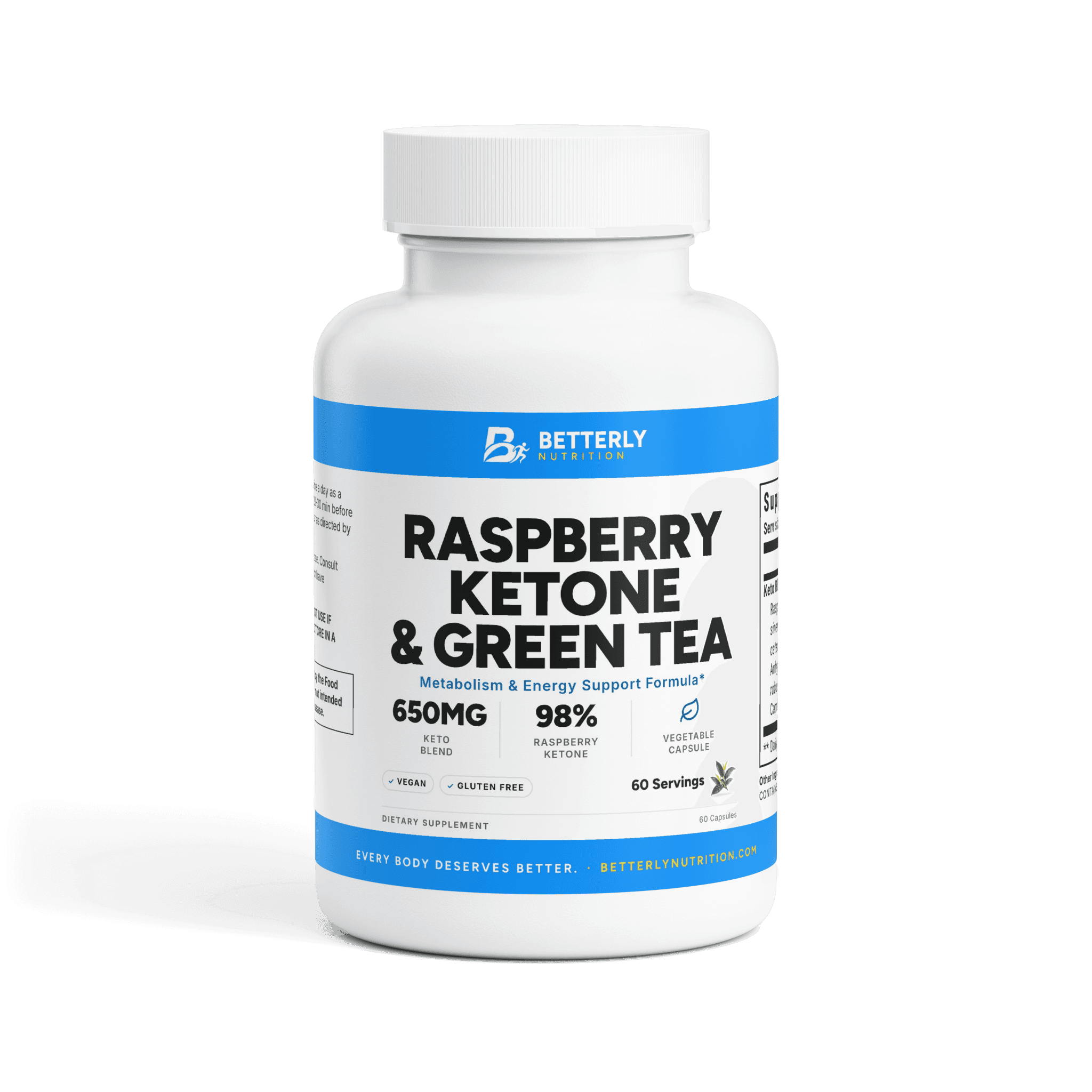
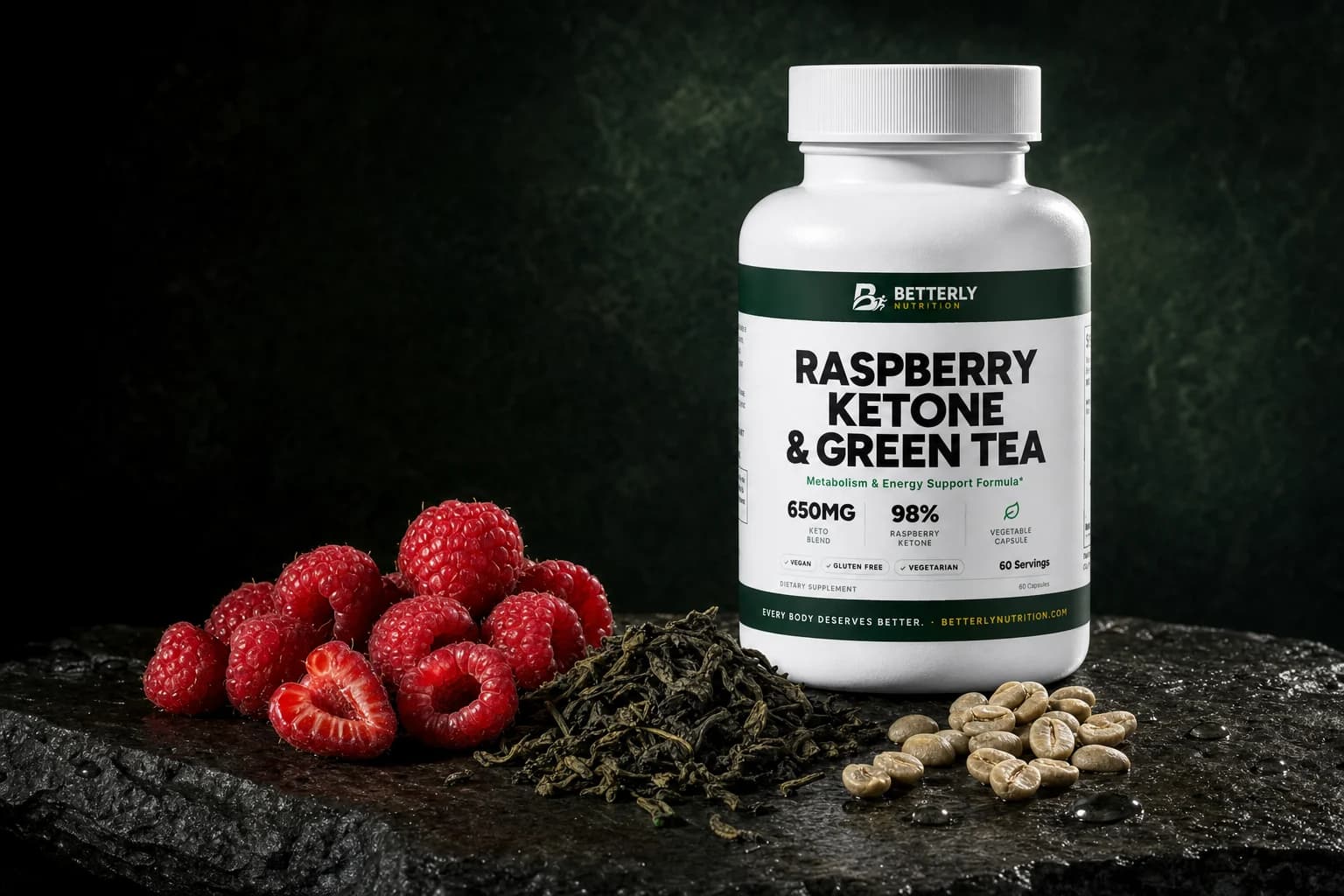
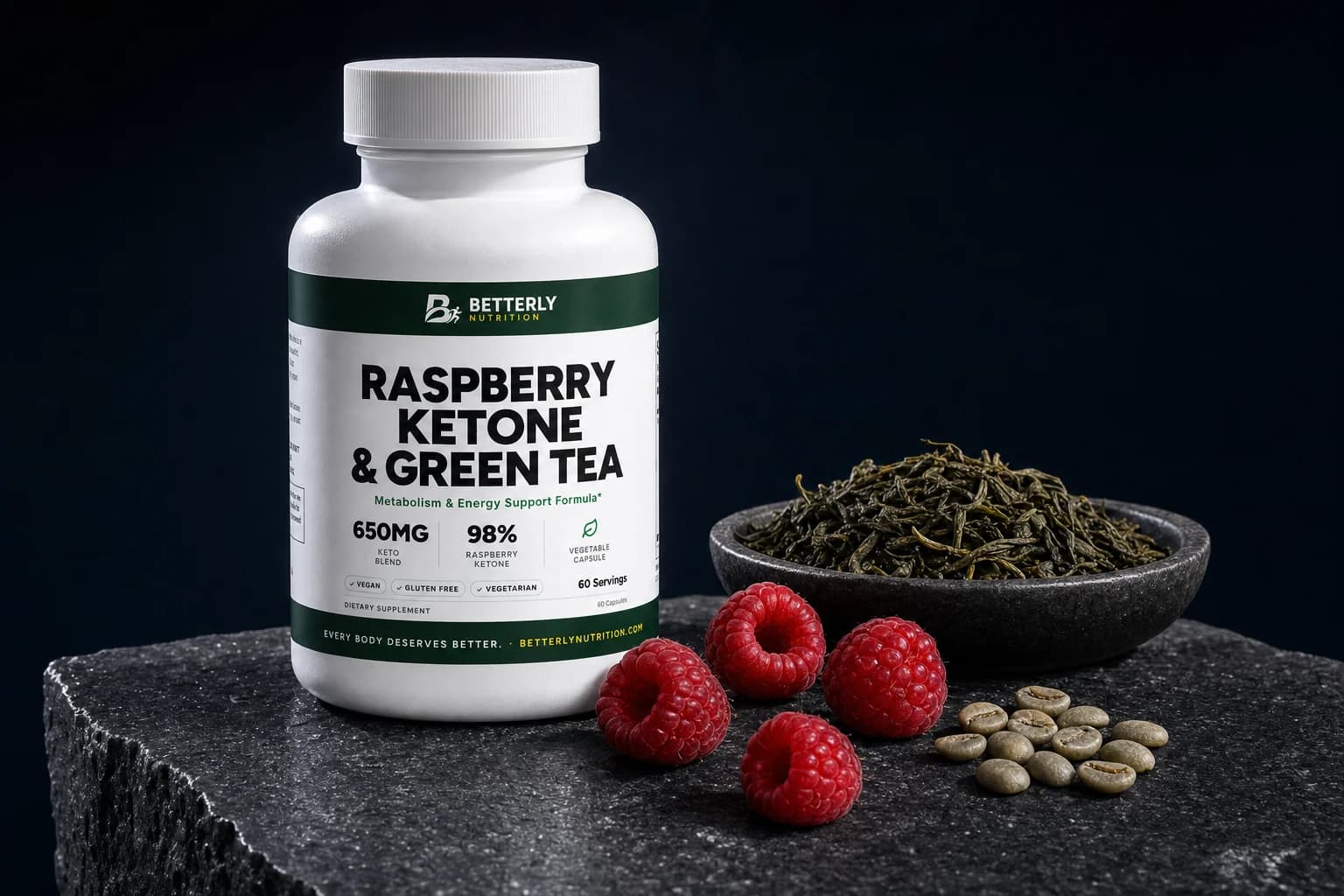
- Betterly's Raspberry Ketone & Green Tea Capsules hold both extracts plus caffeine anhydrous in a 650 mg blend per 1-capsule serving, and the green coffee line names no marker compound.
We sit on one side of this comparison, since Betterly's raspberry ketone capsule contains both extracts. What you get in return is an actual Supplement Facts panel to read with us, vague lines included.
Green coffee bean extract vs green tea extract: what's the difference?
Green coffee bean extract and green tea extract differ in source and signature compounds: unroasted coffee seeds with chlorogenic acids versus tea leaves with catechins such as EGCG.
| Green coffee bean extract | Green tea extract | |
|---|---|---|
| Plant part | Unroasted coffee seed | Camellia sinensis leaf |
| Known for | Chlorogenic acids | Catechins, including EGCG |
| Caffeine | Yes | Yes |
| Everyday drink | Coffee, from roasted beans | Brewed green tea |
| On our label | "50% Extract," no marker named | 98% polyphenols, 75% catechins, 45% EGCG, 6% caffeine |
The two extracts come from different plants and are sold for different compounds, with one well-known stimulant in common.
They also overlap more than the marketing suggests. PubChem, the National Library of Medicine's chemistry database, describes chlorogenic acid as a polyphenol found in coffee and black tea, and it lists the compound as reported in the tea plant itself. Catechins are polyphenols too. So both extracts are polyphenol concentrates that lead with different families.
What is green coffee bean extract, and how does it differ from coffee?
Green coffee bean extract is a concentrate of coffee beans that were never roasted, while brewed coffee is made from roasted beans and poured by the cup.
The NIH Office of Dietary Supplements (ODS) defines green coffee beans plainly as unroasted coffee beans. It also notes that they contain caffeine, which is an easy detail to miss. "Green" is simply the raw bean's color before roasting, and it says nothing about strength or caffeine.
Chlorogenic acid's name can throw you off. PubChem describes it as an ester built from caffeic acid and quinic acid. Caffeic acid sounds like caffeine, but it's a separate molecule, so a chlorogenic acid figure tells you nothing about a product's caffeine.
Our label lists it as Green Coffee Bean (Coffee robusta)(seed)(50% Extract): robusta is the coffee species, and seed is the botanical word for the bean.
How is green tea extract different from the green tea you brew?
Green tea extract is a concentrate of compounds from Camellia sinensis leaves, while brewed green tea is a drink whose catechins and caffeine come diluted in a cup of water.
According to the National Center for Complementary and Integrative Health (NCCIH), green, black and oolong teas all come from that one plant. Green tea leaves are steamed, pan fried and dried without being fermented. Black tea is fermented, and oolong is partly fermented.
NCCIH refers to the catechins and caffeine in green tea and its extracts, and it notes that the effects of green tea products can vary with the product's composition. That means two products that both say green tea on the front can be quite different inside.
Our label shows what concentration looks like on paper. The green tea line lists 98% polyphenols, 75% catechins and 45% EGCG.
Which extract has more caffeine, and how does each compare with a cup?
Neither green coffee bean extract nor green tea extract has a fixed caffeine amount; it depends on the extract, and our capsule doesn't print a milligram figure for either.
The drinks are easier to pin down. The FDA's caffeine guide, Spilling the Beans, puts a 12-fluid-ounce cup of brewed coffee at 113 to 247 mg and the same size green tea at 37 mg. As drinks, coffee usually carries several times the caffeine of green tea.
As extracts, that gap stops being useful, because the dose depends on how much extract a serving holds. Our capsule has three caffeine sources, each described differently on the panel:
- Green tea: 6% caffeine, printed as a percentage of the tea ingredient.
- Green coffee bean: no caffeine figure at all.
- Caffeine anhydrous: listed by name, with no milligram amount.
For the capsule as a whole, the panel's only caffeine statement is "CONTAINS CAFFEINE," printed under Other Ingredients with no milligram total. The blend doesn't give the tea's own weight either, so 6% of an unknown amount stays unknown. Our look at whether raspberry ketones work calculates the ceilings the ingredient order allows.
So how does green tea extract compare with plain caffeine? The FDA is clear that your body handles the caffeine that occurs naturally in coffee and tea no differently from caffeine added to a product. An extract just brings other plant compounds along with it. For most adults, FDA cites 400 mg a day, about two to three 12-ounce cups of coffee, as an amount not generally associated with negative effects.
How is green coffee bean extract different from caffeine anhydrous?
Caffeine anhydrous is caffeine on its own, dried into a powder, while green coffee bean extract is a bean concentrate that contains caffeine alongside chlorogenic acids and other plant compounds.
The word anhydrous just means the water has been removed. On a panel, it tells you caffeine was added as its own ingredient instead of arriving inside a plant. Ours reads Caffeine Anhydrous (98%).
The practical difference is precision. A purified powder can be weighed to the milligram before it goes into a product, while a plant extract's caffeine depends on the beans and the process unless the maker standardizes it and says so.
Precision matters most with loose powder. FDA estimates toxic effects can appear when about 1,200 mg is taken quickly, an amount smaller than half a teaspoon of the pure powder. Our capsule's whole blend weighs 650 mg, so a single capsule can't hold that much caffeine. The danger FDA describes comes from bulk powder measured by hand.
What do our label's standardizations tell you, and what don't they?
The Raspberry Ketone & Green Tea label describes its green tea by percentages, names no marker for its green coffee, and gives neither ingredient its own weight.
Standardizing means a maker holds a named compound, called a marker, at a set percentage of the extract. Our guide to what a standardized extract means covers the concept. The table below applies it to our capsule, with our Caffeine & L-Theanine Energy Strips alongside, since they print caffeine as an amount:
| Panel line | What it names | What you can work out |
|---|---|---|
| Green tea (leaf) | Polyphenols, catechins, EGCG, caffeine | Proportions only, and 98% + 6% passes 100% |
| Green coffee bean (seed) | "50% Extract," no compound | Nothing about its compounds |
| Caffeine anhydrous | A bare 98% | Not how much is present |
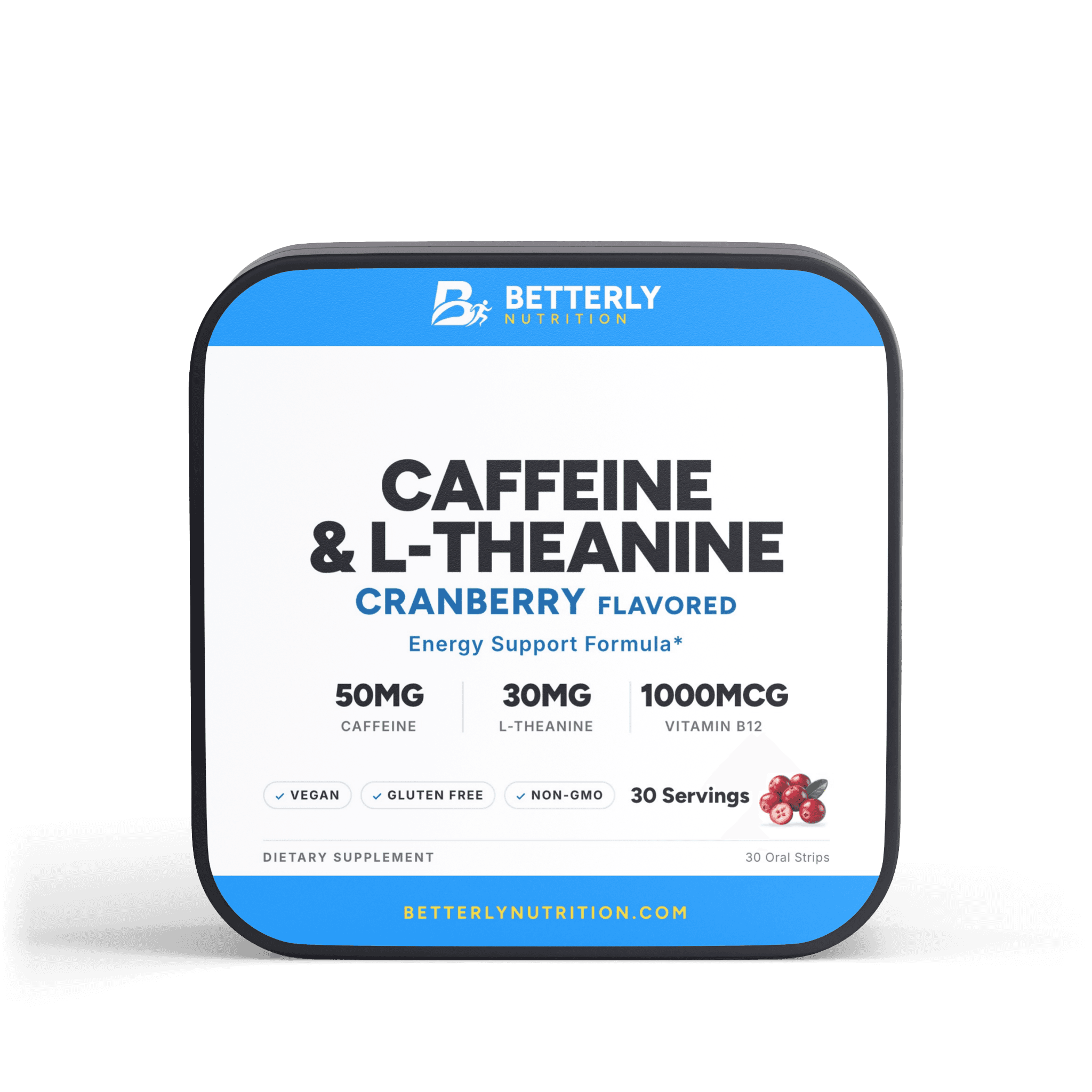
| Energy strip | Caffeine, 50 mg | The exact dose per strip |
Only the strip row gives you a dose. The tea row gives proportions, and the coffee row gives almost nothing.
Why can't a percentage become milligrams? The green tea sits inside the 650 mg Keto Blend with four other ingredients, and a proprietary blend shows only the combined weight. Turning 45% into milligrams of EGCG would take the tea's own weight, which the panel doesn't give. The tea's figures don't share one base either: 98% polyphenols plus 6% caffeine comes to 104%, and the label doesn't say how each was measured.
Our panel never says what the green coffee's "50% Extract" refers to, and nothing else on the bottle explains it. When you compare green coffee products, a line that names its marker, such as chlorogenic acids, tells you more than a bare percentage, and a milligram amount tells you more still.
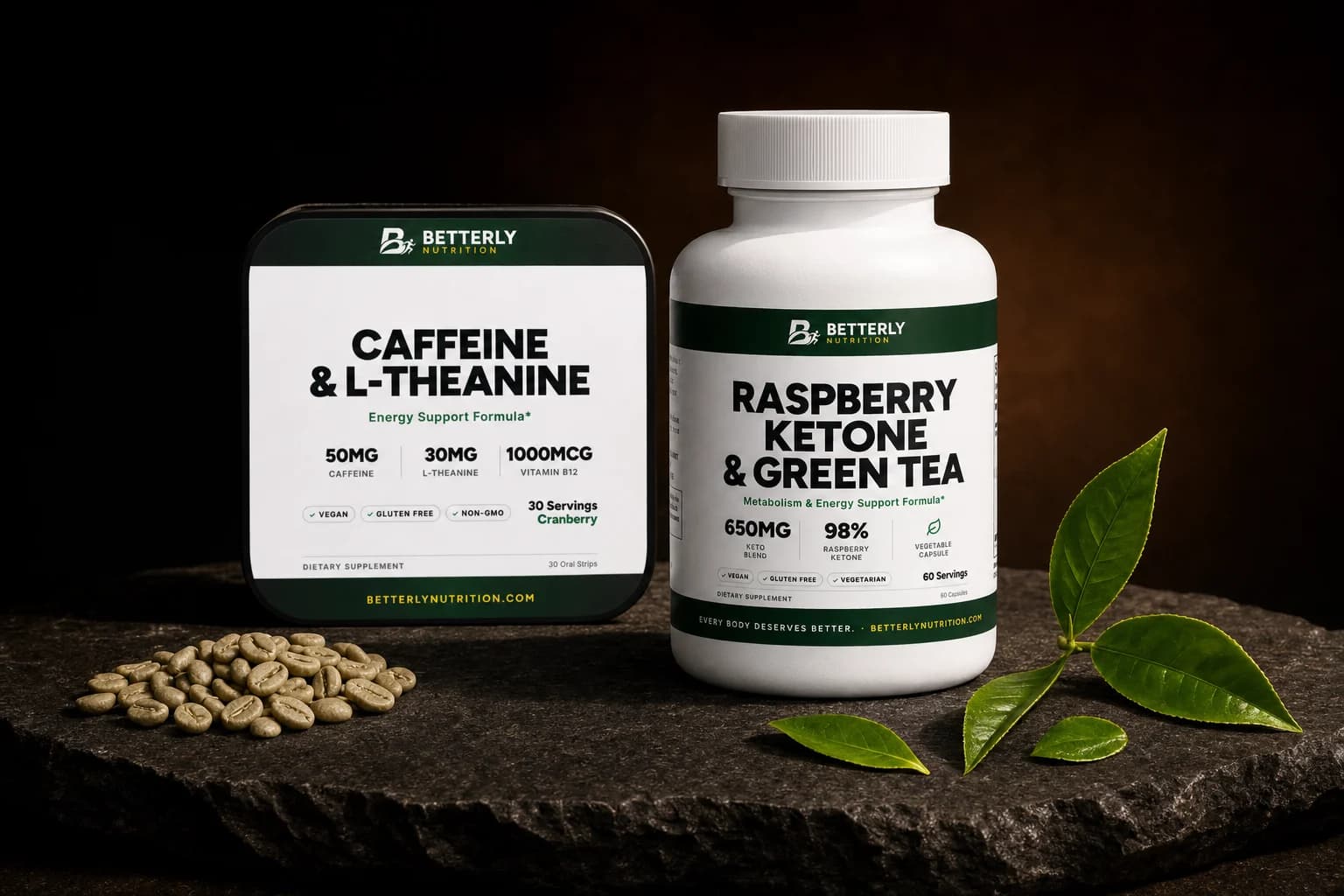
From our shop: Raspberry Ketone & Green Tea Capsules — green tea described by four printed percentages and green coffee bean listed as a 50% extract, together in a 650 mg blend per 1-capsule serving.
How do you take each product, according to its label?
The label for Raspberry Ketone & Green Tea Capsules says one capsule twice a day before meals, and the Caffeine & L-Theanine Energy Strips label says one strip a day.
For the capsules, the label's suggested use is one capsule twice a day, 20 to 30 minutes before a meal, with an 8 oz (237 ml) glass of water. A few practical notes:
- Two capsules is the full day. The caution reads "Do not exceed recommended dose."
- The capsule contains caffeine, so your earlier meals are a better fit than dinner.
- When a product adds caffeine without declaring the amount, FDA's advice is to take care on your first use, and this capsule is one of those. Ease back on coffee and tea on capsule days, at least at first.
- At two a day, the 60-capsule bottle lasts 30 days.
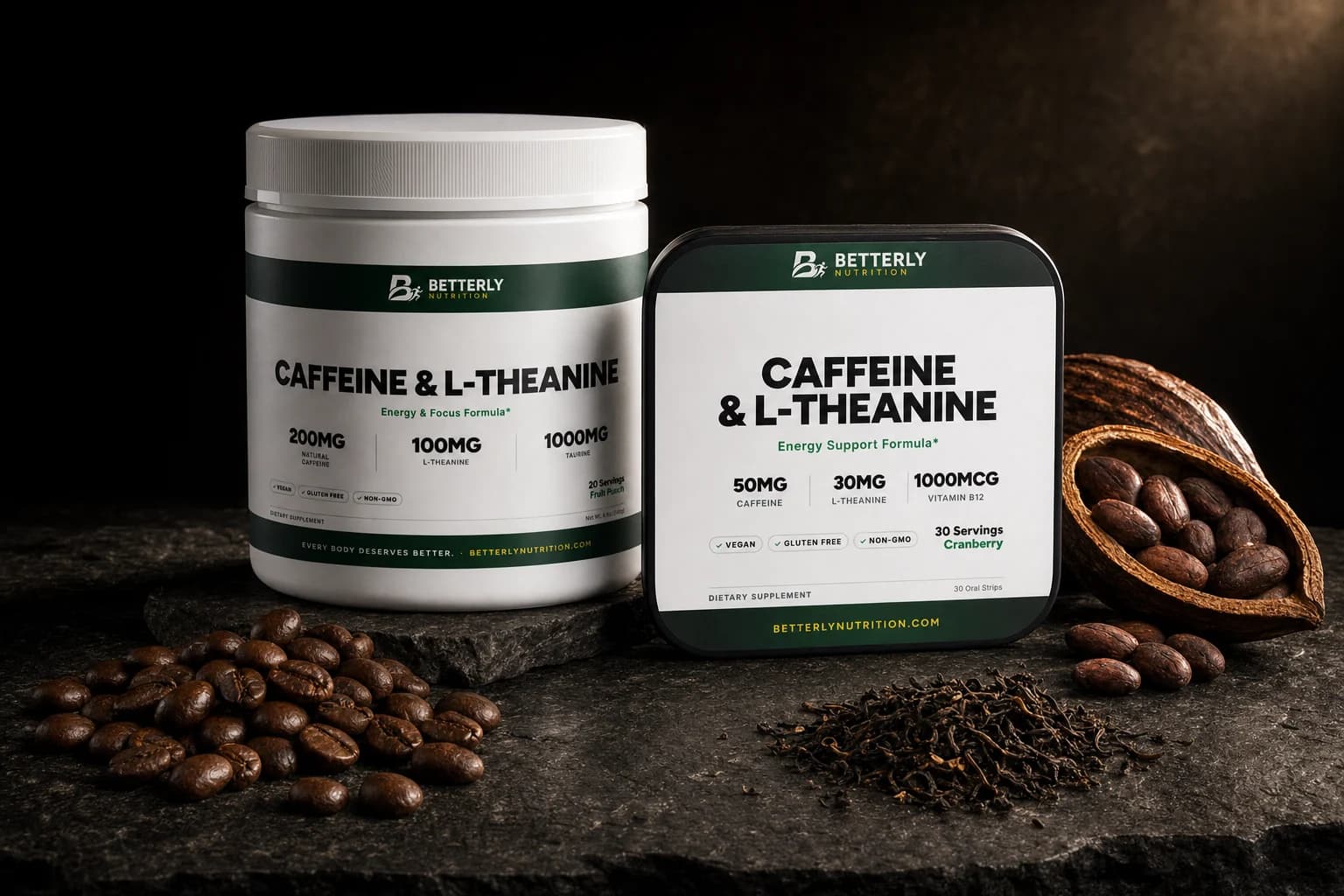
For the strips, the label says to set one strip on your tongue once a day and let it dissolve. Each 1 oral strip (290 mg) serving lists 50 mg of caffeine, 30 mg of L-theanine and 1000 mcg of vitamin B12 as methylcobalamin, and the pack holds 30.
Use one or the other on a given day rather than stacking them. Both add caffeine, and only one tells you how much. To see how 50 mg compares with the drinks you already have, our guide to whether 50 mg of caffeine is a lot converts it into cups.
From our shop: Caffeine & L-Theanine Energy Strips — 50 mg of caffeine and 30 mg of L-theanine per 1-strip serving, printed as amounts, in a cranberry-flavored strip labeled vegan and gluten free.
When don't you need green coffee or green tea extract?
You don't need green coffee or green tea extract if caffeine is all you're after, since a source printed in milligrams is easier to plan around than a percentage.
You can also pass on both if:
- You already drink coffee or green tea and like it. The cup gives you each plant and its caffeine in servings you can count.
- You're cutting out caffeine. ODS says green coffee beans contain it, and NCCIH says green tea does too.
- You want every amount printed. A proprietary blend won't give you that.
Want the same shelf without caffeine? The other formulas in our weight support collection list no caffeine source on their panels. At most, a formula like ours can support healthy weight management alongside diet and exercise.
Who should check with a healthcare provider first?
Check with a healthcare provider before taking green coffee or green tea extract if you're pregnant, nursing, under 18, taking any medication or managing a medical condition.
That list mirrors our capsule's caution: "Consult a physician if pregnant, nursing, under 18, or have a medical condition." Each extract gives you something specific to raise.
For green tea extract, it's the liver note. NCCIH says liver injury has been reported, though it's uncommon, in some people using green tea products, mostly extract tablets or capsules. ODS separates the forms the same way, calling the drink safe and the extract possibly not. Mention the capsule even if green tea is already your daily drink.
For both extracts, it's caffeine. NCCIH says caffeine in pregnancy shouldn't go past moderate levels and that it can pass to an infant through breast milk. Our panel gives no milligram total, so show your provider the full ingredient list.
With medicines, NCCIH says green tea can lower blood levels of certain drugs, and ODS notes that many ingredients in this aisle haven't been tested in combination. Scheduled for surgery? Tell your surgeon about this capsule and every other supplement you use.
Our raspberry ketone side effects guide covers the rest of this formula's ingredients.
FAQ: green coffee bean vs green tea extract
Is green tea extract the same as EGCG?
No. Green tea extract is a mix of compounds from the tea leaf, and EGCG (epigallocatechin gallate) is one of them. Our green tea line shows the layers: 45% EGCG sits within 75% catechins, within 98% polyphenols, with 6% caffeine listed on its own. A label like ours gives proportions of the whole extract and no single compound's weight.
Does green tea extract contain L-theanine?
Not as far as our label shows: the green tea extract line in our capsule doesn't list L-theanine, so you can't count on getting any from it. The line names only polyphenols, catechins, EGCG and caffeine. If you want L-theanine and caffeine as printed amounts, our energy strips list 30 mg of L-theanine and 50 mg of caffeine per 1-strip serving.
Can you take green coffee bean extract and green tea extract together?
Green coffee bean extract and green tea extract are often sold together, our capsule included, but both bring caffeine. ODS notes that combining caffeine with other stimulant ingredients can increase caffeine's effects. If a formula already pairs the two, don't add a separate green tea or green coffee supplement on top, and count coffee, tea and energy drinks toward your day.
Can green coffee bean extract keep you awake at night?
Yes, green coffee bean extract can keep you up, since ODS says the beans contain caffeine and that caffeine can affect your sleep. Our capsule's label pairs each dose with a meal, so the easy fix is to use your two earlier meals and leave dinner out, especially if you're sensitive to caffeine.
Which gives more energy, green coffee or green tea extract?
For energy, the ingredient that matters in both extracts is caffeine, which ODS describes as a stimulant that can make you more alert. Neither extract has a set caffeine amount, and our label doesn't give one, so our panel can't tell you which lifts you more.
Sources
- NIH Office of Dietary Supplements: Dietary Supplements for Weight Loss, Fact Sheet for Consumers
- National Center for Complementary and Integrative Health: Green Tea: Usefulness and Safety
- U.S. Food and Drug Administration: Spilling the Beans: How Much Caffeine is Too Much?
- National Library of Medicine, PubChem: Chlorogenic Acid, CID 1794427
If this left you looking for somewhere to start, read capsules with green coffee bean and green tea extract — its amounts per serving are listed on the page. For the practical questions this raises, how dosing, sourcing and subscriptions work is answered in one place.