On this page
- Key takeaways
- Do raspberry ketones work on their own?
- How do the other ingredients in a raspberry ketone formula compare?
- What do the 98% numbers on a raspberry ketone label mean?
- Is raspberry ketone natural, or is it made in a lab?
- Do raspberry ketones give you energy?
- How do you take raspberry ketone capsules, per the label?
- Want a caffeine-free pick from this shelf?
- When don't you need a raspberry ketone supplement?
- Who should check with a healthcare provider first?
- FAQ: raspberry ketones
- Sources
The short answer: Do raspberry ketones work? Nobody can say yet. According to the NIH Office of Dietary Supplements, raspberry ketone has only been tested for its marketed purpose mixed with other ingredients, never alone, so its own effects are unknown. There also isn't enough research to judge its safety. Our formula pairs it with caffeine and green tea, and caffeine is the likely source of any lift you feel.
Key takeaways
- Raspberry ketone has only been tested for its marketed job alongside other ingredients, so the NIH Office of Dietary Supplements calls its own effects unknown.
- ODS has verdicts on the other four ingredients in our blend, but our label gives none of their amounts, so those findings can't be matched to one capsule.
- ODS calls caffeine a stimulant but doesn't describe raspberry ketone as one, and the green tea in our capsule alone can carry up to about 20 mg of caffeine.
- "98%" appears three times on our panel: most likely a purity grade after raspberry ketone and caffeine anhydrous, and a polyphenol share for green tea. None is a milligram weight.
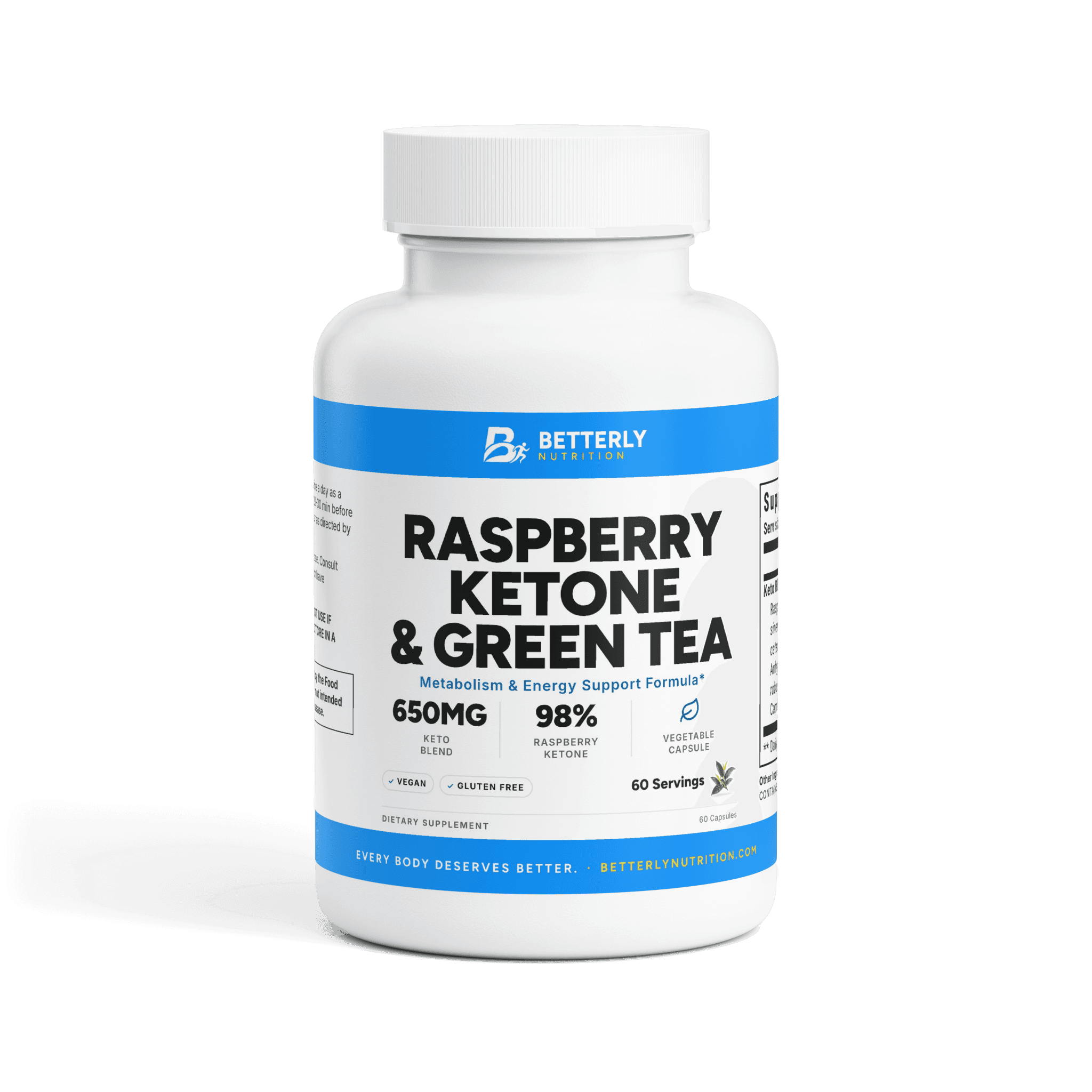
We sell Raspberry Ketone & Green Tea Capsules, and we still can't point you to proof that raspberry ketone works. So instead of a promise, here's a line-by-line read of that bottle's Supplement Facts panel, including where it leaves milligrams out.
Do raspberry ketones work on their own?
The NIH's dietary supplement office doesn't say raspberry ketones work on their own, because raspberry ketone hasn't been tested alone for the purpose it's sold for.
The NIH Office of Dietary Supplements (ODS) reviewed the ingredients that turn up most in this aisle. For raspberry ketone, it reports that the compound has only been studied for this use in combination with other ingredients, and that there isn't enough research to judge its safety.
Why does a mix matter? If a five-ingredient capsule beats a placebo in a trial, you still can't tell which ingredient did the work. Raspberry ketone could be along for the ride.
ODS also notes that companies selling these products rarely test their finished formulas in people. Ours hasn't been through a human trial either. And despite the word "ketone," it isn't a keto ingredient; our raspberry ketones vs BHB breakdown explains where the name comes from.
How do the other ingredients in a raspberry ketone formula compare?
ODS reached a verdict on each of the other four ingredients in our raspberry ketone formula, while raspberry ketone's own effects remain unknown.
Raspberry ketone has the least evidence, since it's never been studied alone for the use it's marketed for, while garcinia cambogia has the weakest result: ODS says it has little to no effect.
| Ingredient on our panel | What ODS concluded | ODS on safety |
|---|---|---|
| Raspberry ketone (98%) | Unknown; only tested in mixes | Not studied enough to judge |
| Green tea leaf | Might have a small effect | Drinking it is safe; extracts might not be |
| Caffeine anhydrous (98%) | Might have a small effect, which tolerance can dull | Safe for most adults up to 400 to 500 mg a day |
| Green coffee bean (50% extract) | Might have a small effect | Seems safe up to 200 mg a day for 12 weeks |
| Garcinia cambogia (50% extract) | Little to no effect | Seems fairly safe; headache and nausea possible |
None of these findings can be matched to what's in one capsule, because our blend gives no single ingredient's amount.
At 98% polyphenols, our green tea is a concentrated ingredient, nothing like a steeped cup, so the extract half of its safety cell is what applies.
The most we'll say for a formula like this is that it can support healthy weight management alongside diet and exercise. Our comparison of green coffee bean and green tea extract takes those two further.
What do the 98% numbers on a raspberry ketone label mean?
Our raspberry ketone label prints 98% three times, and none of them is a weight: two are most likely purity grades, and one is green tea's polyphenol share.
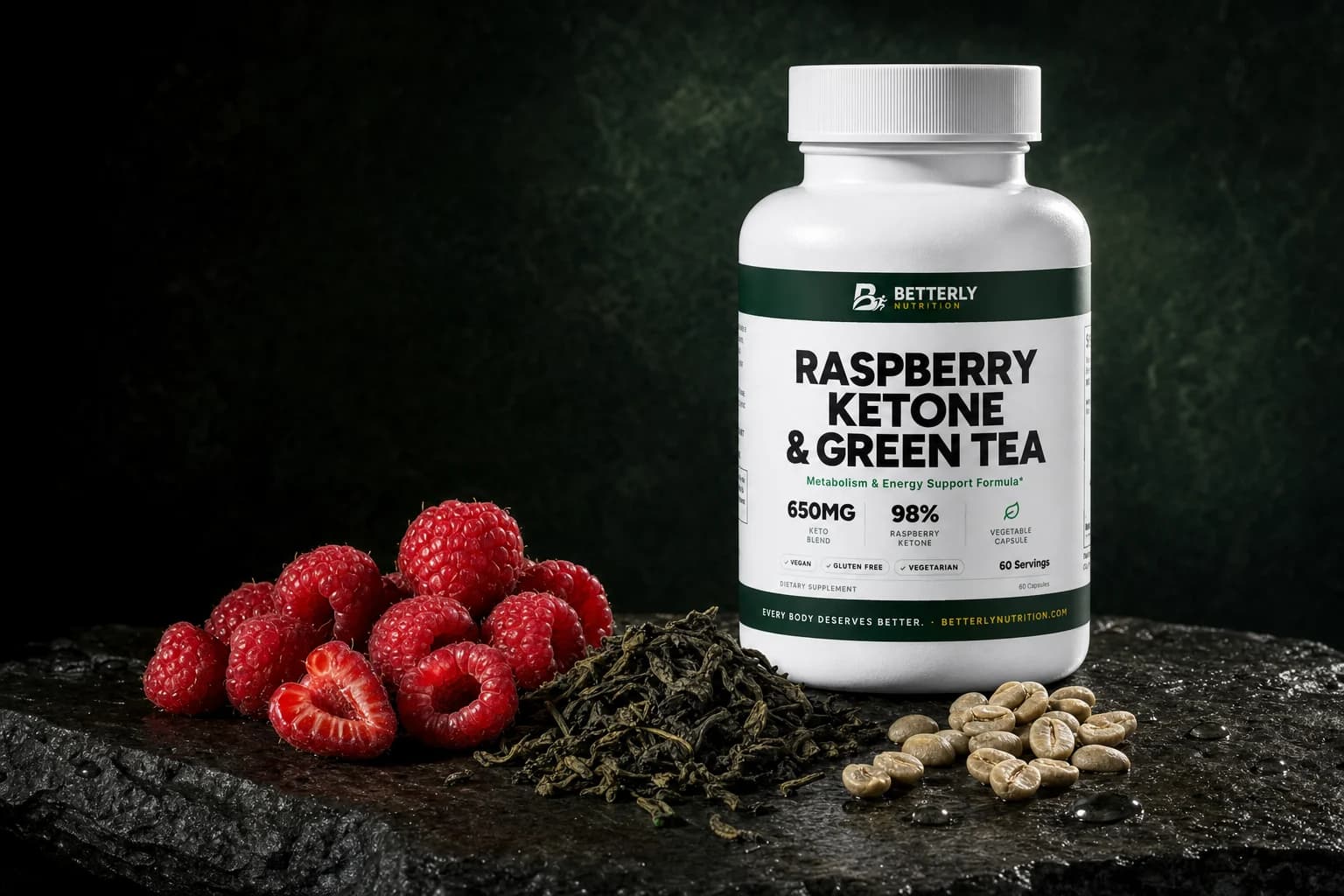
Our panel has one row with an amount: a 650 mg Keto Blend per 1-capsule serving. Its five ingredients sit beneath it, heaviest first, with no weights of their own:
- Raspberry Ketone (98%). Top billing means no other ingredient outweighs it. That puts it at 130 mg or more: five ingredients all under 130 mg couldn't reach 650 mg.
- Green Tea (Camellia sinensis) (leaf). Here the 98% describes makeup, not purity: 98% polyphenols, 75% catechins, 45% EGCG and 6% caffeine. The first three nest: EGCG (epigallocatechin gallate) is one catechin, and catechins are one group of polyphenols. The 6% caffeine is a separate measure, since caffeine isn't a polyphenol. Taken singly, the figures put 45 mg of EGCG and 6 mg of caffeine in every 100 mg. But 98% plus 6% tops 100%, so they aren't all shares of the same 100 mg, and the label doesn't explain that.
- Caffeine Anhydrous (98%). "Anhydrous" means without water: caffeine dried into a powder. Its 98% is printed bare, like raspberry ketone's. Both are most likely purity grades, though the panel never defines them.
- Green Coffee Bean (Coffee robusta) (seed) (50% Extract). The label doesn't say what the 50% measures.
- Garcinia Cambogia (fruit) (50% Extract). Same gap. ODS names hydroxycitric acid as the compound claimed to do the work in garcinia, but this line doesn't say the 50% measures it.
None of those percentages converts to an exact dose, since the panel never says how much green tea the blend holds. Our guide to what a proprietary blend is covers the limits of the heaviest-first rule.
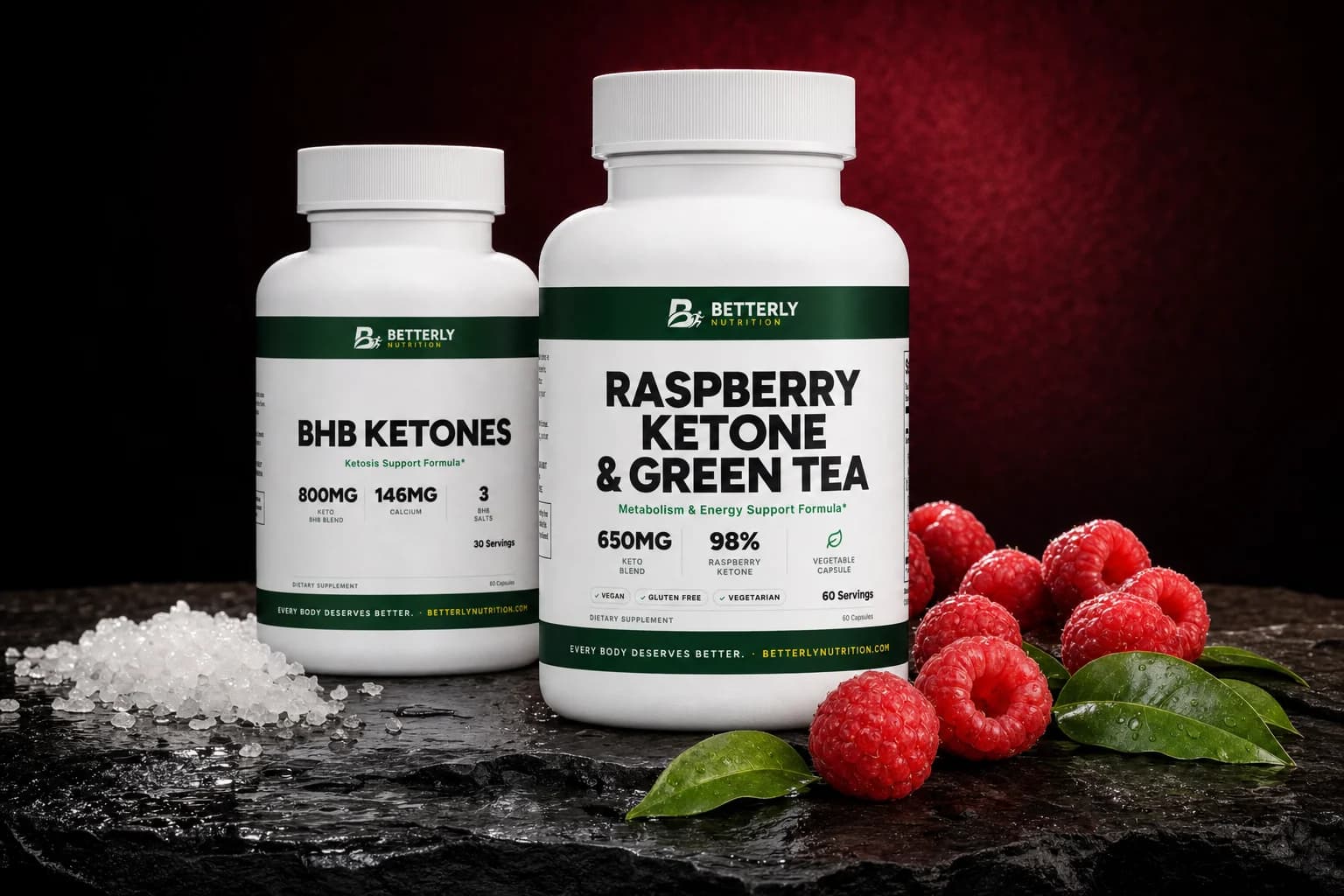
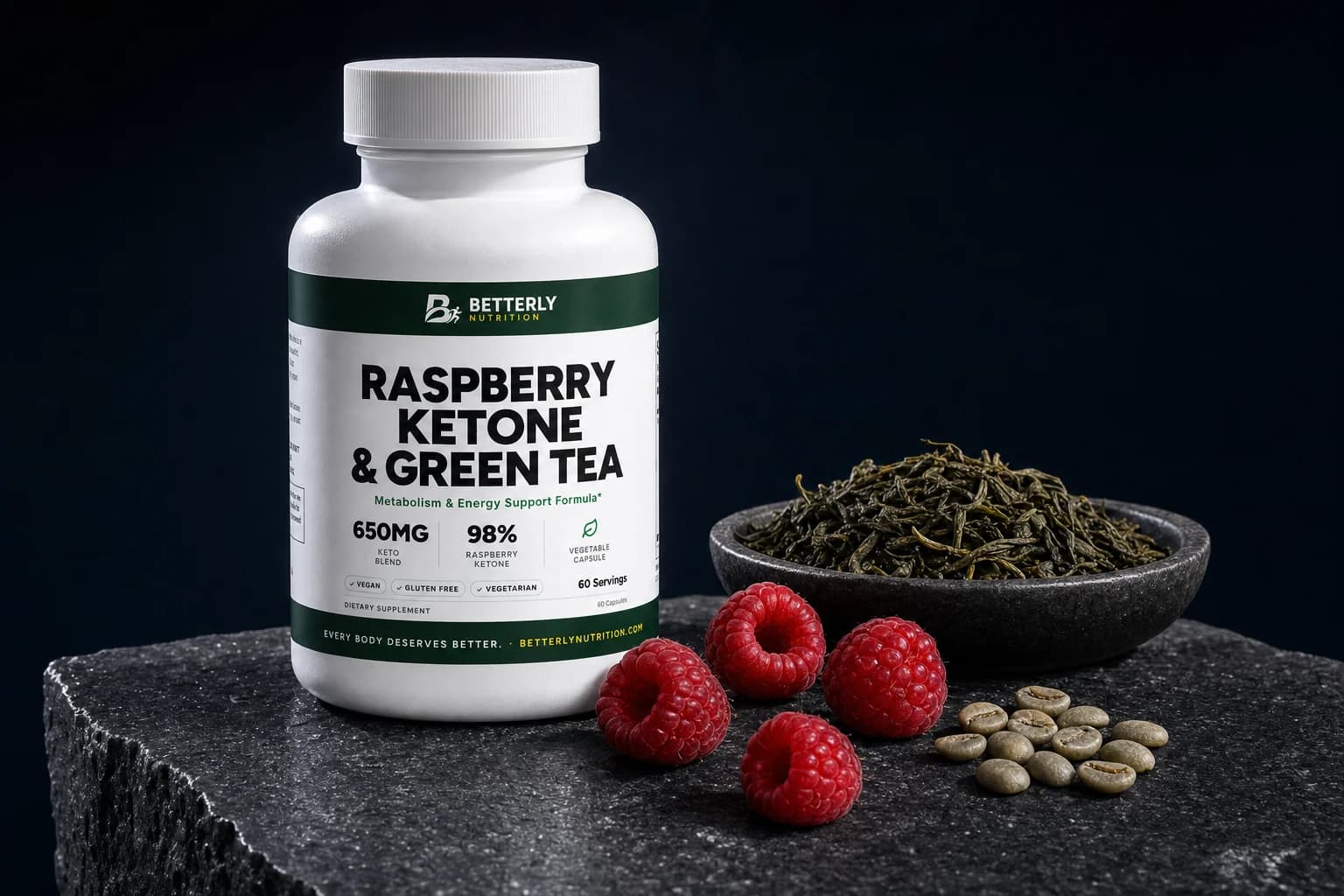
From our shop: Raspberry Ketone & Green Tea Capsules — each capsule's 650 mg blend names all five ingredients heaviest first, raspberry ketone at the top, and the label flags that it contains caffeine.
Is raspberry ketone natural, or is it made in a lab?
Raspberry ketone is natural in the sense that raspberries make it, but it can also be made in a lab, and our label doesn't say which source ours comes from.
PubChem, the National Library of Medicine's chemistry database, lists raspberries, blackberries, cranberries and other plants as natural sources. The amounts are tiny: about 1 to 4 mg in each kilogram of raspberries.
At that rate, the 130 mg or more in one capsule would take roughly 33 to 130 kg of raspberries, about 72 to 287 pounds.
The same PubChem record calls naturally sourced raspberry ketone extremely expensive and documents a lab route from two simpler chemicals, 4-hydroxybenzaldehyde and acetone. And its regulatory section notes that FDA permits raspberry ketone in food as a synthetic flavoring substance.
Either way, it's the same compound. Our panel reads "Raspberry Ketone (98%)" with no source listed, so this bottle can't tell you which route its ingredient took.
Do raspberry ketones give you energy?
ODS calls caffeine a stimulant but doesn't describe raspberry ketone as one, so any lift you feel from a capsule like ours most likely comes from its caffeine.
Green tea is listed second, so it can't outweigh raspberry ketone, which caps it at half the blend, or 325 mg. At 6% caffeine, that's about 20 mg per capsule at most. The FDA's caffeine guide, Spilling the Beans, puts a 12-ounce green tea at 37 mg, so one capsule's tea tops out at a little over half that.
Caffeine anhydrous is murkier. Sitting third of five, it's capped at a third of the blend, about 217 mg, yet nothing stops it from being a sliver. Heaviest-first ordering sets a ceiling, never an amount.
FDA also says your body treats caffeine the same whether it grew in a tea leaf or was added as a powder, so both shares count toward one daily total. Its advice for a product with added caffeine and no stated amount is to take care the first time you try it. For most adults, FDA cites 400 mg a day as an amount not generally linked to negative effects.
Our guide on how much 50 mg of caffeine really is puts everyday drinks in milligrams.
How do you take raspberry ketone capsules, per the label?
The label's suggested use for raspberry ketone capsules is one capsule twice a day, 20 to 30 minutes before a meal, with 8 oz (237 ml) of water.
Two capsules means two 650 mg blends, or 1,300 mg of the Keto Blend a day. The caffeine ceilings double too: the green tea's share tops out near 39 mg a day, plus caffeine anhydrous that could be anywhere from a sliver up to about 433 mg at its ceiling. The panel can't show you'd stay under FDA's 400 mg figure, which is why the tips below matter. The label's caution says not to exceed the recommended dose.
- Ease off other caffeine, especially at first. With no caffeine total on the panel, trim or skip coffee, tea and soda on the days you take it rather than guessing how close you are to FDA's 400 mg figure.
- Skip other caffeinated supplements. Pre-workouts, energy drinks and caffeine strips each bring their own dose.
- Don't stack weight support formulas. Caffeine and garcinia repeat across this aisle, so two products can quietly double up.
Want a caffeine-free pick from this shelf?
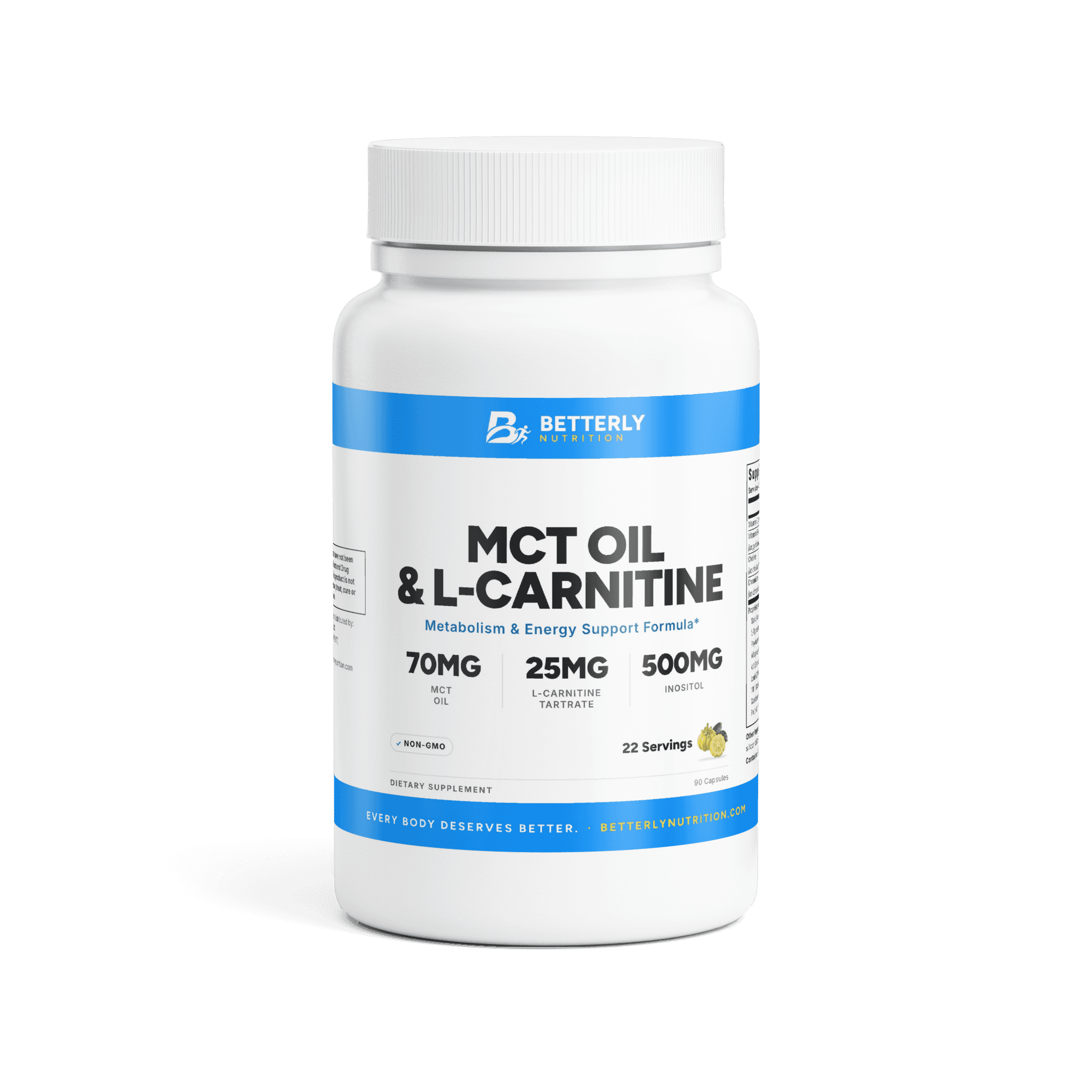
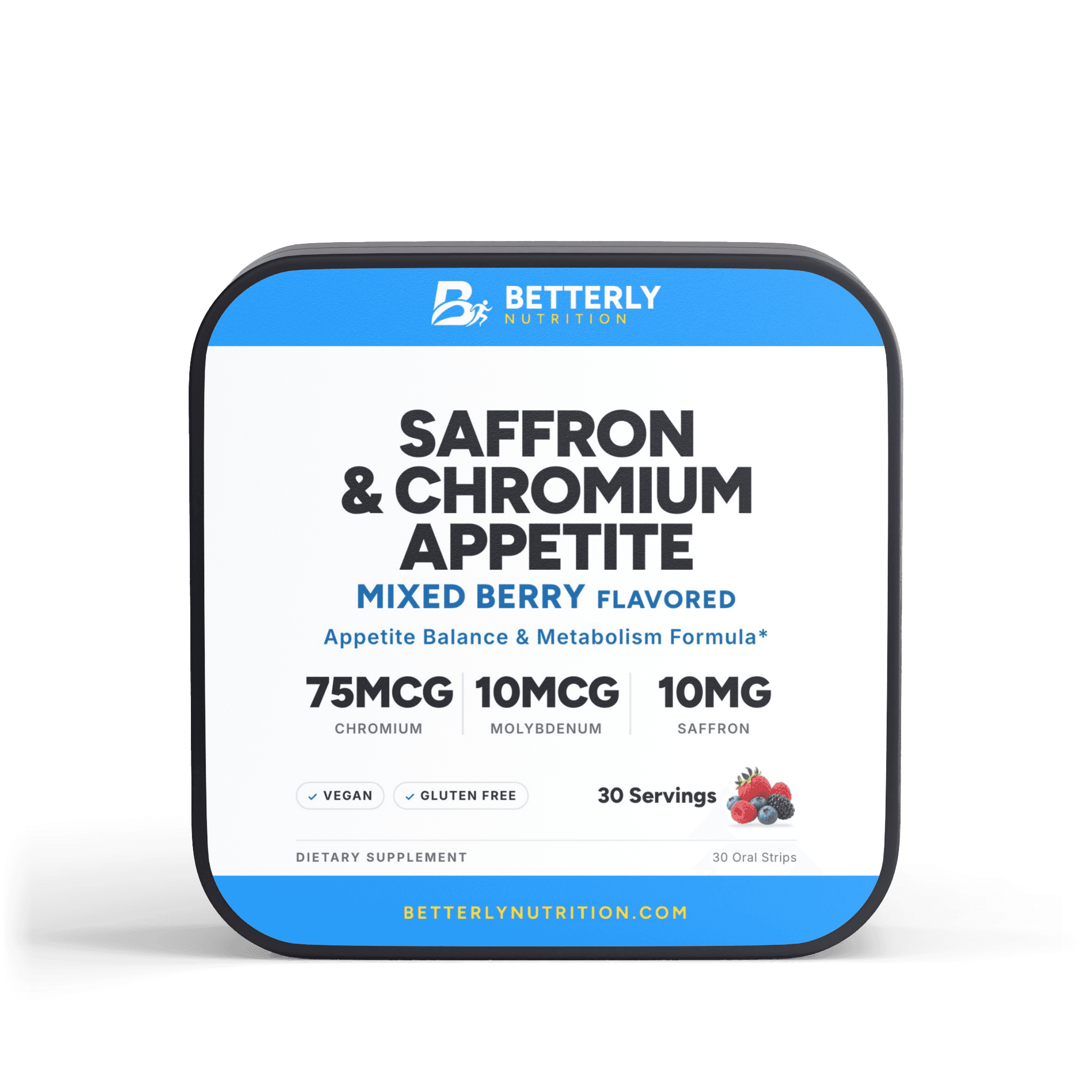
For a caffeine-free pick from the same shelf, our MCT Oil & L-Carnitine Capsules and Saffron & Chromium Appetite Strips list none on their panels.
| Your priority | Our product | On its label |
|---|---|---|
| Caffeine in the formula | Raspberry Ketone & Green Tea | Three caffeine sources, no mg total |
| No caffeine, 14 ingredients dosed | MCT Oil & L-Carnitine | 200 mcg chromium, 200 mg choline per 4 capsules |
| No caffeine, no pills | Saffron & Chromium strip | 10 mg saffron, 75 mcg chromium per strip |
| A plant-based capsule | Raspberry Ketone & Green Tea | Cellulose capsule, labeled vegan |
The raspberry formula is the only one of the three that keeps every amount inside a blend.
The MCT capsules print amounts for 14 ingredients, including 200 mg of garcinia cambogia fruit extract (50% hydroxycitric acid) per 4-capsule serving, plus a 631 mg blend of 15 more. The panel also lists grapefruit extract, kelp and bladderwrack, so if you take any medication, show it to your pharmacist or provider first. The capsules use bovine gelatin and list fish and shellfish as allergens. Both formulas contain garcinia, so treat them as an either-or choice.
You place one strip a day on your tongue and let it melt, and it's labeled vegan and gluten free. Browse the rest on our full weight support shelf.
From our shop: MCT Oil & L-Carnitine Capsules — a panel with no caffeine listed that doses 14 ingredients by name, including 200 mcg chromium, 200 mg choline and 25 mg L-carnitine per 4-capsule serving.
When don't you need a raspberry ketone supplement?
You don't need a raspberry ketone supplement if you want proof that raspberry ketone itself does something, because ODS says its effects on their own are unknown.
Skipping it also makes sense if:
- Coffee, tea or soda already covers your caffeine, and you like knowing your daily total to the milligram.
- You want a capsule to stand in for how you eat and move. ODS names healthful eating, fewer calories and regular activity as the approaches with proof behind them.
- Caffeine easily throws off your sleep or leaves you jittery.
Who should check with a healthcare provider first?
Check with a healthcare provider before taking raspberry ketone capsules if you're pregnant, nursing, under 18, managing a medical condition or taking any medication.
Our label's caution names the first four groups. The medication point is from ODS, which warns that products in this aisle can interact with medicines and that many of their ingredient pairings have never been tested together.
- Caffeine. FDA says certain medications and health conditions can raise your sensitivity to it, and suggests talking to a provider about caffeine if you're pregnant, trying to become pregnant or breastfeeding.
- Green tea extract. The National Center for Complementary and Integrative Health (NCCIH) says liver injury is uncommon but has been reported with green tea products, chiefly extracts taken as tablets or capsules. People carrying one gene variant, 5 to 15 percent of Americans, appear especially susceptible. NCCIH adds that green tea can lower blood levels of certain prescription drugs.
FDA's list of what too much caffeine can do includes a faster heart rate, jitters, an upset stomach and disrupted sleep. If any of those show up, stop the capsules and let your provider know. Safety and interactions get fuller treatment in our guide to raspberry ketone side effects.
FAQ: raspberry ketones
What are the benefits of raspberry ketones?
Raspberry ketones have no benefit established when taken alone, based on the NIH Office of Dietary Supplements' review. The compound's settled role is as a flavoring: PubChem lists it in soft drinks, sweets and ice cream for a sweet, jammy berry taste. In supplements like ours, it shares the capsule with caffeine and green tea, so any effect you notice can't be credited to raspberry ketone itself.
How long do raspberry ketones take to work?
There's no evidence-based timeline for raspberry ketones, because ODS says their effects on their own are unknown. What you can notice is the caffeine. A caffeinated formula like ours can leave you feeling more alert, and that alertness can pass for raspberry ketone at work. Our label names no timeline, so neither do we.
How much raspberry ketone is in food flavoring compared with a capsule?
Raspberry ketone shows up in food at far smaller amounts than one capsule holds. PubChem gives about 13 parts per million as typical use in baked goods, so the 130 mg or more in one of our capsules would flavor roughly 10 kg of baked goods. PubChem also notes that the Joint FAO/WHO Expert Committee on Food Additives found no safety concern at current intake levels for flavoring use. That finding covers flavoring amounts, and ODS says capsule amounts haven't been studied enough.
What does green coffee add to a raspberry ketone supplement?
Green coffee bean adds caffeine to a raspberry ketone supplement, since ODS notes that these unroasted beans contain it. ODS also says the extract seems safe at up to 200 mg a day for 12 weeks. On our panel it sits fourth of five, which caps it at a quarter of the blend: about 162 mg a capsule, or 325 mg at the label's two a day. The panel can't show you'd stay within that 200 mg figure.
Sources
- NIH Office of Dietary Supplements: Dietary Supplements for Weight Loss, Fact Sheet for Consumers
- National Center for Complementary and Integrative Health: Green Tea: Usefulness and Safety
- U.S. Food and Drug Administration: Spilling the Beans: How Much Caffeine is Too Much?
- National Library of Medicine, PubChem: 4-(4'-Hydroxyphenyl)-2-butanone (raspberry ketone), CID 21648
If this left you looking for somewhere to start, read raspberry ketone capsules with green tea and caffeine — its amounts per serving are listed on the page. For the practical questions this raises, how dosing, sourcing and subscriptions work is answered in one place.