On this page
- Key takeaways
- Raspberry ketones vs BHB: what's the actual difference?
- Why is raspberry ketone called a ketone if it isn't a ketone body?
- Are raspberry ketones exogenous ketones like BHB?
- Do raspberry ketones put you in ketosis?
- What's inside each capsule? Our two labels side by side
- Is raspberry ketone a stimulant, or is that the caffeine?
- How do you take each one, according to the label?
- When don't you need either one?
- Who should check with a healthcare provider first?
- FAQ: raspberry ketones vs BHB
- Sources
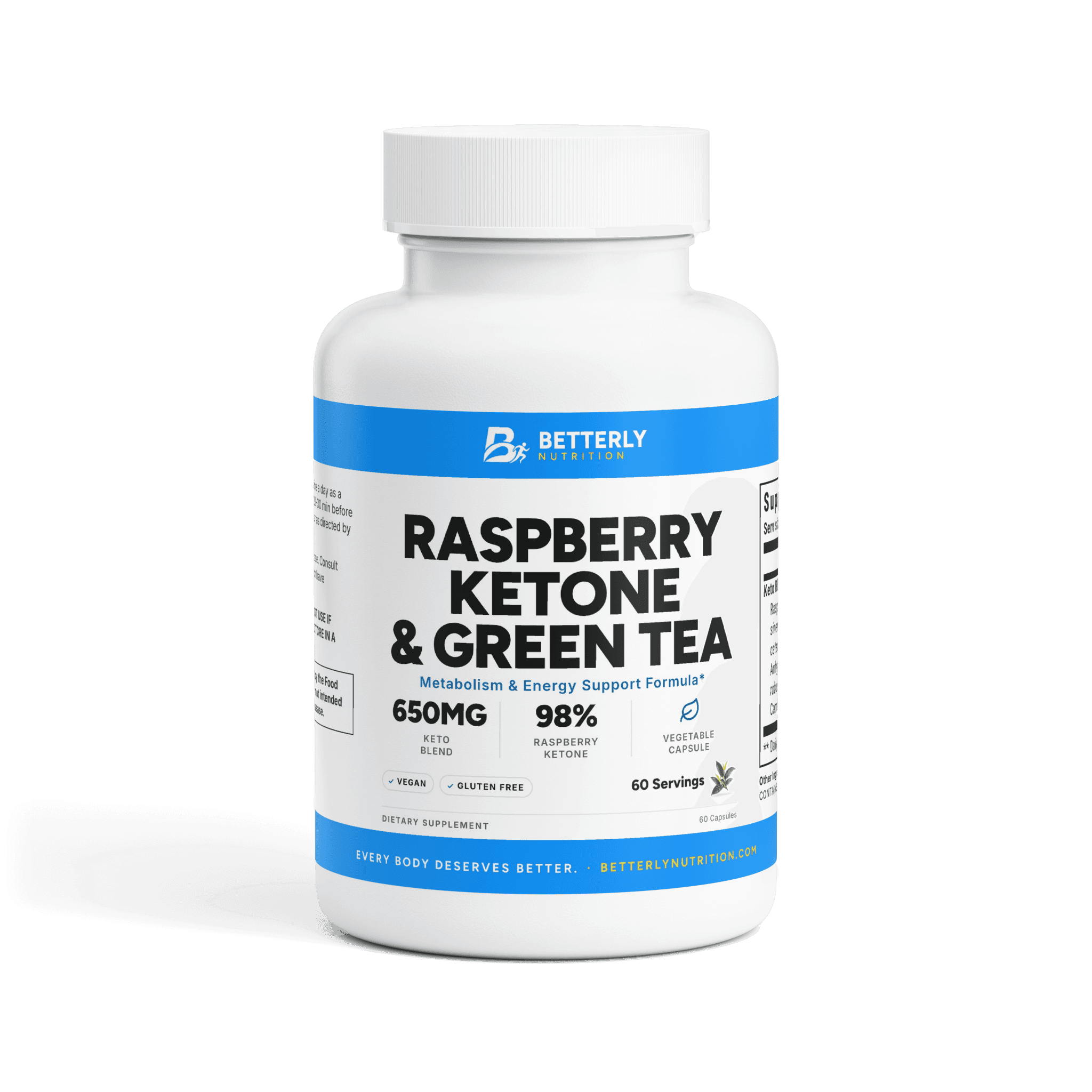
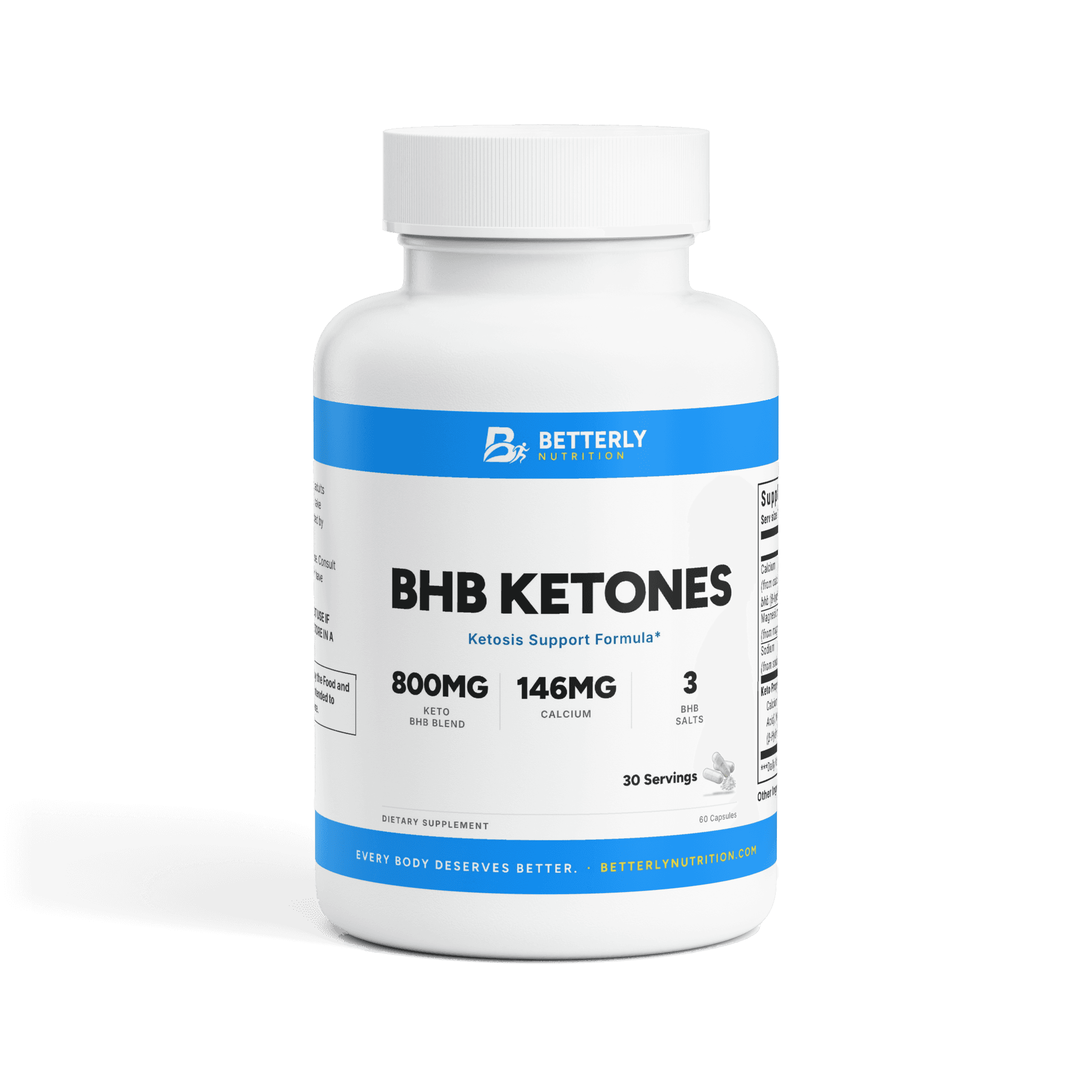
The short answer: Raspberry ketones vs BHB comes down to one fact: only BHB (beta-hydroxybutyrate) is a ketone body, and its levels rise during ketosis. Raspberry ketone isn't one, despite its name. Our own labels show the gap. The raspberry ketone capsule is a caffeinated 650 mg blend per 1-capsule serving. The BHB capsule is an 800 mg blend of calcium citrate, MCT powder and three BHB salts per 2-capsule serving.
Key takeaways
- Raspberry ketone is a flavor and fragrance compound found in raspberries, and the "ketone" in its name describes its chemical structure, not a role in ketosis.
- BHB is one of the ketone bodies the liver makes. BHB supplements often supply it bound to a mineral as a salt, and ours lists calcium, magnesium and sodium BHB.
- Betterly's raspberry ketone formula lists three ingredients that carry caffeine, while our BHB capsule lists none.
- Neither of our labels prints the exact amount of raspberry ketone or BHB per serving, because each sits inside a blend that shows only a total weight.
Both of these bottles are in our Weight Support collection, and we'd be glad if you bought one. That's why every product detail below comes from the two Supplement Facts panels, and every outside fact from one of four federal pages.
Raspberry ketones vs BHB: what's the actual difference?
Raspberry ketone is a plant aroma compound, and BHB is a ketone body the human liver makes from fat. They share a word, not a job.
Our Raspberry Ketone & Green Tea Capsules and BHB Ketone Capsules share a category in our shop, so it's fair to ask whether BHB is the same as raspberry ketones. It isn't.
| Question | Raspberry ketone | BHB |
|---|---|---|
| What it is | An aroma compound | A ketone body |
| Chemical family | A true ketone and a phenol | A hydroxy acid |
| Where it comes from | Raspberries, blackberries, cranberries | Your liver, from fatty acids |
| Linked to ketosis? | No | Yes, levels rise in ketosis |
| Caffeine in our capsule | Yes | None listed |
The ketosis row settles it. If the molecule you want is the one your body makes during ketosis, raspberry ketone isn't a substitute, whatever the front of a bottle suggests.
Why is raspberry ketone called a ketone if it isn't a ketone body?
Raspberry ketone gets its name from chemistry: it carries a ketone group, which is an oxygen atom double-bonded to a carbon that sits between two other carbons.
Chemists name molecules by structure, and that group turns up in plenty of flavorings. It says nothing about what a molecule does once you swallow it.
PubChem, the chemistry database run by NIH's National Library of Medicine, describes raspberry ketone as a methyl ketone and a member of the phenols. Its record notes a sweet, fruity smell "resembling raspberry preserve" and lists the compound among FDA substances added to food as a flavoring agent. Making things smell and taste like berries is its original day job.
The mix-up runs both ways. PubChem classifies BHB as a 3-hydroxy monocarboxylic acid. Here's our plain-English reading of that: the molecule has an -OH group and an acid group, but no ketone group. BHB belongs with the ketone bodies because of where it's made and what it does, not because of its shape.
So the compound called a ketone isn't a ketone body, and the best-known ketone body isn't, strictly speaking, a ketone.
Are raspberry ketones exogenous ketones like BHB?
No. Raspberry ketone isn't a ketone body, so it doesn't count as an exogenous ketone, the term for BHB and other ketone bodies you take in from outside your body.
Your liver makes BHB from fatty acids on its own. According to PubChem's record for 3-hydroxybutyric acid, it's an energy carrier that moves energy from the liver to other tissues when the glucose supply runs too low, and its levels rise during ketosis. Ketosis is the state your body shifts into when carbohydrate is scarce and it leans on fuel made from fat.
A BHB supplement usually binds the BHB to a mineral as a salt. That's why our label lists calcium BHB, magnesium BHB and sodium BHB rather than plain BHB. Whether bottled BHB is worth taking is its own question, and our guide on whether exogenous ketones work takes it on.
Do raspberry ketones put you in ketosis?
No. Raspberry ketone isn't a ketone body, so a raspberry ketone capsule doesn't supply BHB, and no federal source we checked describes it as a route into ketosis.
Ketosis depends on your fuel supply: what you eat and how long you go between meals. When glucose runs short, the liver turns fatty acids into ketone bodies. Nothing in raspberry ketone's chemistry stands in for that process.
The research is thin, too. The NIH Office of Dietary Supplements says that when raspberry ketone has been studied for body weight, it was always combined with other ingredients, never tested alone. The same fact sheet says it "hasn't been studied enough to tell if it's safe."
What raspberry ketone formulas can and can't do is a bigger topic, covered in our guide asking do raspberry ketones work.
What's inside each capsule? Our two labels side by side
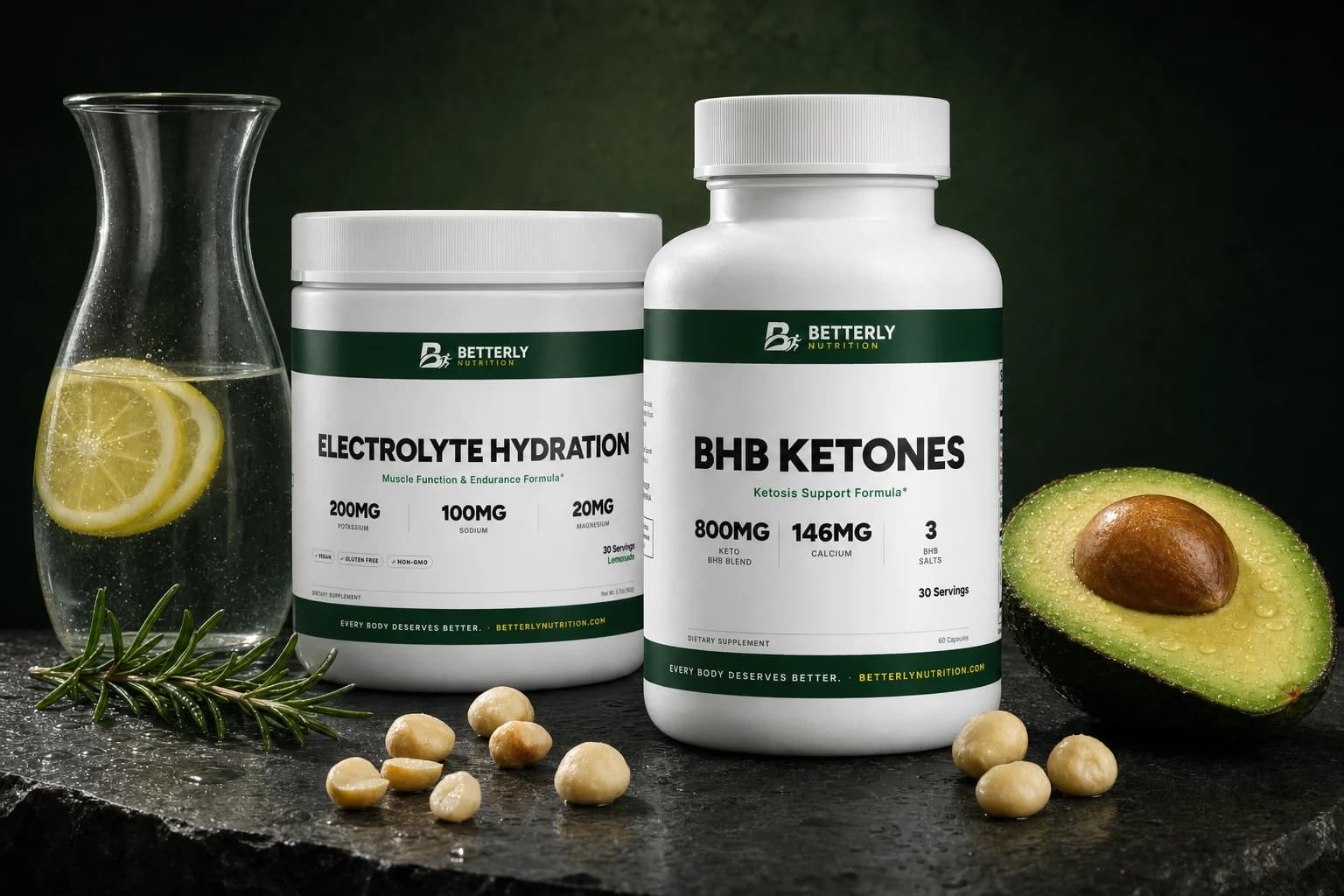
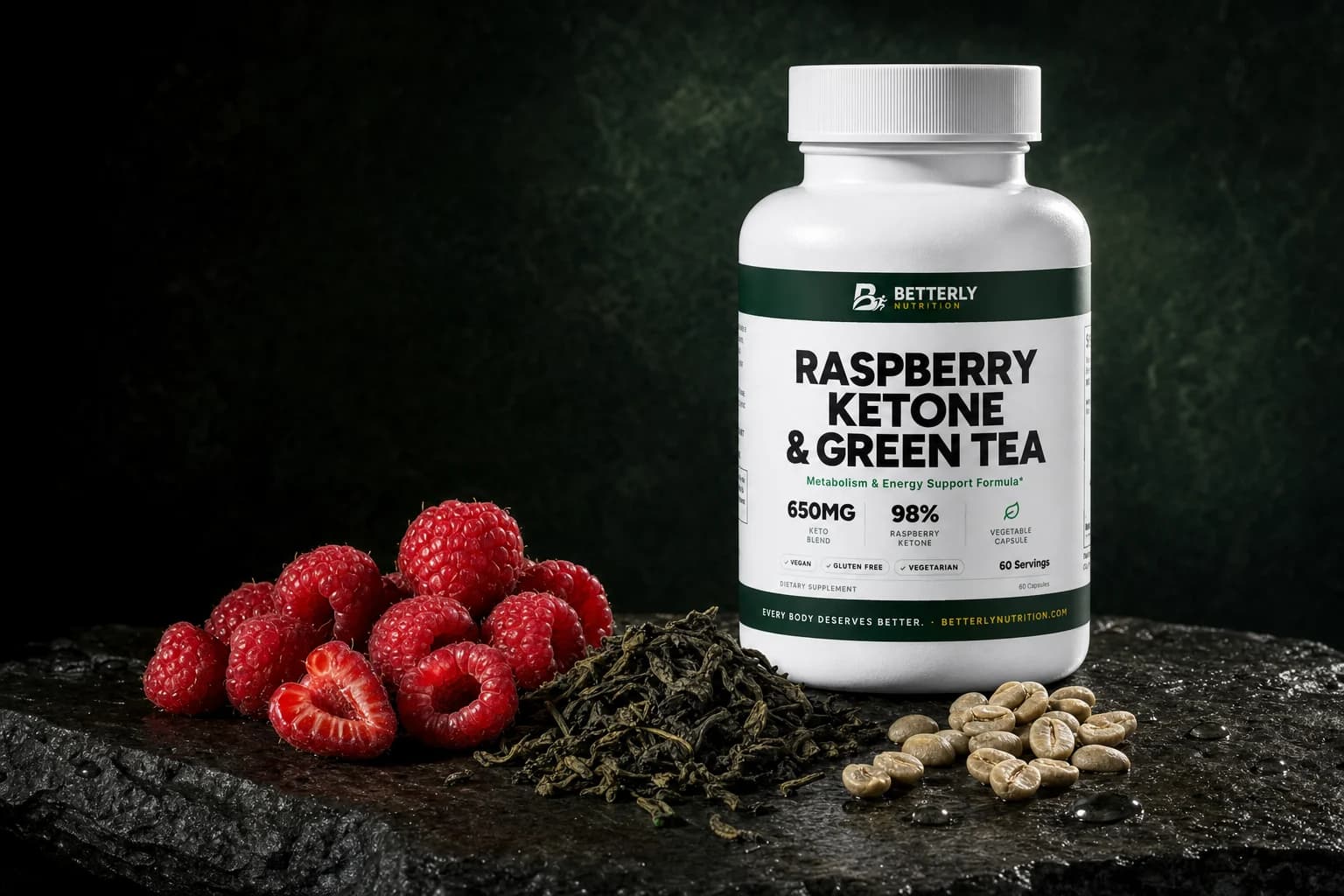
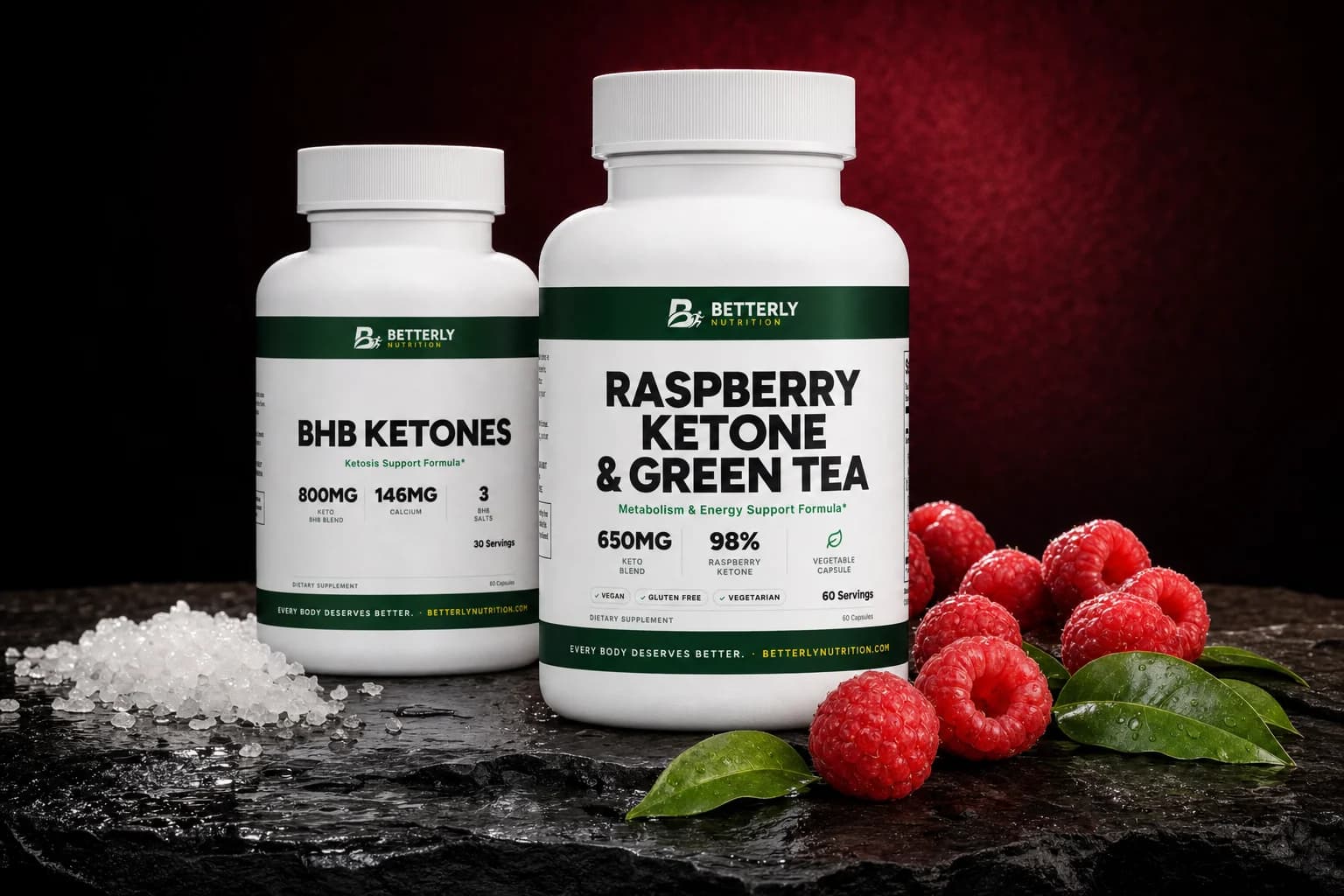
Betterly's Raspberry Ketone & Green Tea Capsules hold a 650 mg blend per 1-capsule serving, and the BHB Ketone Capsules hold an 800 mg blend per 2-capsule serving.
| Label detail | Raspberry Ketone & Green Tea | BHB Ketone Capsules |
|---|---|---|
| Serving size | 1 capsule | 2 capsules |
| Blend per serving | 650 mg Keto Blend | 800 mg Keto Proprietary Blend |
| Listed first in the blend | Raspberry ketone (98%) | Calcium citrate |
| Minerals with amounts | None | Calcium 146 mg, magnesium 1 mg, sodium 1 mg |
| Capsule | Cellulose (vegetable) | Gelatin |
| Servings per bottle | 60 | 30 |
Both front labels lead with a blend weight, but the blends share no ingredients. Only the BHB blend contains a ketone body.
On our BHB panel, calcium citrate weighs more than any of the three BHB salts. The FDA's dietary supplement labeling guide requires a proprietary blend to list its ingredients in descending order by weight, and ours runs calcium citrate, then MCT powder, then calcium, magnesium and sodium BHB. The magnesium and sodium rows read 1 mg each, a hint that those two salts are a small part of the mix.
That's why the 800 mg on our BHB front label is the blend, not 800 mg of BHB, and the panel doesn't print a BHB total. Calcium is the one mineral present in a real amount: 146 mg per 2-capsule serving (11% DV), from both calcium citrate and calcium BHB.
The raspberry ketone blend follows the same heaviest-first order. Raspberry ketone comes first, so it's the largest of the five ingredients and at least a fifth of the 650 mg. The 98% describes how concentrated the ingredient is, not its share of the blend. Next come green tea leaf (Camellia sinensis, standardized to 98% polyphenols, 75% catechins, 45% EGCG and 6% caffeine), caffeine anhydrous, green coffee bean extract and garcinia cambogia fruit extract. The label carries vegan and gluten free claims.
From our shop: Raspberry Ketone & Green Tea Capsules — a 650 mg blend led by raspberry ketone (98%), with standardized green tea and caffeine, per 1-capsule serving in a vegetable capsule.
Is raspberry ketone a stimulant, or is that the caffeine?
Raspberry ketone isn't caffeine, but Betterly's Raspberry Ketone & Green Tea formula does contain caffeine, from caffeine anhydrous, standardized green tea and green coffee bean extract.
The NIH Office of Dietary Supplements calls caffeine a stimulant, and its entry on raspberry ketone doesn't describe it that way. So when you wonder whether a raspberry ketone product is stimulating, read past the name to the rest of the ingredient line. Caffeine turns up across this aisle, and our label read of L-carnitine and MCT oil together compares a stimulant-free formula with a caffeinated one.
Our panel prints "CONTAINS CAFFEINE" under other ingredients but gives no milligram total, because all three caffeine sources sit inside the 650 mg blend. ODS also points out that green coffee beans contain caffeine, so that ingredient counts too.
According to the same ODS fact sheet, caffeine is safe for most adults at up to 400 to 500 mg a day, but it can make you nervous, jittery and shaky and can affect your sleep. Combining it with other stimulants can increase its effects.
With no milligram figure on our label, count every capsule toward your caffeine for the day. Don't combine it with coffee, energy drinks, pre-workout or other caffeine sources, because you can't tell how much the capsule adds. Our pre-workout vs energy drink comparison shows how fast those other sources stack up.
The BHB Ketone Capsules list no caffeine, green tea or coffee.
How do you take each one, according to the label?
Raspberry Ketone & Green Tea's label says 1 capsule twice a day before meals, while the BHB Ketone Capsules label says 2 capsules daily with water.
For Raspberry Ketone & Green Tea Capsules, the label's suggested use is:
- Take 1 capsule, twice a day.
- Take it 20 to 30 minutes before a meal, with an 8 oz (237 ml) glass of water.
- Don't exceed the recommended dose.
At that pace, the 60-capsule bottle lasts 30 days. The label doesn't say which two meals. Because the formula carries caffeine, and ODS notes caffeine can affect sleep, pick them with your bedtime in mind.
For BHB Ketone Capsules, the label's suggested use is 2 capsules daily with 6 to 8 oz (177 to 237 ml) of water. The label doesn't pair them with food or name a time of day, so the directions leave the timing to you. The 60 capsules make 30 servings, so this bottle lasts 30 days too.
Whichever you choose, stay at or under the label's amount.
From our shop: BHB Ketone Capsules — an 800 mg blend of calcium citrate, MCT powder and calcium, magnesium and sodium BHB per 2-capsule serving, with no caffeine listed.
When don't you need either one?
You don't need raspberry ketones or BHB if the word "ketone" is your main reason for buying, since the two do unrelated things and neither replaces how you eat.
You can likely skip one or both if:
- You picked up raspberry ketone expecting a ketone body. It isn't one, so it won't stand in for BHB.
- You already get steady caffeine from coffee, tea or energy drinks and don't want an uncounted extra dose.
- You eat low-carb and expect a capsule to do the work of ketosis. That state comes from your fuel supply, not a bottle.
- You want exact milligrams for every active. Both of our panels use blends.
Our honest guide to metabolism support supplements covers the rest of this aisle. If you'd rather leave stimulants out entirely, our Weight Support collection has several products with no caffeine on the panel, the BHB capsules among them.
Who should check with a healthcare provider first?
Anyone who's pregnant, nursing, under 18 or managing a medical condition should talk to a healthcare provider before taking raspberry ketone or BHB capsules.
Those four groups come straight from the caution printed on both of our labels, right after the line telling you not to exceed the recommended dose. We'd add two more: anyone taking prescription medication and anyone with surgery coming up.
Some points apply to one bottle more than the other:
- Caffeine sensitivity. If caffeine leaves you jittery or unsettles your sleep, the raspberry ketone formula's unlisted caffeine total makes it a poor fit.
- Concentrated green tea. Our label lists green tea leaf standardized to 98% polyphenols, a concentrated form rather than a brewed cup. The NIH Office of Dietary Supplements says drinking green tea is safe, but taking green tea extract might not be, and in some people it has been linked to liver damage.
- Raspberry ketone itself. As ODS notes, there isn't enough research to say whether it's safe.
- Calcium from the BHB capsules. They add 146 mg of calcium per 2-capsule serving, so count it alongside any other calcium-containing supplement you take.
Deciding between the two? Snap a photo of each Supplement Facts panel for your provider, since the full ingredient lines say far more than the front labels do.
FAQ: raspberry ketones vs BHB
Is raspberry ketone natural?
Raspberry ketone occurs naturally in fruit, but only in tiny amounts. PubChem reports typical concentrations of 1 to 4 mg per kilogram of raspberries, and it also lists blackberries and cranberries as sources. Our label names "Raspberry Ketone (98%)," a concentrated ingredient rather than dried berries. The panel doesn't state how that ingredient was made.
Are raspberry ketones keto friendly?
No, raspberry ketone isn't a keto supplement in the ketosis sense, because it isn't a ketone body, and our label makes no keto-friendly claim. The 650 mg blend on our Raspberry Ketone & Green Tea panel is named "Keto Blend," yet its ingredient line lists raspberry ketone, standardized green tea, caffeine anhydrous, green coffee bean extract and garcinia cambogia, with no BHB or other ketone body.
Can you take raspberry ketones and BHB together?
Possibly, but check with a healthcare provider first, because neither of our labels mentions taking raspberry ketones and BHB together. Only the raspberry ketone formula carries caffeine, and the NIH Office of Dietary Supplements says raspberry ketone hasn't been studied enough to tell whether it's safe. Whatever you decide, keep each product within its own label's suggested use.
Does BHB have caffeine in it?
Our BHB Ketone Capsules list no caffeine. The panel shows calcium citrate, MCT powder and three BHB salts in an 800 mg blend per 2-capsule serving, inside a gelatin capsule with brown rice flour. Other brands' formulas differ, so check the ingredient line of any BHB product for caffeine, green tea or coffee before you buy.
How long does a bottle of each last?
At the label's suggested use, a bottle of either product lasts 30 days. Raspberry Ketone & Green Tea holds 60 one-capsule servings, and the label says 1 capsule twice a day. BHB Ketone Capsules also hold 60 capsules, taken 2 at a time as one daily serving, which makes 30 servings.
Sources
- National Library of Medicine, PubChem: 4-(4'-Hydroxyphenyl)-2-butanone (raspberry ketone), CID 21648
- National Library of Medicine, PubChem: 3-Hydroxybutyric Acid, CID 441
- NIH Office of Dietary Supplements: Dietary Supplements for Weight Loss, Fact Sheet for Consumers
- U.S. Food and Drug Administration: Dietary Supplement Labeling Guide: Chapter IV. Nutrition Labeling
If this left you looking for somewhere to start, read raspberry ketone capsules with green tea — its amounts per serving are listed on the page. For the practical questions this raises, how dosing, sourcing and subscriptions work is answered in one place.