On this page
- Key takeaways
- Can you take L-citrulline and creatine together?
- L-citrulline vs creatine: what does each one do?
- Does L-citrulline help your body make creatine?
- Has anyone studied citrulline and creatine together?
- Can creatine and citrulline make a stim-free pre-workout?
- How do you take L-citrulline and creatine together?
- What should a stim-free pre-workout label with creatine show?
- When is L-citrulline, or this whole stack, not worth adding?
- Who should check with a healthcare provider first?
- FAQ: L-citrulline and creatine
- Sources
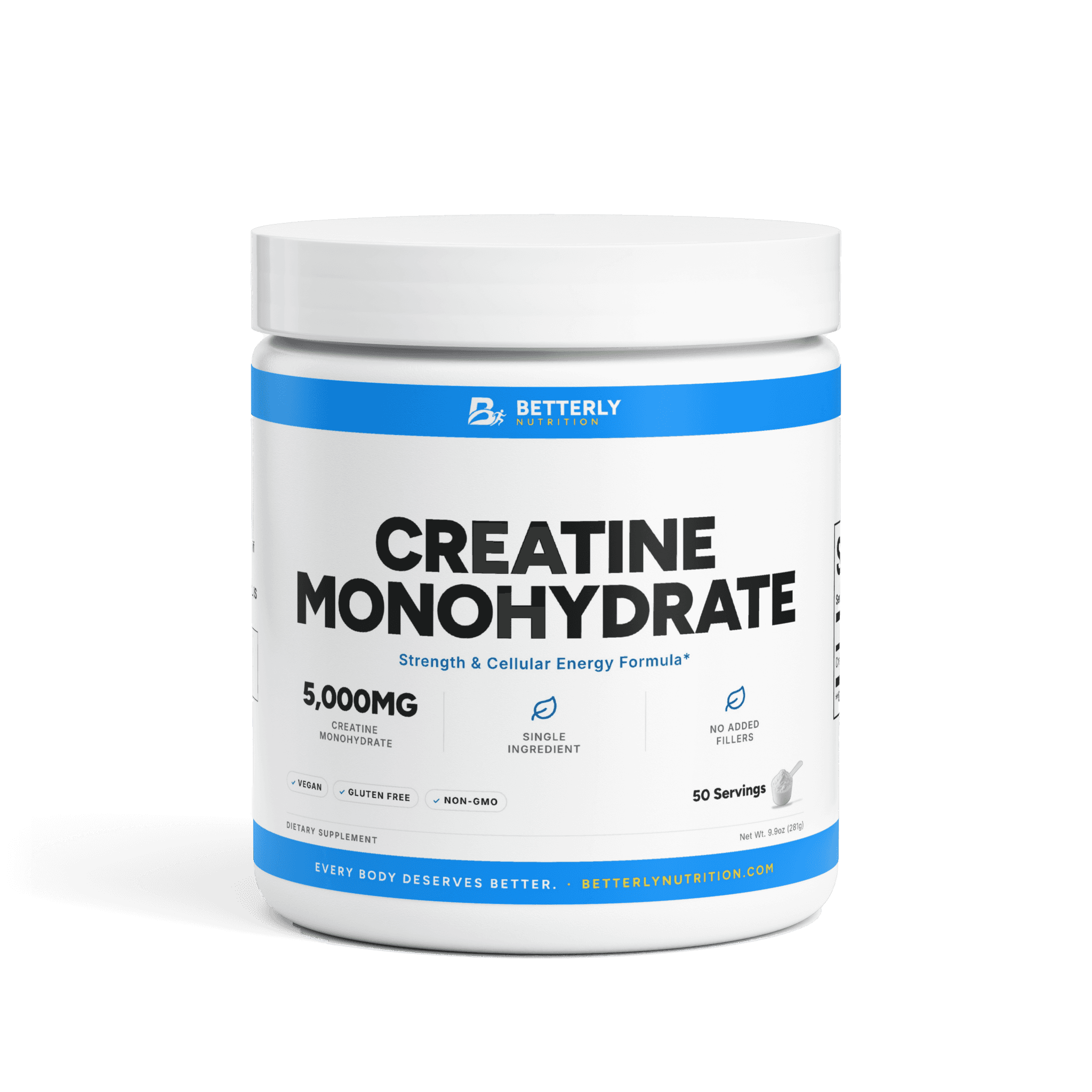
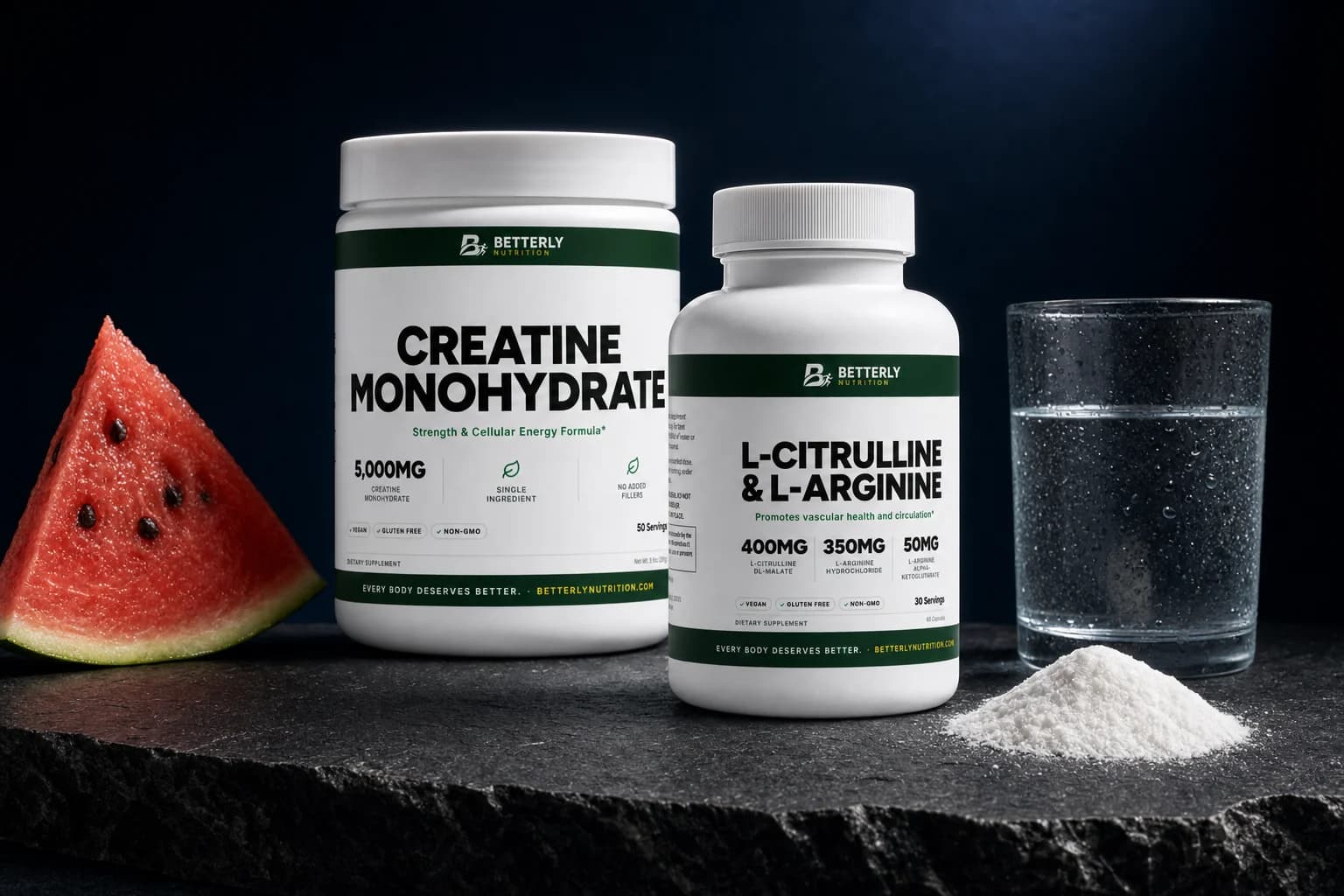
The short answer: No label or NIH page we used warns against taking L-citrulline and creatine together, so healthy adults can pair them on the same day. That falls short of a safety guarantee: the NIH says citrulline's safety isn't established, and most ingredient combinations haven't been studied. Creatine is the half with strong training evidence, and our plain tub prints 5,000 mg of creatine monohydrate per 1 Scoop (5.6g) serving.
Key takeaways
- Creatine and L-citrulline work on separate systems: creatine is a muscle energy reserve, and the kidneys turn most citrulline into the amino acid arginine.
- Only creatine has solid training evidence in the NIH's fact sheet, for repeated short, hard efforts such as lifting and sprinting. The NIH finds little evidence for citrulline or arginine.
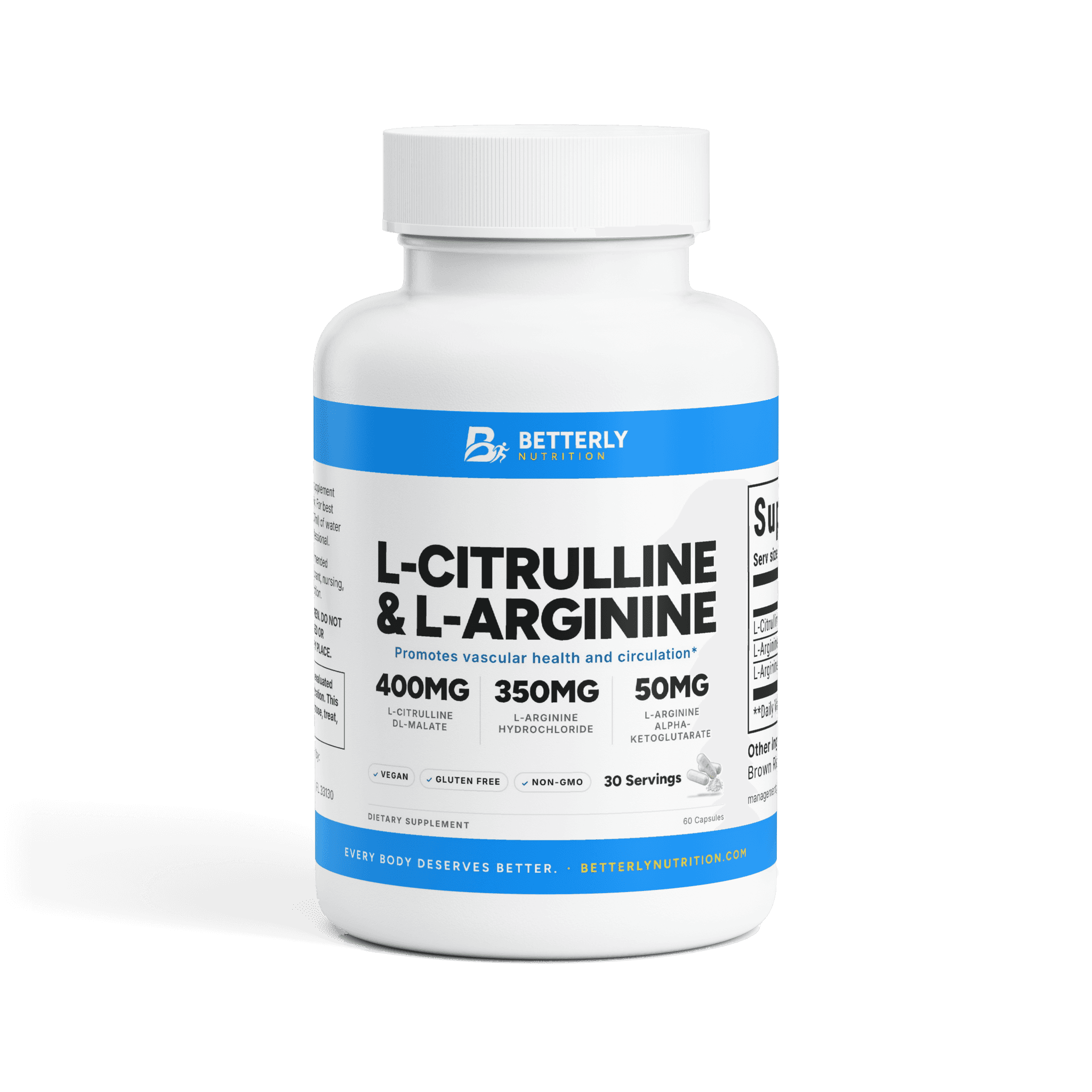
- Betterly's Creatine Monohydrate Powder has 5,000 mg of creatine monohydrate per 1 Scoop (5.6g) serving, while our L-Citrulline & L-Arginine Capsules hold 400 mg of L-citrulline DL-malate per 2-capsule serving.
- None of the three products in this stack lists caffeine, and no label ties a dose to a workout, so the stack runs daily, rest days included.
Disclosure: every product in this guide is ours, including the citrulline capsule we're about to call optional. Every product number below comes off a Supplement Facts panel.
Can you take L-citrulline and creatine together?
You can take L-citrulline and creatine on the same day; no label or NIH source we used flags the pair, but most supplement combinations haven't been studied.
The NIH Office of Dietary Supplements (ODS) makes that point in its consumer fact sheet on performance supplements. Ingredients can act differently once combined, it says, and with most combinations unstudied, nobody knows how effective or safe they are.
ODS rates each ingredient on its own:
- Creatine. Safe for healthy adults for weeks or months, and it seems safe over several years.
- Citrulline. There isn't enough research to know for sure whether it's safe. Some users report stomach discomfort.
- Arginine. Our capsule adds 400 mg of arginine compounds per serving. For arginine supplements, ODS's safety note covers up to 9 g a day over several days or weeks.
L-citrulline vs creatine: what does each one do?
L-citrulline is an amino acid your kidneys mostly convert into arginine, while creatine is a compound your muscles store and draw on for short, hard bursts of effort.
According to the ODS health professional fact sheet on performance supplements, muscles use phosphocreatine to generate ATP, the molecule cells spend for energy, at the start of intense exercise. Creatine supplements may help partly by raising those stores.
Citrulline's story is shorter. Sellers often market it around nitric oxide, but ODS calls the performance research limited, and this guide makes no performance claim for our capsules at 400 mg.
| Point | L-citrulline | Creatine |
|---|---|---|
| Your body makes it | Yes | About 1 g a day |
| Amounts in studies (ODS) | Up to 9 g in one day, or 6 g a day for up to 16 days | 5 to 7 days at about 20 g, then 3 to 5 g a day |
| ODS bottom line | Not much evidence for performance | Good evidence for sprints and lifting |
| Per serving in ours | 400 mg L-citrulline DL-malate | 5,000 mg creatine monohydrate |
In the bottom two rows, our 5,000 mg monohydrate scoop sits at the top of ODS's post-loading range, while our citrulline serving is a small slice of what researchers gave.
Does L-citrulline help your body make creatine?
No source we read shows L-citrulline raising creatine levels, though the two do share a link: arginine, which citrulline becomes, is one of creatine's three building blocks.
The ODS health professional sheet names creatine's raw materials as glycine, arginine and methionine, which the liver and kidneys turn into about 1 g a day. Neither fact sheet draws an arrow from the capsule to your muscles.
The numbers argue against it, too. ODS says a nutritious diet already supplies about 4 to 5 g of arginine a day, next to our capsule's 400 mg of arginine compounds. It adds that creatine itself only seems to matter for performance at much larger, supplement-sized amounts.
Has anyone studied citrulline and creatine together?
Research on citrulline and creatine together is thin; the one trial we read gave them only inside a three-ingredient mix that also included beta-alanine, in basketball players.
The 2025 trial by Li and Sheykhlouvand split 48 basketball players into six groups of 8. Five groups did 4 weeks of short sprint intervals while taking creatine monohydrate (0.1 g per kg of body weight daily), beta-alanine (4.8 g daily), L-citrulline (6 g daily), all three combined, or a placebo. The sixth was an active control group.
The authors report that the supplement groups, the combination included, changed more than the placebo group on sprint, jump and power tests. The abstract doesn't say the three-way mix beat creatine alone. No group took citrulline and creatine without beta-alanine, so the trial can't isolate the pair.
The dose gap matters more for you. Our capsule's 400 mg row weighs citrulline and malic acid together, and with no ratio printed, the citrulline alone falls somewhere near 227 to 289 mg. Even at the top of that range, the trial's 6 g a day is more than 20 times one 2-capsule serving.
Can creatine and citrulline make a stim-free pre-workout?
Creatine and citrulline can make a stim-free training stack, since none of the stack's three labels lists caffeine, and neither creatine label ties its scoop to a workout time.
"Stim-free" means stimulant-free, which in practice means no caffeine. ODS describes caffeine as a stimulant in coffee, tea and energy drinks, and in herbs such as guarana and kola nut.
Here's the stack from our labels, per serving:
| Product | Serving | What's in it | Label directions |
|---|---|---|---|
| Creatine Monohydrate Powder | 1 Scoop (5.6g) | 5,000 mg creatine monohydrate, nothing else | 5-day loading at 4 scoops, then 1 to 2 daily |
| L-Citrulline & L-Arginine Capsules | 2 capsules | 400 mg citrulline DL-malate, 400 mg arginine forms | 2 capsules daily with water |
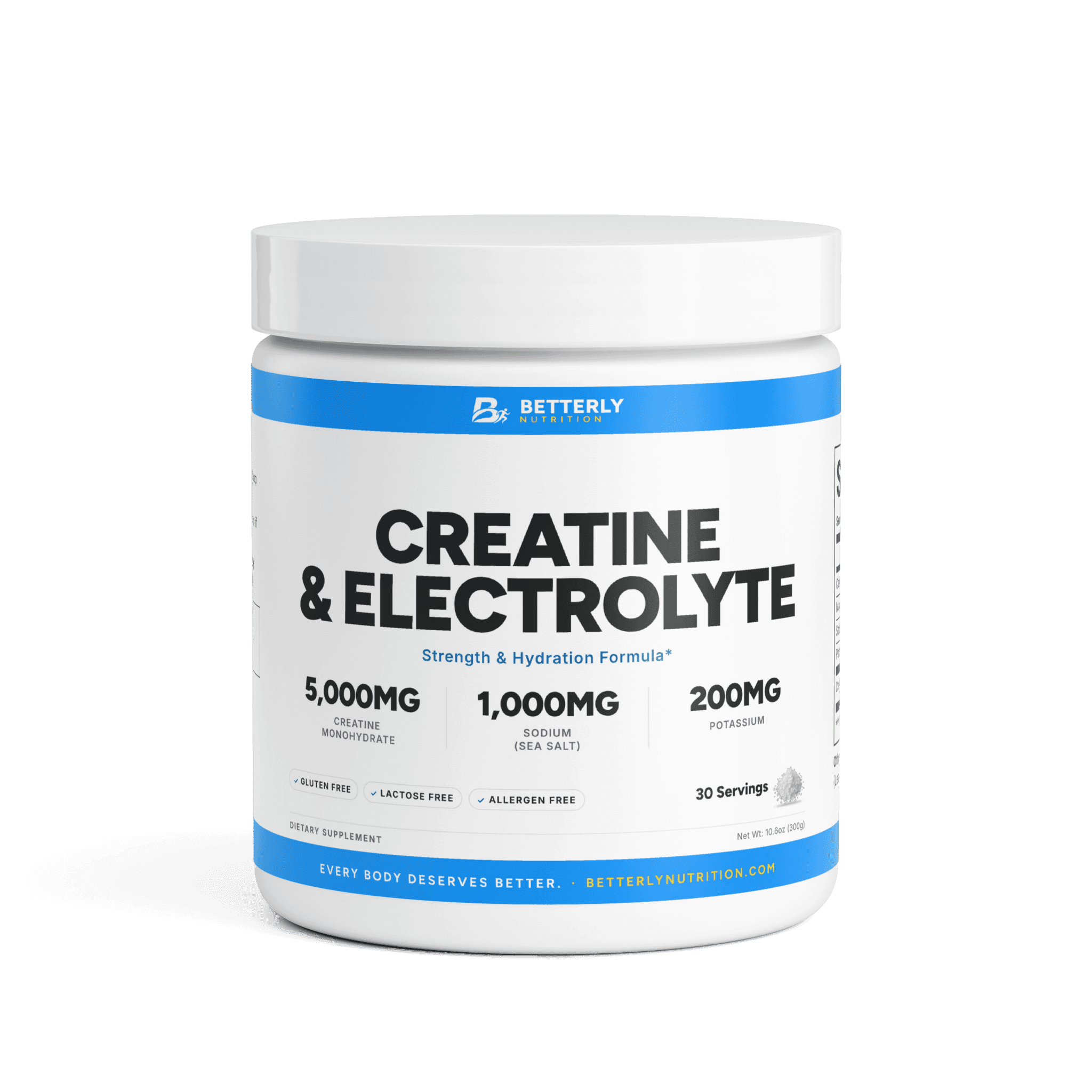
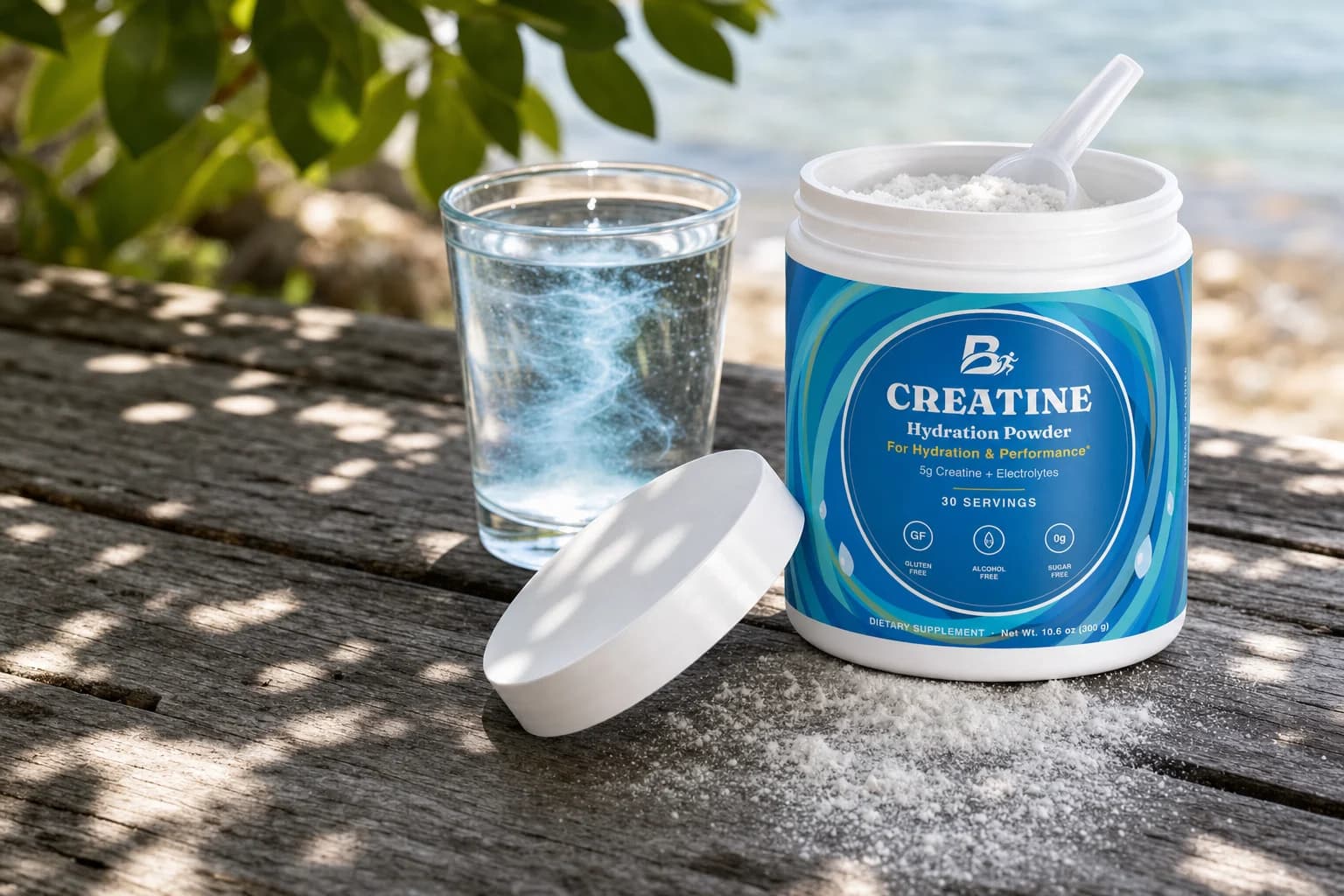
| 5g Creatine & Electrolyte Powder | 1 scoop (10 g) | 5,000 mg creatine, 1,000 mg sodium | 1 scoop daily, no loading |
Every row prints its own amounts, and none carries caffeine. One scoop of either tub (5,000 mg) sits inside ODS's 3 to 5 g maintenance range, but the plain tub's optional second scoop (10,000 mg a day) goes above it. The citrulline row doesn't come close to study amounts.
ODS ties creatine's benefit to repeated hard efforts of up to about 2.5 minutes, as in weightlifting, so this stack suits lifters more than distance athletes.
If you'd rather have caffeine timed to a session, our pre-workout vs creatine comparison covers that route, including whether pre-workouts tend to contain creatine.
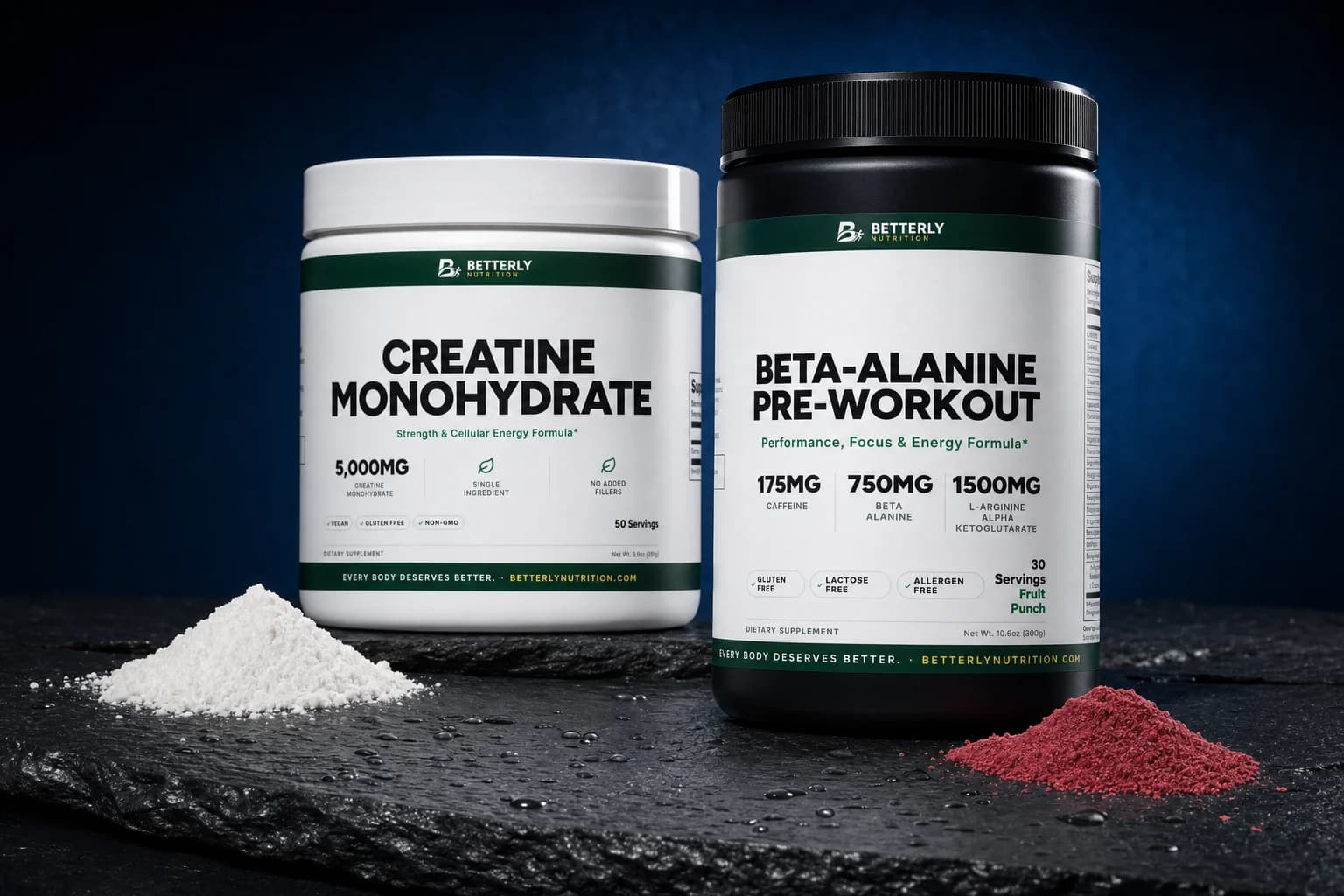
From our shop: Creatine Monohydrate Powder — a single-ingredient tub for the creatine half of this stack: each 1 Scoop (5.6g) serving is 5,000 mg of creatine monohydrate, and the label claims vegan, gluten free and non-GMO.
How do you take L-citrulline and creatine together?
To take L-citrulline and creatine together, follow two sets of directions at once: your creatine tub's scoop schedule and the capsule label's 2 capsules daily with water.
Here's one routine built from the three labels:
- Choose one creatine tub. Each prints 5,000 mg per scoop, but the rows differ: the plain tub lists "Creatine Monohydrate," and the blend lists "Creatine (as Creatine Monohydrate)." Using both would double your creatine, and every blend scoop brings 1,000 mg of sodium (43% DV).
- Match that tub's schedule. The plain tub's label opens with a loading phase: one scoop in 8 oz (237 ml) of water or juice, 4 times a day for the first 5 days, then 1 to 2 scoops daily. If you'd rather not load, the blend is the tub whose label is written that way: 1 scoop daily in 6-8 oz of water or another drink. ODS describes both patterns in research.
- Add one capsule serving. Per the capsule label, that's 2 capsules a day with 6-8 oz (177-237 ml) of water, on training and rest days alike.
- Anchor both to one moment. No label names a time of day or workout window, so pair the scoop and capsules with something you already repeat, like breakfast.
After the plain tub's 5-day loading phase, a full label day holds 400 mg of L-citrulline DL-malate, 400 mg of arginine compounds and 5,000 or 10,000 mg of creatine monohydrate. The 10,000 mg day is above ODS's 3 to 5 g maintenance range.
What should a stim-free pre-workout label with creatine show?
A stim-free pre-workout label with creatine should list creatine and citrulline on their own rows with milligram amounts, and no caffeine or caffeine-bearing herbs.
Run any tub, ours included, through these checks:
- A creatine row with its own amount. Compare the milligrams with the 3 to 5 g daily range above.
- A citrulline row that names its form. "L-citrulline" and "citrulline malate" don't deliver the same citrulline per milligram.
- No blend hiding the numbers. A proprietary blend prints one total for several ingredients, hiding each amount.
- No caffeine sources. Scan the panel and ingredient list for caffeine, coffee or tea extracts, guarana and kola nut.
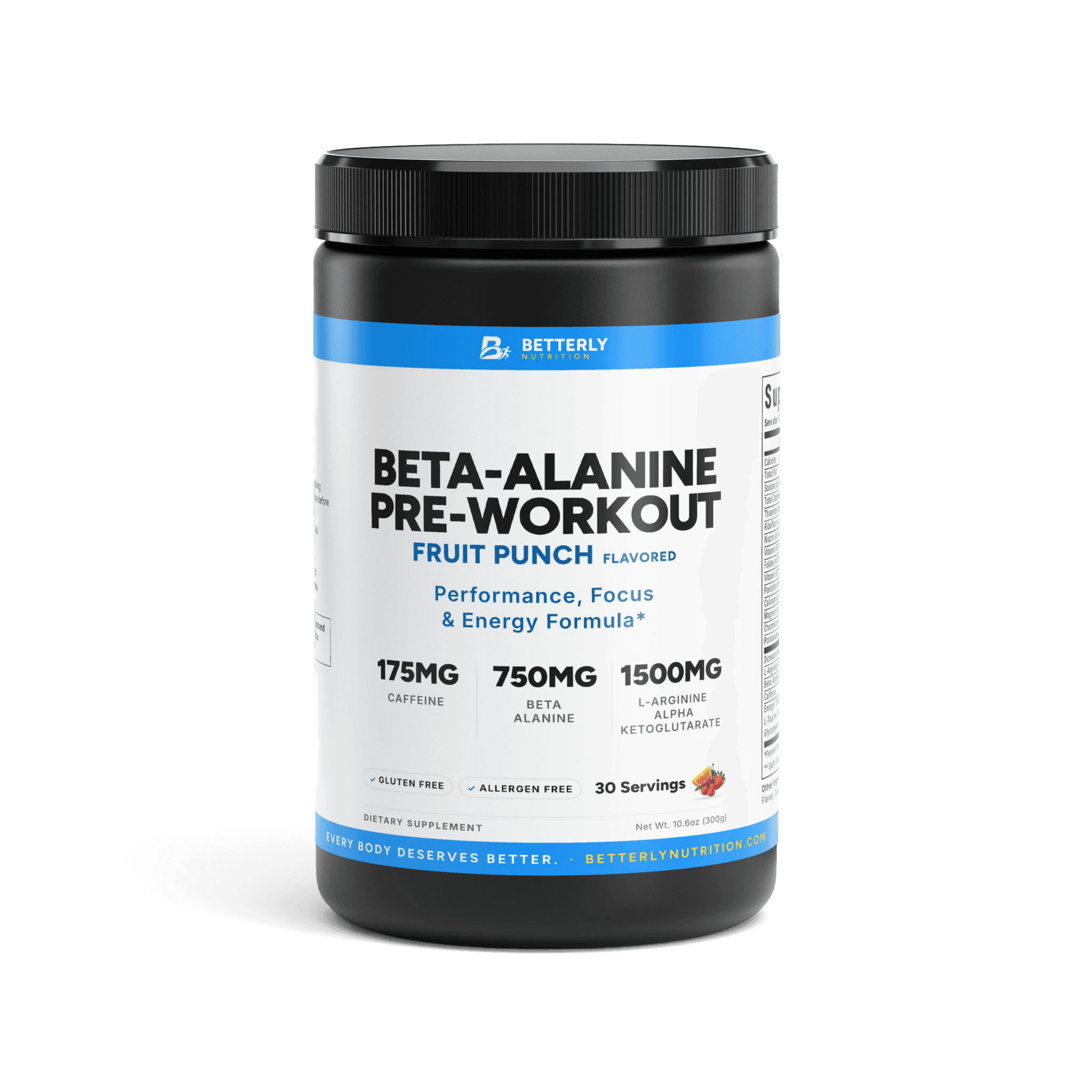
We sell one tub that holds both ingredients, and it passes only the first check. The panel on our Beta-Alanine & Caffeine Pre-Workout Powder (Fruit Punch) prints 1500 mg of dicreatine malate per 10 g (1 Scoop) serving. Its L-citrulline malate is only a name in a 550 mg matrix, with no amount. That scoop also delivers 175 mg of caffeine, which rules it out as stim-free.
Our three-product stack clears all four.
When is L-citrulline, or this whole stack, not worth adding?
L-citrulline is the easy half to drop: skip our capsules if you want only what the training evidence supports, or if you want citrulline at study-sized amounts.
We'd skip part or all of this stack if:
- You only want the half with strong evidence. Creatine can stand alone. ODS finds little evidence that citrulline or arginine supplements help performance.
- You want study-sized citrulline. The label caps the capsules at 2 a day, and that serving holds a small fraction of the trial's 6 g daily.
- Another product already covers both. If your pre-workout lists creatine and citrulline, adding ours piles a second set of amounts on top, and a blend may hide the total.
Where our products fit: you lift, want a routine with no caffeine on any label, and are happy to count the capsules as optional. The rest of our training shelf lives in the performance collection.
From our shop: L-Citrulline & L-Arginine Capsules — a vegan-labeled capsule that prints three rows per 2-capsule serving (400 mg L-citrulline DL-malate, 350 mg L-arginine hydrochloride, 50 mg L-arginine alpha-ketoglutarate) and no caffeine.
Who should check with a healthcare provider first?
Check with a healthcare provider before taking L-citrulline and creatine together if you're pregnant, nursing, under 18, taking any prescription medicine, managing a medical condition or scheduled for surgery.
The caution line on the capsule bottle, repeated on both creatine tubs, reads: "Do not exceed recommended dose. Consult a physician if pregnant, nursing, under 18, or have a medical condition."
The NIH sheet raises one more point: performance supplements might interact with prescription and over-the-counter medicines. If you take supplements and medicines regularly, ODS asks you to tell your healthcare provider.
Mention the totals: a 5-day loading phase on the plain tub means 20,000 mg of creatine monohydrate a day, and the blend carries 1,000 mg of sodium per scoop.
FAQ: L-citrulline and creatine
Can you mix L-citrulline and creatine in the same drink?
L-citrulline and creatine can share a sitting, but with our products only the creatine gets mixed, because our citrulline comes in capsules. The plain creatine tub's label says to stir each scoop into 8 oz (237 ml) of water or juice, and the blend allows water or another drink. The capsule label asks for 6-8 oz of water, so plain water covers that side.
Is it safe to take L-arginine with creatine?
L-arginine with creatine carries no warning on any label or NIH page we used, but we found no study of that exact pair, and ODS says most performance-supplement combinations lack research. The capsule's two arginine rows are small, 350 mg of the hydrochloride form and 50 mg of the alpha-ketoglutarate form per 2-capsule serving. ODS says arginine above 9 g a day can cause GI discomfort. If you also use our caffeinated pre-workout, count its 1500 mg of L-arginine alpha ketoglutarate per 10 g (1 Scoop) serving too.
How long should you take L-citrulline and creatine?
L-citrulline and creatine have very different track records on duration, and none of our three labels sets a stopping point. For creatine, ODS says use over several weeks or months can help with training, and long-term use over several years seems safe. The citrulline performance studies in ODS's consumer fact sheet lasted 16 days at most, and ODS says there isn't enough research to know for sure whether citrulline is safe. If you plan months of the capsules, raise that short record with a healthcare provider.
Can L-citrulline or creatine upset your stomach?
Yes, L-citrulline and creatine can each bother some stomachs, according to the NIH Office of Dietary Supplements. Some citrulline users report stomach discomfort, and ODS lists GI distress among creatine's rare reactions, next to muscle stiffness and cramps. Its health professional sheet adds that adequate hydration might minimize creatine's uncommon side effects. If discomfort keeps up, stop and check with a healthcare provider. Our rundown of creatine side effects covers the creatine half in more depth.
Can you take citrulline malate and creatine together?
Citrulline malate and creatine can share a day on the same terms as plain L-citrulline; the malate form mostly changes how much citrulline each milligram carries. Our capsule's row reads L-Citrulline DL-Malate, 400 mg per 2-capsule serving, a weight that includes the malic acid. The salt math in our comparison of L-citrulline and citrulline malate shows how to compare labels by citrulline content.
Sources
- NIH Office of Dietary Supplements: Dietary Supplements for Exercise and Athletic Performance, Fact Sheet for Consumers
- NIH Office of Dietary Supplements: Dietary Supplements for Exercise and Athletic Performance, Health Professional Fact Sheet
- PubMed, National Library of Medicine: Effects of Combined Versus Single Supplementation of Creatine, Beta-Alanine, and L-Citrulline (Li and Sheykhlouvand, 2025)
If this left you looking for somewhere to start, read citrulline and arginine capsules to take with creatine — its amounts per serving are listed on the page. For the practical questions this raises, how dosing, sourcing and subscriptions work is answered in one place.