On this page
- Key takeaways
- Is citrulline malate the same molecule as L-citrulline?
- How much citrulline is in citrulline malate?
- Is citrulline malate or L-citrulline better?
- What does "DL-malate" mean on a citrulline label?
- How much citrulline did exercise studies use?
- How much L-citrulline per day should you take?
- Is 8 g of citrulline malate more than 6 g of L-citrulline?
- When don't you need citrulline or citrulline malate?
- Who should check with a healthcare provider first?
- FAQ: L-citrulline and citrulline malate
- Sources
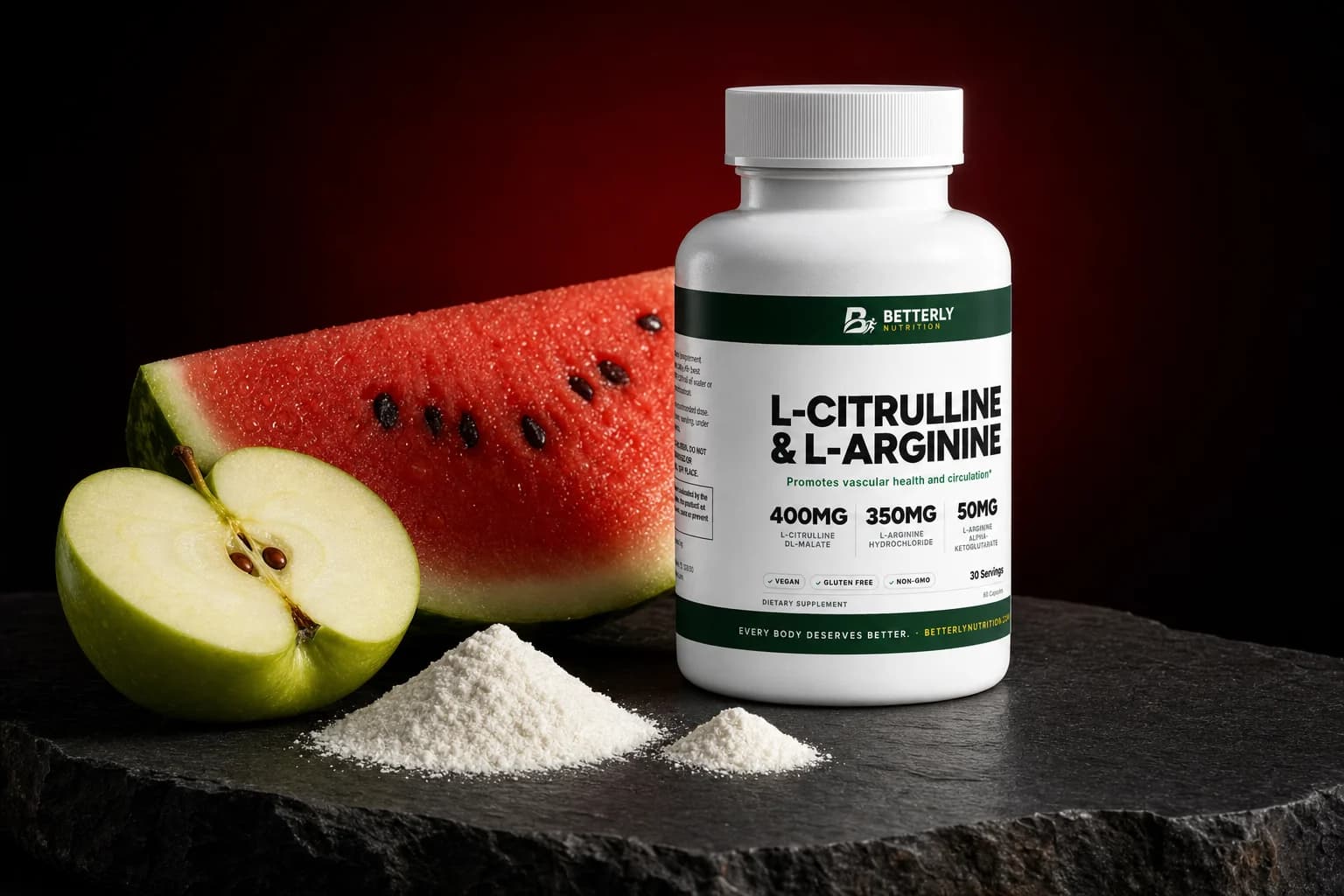
The short answer: In L-citrulline vs citrulline malate, you get the same L-citrulline from both; the malate form adds malic acid, which takes up part of every gram. The molecular-weight math puts a 1:1 citrulline malate at about 57% citrulline and a 2:1 at 67 to 72%, depending on how the ratio is counted. Compare citrulline per serving, not powder. Our capsule's 400 mg of L-citrulline DL-malate holds roughly 227 to 289 mg.
Key takeaways
- Citrulline malate is L-citrulline bound to malic acid, and FDA's labeling rule says the milligrams on a panel are the weight of that whole ingredient.
- A 1:1 citrulline malate is about 57% citrulline by weight, and a 2:1 form is about 72% if the ratio counts molecules or about 67% if it counts grams.
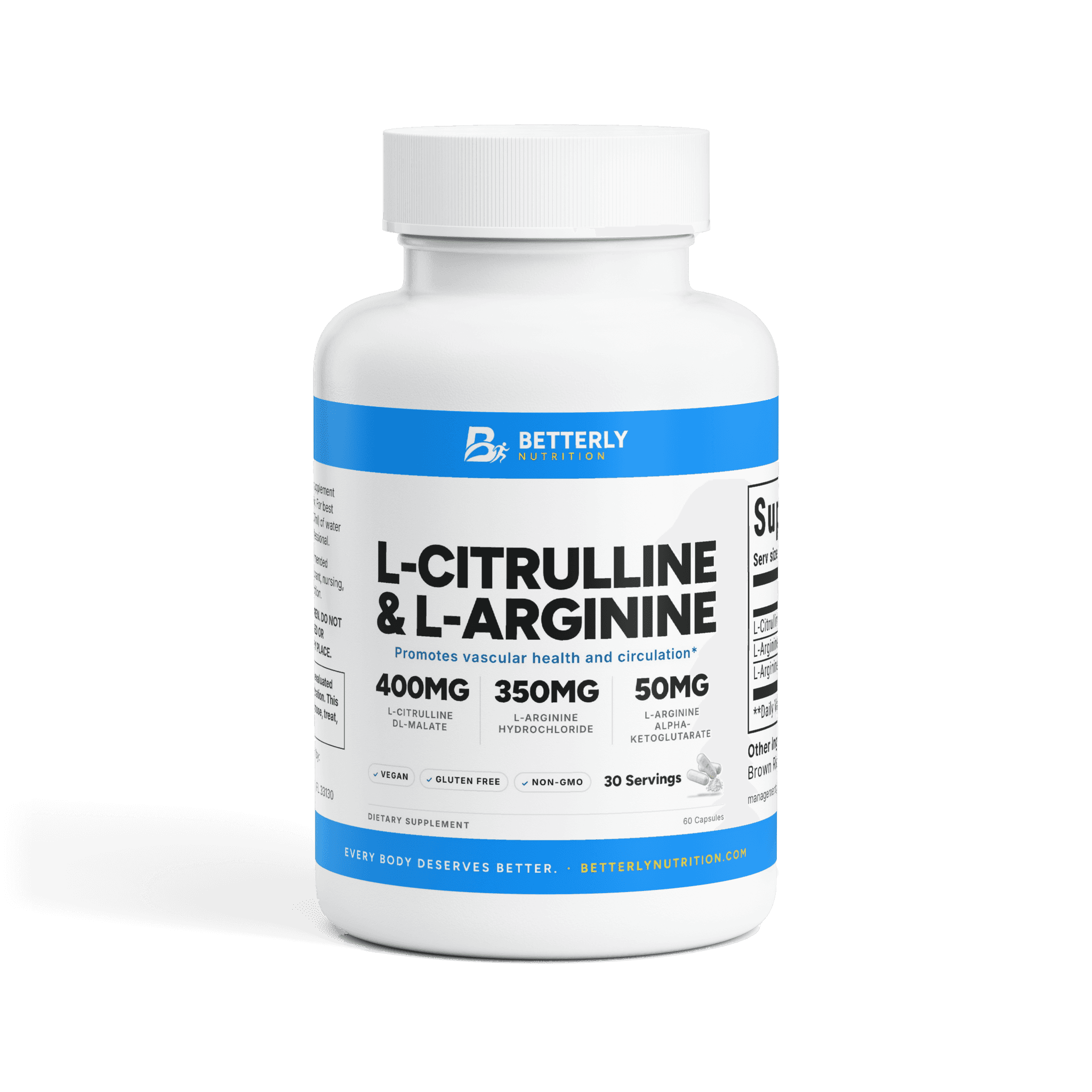
- Each 2-capsule serving of Betterly's L-Citrulline & L-Arginine Capsules carries 400 mg of L-citrulline DL-malate, roughly 227 to 289 mg of citrulline.
- The NIH Office of Dietary Supplements describes studies using up to 9 g of citrulline in a day and still finds little evidence it helps performance.
L-citrulline DL-malate is the first row on a capsule we sell, our L-Citrulline & L-Arginine Capsules, so factor that in as you read. Every figure we quote for that bottle is copied from its Supplement Facts panel, and each conversion is written out so you can redo it on any label.
Is citrulline malate the same molecule as L-citrulline?
Citrulline malate contains the same L-citrulline molecule, but it adds malic acid, so each gram holds less citrulline than a gram of plain L-citrulline.
Citrulline is an amino acid your body produces on its own, and some foods contain it too. The NIH Office of Dietary Supplements (ODS) explains in its fact sheet on performance supplements that your kidneys turn most citrulline into arginine, another amino acid. Our capsule pairs the two.
Malic acid is a small organic acid, and in citrulline malate its weight is part of the milligrams printed on the label.
| If you want... | Look for | Why |
|---|---|---|
| The most citrulline per gram | Plain L-citrulline | Nothing else shares the weight |
| A fair comparison of two tubs | Citrulline per serving | Total grams hide the acid |
| A number for "citrulline malate" with no ratio | The 57% share | It's the lowest share for a 1:1 salt |
| Citrulline from a multi-ingredient capsule | The citrulline row only | Other rows aren't citrulline |
Same milligrams, different citrulline: that's the trap. Plain L-citrulline is the one form where the label number is the citrulline number.
How much citrulline is in citrulline malate?
Citrulline malate is about 57% citrulline by weight in a 1:1 form and about 67 to 72% in a 2:1 form, depending on how the ratio is counted.
A molecular weight tells you how many grams a fixed count of molecules weighs. The National Library of Medicine's PubChem database lists citrulline at 175.19. Its citrulline malate record, one citrulline plus one malic acid, comes to 309.27.
Divide 175.19 by 309.27 and you get 0.566. So a 1:1 product counted by molecules, the form PubChem records as "L-Citrulline DL-malate (1:1)," is about 57% citrulline and 43% malic acid.
A 2:1 product pairs two citrulline units with each malic acid, which weighs about 134.08 (the gap between those two records). That's 350.38 out of 484.46, or about 72%.
Not every seller counts "2:1" that way. Some mean 2 g of citrulline per 1 g of malic acid, which is exactly two-thirds, about 67%. A label that just says "2:1" doesn't tell you which, so the table shows both.
| Panel row says | Citrulline share | In 400 mg | In 6 g |
|---|---|---|---|
| L-Citrulline | 100% | 400 mg | 6 g |
| Citrulline malate 2:1 (molecules) | About 72% | About 289 mg | About 4.3 g |
| Citrulline malate 2:1 (by weight) | About 67% | About 267 mg | About 4 g |
| Citrulline malate 1:1 | About 57% | About 227 mg | About 3.4 g |
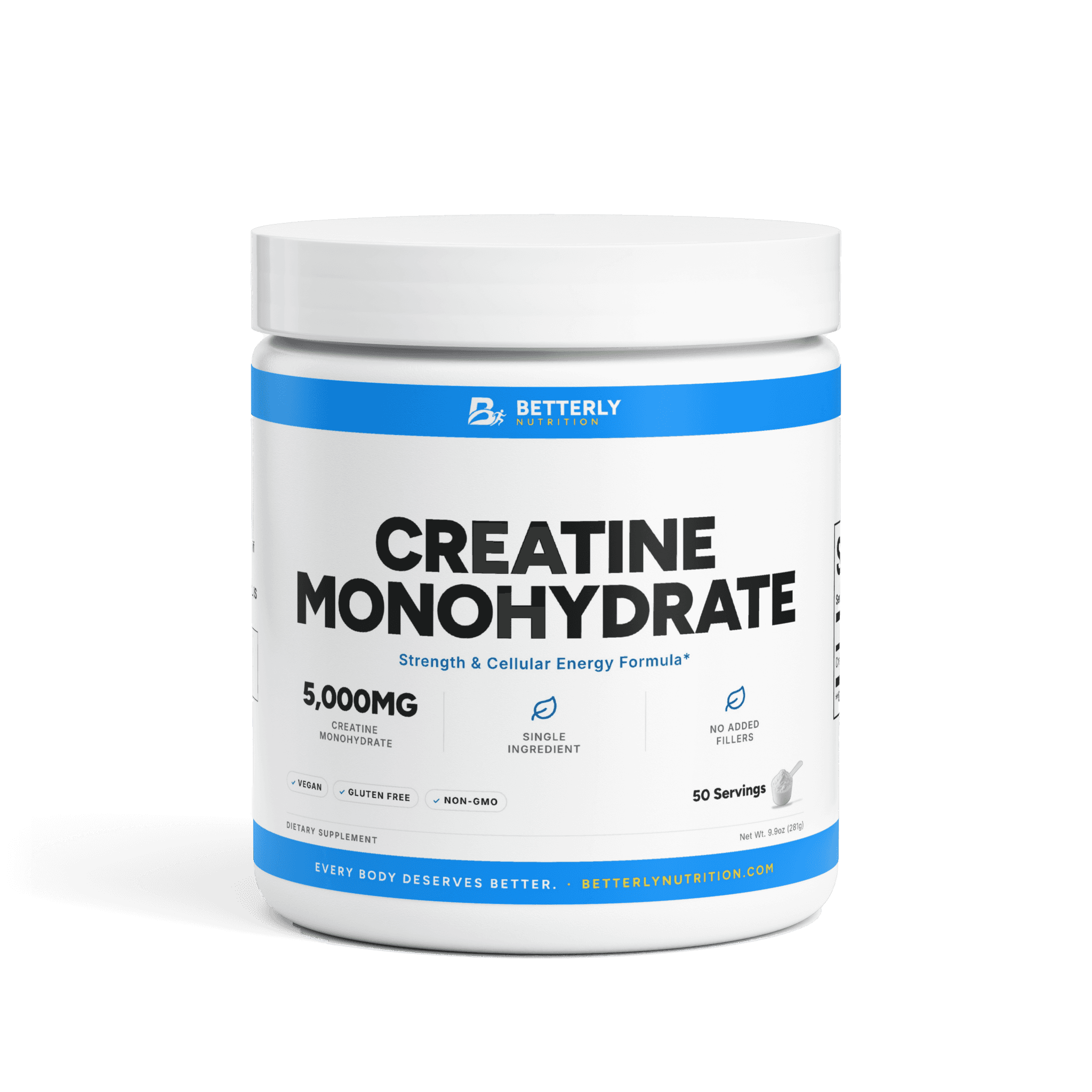
At a 6 g scoop, picking 1:1 over plain L-citrulline costs you about 2.6 g of citrulline. The same salt-form arithmetic applies to creatine, as our guide to creatine monohydrate vs HCl shows.
Is citrulline malate or L-citrulline better?
Neither citrulline malate nor L-citrulline is a better form of citrulline; both deliver the identical molecule, and the difference is how much of it you get per gram.
You'll see the malic acid half marketed as an energy extra. The ODS fact sheet we cite never mentions malic acid, so this guide gives it no exercise role.
For citrulline itself, ODS sums up its verdict in one line: "There's not much scientific evidence to support taking citrulline supplements to improve exercise or athletic performance."
So "better" really means value for the citrulline you want. Divide a tub's cost by its grams of citrulline, not powder, and a cheaper 1:1 tub can turn out pricier per gram of citrulline than a plain one. Taste, mixing and timing are format questions, covered in our guide to L-citrulline capsules vs powder.
What does "DL-malate" mean on a citrulline label?
DL-malate means the malic acid half is a mix of its two mirror-image forms; the citrulline in L-citrulline DL-malate is still L-citrulline.
Many molecules come in left- and right-handed versions, labeled L and D, and a "DL" ingredient is an even mix of the two. In "L-citrulline DL-malate," the DL sits on the word malate, so it describes the malic acid only.
The DL doesn't change your citrulline math. PubChem files "L-Citrulline DL-malate" under its citrulline malate record, at the same 309.27 molecular weight.
The ratio matters far more, and PubChem can't settle it: that record carries both "L-Citrulline DL-malate (1:1)" and "L-Citrulline DL-Malate 2:1" among its names. Our panel shows "L-Citrulline DL-Malate" at 400 mg per 2-capsule serving but prints no ratio.
Read as 1:1, that's about 227 mg of citrulline. Read as 2:1, it's about 267 to 289 mg. We can't confirm which applies, so we give you the whole range rather than its flattering end.
How much citrulline did exercise studies use?
According to the NIH Office of Dietary Supplements, citrulline studies gave people up to 9 g in a single day or 6 g a day for up to 16 days.
ODS says a few studies found citrulline might help, hinder or have no effect on performance, and it calls the research limited.
The fact sheet states those amounts as citrulline without naming a form. Matching 6 g of citrulline would take about 10.6 g of a 1:1 malate, about 8.3 g of a molecule-counted 2:1, or about 9 g of a by-weight 2:1. That's why online dosage answers can clash: some quote the malate, some the citrulline, and not all say which.
Our capsule's roughly 227 to 289 mg of citrulline per serving is about 4 to 5% of that 6 g daily amount. The label says two capsules daily and "Do not exceed recommended dose," so closing that gap isn't an option, and it isn't what the capsule is for.
From our shop: L-Citrulline & L-Arginine Capsules — each 2-capsule serving supplies 400 mg of L-citrulline DL-malate plus two arginine forms (350 mg L-arginine hydrochloride, 50 mg L-arginine alpha-ketoglutarate), 30 servings to a bottle of 60 vegan capsules.
How much L-citrulline per day should you take?
How much L-citrulline you take per day should follow your product's label, since none of the federal sources we read sets a daily amount.
ODS says there isn't enough research on citrulline to know for sure whether it's safe, and some users have reported stomach discomfort. The study amounts above are what researchers tested, not a target.
Here's what our citrulline capsule's label says:
- Suggested use: two capsules daily for adults, taken with 6-8 oz (177-237 ml) of water, or as a healthcare professional directs.
- Other ingredients: cellulose (vegetable capsule) and brown rice flour. The label's claims are vegan, gluten free and non-GMO.
There's no time of day or workout window on the label, and we won't add one.
The capsule's two arginine rows, 350 mg and 50 mg, are weights of arginine salts, so the arginine itself comes to less than 400 mg. That's small next to food: ODS says a nutritious diet supplies about 4 to 5 g of arginine a day.
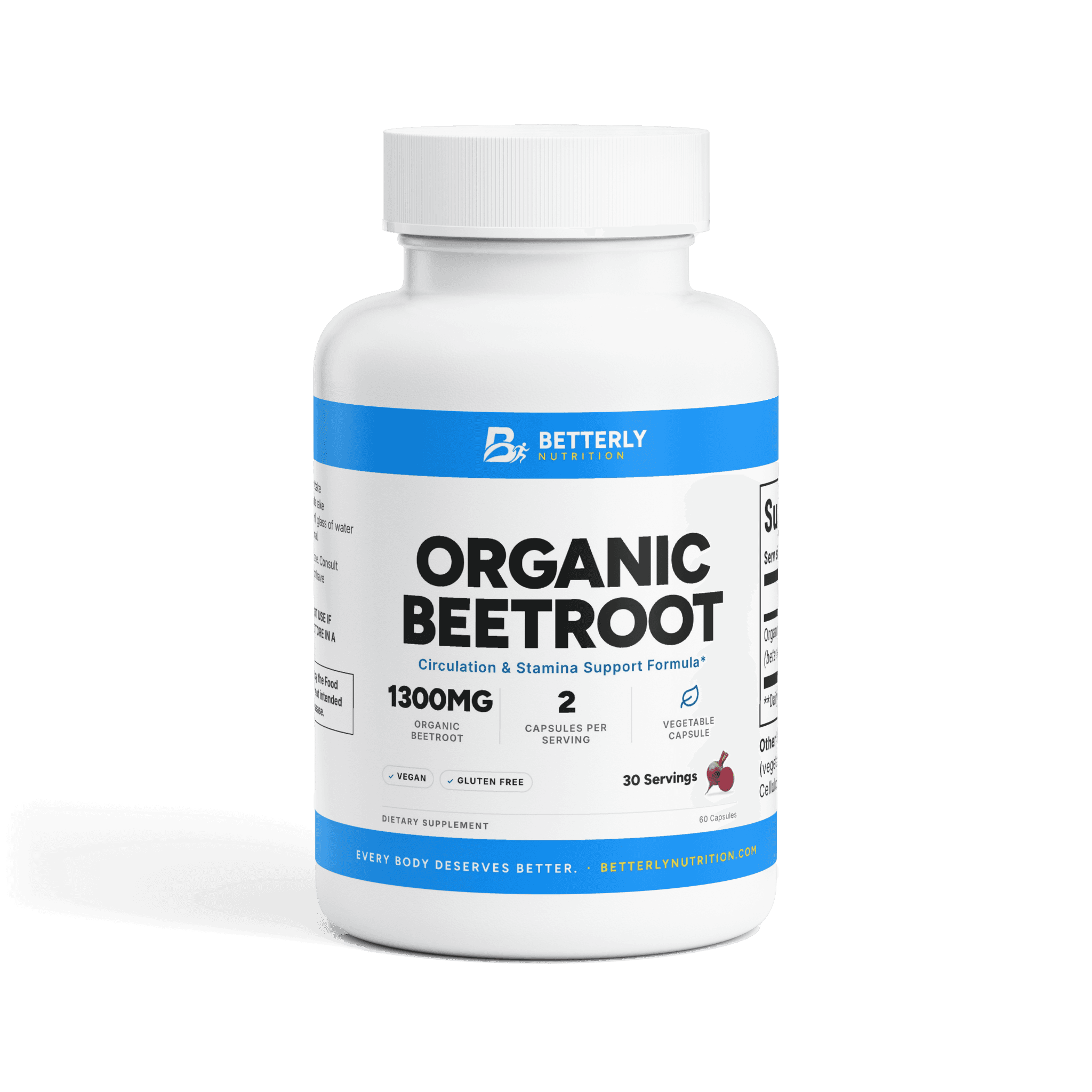
If you'd rather skip amino acids, our Organic Beetroot Capsules hold a vegetable powder instead. Its label directs two capsules once a day, 20-30 minutes before a meal, with 8 oz (237 ml) of water. ODS notes it's unknown whether beetroot powder supplements match the effects of the beet juice researchers tested.
From our shop: Organic Beetroot Capsules — 1300 mg of organic beetroot powder (Beta vulgaris) per 2-capsule serving, in vegan, gluten-free vegetable capsules.
Is 8 g of citrulline malate more than 6 g of L-citrulline?
No: 8 g of citrulline malate 2:1 holds about 5.3 to 5.8 g of citrulline, so 6 g of plain L-citrulline delivers more, despite the smaller number.
Say one tub's panel reads "Citrulline Malate 2:1, 8 g" and another's reads "L-Citrulline, 6 g." The bigger number isn't measuring the same thing.
FDA's rule for Supplement Facts panels, 21 CFR 101.36, says the amount beside an ingredient is the weight of the ingredient as listed, not of any component inside it. So that 8 g is the whole salt, citrulline and malic acid together, while the 6 g is citrulline and nothing else.
Counted by molecules, a 2:1 is about 72% citrulline, and 8 g times 0.72 is about 5.8 g. Counted by weight, it's two-thirds, which gives about 5.3 g. Either way, the plain tub wins by roughly 0.2 to 0.7 g of citrulline per serving.
If the malate tub dropped the ratio and just said "Citrulline Malate, 8 g," read it at the 1:1 share of about 57%. That's about 4.5 g of citrulline, some 1.5 g short of the plain tub.
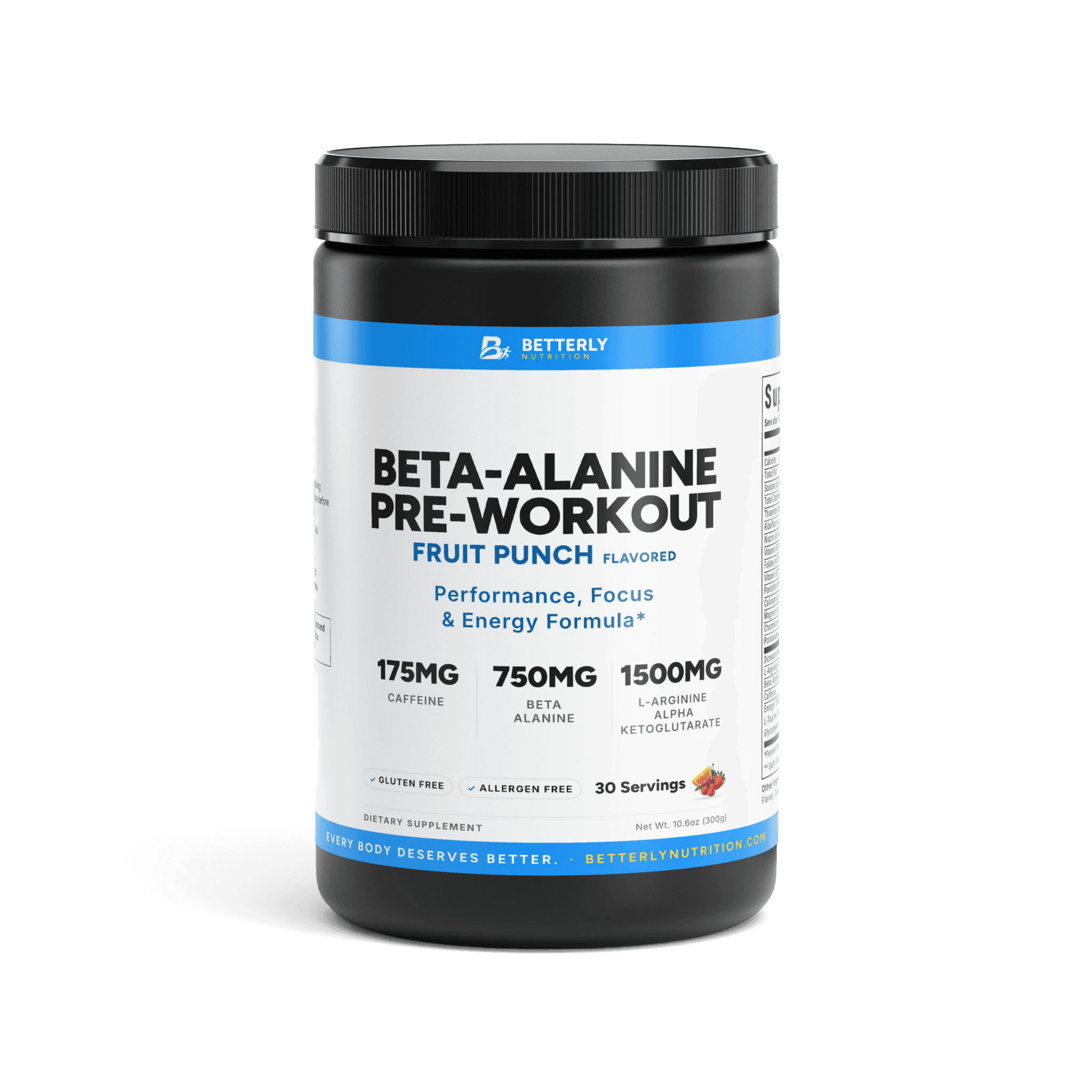
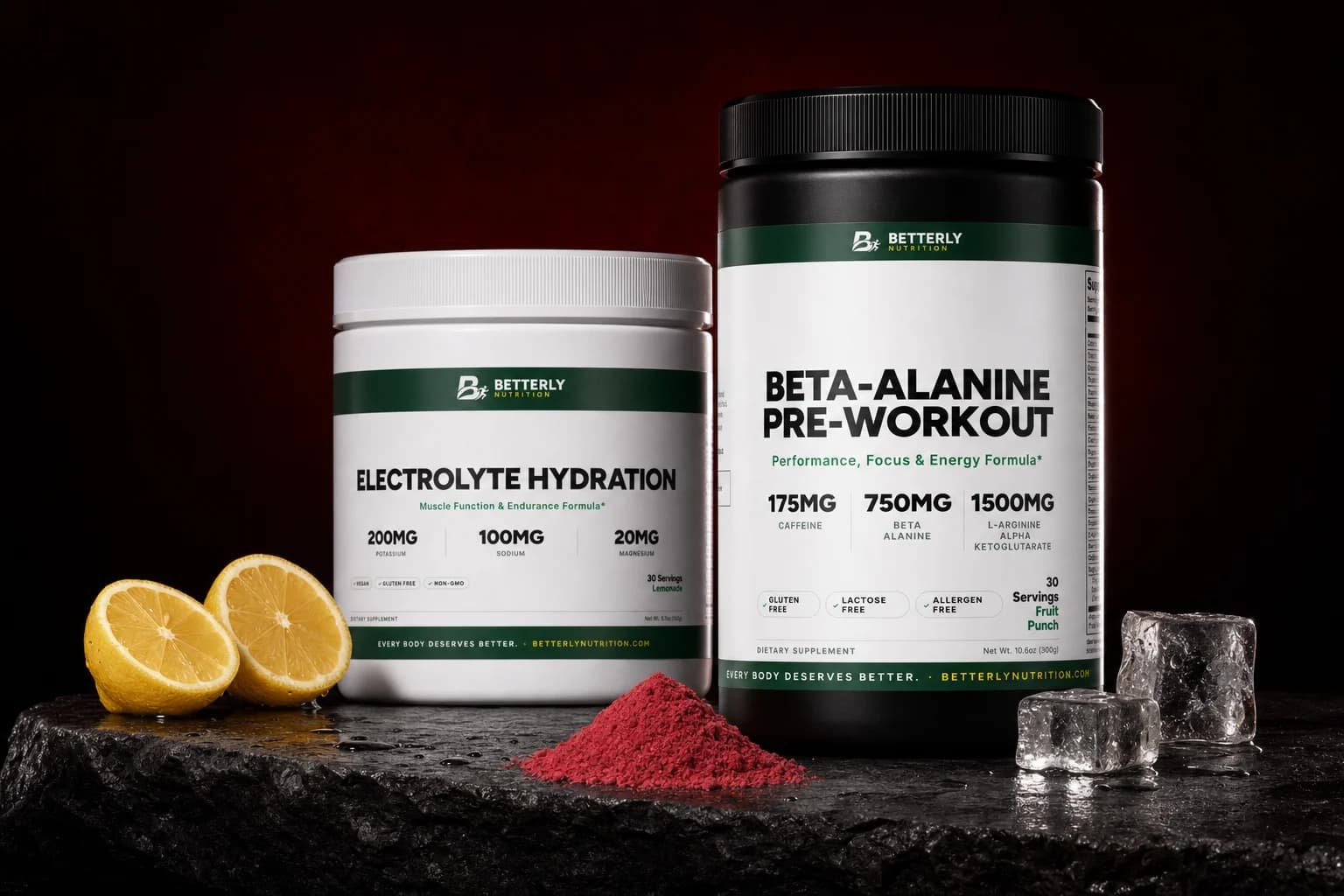
All of this needs a number on the citrulline row. Our Beta-Alanine & Caffeine Pre-Workout Powder (Fruit Punch) doesn't give one: its panel shows a 550 mg "Energy / Endurance / Focus Matrix" in each 10 g (1 Scoop) serving, naming seven ingredients inside it, L-Citrulline Malate among them, with no amount for any of the seven.
The same FDA rule does set a ceiling. Ingredients inside a blend like this must appear heaviest first, and citrulline malate comes fourth of seven. If the panel follows that rule, the citrulline malate is at most a quarter of 550 mg, or 137.5 mg, and the citrulline inside it is less again. Our explainer on how proprietary blends hide single amounts goes deeper.
When don't you need citrulline or citrulline malate?
You don't need citrulline or citrulline malate for a solid training routine; ODS finds little evidence it helps performance, and our capsule holds far less than studies used.
We'd skip it if:
- You want to match exercise-study amounts. Our capsule won't get there within its label.
- Your pre-workout already lists citrulline malate. A second product stacks amounts you can't fully see.
- Your meals are already varied. ODS notes that performance supplements can't take the place of a healthy diet.
- You're brand new to training. Our beginner's guide to pre-workout explains why starting small makes sense.
Where our capsule fits: you want a small, fixed daily amount of citrulline and arginine in two vegan capsules, and the math above sits fine with you. If not, our performance essentials collection has the rest of the training shelf.
Who should check with a healthcare provider first?
Talk to a healthcare provider before taking citrulline malate if you're pregnant, nursing, under 18, taking a prescription medication or managing a medical condition.
Our capsule's caution, shared by the beetroot capsule, reads: "Do not exceed recommended dose. Consult a physician if pregnant, nursing, under 18, or have a medical condition."
ODS advises talking to a healthcare provider before any performance supplement, especially if you're a teen or have a medical condition, and asking whether your medications might interact. We'd also raise it before any scheduled surgery.
Take the panel itself to that conversation, all three rows of it, since a product name alone doesn't say what's inside.
FAQ: L-citrulline and citrulline malate
Is 2:1 citrulline malate better than 1:1?
2:1 citrulline malate isn't better citrulline, but it packs more into each gram: about 72% if the ratio counts molecules or about 67% if it counts grams, versus about 57% for 1:1. A 2:1 product needs a smaller scoop to deliver the same citrulline. If a label only says "citrulline malate," you can't tell which one you have, so work from the lower share until the seller confirms the ratio.
Is citrulline malate the same as creatine?
No, citrulline malate and creatine are different compounds, though they can share a partner: dicreatine malate is creatine bound to malic acid. Our Beta-Alanine & Caffeine Pre-Workout Powder (Fruit Punch) gives dicreatine malate its own row, 1500 mg per 10 g (1 Scoop) serving, apart from the L-citrulline malate in its blend. ODS's exercise fact sheet lists creatine and citrulline separately, and the evidence for each is very different.
Does citrulline malate upset your stomach?
Citrulline malate can upset some stomachs. The NIH Office of Dietary Supplements says some users have reported stomach discomfort from citrulline, without tying it to a particular form or amount. If citrulline disagrees with you, stop, and check with a healthcare provider before trying it again.
How long can you take L-citrulline?
The NIH Office of Dietary Supplements gives no time limit for L-citrulline, and it says there isn't enough research on citrulline to know for sure whether it's safe. The studies it describes ran from a single day to 16 days. Our capsule's directions say to take it daily and give no end date, so check in with a healthcare provider if you plan to take any citrulline product for months.
Can you take L-citrulline and citrulline malate together?
Taking L-citrulline and citrulline malate together means two sources of one molecule, so what counts is your total citrulline, not the pairing. Convert each label with the shares above, add the results, and keep each product within its own directions. Check with a healthcare provider before combining them. Check your pre-workout's panel too, in case citrulline malate is already on it.
Sources
- NIH Office of Dietary Supplements: Dietary Supplements for Exercise and Athletic Performance, Fact Sheet for Consumers
- PubChem, National Library of Medicine: Citrulline malate (CID 162762)
- PubChem, National Library of Medicine: Citrulline (CID 9750)
- Electronic Code of Federal Regulations: 21 CFR 101.36, Nutrition labeling of dietary supplements
If this left you looking for somewhere to start, read citrulline malate and arginine capsules — its amounts per serving are listed on the page. For the practical questions this raises, how dosing, sourcing and subscriptions work is answered in one place.