On this page
- Key takeaways
- NMN vs NR: which is better, at a glance?
- How do NMN and NR turn into NAD+?
- Which raises NAD+ more, NMN or NR?
- How do NMN and NR compare with NAD+, nicotinamide and niacin?
- How do you compare NMN and NR labels and cost per serving?
- How do you take NMN by the label rather than the trial dose?
- When is NR the better pick, and when do you need neither?
- Who should check with a healthcare provider first?
- FAQ: NMN vs NR
- Sources
The short answer: In the NMN vs NR debate, neither has shown a clear edge in people. In the first head-to-head human trial, published in 2026, 1,000 mg a day of either one, twice the daily amount on our NMN label, roughly doubled whole-blood NAD+ in healthy adults. NR has more published human studies, and NMN's head start on the NAD+ pathway is mostly on paper. We sell 500mg NMN Capsules, not NR, and we'll say where NR makes more sense.
Key takeaways
- In a 2026 randomized trial of 65 healthy adults, 1,000 mg a day of NMN or NR, a research dose twice our NMN label's daily amount, raised whole-blood NAD+ by a similar amount.
- Inside your cells, NR can pick up a phosphate group to become NMN, and NMN is then turned into NAD+.
- A 2023 review of 25 published human NR papers found few effects big enough to matter in practice, so a higher blood reading isn't the same as a change you'd feel.
- FDA said in 2025 that NMN isn't excluded from the dietary supplement definition, reversing the position it took in 2022.
- Compare any NMN or NR bottle by the form named on its facts panel, milligrams per serving and cost per 100 mg, not by the front label.
We sell NMN and an NAD+ formula, and we don't carry NR. That colors our view, so every point about NR below comes from a named source, and our verdict leaves real room for NR.
NMN vs NR: which is better, at a glance?
NMN and NR tie on the one outcome tested head to head, blood NAD+, while NR leads on published research and NMN's pathway lead is only on paper.
NMN is short for β-nicotinamide mononucleotide, and NR is nicotinamide riboside. Both are raw materials for NAD+, a coenzyme that takes part in energy metabolism inside every cell. If NAD+ is new to you, start with what NAD+ does in your cells.
| Question | NMN | NR | Edge |
|---|---|---|---|
| Steps to NAD+ inside a cell | One | Two via NMN, more via nicotinamide | NMN, on paper |
| Blood NAD+ at 1,000 mg a day (2x our label), 14 days | About doubled | About doubled | Tie |
| Molecules in 1,000 mg (as used in the 2026 trial) | 3 mmol | 3.4 mmol (as NR chloride) | NR, slightly |
| Published human research by 2023 | 10 trials | 25 papers, since 2016 | NR |
| Sold by Betterly | Yes | No | Our bias |
Only the second row was tested side by side, and it tied. The other edges are chemistry on paper and publication counts, not your body.
How do NMN and NR turn into NAD+?
NR and NMN both feed the salvage pathway, your cells' recycling line for NAD+, and NR can become NMN there by picking up a phosphate group.
A 2023 review in Science Advances on what's really known about NR in humans lays out the steps. NR enters cells through transporter proteins. Inside, enzymes called NR kinases add a phosphate and turn it into NMN, which is then converted into NAD+. NR can also be split into nicotinamide, another B3 compound that feeds the same line.
That makes NMN look like the shortcut, since it's already past the phosphate step. Not every researcher reads the map that way. A 2023 review of human NMN trials in Advances in Nutrition argues that, from a biochemist's view, NR holds the edge, because cells can't absorb NMN directly and NMN is converted to NR before it gets in.
There's a bigger catch: what you swallow doesn't reach your cells untouched. Rodent tracer studies described in the Science Advances review found most oral NR gets broken down in the gut, first to nicotinamide and then, with help from gut bacteria, to nicotinic acid.
The 2026 trial below added human lab work: gut bacteria from human stool samples turned both NR and NMN into nicotinic acid. The authors proposed that both may raise blood NAD+ partly through that gut route. It's a model, not a settled fact, but it's a reason not to lean on the diagram.
Which raises NAD+ more, NMN or NR?
Neither NMN nor NR raised NAD+ clearly more in the first head-to-head human trial, where 1,000 mg a day of each, a research dose, roughly doubled whole-blood NAD+.
The study, published in Nature Metabolism in 2026, randomly assigned healthy adults to four groups and analyzed 65 of them, average age about 35. Each group took 1,000 mg of NR, 1,000 mg of NMN, 500 mg of nicotinamide or a placebo once a day for 14 days.
Compared with placebo, whole-blood NAD+ rose by 49.4 µM (micromoles per liter) with NR and 43.1 µM with NMN. The statistical ranges around those numbers overlap heavily, and the authors call the increases comparable. Nicotinamide didn't significantly raise the day-14 reading.
Weigh what the trial couldn't tell you:
- It was open-label, so everyone knew what they were taking.
- It was short and measured blood, not muscle, brain, years of use or how anyone felt.
- The volunteers were healthy adults aged 18 to 50, and the authors note NAD+ was pushed above normal values.
- Most authors work for Nestlé companies, which the paper discloses.
That fits the wider NR record. The 2023 Science Advances review assessed 25 published human NR papers going back to 2016. It concluded that oral NR had shown few effects big enough to matter in practice, and that papers in the field tend to overstate their findings.
NMN's published record is thinner. The Advances in Nutrition review found 10 published human NMN trials by 2023, and the largest enrolled 108 older adults. Counting trials and counting papers isn't a perfect match, but the gap is plain. For the doses and side-effect reports in those trials, see our rundown of what the small NMN trials logged.
How do NMN and NR compare with NAD+, nicotinamide and niacin?
NMN, NR, nicotinamide and niacin are all starting materials for NAD+, and an NAD+ supplement contains the end molecule, though digestion is thought to break much of it down.
| Ingredient | What it is | What the 2026 trial found at its doses |
|---|---|---|
| NMN | NR with a phosphate group added | Blood NAD+ about doubled at day 14 |
| NR | A compound cells turn into NMN or nicotinamide | Blood NAD+ about doubled at day 14 |
| Nicotinamide (niacinamide) | A B3 compound in the salvage pathway | Brief change within 4 hours; no day-14 rise |
| Nicotinic acid (niacin) | The B3 form tied to skin flushing | Not given to volunteers |
| NAD+ | The end molecule; largely broken down in digestion | Not given to volunteers |
NMN and NR behaved alike, but plain nicotinamide didn't hold NAD+ up. The authors add that skin flushing and stomach symptoms limit high doses of nicotinic acid.
The NIH's niacin fact sheet sets an upper limit of 35 mg a day from supplements for adults, nicotinamide included, and says 500 mg a day or more of nicotinamide can cause diarrhea and easy bruising. The trial's 500 mg arm was a research dose, not one to copy.
An NAD+ capsule isn't a way around the precursors, either. As our comparison of NMN and NAD+ capsules explains, research suggests much of a swallowed NAD+ dose is broken down during digestion, partly into the same building blocks your body already uses.
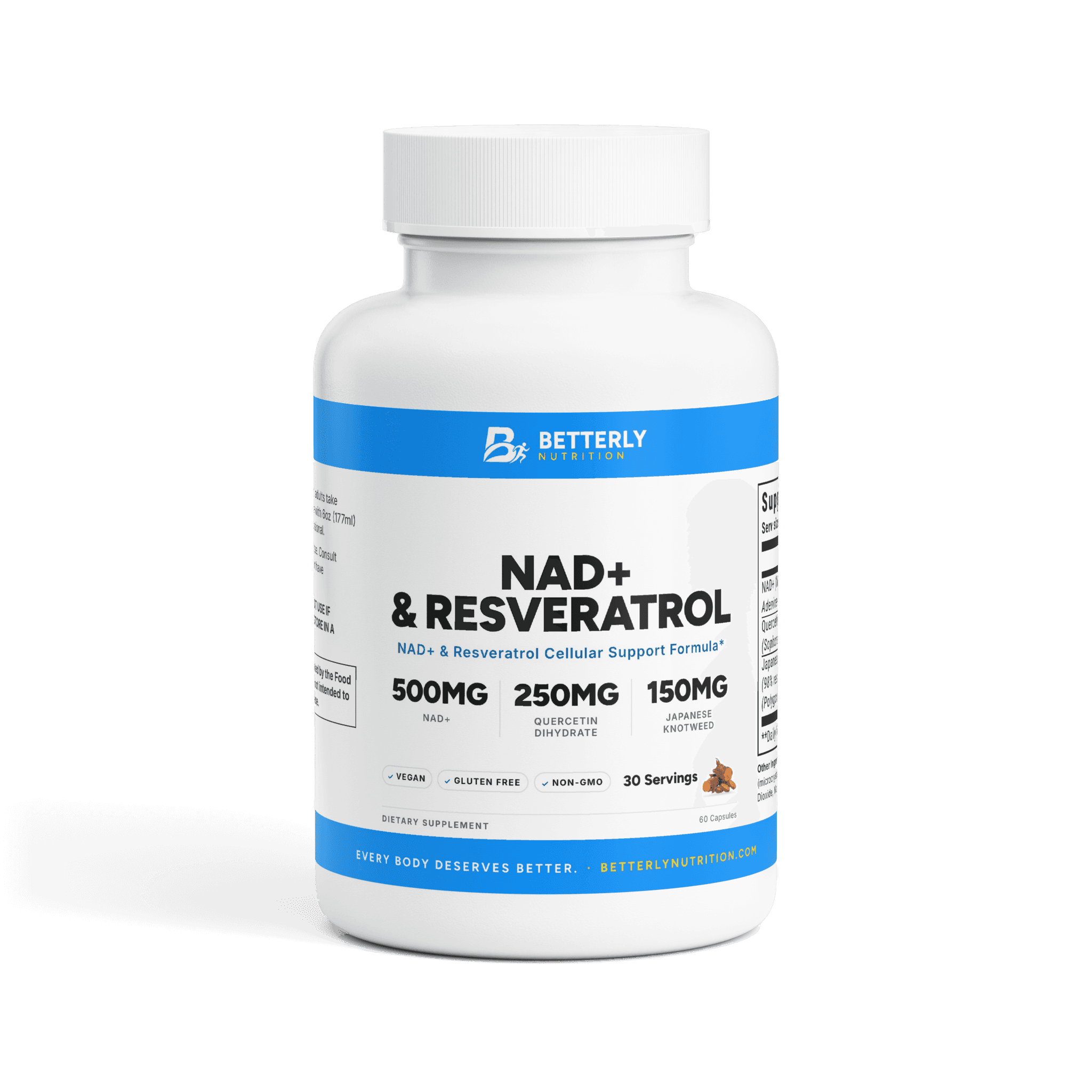
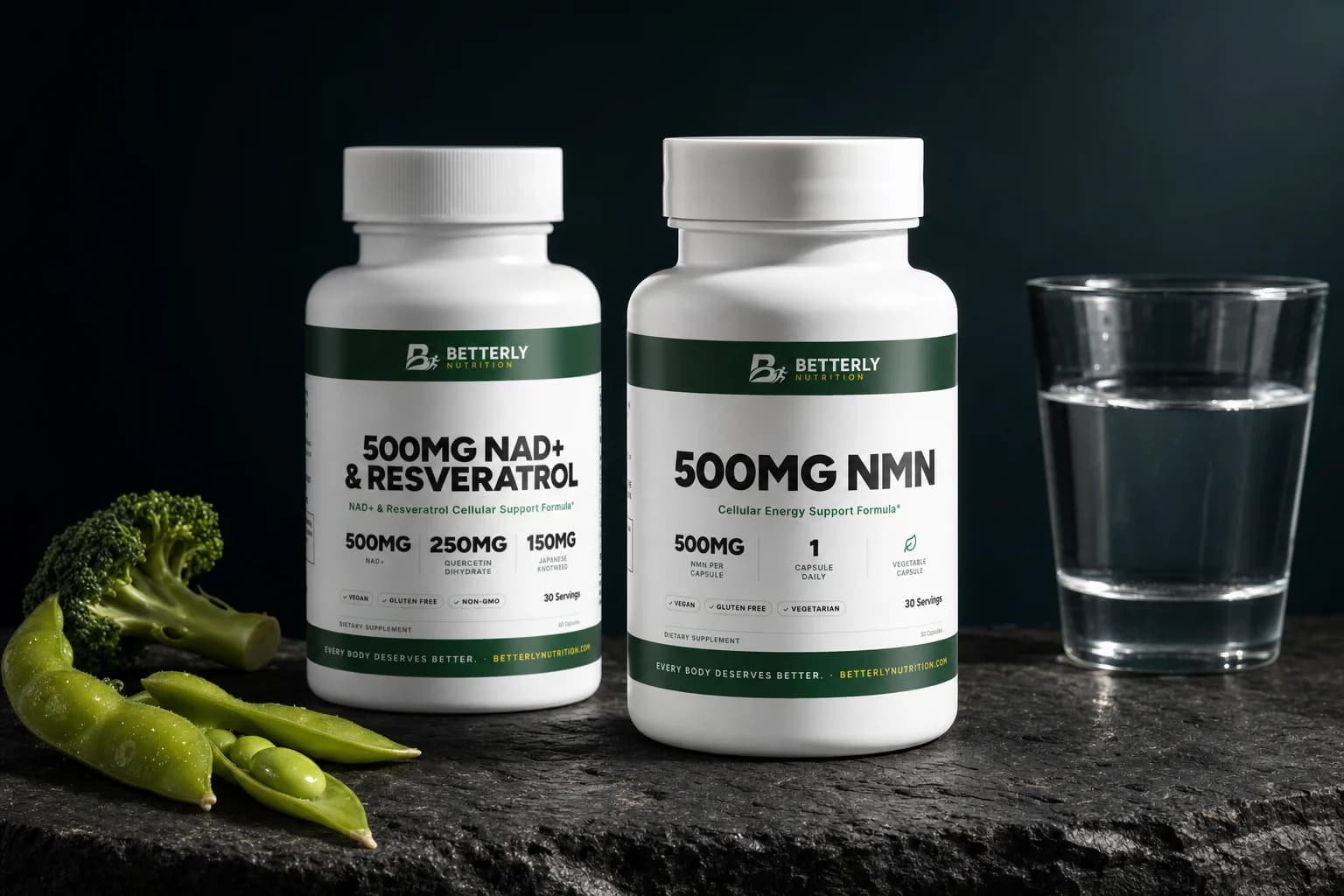
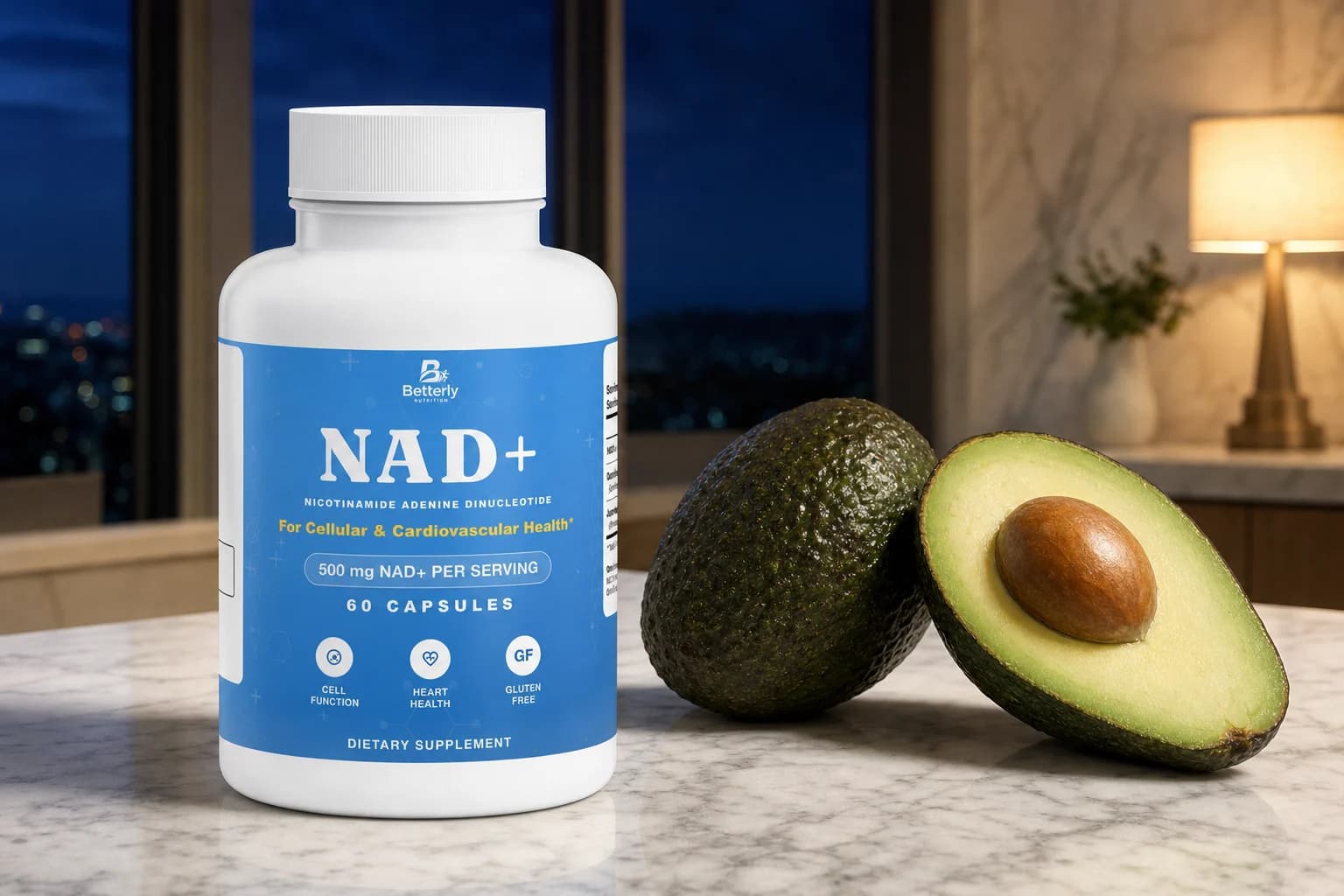
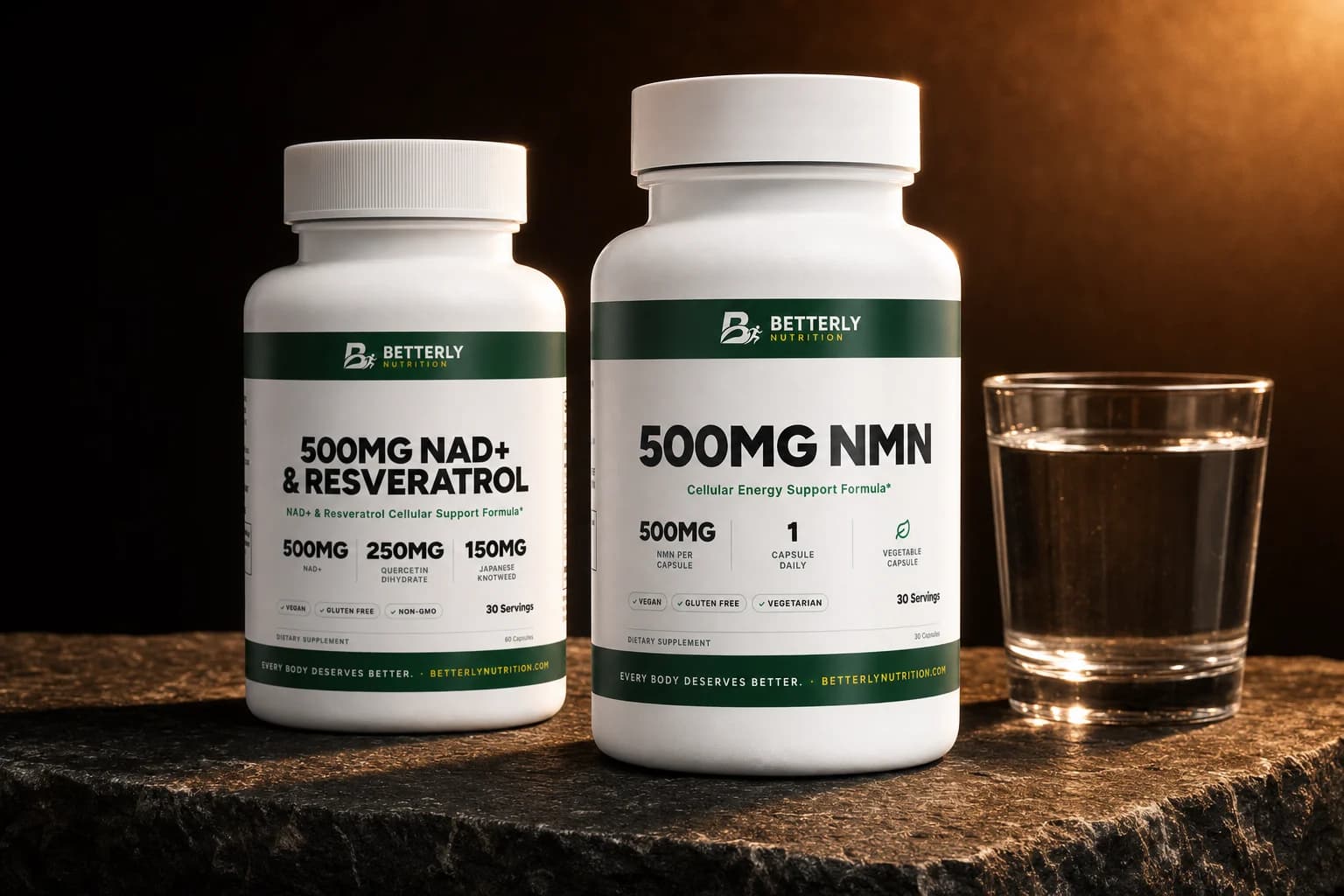
From our shop: 500mg NAD+ & Resveratrol Capsules — a formula whose facts panel lists NAD+ itself, 500 mg per 2-capsule serving, alongside quercetin dihydrate and Japanese knotweed extracts.
How do you compare NMN and NR labels and cost per serving?
To compare NMN and NR labels, check the form named on the facts panel, then work from milligrams per serving to a bottle total and a cost per 100 mg.
- Check the named form. NMN appears as β-nicotinamide mononucleotide. NR may be listed as a salt, nicotinamide riboside chloride, where the chloride adds weight but no NR, so compare salt with salt.
- Get the bottle total by multiplying milligrams per serving by servings per container.
- Work out cost per 100 mg: divide the price by the bottle total, then multiply by 100.
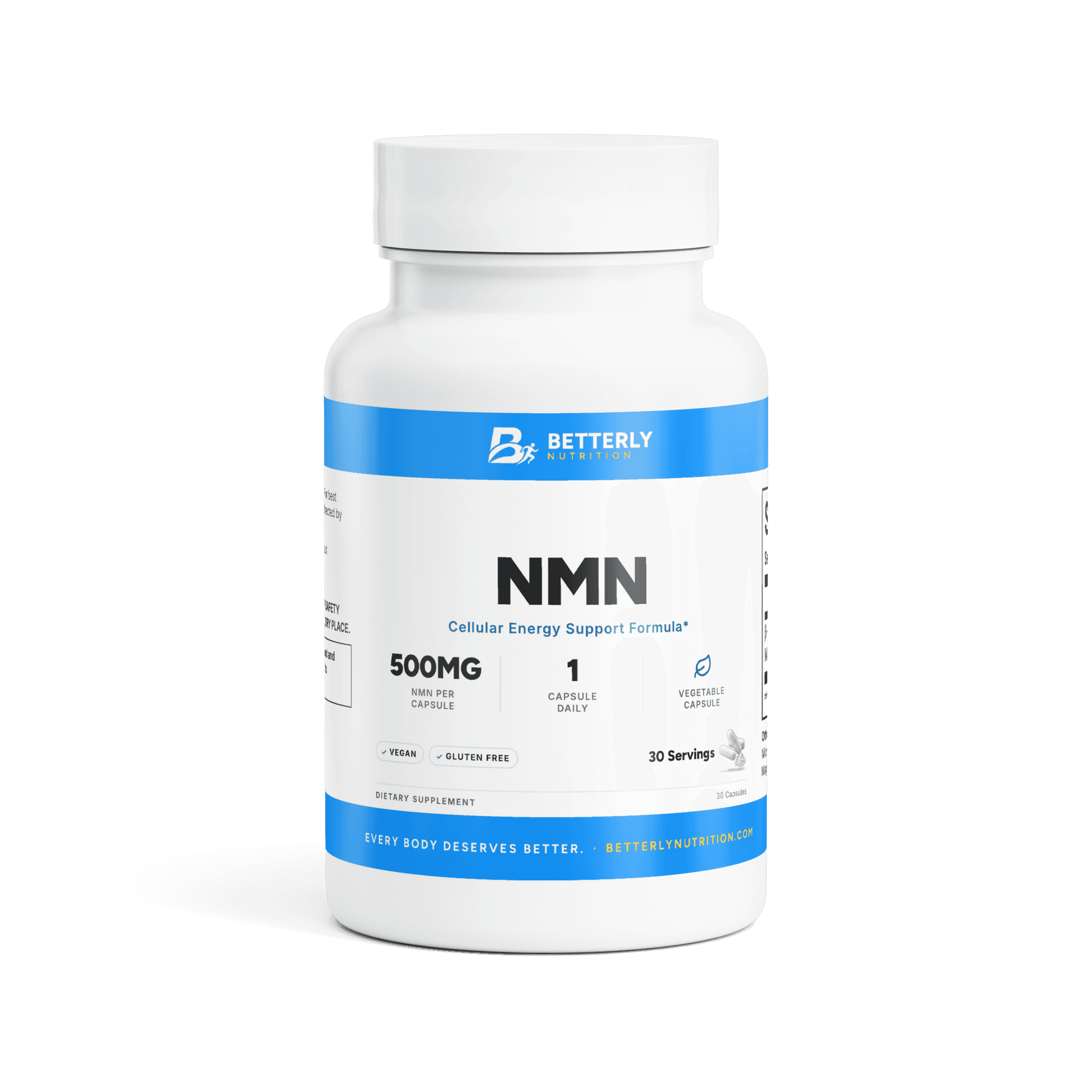
Our 500mg NMN Capsules list 500 mg of β-Nicotinamide Mononucleotide per 1-capsule serving and 30 servings, so a bottle holds 15,000 mg, and its cost per 100 mg is the shelf price divided by 150. A made-up NR label with 300 mg per 2-capsule serving and 30 servings holds 9,000 mg, so you'd divide its price by 90.
One wrinkle: weight isn't molecule count. In the 2026 trial, 1,000 mg of NR came to 3.4 mmol (millimoles, a molecule count), which by our math matches NR in its chloride salt form. The same weight of NMN came to 3 mmol, because its phosphate makes each molecule heavier. By exact molecular weight, NR chloride carries about 15% more molecules per milligram.
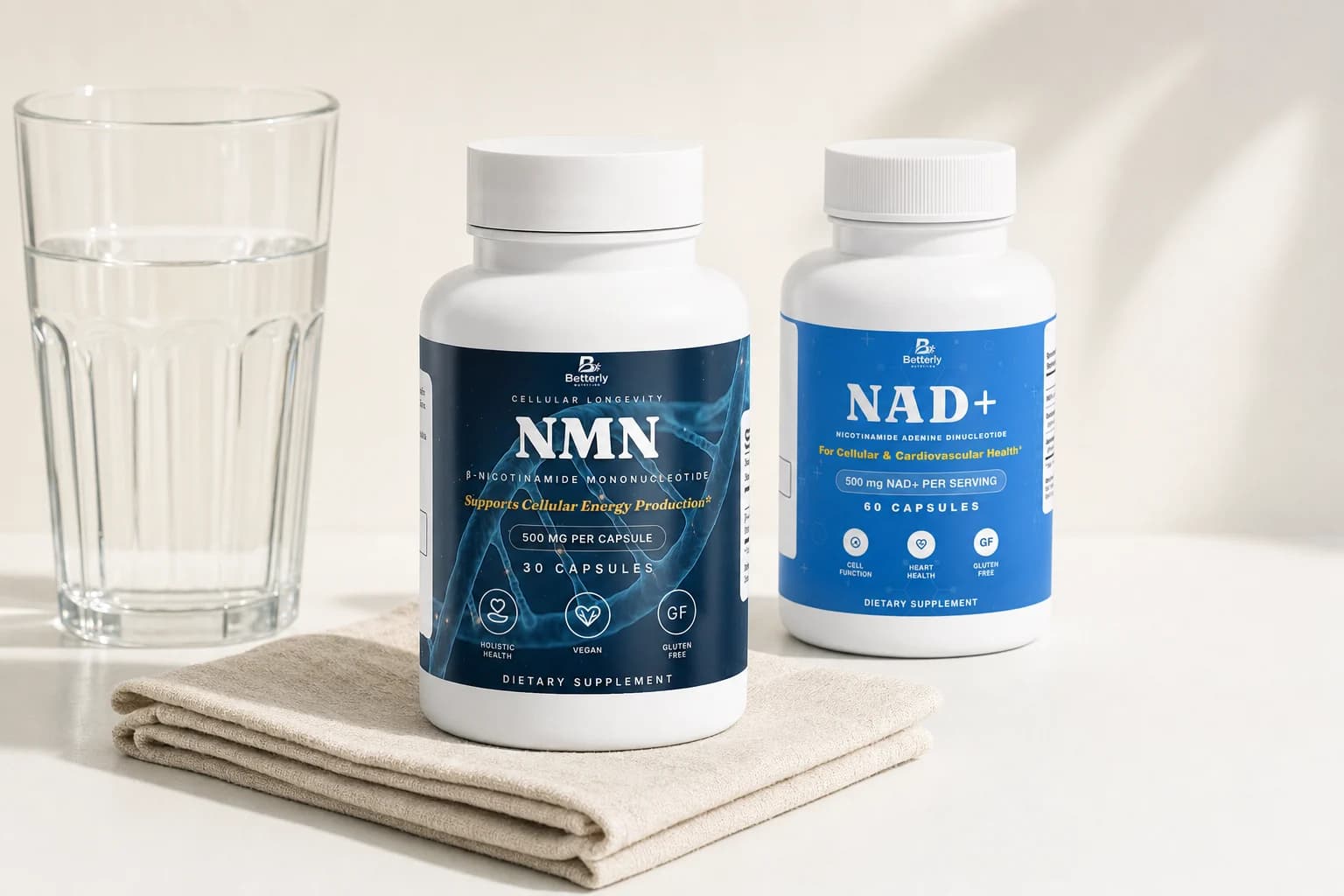
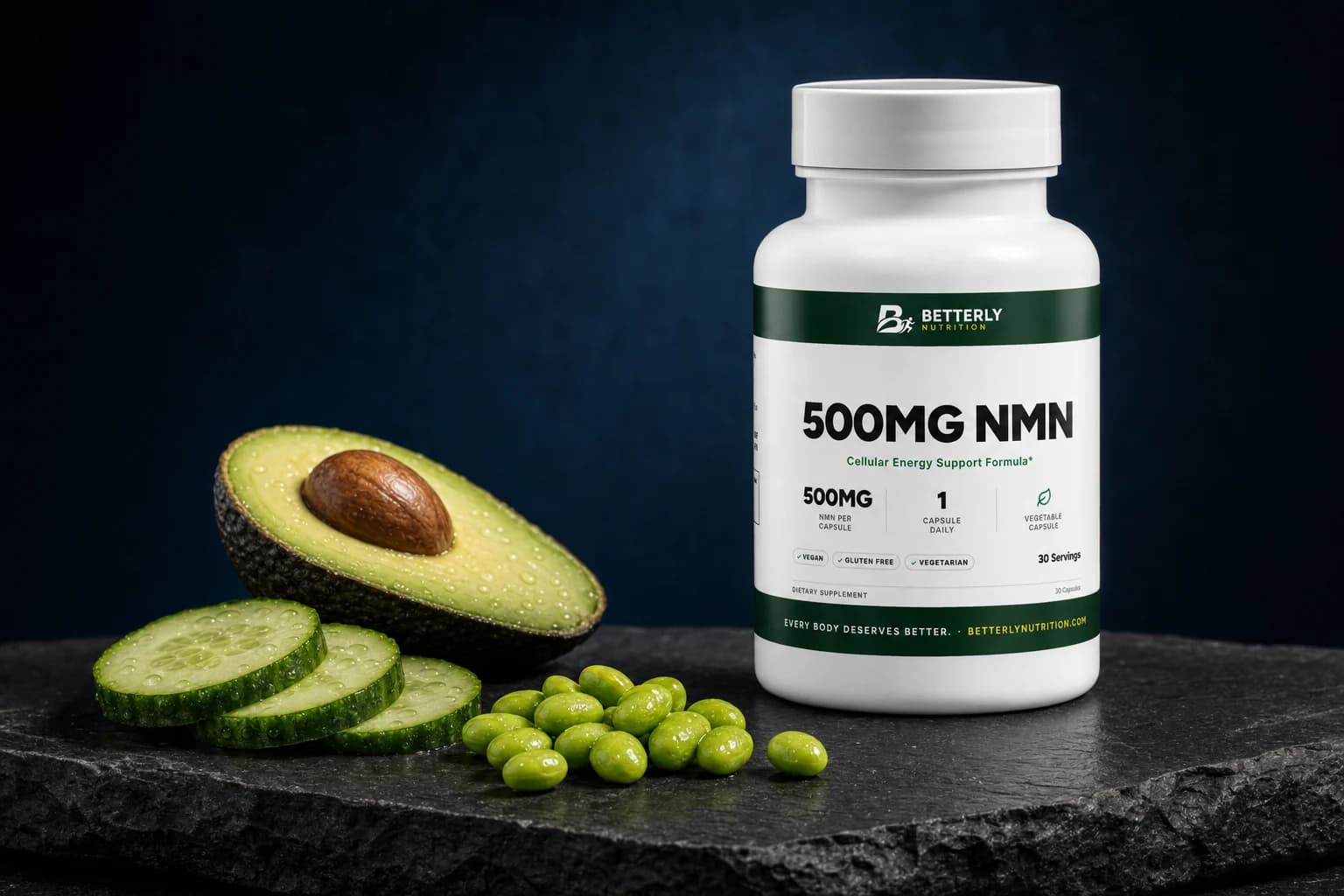
From our shop: 500mg NMN Capsules — the NMN we sell, at 500 mg per 1-capsule serving with 30 servings per bottle, for readers who want one ingredient in one daily capsule.
How do you take NMN by the label rather than the trial dose?
Take NMN by the label: our 500mg NMN Capsules label sets one 500 mg capsule a day, half the 1,000 mg a day the trial's NMN group took.
The directions begin "Adults take one (1) capsule daily," with 6 to 8 ounces of water alongside, unless a healthcare professional tells you otherwise. By our math, that capsule holds about 1.5 mmol of NMN, against the 3 mmol each NMN volunteer swallowed daily.
Researchers picked their doses to compare precursors over 2 weeks, not to set a daily amount for you. Your label does that job, and its caution line rules out going above it.
The label says nothing about adding NR. If you're weighing both, bring both labels to a pharmacist before you combine them.
When is NR the better pick, and when do you need neither?
NR is a reasonable pick if you value its larger published research record, and you may need neither if you want an energy lift you'll feel.
NR makes sense if you'd rather go with the ingredient that has more published human studies, or you already take NR and it suits you. Switching just because we sell NMN isn't a good reason.
NMN makes sense if you've weighed both readings of the pathway and simply prefer it, or you want one ingredient in one daily capsule.
If NMN's legal status is steering you, here's where it stands. In late 2022, FDA told the companies that had filed NMN ingredient notifications that it considered NMN excluded from the supplement definition, because NMN had been authorized for study as a drug before it was lawfully sold as a supplement or food. In its September 2025 response to a citizen petition, FDA reversed course: "we have determined that NMN is not excluded from the dietary supplement definition." How FDA's position on NMN changed gets its own guide.
Neither makes sense if:
- You're after energy you can feel today. The trial measured blood chemistry, not how anyone felt.
- You'd take two precursors to hedge your bets. Pick one and follow its label.
- The monthly cost would squeeze out food, sleep or anything else you already know helps.
You can line up more labels on our NAD+ & Longevity shelf.
Who should check with a healthcare provider first?
Check with a healthcare provider before NMN or NR if you're pregnant, nursing, under 18, managing a medical condition, taking any medication or scheduled for surgery.
The NMN label puts it this way: "Consult a physician if pregnant, nursing, under 18, or have a medical condition." The 2026 trial enrolled only healthy adults, so it says nothing about pregnancy, teens, older adults or anyone managing a health condition.
That trial also excluded people on prescription drugs the researchers flagged as possible interactions with NAD+ precursors, naming certain antibiotics, blood thinners and bile acid sequestrants. If you take a prescription, ask your pharmacist whether an NAD+ precursor fits alongside it, and write NMN or NR on any pre-surgery paperwork. Should something seem wrong once you've started, stop and call your healthcare provider.
FAQ: NMN vs NR
Can you take NMN and NR together?
No human trial we found has tested NMN and NR together, so there's no evidence the pair does more than one alone. They feed the same NAD+ pathway, so doubling up mostly doubles the cost. Our 500mg NMN Capsules label sets one capsule a day and doesn't cover adding NR, so bring both labels to a pharmacist before you combine them.
Is nicotinamide riboside the same as niacinamide?
No, nicotinamide riboside isn't the same as niacinamide, though your body can turn NR into it. Niacinamide is another name for nicotinamide. The Science Advances review explains that cells can split NR into nicotinamide, and that gut breakdown of oral NR produces it too. In the 2026 trial, 500 mg a day of nicotinamide didn't raise blood NAD+ at day 14, while 1,000 mg a day of NR did.
When should you take NMN or NR?
You can take NMN at any time, because our 500mg NMN Capsules label sets no clock time and is silent on meals. All it asks is one capsule daily with water. On the 2026 trial's test days, volunteers took their dose a couple of hours after a standard breakfast drink, but that schedule served the blood draws. For an NR product, go by that bottle's directions.
Is NMN or NR better for energy?
Neither NMN nor NR has been shown to give you energy you can feel. NAD+ takes part in energy metabolism inside your cells, but the 2026 head-to-head trial measured NAD+ in blood, not how people felt. If a noticeable lift is your goal, a precursor probably isn't the right tool.
Are NMN and NR safe to take with medication?
There's no clear answer yet on whether NMN or NR is safe with a given medication. The head-to-head trial can't settle it, because it excluded people taking drugs the researchers flagged as possible interactions. Across all four groups, only three adverse events were judged probably product-related, one of them in the placebo group. If you take a prescription, bring the bottle to a pharmacist before the first dose.
Sources
- The differential impact of three different NAD+ boosters on circulatory NAD and microbial metabolism in humans, Nature Metabolism, 2026 (PubMed Central)
- What is really known about the effects of nicotinamide riboside supplementation in humans, Science Advances, 2023 (PubMed Central)
- The Safety and Antiaging Effects of Nicotinamide Mononucleotide in Human Clinical Trials: an Update, Advances in Nutrition, 2023 (PubMed Central)
- Response to citizen petition FDA-2023-P-0872 on β-nicotinamide mononucleotide (NMN), U.S. Food and Drug Administration, via Regulations.gov
- Niacin: Fact Sheet for Consumers, NIH Office of Dietary Supplements
If this left you looking for somewhere to start, read 500 mg NMN capsules, one a day — its amounts per serving are listed on the page. For the practical questions this raises, how dosing, sourcing and subscriptions work is answered in one place.