On this page
- Key takeaways
- Exogenous ketones vs MCT oil: how do they actually differ?
- Is MCT oil an exogenous ketone?
- BHB vs MCT oil: how fast do blood ketones rise with each?
- Ketone salts vs MCT oil: which is harder on your stomach?
- How much BHB or MCT is in each Betterly label?
- Can you take exogenous ketones and MCT oil together?
- How should you take BHB and MCT products, by the label?
- When is neither BHB nor MCT oil worth buying?
- Who should check with a healthcare provider first?
- FAQ: exogenous ketones vs MCT oil
- Sources
The short answer: Exogenous ketones vs MCT oil is a question of dose as much as type. In one review, 16 to 18 g of C8 MCT oil taken without food lifted blood BHB to about 0.5 to 0.6 mmol/L two hours later. A serving of any of our four BHB and MCT products holds a small fraction of that much MCT.
Key takeaways
- A 2018 review in PeerJ found that MCTs raise blood BHB and prompt the liver to make ketones, while bottled ketones add BHB without that step.
- Among the MCTs, C8 (caprylic acid) makes the most ketones, and eating a carb-containing meal with it can roughly halve the response.
- Ketone salts, BHB bound to minerals such as sodium or calcium, caused more stomach complaints than ketone esters in research a 2018 PeerJ review summarizes.
- Of our four BHB and MCT labels, only the MCT Oil & L-Carnitine Capsules print an MCT amount: 70 mg per 4-capsule serving.
Every product we compare here is ours: a BHB capsule and three others with MCT in the name. So the label section below works out the most MCT each one could hold, printed amount or not.
Exogenous ketones vs MCT oil: how do they actually differ?
Exogenous ketones supply BHB itself, while MCT oil supplies a fat that your liver must convert into ketones first.
Your liver makes ketones on its own, mainly when carbs are scarce. The bottled kind gets the label "exogenous" because it's made outside your body, then sold as a drink, a powder or a capsule, such as our BHB Ketone Capsules.
| Question | Exogenous ketones (BHB) | MCT oil |
|---|---|---|
| What you swallow | A ketone body, often bound to a mineral | A fat made of medium-chain fatty acids |
| Who makes the ketone | The manufacturer | Your liver |
| Your liver's own ketone making | May be dampened | Gets a push |
| Common complaint | Stomach upset, plus minerals | Stomach upset and loose stools |
| What changes the result | Salt or ester form, and food | MCT type, dose and your meal |
The verdict in one line: pick by form, dose and how your stomach copes, since neither one stands in for the way you eat.
Is MCT oil an exogenous ketone?
No, MCT oil isn't an exogenous ketone. MCT stands for medium-chain triglycerides, fats your liver can turn into ketones, so MCT oil is a ketone precursor rather than a ketone.
A 2018 narrative review in PeerJ by Harvey and colleagues lays out the chemistry. In an MCT, two or three of the fatty acid chains are 6 to 12 carbons long: caproic (C6), caprylic (C8), capric (C10) and lauric (C12) acids.
Their route through your body differs, too. Longer fats need bile and a trip through your lymph system, while MCTs diffuse into the portal vein, the blood vessel linking gut and liver. The liver then preferentially turns them into ketone bodies.
A 2021 review in Frontiers in Nutrition by Lin and colleagues explains C8's reputation. Fatty acids with 8 or fewer carbons can enter mitochondria, the cell's energy factories, without the carnitine-dependent shuttle that longer fats need. The review rates C8 about three times as ketogenic as C10 and six times as ketogenic as C12.
BHB vs MCT oil: how fast do blood ketones rise with each?
No human study we cite times BHB against MCT oil directly. In separate studies, a ketone ester drink peaked in about an hour, and C8 lifted BHB at 2 hours.
For bottled BHB, Stubbs and colleagues, writing in Frontiers in Physiology in 2017, gave healthy adults ketone drinks, the smaller ones holding about 12 g of BHB. Salt drinks peaked lower than ester drinks and took about twice as long to get there. In a second test, a fasted ester drink peaked at about 66 minutes, and eating a meal first cut that peak from 3.3 to 2.2 mmol/L, about a third.
For MCT oil, the Lin review reports that 16 to 18 g of C8, taken without a meal, raised blood BHB from under 0.1 mmol/L to about 0.5 to 0.6 mmol/L at 2 hours. Food matters here as well. In one cited study, the ketone response was about twice as high without a meal. In another, adding 50 g of glucose to 20 g of C8 cut it by 63%.
For scale, the PeerJ review notes that a blood BHB of 0.5 mmol/L or more is the common nutrition-research marker for ketosis. A large, fasted dose of pure C8 only just reaches it.
The BHB evidence gets a fuller look in do exogenous ketones work?
Ketone salts vs MCT oil: which is harder on your stomach?
Neither ketone salts nor MCT oil is clearly gentler: no study we cite compares them for stomach effects, and both come with reported stomach complaints. Salts also add a mineral load.
The PeerJ review describes salt supplements as some mix of sodium, magnesium, calcium or potassium BHB. In the research it summarizes, people reported significantly more stomach symptoms with salts than with esters, and the authors flag the mineral load as a possible longer-term concern.
With MCT oil, dose is the lever. The Lin review names stomach discomfort and diarrhea as common side effects, and in one study it cites, 3 of 7 people had both after about 23 g (25 mL) of MCTs. The review suggests capping C8 at 15 to 20 g per intake and cites advice to start with 5 g.
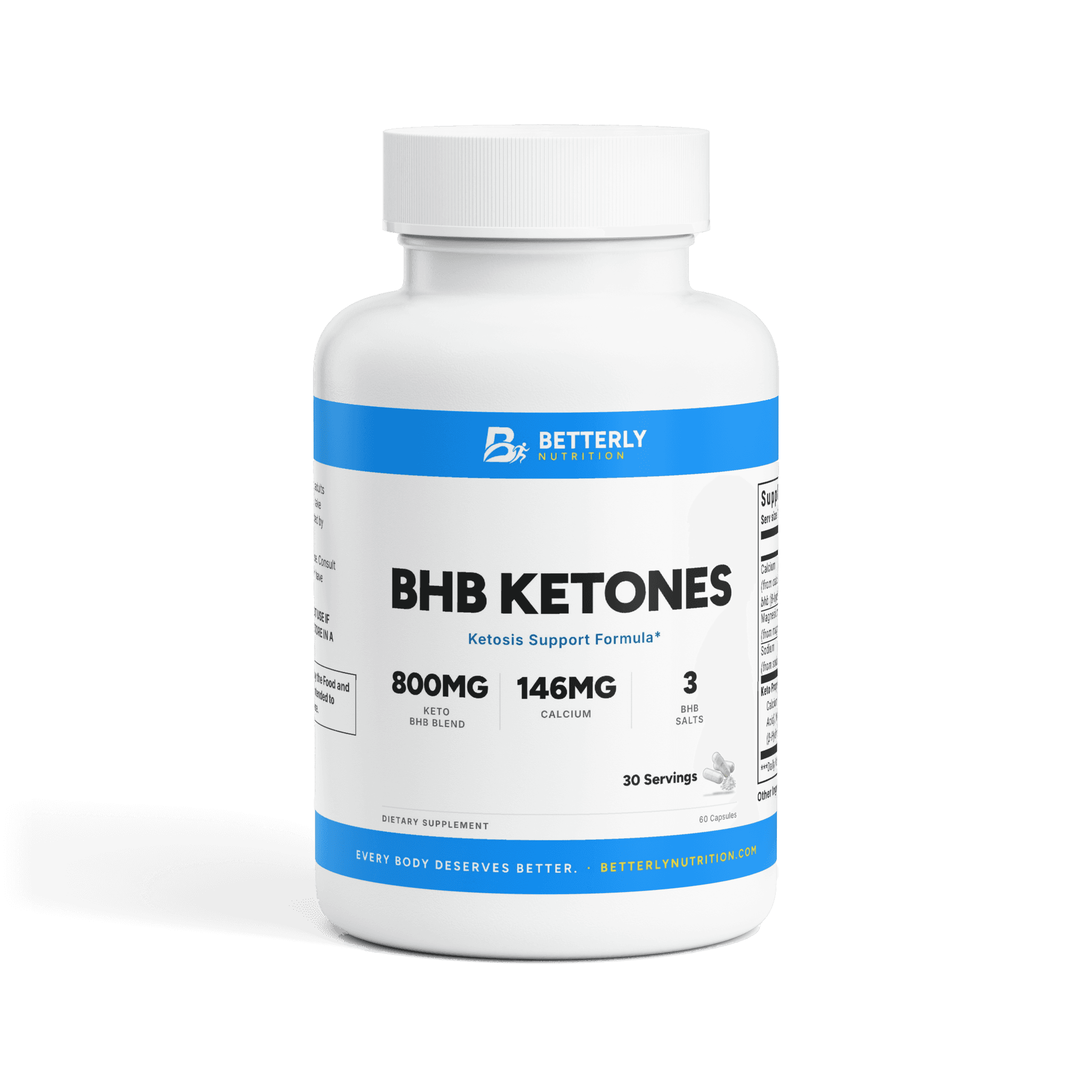
Our label amounts sit far below those study doses. The BHB capsule's sodium and magnesium rows read just 1 mg apiece per 2-capsule serving, next to 146 mg of calcium (11% DV). Every MCT figure on our labels lands well under 5 g.
How much BHB or MCT is in each Betterly label?
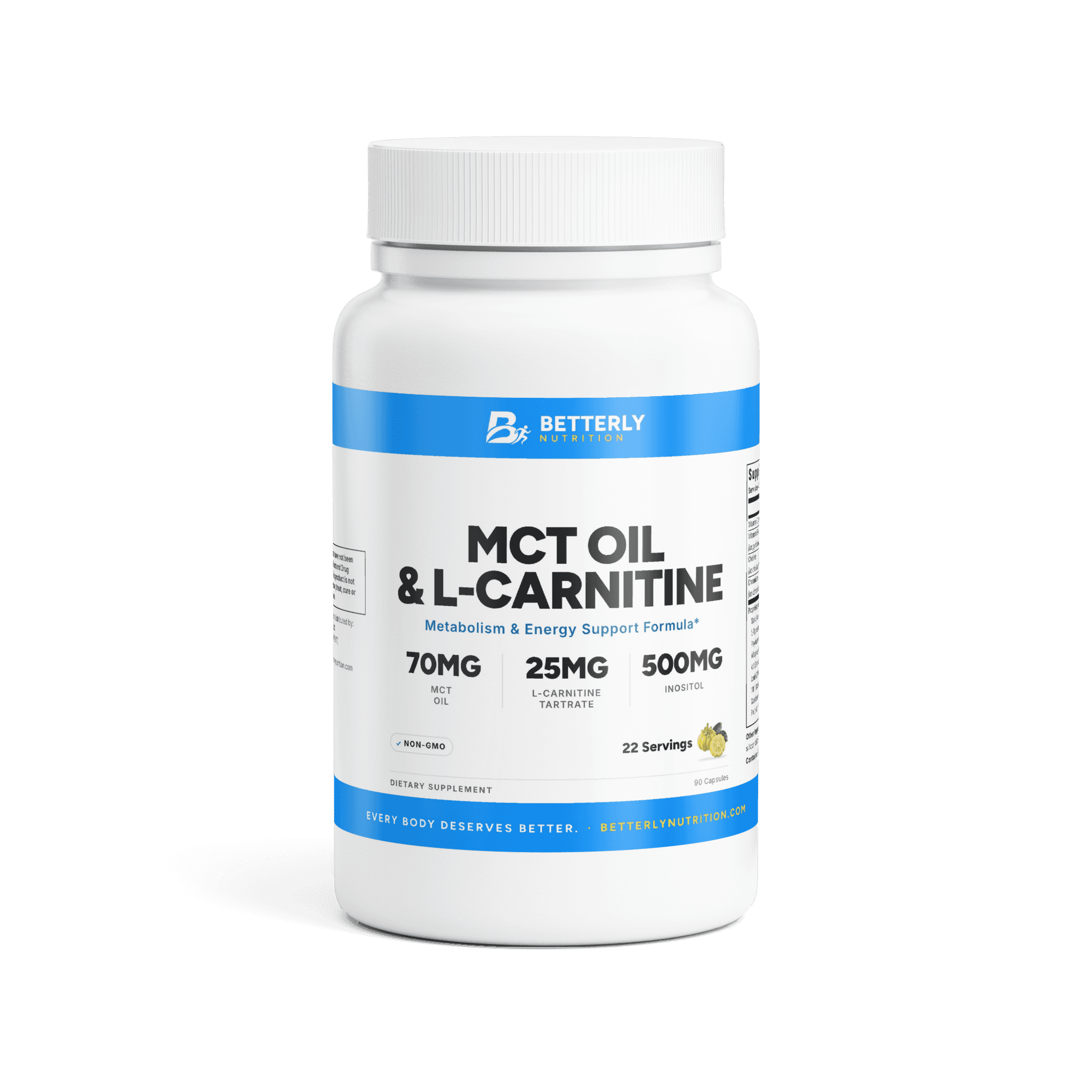
Only our MCT Oil & L-Carnitine label prints an MCT amount, 70 mg per 4-capsule serving. The other three show a blend total or a total-fat row, which caps what an ingredient could be.
| Product and serving | What the panel shows | BHB or MCT amount |
|---|---|---|
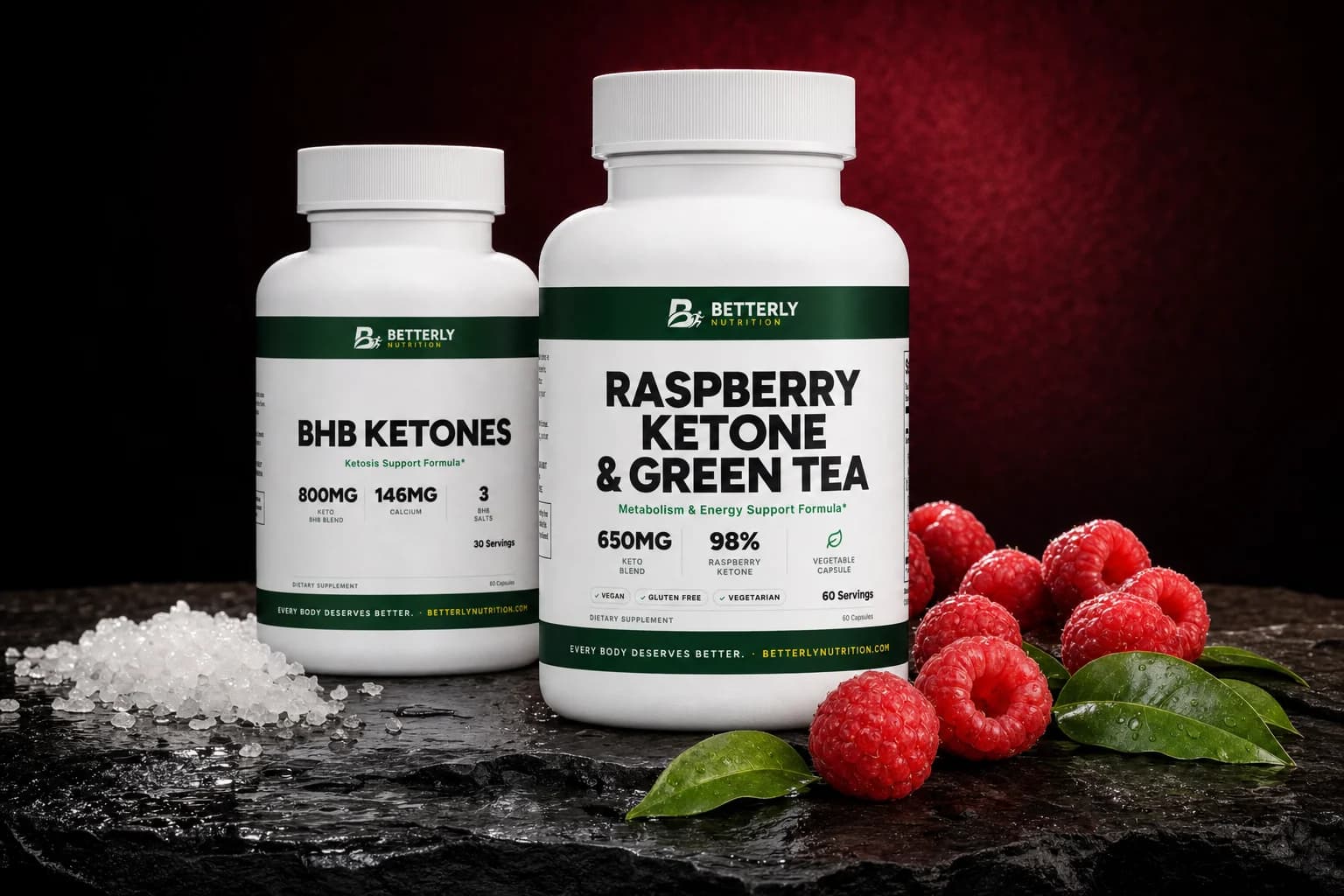
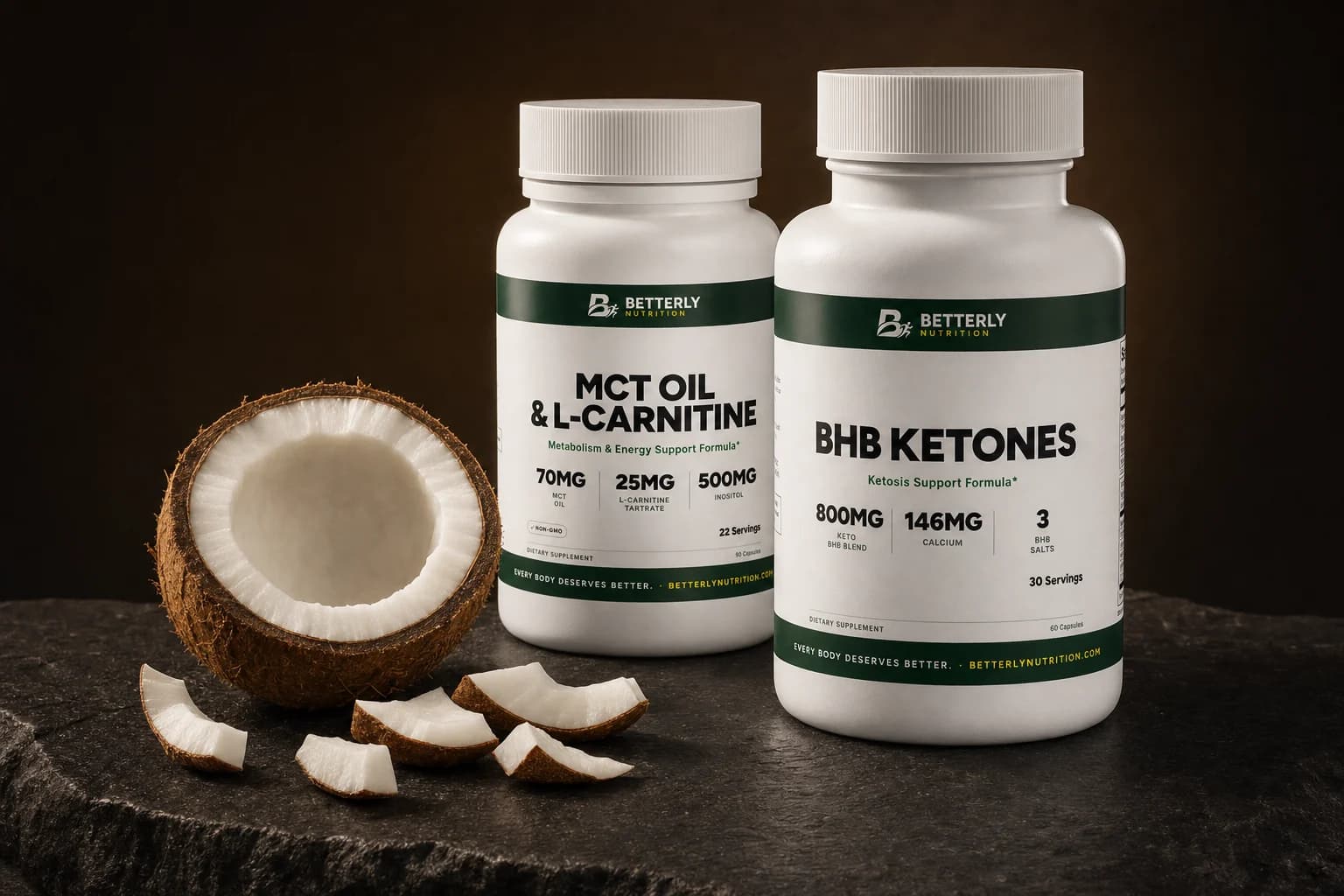
| BHB Ketone Capsules, 2 capsules | An 800 mg Keto Proprietary Blend holding calcium citrate, MCT powder and BHB salts | Neither printed; both share the 800 mg |
| MCT Oil & L-Carnitine Capsules, 4 capsules | Its own Medium Chain Triglycerides Oil row | 70 mg of MCT oil |
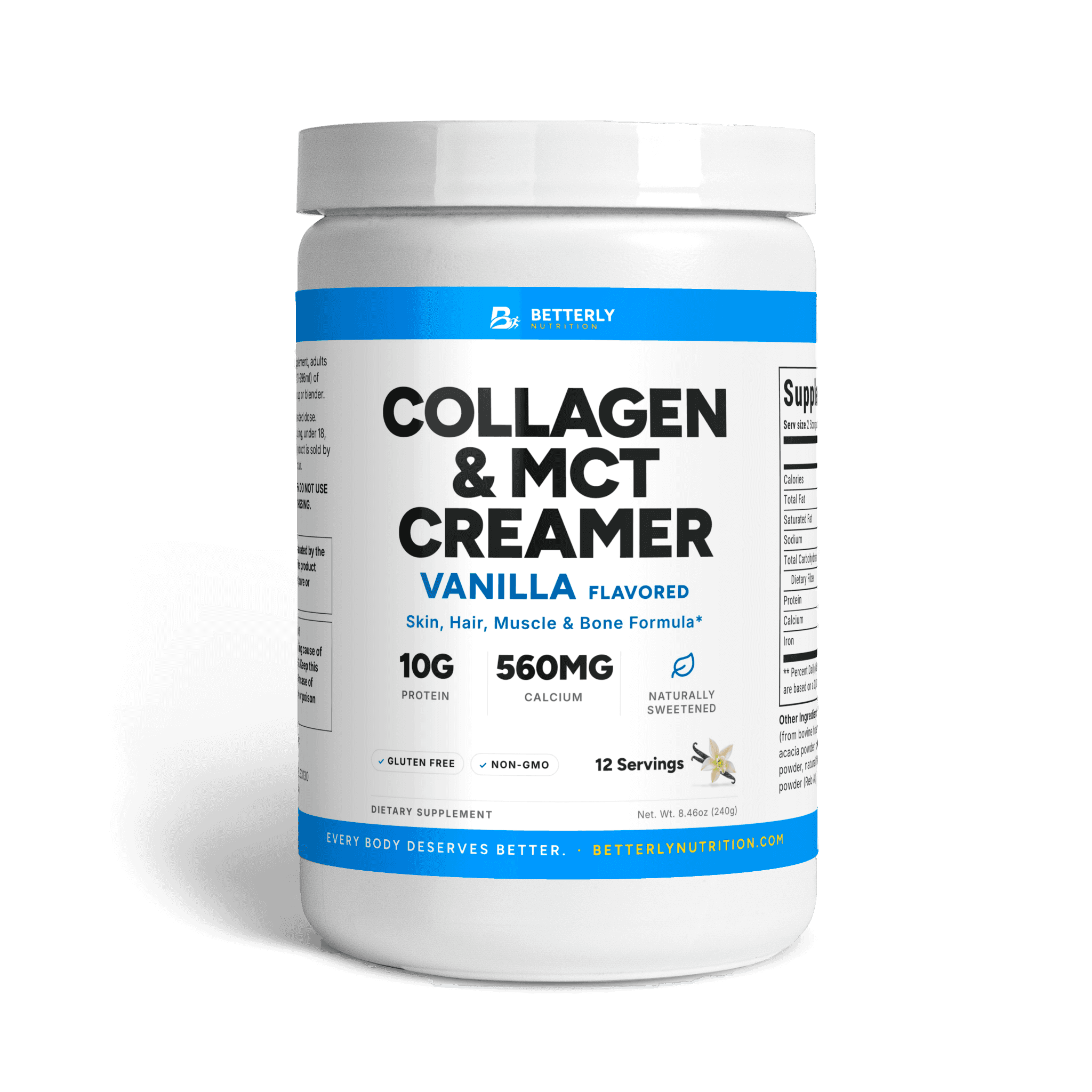
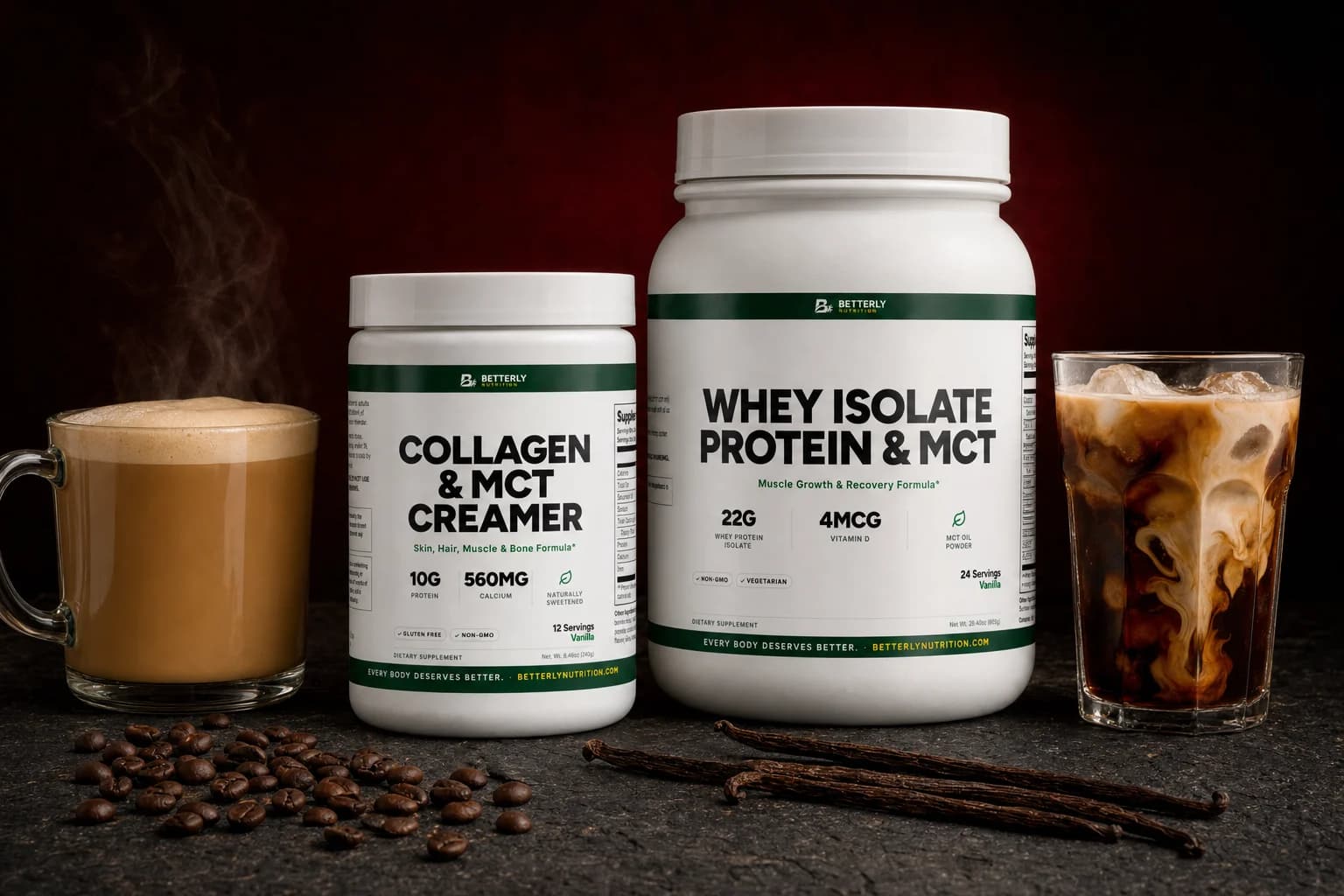
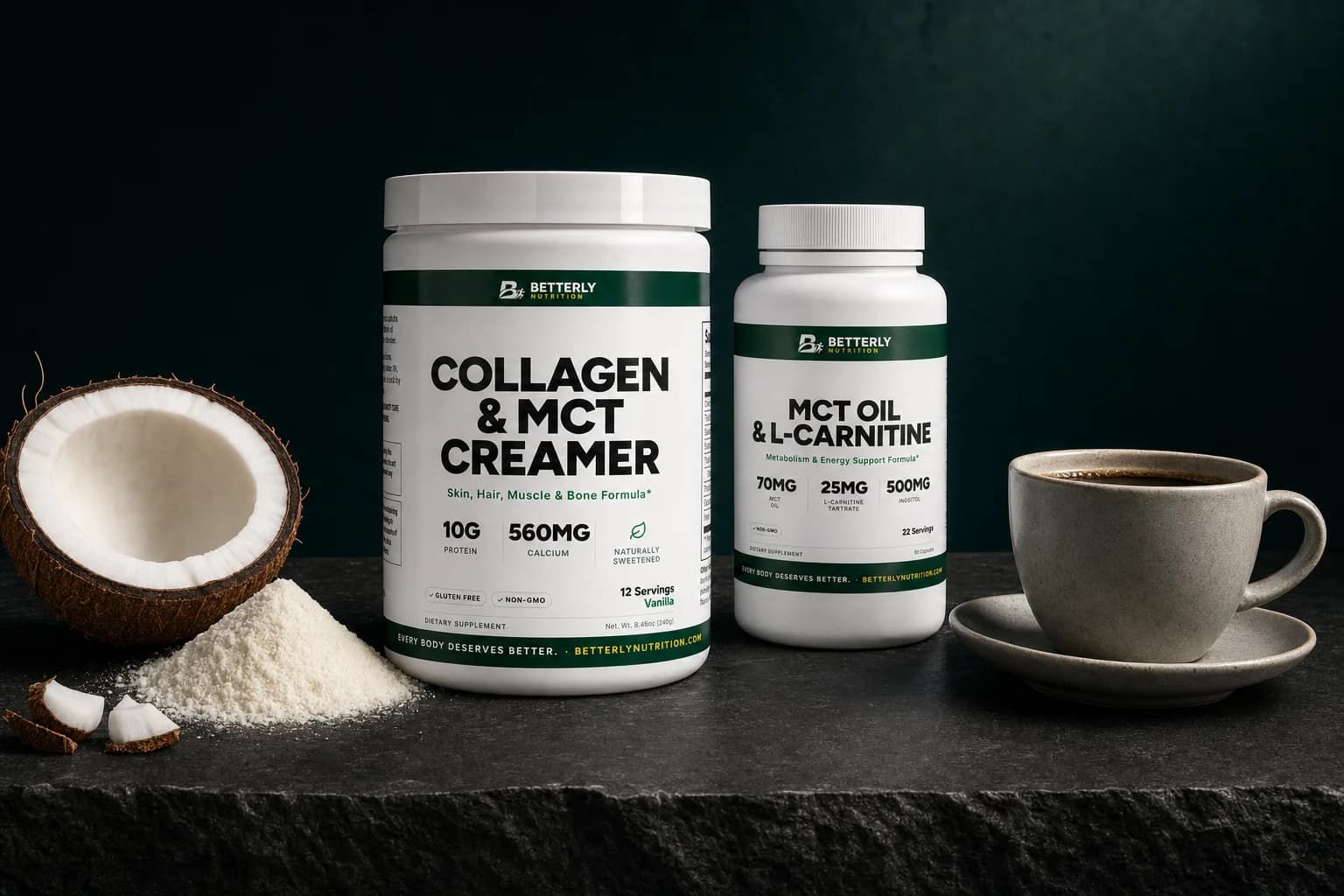
| Collagen Peptides & MCT Creamer (Vanilla), 2 Scoops (20 g) | MCTs in the ingredient list; 2 g total fat | Not printed; about 2 g at most |
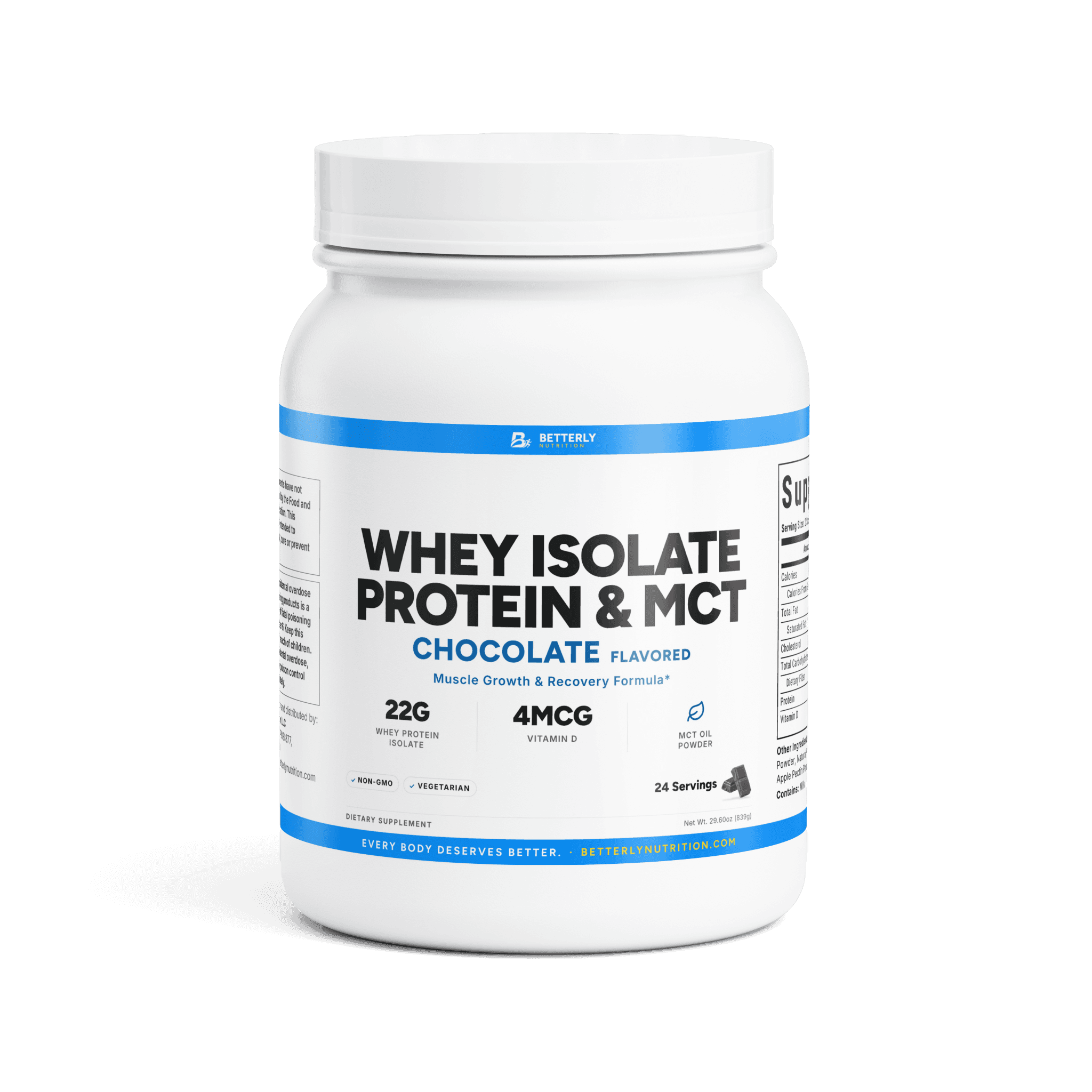
| Whey Protein Isolate & MCT Powder (Vanilla), 2 Scoops (34g) | MCT oil powder in the ingredient list; 1 g total fat | Not printed; about 1 g at most |
Even the largest ceiling here is an eighth of that 16 g research dose of C8, so judge each product on the rest of its panel.
Our BHB capsule is a hybrid. Its blend opens with calcium citrate, followed by MCT powder and the three BHB salts (calcium, magnesium, sodium), so each serving holds less than 800 mg of either BHB or MCT. What that ingredient order tells you is covered in our side-by-side of raspberry ketones and BHB. The smaller drink in the 2017 study held about 12 g of BHB, roughly 15 times the capsule's entire blend.
The MCT Oil & L-Carnitine Capsules list 70 mg of MCT oil per 4-capsule serving, or 0.07 g; that research dose is over 200 times larger. MCT is a minor row here: the 631 mg proprietary blend, 500 mg of inositol and 200 mg each of choline and garcinia cambogia fruit extract all outweigh it.
Medium chain triglycerides come second on the ingredient list of our Collagen Peptides & MCT Creamer (Vanilla), right behind hydrolyzed collagen peptides from bovine hide. MCTs are fat, so they can't be more than the roughly 2 g on the total fat row.
The Whey Protein Isolate & MCT Powder (Vanilla) lists MCT oil powder third, and each 2 Scoops (34g) serving shows 1 g of total fat next to 22 g of protein. Panel fat values are rounded, hence "about." The protein is the real draw.
From our shop: BHB Ketone Capsules — the hybrid pick, with BHB salts and MCT powder sharing one gelatin capsule, 60 capsules to a bottle, taken two at a time.
Can you take exogenous ketones and MCT oil together?
Yes, you can take exogenous ketones and MCT oil together, and our BHB capsule already puts both in one blend. Human evidence that the pair beats either alone is thin.
In the PeerJ review's rat study, MCT alone and MCT with ketone salts kept blood BHB raised, while salts alone didn't. In people, salts do raise BHB, so that result may not carry over.
If you combine products:
- Keep each one at or under its own suggested use. None of our labels gives directions for stacking.
- Add up the MCT and the minerals across everything you take.
- Add one new product at a time. If your stomach complains, you'll know the culprit.
How should you take BHB and MCT products, by the label?
Each of our four BHB and MCT labels sets its own amount, two also say when to take it, and all four say not to exceed the recommended dose:
- BHB Ketone Capsules: two capsules a day, washed down with 6 to 8 oz of water (177 to 237 ml). No time of day is named.
- MCT Oil & L-Carnitine Capsules: four capsules a day with meals, split into two before breakfast with water and two before dinner.
- Collagen Peptides & MCT Creamer (Vanilla): 2 scoops mixed with 8 to 10 oz (237 to 296 ml) of your favorite beverage in a shaker cup or blender.
- Whey Protein Isolate & MCT Powder (Vanilla): 2 scoops a day in 6 to 8 oz of water or another drink (177 to 237 ml). For best results, the label points to 20 to 30 minutes before a meal.
Using more than one? The calcium adds up: 146 mg per 2-capsule serving of the BHB capsule, 560 mg (43% DV) per 2 Scoops (20 g) serving of the creamer and 105 mg (8% DV) per 2 Scoops (34g) serving of the whey. That's 811 mg a day before food or any other supplement.
Stirring the creamer or whey into hot coffee? Protein powder in coffee walks through how to skip the clumps.
From our shop: Collagen Peptides & MCT Creamer (Vanilla) — a vanilla creamer whose ingredient list puts medium chain triglycerides second, with 2 g of total fat per 2 Scoops (20 g) serving, labeled gluten free.
When is neither BHB nor MCT oil worth buying?
Neither exogenous ketones nor MCT oil is worth buying if you aren't chasing higher blood ketones, or if you'd rather get there through food.
You can probably skip them if:
- You expect a capsule to create ketosis on a normal diet. The PeerJ authors write that bottled ketones mimic nutritional ketosis rather than bring it on, and may even slow your liver's own ketone making.
- You want a known MCT dose. Three of our four labels don't print one.
- You're eyeing the MCT capsule for its MCT. At 70 mg, you'd be paying for the other rows.
- MCTs or ketone salts have upset your stomach before.
Want to compare? Each product in our Weight Support collection lists its amounts per serving.
Who should check with a healthcare provider first?
Talk to a healthcare provider before starting BHB or MCT products if you're pregnant or nursing, under 18, living with a medical condition, on prescription medication or scheduled for surgery.
All four labels say: "Consult a physician if pregnant, nursing, under 18, or have a medical condition." We add medication and surgery. From the panels themselves:
- Allergens: the Contains line on the MCT Oil & L-Carnitine Capsules reads "fish and shellfish," and the whey powder's reads milk.
- Vitamin B6: the MCT capsule has 25 mg (1471% DV) per 4-capsule serving. Our guide to how much vitamin B6 is too much shows how to total it.
- Iron: the creamer has 3 mg (17% DV) per 2 Scoops (20 g) serving and an iron warning for homes with children under 6.
- Capsule shells: both capsule products use gelatin.
- Medication: show the MCT capsule's long panel to your pharmacist.
FAQ: exogenous ketones vs MCT oil
Will MCT oil kick you out of ketosis?
No, MCT oil won't push you out of ketosis by itself. It's a fat, and in the studies Lin and colleagues reviewed, it raised blood BHB. What blunts its ketone effect is carbohydrate eaten alongside it, so check mixed products. Our Whey Protein Isolate & MCT Powder (Vanilla) lists 5 g of total carbohydrates per 2 Scoops (34g) serving, and the creamer lists 3 g, including 1 g of fiber, per 2 Scoops (20 g) serving.
Is MCT oil the same as coconut oil?
No. Coconut oil contains some MCTs, but the Lin review puts it at under 10% C8 and 5 to 6% C10, with 41 to 42% lauric acid (C12), the least ketogenic of the three. In a study that review cites, 30 g of coconut oil alone didn't significantly raise blood BHB compared with sunflower oil.
Is C8 MCT oil better than regular MCT oil?
For raising ketones, C8 MCT oil comes out ahead. The Lin review calls caprylic acid the major ketogenic part of MCTs and rates it about three times as ketogenic as C10. None of our labels says which MCTs it uses, so we can't tell you how much of ours is C8.
Do BHB capsules add to your daily calcium?
Yes, our BHB Ketone Capsules do: they list 146 mg of calcium (11% DV) per 2-capsule serving, from calcium citrate and calcium BHB. According to the NIH Office of Dietary Supplements, the daily upper limit for calcium from food, drinks and supplements combined is 2,500 mg for adults 19 to 50 and 2,000 mg from age 51. ODS also notes that calcium supplements can interact with some medicines, so mention yours to your pharmacist.
When is the best time to take BHB or MCT oil?
Start with the label. Our BHB Ketone Capsules name no time of day, while the MCT Oil & L-Carnitine Capsules call for 2 capsules before breakfast and 2 before dinner. The Lin review reports a stronger ketone response when C8 is taken without a meal, but that doesn't override your bottle's directions.
Sources
- Harvey et al., PeerJ (2018): The use of nutritional supplements to induce ketosis and reduce symptoms associated with keto-induction: a narrative review
- Lin et al., Frontiers in Nutrition (2021): The Ketogenic Effect of Medium-Chain Triacylglycerides
- Stubbs et al., Frontiers in Physiology (2017): On the Metabolism of Exogenous Ketones in Humans
- NIH Office of Dietary Supplements: Calcium: Fact Sheet for Consumers
If this left you looking for somewhere to start, read BHB ketone salt capsules with MCT powder — its amounts per serving are listed on the page. For the practical questions this raises, how dosing, sourcing and subscriptions work is answered in one place.