On this page
- Key takeaways
- Black cohosh vs blue cohosh: what's the difference?
- Why do two different plants share the name cohosh?
- How can you tell the black cohosh and blue cohosh plants apart?
- Why does mixing up black cohosh and blue cohosh matter?
- How do you check which cohosh is on a Supplement Facts panel?
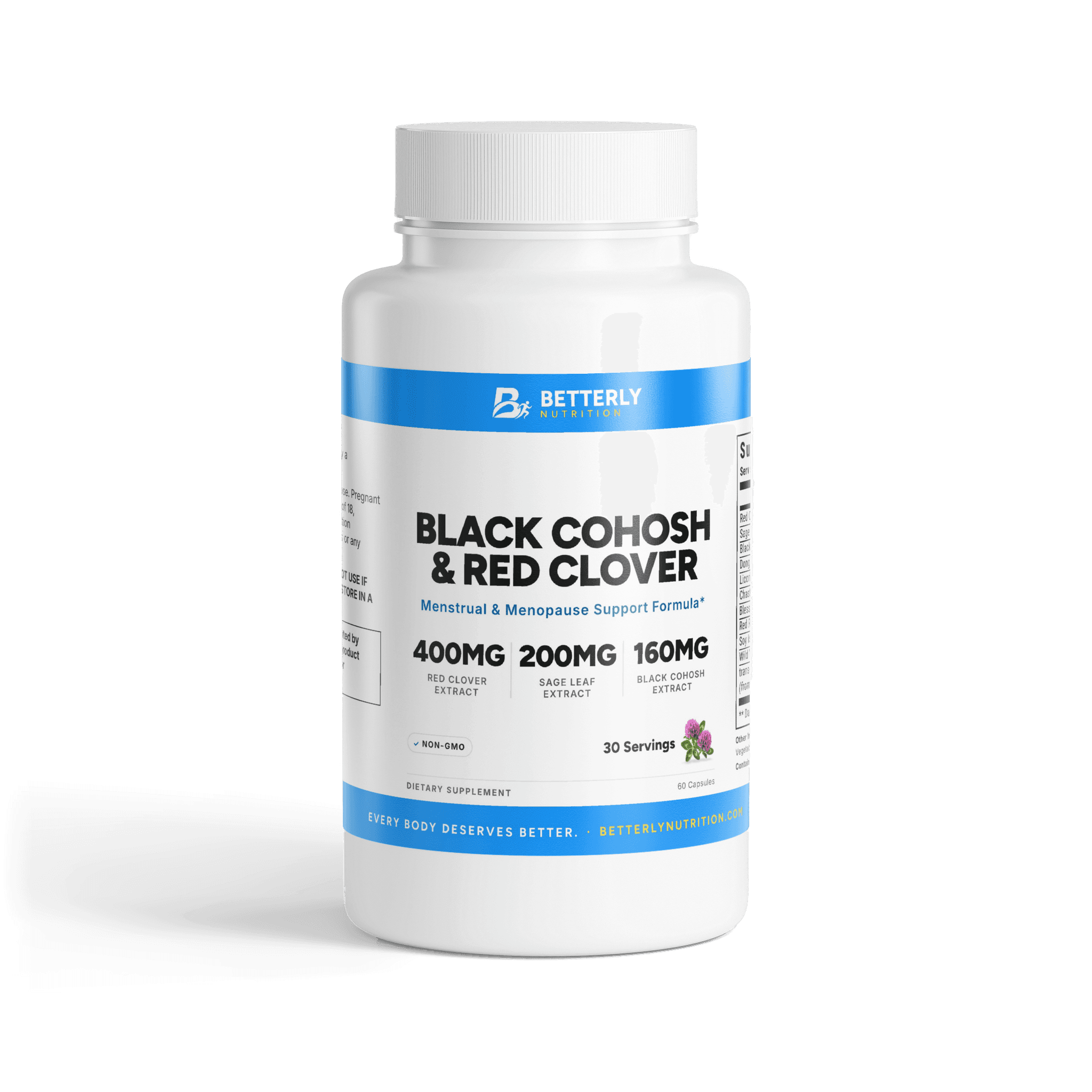
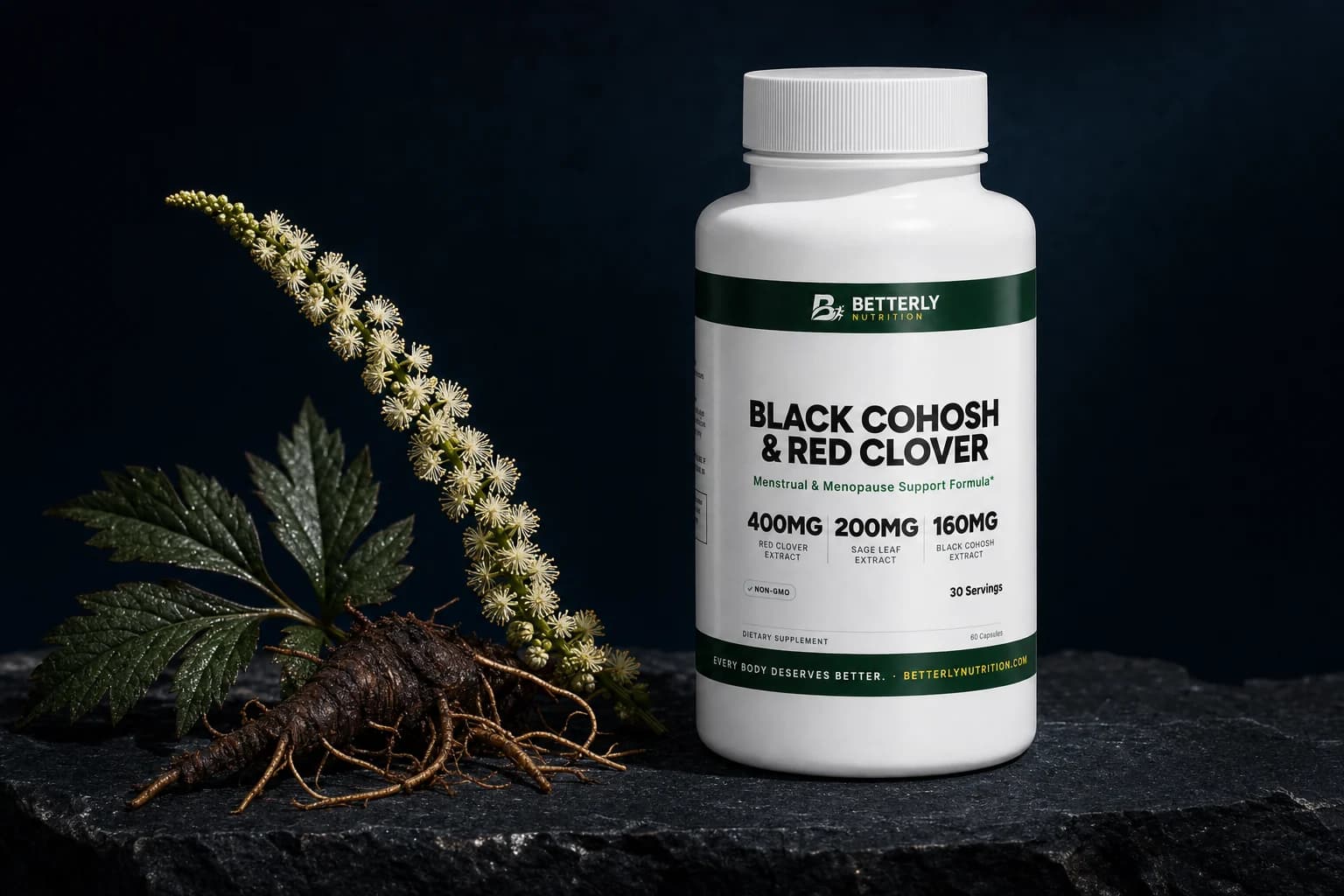
- Which cohosh is in Betterly's Black Cohosh & Red Clover Capsules?
- What does our label say about taking its black cohosh?
- When don't you need either cohosh?
- Who should check with a healthcare provider first?
- FAQ: black cohosh vs blue cohosh
- Sources
The short answer: Black cohosh vs blue cohosh compares two separate plants that happen to share a name, not two grades of one herb. Black cohosh (Actaea racemosa) is in the buttercup family, and blue cohosh (Caulophyllum thalictroides) is in the barberry family. NCCIH, part of the NIH, calls them different herbs. Our Black Cohosh & Red Clover Capsules contain 160 mg of black cohosh root extract per 2-capsule serving and list no blue cohosh.
Key takeaways
- Black cohosh and blue cohosh come from two different plant families, so the shared word "cohosh" says nothing about how alike they are.
- A label's species name shows which plant it means: Actaea racemosa (or its alternate name, Cimicifuga racemosa) is black cohosh, and Caulophyllum thalictroides is blue cohosh.
- A printed Latin name is still the seller's statement, and NCCIH reports that some black cohosh products have held the wrong herb.
- NCCIH lists possible adverse effects for blue cohosh, chest pain among them, apart from its notes on black cohosh.
- No Betterly label lists blue cohosh. Our one cohosh row reads "Black Cohosh Root Extract," 160 mg per 2-capsule serving, with no Latin name printed.
We sell one black cohosh product and no blue cohosh, so we aren't neutral about which name ends up in your cart. Every figure we give for our capsule comes from its printed Supplement Facts panel, including the spot where that panel is vaguer than we'd like.
Black cohosh vs blue cohosh: what's the difference?
The difference between black cohosh and blue cohosh starts with the plants themselves: they're separate species from separate families that share only part of a common name.
NCCIH's black cohosh page describes black cohosh as a member of the buttercup family that grows in North America. The USDA PLANTS profile for Caulophyllum thalictroides files blue cohosh under Berberidaceae, the barberry family, and lists it as a perennial herb native to the lower 48 states and Canada.
| Trait | Black cohosh | Blue cohosh |
|---|---|---|
| Latin name | Actaea racemosa | Caulophyllum thalictroides |
| Plant family | Buttercup | Barberry |
| Height | 3 to 8 feet | About 2.5 feet when mature |
| Federal safety note | Rare liver reports; cause uncertain | Adverse effects, chest pain among them |
| On a Betterly label | Yes, 160 mg root extract per 2 capsules | No |
Keep the family row in mind above the rest. Plants from two different families don't share a safety record, so what you learn about one cohosh doesn't carry over to the other.
Why do two different plants share the name cohosh?
The word "cohosh" is a folk label, not a single botanical group, and today it sits on plants in two different families.
A USDA Forest Service bibliography on black cohosh traces "cohosh" to an Algonquian word meaning "rough." The authors say it describes black cohosh's dark, hard, knotted rhizomes, the underground stems that get dug up and dried. None of our federal sources explains how blue cohosh picked up the same word.
Official naming shows how tangled it got. USDA PLANTS gives "cohosh" as the common name for the whole Caulophyllum genus, the group blue cohosh belongs to. Black cohosh's own genus, Actaea, holds relatives the Forest Service calls baneberries, plus a "yellow cohosh," Actaea podocarpa. So "cohosh" shows up in two families, and the word cohosh alone doesn't tell you which.
Color words can mislead the other way, too. On our Organic Maca Root Capsules, the black, red and yellow maca rows all print one species, Lepidium meyenii, and our guide to maca's three root colors explains why. Cohosh breaks that pattern. "Black" and "blue" name two species, so the color is never a variety of one plant.
How can you tell the black cohosh and blue cohosh plants apart?
Black cohosh is the taller plant: the Forest Service puts it at 3 to 8 feet, with arching spikes of greenish-white flower tufts from July through September.
The Forest Service bibliography adds details you'd notice on a woodland walk. The leaves have sharply toothed edges and divide into many leaflets. The flowers have no petals, just showy tufts of stamens, on spikes called racemes that run from half a foot to 2 feet long. The seedpods hang on through winter, and the dry seeds rattle in the wind, which is where old names like rattleroot and rattleweed come from.
The same report says the flowers have an unpleasant smell, a trait it links to the genus Cimicifuga, black cohosh's alternate genus name. Separately, it traces that name to Cimex, the bed bug's genus, and the Latin fugare, to put to flight.
Blue cohosh is smaller and easier to overlook. USDA's plant data for it lists a mature height of 2.5 feet and purple flowers that it rates as not conspicuous.
Leave identification to experts anyway. The same bibliography says look-alike Actaea plants get harvested along with black cohosh, sometimes by mistake and sometimes on purpose to add bulk. It names yellow cohosh and two baneberries, Actaea pachypoda and Actaea rubra. If harvesters mix these up, a side-by-side photo won't protect you, and we don't suggest gathering either cohosh to take.
Why does mixing up black cohosh and blue cohosh matter?
Mixing them up matters because NCCIH describes black cohosh and blue cohosh as different herbs with different safety notes, so one plant's record can't vouch for the other.
NCCIH's page stops to say it outright: "Black cohosh and blue cohosh (Caulophyllum thalictroides) are different herbs." It then lists possible adverse effects of blue cohosh, with chest pain among them.
Black cohosh has a caution of its own. NCCIH describes liver damage, some of it very serious, in people who used products bearing the black cohosh name. It calls those problems rare, and it hasn't pinned them on the herb itself. Our page on who should pass on black cohosh goes deeper on that caution.
The mix-up can also happen before a bottle ever reaches you. NCCIH says some black cohosh products on the market held the wrong herb, or extra herbs the label never listed. Put that beside the Forest Service's note on look-alike harvests, and a precise label name starts to look like the least you should ask for.
How do you check which cohosh is on a Supplement Facts panel?
Look for the species name beside the ingredient: Actaea racemosa or Cimicifuga racemosa means black cohosh, and Caulophyllum thalictroides means blue cohosh. The same check works on a tea box.
Federal rules only set a floor. Under 21 CFR 101.4, each botanical on a supplement label has to identify, in English, which part of the plant it comes from. A Latin name is also required, unless the common name on the label is already a standard name in an industry reference called Herbs of Commerce. So a panel can follow the rule and still leave the species off.
Read the second word, too. Yellow cohosh and the baneberries are Actaea species as well, so "Actaea" alone doesn't tell you the label means black cohosh. The species word racemosa does.
| Label wording | Plant it names | Next step |
|---|---|---|
| Actaea racemosa or Cimicifuga racemosa | Black cohosh | Confirm the part: root or rhizome |
| Caulophyllum thalictroides | Blue cohosh | Different herb; ask a provider first |
| Black cohosh, no Latin name | Black cohosh by common name | Check the plant part; ask the seller |
| "Cohosh," no color or Latin name | Can't tell | Wait until the seller confirms |
| Macrotys, black snakeroot, rattleweed | Names NCCIH lists for black cohosh | Look for racemosa as well |
Only the top two rows name the plant without ambiguity. They're still the seller's statement, though, and NCCIH's wrong-herb finding means no label wording is proof. A vague cohosh line is a question to ask before you buy, not after.
Our own panel lands in the third row. It reads "Black Cohosh Root Extract," which names the part but not the species. Most of its 11 rows name a plant part, from red clover aerial parts to wild yam root. Only one prints a Latin name: the 1 mg trans-resveratrol row, "from Polygonum cuspidatum Root Extract." We'd like every botanical row to be that specific.
Which cohosh is in Betterly's Black Cohosh & Red Clover Capsules?
The only cohosh in Betterly's Black Cohosh & Red Clover Capsules is black cohosh: 160 mg of root extract per 2-capsule serving. The panel lists no blue cohosh.
It's also the only product in our catalog whose panel lists cohosh of either color.
That 160 mg is the weight of an extract, and a weight says nothing about species. Only a species name pins down which plant the label intends, and our row relies on the common name alone. Red clover, the other plant in the product's name, gets its own side-by-side in our black cohosh vs red clover breakdown.
From our shop: Black Cohosh & Red Clover Capsules — 160 mg of black cohosh root extract per 2-capsule serving among 11 itemized rows, and no blue cohosh on the panel.
What does our label say about taking its black cohosh?
Two capsules a day, preferably with meals, is the suggested use on our Black Cohosh & Red Clover Capsules, and a healthcare professional can direct otherwise.
In practice:
- The 2 capsules cover the whole day, not each meal, so the 60-capsule bottle holds 30 servings.
- Take them with food, because the directions read "preferably with meals."
- Don't add a third. The caution warns against taking more than the recommended dose.
- Skip a second cohosh product, black or blue, unless a provider OKs it.
- The "Contains" line declares soy, which traces to the 30 mg soy isoflavones row.
- The capsules are bovine gelatin, the first entry among the other ingredients.
When don't you need either cohosh?
Neither black cohosh nor blue cohosh is something you need just because someone mentioned the name. Nothing in NCCIH's notes presents either plant as a general wellness staple.
- Someone said "cohosh" without a color. Ask which plant they meant before buying anything.
- You were after blue cohosh. We don't sell it, and given NCCIH's list of possible adverse effects, that's something to raise with a provider, not a store.
- You already drink a tea blend that lists cohosh. Check its box for a species name before adding anything else with that name.
- Your provider named one specific product. Stick with it rather than a bottle with a similar name.
- You only wanted the names sorted out. That's no reason to start either plant.
Our other targeted support formulas are grouped on one page.
From our shop: Black Cohosh & Red Clover Capsules — a 60-capsule bottle of 30 servings at 2 capsules a day, with its cohosh row labeled "Black Cohosh Root Extract" rather than a bare "cohosh."
Who should check with a healthcare provider first?
Check with a provider before either cohosh if you're younger than 18, use any medicine or live with a known medical condition. Skip both while pregnant or nursing unless a physician approves.
- Pregnant or nursing: neither black cohosh nor blue cohosh should be used without a physician's approval. Our label asks pregnant or nursing mothers to consult a physician.
- Under 18: our label calls for a physician first.
- Taking any medicine: NCCIH wants people on any medicine to loop in a provider before black cohosh or other herbal products, citing harmful herb-drug interactions.
- A known medical condition: the label's caution names this group for a physician visit as well. Bring up any liver history too, since NCCIH describes rare liver problems tied to black cohosh products. The same page says to call your provider if dark urine and fatigue appear while you're taking it.
- An upcoming procedure: when your care team asks about supplements, name every herbal product, cohosh included.
- Holding a product that just says "cohosh": bring the label along, so your provider sees exactly which plant it names.
FAQ: black cohosh vs blue cohosh
Is blue cohosh safe to take?
NCCIH doesn't describe blue cohosh as safe to take: it says blue cohosh may cause adverse effects, chest pain among them. It also calls blue cohosh a different herb from black cohosh, so black cohosh's research doesn't cover it. We don't sell blue cohosh, and no Betterly label lists it. If someone has suggested it to you, bring the product label to a physician and ask directly, and don't use it while pregnant or nursing without a physician's approval.
What's the difference between black cohosh and black cohosh root?
Usually there's no difference, because black cohosh root is the part of the plant that supplements use. NCCIH says herbal preparations draw on the root or the rhizome, an underground stem. The difference worth watching is form. Ground root and a root extract, like the 160 mg row on our panel, are made differently, so their milligrams don't line up one to one between brands.
What is another name for black cohosh?
NCCIH lists black snakeroot, macrotys, bugbane, bugwort, rattleroot and rattleweed as other common names for black cohosh, and Cimicifuga racemosa as a second Latin name. The Forest Service bibliography explains the Latin shuffle. Linnaeus first called the plant Actaea, later split off Cimicifuga, and 1998 work on plant traits and DNA moved it back. It notes botanists differed on the split, and NCCIH still lists both Latin names, so you may see either on a label.
Are black cohosh tea and blue cohosh tea the same?
No, a tea labeled black cohosh and a tea labeled blue cohosh come from two different plants, and a blend that lists both is meant to hold both. Check the box for Latin names the same way you'd check a capsule panel. NCCIH's blue cohosh notes aren't tied to any one form, so we'd apply them to a tea that contains it too. Get a provider's view before trying a blend with blue cohosh, and don't drink either while pregnant or nursing without a physician's approval.
Blue cohosh vs black cohosh: are they related?
Not closely. Blue cohosh is in the barberry family, per USDA PLANTS, and black cohosh is in the buttercup family, per NCCIH. Their link is the shared word "cohosh," not a close family tie. Black cohosh's nearer kin sit in its own genus, Actaea, including yellow cohosh and the two baneberries the Forest Service bibliography names. By that measure, yellow cohosh is a closer relative of black cohosh than blue cohosh is.
Sources
- Black Cohosh: Usefulness and Safety, National Center for Complementary and Integrative Health (NIH)
- Caulophyllum thalictroides (L.) Michx., blue cohosh: plant profile, USDA PLANTS Database
- Black Cohosh (Actaea racemosa): An Annotated Bibliography, USDA Forest Service, Southern Research Station, General Technical Report SRS-97 (2006)
- 21 CFR 101.4: Food; designation of ingredients, Electronic Code of Federal Regulations
If this left you looking for somewhere to start, read black cohosh root extract capsules with no blue cohosh — its amounts per serving are listed on the page. For the practical questions this raises, how dosing, sourcing and subscriptions work is answered in one place.