On this page
- Key takeaways
- Black cohosh vs red clover: what's the actual difference?
- What is black cohosh, and which part is used?
- What is red clover, and where do isoflavones come in?
- Black cohosh and red clover benefits: what do NIH sources say?
- Can black cohosh and red clover be taken together?
- How do 160 mg and 400 mg compare on our label?
- How do you take a black cohosh and red clover capsule?
- When don't you need black cohosh or red clover?
- Who should check with a healthcare provider first?
- FAQ: black cohosh vs red clover
- Sources
The short answer: Black cohosh vs red clover pits a North American root (Actaea racemosa) against an unrelated, isoflavone-containing legume (Trifolium pratense). The NIH's National Center for Complementary and Integrative Health (NCCIH) counts a substantial number of human studies on black cohosh, and the NIH Office of Dietary Supplements calls the results mixed. NCCIH says red clover's research hasn't shown conclusive benefits. Our Black Cohosh & Red Clover Capsules list 160 mg and 400 mg of the two extracts per 2-capsule serving.
Key takeaways
- Black cohosh is an underground root from North America, and red clover is a legume native to Europe, central Asia and northern Africa.
- NCCIH names isoflavones, a group of plant compounds, as the notable substance in red clover, and its black cohosh page doesn't describe black cohosh that way.
- Black cohosh has a substantial number of human studies with mixed results, according to NIH sources, while red clover's research hasn't shown conclusive benefits for any health condition.
- On our label, red clover outweighs black cohosh 400 mg to 160 mg per 2-capsule serving, and nine other ingredients share the panel.
- NCCIH's pages don't review the two herbs as a pair, so a provider is the right person to judge the combination for you.
A disclosure that shapes this whole page: we sell black cohosh and red clover only as a pair, in one capsule with nine other ingredients. That gives us a reason to make the combination sound better than the evidence allows, so we point out each place where the evidence stops short.
Black cohosh vs red clover: what's the actual difference?
Black cohosh and red clover differ in plant family, native range, the part that's used and the compounds NCCIH names, so neither one can stand in for the other.
The two line up like this on NCCIH's pages and on our own Supplement Facts panel:
| Trait | Black cohosh | Red clover |
|---|---|---|
| Latin name | Actaea racemosa | Trifolium pratense |
| Plant family | Buttercup | Legume |
| Native range | North America | Europe, central Asia, northern Africa |
| Part on our label | Root extract | Aerial parts extract (1%) |
| Compounds NCCIH names | None named | Isoflavones |
| Safe use in studies, per NCCIH | Up to 1 year; rare liver reports | Up to 2 years |
| Our amount per 2 capsules | 160 mg | 400 mg |
Every row in that table splits the two, right down to where the plant is harvested. Black cohosh comes from below the soil and red clover from above it, and only red clover has a compound group that NCCIH names.
The form difference matters when you shop, too. The NIH Office of Dietary Supplements (ODS) explains in its botanical supplements background sheet that some roots need simmering, called a decoction, to release their constituents, while a tea is simply steeped. Teas, tinctures and extracts also differ in strength from one another, ODS adds.
What is black cohosh, and which part is used?
Black cohosh is Actaea racemosa, a buttercup-family plant that grows in North America, and supplements use its root or rhizome, the underground stem.
NCCIH's black cohosh page also lists a second Latin name, Cimicifuga racemosa, and common names such as black snakeroot and bugbane. Common names can be shared, though, and other plants go by bugbane too, so the Latin name Actaea racemosa is the surer thing to look for. NCCIH adds that black cohosh has been used in Germany since the late 19th century.
Two identity notes are worth knowing before you buy. First, blue cohosh (Caulophyllum thalictroides) is a different plant despite the shared name, and NCCIH lists adverse effects of its own for it. Our guide to black cohosh vs blue cohosh covers that mix-up. Second, NCCIH reports that some commercial black cohosh products have contained the wrong herb or unlisted herbs. For a comparison like this one, that means the herb in a bottle and the herb in a study aren't guaranteed to match.
What is red clover, and where do isoflavones come in?
Red clover is Trifolium pratense, a flowering legume related to peas and beans, and NCCIH says it contains isoflavones, a group of plant compounds.
NCCIH's red clover page gives its common names as cow clover, meadow clover and wild clover. It's native to Europe, central Asia and northern Africa, and it's now grown in many other regions. Our label specifies "aerial parts," meaning the stems, leaves and flowers above the ground rather than any root.
Soy is another legume that supplies isoflavones, and our panel happens to list both. The red clover row is 400 mg of extract marked "(1%)," and a separate row lists soy isoflavones at 30 mg per 2-capsule serving. Only the soy row gives an isoflavone amount. The red clover row doesn't say what its 1% refers to, so we won't guess how many milligrams of isoflavones it holds.
Black cohosh and red clover benefits: what do NIH sources say?
For black cohosh, NCCIH counts a substantial number of human studies and ODS calls the results mixed; for red clover, NCCIH says research hasn't shown conclusive benefits.
NCCIH says the black cohosh studies in people have centered on the menopause years, with much less research on anything else. ODS sums up that work as "numerous studies (with mixed results)," and NCCIH's summary of a 2023 review reports findings that varied from one measure to the next. For other uses, NCCIH says there aren't enough reliable data to show whether black cohosh is effective.
Red clover's summary is blunter. NCCIH's own words are that "the research hasn't shown conclusive evidence of benefits for any health condition." It adds that some red clover studies carried a high risk of bias, meaning their design could have skewed the results, and that only a few looked at bone density.
Keep two limits in mind when you read any "benefits" list for either herb. The 2023 black cohosh review NCCIH cites included products that mixed black cohosh with other herbs, so it isn't a verdict on one plant. And none of this research tells you what a multi-herb capsule, ours included, will do for you.
Can black cohosh and red clover be taken together?
Black cohosh and red clover can be combined, as ours are, but NCCIH's pages don't review the pair, so ask a provider whether the combination suits you.
Taken one at a time, each herb has a study record NCCIH describes as well tolerated: up to a year of safe use for black cohosh and up to 2 years for red clover extracts. The black cohosh record carries a caveat, though. NCCIH notes rare reports of liver damage, some of them very serious, in people who used black cohosh products, and it can't say the herb itself was the cause.
Why do formulas combine them? NCCIH says black cohosh is promoted for the menopause years and red clover for women's health, so both are marketed to the same shopper. What no NCCIH page shows is that the pair does more together than either does alone.
If our formula is already part of your day, the combination question has a second half: what else is in your cabinet. A standalone bottle of either herb, or of soy isoflavones, would double up on rows this capsule already fills, so run any add-on past your provider.
How do 160 mg and 400 mg compare on our label?
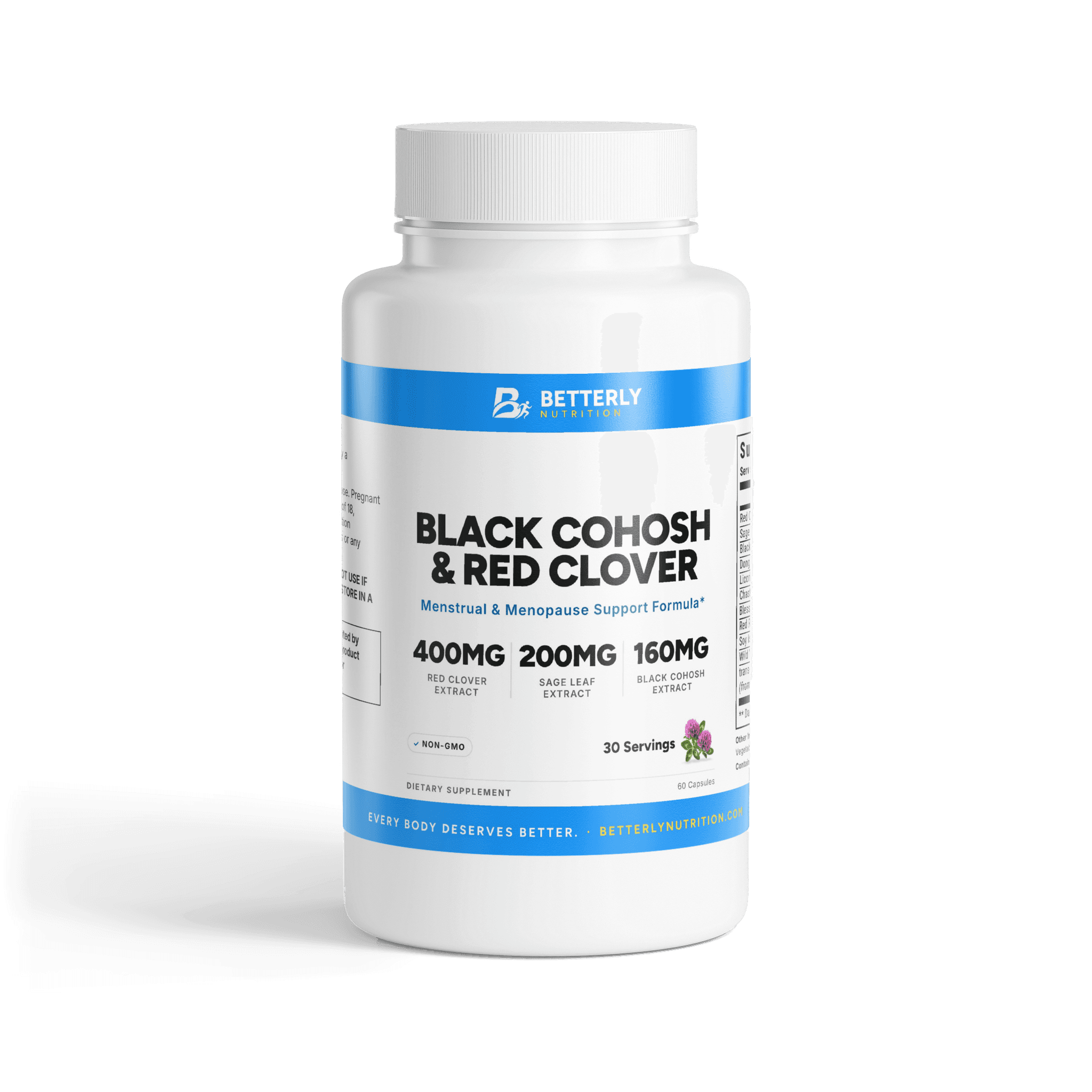
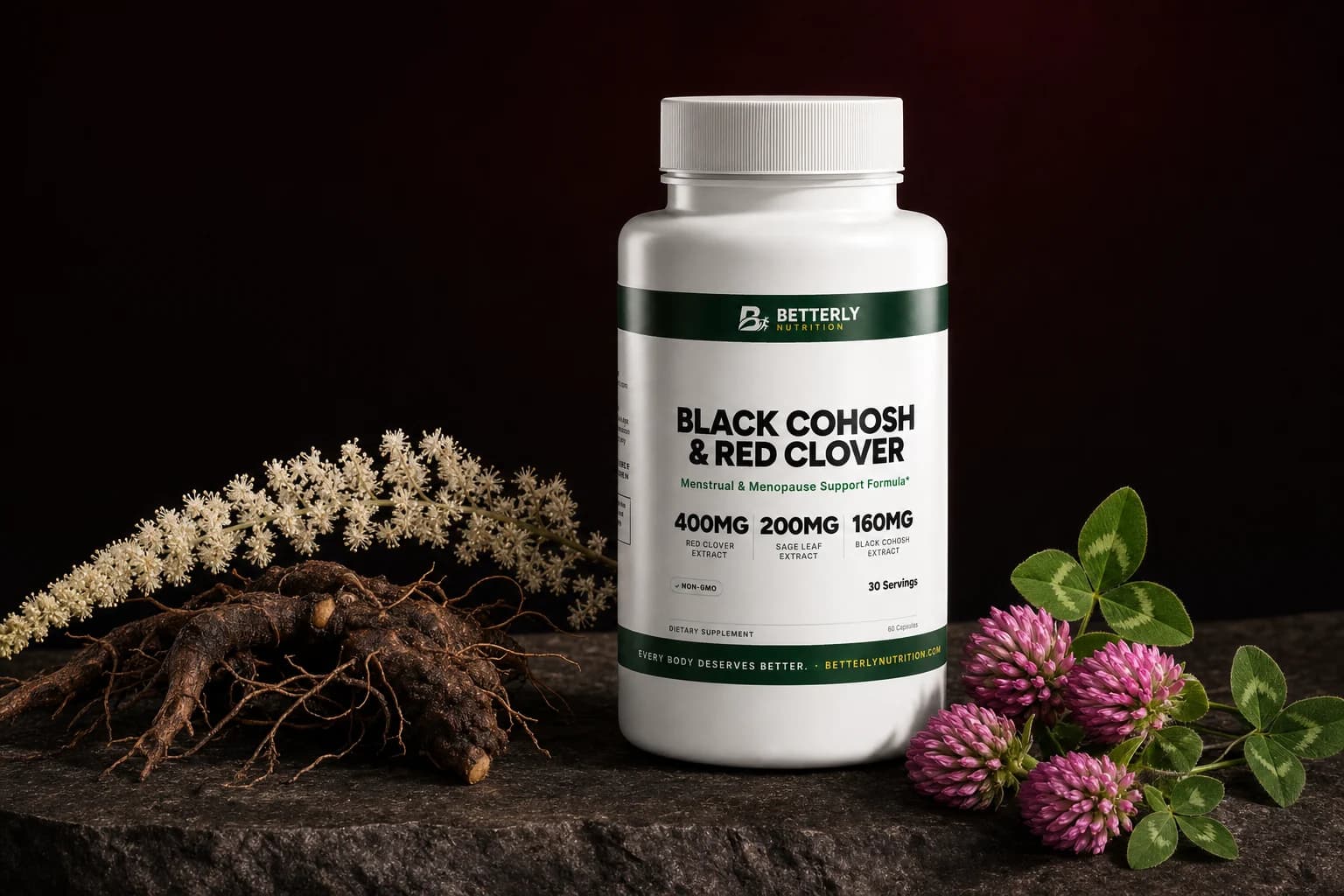
Our Black Cohosh & Red Clover Capsules list 400 mg of red clover extract and 160 mg of black cohosh root extract per 2-capsule serving, a 2.5-to-1 ratio.
That ratio tells you which extract fills more of each capsule, not which herb does more. Nine more ingredients share the panel, and our safety guide's full ingredient table lists every one with its amount.
Then there's the "(1%)" printed after red clover. ODS explains that standardization means measuring chosen marker compounds and adjusting each batch to match, and it notes that US law has no definition of the term. If that 1% is a standardization figure, it would be 4 mg of a marker the label doesn't name. The black cohosh row carries no percentage at all.
That's also why milligrams rarely line up between brands. Another bottle might print a bigger black cohosh number because it uses plain ground root, which is bulkier, or a smaller one because its extract is more concentrated. Unless a label states the plant part, the form and an extract ratio, a larger figure doesn't mean more herb. Ours gives the part and the form, root extract, but no ratio.
One thing our panel does give you is a separate weight for every row, and that's the only reason you can work out the ratio at all. A proprietary blend prints one combined total instead, so a split like 400 to 160 would stay hidden.
From our shop: Black Cohosh & Red Clover Capsules — 400 mg of red clover extract, 200 mg of sage leaf extract and 160 mg of black cohosh root extract per 2-capsule serving, in a 60-capsule bottle.
How do you take a black cohosh and red clover capsule?
The label's suggested use for our Black Cohosh & Red Clover Capsules is 2 capsules daily, preferably with meals, or as directed by a healthcare professional.
A few label-based points:
- Two capsules make up the full day's serving, so a 60-capsule bottle lasts 30 days.
- Tie it to a meal you eat every day, since the label prefers taking it with food.
- Don't add capsules to match the black cohosh figure on another brand's bottle. Every other row would climb with it, and the label's caution says not to exceed the recommended dose.
Two panel details matter before the first dose. Soy is declared as an allergen on this label, and the other-ingredients line lists bovine gelatin, so the capsules are made with gelatin from cattle. The only attribute claim printed on the label is non-GMO.
When don't you need black cohosh or red clover?
You don't need black cohosh or red clover if you want a general daily supplement, prefer single-herb products or already take something that repeats their rows.
- You want an everyday basic. These are targeted herbs, not a stand-in for a multivitamin.
- You'd rather take just one of the two. Our capsule doesn't split them, so a single-herb product would suit you better.
- You avoid soy or beef gelatin. This label has both.
- You'd be doubling up. If a bottle you already own lists red clover, soy isoflavones, sage, licorice, dong quai or chasteberry, this capsule repeats it.
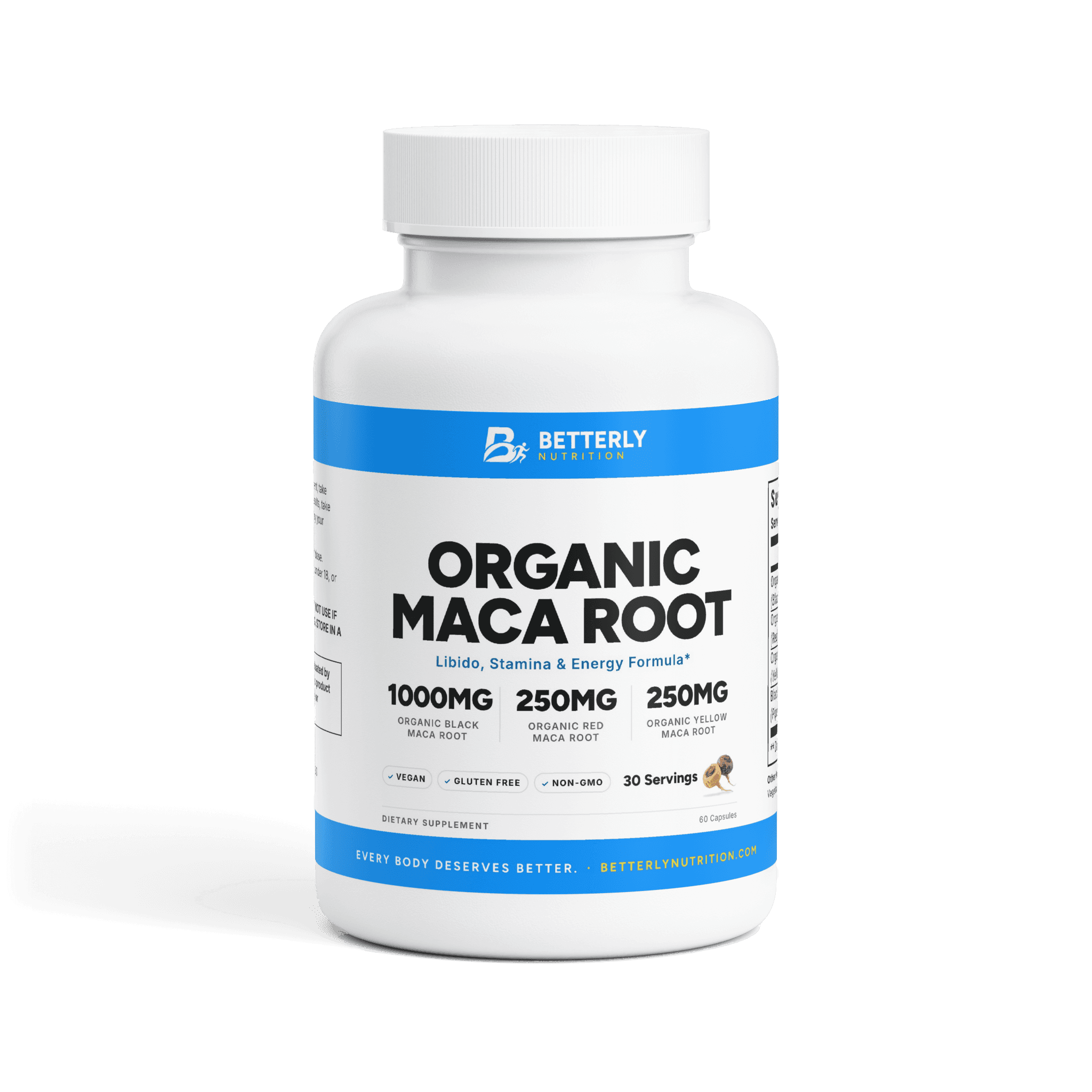
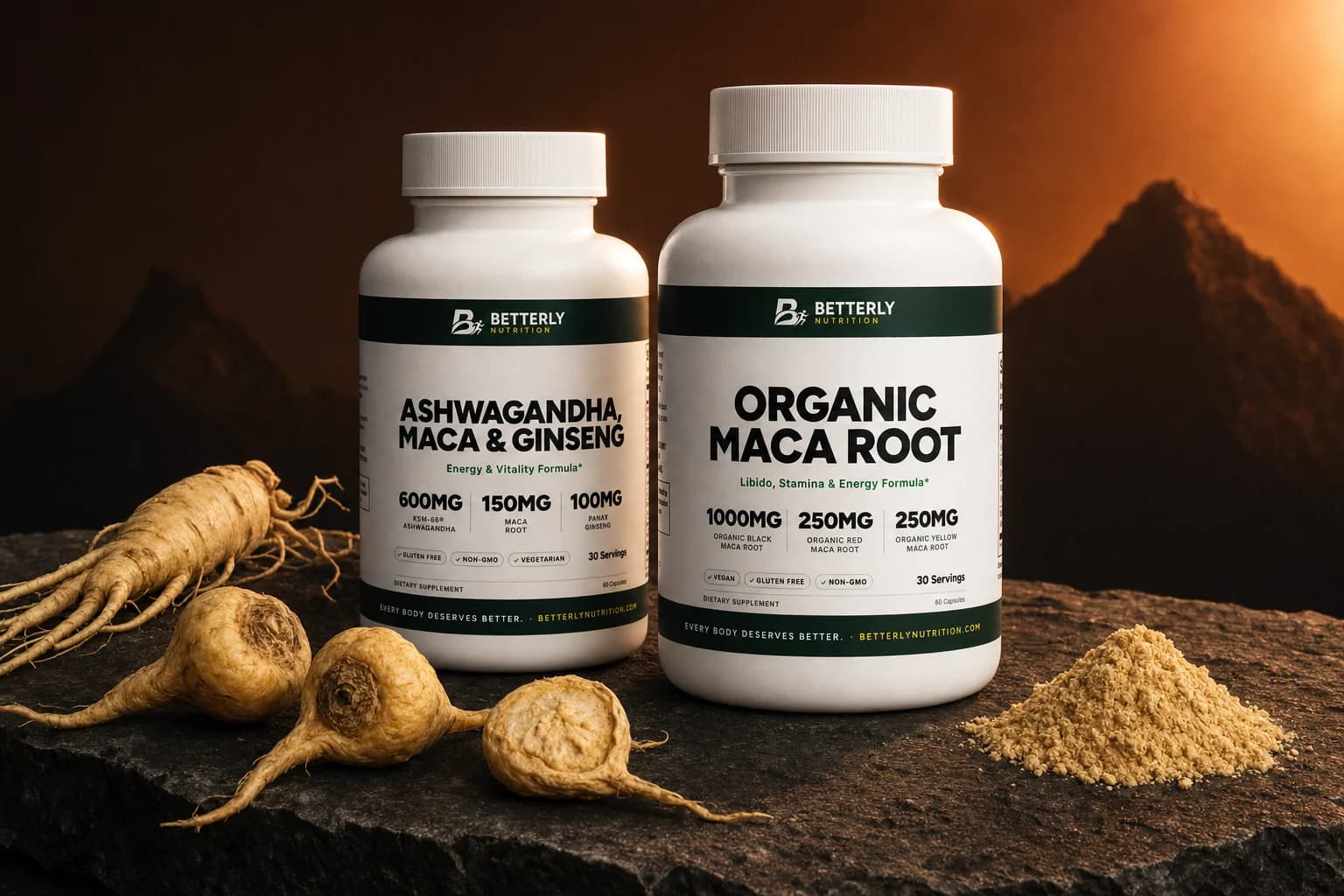
- You came here comparing maca. Maca is a different root again. The panel on our Organic Maca Root Capsules lists no black cohosh, red clover or soy, and our maca guide walks through the small trials behind it.
Our Targeted Support collection holds the rest of our single-purpose formulas if neither herb fits what you're after.
From our shop: Organic Maca Root Capsules — 1,500 mg of black, red and yellow maca root per 2-capsule serving, with none of the black cohosh formula's 11 rows on the panel.
Who should check with a healthcare provider first?
Anyone who's pregnant or nursing, under 18, on medicine or living with a known medical condition should clear black cohosh and red clover with a provider before starting.
- Pregnant or nursing: NCCIH says black cohosh, red clover and chasteberry may each be unsafe during pregnancy or breastfeeding.
- Under 18: the caution on our label asks for a physician first.
- On any type of medicine: both herb pages warn that some herbs and medicines interact in harmful ways.
- A known medical condition: that includes a hormone-sensitive health history, where NCCIH isn't sure black cohosh is safe and warns chasteberry may not be, and any past liver problems, since NCCIH notes rare reports of liver damage in people using black cohosh products.
This comparison sticks to the two headline herbs. The licorice, chasteberry, sage and soy rows in our formula carry NCCIH cautions of their own, and our ingredient-by-ingredient safety guide covers each one, along with what to tell a surgical team.
FAQ: black cohosh vs red clover
Is black cohosh or red clover better?
Neither black cohosh nor red clover wins outright, because they're different plants with different research records. NCCIH notes a substantial number of human studies on black cohosh, which ODS describes as having mixed results, and NCCIH says red clover's research hasn't shown conclusive benefits. Which one suits you depends on your health history, your medicines and your provider's view. A blend like ours includes both, which also means accepting nine other ingredients.
What's the difference between black cohosh and chasteberry?
Black cohosh and chasteberry are different plants from different parts of the world. Chasteberry, also sold as vitex, is Vitex agnus-castus, a shrub native to the Mediterranean and Central Asia, according to NCCIH's chasteberry page. NCCIH says studies have given its fruit extract safely for as long as 3 months, but it may be unsafe in pregnancy or breastfeeding and for women with hormone-sensitive conditions. Our formula holds 160 mg of black cohosh root extract and 50 mg of chasteberry fruit extract (0.5%) per 2-capsule serving.
Is red clover the same as white clover or crimson clover?
No, red clover is one species, Trifolium pratense, and white clover and crimson clover are separate species in the same Trifolium genus. The supplement research NCCIH summarizes is about red clover specifically. So if you see "clover" on a tea or supplement label without the word red or a Latin name, you can't assume it's the same plant.
Can you use black cohosh and red clover tea instead of capsules?
You can find both herbs sold as tea, but a cup won't tell you how much of either you're getting. ODS notes that one quantity of a plant might arrive as a full mug of tea, as several teaspoons of tincture or as a far smaller amount of extract. So tea and our capsule's extract rows can't be swapped by weight. Check with your provider before switching forms.
Is red clover safer than black cohosh?
Red clover has a quieter safety record on NCCIH's pages, but that doesn't make it safe for everyone. NCCIH says red clover extracts were used in studies for up to 2 years with apparent safety. NCCIH puts black cohosh's safe use in studies at up to a year, though rare reports of liver damage exist that NCCIH can't confirm the herb caused. Both may be unsafe in pregnancy or while breastfeeding.
Sources
- Black Cohosh: Usefulness and Safety (NCCIH)
- Red Clover: Usefulness and Safety (NCCIH)
- Chasteberry: Usefulness and Safety (NCCIH)
- Botanical Dietary Supplements: Background Information (NIH Office of Dietary Supplements)
If this left you looking for somewhere to start, read black cohosh and red clover capsules with 400 mg of red clover — its amounts per serving are listed on the page. For the practical questions this raises, how dosing, sourcing and subscriptions work is answered in one place.