On this page
- Key takeaways
- What is MCT in protein powder?
- Is MCT powder the same as MCT oil?
- What does MCT oil powder do in a protein shake?
- How much MCT is in a protein powder with MCT oil?
- Is whey protein powder with MCT different from plain whey isolate?
- Can you add MCT oil to a protein shake yourself?
- How do you take Whey Protein Isolate & MCT Powder?
- When is MCT in your protein powder not worth it?
- Who should check with a healthcare provider first?
- FAQ: protein powder with MCT oil
- Sources
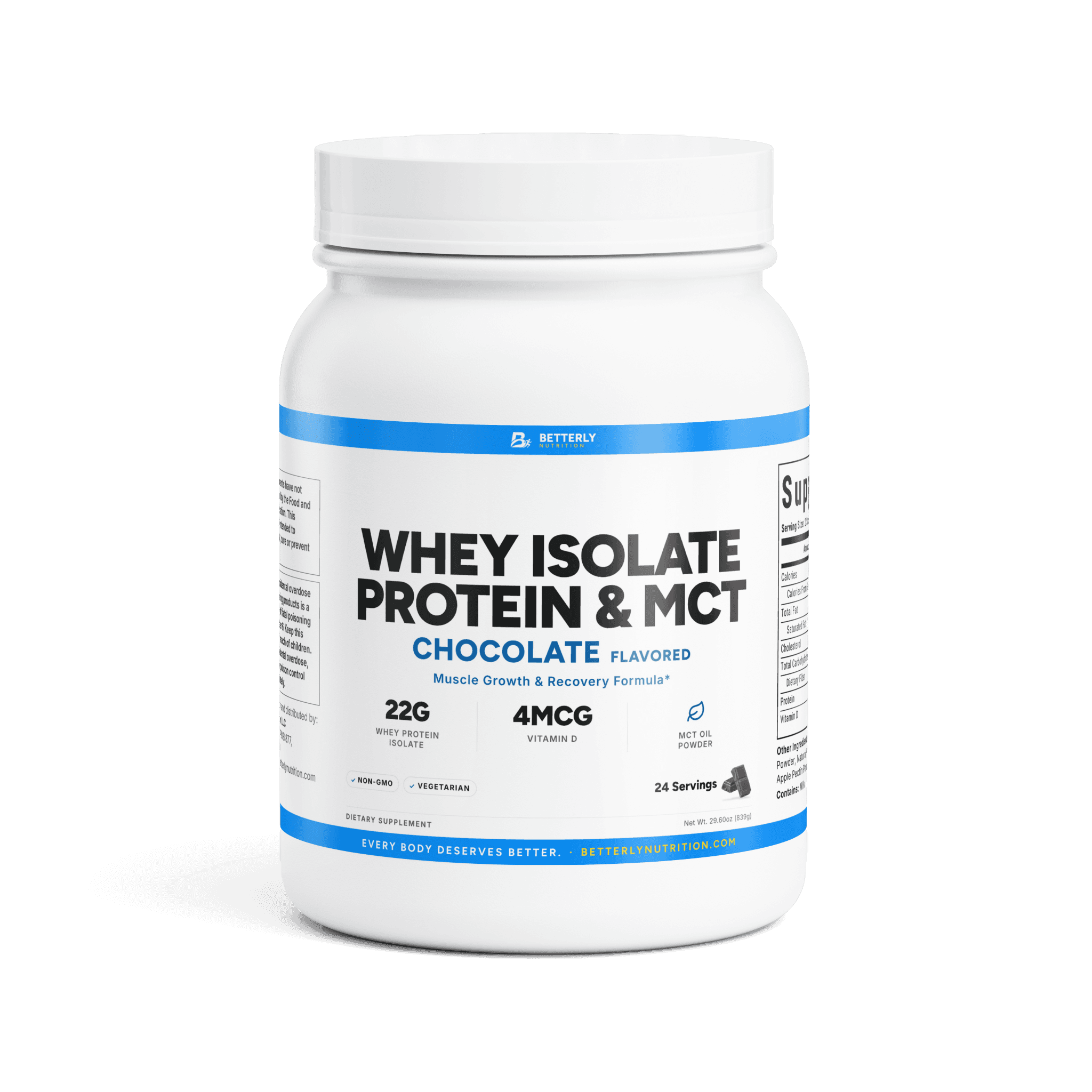
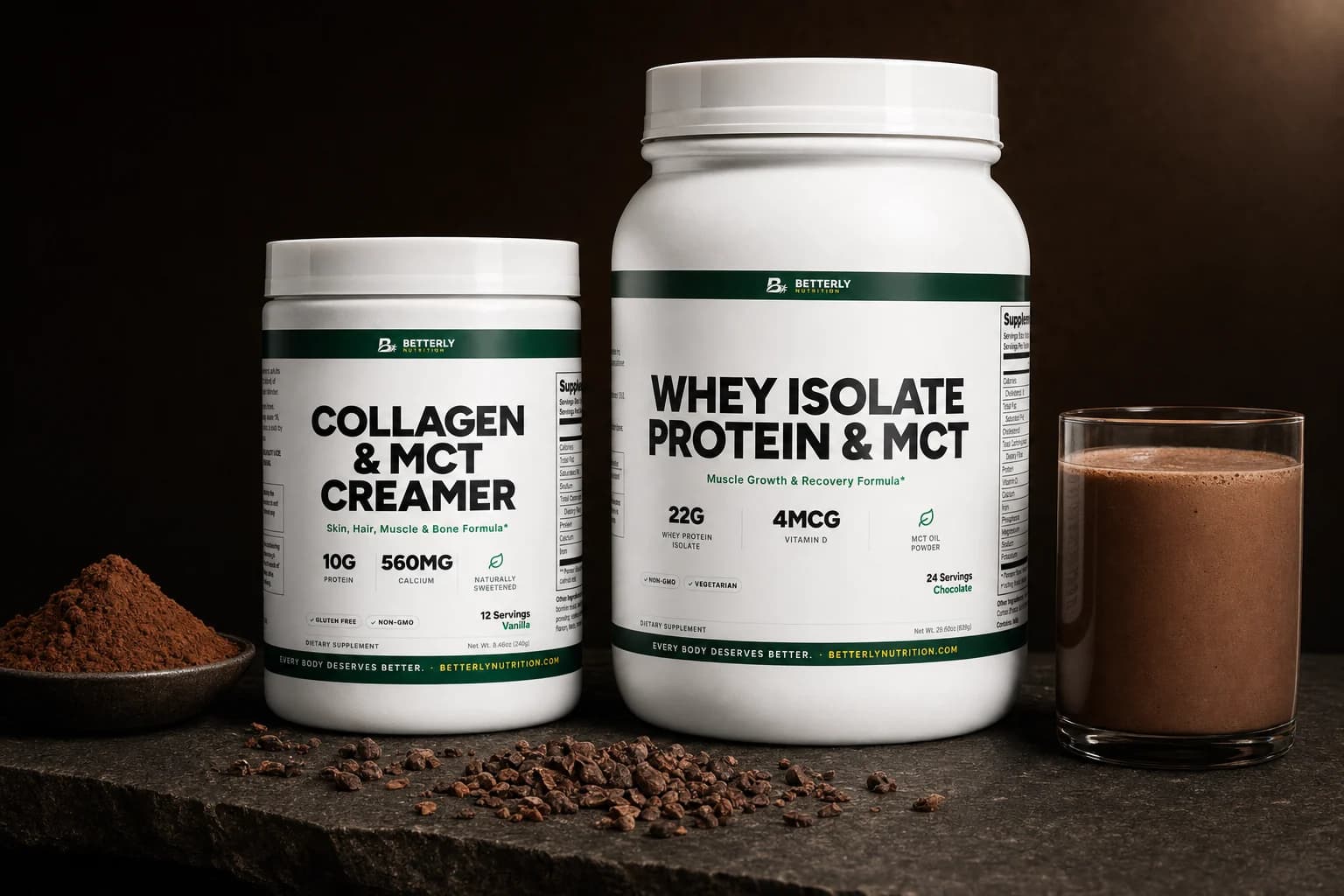
The short answer: Protein powder with MCT oil almost never holds liquid oil. It holds MCT oil powder: medium-chain triglyceride oil dried onto a carrier so it scoops and mixes like the rest of the tub. Its likely role is texture. Our Whey Protein Isolate & MCT Powder (Chocolate) lists 1.5 g of total fat per 2 Scoops (35g) serving, and the MCTs are only part of that rounded figure.
Key takeaways
- MCTs are fats built from fatty acids 6 to 12 carbons long, usually taken from coconut or palm kernel oil.
- MCT oil powder is the oil plus a carrier, such as a starch or a fiber, so a gram of powder holds less than a gram of MCTs.
- On our protein powder and creamer panels, MCTs get no row of their own, so the rounded Total Fat line is your closest guide, and it counts every fat in the scoop.
- You can blend your own MCT oil into a shake, but then the panel no longer describes what's in your shaker.
Betterly profits from the five MCT powders mentioned here, including the ones whose panels we pick apart below. Every product number we quote comes from the printed label (the Supplement Facts panel or its directions), we show any math we do with those numbers, and the one figure those panels never give, MCT grams, we leave blank rather than estimate.
What is MCT in protein powder?
MCT in protein powder means medium-chain triglycerides, a type of fat, and it's almost always added as a dry MCT oil powder rather than a pourable oil.
A triglyceride is the everyday shape of dietary fat: three fatty acids attached to a glycerol backbone. "Medium-chain" means those fatty acids run 6 to 12 carbon atoms long. That range covers four of them, caproic, caprylic, capric and lauric acid, often shortened to C6, C8, C10 and C12.
Commercial MCTs are usually separated out of coconut oil or palm kernel oil. The MedlinePlus page Dietary fats explained lists coconut, palm and palm kernel oil among the vegetable oils that contain saturated fats.
That fits our chocolate panel, where Total Fat and Saturated Fat both read 1.5 g per serving, though the cocoa supplies some of that fat.
Is MCT powder the same as MCT oil?
No. MCT oil is pure liquid fat, while MCT oil powder is that oil dried onto a carrier, so the powder is only part MCT by weight.
Makers spray-dry the oil with a carrier, such as a starch, a gum like acacia, or a milk protein. The result pours like flour, leaves no slick in the shaker and keeps well on a shelf.
The catch is dilution. Here's how the common forms compare:
| Form | What it is | How it mixes | What its label tells you |
|---|---|---|---|
| MCT oil | Liquid MCTs only | Floats until blended | Total fat per serving |
| MCT oil powder | Oil dried onto a carrier | Stirs in like protein | Total fat per serving; weight includes carrier |
| MCT in a protein tub | A share of that powder | Already mixed in | On ours, a spot in the list |
| Coconut oil | Mixed fats, some medium-chain | Firms up when cold | Total fat per serving |
A powder's scoop weight overstates its MCTs because the carrier is part of it. Its Total Fat line is the better guide, and in our chocolate whey tub even that line mixes MCTs with milk fat, lecithin and cocoa. Our whey and MCT labels also name "MCT Oil Powder" without naming its carrier.
What does MCT oil powder do in a protein shake?
MCT oil powder in a protein shake is most likely there for texture, and with total fat at 1 to 1.5 g per whey serving, expect a subtle difference.
Whey isolate carries very little fat of its own, so mixed with water it makes a thin, clean-tasting drink. A little added fat may change how that drink feels in your mouth. Our whey and MCT tubs also list sunflower lecithin, an emulsifier that keeps fat and water from separating, and apple pectin powder, the same fruit fiber that sets jam.
Plenty of MCT shake marketing promises far more than texture. At 1.5 g of total fat or less per serving, our protein panels can't back claims like that.
How much MCT is in a protein powder with MCT oil?
Our Whey Protein Isolate & MCT Powder lists no MCT amount, so MCTs are only part of its rounded Total Fat: 1.5 g per chocolate serving, 1 g per vanilla.
Four label clues narrow it down:
1. Total fat covers every fat, rounded. The MCTs share that row with the trace of milk fat in the whey, the lecithin and, in the chocolate, the cocoa. 21 CFR 101.36, the federal rule for Supplement Facts panels, has them use the food label's rounding steps, and those put fat under 5 g to the nearest half gram. So "1.5 g" means about 1.25 g up to just under 1.75 g from every source combined.
2. Ingredient order gives rank, not grams. The FDA's Dietary Supplement Labeling Guide says ingredients appear in descending order of predominance by weight. MCT Oil Powder is third on both whey and MCT tubs, after whey protein isolate and Nidau cocoa powder in the chocolate, and after whey protein isolate and natural flavors in the vanilla.
3. The powder outweighs its MCTs. The carrier counts too, so that third-place spot includes the carrier's weight, not just fat.
4. Calories from fat line up. MedlinePlus puts fat at 9 calories per gram, and 1.5 g times 9 is 13.5, close to the chocolate panel's 15 Calories From Fat out of 120.
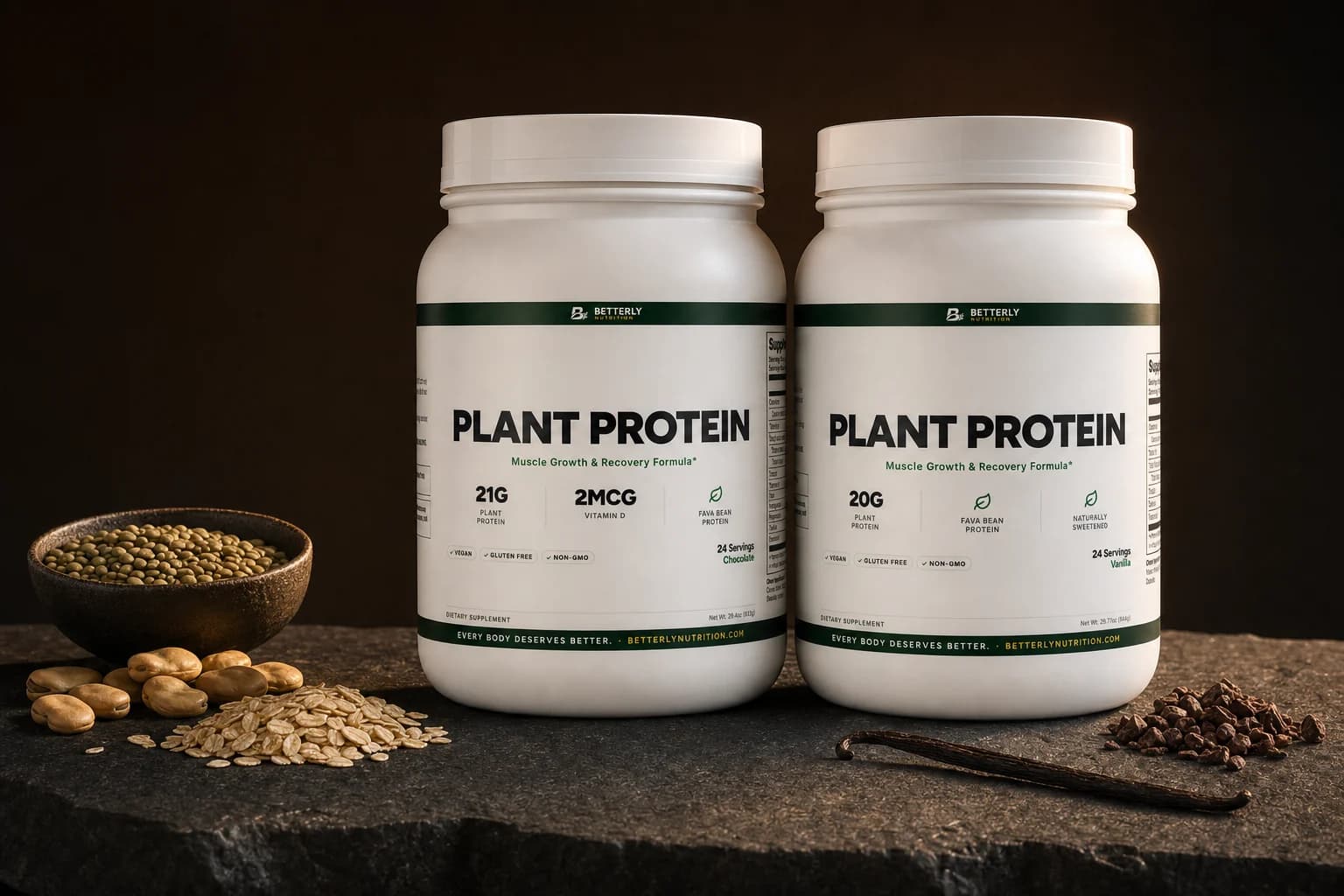
Among our powders, MCTs show up in three lines: the whey and MCT tubs, our Fava Bean Protein Isolate Powder (Chocolate) and its vanilla twin, and the Collagen Peptides & MCT Creamer (Vanilla). Here's how four of them read beside our Whey Protein Isolate Powder (Chocolate), which has none:
| Product | Serving | Total fat (saturated) | MCT's spot in the list |
|---|---|---|---|
| Whey Protein Isolate & MCT Powder (Chocolate) | 2 Scoops (35g) | 1.5 g (1.5 g) | 3rd of 10 |
| Whey Protein Isolate & MCT Powder (Vanilla) | 2 Scoops (34g) | 1 g (1 g) | 3rd of 8 |
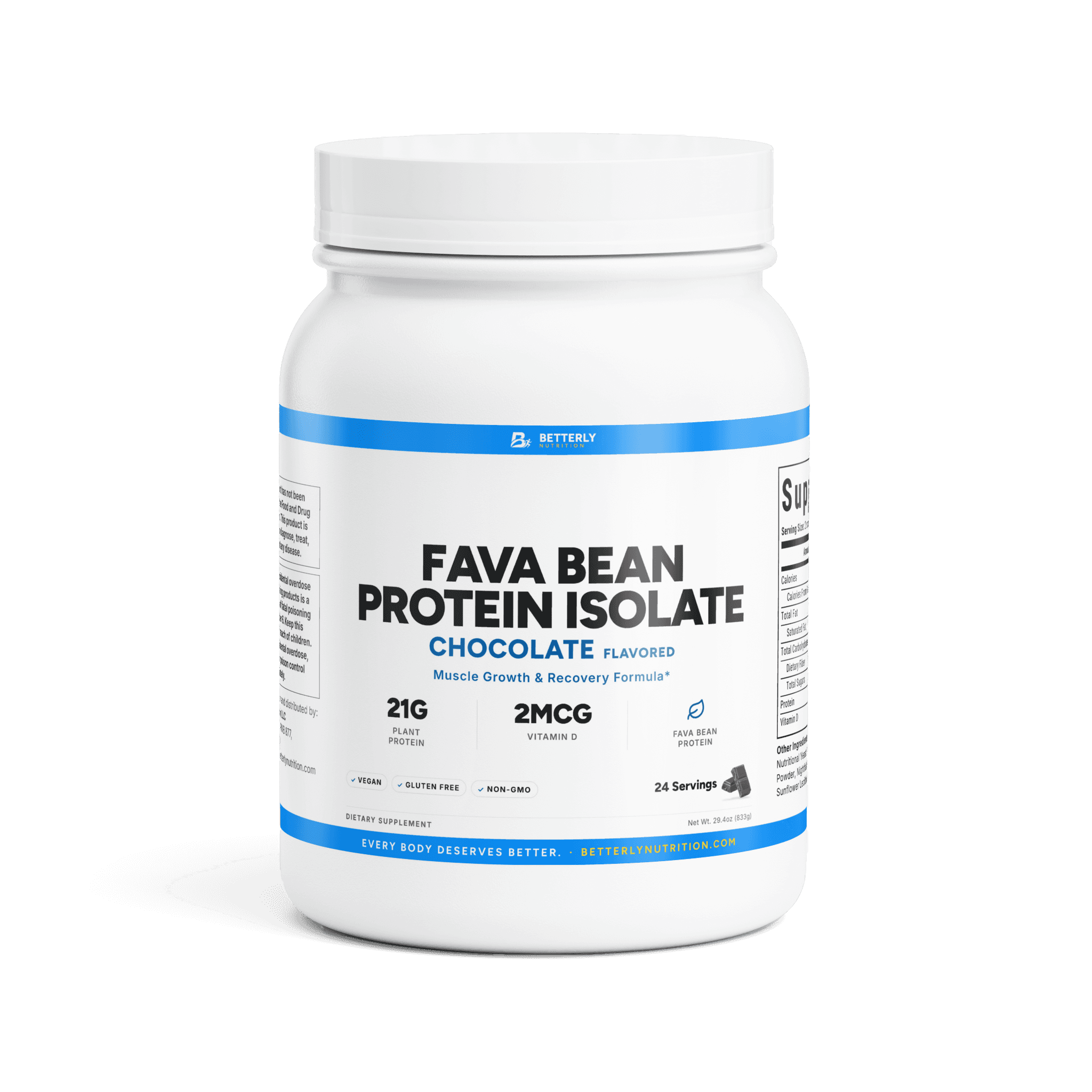
| Fava Bean Protein Isolate Powder (Chocolate) | 2 scoops (34.7g) | 1.5 g (1 g) | 5th of 10 |
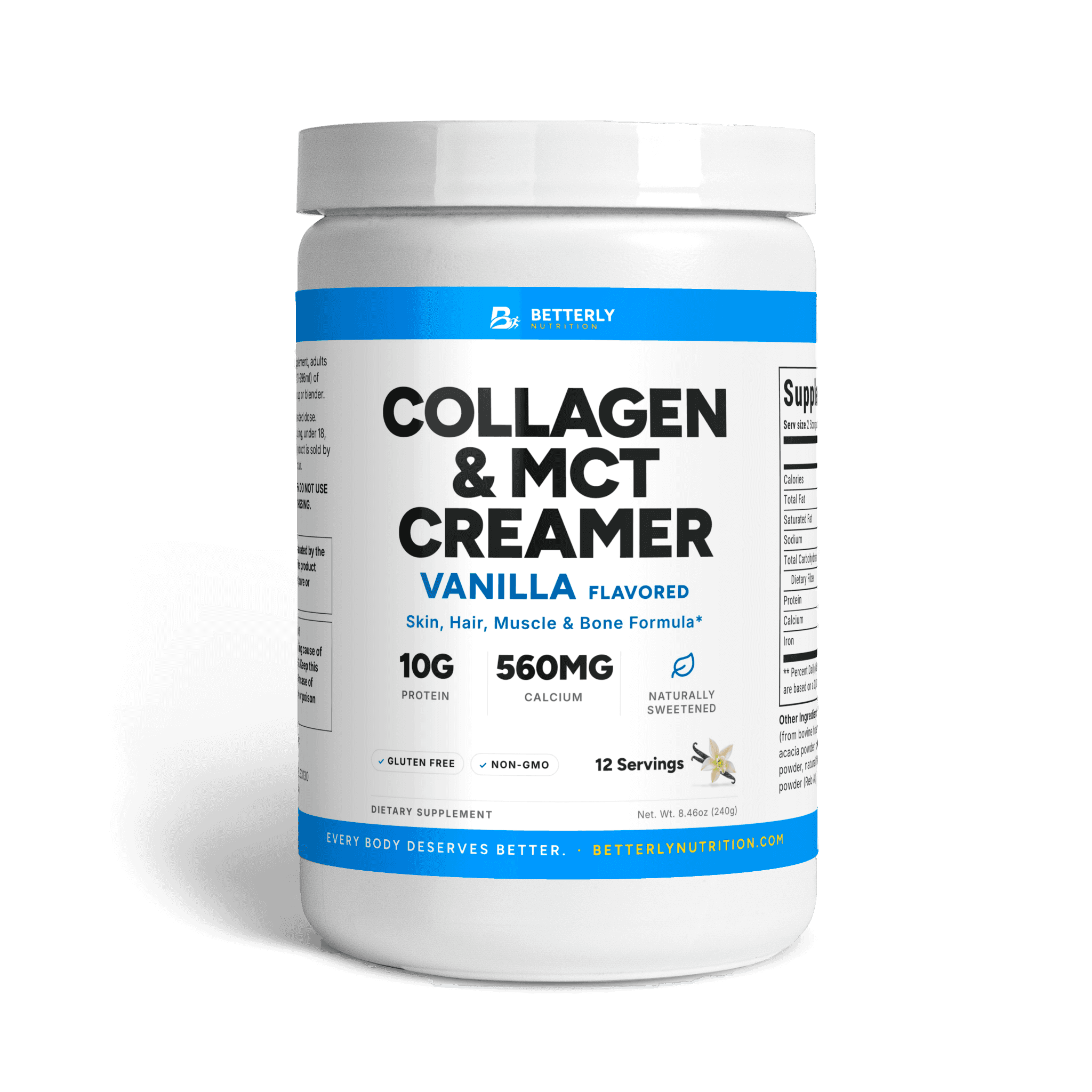
| Collagen Peptides & MCT Creamer (Vanilla) | 2 Scoops (20 g) | 2 g (2 g) | 2nd of 8 |
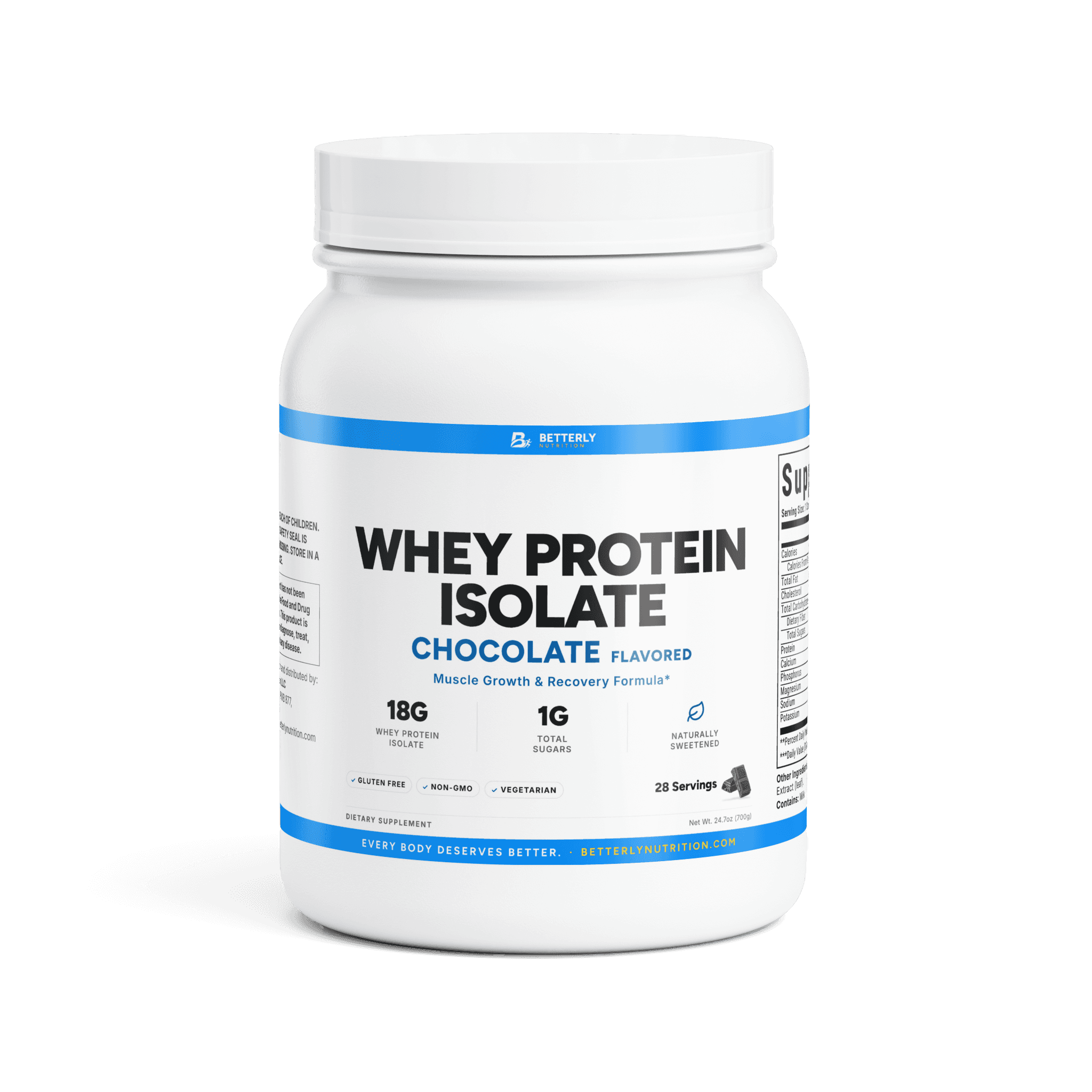
| Whey Protein Isolate Powder (Chocolate) | 1 Scoop (25g) | 1 g (no row) | Not listed |
Only the creamer ranks MCTs near the top, and even its whole serving lists 2 g of fat. The plain chocolate isolate shows 1 g of fat with no MCTs at all, so the gap between our MCT whey and plain whey is half a gram of rounded fat, in a bigger serving that also holds cocoa and lecithin.
From our shop: Whey Protein Isolate & MCT Powder (Chocolate) — 22 g of protein per 2 Scoops (35g) serving, with MCT oil powder third in its ingredient list and 1.5 g of total fat.
Is whey protein powder with MCT different from plain whey isolate?
Whey protein powder with MCT, like ours, differs from plain isolate mainly in its extras: more ingredients, a bigger serving, vitamin D in both flavors and iron in the chocolate.
Both protein figures come mostly from whey protein isolate, the first ingredient on each list. The NIH Office of Dietary Supplements fact sheet on exercise and athletic performance notes that most protein powders contain whey, a milk protein that provides all the essential amino acids. MCTs add no protein.
Here's how our two chocolate whey tubs differ per label serving:
- Protein: 22 g per 2 Scoops (35g) in the MCT tub, against 18 g per 1 Scoop (25g) in the plain one. Divide protein by scoop weight, though, and the plain powder comes out about 72% protein, the MCT powder about 63%.
- Sodium: 180 mg against 50 mg. Only the MCT tub lists sea salt.
- Vitamins and minerals: the MCT chocolate lists 4 mcg of vitamin D (18% DV) and 2 mg of iron (9% DV). The plain panel has neither row.
- Ingredients: ten against three. The plain tub lists whey protein isolate, natural flavors and stevia extract, and that's all.
The Whey Protein Isolate & MCT Powder (Vanilla) keeps the 22 g of protein per 2 Scoops (34g) serving and the 4 mcg of vitamin D (18% DV), with 1 g of total fat and no iron row. If you stir either flavor into a mug, our guide to protein powder in coffee covers getting it smooth.
Can you add MCT oil to a protein shake yourself?
Yes, you can blend MCT oil into a protein shake yourself, but it's a kitchen choice, and the Supplement Facts panel no longer describes your drink once you do.
If you try it:
- Blend, don't stir. Oil floats on a water-based shake, and a spoon leaves a film on top.
- Follow the oil's own label. We won't set a dose for a product we don't make.
- Count what it adds. At 9 calories per gram of fat, added oil quickly passes the 15 Calories From Fat on our chocolate panel.
- Coconut oil acts differently. It firms up when cold, so an iced shake can end up with waxy flecks.
How do you take Whey Protein Isolate & MCT Powder?
The label's suggested use for Whey Protein Isolate & MCT Powder is for adults to mix two scoops with 6-8 oz of water or a favorite beverage daily.
Both flavors print the same suggested use, and its "for best results" line adds one cue: take it 20-30 minutes before a meal with 8 oz (237ml) of water.
- Pour 6-8 oz of cold water, milk or another drink into a shaker.
- Add two level scoops. Liquid first keeps powder from packing into the corners.
- Seal it and shake until no dry powder shows.
- Stop at one serving. We read "daily" as once a day, and the label adds "Do not exceed recommended dose."
The MCT is already dried into the powder, so there's no oil to measure. If you use milk, its carton lists the fat it adds.
When is MCT in your protein powder not worth it?
MCT in your protein powder isn't worth seeking out if you want a set MCT amount, the shortest ingredient list, or a shake that's already rich.
- You're counting MCT grams. None of our protein or creamer panels prints one.
- You like short labels. The plain chocolate isolate's three ingredients beat the MCT chocolate's ten.
- Your shake is already rich. If nut butter or full-fat yogurt goes in, the MCTs become a small share of the fat in your glass.
- You avoid milk. Both whey tubs print "Contains: Milk." Our plant chocolate powder is labeled vegan and still lists MCT oil powder, and our fava bean and pea protein comparison covers where its protein comes from.
- You mainly want a creamer. The collagen creamer ranks MCTs second, and our collagen coffee guide explains what its label does and doesn't list.
Compare tubs in our protein collection, then open any one to read its amounts per serving.
From our shop: Fava Bean Protein Isolate Powder (Chocolate) — 21 g of protein per 2 scoops (34.7g) serving, labeled vegan, with MCT oil powder fifth in its ingredient list.
Who should check with a healthcare provider first?
Ask a healthcare provider about a daily whey and MCT shake first if you're pregnant or nursing, under 18, on a prescription, heading into surgery or managing a medical condition.
Our label's caution covers four of those groups in one line: "Consult a physician if pregnant, nursing, under 18, or have a medical condition." Prescriptions and surgery are our additions, because a daily shake belongs on any list of what you take. Numbers worth having on hand:
- Fat and sodium targets. One 2 Scoops (35g) serving of the whey and MCT chocolate adds 1.5 g of saturated fat (7% DV) and 180 mg of sodium (8% DV).
- Milk. Both whey and MCT tubs contain milk.
- Iron and children. Per serving, the whey and MCT chocolate lists 2 mg of iron, the plant chocolate 1 mg and the creamer 3 mg. Each label prints: "Accidental overdose of iron-containing products is a leading cause of fatal poisoning in children under 6." Store these tubs where small hands can't reach them.
FAQ: protein powder with MCT oil
Does MCT oil powder add carbs to a protein shake?
Yes, MCT oil powder can add some carbs, because its carrier is often a starch or a fiber. On our Whey Protein Isolate & MCT Powder (Chocolate), every carbohydrate source together totals 4 g per 2 Scoops (35g) serving, including 1 g of dietary fiber. Cocoa, pectin and whatever carrier the MCT powder uses share that figure, and the panel doesn't split out the MCT powder's part.
Is MCT oil a protein?
No, MCT oil is a fat, not a protein. Pure MCT oil is made of triglycerides, so its label lists fat and no protein. In a protein powder with MCT oil, the protein comes from ingredients other than the oil itself. In our whey and MCT tubs, whey protein isolate, the first ingredient, supplies most of the 22 g per serving.
Is MCT oil powder dairy-free?
MCT oil powder isn't always dairy-free. Some MCT powders are dried onto a milk-based carrier, so check the allergen line. On our whey and MCT tubs it doesn't matter, since both print "Contains: Milk" because of the whey. If you avoid dairy, our Fava Bean Protein Isolate Powder (Chocolate) is labeled vegan and lists MCT oil powder.
Can you drink a protein shake with MCT oil every day?
Yes, one shake a day made with our Whey Protein Isolate & MCT Powder matches its directions, which say to mix two scoops daily and not exceed that. Over a week, that's 10.5 g of saturated fat from the chocolate (7% DV per serving) or 7 g from the vanilla (5% DV per serving). The MCTs are an unlisted part of that total. If a group in the healthcare-provider section above describes you, get that check first.
When should you drink a protein shake with MCT?
Our Whey Protein Isolate & MCT Powder label gives one timing cue: for best results, take it 20-30 minutes before a meal with 8 oz (237ml) of water. The MCT doesn't change that, since it's already part of the powder. It still means one serving that day, not one before every meal, since the label's caution rules out going past the recommended dose.
Sources
- Dietary fats explained, MedlinePlus Medical Encyclopedia
- Dietary Supplement Labeling Guide: Chapter V. Ingredient Labeling, U.S. Food and Drug Administration
- 21 CFR 101.36, Nutrition labeling of dietary supplements, Electronic Code of Federal Regulations
- Dietary Supplements for Exercise and Athletic Performance, NIH Office of Dietary Supplements
If this left you looking for somewhere to start, read chocolate whey isolate with MCT oil powder, 22 g protein per serving — its amounts per serving are listed on the page. For the practical questions this raises, how dosing, sourcing and subscriptions work is answered in one place.