On this page
- Key takeaways
- What's the difference between EPA and DHA?
- What does DHA do in the body?
- What does EPA do in the body?
- EPA vs DHA: which is better, or more important?
- Does the EPA to DHA ratio matter?
- EPA vs DHA vs ALA: where does each omega-3 come from?
- How do you take EPA and DHA from Betterly's softgels?
- When don't you need a separate EPA or DHA supplement?
- Who should check with a healthcare provider first?
- FAQ: EPA vs DHA
- Sources
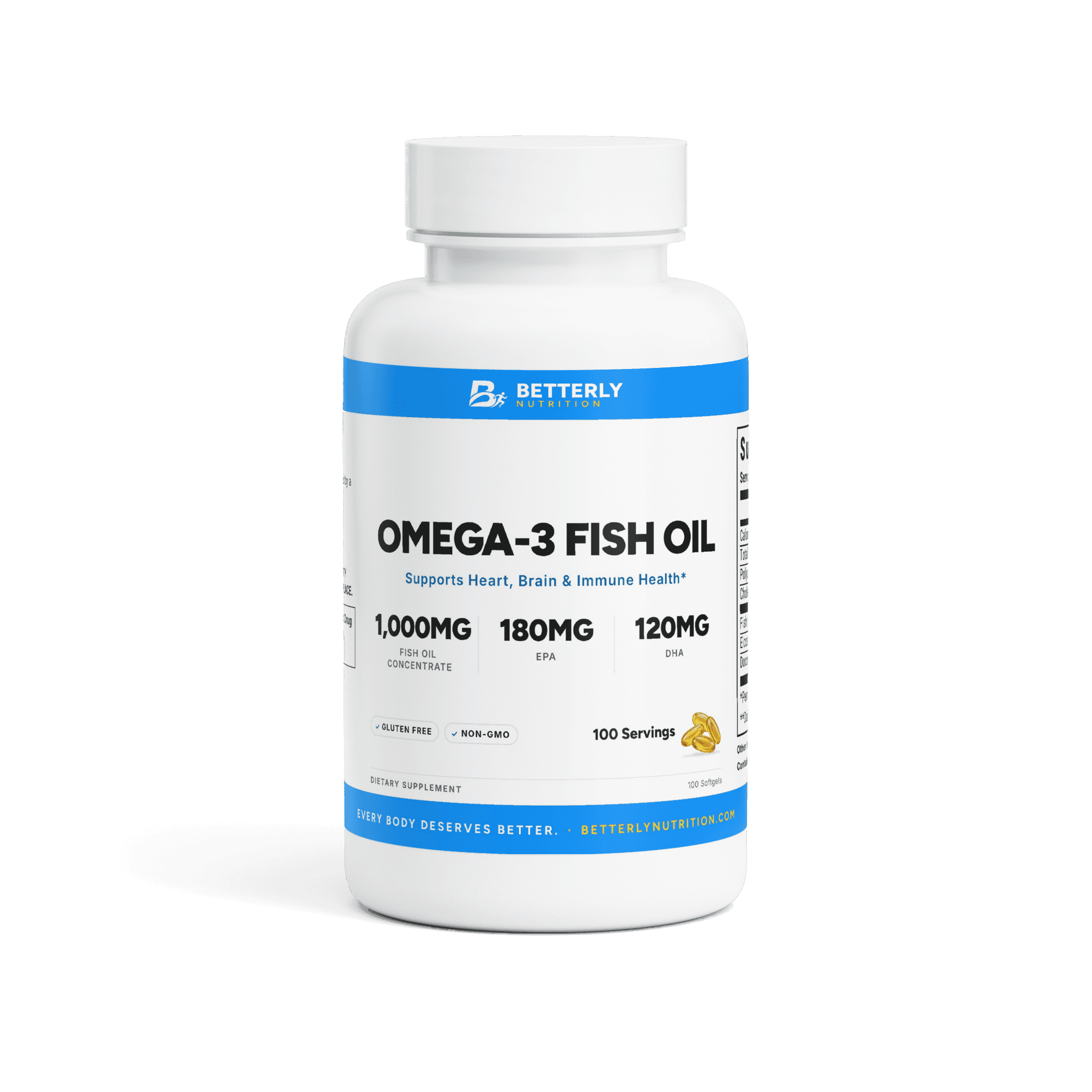
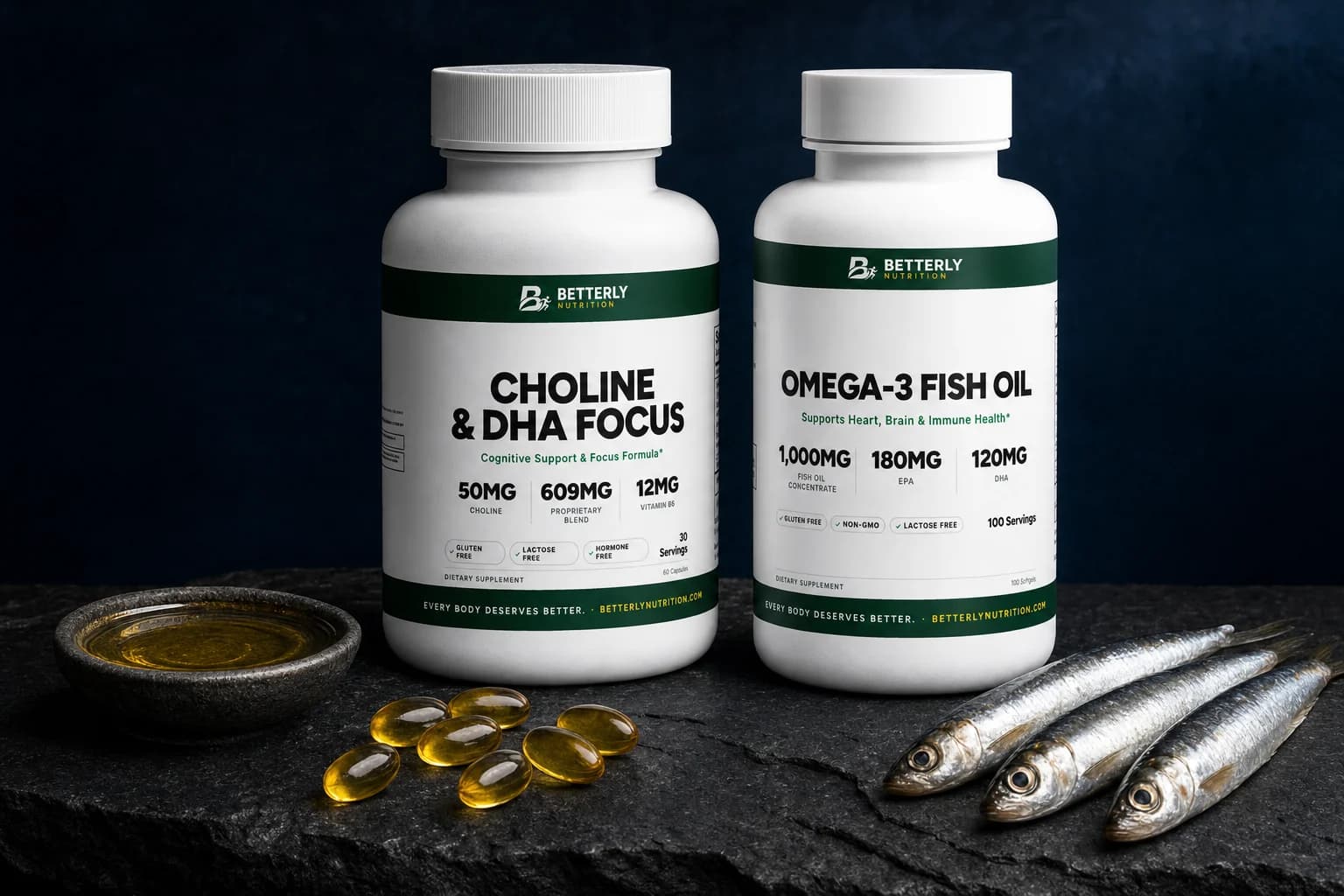
The short answer: EPA vs DHA isn't a contest between a good omega-3 and a weak one. Both are long-chain omega-3 fats from fish and seafood. DHA has the longer chain, and the NIH says its levels run especially high in the brain and the retina. Federal advice counts EPA and DHA together and sets no ideal split. Betterly's Omega-3 Fish Oil Softgels list 180 mg of EPA and 120 mg of DHA per 1-softgel serving.
Key takeaways
- Eicosapentaenoic acid (EPA) and docosahexaenoic acid (DHA) are omega-3 fats found mainly in fish and seafood, and fish oil supplies the two together.
- According to the NIH Office of Dietary Supplements, DHA levels are especially high in the brain and the retina.
- Plant ALA converts to EPA and DHA in only very small amounts, so flaxseed and walnuts don't replace fish as a source.
- Each 1-softgel serving of Betterly's Omega-3 Fish Oil Softgels holds 180 mg of EPA and 120 mg of DHA, a split of 1.5 parts EPA to 1 part DHA.
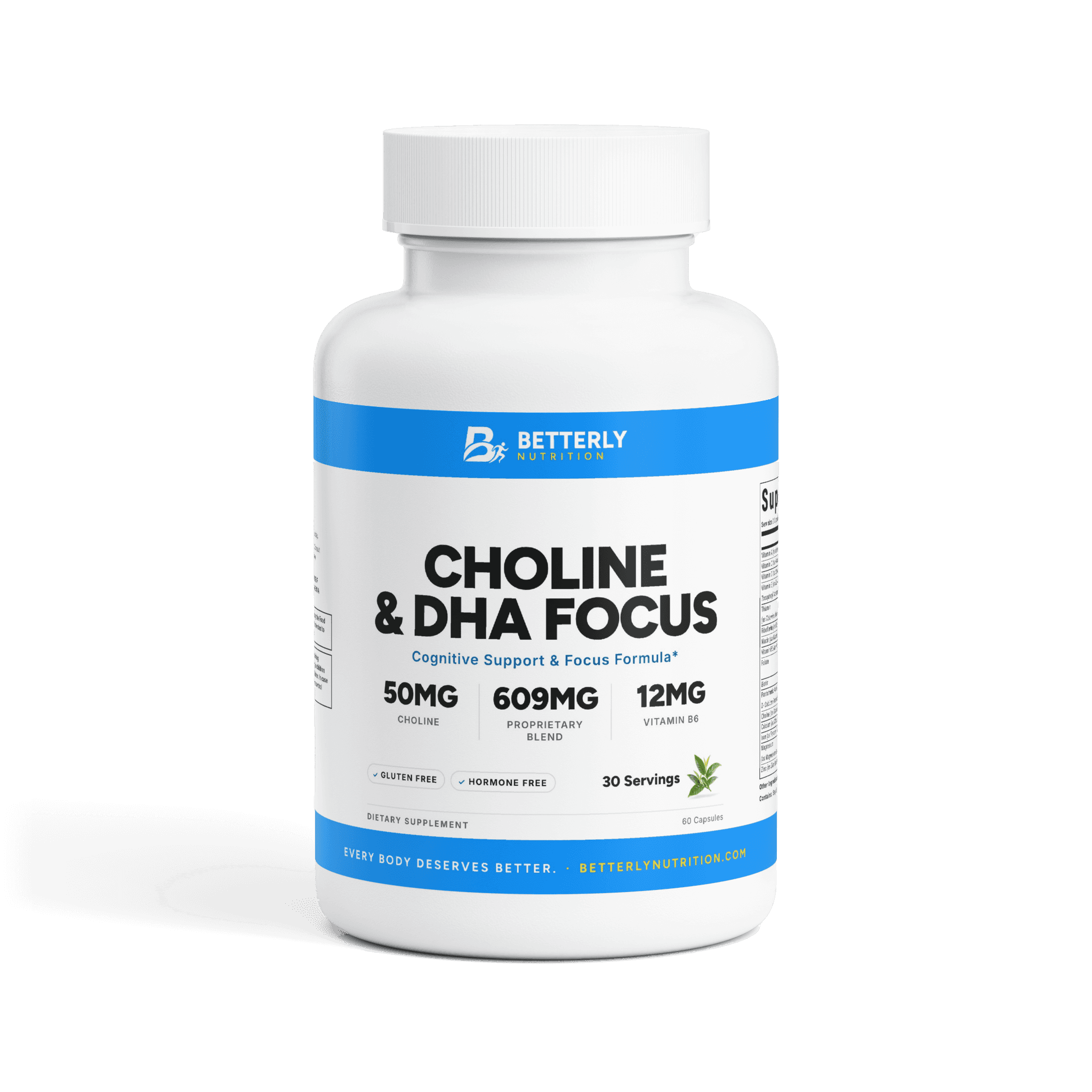
Two products in this comparison come off our own shelf: that softgel and the Choline & DHA Focus Capsules, whose blend names DHA. You'll see what each label tells you, including the spots where ours come up short. The softgel belongs to our targeted support collection.
What's the difference between EPA and DHA?
EPA and DHA are both marine omega-3 fats, but DHA has a longer, more unsaturated chain and is the one found at especially high levels in the brain and eyes.
The names are chemistry shorthand. In eicosapentaenoic acid, "eicosa" means 20 carbon atoms and "penta" means five double bonds. In docosahexaenoic acid, "docosa" means 22 carbons and "hexa" means six. The "omega-3" part says the first double bond sits three carbons in from the tail end of the chain. ALA, or alpha-linolenic acid, is the shorter plant cousin, so it gets a column too.
| Trait | EPA | DHA | ALA |
|---|---|---|---|
| Full name | Eicosapentaenoic acid | Docosahexaenoic acid | Alpha-linolenic acid |
| Chain | 20 carbons, 5 double bonds | 22 carbons, 6 double bonds | 18 carbons, 3 double bonds |
| Main food sources | Fish and seafood | Fish and seafood | Flaxseed, soybean and canola oils, chia, walnuts |
| What the NIH notes | A step between ALA and DHA | Especially high in brain and retina | The only omega-3 with a set daily amount |
| Vegetarian supplement | Some algal oils | Algal oils | Flaxseed oil |
| Per Betterly softgel | 180 mg | 120 mg | Not listed |
One row stands out. DHA is the only one of the three that federal fact sheets tie to particular places in the body. EPA and DHA share their food sources, which is why a fish oil capsule hands you both at once.
What does DHA do in the body?
DHA is a structural fat: it's built into the membranes around your cells, and the NIH says DHA levels are especially high in the retina and the brain.
The NIH Office of Dietary Supplements (ODS) explains in its omega-3 fact sheet for consumers that omega-3s are important parts of the membrane around every cell. DHA is the one it singles out, with especially high levels in the retina and the brain. MedlinePlus puts it plainly: we need omega-3 fats to build brain cells.
So DHA is more a building material than a switch. Where it sits isn't the same as what a capsule will do, though. Neither page says extra DHA sharpens focus or changes eyesight in a healthy adult, so you won't find that promise here.
If focus brought you here, our nootropics primer for beginners explains where nutrients like omega-3s and choline fit.
What does EPA do in the body?
EPA is an omega-3 that shares DHA's food sources and many of its roles, and it's the middle step when your body converts plant ALA into DHA.
ODS describes jobs for omega-3s as a group, EPA included. They're parts of cell membranes, they supply calories for energy, and they have many functions in your heart, blood vessels, lungs, immune system and endocrine system, the glands that make hormones.
Here's the honest gap. The ODS consumer sheet names no signature spot in the body for EPA the way it does for DHA, which is why this section runs shorter.
The two are also studied as a pair. The National Center for Complementary and Integrative Health (NCCIH) says in its guide to omega-3 supplements that most omega-3 research has focused on EPA and DHA. Fish oil delivers both in one dose, so it's hard to credit a result to either one alone.
EPA vs DHA: which is better, or more important?
Neither EPA nor DHA wins outright, because federal advice on supplements and seafood counts the two together instead of ranking them.
ODS reports that the FDA's advice caps EPA and DHA from supplements at 5 g a day, counted together. NCCIH cites the Dietary Guidelines for Americans, which tell adults to eat 8 ounces or more of varied seafood a week, including some choices higher in EPA and DHA. Neither source splits the pair.
MedlinePlus, in its page on omega-3 fats, says the EPA and DHA in oily fish both have direct benefits for the heart, while plant ALA's benefit is less direct. The same page says most health experts see food as the best way to get omega-3s' benefits.
If you had to watch one, DHA has the clearer structural story. EPA's case rests more on being half of the duo most research has used.
NCCIH's guide sorts its research by health condition, and the rare places it weighs EPA against DHA sit inside those condition questions. If a health concern is driving your comparison, take it to your healthcare provider rather than picking a ratio.
Does the EPA to DHA ratio matter?
No federal source we checked sets an ideal EPA to DHA ratio, and ODS and NCCIH count EPA and DHA together instead of ranking a split.
To find any label's ratio, divide the EPA milligrams by the DHA milligrams. For our softgel, 180 divided by 120 is 1.5. Put another way, 60% of the softgel's EPA and DHA is EPA and 40% is DHA.
Now picture two made-up labels. One lists 200 mg of EPA and 100 mg of DHA per serving, the other 100 mg of EPA and 200 mg of DHA. Their ratios point in opposite directions, yet each serving holds the same 300 mg. A third label with a DHA-heavy split but only 90 mg combined would give you less of both.
A product's ratio is also locked in. An extra softgel beyond the label's two a day doesn't shift the split. It only raises both numbers and goes past the directions. For the milligram math on any bottle, see our walkthrough of how much omega-3 is in 1,000 mg of fish oil.
The split matters in two cases: when you want DHA without fish, or when you need a DHA amount you can count. This table matches the goal to the panel line:
| What you're after | What to find on the panel | Where Betterly fits |
|---|---|---|
| Both EPA and DHA, each counted | Separate EPA and DHA lines in mg | Omega-3 Fish Oil Softgels: 180 mg EPA, 120 mg DHA per softgel |
| DHA without fish | Algal oil named as the source | We don't sell one |
| DHA inside a focus formula | DHA in the ingredient rows | Choline & DHA Focus Capsules list DHA in a blend, with no mg |
| A plant omega-3 | An ALA line, as on flaxseed oil | We don't sell one |
In short: a panel with EPA and DHA in milligrams can be judged, and one that only names DHA can't.
From our shop: Omega-3 Fish Oil Softgels — each 1-softgel serving lists 180 mg of EPA and 120 mg of DHA within 1,000 mg of fish oil concentrate, and the label names sardines and anchovies as its fish.
EPA vs DHA vs ALA: where does each omega-3 come from?
EPA and DHA come mainly from fish and seafood, while ALA comes from plants such as flaxseed, chia seeds and walnuts.
ODS points to fish and other seafood, especially cold-water fatty fish, and NCCIH names shellfish too. ALA shows up in flaxseed, soybean and canola oils, plus chia seeds and walnuts.
ALA is "essential" in the strict sense: your body can't make it. ODS says the body can convert a little ALA to EPA, and some of that EPA on to DHA, but the amounts are very small. That's why ODS calls food, plus supplements if you take them, the only practical way to raise your EPA and DHA levels. So ground flax doesn't stand in for salmon, even though both carry the omega-3 name.
Don't eat fish? NCCIH describes algal oils as a vegetarian DHA source, and only some also contain EPA.
How do you take EPA and DHA from Betterly's softgels?
Betterly's label directs adults to take one Omega-3 Fish Oil Softgel twice a day with meals, which adds up to 360 mg of EPA and 240 mg of DHA daily.
ODS reports the FDA's 5 g daily figure for supplements as one combined EPA and DHA number, so the split never enters that math. The label's 600 mg a day is 12% of it. Since the label ties each softgel to a meal, pin them to two meals you already eat. Timing gets its own treatment in our fish oil timing guide.
The shell is gelatin, glycerin and water, so the softgel isn't vegetarian, and vitamin E is listed as an added ingredient. The label lists gluten free and non-GMO claims.
The Choline & DHA Focus Capsules run on a different schedule: two capsules once a day. Their DHA sits inside a 609 mg proprietary blend, listed only as "14%" with no milligram amount. Two label lines also set them apart from the softgel: the allergen statement names soy and tuna, and each 2-capsule serving's 2.6 mg of iron comes with an accidental-overdose warning for children under 6.
From our shop: Choline & DHA Focus Capsules — taken as two capsules once a day, it pairs choline and B vitamins with a blend whose 18 ingredients include DHA, bacopa and phosphatidylserine.
When don't you need a separate EPA or DHA supplement?
You likely don't need a separate EPA or DHA product if your only reason is the split, because fish oil and oily fish already bring the two together.
Hold off on a second omega-3 bottle when:
- Your fish oil already prints EPA and DHA in milligrams. Neither ODS nor NCCIH suggests stacking a "high-EPA" or "high-DHA" product on top to tilt the ratio.
- You're tempted to switch brands only to flip the split. No source here names a better ratio, so compare combined EPA and DHA instead.
- You planned on the Focus capsules as your DHA source. Their label lists DHA only as "14%" of a blend, with no milligram amount, so they can't fill in for a dose you can count.
- You eat the 8 ounces or more of weekly seafood the Dietary Guidelines suggest, oily fish included. Per MedlinePlus, fish like salmon and tuna carry both EPA and DHA.
- Screen-tired eyes are your real reason. Our honest guide to eye vitamins for screen time covers lutein, bilberry and zinc instead.
Who should check with a healthcare provider first?
Before adding EPA and DHA, run it past a healthcare provider if you take prescription medicine, manage a medical condition, are pregnant or nursing, are under 18, or face surgery.
Our two labels print an identical caution: "Do not exceed recommended dose. Consult a physician if pregnant, nursing, under 18, or have a medical condition."
On a blood thinner? See the medication question in the FAQ below. A fish or soy allergy belongs in that conversation too.
NCCIH says omega-3 side effects are usually mild, such as an unpleasant taste, bad breath, headache, heartburn or nausea. Our guide to fish oil burps and how to handle them goes deeper on that fishy aftertaste.
FAQ: EPA vs DHA
Is DHA or EPA better for the brain?
DHA is the omega-3 with the clearer link to the brain. The NIH Office of Dietary Supplements says DHA levels are especially high in the brain and the retina. That tells you where DHA is found, not what a supplement will do for a healthy adult. If brain support is why you're shopping, pick a label that states DHA in milligrams, so you know exactly how much you're getting.
What is DPA in fish oil?
DPA, short for docosapentaenoic acid, is another long-chain omega-3 that some fish oil labels list. Chemically it sits between EPA and DHA, with 22 carbons and five double bonds. The ODS consumer fact sheet calls ALA, EPA and DHA the three main omega-3s and doesn't mention DPA, and Betterly's softgel panel doesn't list it. If a label does, count it apart from EPA and DHA.
Which fish are highest in EPA and DHA?
Oily, cold-water fish lead the list for EPA and DHA. MedlinePlus names salmon, mackerel, albacore tuna, trout and sardines among the oily fish rich in omega-3s. The NIH Office of Dietary Supplements gives salmon, herring, sardines and trout as examples of fish higher in EPA and DHA and lower in mercury. Neither page ranks fish by their split, so eating a variety of seafood is a simpler guide than any ratio.
Do krill oil and cod liver oil have EPA and DHA?
Cod liver oil does contain both, and a krill oil's panel is the place to check. NCCIH says fish liver oils such as cod liver oil contain EPA and DHA, along with vitamins A and D in amounts that vary between products. For krill oil, NCCIH says only that its omega-3s come in the form of phospholipids. Either way, the EPA and DHA lines on the panel show you that product's split.
Can EPA and DHA interact with medications?
They can. The NIH Office of Dietary Supplements warns that large omega-3 doses taken alongside warfarin or other anticoagulant medicines may lead to bleeding problems, and it advises asking your health care provider about interactions. Because ODS ties that concern to high doses, the figure worth bringing to your prescriber is your daily EPA and DHA from every product combined, not your ratio.
Sources
- Omega-3 Fatty Acids: Fact Sheet for Consumers, NIH Office of Dietary Supplements
- Omega-3 Supplements: What You Need To Know, National Center for Complementary and Integrative Health
- Omega-3 fats - Good for your heart, MedlinePlus Medical Encyclopedia
If this left you looking for somewhere to start, read fish oil softgels with 180 mg EPA and 120 mg DHA — its amounts per serving are listed on the page. For the practical questions this raises, how dosing, sourcing and subscriptions work is answered in one place.