On this page
- Why screens leave your eyes feeling so tired
- First, the free stuff: habits that help more than any capsule
- The eye-support ingredients worth knowing
- What research suggests about lutein and heavy screen use
- How to read an eye-supplement label
- How to choose a formula that fits your screen day
- Fitting an eye supplement into your routine
- Key takeaways
- FAQ: eye supplements for screen time
- Sources
By late afternoon on a heavy screen day, your eyes have usually had enough: a dull heaviness, a gritty feeling when you blink, focus that takes a beat longer to land than it should. If that sounds familiar, you've probably typed eye supplements for screen time into a search bar — and met a wall of nearly identical bottles, all shouting. This is the plain-spoken version: what actually makes eyes feel tired at a desk, the free habits that help more than any capsule, and the three ingredient families the research keeps circling back to.
One honest note before we start: no supplement cancels out ten hours of screens. The good ones are support for eyes that are working hard — not a hall pass for skipping breaks.
Why screens leave your eyes feeling so tired
The tired-eye feeling isn't mysterious — and, despite the marketing, it isn't mostly about blue light. Three mechanical things happen when you stare at a screen:
- You stop blinking. People blink roughly half as often at a screen as they do in conversation, and many of those blinks are partial. Fewer full blinks means the surface of your eyes gets less of the moisture it constantly relies on — that's where the gritty, sandy feeling comes from.
- Your focusing muscles never clock out. Holding focus on something two feet away keeps a small muscle inside each eye contracted for hours at a stretch. Like any muscle held in one position all day, it eventually complains.
- Glare makes everything harder. A bright screen in a dim room, reflections on the display, small low-contrast text — your visual system works overtime to compensate.
Blue light is real — screens do emit high-energy blue light, and it's one reason late-night scrolling can make it harder to wind down. But the ache-and-grit side of screen fatigue is mostly blinking and focus mechanics. Keeping that straight explains why habits matter so much, and it frames what a supplement can and cannot do for you.
First, the free stuff: habits that help more than any capsule
We sell supplements, so take it seriously when we say this: the following cost nothing and will probably do more for tired eyes than anything in a bottle.
- Try the 20-20-20 habit. Every 20 minutes, look at something about 20 feet away for 20 seconds. The formal evidence behind those exact numbers is thinner than you'd expect, but eye-care professional groups still recommend regular refocusing breaks, and most people who actually take them notice the difference.
- Blink on purpose. A few slow, complete blinks every hour re-wet the surface of your eyes. It sounds absurd until you try it on a rough afternoon.
- Fix your geometry. Keep the screen roughly an arm's length away — about 20 to 26 inches — with the top of the display at or just below eye level, so you're gazing slightly downward.
- Kill the glare. Match screen brightness to the room, bump up your text size, and angle the display away from windows and overhead lights.
- Dim the evening. Bright screens late at night can nudge your internal clock. If your bigger complaint is trouble winding down after a screen-heavy day, start there before you start shopping.
And if the mental side of a long screen day is what wears you down — attention drifting by mid-afternoon — that's a related but different problem. Our guide to natural ways to support focus covers it.
The eye-support ingredients worth knowing
With the habits in place, three ingredient families show up again and again in research on supplements for tired eyes. Most eye vitamins for screen fatigue are built from some combination of them.
Lutein and zeaxanthin: your eyes' built-in screen filter
Lutein and zeaxanthin are carotenoids — plant pigments concentrated in leafy greens, corn, and egg yolks. What makes them interesting is where your body puts them: in the macula, the small central patch of the retina you use for reading and detail work. There they absorb a portion of incoming high-energy blue light before it reaches the deeper light-sensing cells, and they provide antioxidant support in some of the hardest-working tissue in your body.
So when you see lutein for blue light on a label, the underlying idea isn't invented — lutein genuinely is part of your eyes' own filtering system, and your body can't make it. You have to eat it or supplement it. Randomized studies of adults with six or more hours of daily screen time used 10 mg (Lopresti and Smith, 2025) to about 20 mg (Stringham and colleagues, 2017) of lutein per day, alongside a smaller amount of zeaxanthin.
Bilberry: the berry with a screen-study history
Bilberry is a small European cousin of the blueberry, rich in anthocyanins — the deep purple pigments that give dark berries their color. It has a surprisingly specific research footprint here: in one randomized, placebo-controlled study (Ozawa and colleagues, 2015), office workers who spent their days at displays took 480 mg of bilberry extract daily for eight weeks. After a set session of screen work in the clinic, the bilberry group reported less eye tiredness, heaviness and discomfort than the placebo group, and one objective measure of visual fatigue (critical flicker fusion) dropped less; a second objective measure did not differ. One study, modest effects — but pointed at exactly this situation.
Zinc: the quiet mineral in almost every eye formula
Zinc never gets the marketing budget, but it's among the most concentrated trace minerals in the eye, where it plays a role in normal vitamin A metabolism — and vitamin A is what your retina uses to keep low-light vision working. Nearly every serious eye formula includes a measured amount as backup for what food provides.
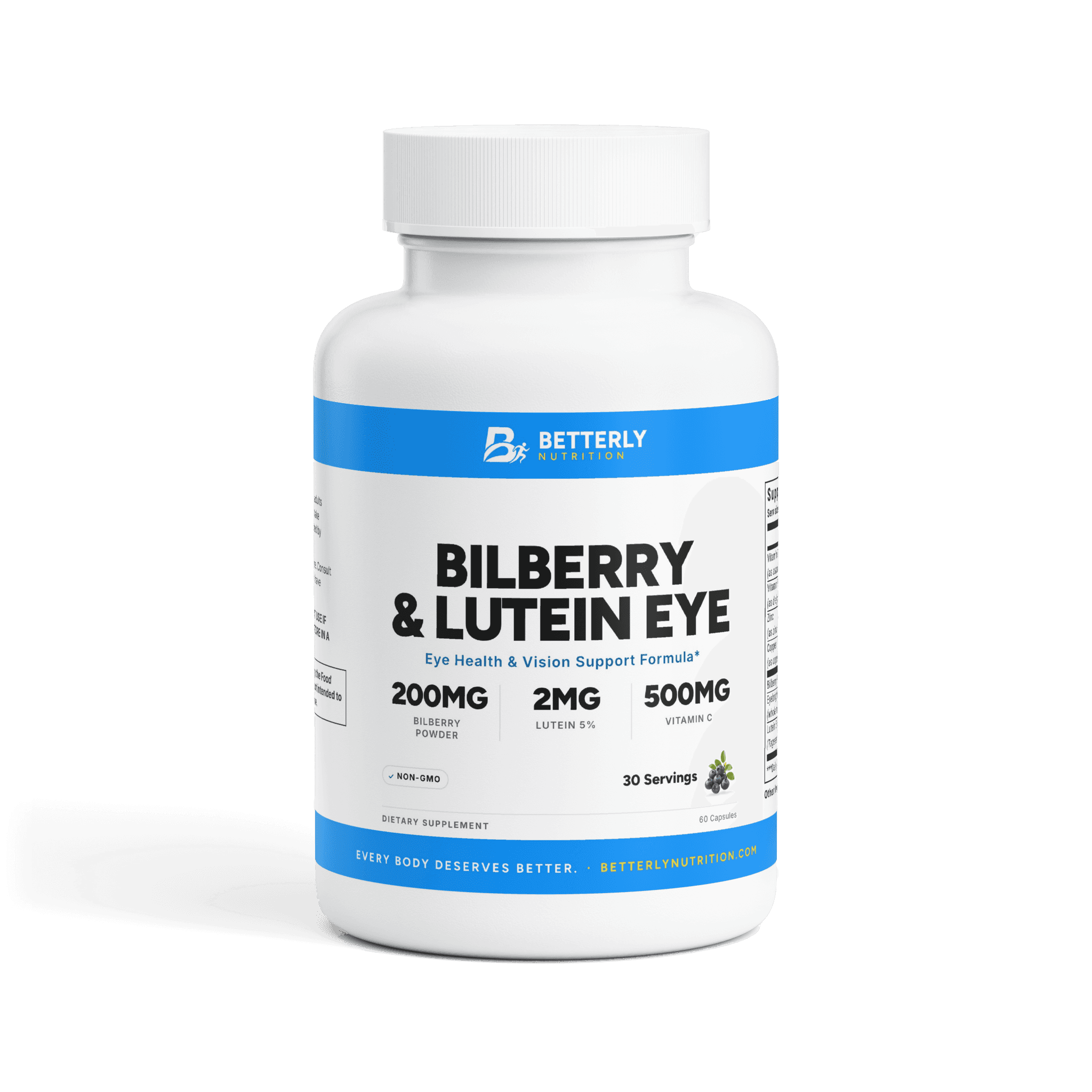
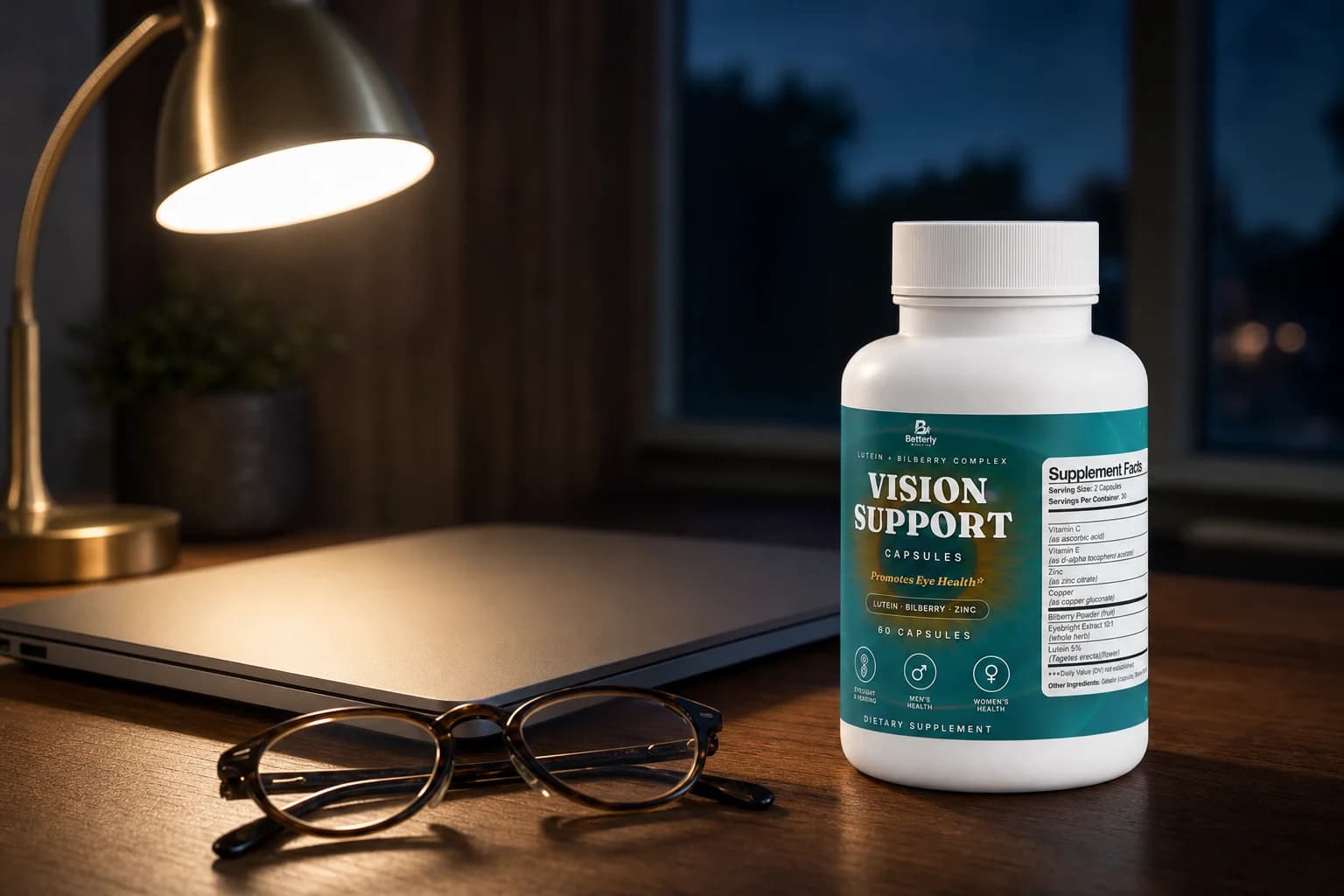
You'll find all three combined in our Bilberry & Lutein Eye Capsules. It lists 80 mg of zinc with 0.9 mg of copper, 500 mg of vitamin C and 30 mg of vitamin E per two-capsule serving, with 200 mg of bilberry fruit powder and 2 mg of a 5% lutein extract from marigold flower as the botanical layer. Honest framing, both directions: if you specifically want study-scale lutein, this isn't that product; if you want lutein, bilberry and zinc together in one capsule, it covers all three, but its zinc amount is one to clear with a healthcare provider first (see the caution below). Sixty capsules, and the whole label is on the product page.
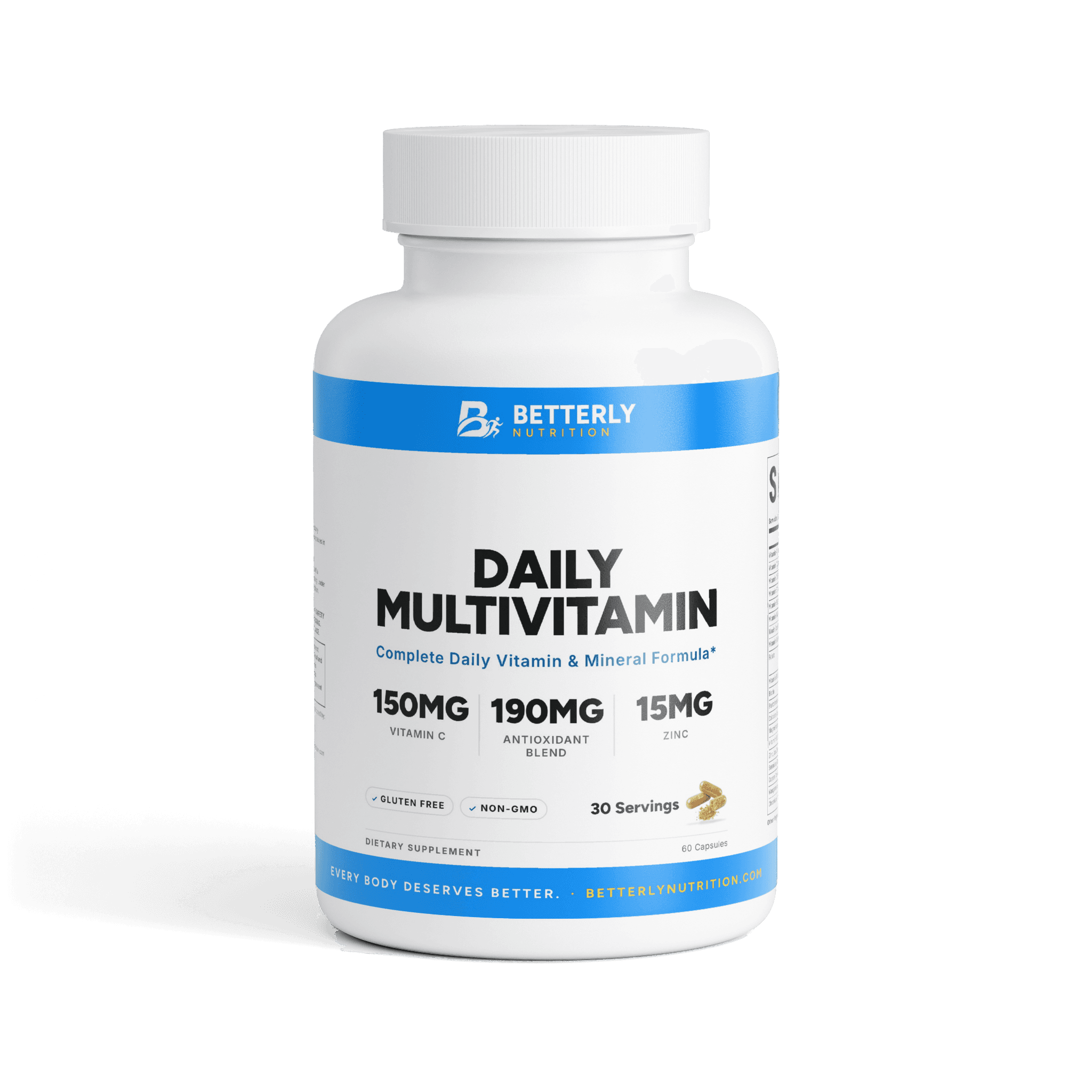
One caution on that zinc: according to NIH's Office of Dietary Supplements, the adult upper limit for zinc is 40 mg a day from all sources, including foods, beverages, supplements and medications. One two-capsule serving of our Bilberry & Lutein Eye Capsules provides 80 mg, twice that limit. Talk with a healthcare provider before taking it, and don't add other zinc on top: our Daily Multivitamin Capsules alone carry 15 mg per 2-capsule serving.
What research suggests about lutein and heavy screen use
This deserves its own section, because it's where marketing most often outruns the evidence. Here's the honest picture.
In small randomized studies of adults who spend six or more hours a day on screens, lutein and zeaxanthin supplementation over several months has been associated with higher macular pigment density — essentially, a denser version of the eye's own light filter. Some of those studies also reported improvements in self-rated eye strain, eye fatigue and sleep quality. Others were more mixed: one found gains on objective measures like tear quality and glare-recovery time, while participants' self-reported comfort didn't separate from placebo.
Two practical conclusions. First, this is slow biology — carotenoids accumulate in the eye over weeks to months, which is why the studies ran from eight weeks to six months. Second, the effects in research are modest and gradual, not dramatic. A fair way to think about lutein is as a reasonable, low-risk addition for someone with long screen days — not a rescue.
How to read an eye-supplement label
Here's the skill that separates a considered purchase from a hopeful one, and it takes about thirty seconds per bottle. When you're deciding what to look for in an eye supplement:
- Look for a named amount next to each active ingredient. "Lutein, 20 mg" tells you something. "Proprietary vision blend, 800 mg" tells you almost nothing — a blend's weight can be mostly filler, with the actives at token levels.
- Compare active amounts, not capsule size or count. The milligrams of the active are the number that matters, not the size of the capsule around them — a large capsule can carry a token amount of the ingredient you actually came for.
- For herbs like bilberry, check the form. Standardized extracts concentrate the anthocyanins; whole-fruit powder is gentler and far less concentrated. Neither is wrong, but the form changes what a milligram means — so compare like with like, and expect powder amounts to read higher for the same effect.
- Check the serving size. Amounts are listed per serving, and a "serving" can quietly be two or three capsules. Divide before you compare.
- Be suspicious of kitchen-sink formulas. Two dozen ingredients in one capsule usually means trace amounts of everything and a meaningful amount of nothing.
We're obviously biased, but this is why our product pages show the amounts from each Supplement Facts panel, and say plainly when a blend lists only a total weight, so you can run this comparison on ours too. If a brand makes the amounts hard to find, that's information too.
How to choose a formula that fits your screen day
There's no single right answer with eye supplements for screen time — it depends on what your day actually looks like. A few honest matchups:
- Eyes are the main complaint, and screens are your whole job. A dedicated eye formula is one option to talk over with a healthcare provider. Our Bilberry & Lutein Eye Capsules combine bilberry, lutein, zinc and vitamin C in one two-capsule serving, with the botanicals at gentle amounts. That serving also carries 80 mg of zinc, twice the 40 mg adult upper limit listed by NIH's Office of Dietary Supplements, so check with a healthcare provider before starting.
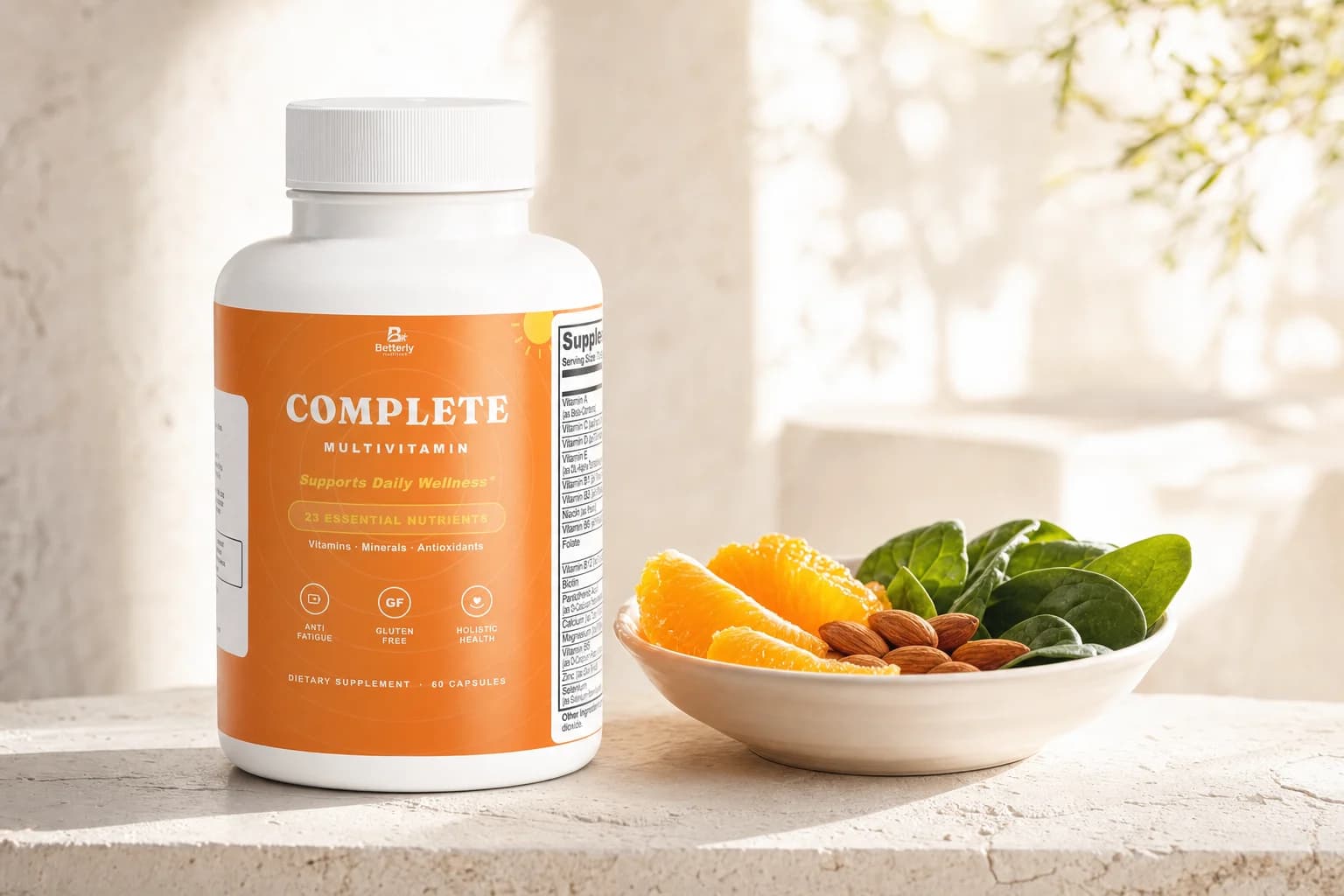
- You're not sure your basics are covered. Nutritional gaps show up in your eyes as much as anywhere. Our Daily Multivitamin Capsules, with 20 vitamins and minerals per 2-capsule serving, are a sensible foundation — and our guide Do You Actually Need a Multivitamin? will help you decide honestly whether you do.
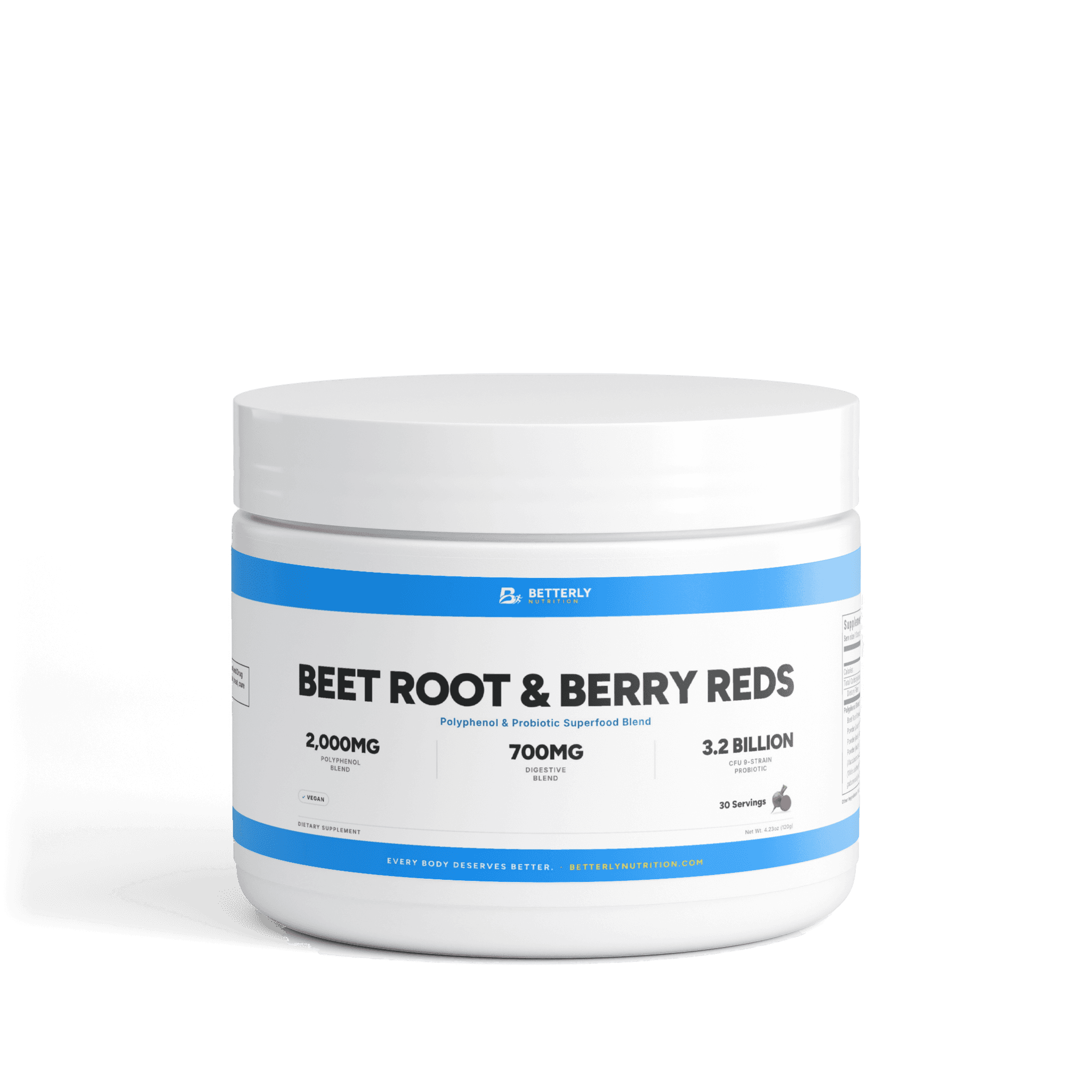
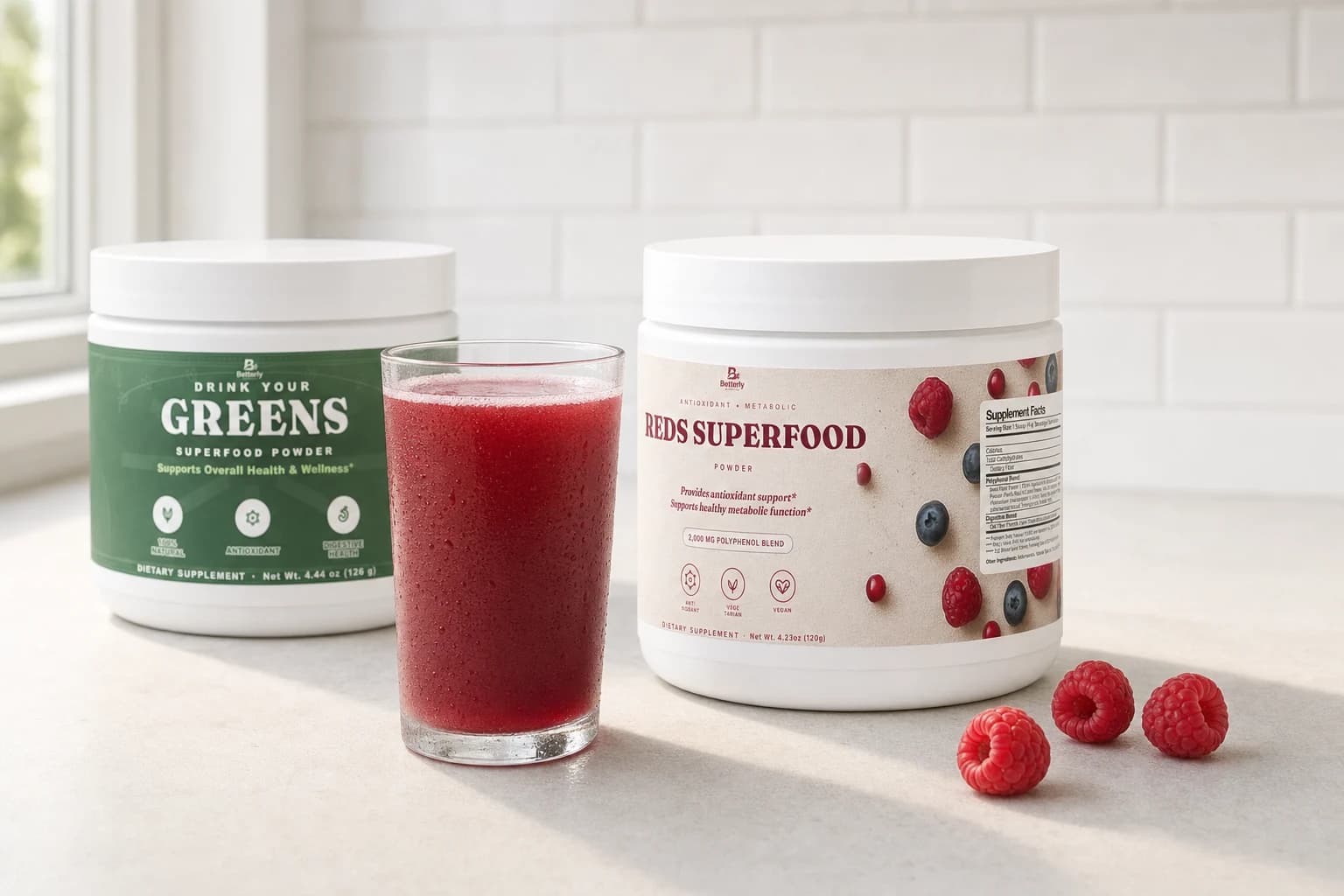
- You'd rather get plant pigments through something food-like. A scoop of Beet Root & Berry Reds Powder brings beet root powder plus berry ingredients, including blueberry extract and cranberry powder (cousins of bilberry), into a daily drink. Curious how red blends differ from green ones? Our guide to reds vs greens powders breaks it down.
All of these live in our shop if you'd rather browse the whole shelf.
Fitting an eye supplement into your routine
Eye supplements for screen time earn their keep through repetition, not timing tricks. A few pointers:
- Know what the label says. The label's suggested use for our Bilberry & Lutein Eye Capsules is two capsules daily for adults, with 6-8 oz of water, or as directed by a healthcare professional. That serving carries 80 mg of zinc, twice the 40 mg adult upper limit listed by NIH's Office of Dietary Supplements, so don't start it without a healthcare provider's go-ahead.
- Same time, every day. With slow-building ingredients, consistency beats everything. Pick a time you'll remember.
- Keep the habits. The 20-20-20 breaks and blink checks aren't optional extras; they're the main event the supplement supports.
- Loop in your eye doctor. Mention any supplement at your regular exam — and if you're pregnant, nursing, under 18, take any medication or are managing a medical condition, check with a healthcare professional before starting anything new.
If you're adding this to an existing stack, our guide to building a simple daily supplement routine shows how to slot it in without turning your counter into a pharmacy shelf.
Key takeaways
- Screen fatigue is mostly mechanics — reduced blinking and locked-in near focus — which is why habits help first and help most.
- Lutein and zeaxanthin are the pigments your eyes already use to filter high-energy blue light; research in heavy screen users suggests modest, slow-building support, at 10 to 20 mg per day in those studies.
- Bilberry's anthocyanins have a small but specific research footprint in office workers with tired eyes.
- Zinc quietly supports the vitamin A cycle your retina depends on for low-light vision.
- Read labels for named amounts, not blend weights — a thirty-second skill that filters out most of the shelf.
- Lutein builds up slowly in the eye, which is why the studies ran for months, so keep taking your breaks either way.
FAQ: eye supplements for screen time
Do eye supplements actually help with screen fatigue?
Sometimes, modestly, and slowly — that's the honest answer. Research suggests ingredients like lutein, zeaxanthin, and bilberry can support eye comfort in people with heavy screen time; those studies ran from eight weeks to six months. Habits like screen breaks and deliberate blinking help faster and help more. The two together beat either alone.
What are the best eye vitamins for computer users?
The ingredient families with the most screen-specific research are the macular carotenoids (lutein and zeaxanthin), anthocyanin-rich berry extracts like bilberry, and supporting minerals like zinc. Whichever brand you choose, favor one that states an exact amount for every active ingredient — a formula you can't evaluate isn't worth guessing on.
How long does lutein take to work?
Longer than you'd like. Lutein accumulates gradually in the macula, and studies generally run eight weeks to six months before measuring change. The label's suggested use for our Bilberry & Lutein Eye Capsules is two capsules daily with 6-8 oz of water, but that serving carries 80 mg of zinc, twice the 40 mg adult upper limit listed by NIH's Office of Dietary Supplements, so ask a healthcare provider before starting.
Can I get these nutrients from food instead?
Largely, yes — and food first is a fine strategy. Lutein is concentrated in spinach, kale, and egg yolks; anthocyanins in dark berries; zinc in meat, shellfish, and legumes. A supplement is a consistency tool, not the only path. And if you're curious about leaf powders as a food-adjacent option, here's what moringa is good for.
Do blue-light glasses do the same thing as lutein?
They aim at the same wavelengths from different directions — glasses filter light outside the eye, lutein filters it inside. The research on blue-light glasses for tired eyes is surprisingly mixed, partly because so much screen fatigue comes from blinking and focus mechanics rather than blue light itself. Neither replaces taking breaks.
Can I take an eye supplement alongside a multivitamin?
Not without checking with a healthcare provider first, because zinc is where the two overlap. According to NIH's Office of Dietary Supplements, the adult upper limit for zinc is 40 mg a day from all sources, including foods, beverages, supplements and medications. Our Bilberry & Lutein Eye Capsules already provide 80 mg per two-capsule serving, twice that limit, and our Daily Multivitamin Capsules add 15 mg per 2-capsule serving, so don't combine them without your provider's go-ahead.
Sources
- Zinc: Fact Sheet for Consumers, NIH Office of Dietary Supplements
- Lopresti AL, Smith SJ. "The effects of lutein/zeaxanthin (Lute-gen®) on eye health, eye strain, sleep quality, and attention in high electronic screen users: a randomized, double-blind, placebo-controlled study." Frontiers in Nutrition, 2025. PMID 39963662.
- Stringham JM, Stringham NT, O'Brien KJ. "Macular Carotenoid Supplementation Improves Visual Performance, Sleep Quality, and Adverse Physical Symptoms in Those with High Screen Time Exposure." Foods, 2017. PMID 28661438.
- Ozawa Y and colleagues. A randomized, placebo-controlled trial of 480 mg a day of bilberry extract for eight weeks in office workers who use video display terminals. Journal of Nutrition, Health & Aging, 2015. PMID 25923485.
If this left you looking for somewhere to start, read bilberry and lutein eye capsules with vitamins C and E — its amounts per serving are listed on the page. For the practical questions this raises, how dosing, sourcing and subscriptions work is answered in one place.