On this page
- Key takeaways
- Why do fish oil burps happen?
- What are the other common fish oil side effects?
- How do you stop fish oil burps without changing your dose?
- Does a fishy aftertaste mean your fish oil has gone bad?
- Do enteric-coated or burp-free fish oils actually help?
- Do cod liver oil, krill oil and algal oil cause burps too?
- How should you take Betterly's fish oil softgels?
- When is a fish oil supplement not worth the aftertaste?
- Who needs medical advice before taking fish oil?
- FAQ: fish oil burps
- Sources
The short answer: Fish oil burps are usually explained as swallowed air coming back up and picking up the taste of the oil on its way. Nothing guarantees a burp-free softgel, but a few habits leave your dose alone: take one softgel per meal, as our Omega-3 Fish Oil Softgels label directs, eat that meal slowly, and keep the bottle cool, dry and tightly closed.
Key takeaways
- The NIH lists an unpleasant taste, bad breath and heartburn among the side effects of omega-3 supplements, and it describes those side effects as usually mild.
- Betterly's fish oil label pairs each of its 2 daily softgels with a meal, and MedlinePlus says eating more slowly means you swallow less air.
- A mild fish smell is normal for fish oil, but a sour or sharp smell from a freshly opened bottle is a good reason to stop and contact the seller.
- Betterly's softgel lists no enteric coating and no added flavor, so it can leave the same aftertaste as any plain fish oil.
- Ask a healthcare provider about fish oil first if you take any prescription medicine (blood thinners above all), have surgery coming up or are allergic to fish.
We sell one of these: a plain fish oil softgel with no special coating. So we'll point out what its label covers, where it comes up short on aftertaste, and which habits carry over to whatever bottle you own. It sits in our targeted support range.
Why do fish oil burps happen?
The usual explanation for fish oil burps is that some air you swallow comes back up as a burp, and after a softgel it can carry the oil's taste.
Burping by itself is ordinary. MedlinePlus's page on gas and burping says passing gas through the mouth is called belching or burping, and that one source of the gas in your digestive tract is air you swallow. Everyone does it.
What fish oil adds is the flavor. Our label lists 1,000 mg of fish oil concentrate per 1-softgel serving, about a gram of oil, and oil doesn't blend into the watery contents of a stomach. The common account is that the oil floats near the top, so a burp passes over it and brings its taste into your mouth.
That's a sensible explanation, not a measured one, but it points to what you control: food, how many softgels go down at once, and the bottle's age and storage.
What are the other common fish oil side effects?
The NIH Office of Dietary Supplements says omega-3 supplement side effects are usually mild, listing unpleasant taste, bad breath, heartburn, nausea, stomach discomfort, diarrhea, headache and smelly sweat.
That list comes from the ODS omega-3 fact sheet for consumers. A near-identical list appears in the omega-3 supplement overview from the National Center for Complementary and Integrative Health (NCCIH).
"Fishy burps" isn't a phrase either agency uses. The closest match is an unpleasant taste, plus the bad breath that lingers after.
Heartburn is the one worth understanding clearly. MedlinePlus defines heartburn as a painful burning feeling in your chest or throat that happens when stomach acid backs up into your esophagus. That's different from a fishy taste, and the provider section below covers when it deserves a call.
How do you stop fish oil burps without changing your dose?
You can try to curb fish oil burps without touching your dose: one softgel per meal as our label directs, slow eating, and a bottle kept cool and dry.
How the common suggestions compare, forum favorites included:
| Habit | Changes your label dose? | Where it comes from |
|---|---|---|
| Take each softgel with a meal | No | Our label's directions |
| Keep the two softgels at separate meals | No | Our label's schedule |
| Eat slowly; choose non-fizzy drinks | No | MedlinePlus tips on gas |
| Store in a cool, dry place | No | Our label's storage line |
| Retire a bottle that smells sour | No | Practical freshness sense |
| Keep softgels in the freezer | No | Some people try it; not on our label |
| Switch to an enteric-coated brand | Maybe | That brand's own label |
| Take extra to "get used to it" | Yes, so don't | Goes against our label |
Read down the middle column: the first six habits keep you at the label's 2 softgels a day, and three of them come straight off our bottle. A new brand means a new label to follow, and taking extra is the one row that breaks ours.
Start with meals. Our label ties each softgel to one, so nothing goes down on an empty stomach. If you're still choosing which two meals, our guide to fish oil timing can help you settle it.
Keep the pair apart, too. Swallowing both at one sitting puts about 2 g of oil in your stomach instead of 1 g, and the label splits them between two meals.
Then slow down at that meal. Among the MedlinePlus ways to cut down on gas are slower eating, so less air goes down with your food, and plenty of water or other non-fizzy drinks. We can't promise that takes the fish out of a burp. It does mean less swallowed air to come back up, and it costs nothing.
One gap is worth stating once. The ODS, NCCIH and MedlinePlus pages we cite don't measure whether food, freezing, an enteric coating or a switch to gummies changes fishy burps, or whether the aftertaste fades with time. So when those questions come up below, we stick to what the labels show.
Does a fishy aftertaste mean your fish oil has gone bad?
A fishy aftertaste alone doesn't mean fish oil has gone bad, since fresh fish oil still tastes of fish. A sour or sharp smell from the bottle is a better reason to stop.
Fish oil is rich in polyunsaturated fat: per 1-softgel serving, our panel lists 0.5 g of it within 1 g of total fat. Oils go stale, or rancid, as they age, and the everyday advice is to keep them away from heat and air. Your nose is the simplest check you have.
Freshness checks you can run at home:
- Smell the bottle when you first open it. A mild fish smell is expected; a sour or sharp one is your cue to stop.
- Find the date printed on the bottle, and open older bottles before newer ones.
- Check the seal before your first softgel. Our label says not to use the bottle if that seal is damaged or missing.
- Close the cap tightly after each use, and keep the bottle away from the stove, a sunny window or a hot car.
- Buy what you'll finish. At the label's 2 softgels a day, a 100-softgel bottle lasts 50 days.
If a new bottle smells off, stop taking it and contact the seller.
Do enteric-coated or burp-free fish oils actually help?
Enteric-coated fish oil may cut fishy burps, since its coating is meant to stay shut through the stomach, but that's the brand's reasoning, not a result we can show you.
The idea is that the softgel releases its oil after the stomach instead of in it. "Burp-free" and "burpless" on a front label don't tell you what the maker changed, so turn the bottle around and look for the specifics:
- An enteric coating, named on the label
- An added flavor, such as lemon, in the other ingredients
- A different oil, like krill or algal oil (next section)
Betterly's softgel has none of the three. Its other-ingredients line reads "Softgel (gelatin, glycerin and water) and Vitamin E." No coating, no flavor. If you want a coating, ours doesn't have one; meals, pacing and storage are the tools left.
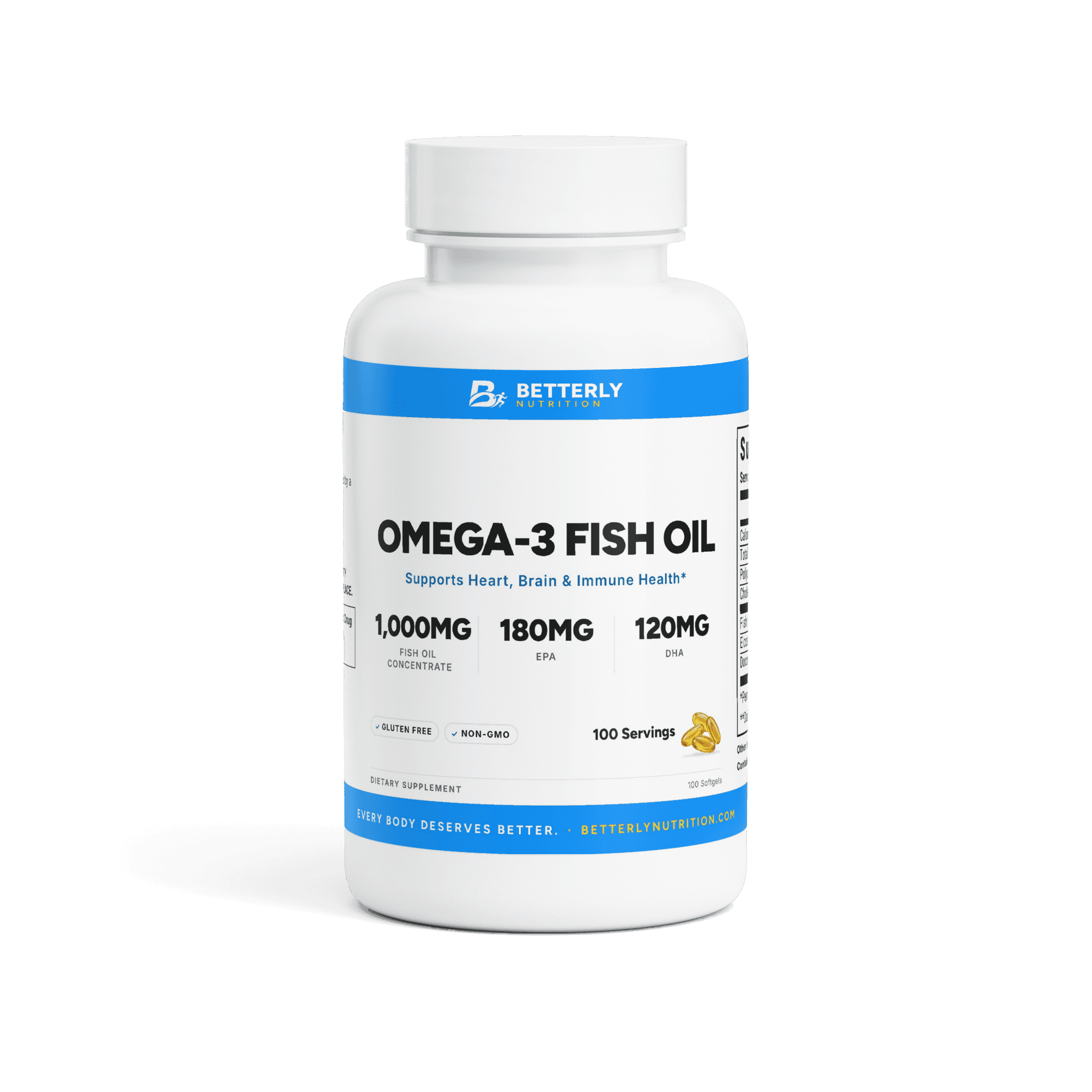
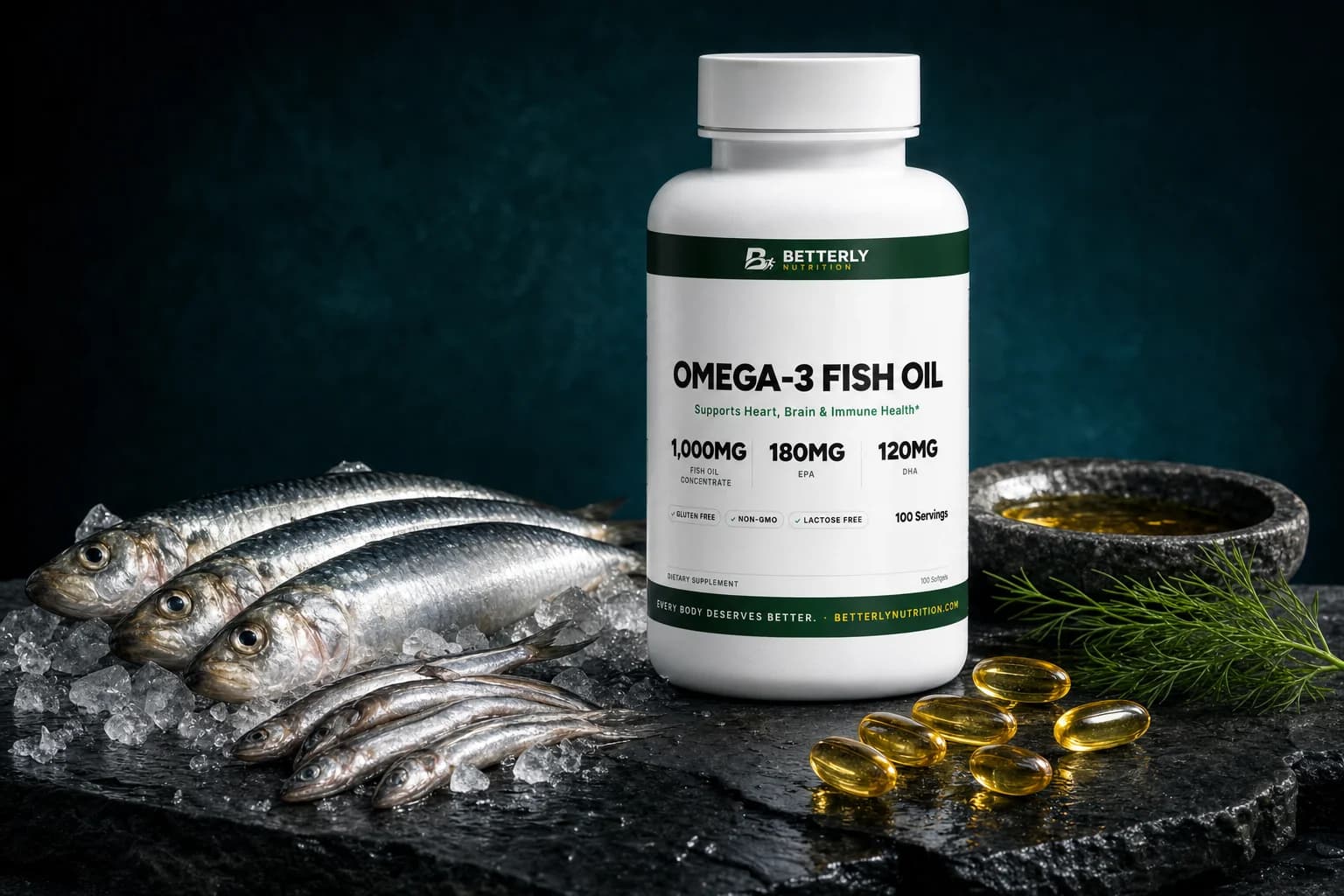
From our shop: Omega-3 Fish Oil Softgels — a plain, uncoated gelatin softgel with no added flavor, listing 180 mg of EPA and 120 mg of DHA per 1-softgel serving and directions to take each one with a meal.
Do cod liver oil, krill oil and algal oil cause burps too?
Cod liver oil can leave the same fishy aftertaste, because it's a fish oil too. Krill and algal oils come from other sources, and we can't give you a fair comparison of their aftertaste.
Cod liver oil comes with extra vitamins A and D, and NCCIH cautions that both can do harm at excessive intakes. Algal oil is made from algae, so if a fish allergy is behind your search, take that question to your allergist. We don't sell any of the three.
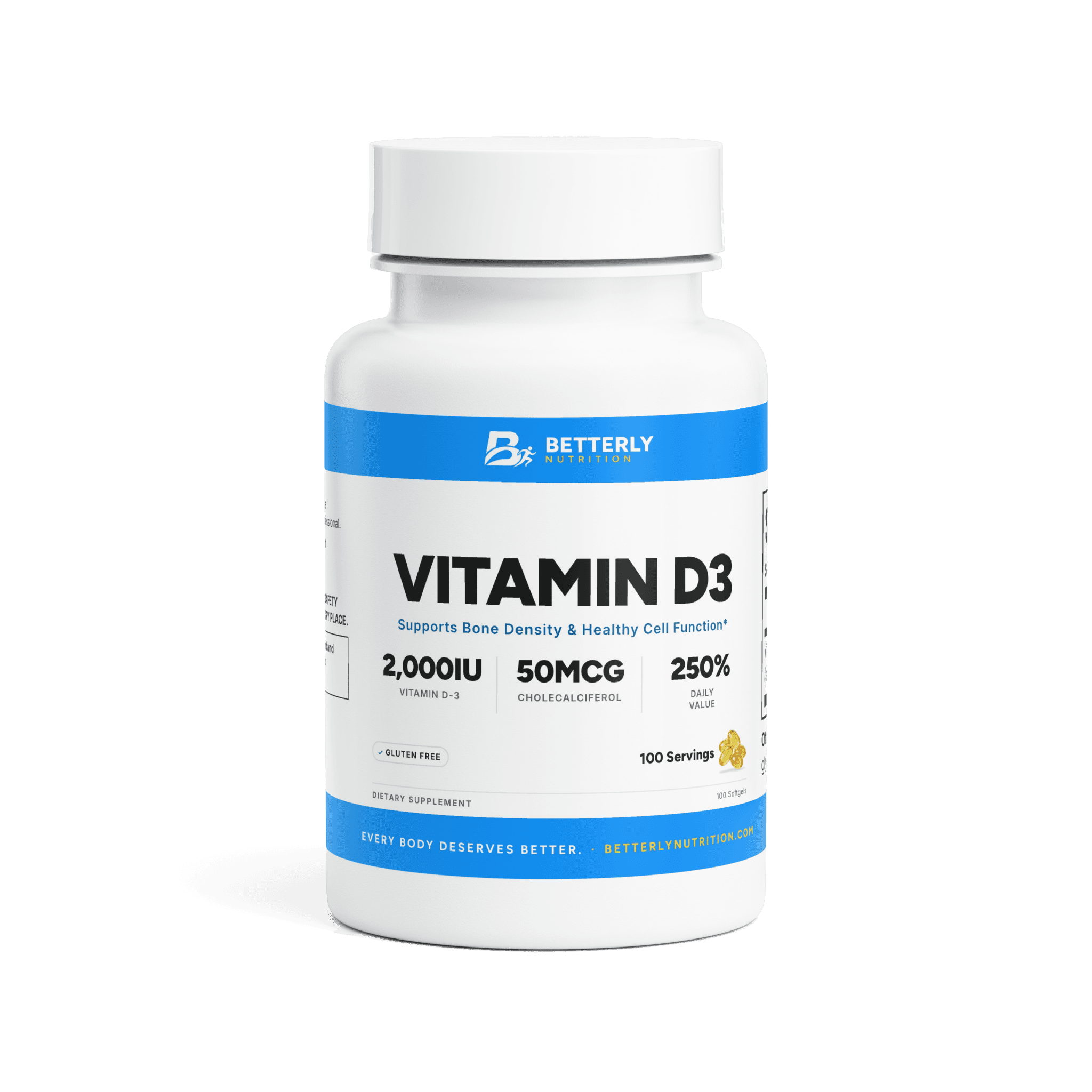
If cod liver oil was your vitamin D source and its taste wore you down, you could cover vitamin D on its own. Our Vitamin D3 Softgels list 50 mcg (2,000 IU) of vitamin D3 per 1-softgel serving, and the only oils on that label are soybean and corn. It won't give you EPA or DHA, though.
From our shop: Vitamin D3 Softgels — 50 mcg (2,000 IU) of vitamin D3 per 1-softgel serving in a soybean and corn oil softgel, with directions for one a day.
How should you take Betterly's fish oil softgels?
Betterly's Omega-3 Fish Oil Softgels label asks adults for 2 softgels a day, one with each of two meals, and cautions against going over that.
The label's wording is: "As a dietary supplement, adults take one (1) softgel, two (2) times daily with meals, or as directed by a health care professional."
Pick two separate meals you actually sit down for, since slow eating is easier at a meal you're not rushing. Our walkthrough of the omega-3 math on a fish oil panel shows what those two softgels add up to.
If the aftertaste still bothers you on the label's schedule, don't rearrange the dose to dodge it. Pause the softgels and bring it up with your doctor or pharmacist.
When is a fish oil supplement not worth the aftertaste?
A fish oil supplement may not be worth the aftertaste if the burps have you skipping doses, or if fatty fish already shows up on your plate most weeks.
Fish oil isn't a requirement. According to ODS, experts haven't set a recommended amount for EPA or DHA, and cold-water fatty fish such as salmon, mackerel, herring and sardines supply both.
Signs it's time to pause or rethink:
- You skip doses to dodge the taste. A bottle you avoid half the week isn't much of a routine, and stopping is a fair call.
- You've started taking both softgels at bedtime, hoping to sleep through the burps. The label pairs each one with a meal, so that workaround has already left the directions.
- The fishy taste arrives with nausea or stomach discomfort most days. That's more than a flavor problem, so stop and raise it with your doctor.
Still sorting out which supplements earn a daily spot? Our guide to building a simple routine walks through it.
Who needs medical advice before taking fish oil?
Before fish oil, ask a provider if you take any prescription medicine, face surgery, have a fish allergy, are pregnant or nursing, are under 18 or have a medical condition.
The pregnancy, nursing, age and medical-condition groups come straight from the softgel's caution: "Do not exceed recommended dose. Consult a physician if pregnant, nursing, under 18, or have a medical condition."
- Taking any prescription medicine? ODS says omega-3 supplements may interact with the medications you take, and it suggests talking with your provider about possible interactions.
- Medicines that affect blood clotting are the example ODS highlights. It warns that bleeding problems may follow when high doses of omega-3s are combined with anticoagulant (blood-thinning) medicines, so let your prescriber weigh whether fish oil belongs in your routine.
- Surgery on the calendar? Tell the surgical team about fish oil and every other supplement well ahead, and follow their stop and restart dates.
- Allergic to fish? This softgel's "Contains" line names sardines and anchovies, so talk to your allergist before you open the bottle.
- Heartburn more than twice a week may point to something beyond an occasional flare, according to MedlinePlus. Stop the softgels and raise it with your doctor.
- Crushing chest pain needs help immediately, MedlinePlus says. Hives or swelling after any fish product also need prompt care.
FAQ: fish oil burps
Do fish oil burps go away on their own?
Nobody can promise that fish oil burps fade over time. ODS describes omega-3 side effects as usually mild but doesn't say whether they ease with use. If the aftertaste sticks around while you follow Betterly's label of a softgel at each of two meals, check how the bottle is stored and how it smells, or pause and ask your provider. Don't add softgels hoping your body adjusts; the caution on the label starts with "Do not exceed recommended dose."
Is it safe to keep taking fish oil if it makes you burp?
An unpleasant taste is one of the usually mild side effects ODS lists for omega-3 supplements, so fish oil burps on their own are often a nuisance rather than a warning sign. Stop the softgels and phone your provider if heartburn becomes frequent, nausea or diarrhea hangs on, or you notice hives or swelling. Anyone on a prescription medicine, blood thinners in particular, should get a provider's view either way.
Why do some fish oil burps taste like lemon or mint?
Some fish oil brands add a flavor, such as lemon or mint, so the burp carries that taste too. Look for it in the label's other ingredients. Betterly's softgel lists gelatin, glycerin, water and vitamin E, with no flavor, so its aftertaste is simply fish. A flavor may change how a burp tastes, but the label won't tell you whether it changes how often you burp.
Are fish oil gummies or liquids a way around the burps?
Not necessarily. Fish oil gummies and liquids still contain fish oil, and the federal pages we rely on don't compare burps across formats. If you look at one, read its other ingredients for added flavors, and compare its EPA and DHA per serving with your current product's panel, since amounts vary. Betterly sells fish oil only as a softgel.
Can fish oil cause bad breath as well as burps?
Yes, fish oil can cause bad breath. ODS and NCCIH both put it on their lists of usually mild omega-3 side effects, next to an unpleasant taste and smelly sweat. The same label habits are worth keeping: take each softgel with a meal and keep the bottle fresh, cool and sealed. If it keeps bothering you, pausing the supplement is a reasonable choice.
Sources
- Omega-3 Fatty Acids: Fact Sheet for Consumers, NIH Office of Dietary Supplements
- Omega-3 Supplements: What You Need To Know, National Center for Complementary and Integrative Health
- Gas, MedlinePlus
- Heartburn, MedlinePlus
If this left you looking for somewhere to start, read fish oil softgels taken with meals — its amounts per serving are listed on the page. For the practical questions this raises, how dosing, sourcing and subscriptions work is answered in one place.