On this page
- Key takeaways
- How much omega-3 is in 1,000 mg of fish oil?
- Is fish oil the same as omega-3?
- How do you read EPA and DHA on a fish oil label?
- How much EPA and DHA is in 2,000 mg of fish oil?
- Why can't you count the DHA in a proprietary blend?
- How much EPA and DHA per day do adults need?
- How should you take a 1,000 mg fish oil softgel?
- When don't you need a fish oil supplement?
- Who should check with a healthcare provider before taking fish oil?
- FAQ: omega-3 in fish oil
- Sources
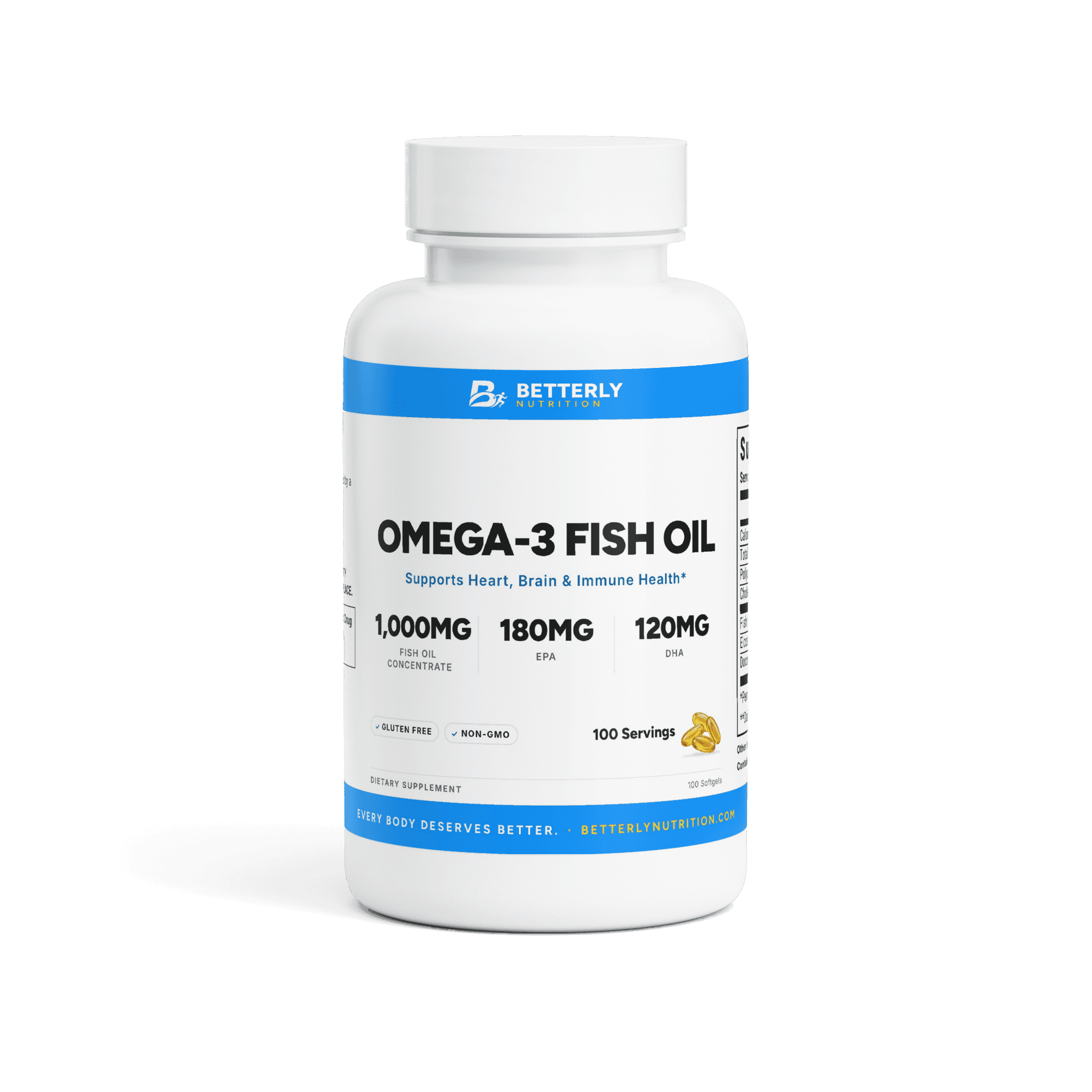
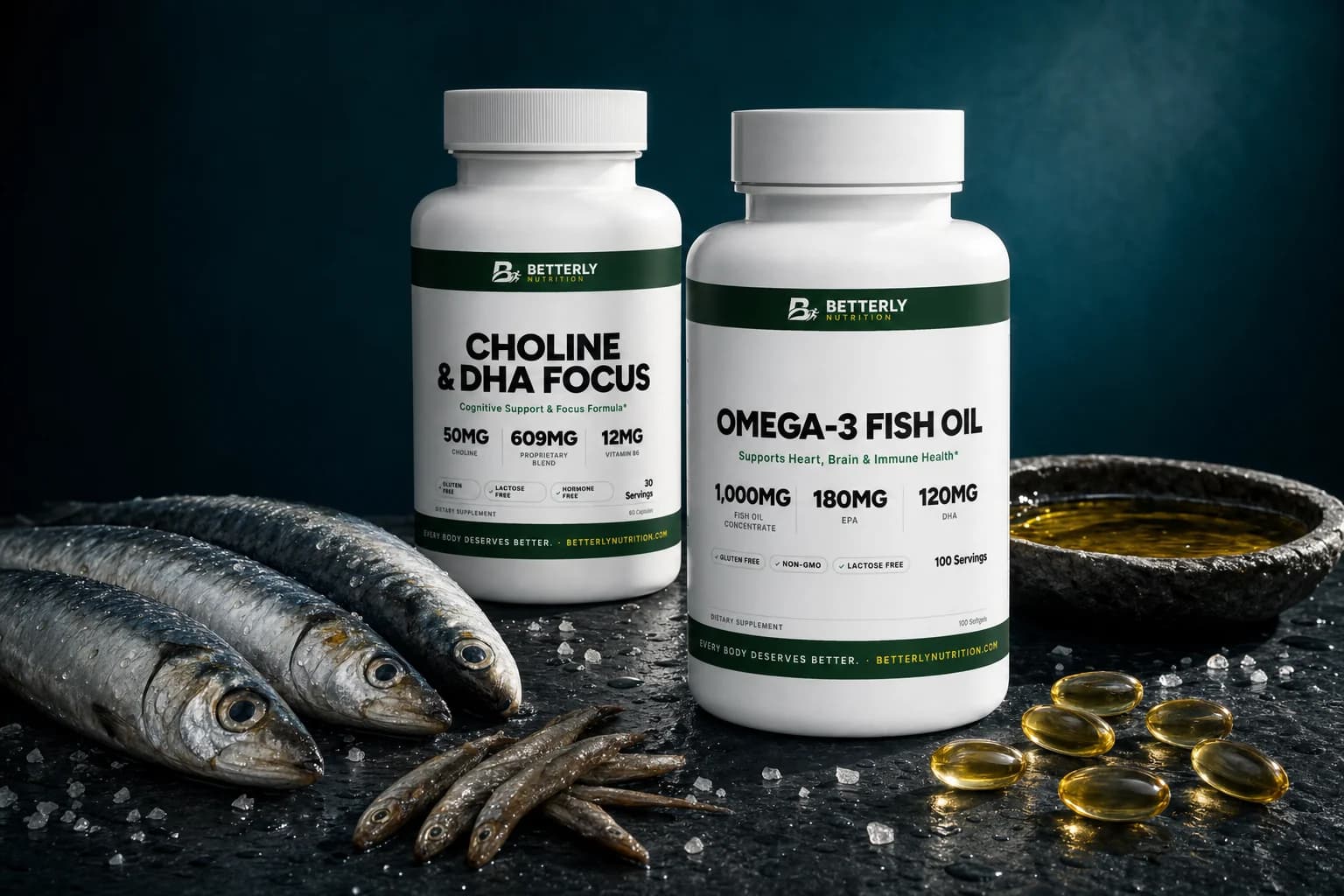
The short answer: On many fish oil labels, ours included, the 1,000 mg is the weight of the whole oil, so the omega-3 you can count in 1,000 mg fish oil is the EPA and DHA its panel lists. Our Omega-3 Fish Oil Softgels carry 180 mg of EPA and 120 mg of DHA in each 1,000 mg softgel. That's 300 mg of EPA and DHA per softgel, or 600 mg at the label's two softgels a day.
Key takeaways
- The big milligram number on a fish oil bottle's front is usually the oil's weight, not its omega-3 content, so check the panel to see which one it is.
- Adding the EPA and DHA lines on the Supplement Facts panel tells you how much of those two omega-3s one serving holds.
- Betterly's Omega-3 Fish Oil Softgels list 180 mg of EPA and 120 mg of DHA per 1-softgel serving, 300 mg combined, so 30% of each softgel's oil is those two omega-3s.
- According to the NIH Office of Dietary Supplements, no recommended daily amount has been established for EPA and DHA, and the FDA advises no more than 5 g a day of the two combined from supplements.
Full disclosure: we sell a fish oil softgel. Every number we quote for it comes off its Supplement Facts panel, and the arithmetic below works on any brand's bottle. Our single-purpose formulas live in the targeted support collection.
How much omega-3 is in 1,000 mg of fish oil?
A 1,000 mg fish oil softgel gives you the EPA and DHA its panel lists, and for Betterly's Omega-3 Fish Oil Softgels that's 300 mg per softgel.
On our label, the 1,000 mg is the fill weight: all the oil sealed inside one capsule. EPA (eicosapentaenoic acid) and DHA (docosahexaenoic acid) are two fats within that oil, and they make up only part of the fill.
Here's how our label splits one softgel:
- Fish oil concentrate: 1,000 mg
- EPA: 180 mg
- DHA: 120 mg
- EPA and DHA together: 300 mg
The panel doesn't break the other 700 mg into named fats, so the omega-3 you can count is the 300 mg.
So two bottles can both say 1,000 mg on the front and still differ inside.
Is fish oil the same as omega-3?
Fish oil isn't the same as omega-3. Fish oil comes from oily fish, and it supplies two members of the omega-3 fat family, EPA and DHA.
The NIH Office of Dietary Supplements (ODS) omega-3 fact sheet names three main omega-3s. ALA (alpha-linolenic acid) comes mostly from plant oils such as flaxseed, soybean and canola. EPA and DHA come from fish and other seafood. Your body turns some ALA into EPA and then DHA, but ODS says only in very small amounts.
So a flaxseed oil and a fish oil can both say "omega-3" and deliver different fats. The National Center for Complementary and Integrative Health (NCCIH) sorts the options in its guide to omega-3 supplements:
| Supplement | Omega-3s it provides (per NCCIH) | What to check on the panel |
|---|---|---|
| Fish oil | EPA and DHA | EPA and DHA mg per serving |
| Cod liver oil | EPA and DHA, plus vitamins A and D | The vitamin A and D lines, too |
| Krill oil | Omega-3s as phospholipids | EPA and DHA mg, not krill oil mg |
| Algal oil | DHA, and in some products EPA | Whether EPA is listed at all |
| Flaxseed oil | ALA | ALA mg, since it isn't EPA or DHA |
The takeaway: whatever the source, compare milligrams of each named omega-3 per serving, never the oil's total weight.
Weighing fish oil against a 3-6-9 blend? MedlinePlus's overview of polyunsaturated fats says those fats include omega-3s and omega-6s, which the body needs for brain function and cell growth. A 3-6-9 capsule splits its fill among three fat families, so find its EPA and DHA lines first. How EPA and DHA differ is covered in our EPA vs DHA guide.
How do you read EPA and DHA on a fish oil label?
To read EPA and DHA on a fish oil label, check the serving size first, then add the EPA and DHA lines. That sum is your EPA and DHA per serving.
Start with the serving size
Our softgel's serving size is 1 softgel. The FDA's dietary supplement labeling guide defines a serving as the most the label recommends per eating occasion. Our directions call for one softgel at each of two meals, so your daily total is double the panel.
If a brand's serving is 2 or 3 softgels, every milligram covers that whole handful, so divide to find one capsule's share.
Read the fat lines at the top
Per 1-softgel serving, ours lists 10 calories, 1 g of total fat, 0.5 g of polyunsaturated fat and 10 mg of cholesterol. MedlinePlus notes that all fats contain 9 calories per gram, which is why 1 g of oil lands near 10 calories. Omega-3s are polyunsaturated, so the 300 mg of EPA and DHA sits inside that rounded 0.5 g line.
Find the fish oil line, then its parts
Next comes fish oil concentrate at 1,000 mg, then EPA at 180 mg and DHA at 120 mg, which are parts of the 1,000 mg, not extra oil. The FDA guide lets brands indent an ingredient's parts beneath it, so some bottles tuck EPA and DHA under the oil.
Some brands add a "Total omega-3 fatty acids" line. If it's bigger than EPA plus DHA, the gap is other omega-3s. Ours lists EPA and DHA only and doesn't say what form the oil is in.
Decode the % Daily Value column
Where you'd expect a percentage, the fish oil, EPA and DHA lines show a symbol. The FDA guide says it must point to a footnote stating the Daily Value isn't established. That's normal for fish oil.
How much EPA and DHA is in 2,000 mg of fish oil?
Two of Betterly's 1,000 mg softgels, the label's daily amount, give 2,000 mg of fish oil with 360 mg of EPA and 240 mg of DHA, 600 mg combined.
| Amount | Fish oil concentrate | EPA + DHA |
|---|---|---|
| 1 softgel (one serving) | 1,000 mg | 300 mg (180 EPA, 120 DHA) |
| 2 softgels (label's daily use) | 2,000 mg | 600 mg (360 EPA, 240 DHA) |
| Whole bottle (100 softgels) | 100 g | 30 g (18 g EPA, 12 g DHA) |
The takeaway: EPA and DHA stay at 30% of the oil in every row, split 3 to 2 in EPA's favor, and at two a day the bottle lasts 50 days.
The same math works on any fish oil panel:
- Add EPA and DHA, then divide by the softgels in one serving. That's the EPA and DHA in a single softgel.
- Multiply by the softgels the label tells you to take each day. That's your daily EPA and DHA.
To compare concentration, divide EPA plus DHA by the fish oil weight. Ours is 300 ÷ 1,000, or 30%. A bottle sold as "1,000 mg omega-3" may mean the oil or the EPA and DHA, so read the panel to see which.
From our shop: Omega-3 Fish Oil Softgels — 1,000 mg of fish oil concentrate with 180 mg of EPA and 120 mg of DHA per 1-softgel serving, from sardines and anchovies, in a 100-softgel bottle.
Why can't you count the DHA in a proprietary blend?
You can't count DHA inside a proprietary blend because the FDA requires the blend's total weight but no separate amount for DHA, so its milligrams can go unprinted.
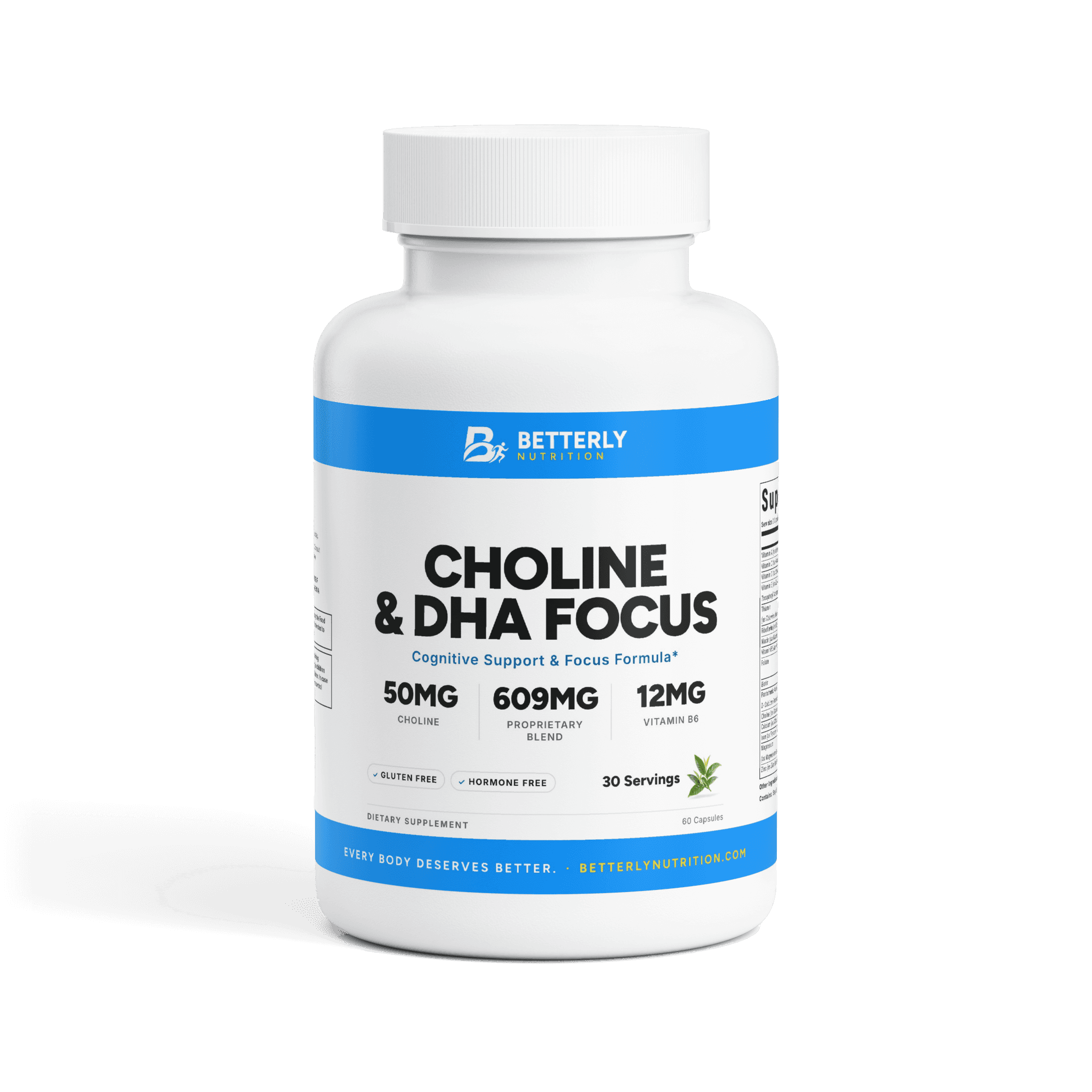
Our Choline & DHA Focus Capsules show what that looks like. Per 2-capsule serving, the panel gives exact amounts for 50 mg of choline, 12 mg of vitamin B6 and other vitamins and minerals. Then comes a 609 mg proprietary blend of 18 ingredients, from DMAE bitartrate to huperzine A. DHA is one of them, printed with "14%" beside it and no milligram figure.
The label doesn't say what that 14% is a percentage of, and we won't guess. Under the FDA guide, a blend lists its ingredients in descending order by weight. Any nutrient with a Daily Value must be listed separately with its own weight, and the rest need no individual amounts. Choline and vitamin B6 have one; DHA doesn't. DHA sits 15th of the 18, so it's one of the smaller parts of the 609 mg.
That's a real limitation of the Focus capsule. For a known amount of DHA, use a fish oil panel with its own DHA line. The Focus capsule is a choline and B-vitamin formula; our beginner's guide to nootropics covers where nutrients like choline fit.
From our shop: Choline & DHA Focus Capsules — 50 mg of choline and 12 mg of vitamin B6 per 2-capsule serving, plus a 609 mg proprietary blend that lists DHA without a separate amount.
How much EPA and DHA per day do adults need?
No recommended daily amount has been set for EPA and DHA. The NIH Office of Dietary Supplements says experts have set a recommended amount only for ALA, the plant omega-3.
ODS lists ALA amounts of 1.6 g a day for men and 1.1 g for women. It adds that most Americans get enough ALA from food, plus small amounts of EPA and DHA, and that omega-3 deficiency is very rare here.
For food, NCCIH points to the Dietary Guidelines for Americans, which recommend that adults eat 8 ounces or more of a variety of seafood each week. Salmon, mackerel, herring and sardines are among the fatty fish ODS lists.
Supplements do have a ceiling. According to ODS, the FDA recommends no more than 5 g a day of EPA and DHA combined from dietary supplements. Our label's two softgels come to 600 mg, or 0.6 g.
Our simple supplement routine guide helps you decide whether fish oil earns a daily slot at all.
How should you take a 1,000 mg fish oil softgel?
Take Betterly's Omega-3 Fish Oil Softgels the way the label says: one softgel, two times a day, with meals.
The full direction reads: "As a dietary supplement, adults take one (1) softgel, two (2) times daily with meals, or as directed by a health care professional." Our guide on when to take fish oil goes deeper on timing.
Side effects of omega-3 supplements are usually mild, according to NCCIH: an unpleasant taste, bad breath, bad-smelling sweat, headache, heartburn, nausea and diarrhea. If one sticks around, stop and check with your provider.
Store the bottle in a cool, dry place, and skip it if the safety seal is damaged or missing. The oil comes from fish and the shell is gelatin, so it isn't vegetarian.
When don't you need a fish oil supplement?
You may not need a fish oil supplement if you regularly eat fatty fish, already take another EPA and DHA product, or avoid fish and animal ingredients.
Skip or rethink it when:
- Seafood is a steady part of your week, at the 8 ounces the Dietary Guidelines suggest, with salmon or sardines in the mix.
- You already take cod liver oil or a DHA product. Total the EPA and DHA first. Cod liver oil also brings vitamins A and D, and our look at whether you need K2 with D3 shows how to add up vitamin D across labels.
- You don't eat fish or animal products. NCCIH lists algal oil as a vegetarian DHA source, some with EPA. We don't sell one.
Who should check with a healthcare provider before taking fish oil?
Check with a healthcare provider before starting fish oil if you're pregnant, nursing, under 18, taking prescription medication, managing a medical condition, scheduled for surgery or allergic to fish.
The softgel label says: "Do not exceed recommended dose. Consult a physician if pregnant, nursing, under 18, or have a medical condition."
Medications deserve extra care. ODS says high doses of omega-3s may cause bleeding problems when taken with warfarin (Coumadin) or other anticoagulant medicines. If you take any prescription, show the panel to your doctor or pharmacist first.
Allergies matter, too. The softgel lists fish (sardines, anchovies), and the Choline & DHA Focus Capsules list soy and fish (tuna). The Focus capsule also contains iron and carries an iron warning, so keep it away from young children. Facing surgery? Give the surgical team your full supplement list, fish oil included.
FAQ: omega-3 in fish oil
How many fish oil softgels equal 1,000 mg of omega-3?
With Betterly's Omega-3 Fish Oil Softgels, 1,000 mg of EPA and DHA would take more than three softgels, since each holds 300 mg. That's above the label's suggested use of one softgel twice daily, which gives 600 mg. Don't exceed a label's directions to reach a number you read online.
How much omega-3 is in cod liver oil?
Cod liver oil's omega-3 content varies by product, so read the EPA and DHA lines on its panel as you would for fish oil. NCCIH notes that fish liver oils also contain vitamins A and D, in amounts that vary from product to product. Count those vitamins toward your daily totals.
Is the FDA's 5 g limit for fish oil or for EPA and DHA?
The FDA's 5 g limit applies to EPA and DHA, not to the fish oil that carries them. According to the NIH Office of Dietary Supplements, the FDA recommends no more than 5 g a day of EPA and DHA combined from supplements. So measure against the EPA and DHA lines, not the oil's weight. Betterly's two softgels a day hold 2,000 mg of oil but 600 mg of EPA and DHA.
Can you take fish oil if you're allergic to fish?
Not without your allergist's go-ahead: fish oil is made from fish, and Betterly's softgel label lists fish (sardines, anchovies). If fish is off the table, NCCIH notes that algal oils are a vegetarian source of DHA, and some also contain EPA. Ask your allergist whether an algal oil could suit you. We don't sell one.
How long does a bottle of 100 fish oil softgels last?
A 100-softgel bottle of Betterly's Omega-3 Fish Oil Softgels lasts 50 days at the label's suggested use of one softgel twice daily. Keep it somewhere cool and dry, as the label directs. To work out any brand's supply, divide the softgel count by the number its label says to take each day.
Sources
- Omega-3 Fatty Acids: Fact Sheet for Consumers, NIH Office of Dietary Supplements
- Omega-3 Supplements: What You Need To Know, National Center for Complementary and Integrative Health
- Dietary Supplement Labeling Guide: Chapter IV. Nutrition Labeling, U.S. Food and Drug Administration
- Facts about polyunsaturated fats, MedlinePlus Medical Encyclopedia
If this left you looking for somewhere to start, read 1,000 mg fish oil softgels with 300 mg EPA and DHA — its amounts per serving are listed on the page. For the practical questions this raises, how dosing, sourcing and subscriptions work is answered in one place.