On this page
- Key takeaways
- Greens capsules vs powder: what's the real difference?
- Is a scoop of greens powder stronger than two capsules?
- Greens powder vs pills: which gives you more fiber?
- What's in a greens capsule besides the greens?
- Which is easier to take every day, capsules or powder?
- Are powder greens worth it, or are capsules the better buy?
- How do you take greens capsules and powder, per the label?
- When don't you need greens in either form?
- Who should check with a healthcare provider first?
- FAQ: greens capsules vs powder
- Sources
The short answer: Greens capsules vs powder mostly comes down to how much plant material fits in one serving. A 2-capsule serving of ours holds 600 mg or 800 mg, while a serving of either of our greens powders weighs 4.2 g or about 5 g. If taste or mixing is what makes you skip days, capsules fix that. If you want more grams, a little fiber and a lower cost per gram, pick a powder.
Key takeaways
- Our Fruit & Vegetable Blend Capsules and Moringa Oleifera Leaf Capsules hold 600 mg and 800 mg per 2-capsule serving, while our Barley Grass & Spirulina Greens Powder and Alfalfa & Chlorella Greens Powder weigh 4.2 g and about 5 g.
- Counting only green and algae blends, a Barley Grass & Spirulina scoop holds about 2.5 times the leaf in two moringa capsules, and an Alfalfa & Chlorella serving holds at least 2 times as much.
- Only our powders print a fiber line: 2 g per scoop in one tub and less than 1 g in the other.
- The gelatin shell on our Fruit & Vegetable Blend Capsules rules out a vegan claim, while our Moringa Oleifera Leaf Capsules use a hypromellose shell and are labeled vegan.
- We found no federal source showing that greens powder absorbs better than capsules.
We sell both formats, so this guide isn't neutral: it sets two of our capsules against our two greens powders. Every product number below comes from those four labels, and our own capsules come out looking small next to our tubs.
Greens capsules vs powder: what's the real difference?
Dose is what separates greens capsules from powder: a capsule holds a few hundred milligrams, while one scoop of greens powder holds several grams.
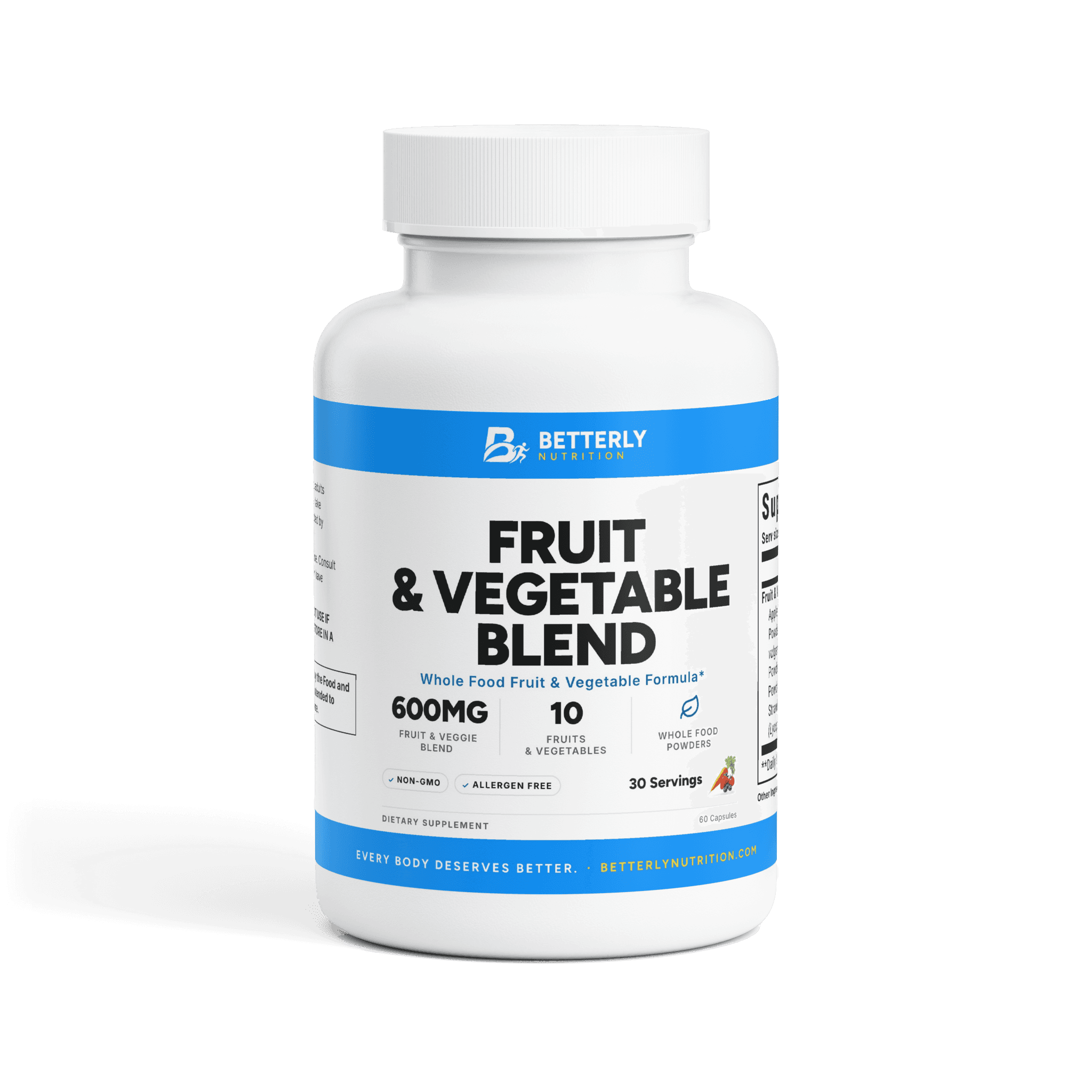
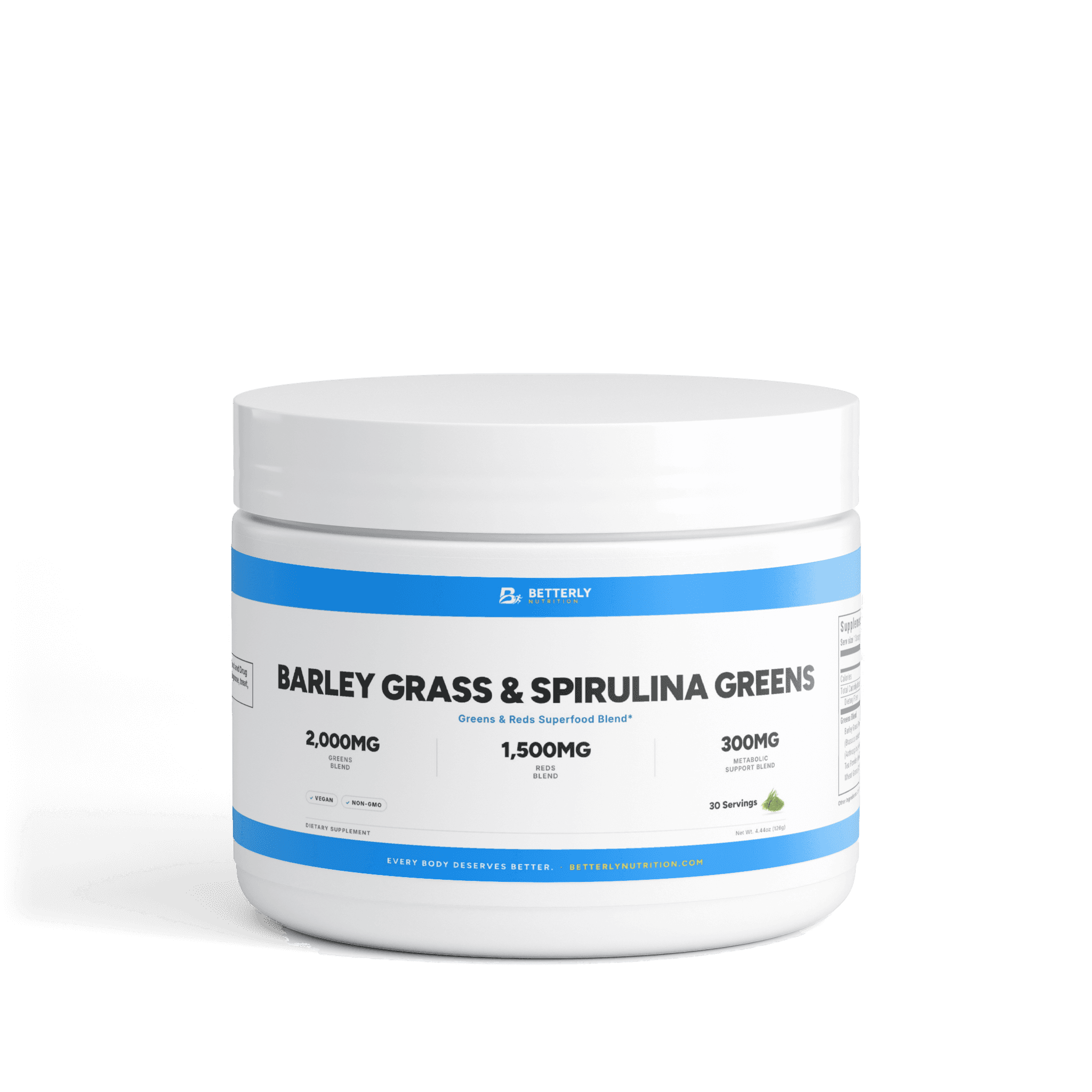
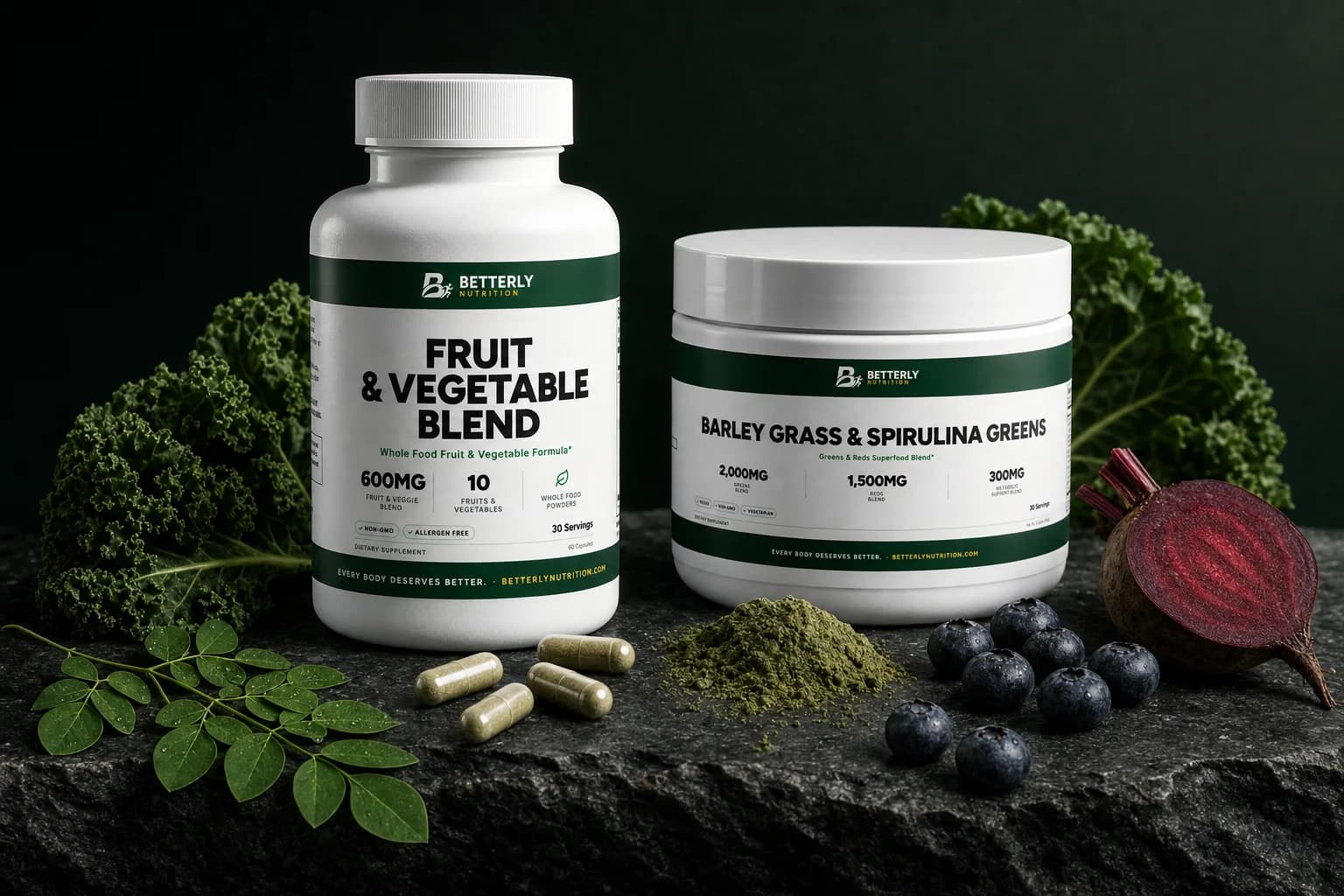
Our Fruit & Vegetable Blend Capsules list a 600 mg Fruit & Veggie Blend per 2-capsule serving, or 300 mg per capsule. Our Barley Grass & Spirulina Greens Powder weighs 4.2 g per 1-scoop serving. By weight, it would take 14 of those capsules to equal one scoop, and the capsule label's suggested use is two a day.
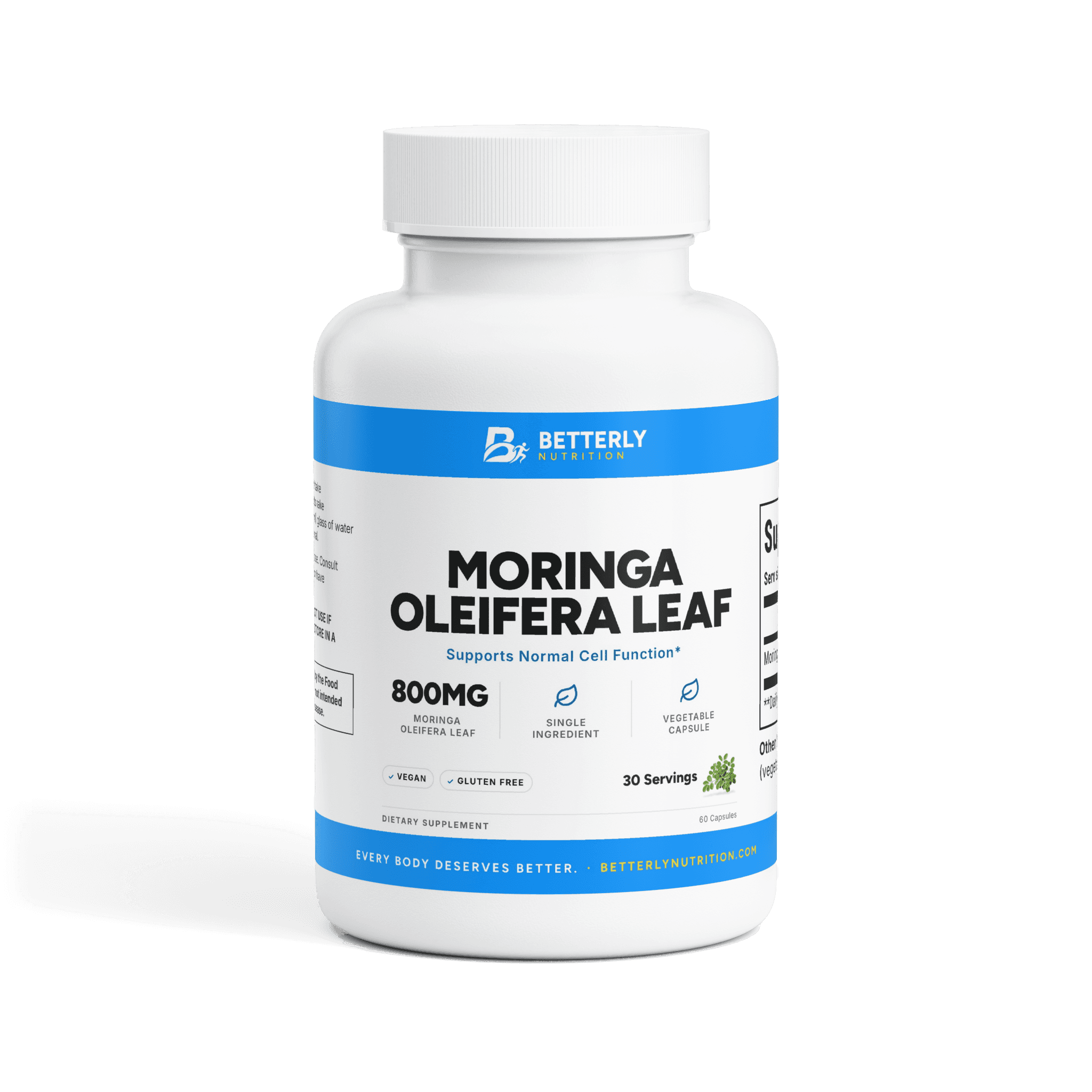
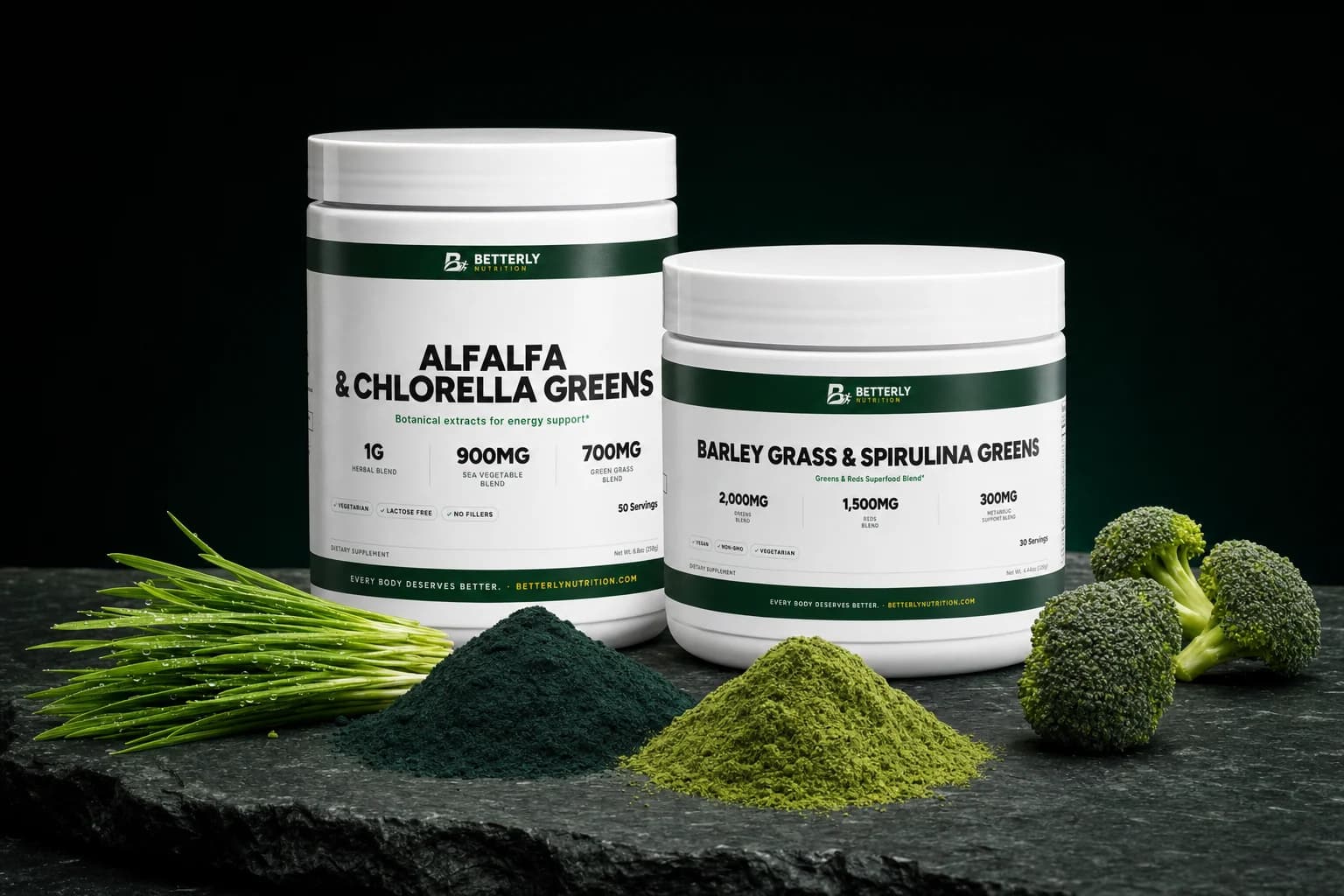
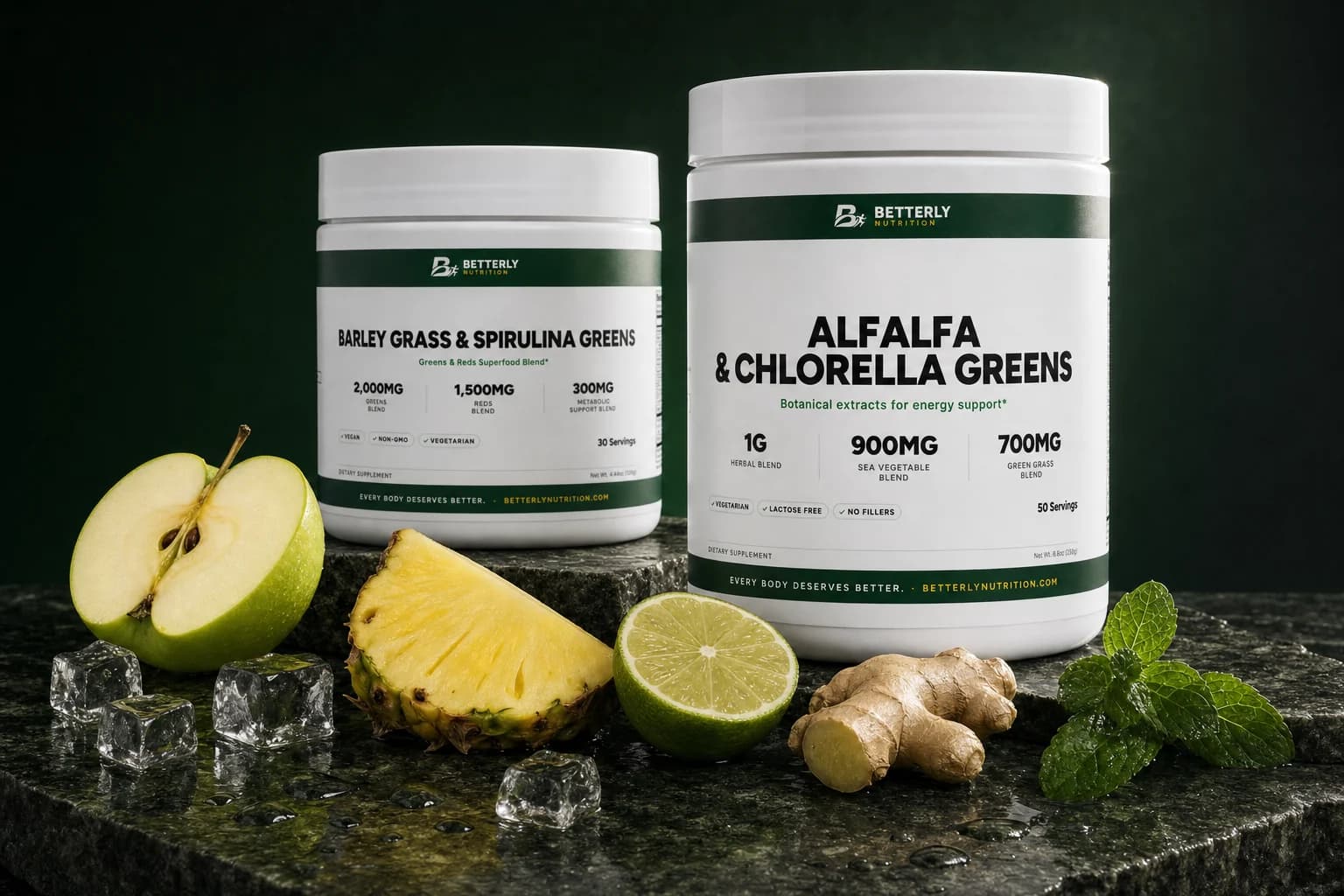
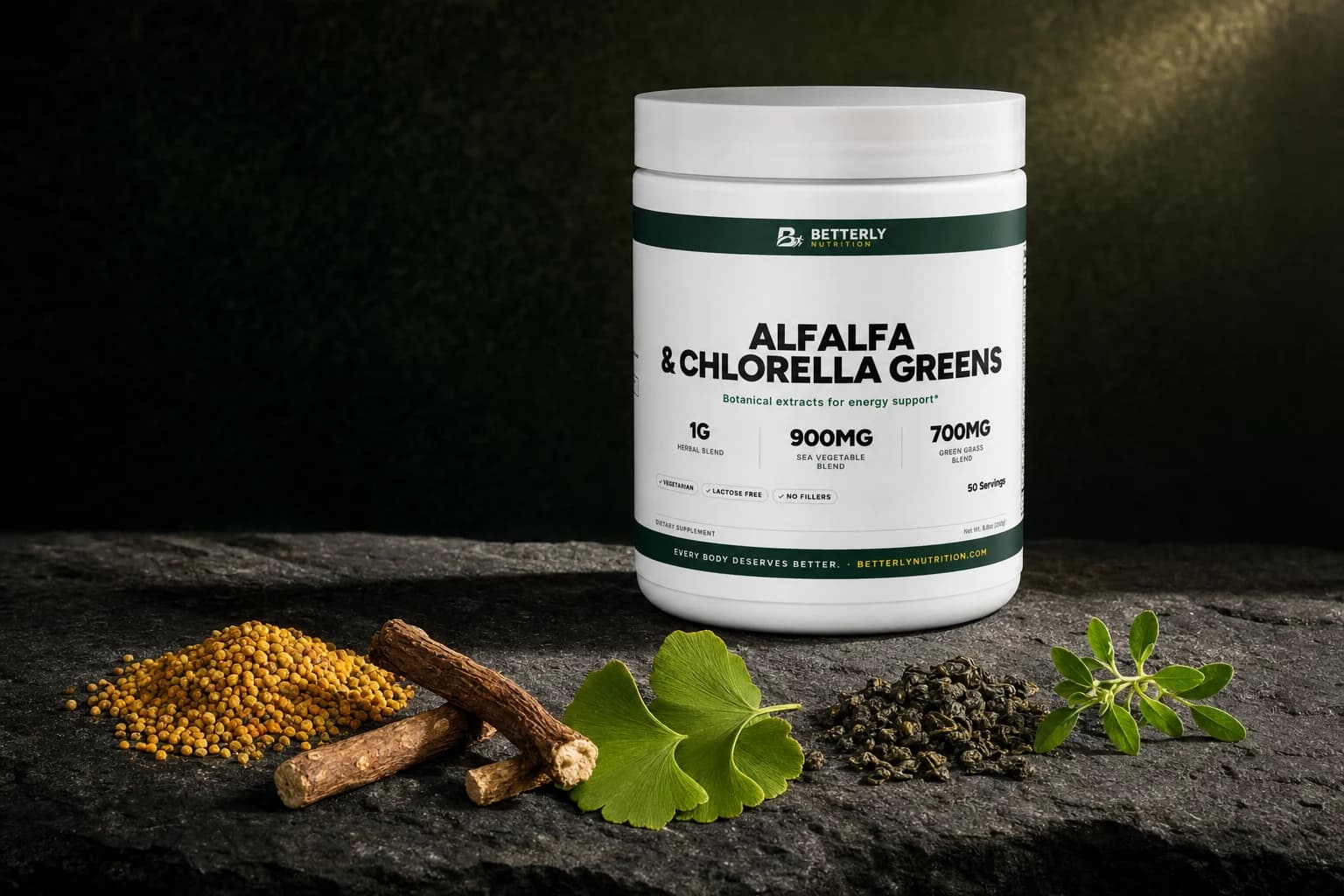
Our Moringa Oleifera Leaf Capsules hold 800 mg of leaf per 2-capsule serving, and our Alfalfa & Chlorella Greens Powder serves 2 teaspoons, about 5 g.
| Product | Serving | Amount per serving | Per container |
|---|---|---|---|
| Fruit & Vegetable Blend Capsules | 2 capsules | 600 mg blend | 30 servings (18 g) |
| Moringa Oleifera Leaf Capsules | 2 capsules | 800 mg leaf | 30 servings (24 g) |
| Barley Grass & Spirulina Greens Powder | 1 scoop | 4.2 g | 30 servings (126 g) |
| Alfalfa & Chlorella Greens Powder | 2 teaspoons | About 5 g | 50 servings (250 g) |
Per serving, our powders weigh roughly five to eight times what our capsules hold. Bottle totals are our math, and tub weights are each label's net weight.
One honest detail: our Fruit & Vegetable Blend isn't really a greens capsule. Its ten ingredients include carrot, beet root, blueberry and tomato, and none of them is a leaf or a grass. Our closest true greens capsule is the single-leaf moringa.
Is a scoop of greens powder stronger than two capsules?
A scoop of greens powder holds more plant material than two capsules, though less extra greenery than the weights suggest. Counting green and algae blends only, ours hold about 2.5 times (Barley Grass & Spirulina) and at least 2 times (Alfalfa & Chlorella) the leaf in two moringa capsules.
Here's what each powder panel lets you count as greens:
- Barley Grass & Spirulina Greens Powder: its Greens Blend is 2,000 mg of the 4.2 g scoop, and a 1,500 mg Reds Blend takes up much of the rest.
- Alfalfa & Chlorella Greens Powder: its Green Grass Blend (700 mg of barley, kamut, oat, rye and wheat grasses) and its Sea Vegetable Blend (900 mg of spirulina, chlorella and a brown seaweed called sea whistle) add up to 1,600 mg per 2-teaspoon (about 5 g) serving.
That 1,600 mg is a floor, not the full green count. The product's namesake alfalfa leaf sits in a 1 g Herbal Blend alongside parsley leaf, bee pollen, royal jelly, Siberian ginseng root and eleven other ingredients. Spinach leaf and broccoli share a 265 mg Vegetable Blend with beet and rhubarb juice powders.
The panel doesn't split those blends, so the true green total is higher by an amount the label won't let you work out. Its biggest row isn't green at all: a 1.25 g Great Grains Blend of brown rice bran, flax seed and barley malt. A heavy scoop isn't the same as a heavy dose of leaves.
Does greens powder absorb better than capsules?
No federal source we checked shows greens powder absorbing better than greens capsules, and none of our four labels claims an edge for either format.
Some format pages say powders absorb better, and we couldn't back that up. The NIH Office of Dietary Supplements (ODS) makes a more useful point in its background page on botanical supplements: one plant gets sold many ways, like dried ginger root in capsules, tablets, tea bags and liquids. Teas, tinctures and extracts also differ in strength.
So read the ingredient lines, not the format. Our produce capsule lists Tomato Extract beside whole carrot powder, and our Barley Grass & Spirulina scoop lists Blueberry Extract beside barley grass powder.
Greens powder vs pills: which gives you more fiber?
In our lineup, greens powder gives you more fiber than greens pills: only the powders print a fiber line, and the higher one lists 2 g.
The Barley Grass & Spirulina Greens Powder lists 2 g of dietary fiber (6% DV) per scoop. The Alfalfa & Chlorella Greens Powder lists less than 1 g (2% DV) per serving. Neither capsule panel has a fiber row, which fits a serving that weighs under a gram.
The MedlinePlus fiber page puts the daily target at 21 to 38 grams for older children, teens and adults, so a 2 g scoop is a small extra, not a strong reason to choose powder by itself.
The same page says to add fiber gradually over a few weeks and drink plenty of fluids, since a lot of fiber at once can cause gas, bloating and cramps.
The fiber row isn't the only one worth reading, though. The Barley Grass & Spirulina Digestive Support blend lists inulin (from Helianthus tuberosus root), and the Alfalfa & Chlorella panel lists 98 mg of FOS (fructooligosaccharides). If a new scoop doesn't sit well, our guide to greens powder side effects goes through the likely culprits.
What's in a greens capsule besides the greens?
A greens capsule also contains its shell and sometimes other added ingredients, and that shell decides whether the product can be vegan.
According to ODS in Dietary Supplements: What You Need to Know, a Supplement Facts label lists the active ingredients, the amount per serving and other ingredients such as fillers, binders and flavorings. That last line is where a capsule's shell shows up.
| Product | Other ingredients | Claims on the label |
|---|---|---|
| Fruit & Vegetable Blend Capsules | Gelatin (capsule), brown rice flour | Non-GMO, allergen free |
| Moringa Oleifera Leaf Capsules | Hypromellose (vegetable capsule) | Vegan, gluten free |
| Barley Grass & Spirulina Greens Powder | Citric acid, stevia extract (leaf) | Vegan, non-GMO |
| Alfalfa & Chlorella Greens Powder | Silica | Vegetarian, lactose free |
The shell is where our capsules split. Gelatin comes from animals, so our produce capsule makes no vegan or vegetarian claim. The moringa capsule uses hypromellose, which its label calls a vegetable capsule, and it's the only product of the four labeled gluten free.
Which is easier to take every day, capsules or powder?
Capsules are easier for most routines because there's nothing to taste, measure or stir, though our capsule labels still pair each serving with a glass of water.
Taste is the big one, since a capsule tastes of nothing. If a grassy flavor is why your last tub sat half full, try our tips on making greens powder taste better before you give up on powder.
For travel, a week of our capsules is 14 in a pill case, while a week of powder means seven portions and something to shake them in.
Swallowing is where powder wins on ease. If pills are hard for you, our roundup of vitamins you don't have to swallow whole covers strips, gummies, chewables and more.
Are powder greens worth it, or are capsules the better buy?
Powder greens are worth it if you'll drink them daily and want more grams for your money, while capsules are the better buy if convenience keeps you consistent.
On cost, the greens pills vs powder math is simple: divide the price on each product's shop page by the grams in the container, using the totals in our first table. Tubs usually come out cheaper per gram, even though their weights include other ingredients.
| If this sounds like you | Lean toward | Why, from the labels |
|---|---|---|
| Grassy flavor makes you skip days | Capsules | Nothing to taste |
| You want the most plant material | Powder | 4.2 to 5 g vs 600 to 800 mg |
| You want some fiber | Barley Grass & Spirulina powder | 2 g per scoop |
| You avoid animal products | Moringa capsules or Barley Grass & Spirulina powder | Both labeled vegan |
A tub's lower price per gram only pays off if you finish it, so weigh it against the taste question above. All four sit side by side in our greens and superfoods aisle.
From our shop: Fruit & Vegetable Blend Capsules — a 600 mg blend of ten fruits and vegetables per 2-capsule serving, with nothing to taste or measure.
How do you take greens capsules and powder, per the label?
Take each greens product exactly as its own label says: two capsules for our capsules, one scoop or two teaspoons for our powders, with no extra servings. All four also warn, "Do not exceed recommended dose."
- Fruit & Vegetable Blend Capsules: adults take two capsules daily with 6 to 8 oz (177 to 237 ml) of water.
- Moringa Oleifera Leaf Capsules: two capsules once a day. The label's "for best results" note puts them 20 to 30 minutes before a meal, with an 8 oz (237 ml) glass of water.
- Barley Grass & Spirulina Greens Powder: one scoop in 6 to 8 oz of cold water or a favorite beverage, once daily, within 10 minutes of mixing.
- Alfalfa & Chlorella Greens Powder: adults mix two teaspoons into 8 oz (237 ml) of apple juice "or other favorite liquid," in the label's words. Water counts, and it keeps the glass closer to the panel's 20 calories per serving.
From our shop: Barley Grass & Spirulina Greens Powder — one 4.2 g scoop a day stirred into cold water, with 2 g of fiber per serving and 30 servings per tub.
When don't you need greens in either form?
Neither greens capsules nor greens powder is needed if leafy greens and other vegetables are a regular part of your week, or if a supplement would start replacing them.
Are powdered greens as good as fresh? No, and capsules aren't either. The ODS page on what you need to know about supplements says they can't take the place of the variety of foods a healthy eating routine depends on.
You don't need both formats, either. Our produce capsule and Barley Grass & Spirulina scoop repeat four plants, so that pair adds less variety than it looks.
Who should check with a healthcare provider first?
Check with a healthcare provider before starting greens capsules or powder if you're under 18, pregnant or nursing, take a prescription, have surgery scheduled or manage a medical condition.
Whichever of the four you pick up, its caution reads: "Consult a physician if pregnant, nursing, under 18, or have a medical condition." ODS also wants your providers to know about every supplement you use, and says to raise them before any surgery.
If you take a blood thinner, ask first. The ODS vitamin K fact sheet counts spinach, kale, broccoli and other green leafy vegetables among the foods that supply vitamin K. It says people on warfarin should keep their vitamin K about the same every day. Switching between moringa capsules and a scoop changes how much leafy material you get, and none of our four panels lists a vitamin K amount.
Super greens powders like ours also tend to add herbs and reds that a single-leaf capsule doesn't carry. Our Barley Grass & Spirulina scoop lists ashwagandha, Panax ginseng, turmeric extract and green tea. On the Alfalfa & Chlorella panel you'll find ginkgo, licorice, Siberian ginseng and green tea. The moringa capsule lists one plant, which makes it the simpler label to hand a provider.
FAQ: greens capsules vs powder
How many greens capsules equal a scoop of greens powder?
By weight, a 4.2 g scoop of Barley Grass & Spirulina Greens Powder equals 14 Fruit & Vegetable Blend Capsules or 10.5 Moringa Oleifera Leaf Capsules. That math isn't a dosing plan, though. Both capsule labels set the serving at two and warn "Do not exceed recommended dose." If you want a scoop's worth of grams, choose a powder instead of doubling up on pills.
Can you open greens capsules and stir them into a drink?
Not by the label: neither the Fruit & Vegetable Blend Capsules nor the Moringa Oleifera Leaf Capsules directions mention opening the shell, so swallow them as directed. Opening two produce capsules would only give you the 600 mg blend plus brown rice flour, a small fraction of a scoop. If you'd rather drink your greens, a powder is made for mixing.
Can you take greens capsules and greens powder on the same day?
Yes, as long as you check what the two share. Our Fruit & Vegetable Blend Capsules and Barley Grass & Spirulina Greens Powder share four ingredients by name: beet root, strawberry juice powder, blueberry and ginger, so pairing them repeats plants. Moringa appears on neither powder panel. If you take any prescription, ask your healthcare provider before combining products.
When is the best time to take greens capsules or powder?
Only the Moringa Oleifera Leaf Capsules label names a time: for best results, 20 to 30 minutes before a meal. The Barley Grass & Spirulina Greens Powder label cares about the glass instead, asking you to finish it within 10 minutes of mixing. That's a real format difference: capsules can wait in your bag until lunch, while a greens drink gets made when you're ready to drink it.
Sources
- Botanical Dietary Supplements: Background Information, NIH Office of Dietary Supplements
- Dietary Supplements: What You Need to Know, NIH Office of Dietary Supplements
- Fiber, MedlinePlus Medical Encyclopedia
- Vitamin K: Fact Sheet for Consumers, NIH Office of Dietary Supplements
If this left you looking for somewhere to start, read fruit and vegetable capsules with nothing to mix — its amounts per serving are listed on the page. For the practical questions this raises, how dosing, sourcing and subscriptions work is answered in one place.