On this page
- Key takeaways
- What vitamins can you take if you can't swallow pills?
- How do strips, gummies, chewables, liquids and powders compare?
- What can a vitamin strip hold, and what can't it?
- Are there chewable vitamins for adults that aren't gummies?
- Can you crush a vitamin or open a capsule instead?
- Are liquid vitamins or sprays better than pills?
- How do you take vitamin strips, and can you take more than one?
- When don't you need a pill-free vitamin?
- Who should check with a healthcare provider first?
- FAQ: vitamins without pills
- Sources
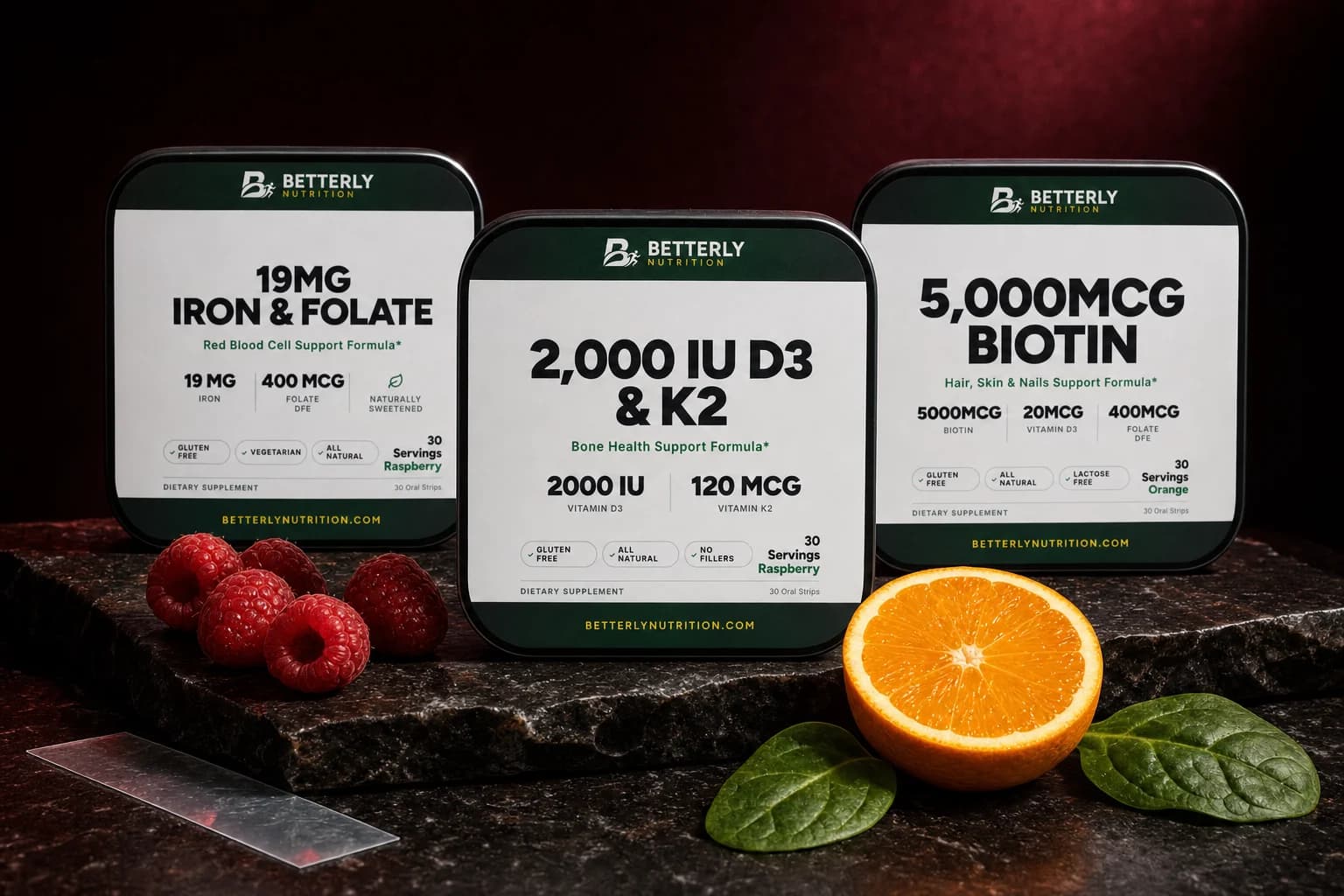
The short answer: Vitamins for people who can't swallow pills come as dissolving strips, chewable tablets, gummies, liquid drops, powders and oral sprays. The real limit is how much each format can carry. Our 2,000 IU Vitamin D3 & K2 strip weighs 100 mg in total, so strips suit nutrients measured in micrograms. Bulkier nutrients, like magnesium or collagen, need a powder or several capsules.
Key takeaways
- Dissolving strips suit vitamins measured in micrograms, such as D3, K2, biotin and folate, because the three vitamin strips in this guide weigh 100 mg to 200 mg each.
- Gummies trade the swallow for sweetness: our Biotin & Collagen Gummies list 4 g of added sugars per 2-gummy serving.
- In its advice on medicines, the FDA says not to break, crush or chew tablets without first asking a health professional.
- An iron strip is still a full dose of iron, so it needs the same care around children as an iron pill.
- If swallowing is difficult or painful for you, talk to your provider before you pick any format.
We sell the three vitamin strips covered here, a vitamin gummy and a chewable tablet, so our view isn't neutral. We'll also show the gaps on our own shelf: no vitamin-first drop, no spray and no pill-free multivitamin.
What vitamins can you take if you can't swallow pills?
If you can't swallow pills, you can take vitamins as dissolving strips, chewable tablets, gummies, liquid drops, powders mixed into a drink, or oral sprays.
Each of these alternatives to swallowing pills moves the work somewhere else. A strip melts while you wait, a chewable needs chewing, gummies usually bring sugar, and liquids, sprays and powders need measuring or mixing.
None of them is better than a pill by default. The question that matters is plainer: can this format hold the amount you actually want?
How do strips, gummies, chewables, liquids and powders compare?
Strips carry doses measured in micrograms or a few milligrams, gummies hold a wider mix, and powders are the only pill-free format here that carries grams per serving.
Where we sell a format, the numbers below come from our own Supplement Facts panels.
| Format | Our example, per serving | Sweetened with | The catch |
|---|---|---|---|
| Dissolving strip | D3 & K2 strip: 2000 IU D3, 120 mcg K2 (1 strip, 100 mg) | Erythritol, sorbitol syrup, steviol glycosides | Tiny total weight |
| Gummy | Biotin & Collagen Gummies: 6000 mcg biotin (2 gummies) | Glucose syrup, sugar, glucose | 4 g added sugars |
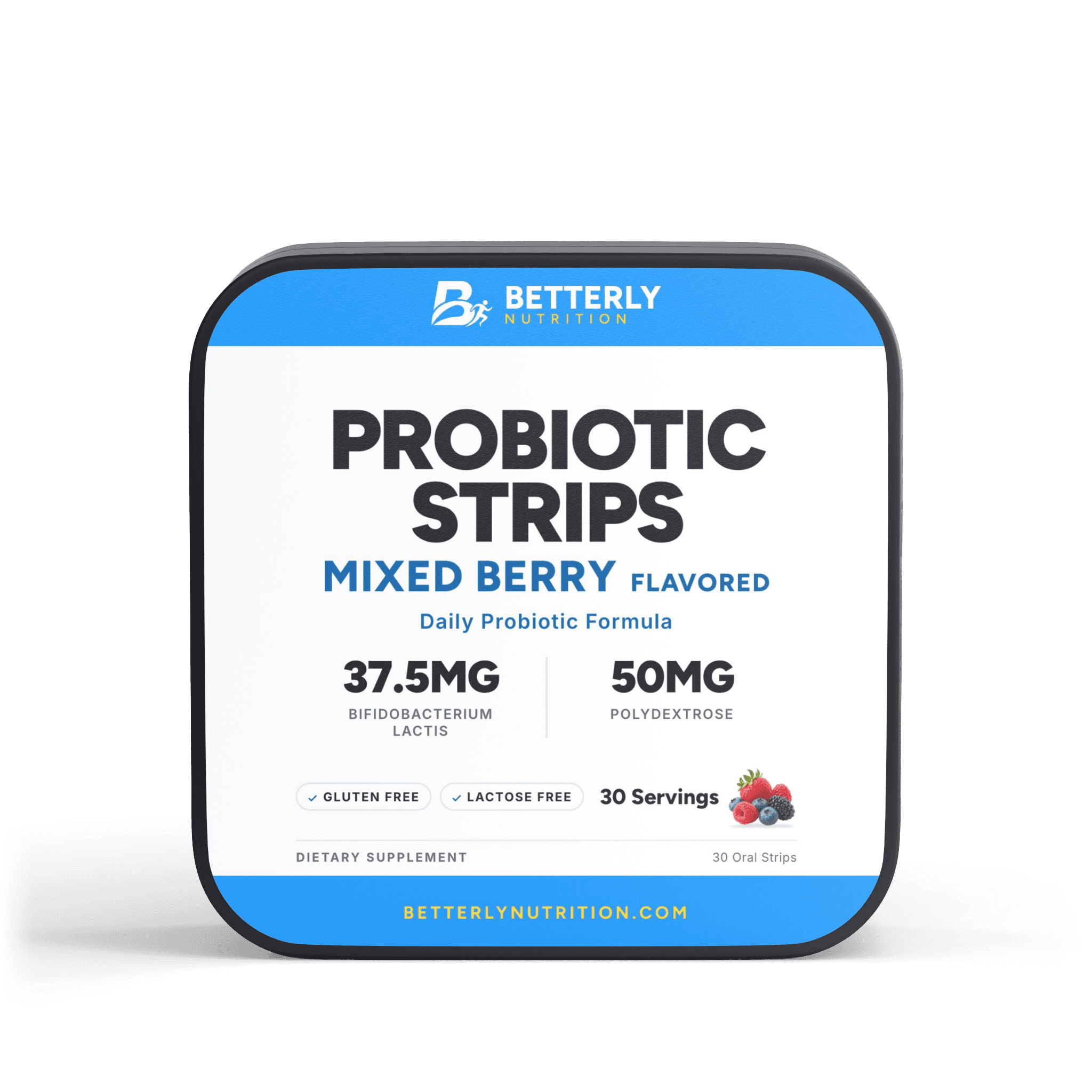
| Chewable tablet | Oral Probiotic & Xylitol Chewables: 4 Billion CFU (1 tablet) | Xylitol | You still chew a firm tablet |
| Liquid drops | We don't sell a vitamin-first drop | Varies by brand | Measured in ml or drops |
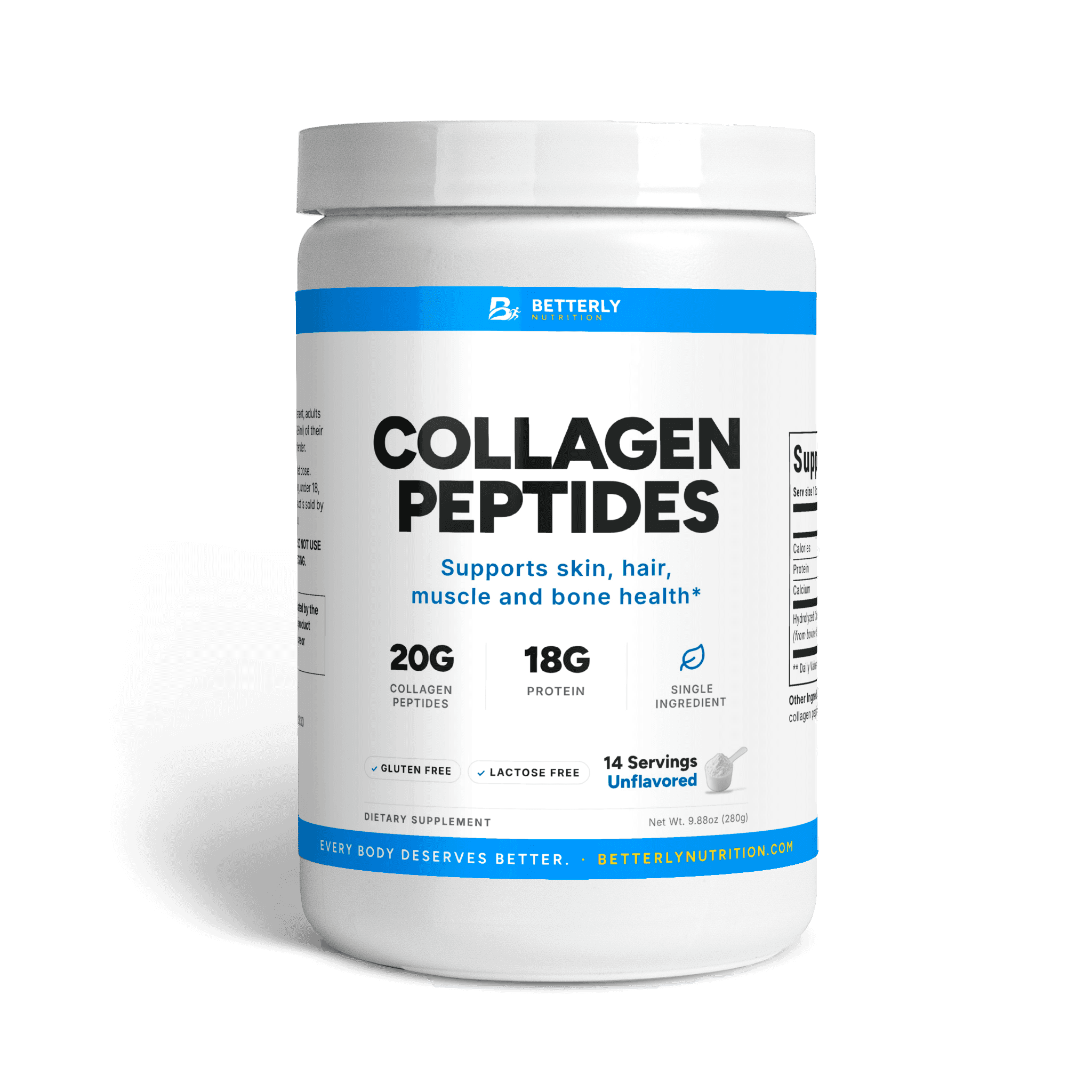
| Powder | Collagen Peptides Powder (Unflavored): 20 g collagen peptides (1 scoop) | Nothing else listed | A drink to mix daily |
The pattern: strips take the least effort and carry the least, gummies carry more with sugar attached, and powders carry the most but need a glass and a spoon every day. Pick by the dose you need first, then by the habit you'll keep.
Where do gummies fit?
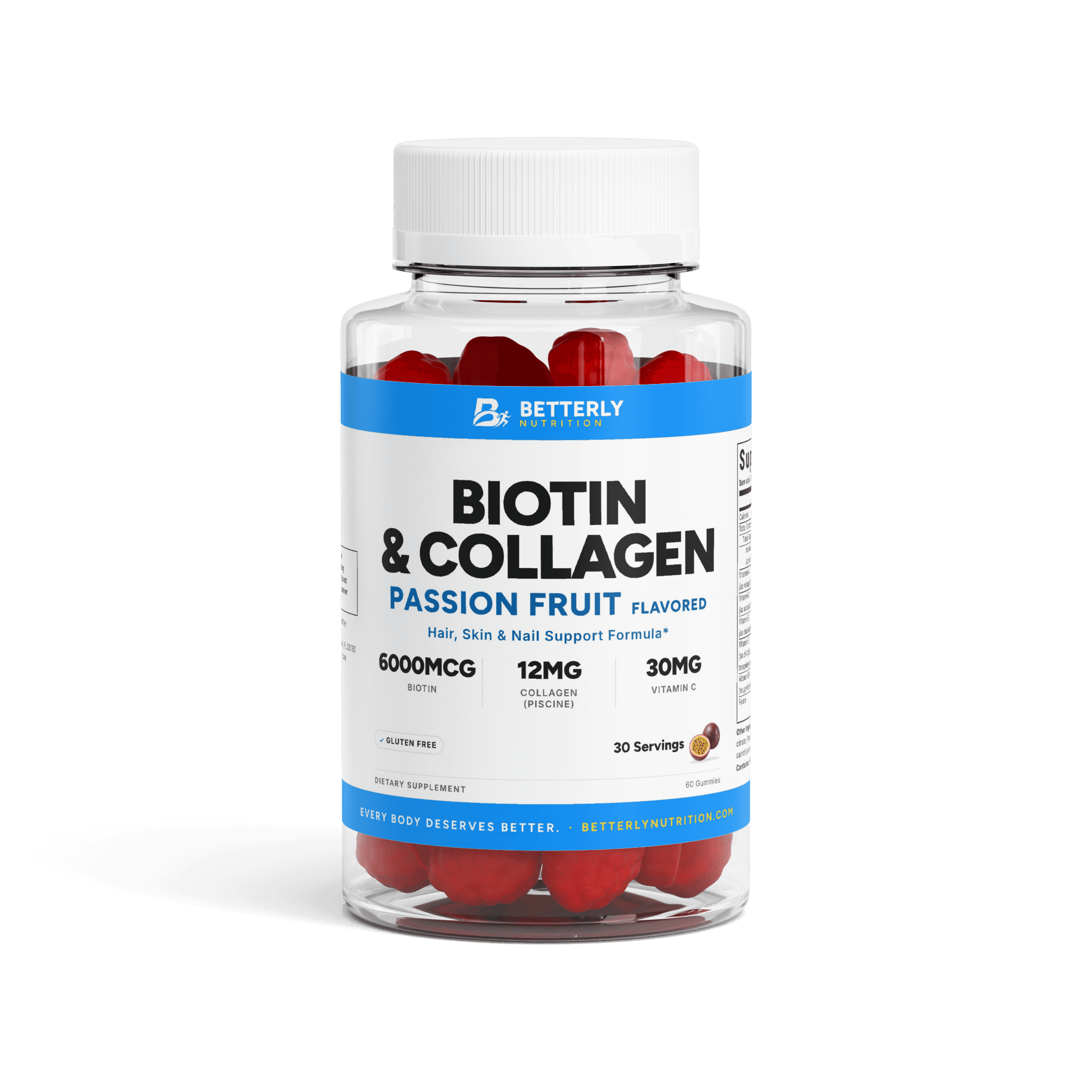
Gummies hold more than a strip. Our Biotin & Collagen Gummies fit nine vitamins, plus iodine, zinc, PABA, collagen and silicon, into a 2-gummy serving. That serving also brings 15 calories and 4 g of added sugars (8% DV), and the panel lists fish (tilapia) and tree nuts (coconut) as allergens. We weighed the same trade of sugar against dose in our look at whether mushroom gummies work.
What can a vitamin strip hold, and what can't it?
A vitamin strip holds micrograms or a few milligrams of a nutrient; the three dissolvable vitamins for adults in this guide weigh 100 mg to 200 mg per strip.
Pullulan comes first under Other Ingredients on every one of our strip panels. It's the film that holds each strip together, and even our heaviest strip weighs 290 mg, so there's room only for small amounts:
- Vitamin D3 fits easily. Our Vitamin D3 Softgels label prints 2,000 IU as 50 mcg, which is just 0.05 mg.
- Magnesium doesn't fit. Our Magnesium Glycinate Capsules use 2,500 mg of magnesium glycinate, across three capsules, to supply 275 mg of magnesium. That's 25 times the weight of a whole D3 & K2 strip.
- Collagen shrinks to a sample. Our Collagen & Vitamin E Strips list 100 mg of collagen peptide per 265 mg strip. One scoop of our unflavored Collagen Peptides Powder holds 20 g, so you'd need 200 strips to match it.
Our strip labels don't claim the vitamins soak in through your mouth or work faster than a softgel, and neither do we. A strip is an easier way to take a small dose, not a stronger one.
The D3 and K2 strip
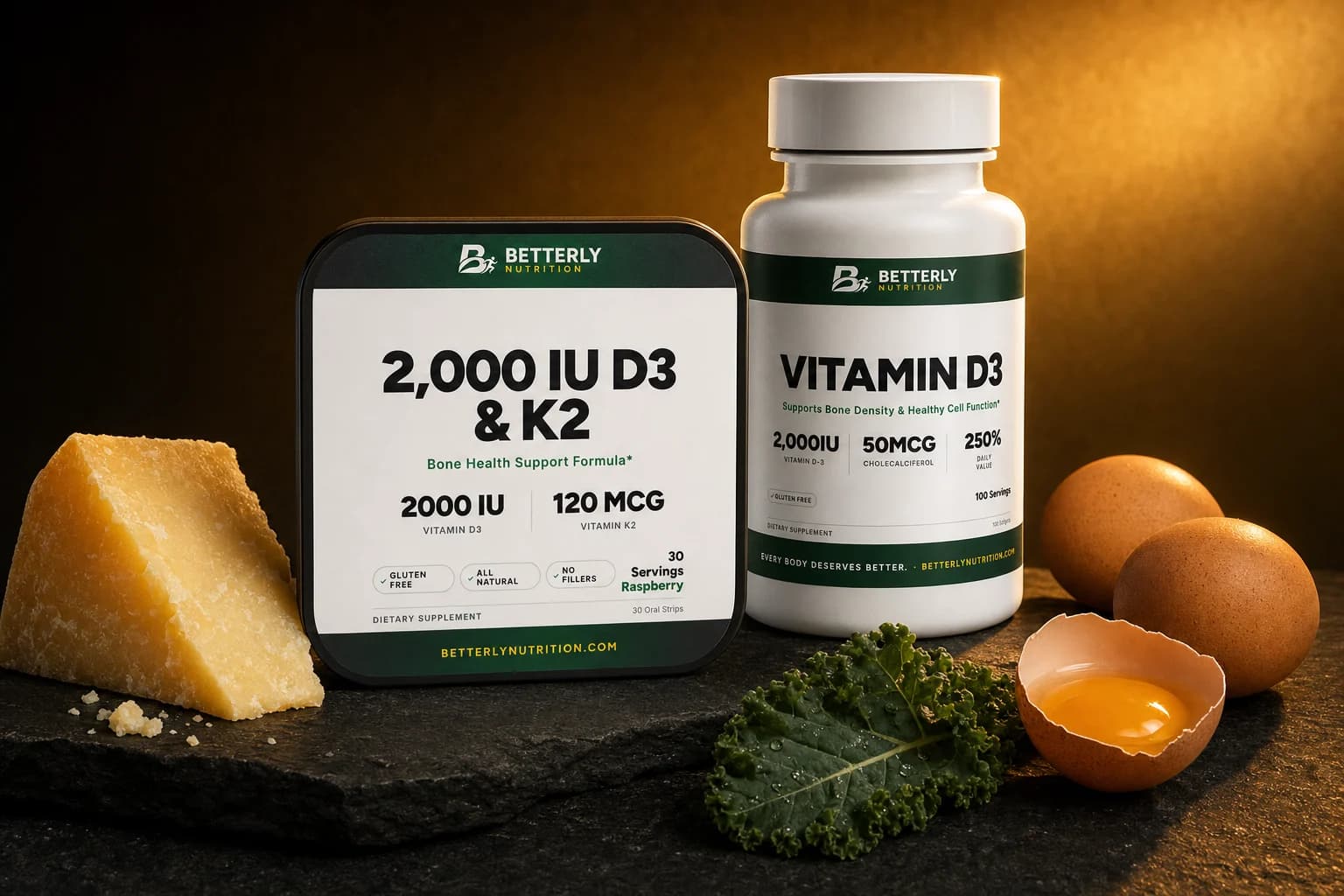
Betterly's 2,000 IU Vitamin D3 & K2 Strips list 2000 IU of vitamin D3 (250% DV) and 120 mcg of vitamin K2 as menaquinone (100% DV) per 1-strip (100 mg) serving. The panel doesn't name the menaquinone form. Its label claims gluten free, not sugar-free, so we don't call it sugar-free.
The iron strip
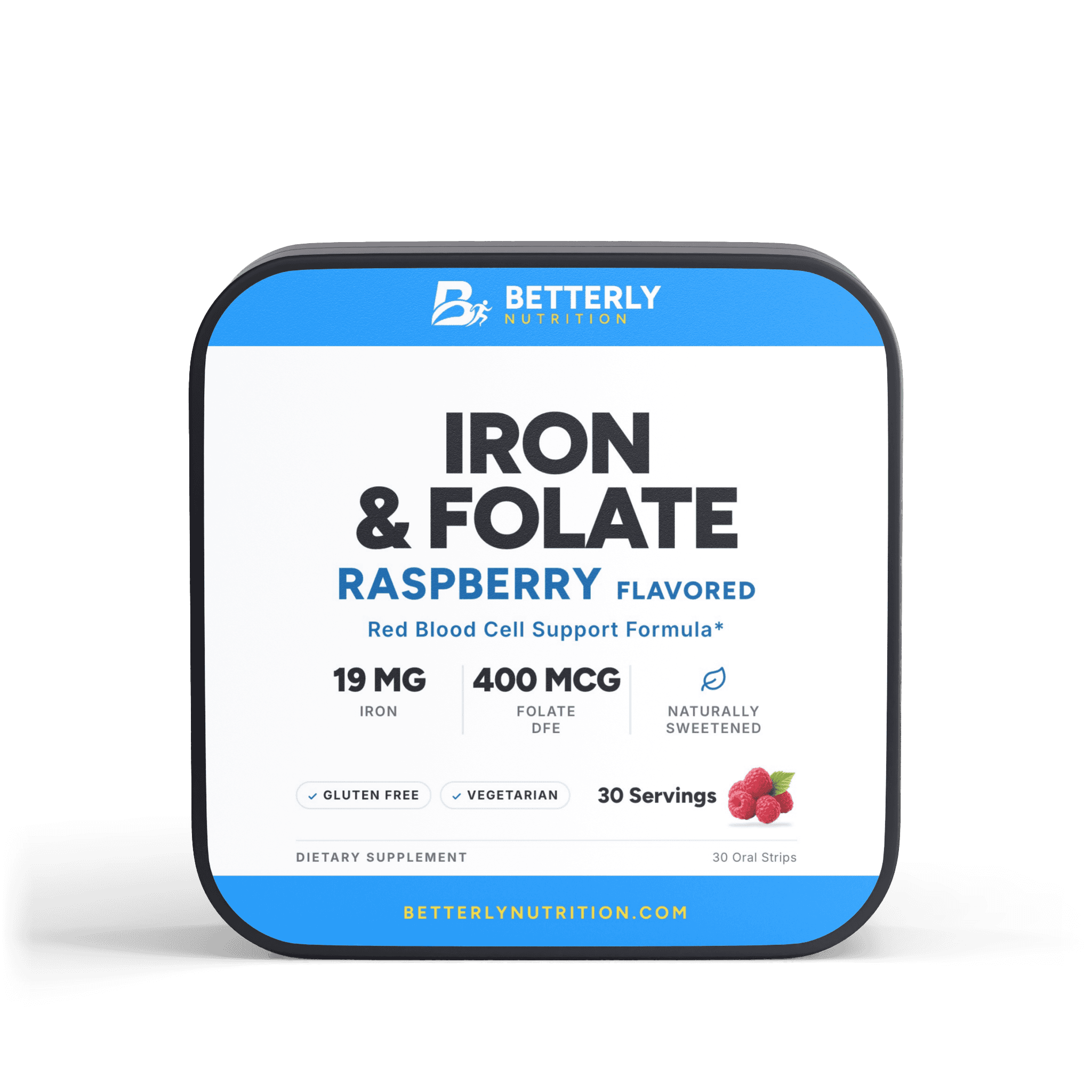
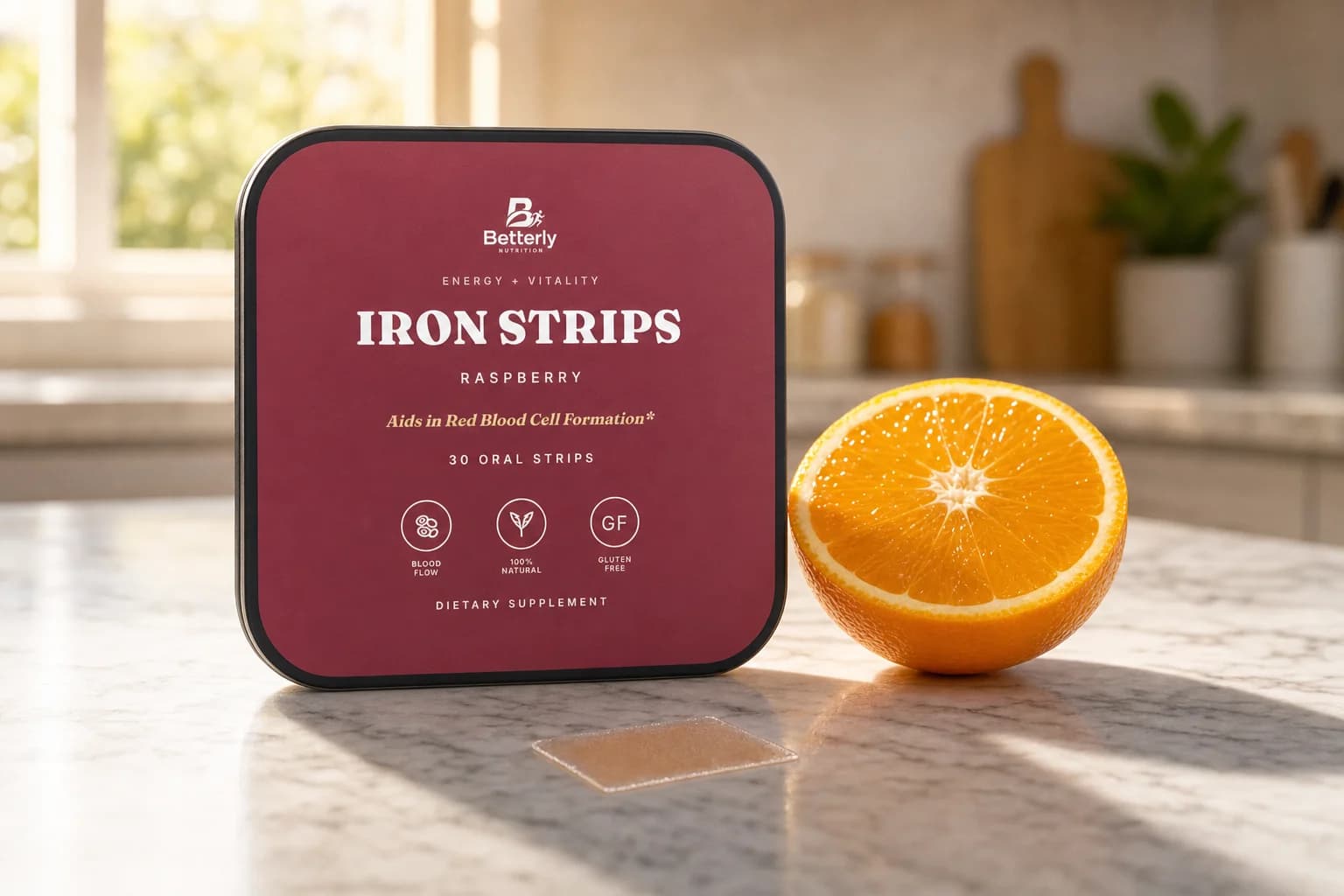
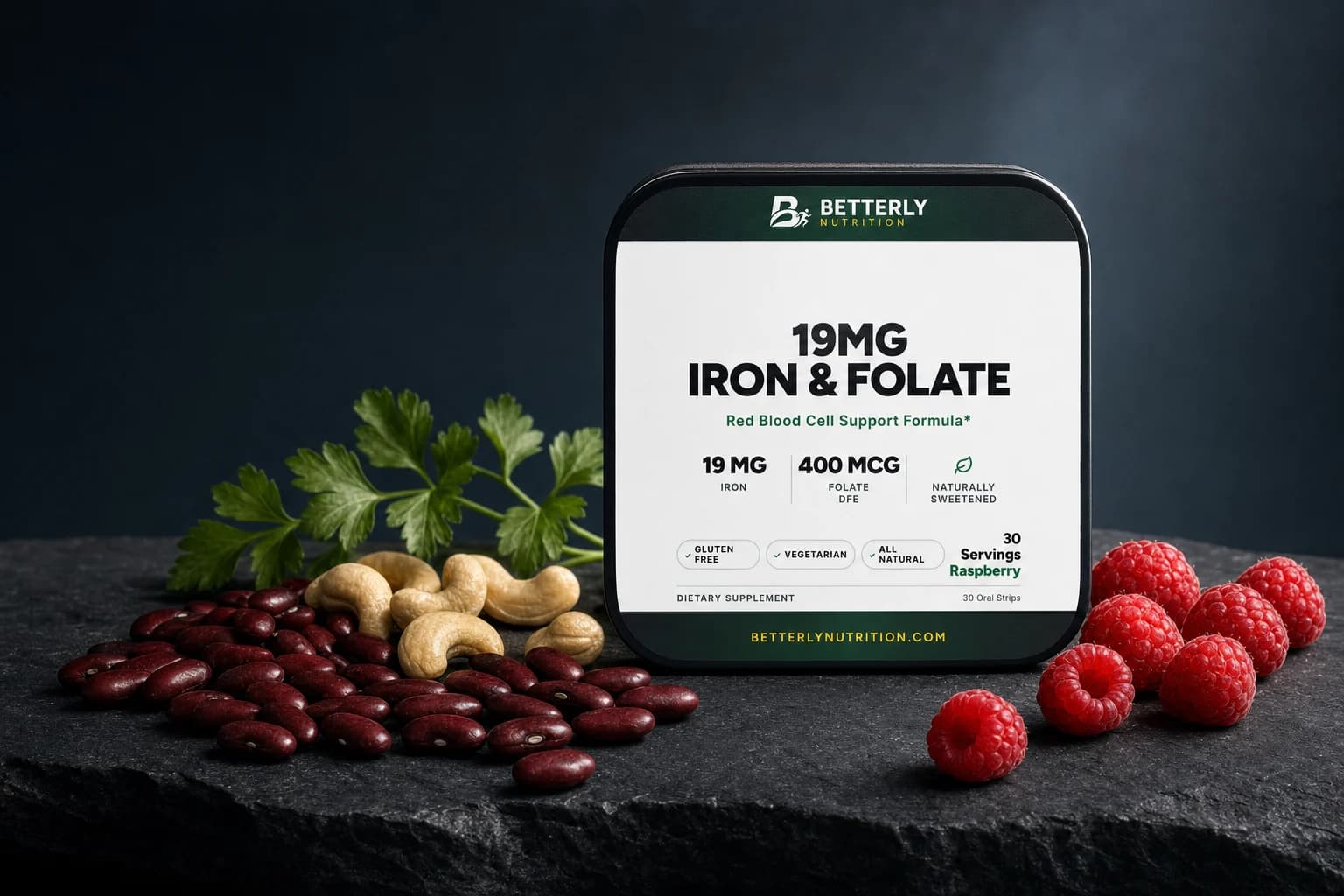
Betterly's 19mg Iron & Folate Strips list 19 mg of iron as ferric saccharate (106% DV) and 400 mcg DFE of folate (240 mcg folic acid) per 1-strip (200 mg) serving. Your body uses iron to make hemoglobin, the protein in red blood cells that carries oxygen, says the NIH Office of Dietary Supplements iron fact sheet. It sets the adult upper limit at 45 mg a day from all sources. Our iron timing and pairing guide covers what to take it with, and our comparison of iron strips and iron pills goes deeper on format.
The biotin strip
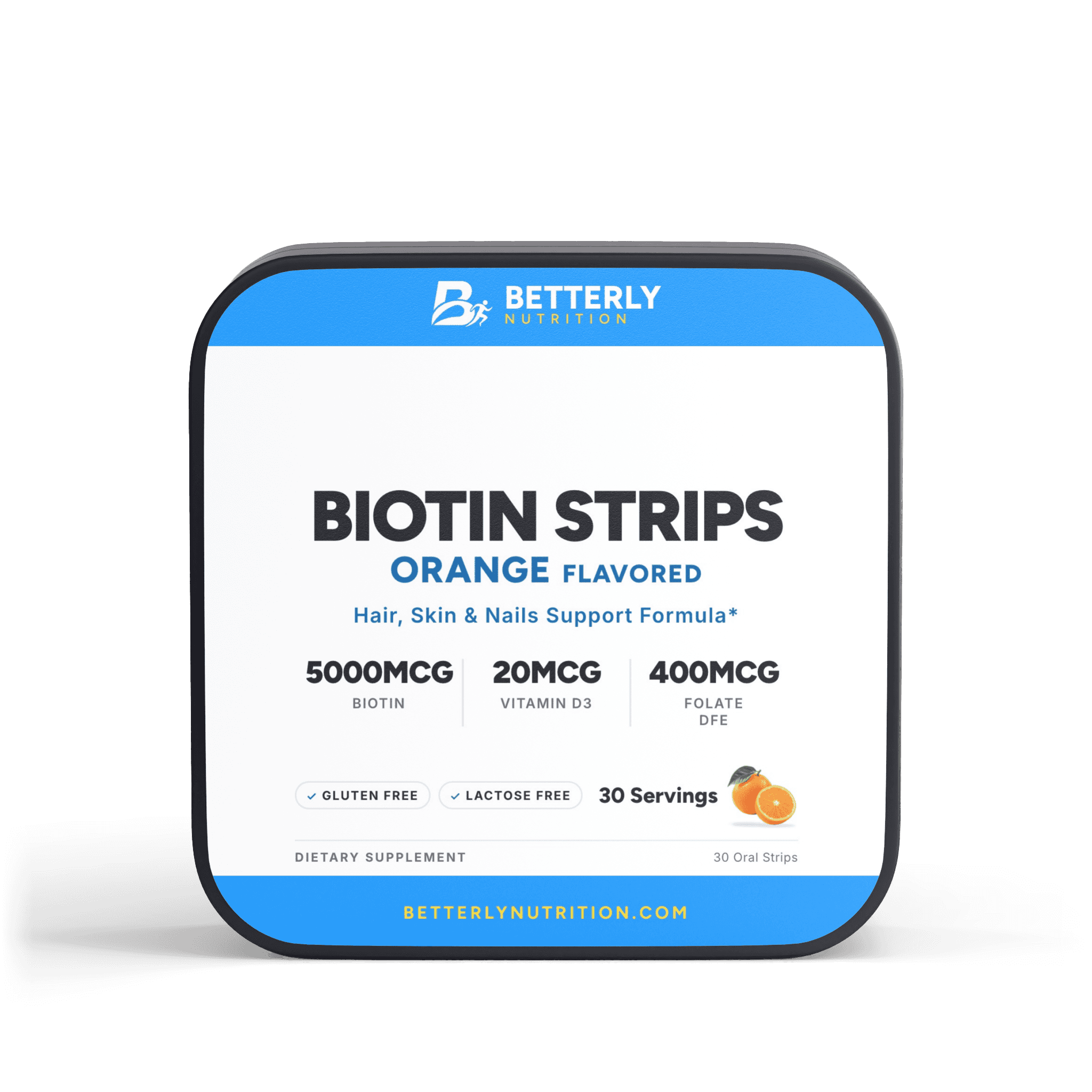
The 5,000mcg Biotin Strips list 5000 mcg of biotin (16,667% DV), 20 mcg of vitamin D3 and 400 mcg DFE of folate per 1-strip (100 mg) serving. Adults need 30 mcg of biotin a day, says the ODS biotin fact sheet, and taking more biotin than recommended can skew some lab results, including thyroid hormone tests.
From our shop: 2,000 IU Vitamin D3 & K2 Strips — a 30-strip pack at one strip a day, each 100 mg strip listing 2000 IU of vitamin D3 and 120 mcg of vitamin K2 for adults who'd rather skip the softgel.
Are there chewable vitamins for adults that aren't gummies?
Yes, adult chewable tablets exist, but we don't sell a chewable vitamin; our only chewable tablet is an oral probiotic.
If you shop for an adult chewable vitamin, start with the serving size, since it may be two or more tablets. Then scan Other Ingredients for sweeteners such as sorbitol or xylitol. Last, check whether the directions say to chew thoroughly or allow swallowing whole.
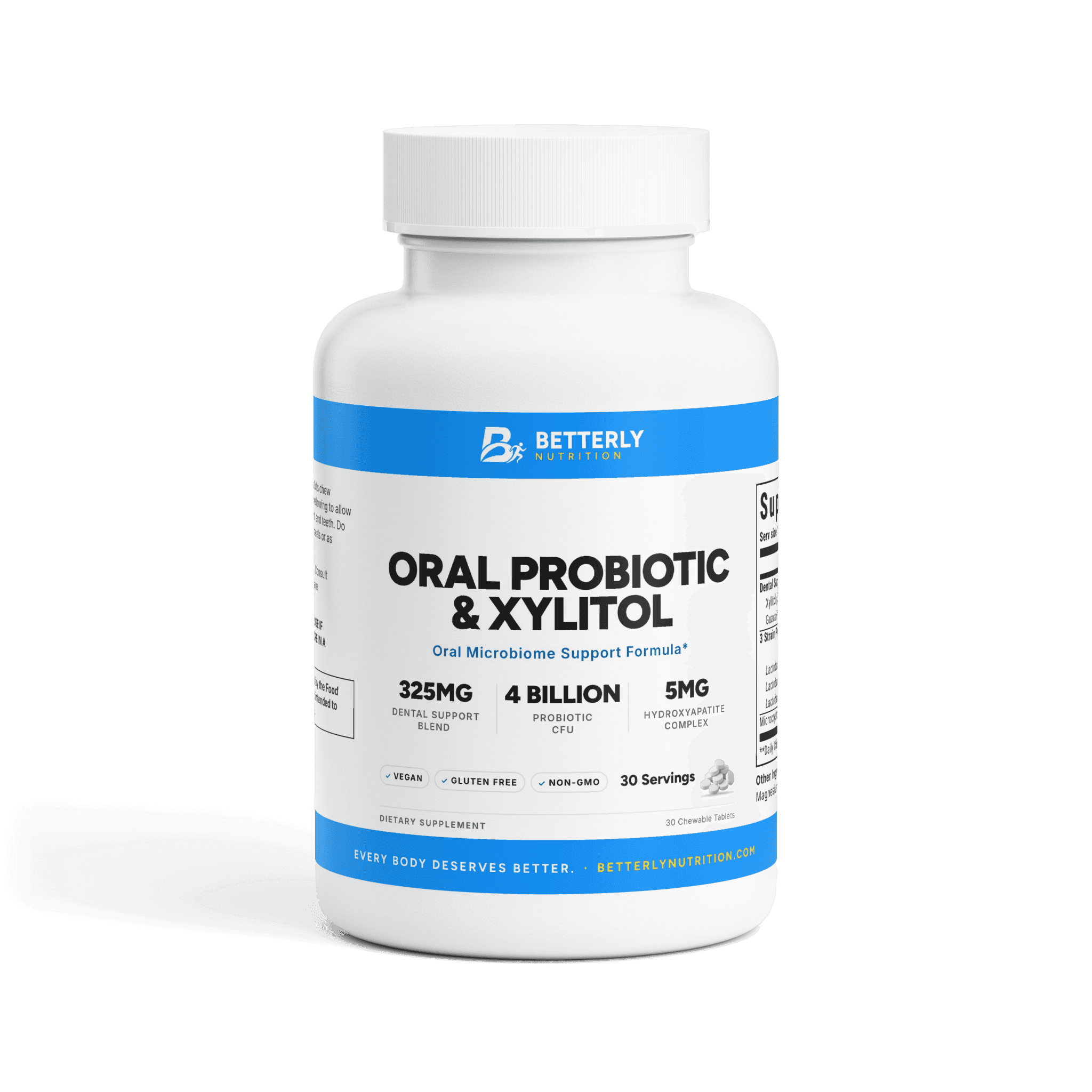
Our Oral Probiotic & Xylitol Chewables show what the format asks of you. The label says to chew one tablet daily, chew it thoroughly and not swallow it whole. Each tablet lists a 325 mg blend of xylitol and guava fruit powder, plus 20 mg (4 Billion CFU) of a three-strain probiotic.
A chewable suits you if chewing feels fine but pills catch in your throat. It won't help if a firm tablet in your mouth bothers you just as much.
Can you crush a vitamin or open a capsule instead?
Sometimes you can, but ask a pharmacist first; the FDA says not to break, crush or chew tablets without first asking your health care professional.
That advice comes from the FDA page As You Age: You and Your Medicines, which is written about medicines. Its tip on swallowing tablets is one we'd borrow for supplements: "If you have trouble swallowing tablets, ask your doctor, nurse, or pharmacist for ideas."
Softgels raise a separate problem, because they hold oil. Our Vitamin D3 Softgels keep their D3 in soybean and corn oil inside a gelatin shell. None of our capsule or softgel labels give directions for opening them, so we can't tell you it's fine. The simpler path is a product whose label is written for how you want to take it.
What if you can't swallow pills at all?
Follow the FDA's suggestion and ask your pharmacist whether the same product comes as a smaller tablet or in another form. If swallowing hurts, or food catches as well as pills, tell your provider before you pick any format.
Are liquid vitamins or sprays better than pills?
We found no federal source showing liquid vitamins or sprays work better than pills, so compare their labels the way you'd compare any other format.
You'll often read that liquids absorb better, but the fact sheets we cite don't say that. Before you buy one, check the serving size in ml, drops or sprays, then the amount of each nutrient in that serving.
We don't sell a vitamin-first drop or any spray; our one drop that lists a vitamin is built around mushrooms.
How do you take vitamin strips, and can you take more than one?
Take vitamin strips exactly as each label says: all three of ours read "Place 1 oral strip on the tongue daily and allow it to dissolve."
A simple routine:
- Set one strip on your tongue and let it dissolve. The labels don't name a time of day.
- If you like, take the D3 & K2 strip at a meal. The ODS vitamin D fact sheet says vitamin D is absorbed best alongside a meal or snack containing some fat.
- Keep the iron strip apart from any calcium supplement. ODS notes calcium might interfere with iron absorption, and taking them at different times of day might help.
Now the stacking math. The D3 & K2 strip (50 mcg) plus the biotin strip (20 mcg) comes to 70 mcg, or 2,800 IU, of vitamin D3 a day. ODS sets the adult upper limit at 4,000 IU (100 mcg) from all sources. Add our Vitamin D3 Softgels at 50 mcg and you'd reach 120 mcg, over the limit, so choose one main D3 product.
Folate stacks the same way. The iron and biotin strips each list 240 mcg of folic acid, so taking both gives you 480 mcg before fortified cereal or a multivitamin. Take only one of each strip a day, since every label says, "Do not exceed recommended dose."
From our shop: 19mg Iron & Folate Strips — 19 mg of iron and 400 mcg DFE of folate per 1-strip (200 mg) serving, raspberry flavored and sweetened with monk fruit and steviol glycosides.
When don't you need a pill-free vitamin?
You may not need one at all: according to ODS, most Americans get enough iron, most get enough biotin from food, and most have adequate vitamin D.
A new format only helps if the nutrient itself fits your needs. Consider passing if:
- A blood test or your provider says your levels are fine.
- You're an adult man or over 51. ODS lists 8 mg of iron a day for both groups, and a 19 mg strip is more than double that.
- You only struggle with large tablets. A single softgel may be easier, and our Vitamin D3 Softgels give the same 2,000 IU (50 mcg) per 1-softgel serving as the strip.
You'll find the D3 & K2 and iron strips alongside our other targeted support formulas.
Who should check with a healthcare provider first?
Check with a healthcare provider before starting a pill-free vitamin if you're pregnant or nursing, under 18, taking prescription medicine, having surgery soon, or managing a medical condition.
All three strip labels say: "Do not exceed recommended dose. Consult a physician if pregnant, nursing, under 18, or have a medical condition." A few more flags:
- Swallowing. If swallowing is difficult or painful for you, ask your provider before you choose any format.
- Warfarin. Vitamin K can change how warfarin works, so talk to your prescriber before adding the D3 & K2 strip. Our D3 and K2 pairing guide explains why.
- Other prescriptions. ODS notes that iron supplements can interact with some medicines, so show the iron strip's label to your pharmacist.
- Blood work. Tell whoever orders your lab tests that you take a high-biotin product such as the biotin strip or the Biotin & Collagen Gummies.
FAQ: vitamins without pills
Do vitamin strips work as well as pills?
There's no simple yes: a vitamin strip contains the amount printed on its panel, but we found no federal source comparing strip and pill absorption. What you can compare is the dose: our D3 & K2 strip and our Vitamin D3 Softgels both list 2,000 IU of vitamin D3 per serving, so the better one is whichever you'll actually remember.
Can you get iron without swallowing a pill?
Yes. Our 19mg Iron & Folate Strips list 19 mg of iron per 1-strip serving, taken by letting one strip dissolve on your tongue. That's a full dose of iron, so the usual iron rules apply: stay under the 45 mg adult upper limit from all sources, take calcium supplements at a different time of day, and store the pack out of children's reach. Ask your provider whether you need extra iron at all.
Is there a multivitamin for people who can't swallow pills?
Pill-free multivitamins are sold as gummies, chewables, powders and strips, but Betterly doesn't make one; our Daily Multivitamin Capsules are 2 capsules per serving. The closest thing we sell is the Biotin & Collagen Gummies, with nine vitamins plus iodine and zinc per 2-gummy serving. They're built around 6000 mcg of biotin and add 4 g of added sugars, so compare panels row by row before you switch.
Are vitamin strips safe for kids?
Our vitamin strips aren't made for children. Every one of our strip labels tells anyone under 18 to consult a physician first and says to keep the pack out of children's reach. That matters most for the iron strip, whose label warns that accidental overdose of iron-containing products is a leading cause of fatal poisoning in children under 6. Flavored strips can look like candy to a child, so store them up high.
Do vitamin strips have sugar?
None of our three vitamin strip ingredient lists includes sugar, but we don't call them sugar-free because none of their labels makes that claim. The D3 & K2 strip uses erythritol, sorbitol syrup and steviol glycosides. The iron strip uses monk fruit extract and steviol glycosides, and the biotin strip adds mannitol. If you track sugar alcohols, read the Other Ingredients line before you buy.
Sources
- As You Age: You and Your Medicines, U.S. Food and Drug Administration
- Iron: Fact Sheet for Consumers, NIH Office of Dietary Supplements
- Biotin: Fact Sheet for Consumers, NIH Office of Dietary Supplements
- Vitamin D: Fact Sheet for Consumers, NIH Office of Dietary Supplements
If this left you looking for somewhere to start, read dissolving vitamin D3 and K2 strips — its amounts per serving are listed on the page. For the practical questions this raises, how dosing, sourcing and subscriptions work is answered in one place.