On this page
- Key takeaways
- Vitamin K1 vs K2: what's the actual difference?
- Is vitamin K2 the same as vitamin K?
- What do vitamin K1 and K2 do in the body?
- Where do vitamin K1 and K2 come from in food?
- How do supplement labels name vitamin K1 and K2?
- Vitamin K1 vs K2 supplement: which one fits you?
- How do you take a vitamin K2 strip or capsule?
- When don't you need a vitamin K supplement?
- Who should check with a healthcare provider first?
- FAQ: vitamin K1 and K2
- Sources
The short answer: Vitamin K1 vs K2 is a difference in source and structure, not in how much you need. K1 (phylloquinone) is the plant form, found in leafy greens, herbs and some plant oils. K2 is a group of compounds called menaquinones, found mainly in fermented foods, some cheeses and some poultry. Both count toward one daily target: 120 mcg for adult men and 90 mcg for adult women.
Key takeaways
- Vitamin K1 (phylloquinone) comes from plants, while vitamin K2 (menaquinones such as MK-4 and MK-7) comes mostly from fermented foods and some animal foods.
- The NIH lists one adequate intake for all vitamin K combined, with no separate target for K2.
- Federal health sources say vitamin K is important for normal blood clotting and healthy bones, without dividing those roles between K1 and K2.
- On a Supplement Facts panel, "phylloquinone" or "phytonadione" means K1, and "menaquinone" means K2.
- If you take a blood thinner, keep your vitamin K steady and ask your prescriber before adding a K1 or K2 supplement.
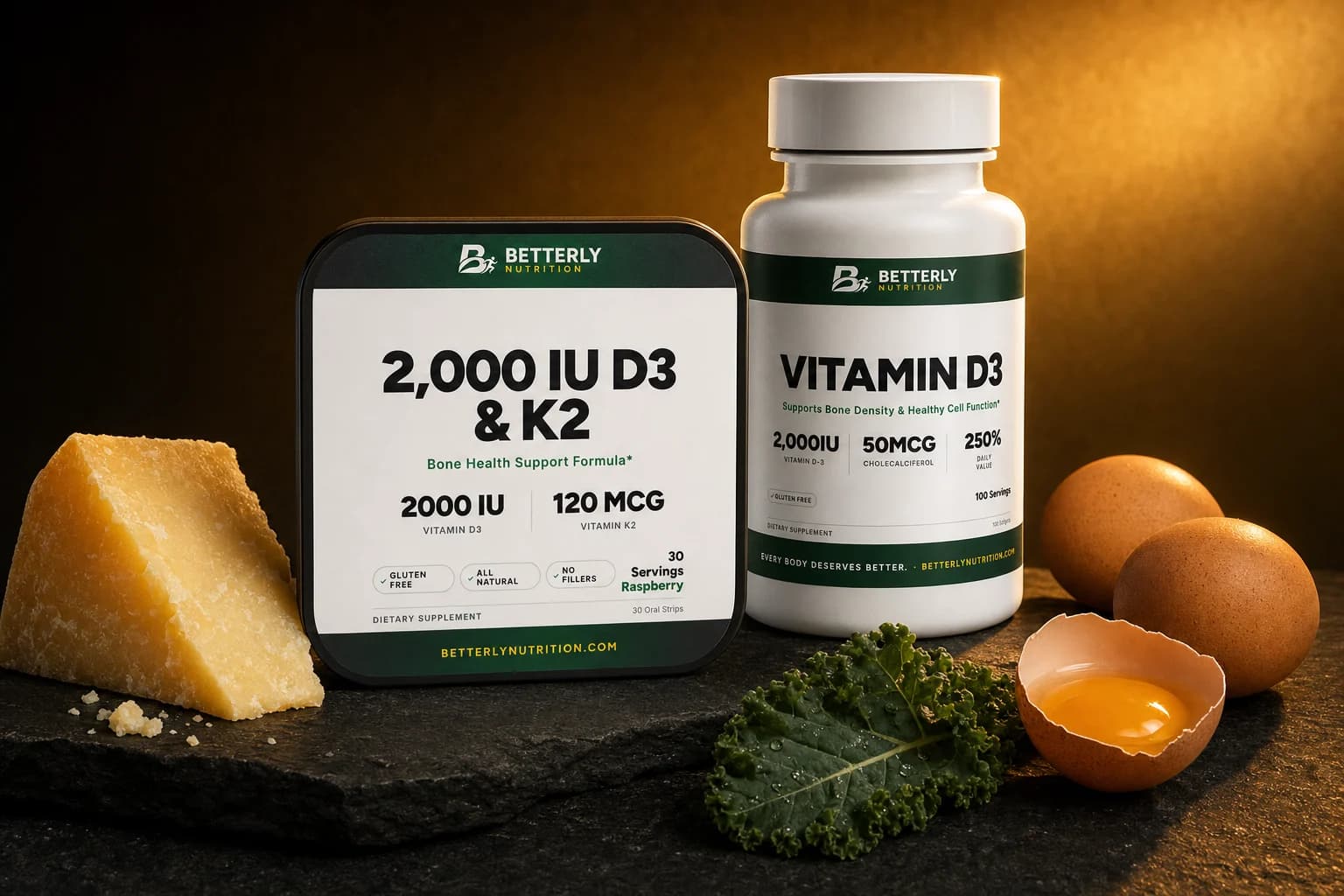
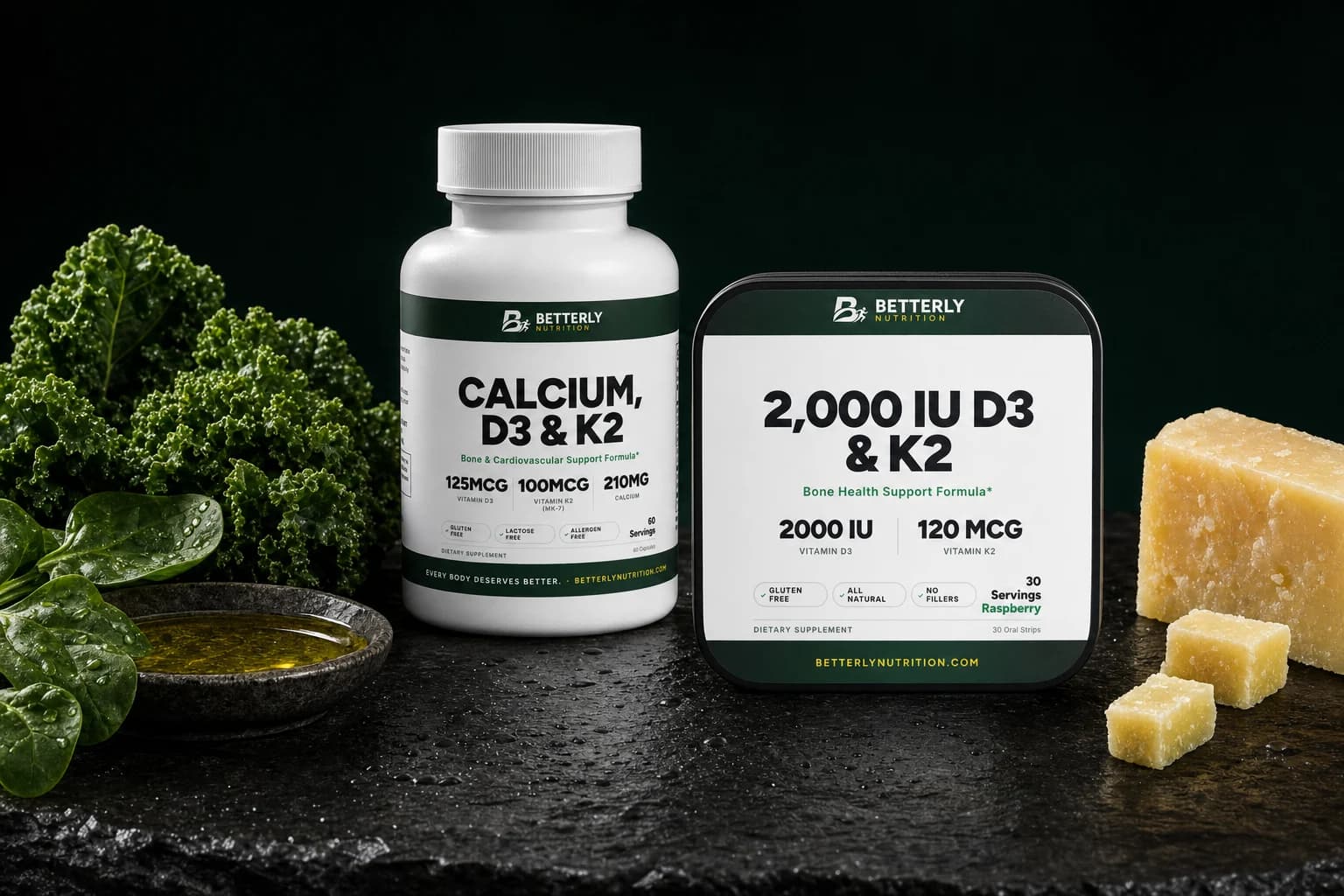
A quick disclosure: Betterly sells two products with vitamin K, and both use K2. Our 2,000 IU Vitamin D3 & K2 Strips and Calcium, Vitamin D3 & K2 Capsules each list menaquinone, and we don't sell K1. That gives us a reason to lean toward K2, so every health and product claim below ties to a named federal source or our own printed panels.
Vitamin K1 vs K2: what's the actual difference?
Vitamin K1 and K2 are two natural forms of one vitamin: plants make K1, while K2 comes mostly from fermented foods and some animal products.
K1 goes by the name phylloquinone. K2 is a family of related compounds called menaquinones. ODS names two members, menaquinone-4 and menaquinone-7 (MK-4 and MK-7), as common supplement forms.
| Vitamin K1 | Vitamin K2 | |
|---|---|---|
| Chemical name | Phylloquinone, also sold as phytonadione | Menaquinones (MK-4, MK-7 and others) |
| Main food sources | Leafy greens, herbs, soybean and olive oil | Fermented foods, some cheeses, some poultry |
| Daily target | One adequate intake shared with K2 | The same shared adequate intake |
| In Betterly products | None | Our D3 & K2 strip and calcium capsule |
The takeaway: K1 and K2 differ in where you find them and how they're built, but the daily target counts them as one nutrient.
Is vitamin K2 the same as vitamin K?
Vitamin K2 is one type of vitamin K, so any guideline or label that simply says "vitamin K" covers K1 and K2 together.
The NIH Office of Dietary Supplements (ODS) vitamin K fact sheet gives one amount for each age and sex. Adult men need 120 mcg a day and adult women need 90 mcg, which stays the same during pregnancy and breastfeeding. Teens 14 to 18 need 75 mcg. None of those figures is split into a K1 share and a K2 share.
These are adequate intakes, a softer kind of target than a recommended dietary allowance. A USDA Agricultural Research Service article on vitamin K explains that experts use "adequate" when there isn't enough experimental evidence to set the standard kind.
What do vitamin K1 and K2 do in the body?
Vitamin K1 and K2 share the roles federal sources describe for vitamin K, which is important for normal blood clotting and for healthy bones.
If you're comparing vitamin K1 vs K2 benefits, that shared list is the honest starting point. ODS says vitamin K is important for blood clotting and healthy bones and has other functions as well. Neither ODS nor the USDA article hands clotting to one form and bones to the other.
On bones, ODS words things carefully. In some research, people who eat more vitamin K-rich foods have stronger bones. Studies of vitamin K supplements have mixed results, and ODS says more research is needed.
The sources we used don't give K2 a separate job, such as steering calcium to one place in the body. They don't compare how long each form stays in your blood, either. So we don't make those claims, and neither form earns a higher price on that basis.
Where do vitamin K1 and K2 come from in food?
Vitamin K1 comes from green leafy vegetables, herbs and certain plant oils, while vitamin K2 comes mainly from fermented foods, dairy such as some cheeses, and some poultry.
That split comes from the USDA article, which calls K1 "entirely plant-based." It describes K2 as "found primarily, but not exclusively, in fermented foods, dairy (especially some cheeses), and some poultry products."
ODS gives a broader list for vitamin K overall:
- Green leafy vegetables, such as spinach, kale, broccoli and lettuce
- Vegetable oils
- Some fruits, such as blueberries and figs
- Meat, cheese, eggs and soybeans
Your body adds a little on its own. ODS says bacteria in the colon make some vitamin K that the body can absorb, which is one reason a true shortfall is uncommon.
How do supplement labels name vitamin K1 and K2?
Supplement labels list vitamin K1 as phylloquinone or phytonadione, and vitamin K2 as menaquinone, sometimes followed by an MK number such as MK-4 or MK-7.
Those are the common supplement forms ODS names. K1 is the side that trips people up, because it has two label names. Whether a panel prints phylloquinone or phytonadione, you're looking at K1, the same form leafy greens supply. A row that just says "Vitamin K," with nothing in parentheses, doesn't tell you which form is inside.
The amount comes next. The FDA's Daily Value table gives vitamin K a single Daily Value of 120 mcg and counts 20% DV or more in a serving as high.
Here's how our own panels read:
| Our product | Vitamin K line, as printed | Per serving | What it tells you |
|---|---|---|---|
| 2,000 IU Vitamin D3 & K2 Strips | Vitamin K2 (Menaquinone), 100% DV | 120 mcg per 1 oral strip (100 mg) | K2, type not named |
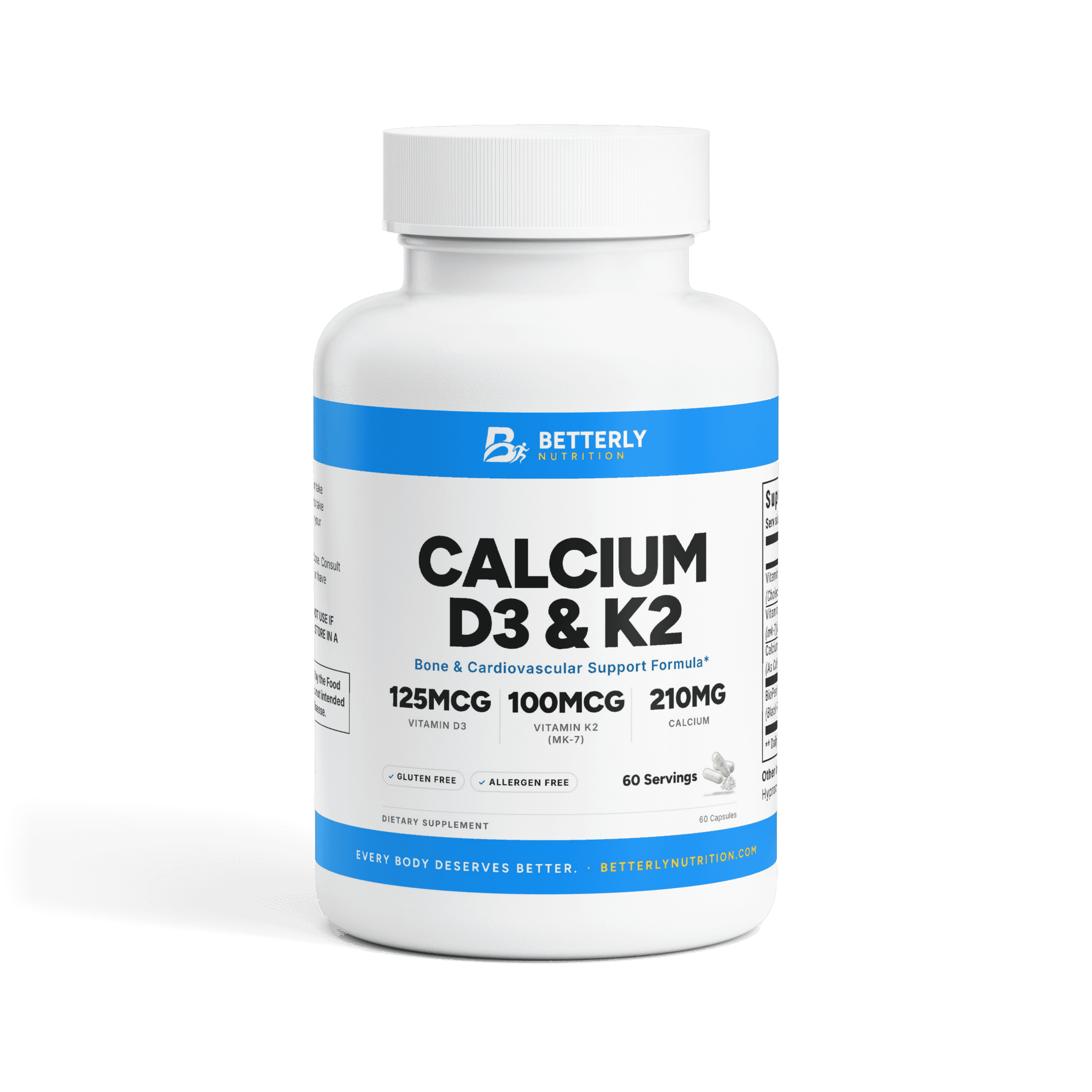
| Calcium, Vitamin D3 & K2 Capsules | Vitamin K2 (mk-7)(as Menaquinone), DV ** | 100 mcg per 1 veggie capsule | K2 as MK-7 |
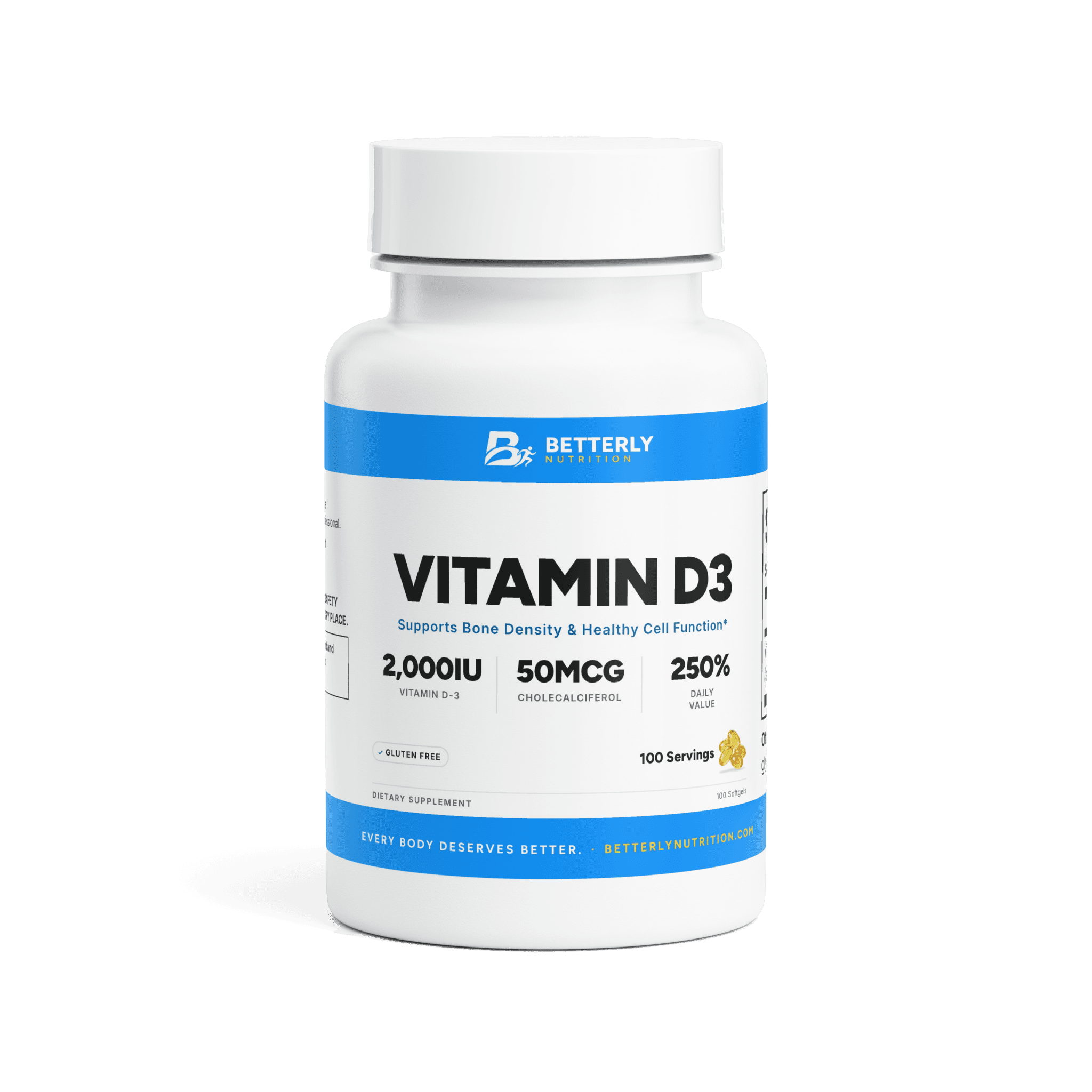
| Vitamin D3 Softgels | No vitamin K line | None | Vitamin D3 only |
The takeaway: both of our vitamin K products use K2 and neither contains K1, but only the capsule names which K2 it uses.
The strip prints 100% for its 120 mcg, matching the FDA's Daily Value. The capsule prints two asterisks, and its footnote reads "Daily Value (DV) not established." Against that same 120 mcg, its 100 mcg works out to about 83%.
Wondering whether MK-4 or MK-7 matters, or whether K2 has to come with D3 at all? Our guide on pairing K2 with vitamin D3 covers both.
Vitamin K1 vs K2 supplement: which one fits you?
For most people, neither a vitamin K1 nor a vitamin K2 supplement is needed, since ODS reports that most Americans already get enough vitamin K through their meals.
ODS doesn't rank the two forms against each other, either. So let your diet and the label guide you:
- If you eat leafy greens most days, food is already covering K1.
- If greens and fermented foods rarely make it onto your plate, a product with either form counts toward the daily target.
- If you want vitamin D3 in the same step, both of our vitamin K products pair K2 with D3, so compare their D3 amounts (next section).
- If you take a blood thinner, let your prescriber weigh in first.
Want K1 specifically? We don't make one, so check other brands' panels for the K1 names above. For the rest of this category, browse our targeted support supplements, including plain Vitamin D3 Softgels with no vitamin K.
From our shop: 2,000 IU Vitamin D3 & K2 Strips — lists 120 mcg of vitamin K2 (menaquinone) with 2000 IU of vitamin D3 per 1 oral strip (100 mg) serving, for anyone who prefers a dissolving raspberry strip to a capsule.
How do you take a vitamin K2 strip or capsule?
The 2,000 IU Vitamin D3 & K2 Strips label calls for one strip dissolved on the tongue daily; the calcium capsule's label dose tops the vitamin D upper limit.
The strip label reads: "Place 1 oral strip on the tongue daily and allow it to dissolve." The label names no time of day and doesn't mention water. The other ingredients include erythritol, sorbitol syrup and steviol glycosides, so scan that list if you avoid any sweetener.
The calcium capsule needs a plain warning. Its label directs one capsule twice a day, 20 to 30 minutes before a meal. Each capsule holds 125 mcg (5,000 IU) of vitamin D3. The ODS vitamin D fact sheet sets the adult upper limit at 100 mcg (4,000 IU) a day from food, drinks and supplements combined.
So one capsule is already over the limit, and the label's two a day add up to 250 mcg (10,000 IU). We don't recommend this capsule at the label's two a day, or at one a day, because each capsule alone is over the adult limit. If you're considering it, talk with your healthcare provider first. Our vitamin D IU to mcg chart shows how to convert any label yourself.
When don't you need a vitamin K supplement?
You probably don't need a vitamin K supplement if leafy greens, vegetable oils, cheese or eggs show up in your meals most days, since ODS calls deficiency very rare.
Your greens aren't a lesser kind of vitamin K, either. K1 from a salad and K2 from a supplement go toward the same adequate intake, so a K2 product doesn't fill a gap that food has already covered. If you're torn between one broad formula and a few single nutrients, our look at whether a daily multivitamin is worth it walks through that choice.
The USDA article adds a fair caveat. Citing national survey data, it reports that many older adults, especially men, don't reach the adequate intake for vitamin K. If you're older and greens seldom land on your plate, start with food, then ask your provider whether a supplement makes sense.
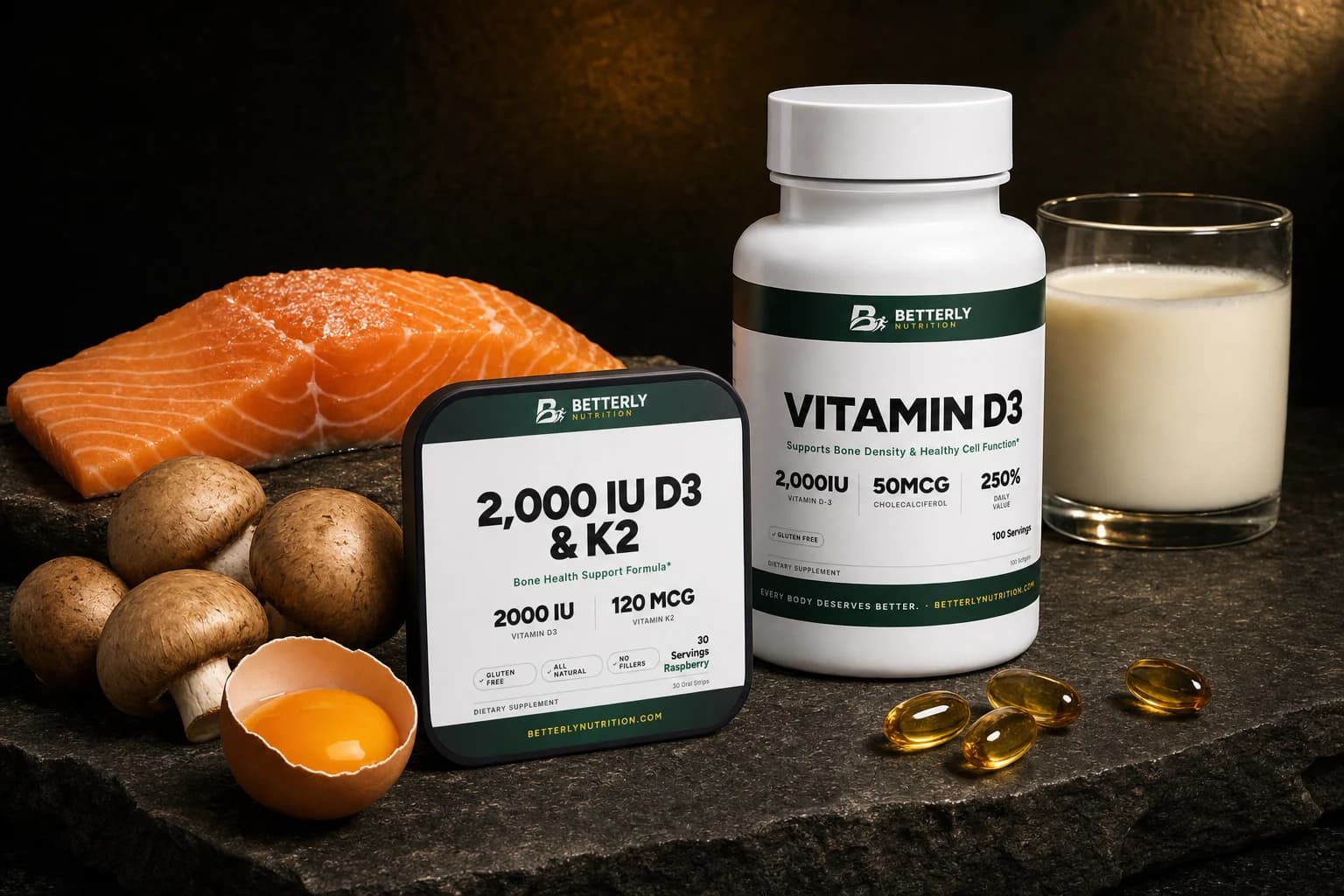
From our shop: Vitamin D3 Softgels — a plain vitamin D3 softgel at 50 mcg (2,000 IU) per 1 softgel capsule serving, a fit if leafy greens already cover your vitamin K.
Who should check with a healthcare provider first?
If you take a blood thinner, keep your vitamin K steady and ask your prescriber before adding a vitamin K1 or K2 supplement.
Here's the part that matters for a K1 vs K2 comparison. For people on warfarin (Coumadin), ODS says the vitamin K from food and supplements together should stay about the same each day. That advice makes no distinction between the two forms. So piling your plate with kale and spinach changes your vitamin K total, and so does starting a K2 strip. Both count.
That's why "it's only food" isn't a free pass. If you're planning a big shift in how many greens you eat, mention it to your prescriber along with any new supplement.
Your vitamin K supply can also run differently from most people's in a few situations, per ODS:
- You've had bariatric surgery.
- You have a digestive condition that reduces how much vitamin K your body absorbs.
- You've been on antibiotics for more than a few weeks. Gut bacteria make some of your vitamin K, and a long course may reduce that supply.
- You use a bile acid sequestrant or orlistat, both of which can lower vitamin K absorption.
Outside vitamin K, the caution printed on both of our K2 products asks you to consult a physician first if you're pregnant, nursing, under 18 or have a medical condition. Both also carry vitamin D3, which ODS says can interact with some medicines, so bring any prescription list to that conversation. Have surgery scheduled? Tell your care team about every supplement you take.
FAQ: vitamin K1 and K2
Is phytonadione vitamin K1 or K2?
Phytonadione is vitamin K1. ODS lists phylloquinone and phytonadione as the K1 forms found in supplements, and menaquinone-4 and menaquinone-7 as K2 forms. So phytonadione on a Supplement Facts panel means the plant form of vitamin K, the same type found in leafy greens. It counts toward the same adequate intake as K2.
Do multivitamins contain vitamin K1 or K2?
Some multivitamins contain vitamin K, and the panel tells you which form. ODS says vitamin K is found in multivitamin/mineral supplements, so check for a vitamin K row and read the name in parentheses beside it. Our Daily Multivitamin Capsules list no vitamin K at all. If yours does list it, add that amount to any separate K product you take, since both count toward one daily total.
Is 120 mcg of vitamin K2 a lot?
A 120 mcg serving of vitamin K2 equals 100% of the Daily Value for vitamin K, which the FDA sets at 120 mcg. It's also the ODS daily amount for adult men, while adult women need 90 mcg. ODS says vitamin K has not been shown to cause any harm. Keep in mind that meals add to whatever a supplement supplies, and ODS reports that most people already get enough vitamin K from food.
Is vitamin K the same as potassium?
No, vitamin K is a vitamin and potassium is a mineral. The mix-up happens because K is potassium's symbol on the periodic table. The two do different jobs and appear as separate lines on a Supplement Facts panel. Neither of our vitamin K products lists potassium, so there's nothing to add up between them.
Can you take vitamin K1 and K2 together?
Yes, and a mixed diet already gives you both: K1 from greens and plant oils, K2 from fermented foods and some cheeses. ODS sets no separate K1 or K2 share, so there's no ratio to aim for. Just count every source toward one daily total. On a blood thinner, keep that total steady and plan any new K product with your prescriber.
Sources
- Vitamin K: Fact Sheet for Consumers, NIH Office of Dietary Supplements
- Vitamin D: Fact Sheet for Consumers, NIH Office of Dietary Supplements
- Can a Vitamin Improve the Quality of Life for Older Adults?, USDA Agricultural Research Service
- Daily Value on the Nutrition and Supplement Facts Labels, U.S. Food and Drug Administration
If this left you looking for somewhere to start, read vitamin D3 and K2 oral strips — its amounts per serving are listed on the page. For the practical questions this raises, how dosing, sourcing and subscriptions work is answered in one place.