On this page
- Key takeaways
- What is sublingual vitamin D?
- Is sublingual vitamin D better than pills?
- Can a dietary supplement really be sublingual?
- Does sublingual vitamin D need fat to absorb?
- How do Betterly's D3 strip and softgel compare at 2,000 IU?
- How do you take a vitamin D strip or softgel?
- Sublingual vitamin D side effects: what's the real risk?
- When is under-the-tongue vitamin D not worth it?
- Who should check with a healthcare provider first?
- FAQ: sublingual vitamin D
- Sources
The short answer: Sublingual vitamin D is a spray, drop, tablet or film you hold under your tongue, usually sold on the idea that it absorbs better. We found no federal source showing that. The NIH says vitamin D is fat-soluble and best absorbed alongside food that has some fat, and the FDA says supplements must be swallowed. So let comfort pick the format, and save your scrutiny for the IU count on the panel.
Key takeaways
- No NIH or FDA page we checked shows that under-the-tongue vitamin D is absorbed better than a swallowed softgel or tablet.
- Vitamin D is fat-soluble, and the NIH says your body takes it in best when a little fat comes with it, from a meal or a snack.
- The FDA defines a dietary supplement as a product you swallow, and our strip's directions place the film on top of your tongue, with no mention of "sublingual" anywhere on its label.
- Betterly's D3 & K2 strip and D3 softgel hold the same 2,000 IU of vitamin D3 a serving, so choosing between them comes down to K2, format and other ingredients.
- According to the NIH Office of Dietary Supplements, adults shouldn't go past 4,000 IU (100 mcg) of vitamin D a day from all sources, whatever the route, unless a provider advises it.
Vitamin D3 appears on a number of our labels. This guide compares the two 2,000 IU ones, the 2,000 IU Vitamin D3 & K2 Strips and the Vitamin D3 Softgels, and since we sell both, read our take knowing that. We'll show both panels, flaws included, and credit every health fact to the federal page that states it.
What is sublingual vitamin D?
Sublingual vitamin D is vitamin D made to be held under the tongue, usually sold as a spray, liquid drops, a fast-melting tablet or a thin dissolving film.
"Sublingual" names a route into the body. The FDA's data-standards list of routes of administration defines it as administration beneath the tongue. Buccal, a close cousin, means directed toward the cheek from inside the mouth.
The pitch rarely changes: vitamin D supposedly slips through the thin lining under your tongue and straight into your bloodstream, with no stop in your gut. Here's how the common formats measure a dose:
| Format | How one serving is measured | What to read on the label |
|---|---|---|
| Spray | A set number of sprays | IU per spray, sprays per serving |
| Liquid drops | Drops or ml | Whether to hold it or swallow it |
| Melting tablet | One tablet | IU per tablet, sweeteners |
| Dissolving film | One strip | "On" or "under" the tongue |
| Softgel, for contrast | One softgel | The oil the vitamin sits in |
Only the label tells you whether a serving means one spray or four, so do that math before you compare two products.
Is sublingual vitamin D better than pills?
Sublingual vitamin D has no edge over pills in the evidence we can cite: the NIH fact sheet never mentions the route, and its absorption tip is about dietary fat.
The NIH Office of Dietary Supplements (ODS) vitamin D fact sheet says nothing about sprays, drops or films held in the mouth. Its absorption advice fits in one sentence: because vitamin D is fat-soluble, your body absorbs it best with a meal or snack that includes some fat.
Some brand pages point to their own research on vitamin D mouth sprays. We haven't reviewed that work, and none of the federal fact sheets we rely on gives the under-the-tongue route an edge.
ODS also sketches the ordinary path in a single line: "the vitamin D you consume is absorbed in the gut along with fat." The sublingual pitch says a spray or film can skip that trip. ODS carves out no exception for products held in the mouth, so its fat tip is the advice we'd follow whatever format you buy.
Can a dietary supplement really be sublingual?
The FDA says dietary supplements are products that are ingested and "must be swallowed," so a supplement sold for absorption under the tongue sits awkwardly with that definition.
That line comes from the FDA's Questions and Answers on Dietary Supplements page, which traces the rule to a 1994 law defining a supplement as a product intended for ingestion. Topical and inhaled products, it adds, don't count.
Here's what our own strip's label says: "Place 1 oral strip on the tongue daily and allow it to dissolve." Those directions never ask you to hold the film beneath your tongue. The word "sublingual" isn't printed anywhere on the label, and we make no under-the-tongue absorption claim for the strip.
When a brand prints "sublingual" on a vitamin D product, read it as an instruction about where to put the dose, not as evidence of a better result.
Does sublingual vitamin D need fat to absorb?
ODS gives no separate advice for under-the-tongue products, so its general rule applies: vitamin D is absorbed best with a meal or snack that includes some fat.
So look at what your product carries its vitamin D in. The softgel lists soybean oil and corn oil inside a shell of gelatin, glycerin and water. The strip is a pullulan film, and its other ingredients name no oil: pullulan, cellulose, erythritol, pectin, raspberry flavor, malic acid, lecithin, sorbitol syrup and steviol glycosides.
The simplest way to follow ODS's advice works for both: take your vitamin D with food that has some fat, like eggs or whole-milk yogurt. With drops and sprays, read the other-ingredients line to see what liquid the vitamin D sits in.
How do Betterly's D3 strip and softgel compare at 2,000 IU?
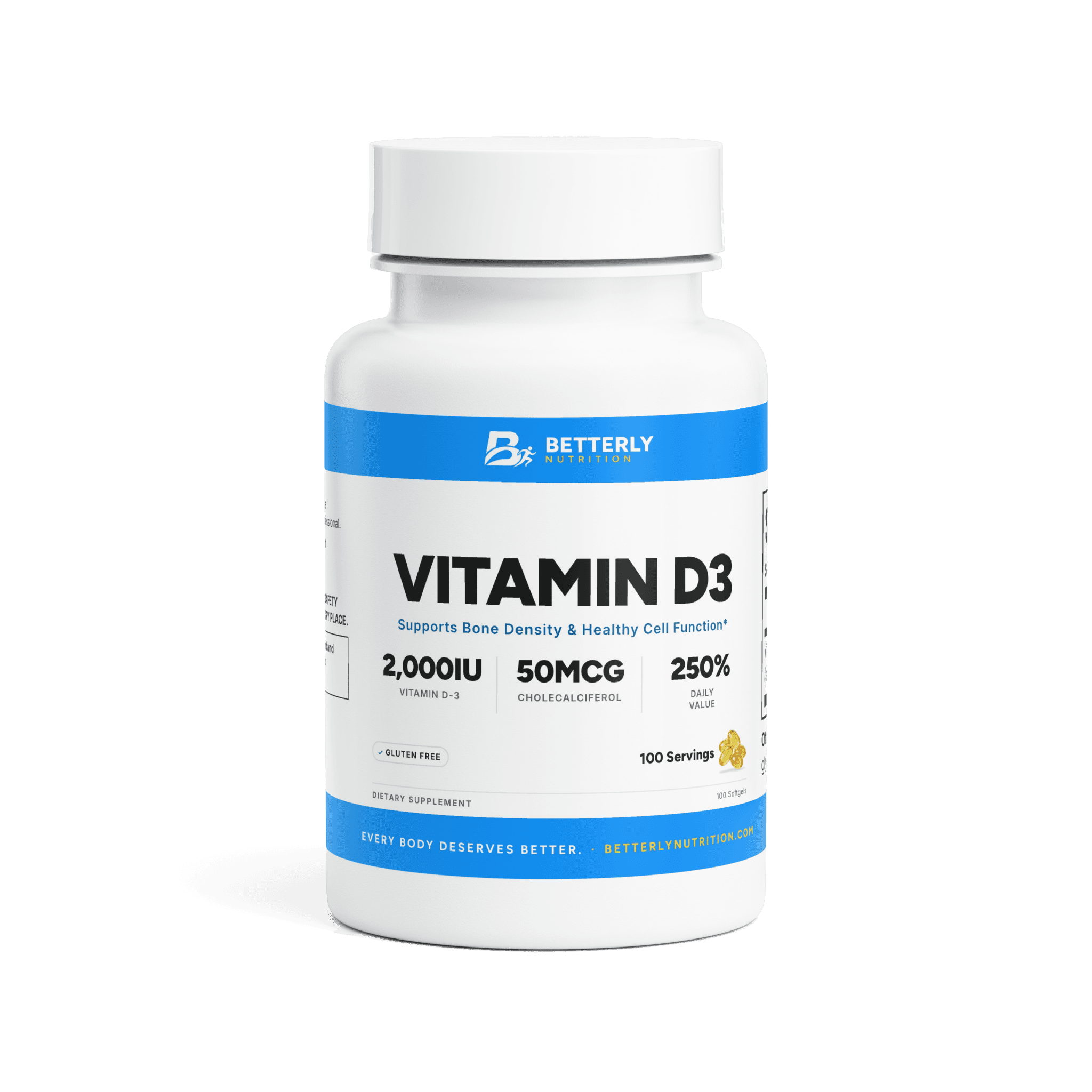
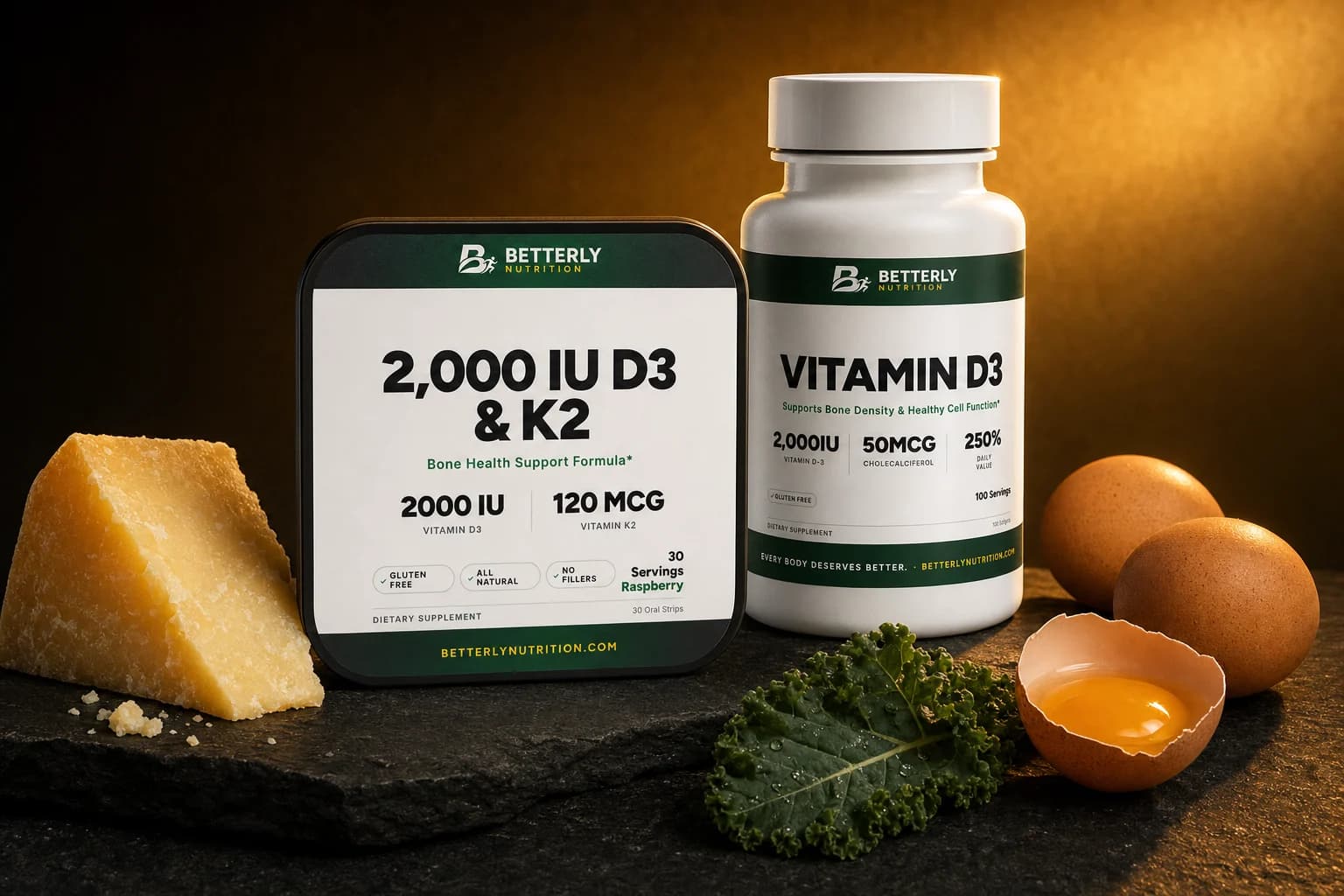
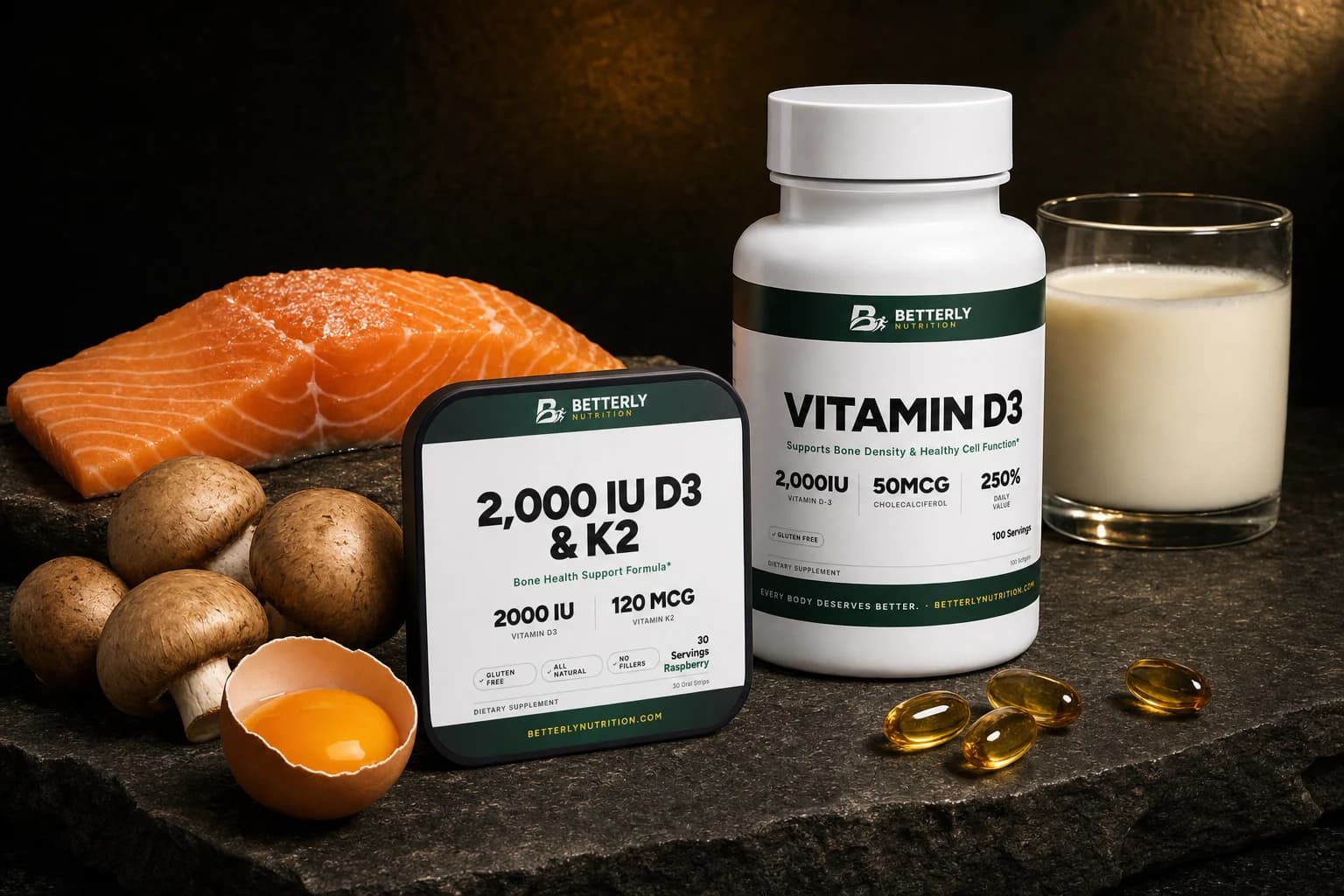
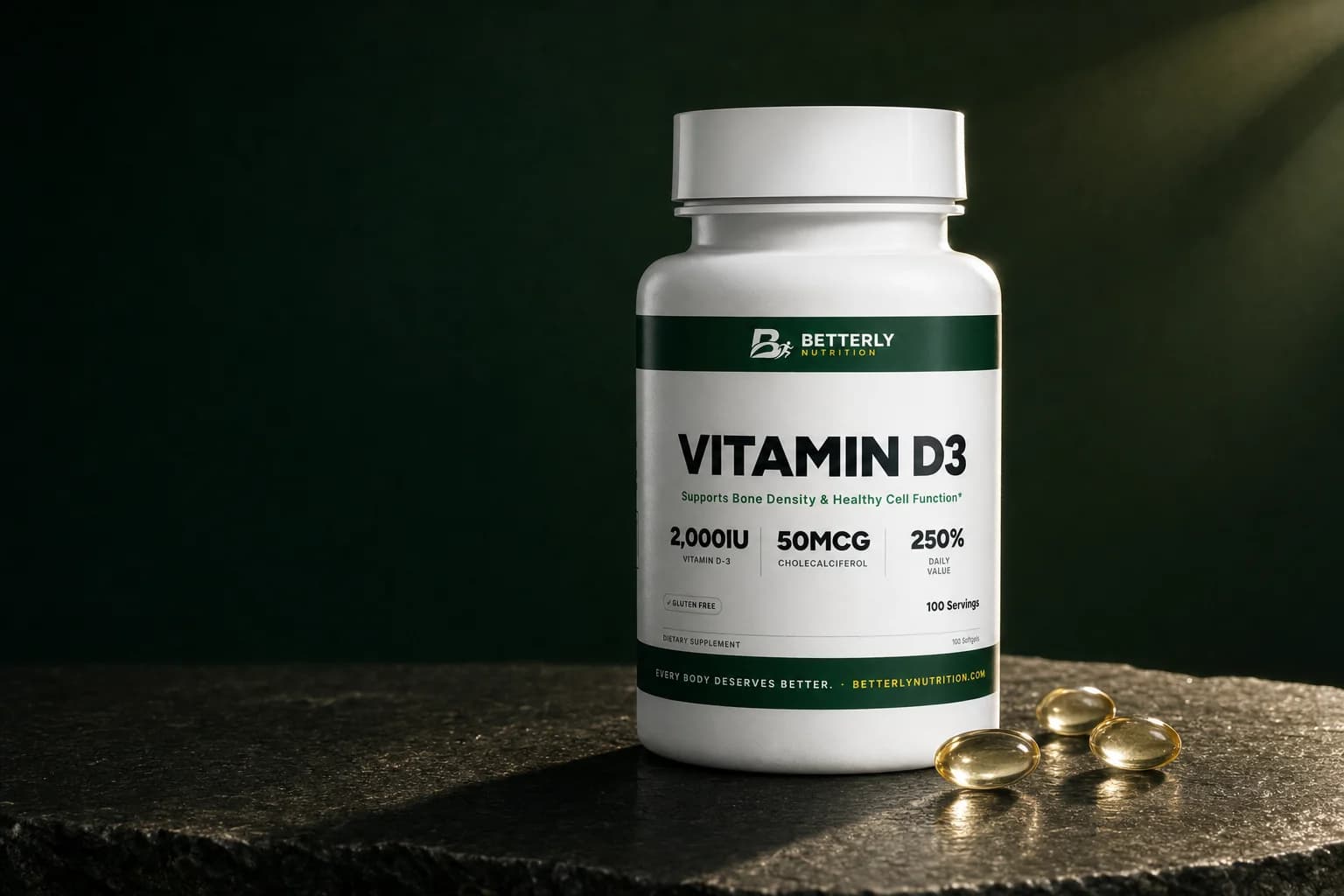
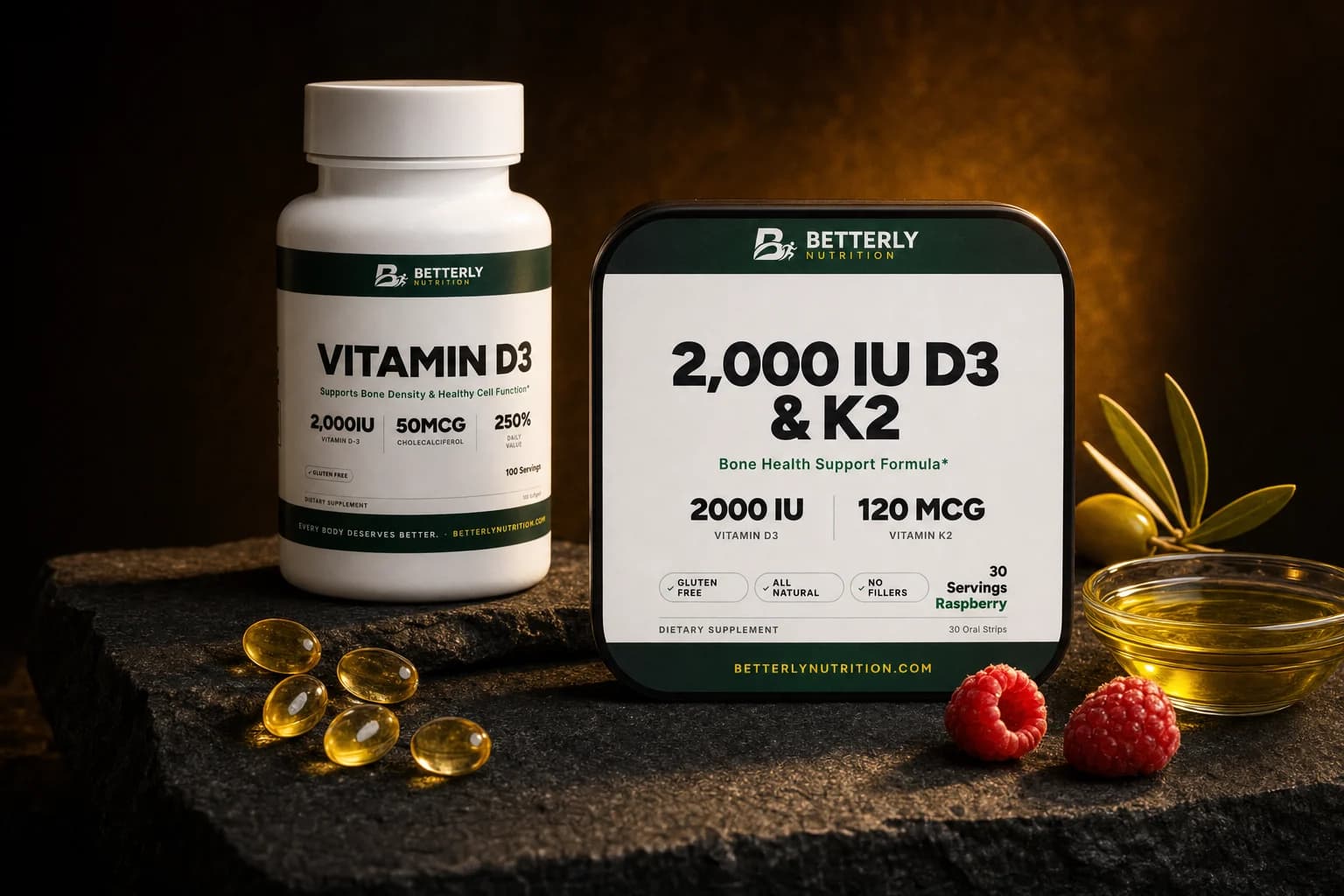
Betterly's 2,000 IU Vitamin D3 & K2 Strips and Vitamin D3 Softgels carry equal vitamin D3 (cholecalciferol), 2,000 IU a serving, but differ in K2, carrier, sweeteners and pack size.
| Label detail | D3 & K2 Strips | D3 Softgels |
|---|---|---|
| Vitamin D3, per serving | 2000 IU (250% DV) per 1-oral-strip (100 mg) serving | 50 mcg (2,000 IU), 250% DV, per 1-softgel-capsule serving |
| Vitamin K2 | 120 mcg as menaquinone (100% DV) | None listed |
| What carries the D3 | Pullulan film, no oil listed | Soybean and corn oil in a gelatin shell |
| Sweeteners | Erythritol, sorbitol syrup, steviol glycosides | None listed |
| Directions | 1 strip on the tongue daily, dissolved | 1 softgel daily |
| Servings per pack | 30 | 100 |
| Says "sublingual"? | No | No |
On vitamin D alone, the two tie at 50 mcg a serving. The strip suits you if swallowing is a chore or you want K2 in the same step. The softgel suits you if you want vitamin D by itself, with no sweeteners, and gelatin and soybean oil are fine for you.
The honest limit on our strip: its panel names the K2 only as "Menaquinone," without saying which type. If format is your real question, our look at vitamins for people who can't swallow pills weighs strips against gummies, chewables and powders.
What about sublingual vitamin D3 with K2?
Adding K2 doesn't change the route question; it adds a second vitamin. Betterly's strip, dissolved on top of the tongue, lists 120 mcg of vitamin K2 per 1-strip serving. According to the ODS vitamin K fact sheet, vitamin K deficiency is very rare, and food covers most people's needs. ODS lists a recommended 120 mcg a day for adult men and 90 mcg for adult women. Whether a combo earns its place is a separate debate, which our breakdown of plain D3 versus D3 and K2 combos works through.
From our shop: 2,000 IU Vitamin D3 & K2 Strips — 30 raspberry-flavored strips per pack, each 1-strip (100 mg) serving pairing 2000 IU of vitamin D3 with 120 mcg of vitamin K2.
How do you take a vitamin D strip or softgel?
Take each product as its label says: Betterly's strip label calls for one oral strip on the tongue daily, and the softgel label says adults take one softgel daily.
- Don't double up on these two. The strip and the softgel on the same day add up to 100 mcg (4,000 IU), the entire ODS adult upper limit, before food counts.
- For the strip, rest it on your tongue until it melts. Its label names no water or time of day.
- For the softgel, swallow one a day, or follow your healthcare professional's directions, which the label allows for.
- Add the fat tip if you like. Taking either one with a meal containing a little fat lines up with ODS's advice.
- Missed a day? Carry on with one the next day. Each label warns, "Do not exceed recommended dose."
Morning or night? Neither label says. Your best anchor is whichever meal of the day reliably includes some fat, since that also covers the ODS tip.
From our shop: Vitamin D3 Softgels — 100 softgels per bottle, each suspending 50 mcg (2,000 IU) of vitamin D3 in soybean and corn oil.
Sublingual vitamin D side effects: what's the real risk?
Sublingual vitamin D's main risk is the same as any vitamin D's: too much. ODS says very high blood levels can cause nausea, vomiting, confusion and muscle weakness.
ODS adds that those high levels almost always come from supplements rather than sunshine. For adults, the ODS upper limit sits at 4,000 IU (100 mcg) daily, with food, drinks and every supplement counted together. If your labels mix units, our chart for converting vitamin D IU to mcg makes the adding easier.
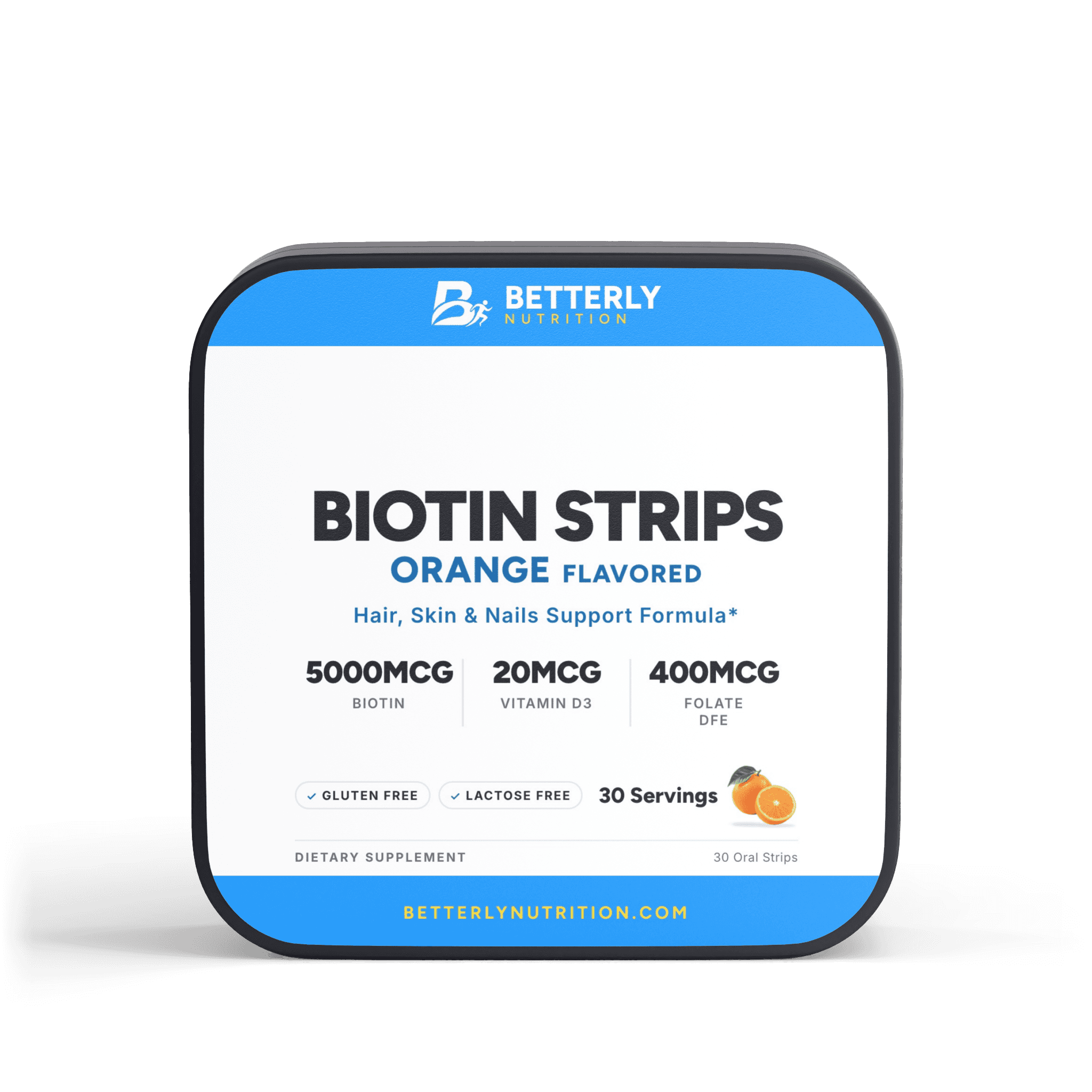
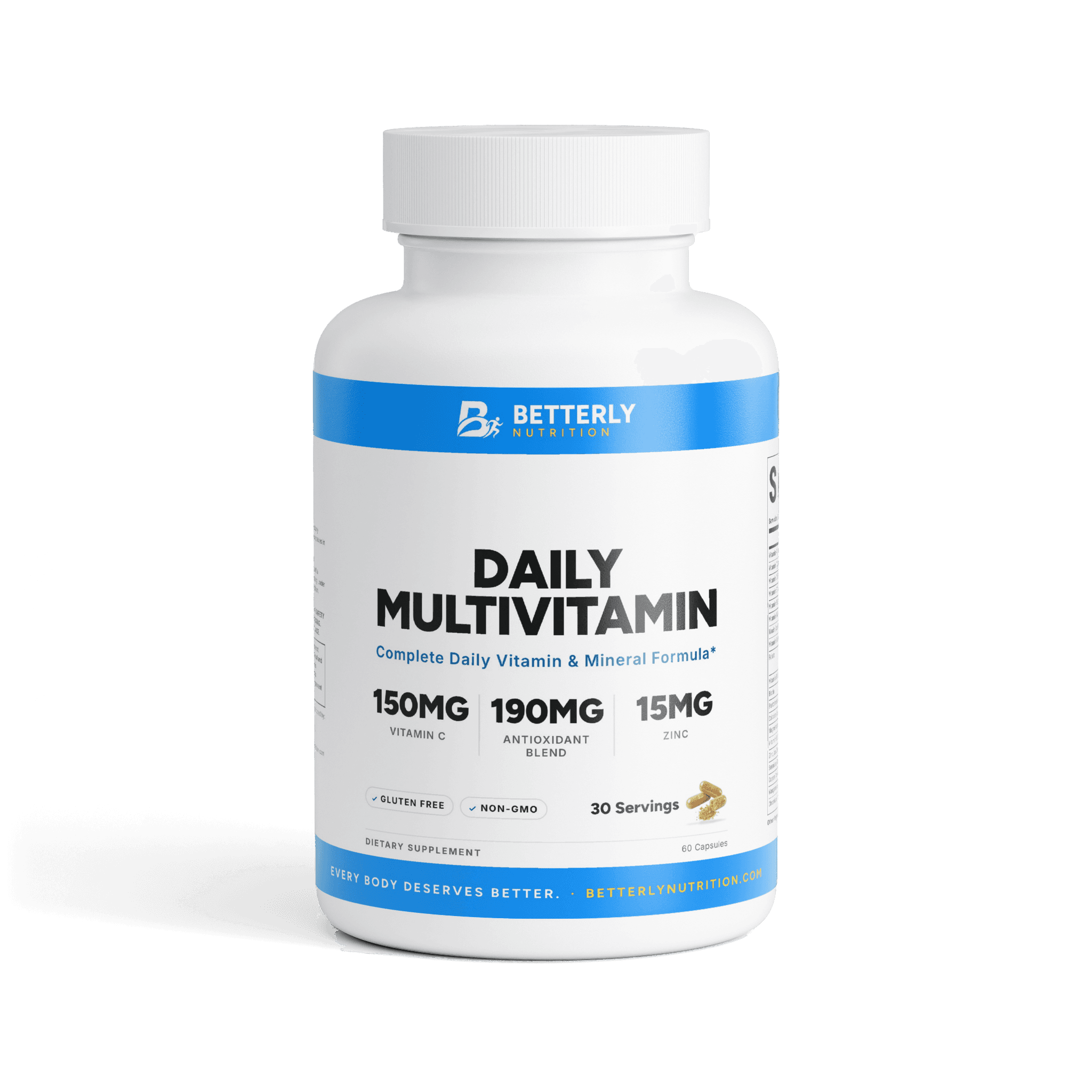
Vitamin D3 also hides in several of our blends, so count those too. Our 5,000mcg Biotin Strips carry 20 mcg in each 1-strip serving, and our Daily Multivitamin Capsules add 10 mcg in each 2-capsule serving.
The D3 & K2 strip plus the multivitamin comes to 60 mcg (2,400 IU) a day. Add the biotin strip and you're at 80 mcg (3,200 IU), with fortified foods still to count.
When is under-the-tongue vitamin D not worth it?
Sublingual vitamin D is hard to justify when a 25-hydroxyvitamin D test already reads adequate, or when food and a multivitamin cover the daily amount ODS recommends.
You may not need extra vitamin D at all if:
- Your 25-hydroxyvitamin D result was 50 nmol/L (20 ng/mL) or higher, the level ODS calls adequate for most people.
- Fortified milk, fatty fish and your multivitamin already reach 600 IU (15 mcg) a day for adults 19 to 70, or 800 IU (20 mcg) from age 71.
- You're shopping for speed. Vitamin D isn't a nutrient you feel kick in, and ODS names a blood test as one way to check your level.
If you do want a daily vitamin D, both of these sit in our targeted support collection. That collection also carries our Calcium, Vitamin D3 & K2 Capsules, which we don't recommend at their label dose. The directions say 1 capsule twice a day, at 125 mcg of vitamin D3 per 1-veggie-capsule serving. That adds up to 250 mcg (10,000 IU) a day, two and a half times the ODS adult upper limit of 100 mcg (4,000 IU). Even a single capsule, at 125 mcg (5,000 IU), is above that limit.
Who should check with a healthcare provider first?
Get a healthcare provider's input before starting any vitamin D product if you're under 18, pregnant or nursing, scheduled for surgery, on a prescription or living with a medical condition.
The strip and softgel labels print an identical caution: "Do not exceed recommended dose. Consult a physician if pregnant, nursing, under 18, or have a medical condition." ODS flags a few more situations to raise:
- If you take warfarin (Coumadin), ODS says to keep your vitamin K intake about the same each day. Talk to your prescriber before starting a D3 and K2 product. The softgel lists no vitamin K.
- ODS lists interactions between vitamin D and several medicines, including orlistat, statins, some steroids and thiazide diuretics. Show your pharmacist the label.
- People who have trouble absorbing fat, or who've had gastric bypass surgery, may struggle to get enough vitamin D, according to ODS. Their plan should come from a provider.
FAQ: sublingual vitamin D
Can you take vitamin D drops under your tongue?
Yes, you can hold vitamin D drops under your tongue when that product's label tells you to, but ODS gives no reason to expect better absorption that way. Its general advice is to pair vitamin D with food that contains some fat. Follow your label on holding or swallowing, and count drops carefully, because the serving size sets your dose.
Does vitamin D under the tongue work faster than a softgel?
No federal source we found shows that vitamin D held under the tongue works faster than a softgel. Vitamin D also isn't something you notice taking effect, the way you might notice a cup of coffee. ODS says one way to know whether you're getting enough is a blood test that measures 25-hydroxyvitamin D, which a provider can order. If speed is why you're eyeing a spray or drops, no federal source we found supports that reason.
Can you take sublingual vitamin D on an empty stomach?
Yes, you can take an under-the-tongue vitamin D product without food unless its label says otherwise, and neither our strip's label nor our softgel's names a meal. ODS does say vitamin D absorbs best when some fat is in the same meal or snack, so pairing your strip, drops or softgel with food follows that advice.
Should you chew, swallow or dissolve a vitamin D strip?
Dissolve a vitamin D strip rather than chewing it. The label on Betterly's 2,000 IU Vitamin D3 & K2 Strips says to place 1 oral strip on the tongue daily and allow it to dissolve, so there's nothing to chew and no water to fetch. As the film melts, it goes down with your saliva. Our Vitamin D3 Softgels work the other way: you swallow one softgel, once a day.
Is a D3 and K2 spray or strip safe if you take a blood thinner?
Not without your prescriber's okay. If you take warfarin, ODS says your vitamin K intake should stay about the same from day to day, because a sudden change can affect how the medicine works. Our on-the-tongue D3 & K2 strip lists 120 mcg of vitamin K2 per 1-strip serving, so starting or stopping it counts as a change. Our Vitamin D3 Softgels list no vitamin K, but a pharmacist should still review them alongside your other medicines.
Sources
- Vitamin D: Fact Sheet for Consumers, NIH Office of Dietary Supplements
- Vitamin K: Fact Sheet for Consumers, NIH Office of Dietary Supplements
- Questions and Answers on Dietary Supplements, U.S. Food and Drug Administration
- Route of Administration, U.S. Food and Drug Administration
If this left you looking for somewhere to start, read 2,000 IU vitamin D3 and K2 dissolving strips — its amounts per serving are listed on the page. For the practical questions this raises, how dosing, sourcing and subscriptions work is answered in one place.