On this page
- Key takeaways
- Is 80 mg of zinc too much for one day?
- How does 80 mg compare with the zinc your body needs?
- What's in an 80 mg zinc eye formula like ours?
- What are the signs of too much zinc?
- Does 0.9 mg of copper cancel out 80 mg of zinc?
- What's your zinc total with a multivitamin or elderberry capsule?
- How do you take Bilberry & Lutein Eye Capsules if a provider says yes?
- When don't you need a high-zinc supplement?
- Which people should clear 80 mg of zinc with a provider first?
- FAQ: 80 mg zinc and upper limits
- Sources
The short answer: For a healthy adult choosing on their own, 80 mg of zinc is too much. The NIH Office of Dietary Supplements lists a 40 mg daily ceiling for adults, with meals, drinks and pills all counted, so 80 mg is double that ceiling before you eat anything. Our Bilberry & Lutein Eye Capsules list exactly 80 mg per 2-capsule serving, so please talk with a healthcare provider before using them.
Key takeaways
- The adult upper limit for zinc is 40 mg a day from every source combined, and 80 mg is twice that amount.
- Adult women need 8 mg of zinc a day and adult men need 11 mg, and ODS says most Americans already meet that through meals.
- Too much zinc over a long stretch can leave you low in copper, and adding 0.9 mg of copper to a formula doesn't change zinc's 40 mg limit.
- The upper limit doesn't apply when a doctor directs zinc for a medical reason, which is why an 80 mg product starts with a provider conversation.
A note on where we stand: Betterly sells the 80 mg eye capsule behind this question, and its zinc row is over the limit. We'd rather do that math with you here than leave you to find the number on the back of the bottle.
Is 80 mg of zinc too much for one day?
Yes, 80 mg of zinc a day is too much for most adults, because it's twice the 40 mg upper limit the NIH Office of Dietary Supplements lists.
The ODS zinc fact sheet for consumers lists that 40 mg figure under the question "Can zinc be harmful?" ODS files the number in its section on harm, apart from the section on how much you need. Read it as the most a healthy adult should get in a day.
Two details on that page shape how you should read an 80 mg label:
- It counts everything. The limit covers zinc from foods, beverages, supplements and medications, all added together.
- It has one exception. ODS says the limits don't apply to people taking zinc for medical reasons under a doctor's care.
That exception is the honest answer to "is 80 mg of zinc safe?" When a provider picks 80 mg for you, it's a plan built around your situation. Choosing it off a shelf yourself is a different decision, and the 40 mg ceiling applies.
How does 80 mg compare with the zinc your body needs?
An 80 mg serving of zinc holds about 7 times the 11 mg adult men need and 10 times the 8 mg adult women need, based on ODS amounts.
| Who | Daily need (ODS) | Upper limit (ODS) | 80 mg a day is |
|---|---|---|---|
| Adult women | 8 mg | 40 mg | 10x the need, 2x the limit |
| Adult men | 11 mg | 40 mg | About 7x the need, 2x the limit |
| Teens 14 to 18 | 9 to 11 mg | 34 mg | More than 2x the limit |
The limit is the same 40 mg for every adult, so 80 mg lands at double it whether you're a man or a woman. Teens have a lower ceiling still, and our eye capsule's directions are written for adults, with anyone under 18 told to ask a physician first.
So where does the "730%" on our panel come from? FDA's reference table of Daily Values sets zinc's Daily Value at 11 mg, and 80 divided by 11 is about 7.3. The percentage says nothing about safety; that's the upper limit's job.
Food covers most people. ODS names oysters as a very high source, with meat, fish, poultry and fortified cereals also giving good amounts. MedlinePlus on zinc in the diet adds that zinc from plant foods is harder for your body to use, and ODS lists vegetarians and vegans among the groups who may run short. Even for them, the fact sheet doesn't point toward 80 mg.
What's in an 80 mg zinc eye formula like ours?
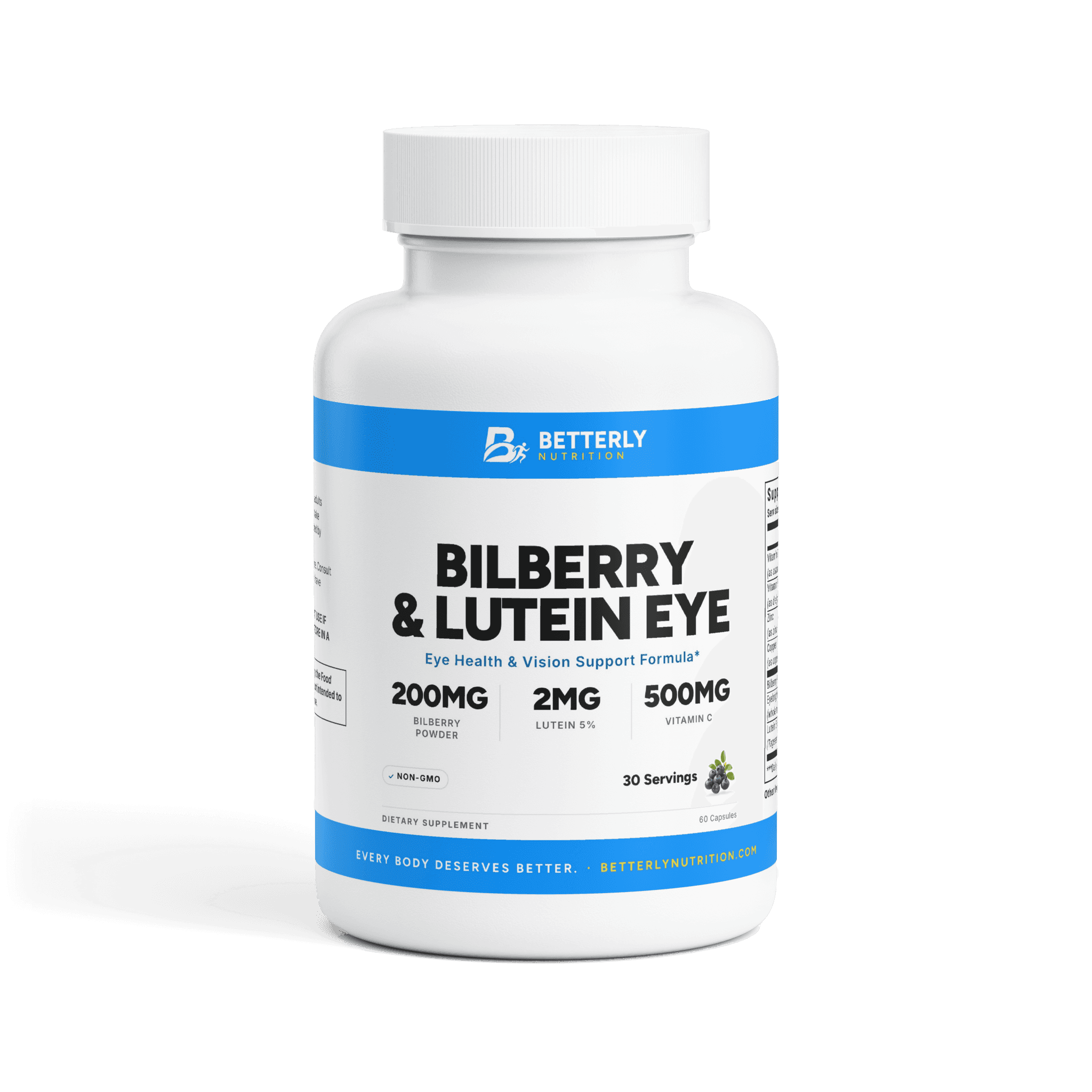
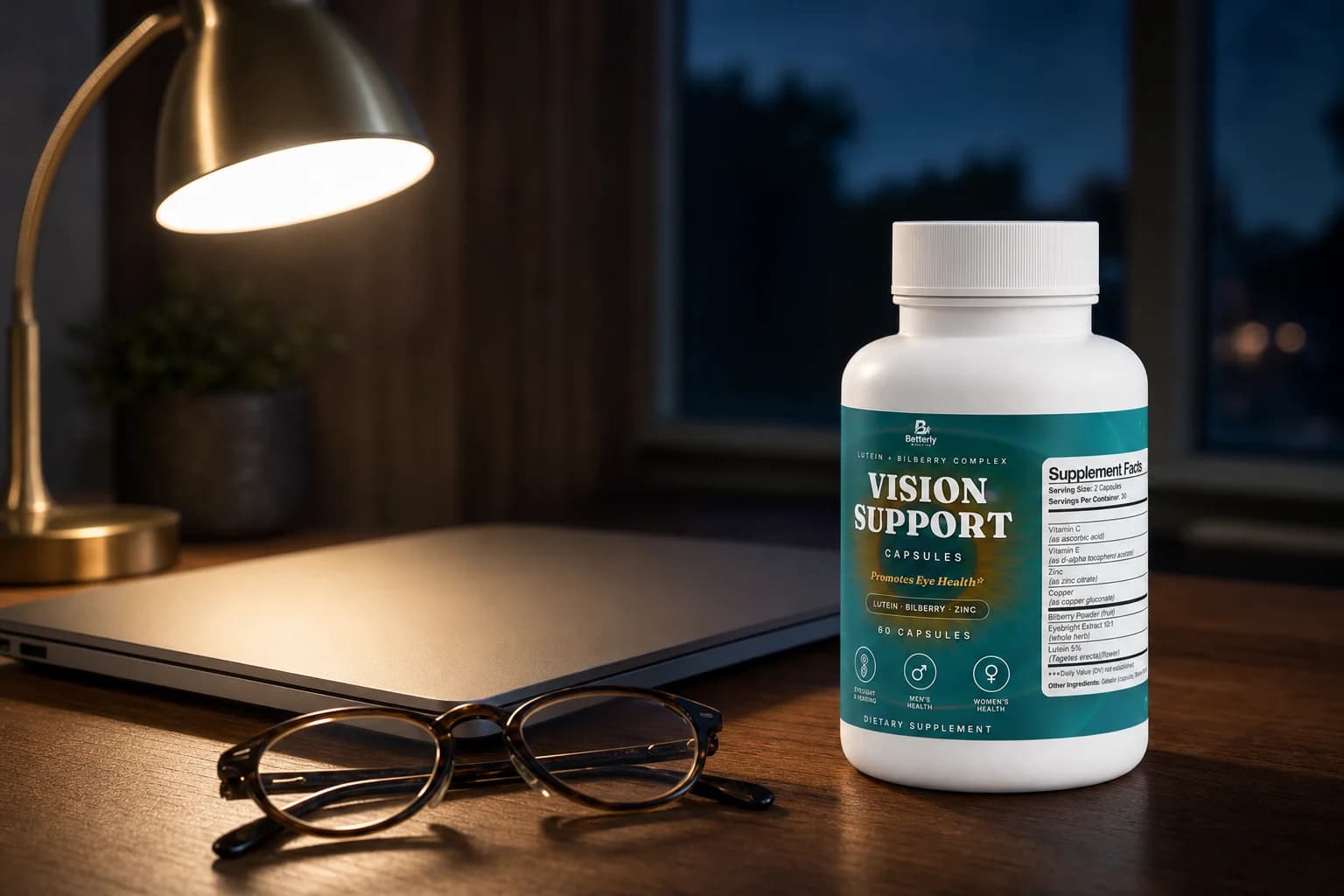
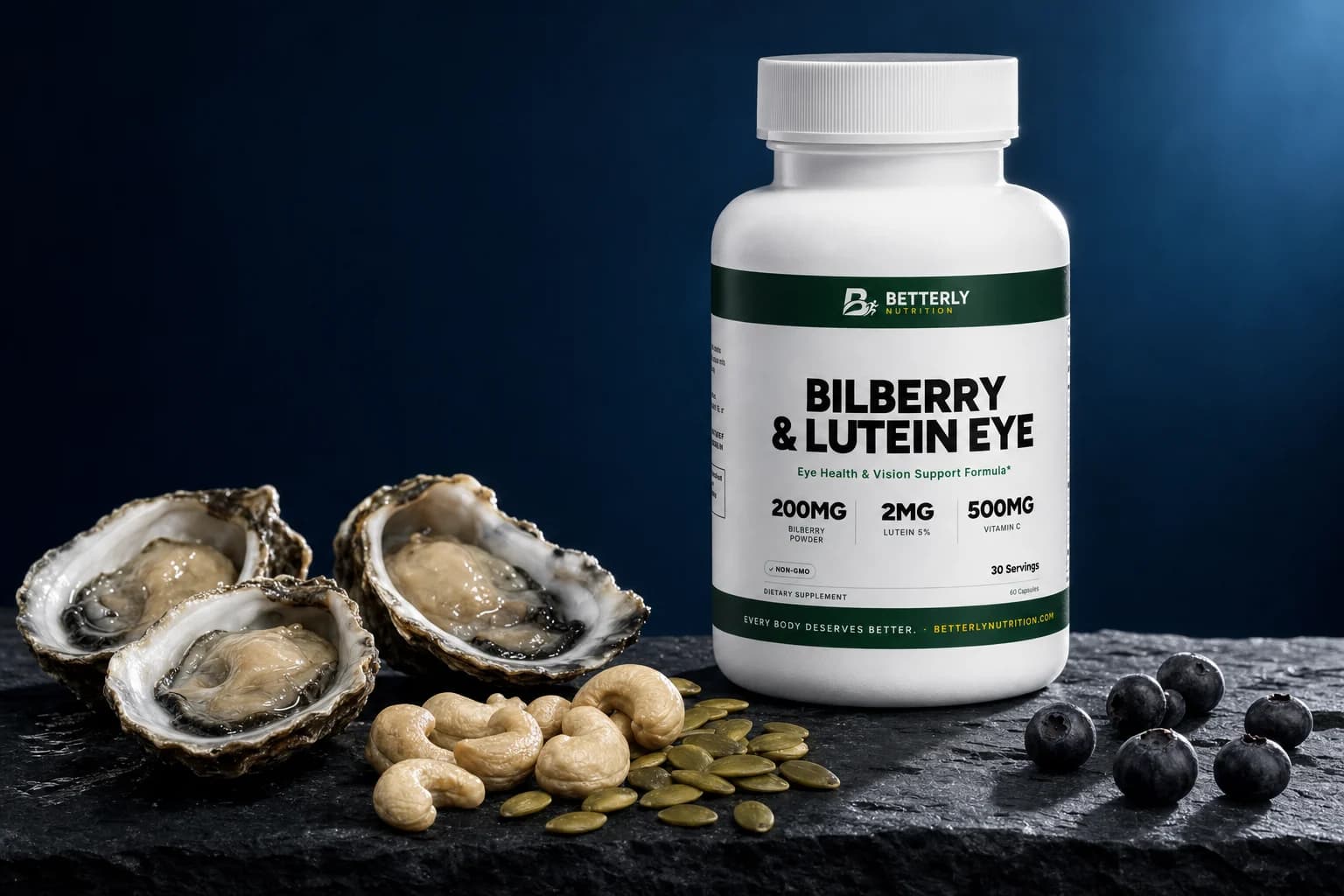
Betterly's Bilberry & Lutein Eye Capsules pair 80 mg of zinc with 0.9 mg of copper per 2-capsule serving, alongside vitamins C and E, bilberry, eyebright and lutein.
Some eye formulas use higher zinc amounts; the upper limit still applies unless a provider advises otherwise. Ours comes from our supplier's formula, and we sell it as labeled. The panel on the eye capsule's product page lists the zinc as zinc citrate (730% DV) and the copper as copper gluconate (100% DV). The rest of the panel holds 500 mg of vitamin C, 30 mg of vitamin E, 200 mg of bilberry fruit powder, 10 mg of eyebright extract and 2 mg of lutein 5%. One thing to know before you shop: the front label advertises the bilberry, lutein and vitamin C amounts, and you have to turn the bottle around to find the 80 mg.
We won't call 80 mg fine because other eye products use it, and we won't suggest changing the serving on your own. If 80 mg doesn't suit you, the product doesn't either.
Our guide to eye vitamins for long screen days already says this capsule's zinc needs adding up. You can compare it with the rest of our targeted support collection, checking each product page's label for zinc.
What are the signs of too much zinc?
The signs of too much zinc that ODS lists are mostly stomach trouble: nausea, vomiting, upset stomach and loss of appetite, plus dizziness and headaches.
MedlinePlus adds diarrhea and abdominal cramps from large supplement amounts, and says those symptoms fade soon after the supplements stop.
Daily use at 80 mg raises a slower concern. According to ODS, too much zinc for a long time can bring lower immunity, lower levels of HDL (the "good" cholesterol) and low copper levels. Very high supplement doses can also cut how much magnesium your body absorbs. MedlinePlus sums up the long-term risk as running short on copper, iron or magnesium.
If you notice any of these while taking a zinc product, stop it and call your healthcare provider. Keeping your routine to a few products, as our routine-planning walkthrough suggests, makes that call simpler.
Does 0.9 mg of copper cancel out 80 mg of zinc?
No. The 0.9 mg of copper in our eye capsule covers an adult's daily copper need, but it doesn't raise or remove zinc's 40 mg upper limit.
MedlinePlus on copper in the diet says copper works with iron to help your body form red blood cells, and it helps keep blood vessels, nerves, bones and the immune system healthy. Adults need 900 mcg a day, which is 0.9 mg. FDA uses that same 0.9 mg as copper's Daily Value, so our panel prints 100%.
Since too much zinc over time can leave you low in copper, a high-zinc formula that also lists copper makes sense on paper. But ODS gives its 40 mg limit for zinc itself, with no allowance for products that add copper, and nothing in our sources says the copper softens zinc's stomach effects or its other long-term ones.
If you like ratios, the eye capsule's zinc to copper works out to roughly 89 to 1. Our Daily Multivitamin Capsules come to 7.5 to 1. None of our federal sources sets a target ratio, so neither figure tells you which formula is better.
What's your zinc total with a multivitamin or elderberry capsule?
Your zinc total climbs fast: Betterly's eye capsules reach 95 mg a day with our multivitamin and 91 mg with our Elderberry, Echinacea & Zinc Capsules, before food.
ODS says almost all multivitamins contain zinc, and so do some other over-the-counter products. Here are our own panels at each label's daily serving:
| Daily combination (label servings) | Zinc from supplements | Vs the 40 mg adult limit |
|---|---|---|
| Eye capsules alone (2) | 80 mg | 2x the limit |
| Eye capsules + Daily Multivitamin Capsules (2 + 2) | 95 mg | About 2.4x |
| Eye capsules + Elderberry, Echinacea & Zinc Capsules (2 + 2) | 91 mg | About 2.3x |
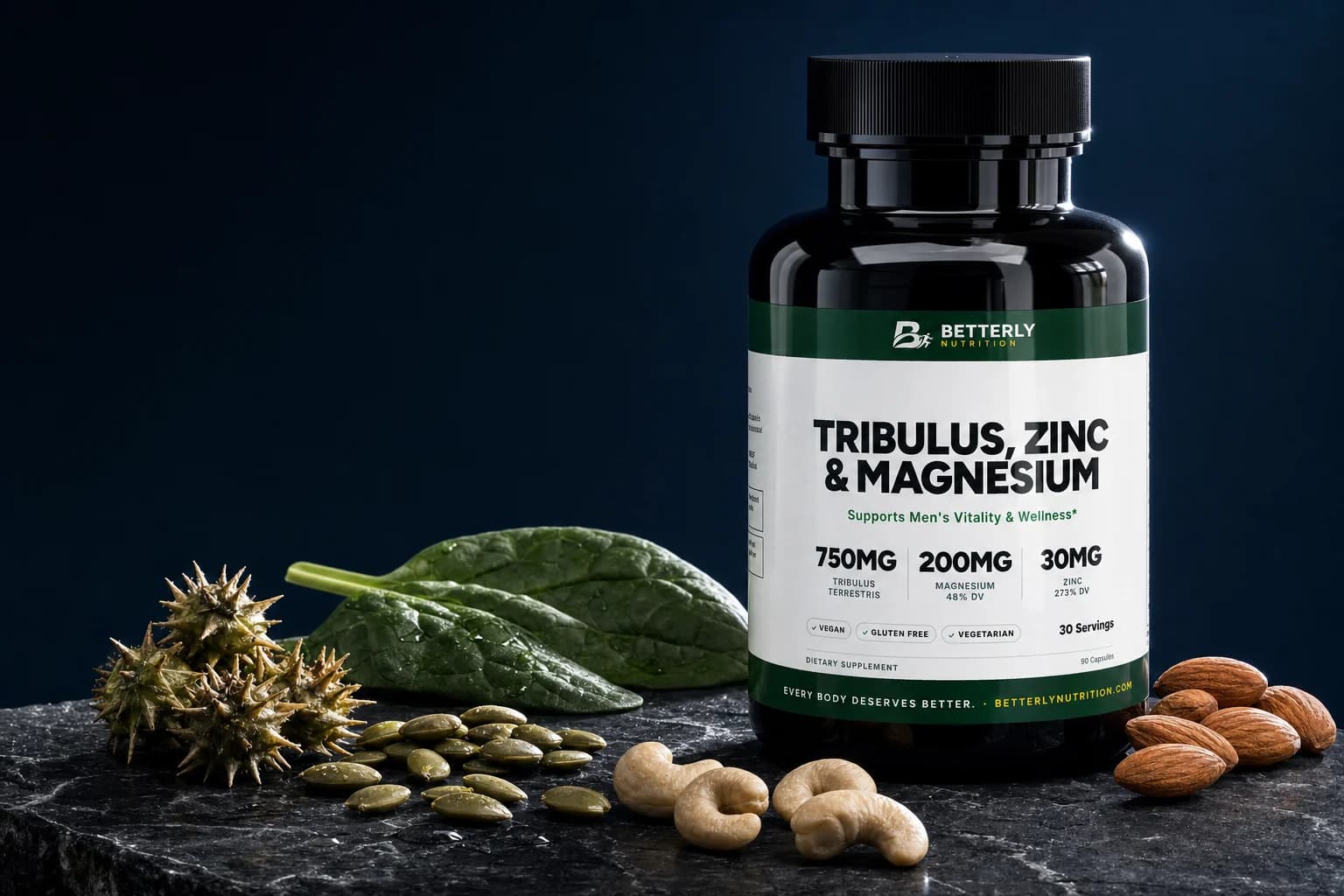
| Multivitamin + Tribulus, Zinc & Magnesium Capsules (2 + 3) | 45 mg | 5 mg over |
| Multivitamin + Tribulus & Ginseng Women's Libido Capsules (2 + 2) | 41 mg | 1 mg over |
| Multivitamin + Elderberry (2 + 2) | 26 mg | 14 mg left for food |
Across the rows, any pairing with the eye capsules lands above 90 mg. Even our two tribulus formulas, at 30 mg per 3-capsule serving and 26 mg per 2-capsule serving, push a multivitamin past 40 mg. Only the multivitamin with the elderberry capsules, at 11 mg per 2-capsule serving, leaves real room, and your meals use some of it.
Check our other panels too. The zinc in our Tongkat Ali, Maca & Ginseng Capsules is 50 mg per 2-tablet serving (the label lists tablets, though the name says capsules), which passes the adult limit on its own. That one also needs a provider's okay before you use it. If magnesium is in your stack, our zinc and magnesium label math runs both minerals side by side.
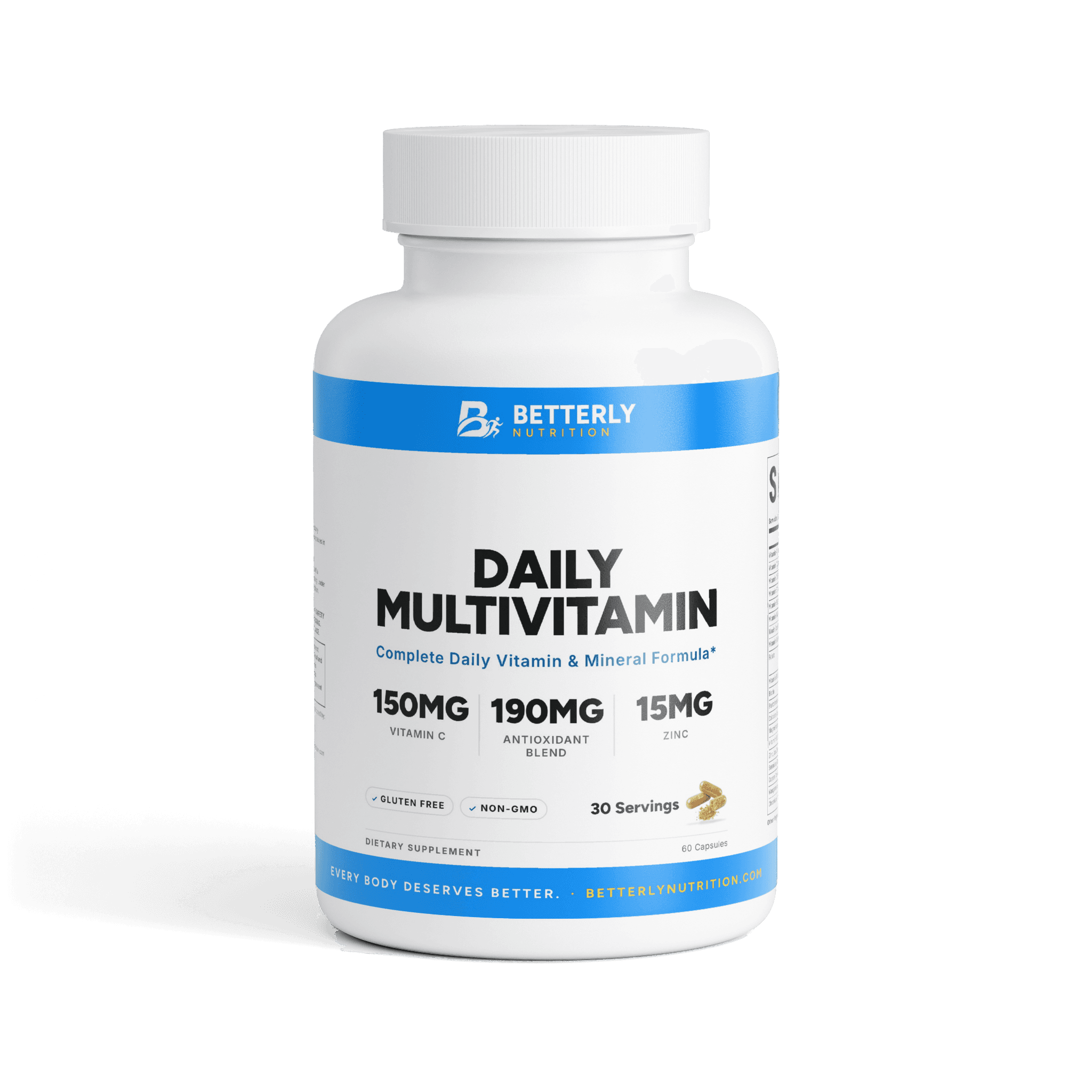
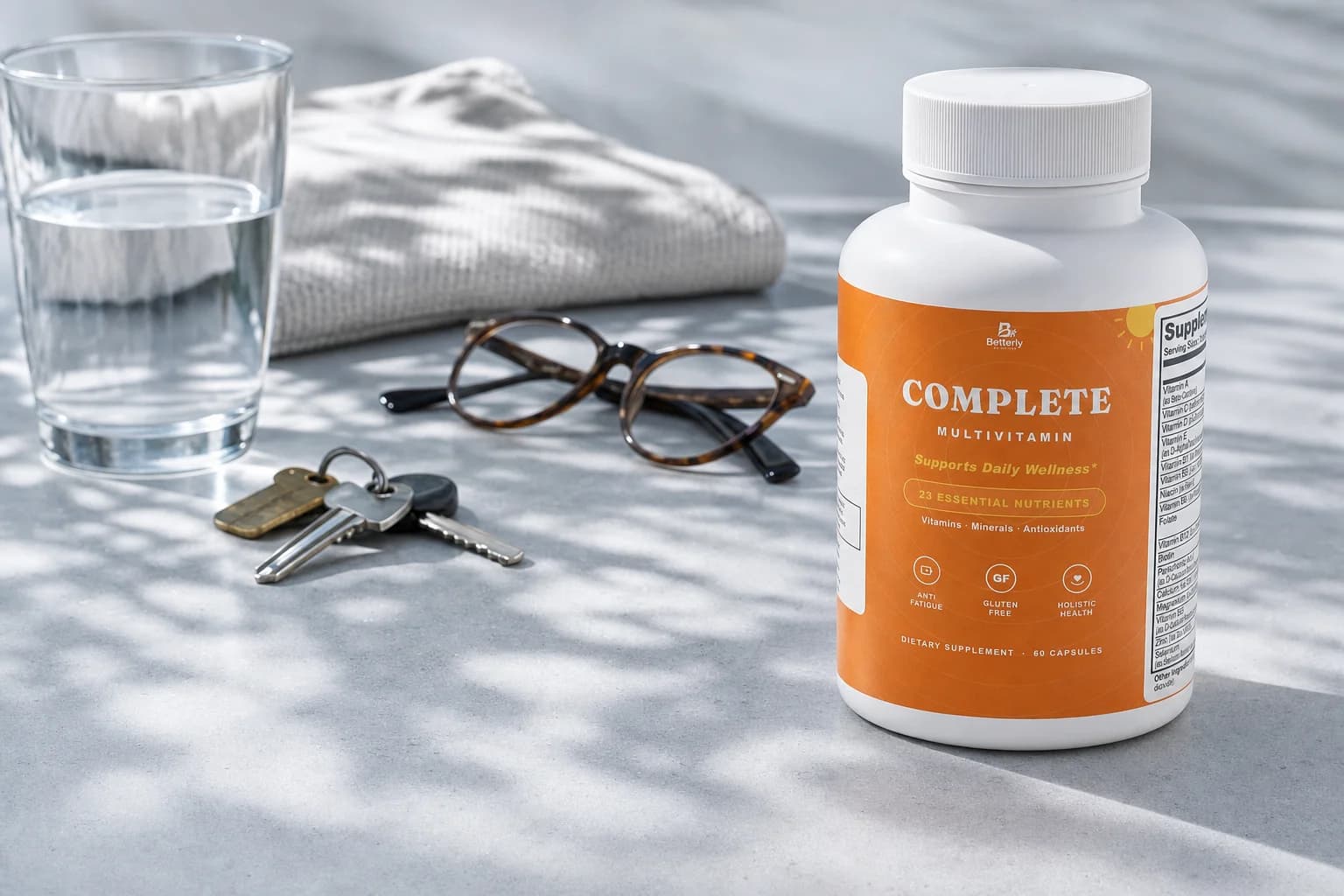
From our shop: Daily Multivitamin Capsules — a morning-with-a-meal formula whose 2-capsule serving pairs 15 mg of zinc (as zinc oxide) with 2 mg of copper.
How do you take Bilberry & Lutein Eye Capsules if a provider says yes?
The label directions on Bilberry & Lutein Eye Capsules call for two capsules daily for adults, with 6 to 8 oz of water, or as a healthcare professional directs.
That last clause carries extra weight here, because the standard serving doubles the adult zinc limit. Bring the bottle itself to your provider, since the zinc row is on the back.
Questions worth asking:
- Is 80 mg of zinc a day right for me, and for how long?
- Should I stop my multivitamin or any other zinc product while I take this?
- Do any of my medicines interact with zinc?
On that last one, ODS offers a specific timing rule. It says quinolone and tetracycline antibiotics might lower how much of each (the zinc and the drug) you absorb. If you need both, ODS suggests a gap: swallow the antibiotic 2 or more hours before your zinc, or wait until 4 to 6 hours after the zinc to take it.
The 80 mg already doubles the adult limit, so don't stack a second zinc product on top, and don't change the serving without your provider.
From our shop: Bilberry & Lutein Eye Capsules — an eye formula for adults whose 2-capsule serving adds 80 mg of zinc and 0.9 mg of copper to its bilberry and lutein, so a provider check comes first.
When don't you need a high-zinc supplement?
You probably don't need an 80 mg zinc supplement if your meals are varied, because ODS reports that most Americans meet their zinc needs through food.
Skip it, or at least rethink it, if:
- You eat meat, seafood, poultry, eggs, dairy, beans, nuts or whole grains most days.
- You already take a multivitamin. Almost all contain zinc, and ours carries 15 mg per 2-capsule serving.
- You mainly want the bilberry or lutein. The 80 mg of zinc comes along whether you want it or not.
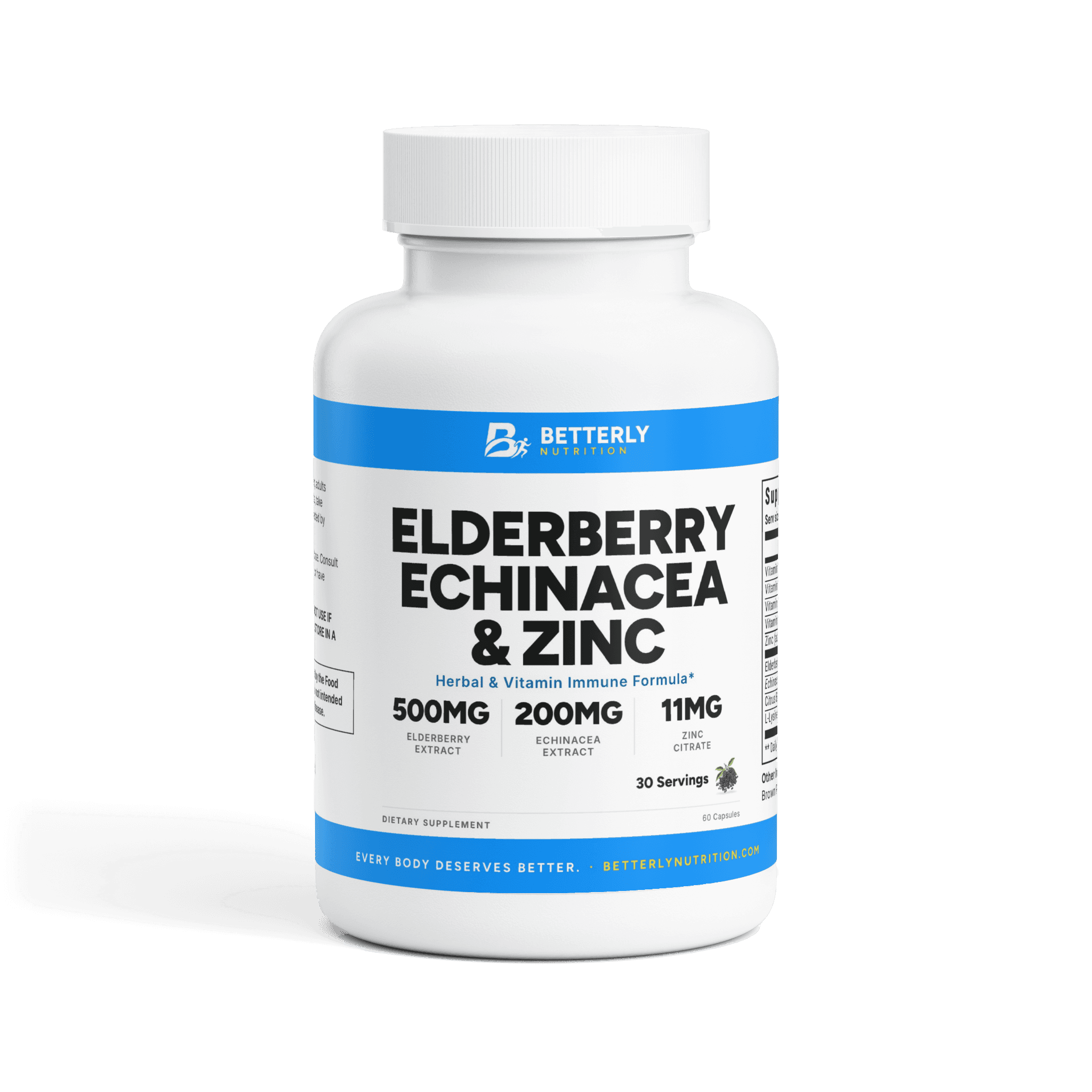
- You want zinc for its role in normal immune function. Our elderberry capsule's 11 mg per 2-capsule serving matches the Daily Value, nowhere near the limit.
Our multivitamin lists lutein and bilberry extract too, but only as parts of blends with no individual amounts, so its dose of either is unknown to us.
If you're weighing one broad formula against single nutrients, our look at whether you need a multivitamin at all helps you decide.
Which people should clear 80 mg of zinc with a provider first?
Anyone weighing 80 mg of zinc should see a healthcare provider before starting, above all if you're pregnant, nursing, under 18, on medication or managing a medical condition.
On the eye capsule, multivitamin and elderberry bottles, the caution lines match word for word: "Do not exceed recommended dose. Consult a physician if pregnant, nursing, under 18, or have a medical condition." From the ODS zinc sheet and general good practice, we'd add:
- Under 18. Teen limits top out at 34 mg, and children's limits are lower.
- Pregnant or breastfeeding. Needs rise to 11 or 12 mg a day, but the adult limit stays at 40 mg.
- Taking medicine. ODS names quinolone and tetracycline antibiotics, penicillamine and thiazide diuretics as medicines that interact with zinc.
- Already on a provider's zinc plan. Don't add one of ours on top without asking.
- Scheduled surgery. Give your surgical team your full supplement list ahead of the date.
FAQ: 80 mg zinc and upper limits
Can a doctor recommend more than 40 mg of zinc a day?
Yes, a doctor can recommend more than 40 mg of zinc a day. ODS says zinc's upper limits don't apply when a doctor has you on supplemental zinc for a medical reason. That plan is made for one person, though, so it doesn't make 80 mg a sensible amount to start on your own.
How much zinc is too much for a woman or a man?
For adult women and men alike, zinc becomes too much above 40 mg a day from all sources combined, according to ODS. Daily needs differ, at 8 mg for women and 11 mg for men, but the ceiling is the same. For 14- to 18-year-olds, the ceiling drops to 34 mg.
How soon do symptoms of too much zinc show up?
Stomach symptoms from large zinc supplement amounts usually appear within 3 to 10 hours, according to MedlinePlus, and fade soon after the supplements stop. Effects on copper, iron and magnesium build over a longer stretch of high intake. If nausea, cramps or vomiting follow a zinc product, stop it and call your provider.
Should you take zinc and copper together?
Zinc and copper can be taken together, and multivitamins such as ours list both. MedlinePlus puts an adult's copper need at 900 mcg a day, and ODS says long-term high zinc can lower copper levels. Still, copper doesn't raise zinc's 40 mg limit, so keep your zinc total under it unless a provider directs otherwise.
Can you take zinc with a multivitamin?
Yes, zinc and a multivitamin can go together when the combined zinc stays under 40 mg a day. ODS says almost all multivitamins already contain zinc, and ours lists 15 mg per 2-capsule serving. With our elderberry capsules that's 26 mg, but with our 80 mg eye capsules it's 95 mg.
Sources
- Zinc: Fact Sheet for Consumers, NIH Office of Dietary Supplements
- Zinc in diet, MedlinePlus Medical Encyclopedia
- Copper in diet, MedlinePlus Medical Encyclopedia
- Daily Value on the Nutrition and Supplement Facts Labels, U.S. Food and Drug Administration
If this left you looking for somewhere to start, read multivitamin capsules with 15 mg of zinc and 2 mg of copper — its amounts per serving are listed on the page. For the practical questions this raises, how dosing, sourcing and subscriptions work is answered in one place.