On this page
- The short answer: three products, three different jobs
- What melatonin sleep strips actually are
- What mouth tape actually is
- What nasal strips actually are
- Sleep strips vs mouth tape vs nasal strips, head to head
- Which one fits your night?
- Where the strip format genuinely earns its keep
- Who should check with a healthcare provider first
- Key takeaways
- FAQ: sleep strips, mouth tape, and nasal strips
Type "sleep strips" into a search bar and you'll get three products that have almost nothing in common. One is a dissolvable film that carries melatonin. One is adhesive tape that holds your lips closed overnight. One is a springy band that pulls your nostrils open. They share a name, and that's roughly where the resemblance ends.
We should be upfront about our seat at this table: we sell one of the three — 1mg Melatonin Sleep Strips, a dissolvable film. But the honest version of this guide isn't "ours wins." The three solve genuinely different nighttime problems, one carries cautions the marketing rarely mentions, and one we'd happily point you toward even though we don't sell it. Here's what each actually is, what the research says, and which fits your night.
The short answer: three products, three different jobs
If you want the conclusion before the detail:
- Melatonin sleep strips are a supplement in film form. A thin strip dissolves on your tongue and delivers melatonin — the well-studied hormone your body uses as its "it's nighttime" signal. They're about timing: supporting the body's natural transition toward sleep.
- Mouth tape is a habit intervention, not a supplement. A strip of skin-safe adhesive holds your lips closed so you breathe through your nose overnight. The theory is interesting; the research is thin, and there are people who genuinely should not do it.
- Nasal strips are a mechanical device. A springy adhesive band sits across the bridge of your nose and gently lifts the nasal passages open. No ingredients, no absorption — just physics. They're well-tolerated and have been around for decades.
None of these is a stronger version of another — they don't even work on the same part of your night. The rest of this guide sorts out which problem each one actually addresses.
What melatonin sleep strips actually are
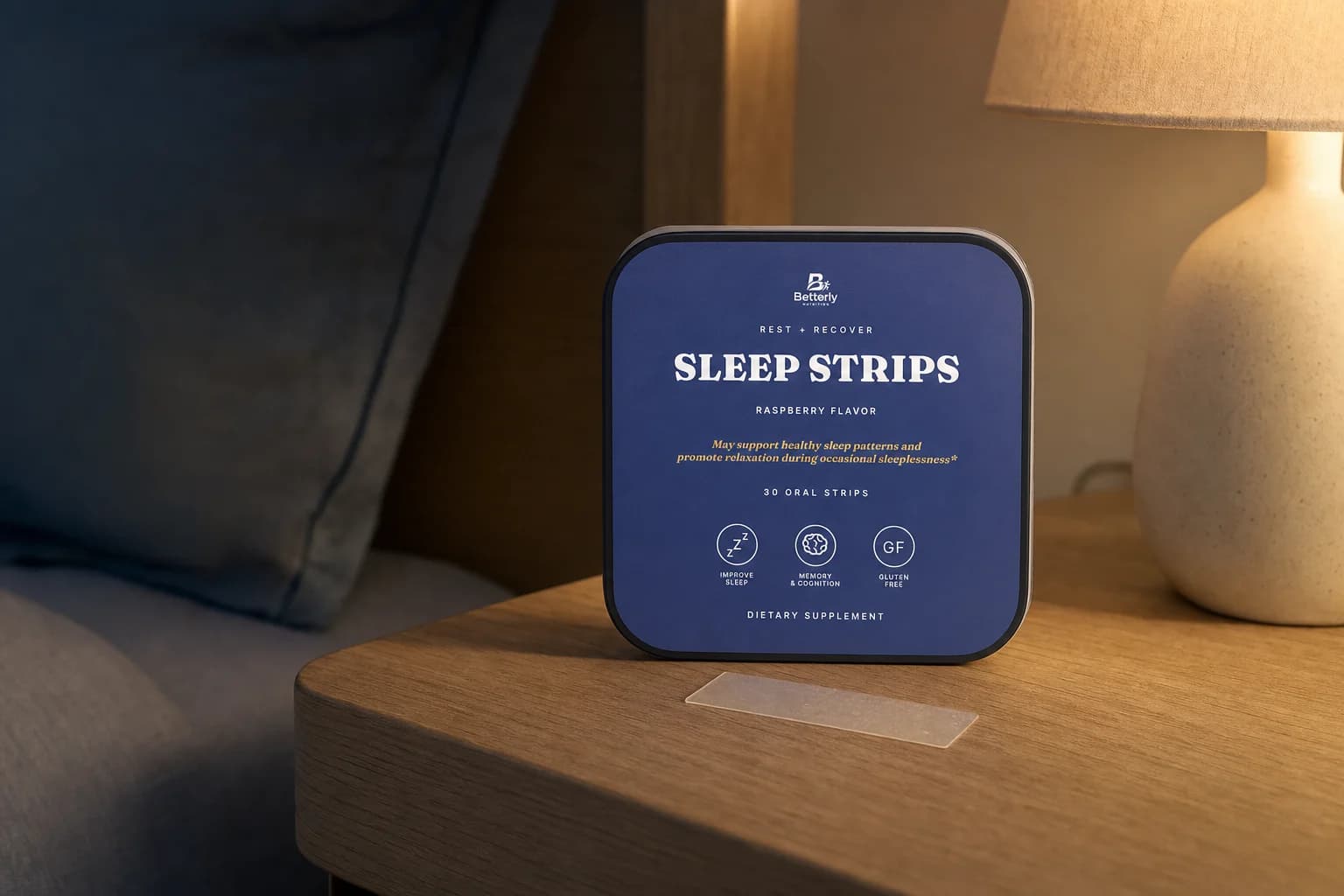
The format is the first thing to understand. An oral strip is a thin film — ours is built on pullulan, a dissolvable film made by fermenting plant starch — that melts on the tongue in under a minute. No water, no swallowing a capsule, no getting out of bed. It's the same idea as breath strips, applied to a supplement.
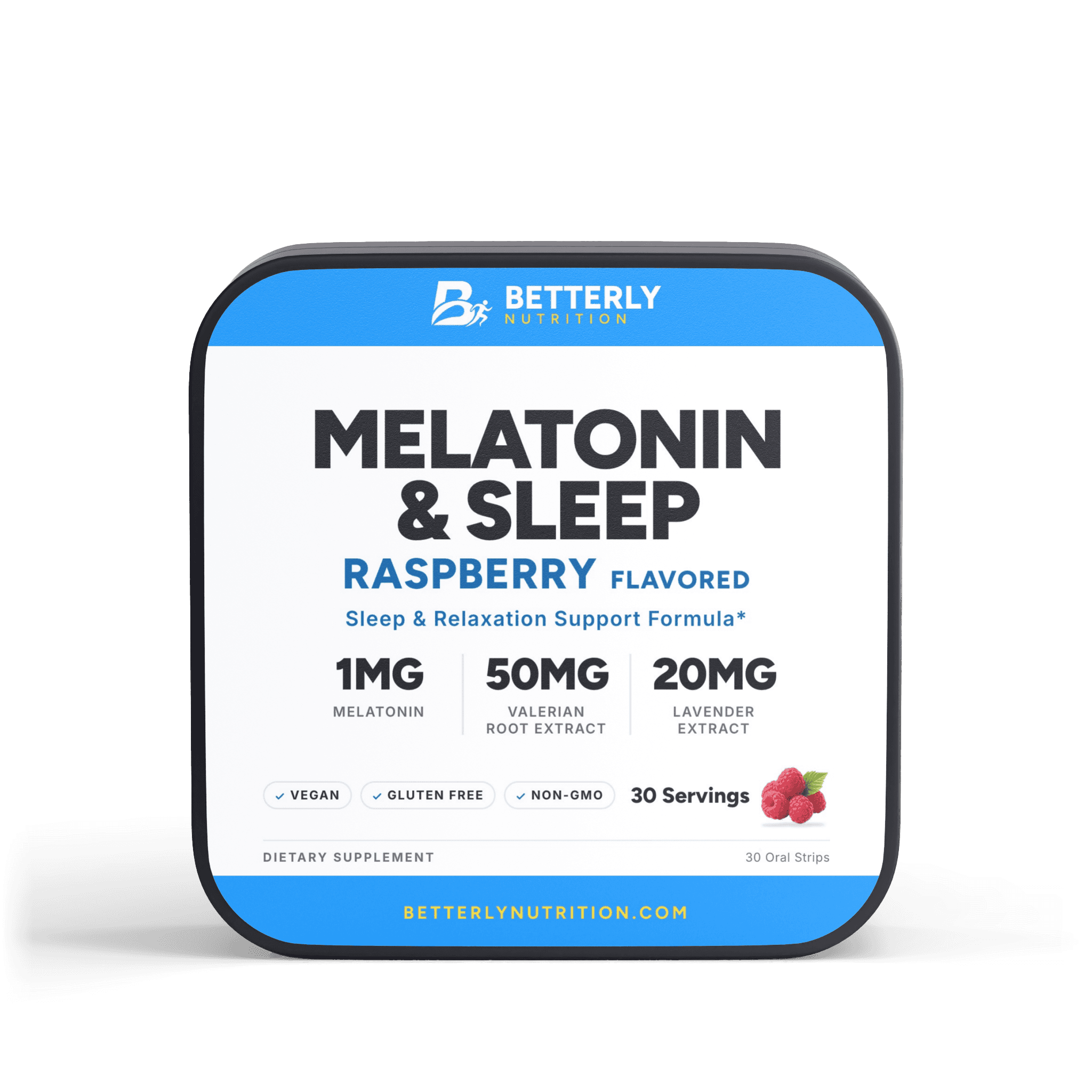
What's in the film matters more than the film. Our 1mg Melatonin Sleep Strips carry 1 mg of melatonin per 1-strip serving, alongside a supporting cast of botanicals: valerian root extract (50 mg), lavender extract (20 mg), chamomile extract (10 mg), and hibiscus extract (10 mg). One strip is one serving, 30 strips per pack, and every one of those amounts is printed on the label — no blends, no mystery, so you can see exactly what you're comparing before you spend a dollar.
Melatonin itself is the best-studied thing in this entire article. It's the hormone your brain releases as light fades — less a sedative than a memo that says night has started. Supplemental melatonin has decades of research behind it, and the honest summary is: modest, real support for the body's sleep-wake timing, most useful when your schedule and your body clock have drifted apart — travel across time zones, late-shifted nights, the 11 p.m. scroll that convinced your brain it's mid-afternoon. It won't knock you out, and any brand implying it will switch you off like a light is overselling it.
Now the number: 1 mg, and it's a deliberate choice. The National Center for Complementary and Integrative Health (NCCIH) notes that for melatonin supplements, particularly at doses higher than what the body normally produces, there isn't enough information yet about possible side effects. That's one reason we chose 1 mg. Melatonin is a signal, and you don't need to shout a signal. We'll be equally honest about the botanicals: at these amounts, the valerian, lavender, chamomile, and hibiscus are gentle supporting notes, below the doses most herbal studies use on their own. The melatonin is the headline, at a modest 1 mg.
What mouth tape actually is
Mouth tape is exactly what it sounds like: a strip of porous, skin-safe adhesive placed over or around the lips before bed, so your mouth stays closed and your breathing routes through your nose. It exploded out of social media rather than a lab, which tells you something about the evidence.
The theory isn't silly. Nasal breathing filters, warms, and humidifies air, and chronic overnight mouth-breathing is a real, unpleasant pattern — dry mouth, sore throat, morning breath. Tape, the reasoning goes, gets you the nasal-breathing benefits by default.
Here's the honest state of the research: thin. The existing studies are small, short, and mixed — a few suggest modest improvements in snoring measures, others find little effect, and no large, well-controlled trial shows mouth taping meaningfully improves how people sleep. The trend ran a long way ahead of the data.
And the cautions are not fine print. If you snore loudly, gasp during the night, wake unrefreshed no matter how long you sleep, or have any breathing issue during sleep, suspected or confirmed — do not tape your mouth shut. Loud snoring can be a sign of a nighttime breathing issue; tape doesn't solve that — it hides a symptom that deserves a clinician's attention and can make a compromised airway worse. Mouth tape is also a bad idea with nasal congestion (your backup airway is the one you're taping), after alcohol or sedatives, and for children, full stop. If you're drawn to the idea, the responsible order of operations is a conversation with a healthcare provider first, tape second — if at all.
We don't sell mouth tape, and this isn't a competitor takedown — it's just what the evidence and the safety picture look like when nobody's trying to sell you the roll.
What nasal strips actually are
Nasal strips are the veteran of this lineup. A flexible band with a mild spring in it sticks across the outside of your nose; as it tries to straighten, it gently lifts the sides of the nasal passages, widening the airway. Nothing is absorbed, nothing is ingested — it's a small piece of mechanical engineering you wear on your face.
Because the mechanism is physical, the evidence is refreshingly straightforward. Studies consistently show nasal strips increase nasal airflow and ease the feeling of congestion, and some report that bed partners rate snoring noise lower. The effect is modest and it's strictly local — a nasal strip does nothing about your body clock, your wind-down, or why you're still wired at midnight. But as a low-risk experiment for a stuffy-nose sleeper, it's about as safe as this category gets: the main downsides are skin irritation and the occasional strip on your pillow by morning.
If your nighttime problem lives in your nose, this is the honest first stop — cheap, drug-free, reversible in one second. We'd rather tell you that plainly than pretend a melatonin film addresses congestion. It doesn't.
Sleep strips vs mouth tape vs nasal strips, head to head
| Melatonin sleep strips | Mouth tape | Nasal strips | |
|---|---|---|---|
| What it is | Dissolvable supplement film | Adhesive over the lips | Springy band on the nose |
| How it works | Melatonin supports natural sleep-wake timing | Forces nasal breathing by holding the mouth closed | Mechanically widens nasal passages |
| Evidence | Decades of research; modest, real timing support | Thin — small, mixed studies | Consistent for airflow; modest for snoring noise |
| Main cautions | Don't exceed the label dose; provider first if pregnant, nursing, under 18, on medication, or managing a medical condition | Not for anyone with breathing issues, congestion, or after alcohol; never for kids | Occasional skin irritation |
| Best fit | A body clock that's drifted from your schedule | Unclear — talk to a clinician first | A congested or narrow nose |
Which one fits your night?
Match the product to the problem, not the other way around:
- Your body and your schedule disagree. You're jet-lagged, on a rotating shift, or your "bedtime" has quietly slid to 1 a.m. This is the timing problem, and it's the one melatonin is actually studied for. A 1 mg strip as part of a consistent wind-down is the right-sized tool.
- You wake up with a dry mouth or suspect you mouth-breathe. Rule out the serious stuff first — if there's any snoring-and-exhaustion pattern, that's a clinician conversation, not a tape purchase. If breathing checks out and congestion is part of the story, a nasal strip is the safer, better-evidenced first experiment.
- Your nose is the bottleneck. Congestion, a naturally narrow nose, a stuffy season — nasal strips, no contest. No supplement addresses a mechanical problem.
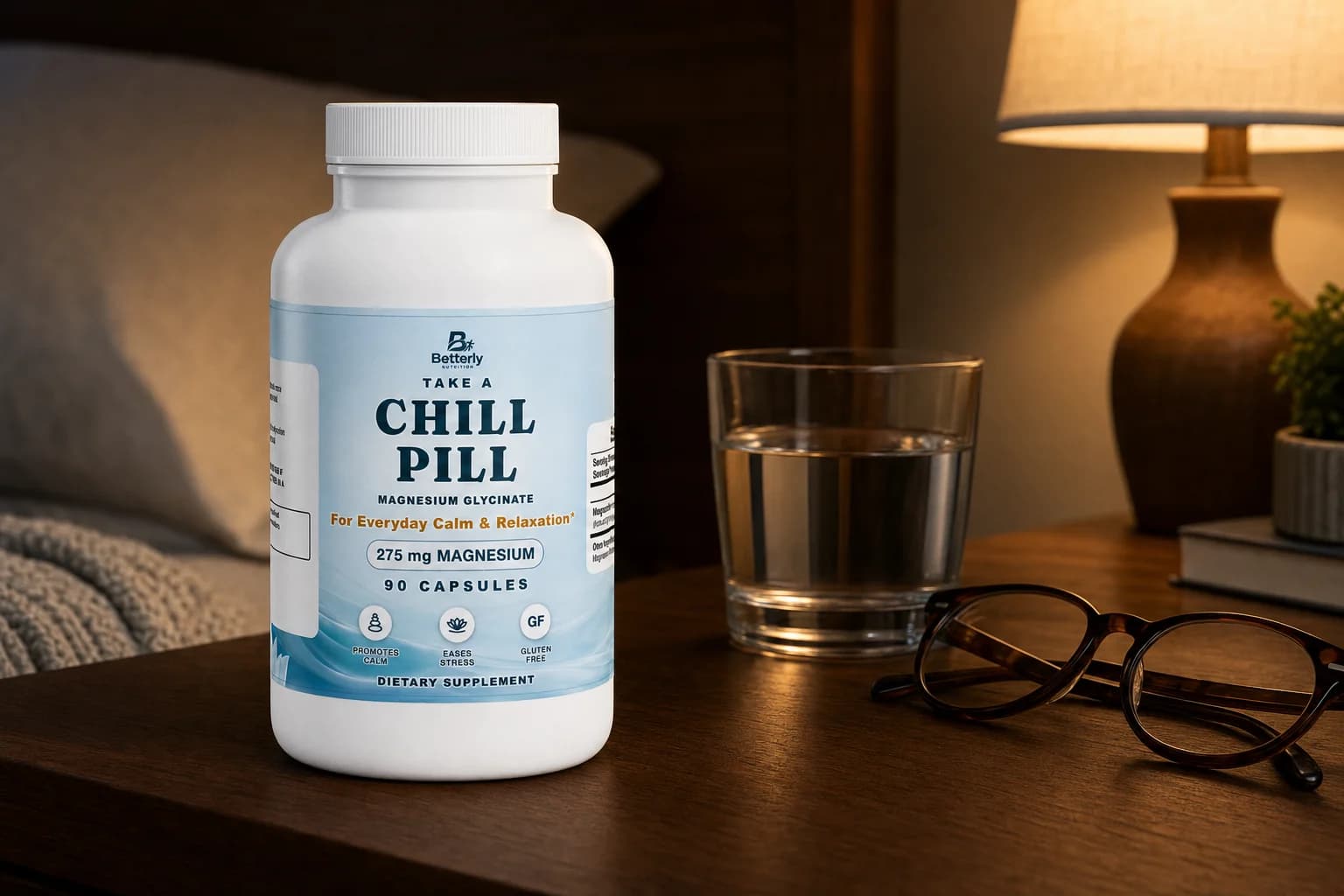
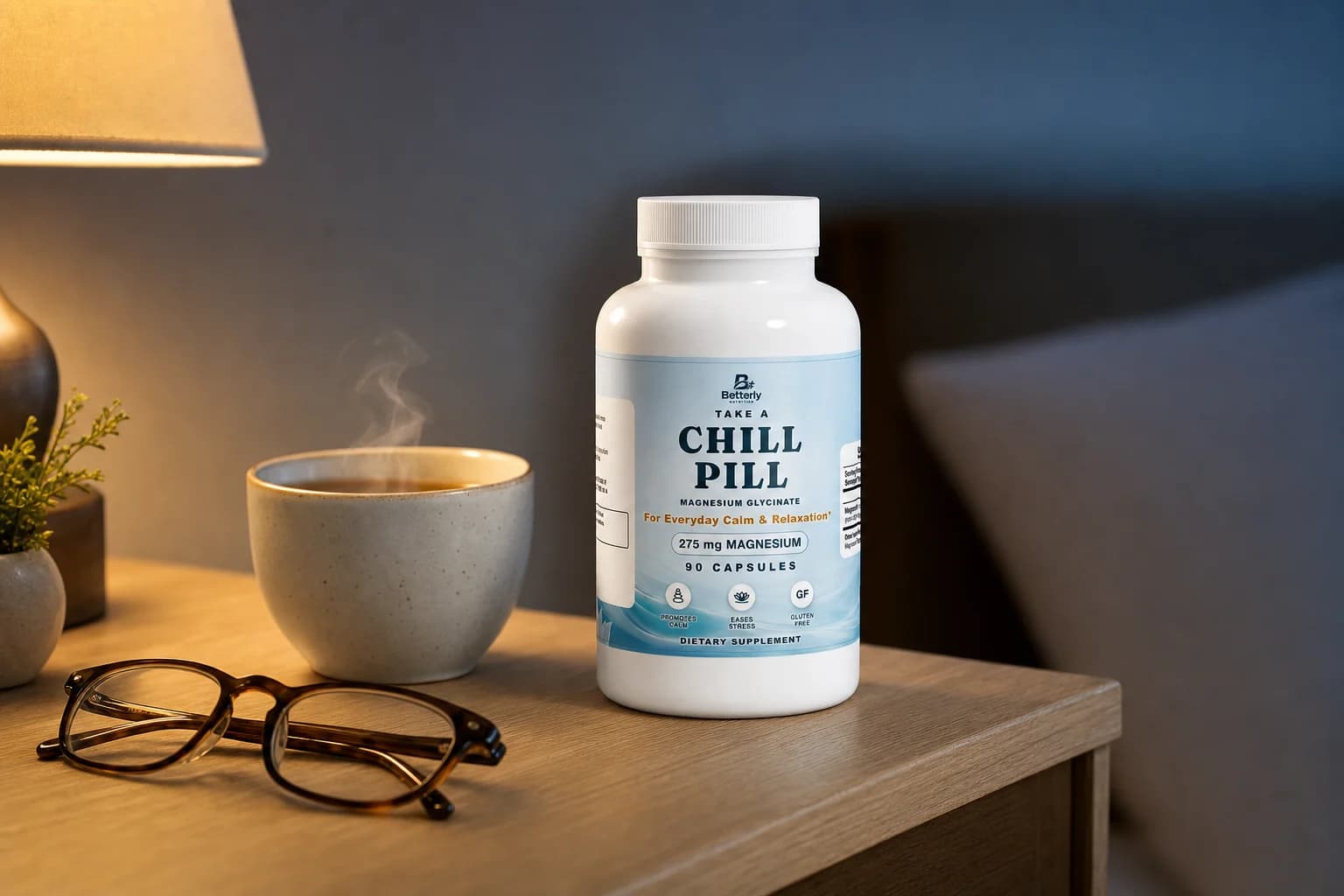
- You'd rather skip melatonin entirely. Fair preference — melatonin isn't for everyone. Magnesium Glycinate Capsules are a classic melatonin-free foundation: 275 mg of magnesium per 3-capsule serving (65% of the Daily Value) in the glycinate form people choose for evening routines. We compared the two paths honestly in magnesium vs melatonin for sleep, and rounded up the wider field in our guide to melatonin-free sleep supplements.
- You want to combine. A nasal strip and a melatonin strip work on completely different systems and coexist fine. Mouth tape is the only one we'd gate behind a provider conversation.
Where the strip format genuinely earns its keep
Let's sell our own product honestly, because the honest case is good.
A melatonin strip isn't stronger than a melatonin pill. Same molecule, same job. What the strip changes is everything around the taking of it — and with melatonin that matters more than usual, because melatonin is time-sensitive: its natural place is your wind-down, when you're already in bed with the lights low — precisely the moment nobody wants to walk to the kitchen for a glass of water.
The format advantages are practical, and real:
- No water, no swallowing. The strip dissolves on your tongue in under a minute. If capsules sit badly with you at night — or you simply hate swallowing pills — that friction is gone.
- It lives where bedtime happens. A flat 30-strip pack sits in a nightstand drawer or a carry-on pocket. For time-zone travel — melatonin's best-studied use case — a supplement that needs no water on a red-eye is quietly great design.
- Low friction means consistency. The supplement you actually take on night twelve beats the technically-equivalent one still in the bathroom cabinet. Routines survive on removed steps.
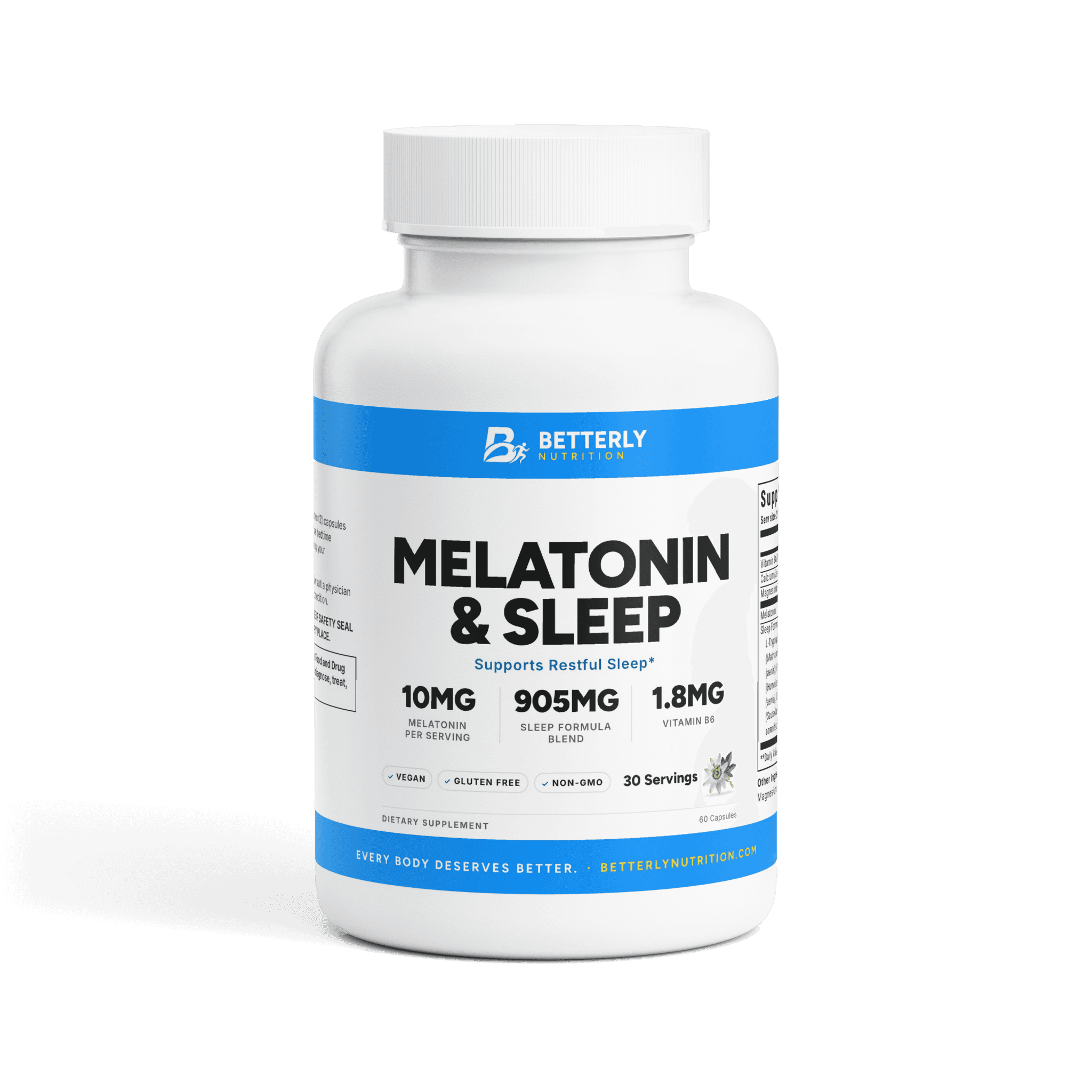
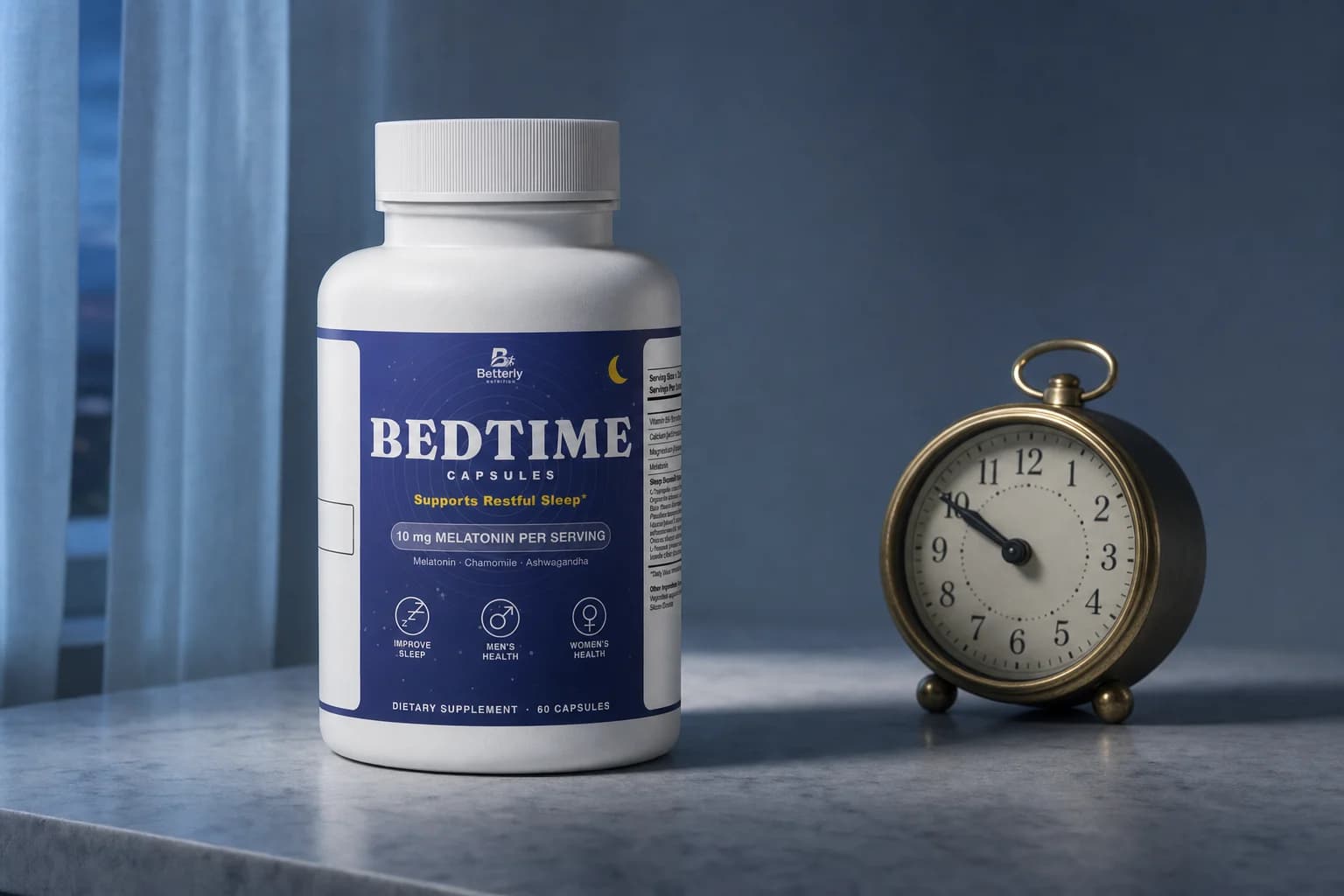
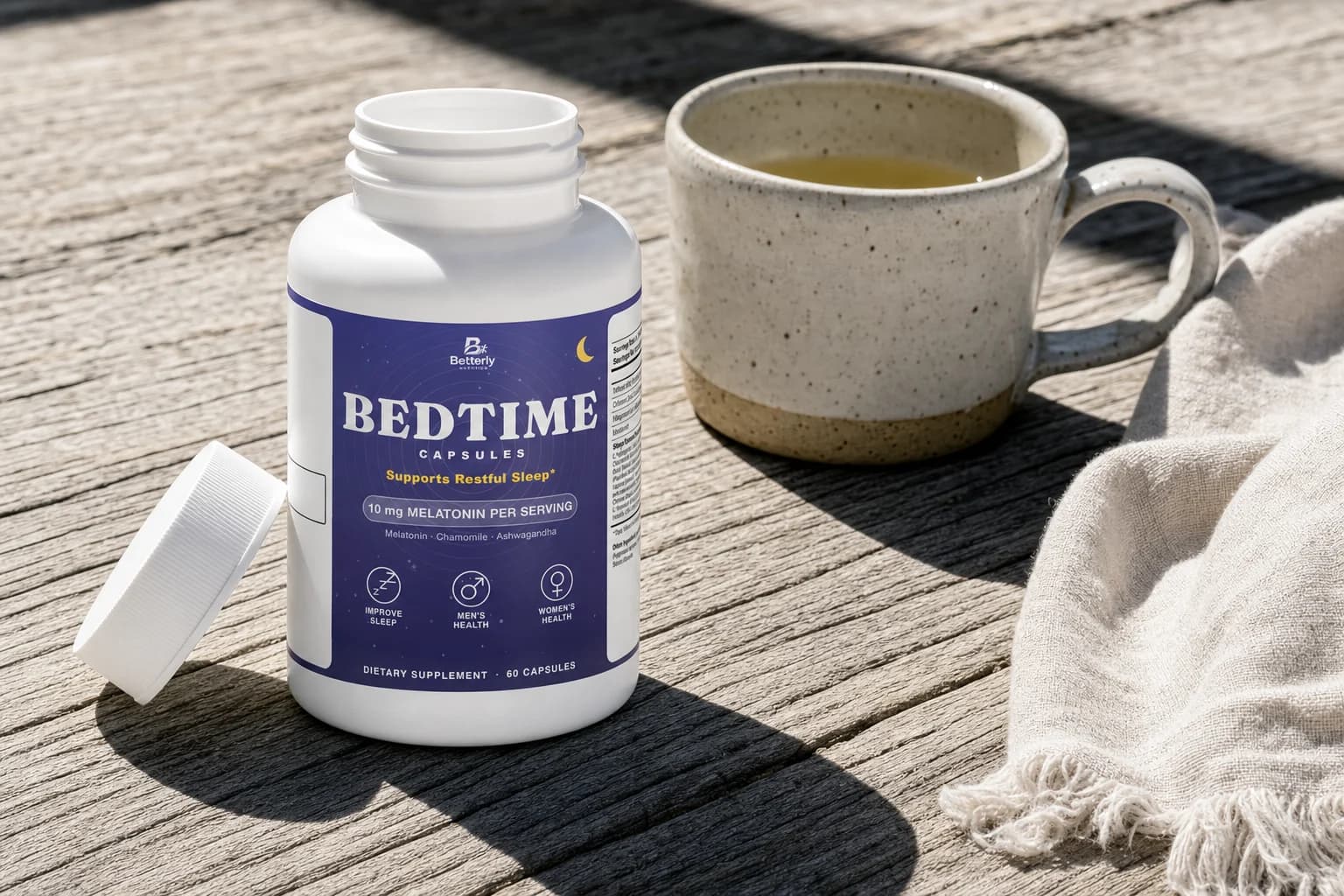
And if you've used melatonin for years and know that 1 mg isn't enough signal for you, we sell the fuller-strength option too: 10mg Melatonin Sleep Capsules carry 10 mg of melatonin per 2-capsule serving — the strong end of what you'll find at retail — plus a 905 mg proprietary blend of fourteen more ingredients, L-tryptophan first, with botanicals like chamomile, lemon balm, and passionflower alongside L-theanine. Two honest notes: proprietary means the individual amounts inside that blend aren't broken out the way they are on the 1mg Melatonin Sleep Strips label, and it includes St. John's Wort, which NCCIH notes can weaken the effects of many medicines. If you take any prescription medication, check with your doctor or pharmacist before using it. The label's suggested use is two capsules once a day, 20 to 30 minutes before bedtime.
One more honest pointer: if your real question is what to build an evening routine around, magnesium deserves a look before anything on this page — our guide to magnesium for sleep covers what the research does and doesn't show.
Who should check with a healthcare provider first
The labels on our 1mg Melatonin Sleep Strips and 10mg Melatonin Sleep Capsules carry the same caution: don't exceed the recommended dose, and consult a physician if you're pregnant, nursing, under 18, or have a medical condition. NCCIH adds that there's been a lack of research on melatonin's safety during pregnancy or breastfeeding, that parents should speak with a health care provider before giving children melatonin, and that people taking certain medications need medical supervision while using it. So talk to your provider first if you:
- are pregnant or nursing
- are under 18
- take any prescription medication (and if you're considering the capsules, see the St. John's Wort note above)
- are managing a medical condition
Key takeaways
- "Sleep strips" is three different products. A dissolvable melatonin film, mouth tape, and nasal strips share a name, not a mechanism.
- Melatonin is the well-studied one. It supports the body's natural sleep-wake timing — a signal, not a sedative — and our 1 mg is a deliberately modest dose.
- Mouth tape has thin evidence and real cautions. Never with any breathing issue, congestion, alcohol, or for kids. Clinician first.
- Nasal strips are the safe mechanical fix. Modest, local, well-tolerated. If the problem is your nose, start there.
- The strip format is about the how, not the strength. Right-sized melatonin, no water, no pills, wherever bedtime happens.
FAQ: sleep strips, mouth tape, and nasal strips
Are sleep strips the same as mouth tape?
No. Dissolvable sleep strips are a supplement — a thin film carrying melatonin that dissolves on the tongue. Mouth tape is an adhesive worn over the lips to keep your mouth closed overnight. They share the word "strips" and nothing else: one delivers an ingredient, the other restricts a behavior, and the safety profiles are very different.
How much melatonin is in a sleep strip?
In our 1mg Melatonin Sleep Strips, it's 1 mg per 1-strip serving — plus 50 mg valerian root extract, 20 mg lavender extract, 10 mg chamomile extract, and 10 mg hibiscus extract, all stated on the label. The low dose is deliberate: the National Center for Complementary and Integrative Health notes there isn't enough information yet about side effects at melatonin doses higher than what the body normally produces.
Do sleep strips work faster than melatonin pills?
Honestly: the format's advantage is convenience more than speed. Some absorption may begin in the mouth, but much of the dose is still swallowed as the strip dissolves, and rigorous head-to-head timing data is limited. What the strip reliably changes is friction — no water, no swallowing, taken right at lights-out — which is worth more than a marginal speed difference for most routines.
Is it safe to tape your mouth shut at night?
Not for everyone, and that caveat is doing heavy lifting. Anyone with a breathing issue during sleep, suspected or confirmed, plus anyone congested, anyone who's been drinking, and all children should not use mouth tape. Loud snoring or unrefreshing sleep is a reason to talk to a clinician, not to tape over the symptom. If breathing has been checked and cleared, discuss it with your provider; the supporting evidence is still thin.
Can you use nasal strips and melatonin together?
Yes — they work on unrelated systems, with no overlap between them. A nasal strip mechanically opens the nasal passages; melatonin supports your internal clock's timing. Many people pair a physical fix for airflow with a wind-down routine; if you'd rather build that routine without melatonin, magnesium glycinate is the usual starting point.
If this left you looking for somewhere to start, read our melatonin sleep strips — no water, no pills — its amounts per serving are listed on the page. For the practical questions this raises, how dosing, sourcing and subscriptions work is answered in one place.