On this page
- Key takeaways
- Is sublingual melatonin faster than oral melatonin?
- What does "sublingual" mean on a melatonin label?
- How do melatonin strips, capsules, gummies and liquids compare?
- Are melatonin gummies less reliable than pills?
- How much of our 1mg strip is melatonin, and what sweetens it?
- How do our melatonin capsules compare with the strip?
- How do you take each format, going by the labels?
- When don't you need a dissolving melatonin format?
- Who should check with a healthcare provider first?
- FAQ: sublingual and oral melatonin
- Sources
The short answer: Sublingual melatonin vs oral pills is mostly a question of routine, not speed. We found no federal health page that times a dissolving melatonin against a swallowed one, and whatever your mouth doesn't absorb gets swallowed with your saliva anyway. The milligrams matter more than the format: our dissolving strip lists 1 mg of melatonin per strip, while our two capsules list 2 mg and 10 mg per 2-capsule serving.
Key takeaways
- We found no federal health page comparing how fast sublingual and swallowed melatonin work, and the faster-onset claims we found came from sellers.
- The 1mg Melatonin Sleep Strips label says to place each strip "on the tongue," so we call them dissolving strips, not sublingual.
- NCCIH describes a 2023 study in which 22 of 25 melatonin gummy products were inaccurately labeled.
- Format decides whether you need water, which sweeteners come along and who measures the dose. The milligrams still set the dose.
We sell melatonin in two of the formats covered here: the dissolving 1mg Melatonin Sleep Strips and two capsules. We don't sell a melatonin gummy, liquid or spray, so those get label-reading advice, not a pitch.
Is sublingual melatonin faster than oral melatonin?
Sublingual melatonin hasn't been shown to work faster than oral melatonin on any federal page we read, and head-to-head timing data for melatonin formats is limited.
Search the question and you'll meet confident claims: onset in 15 minutes, double the absorption, a shortcut past the liver. In our search, those came from sellers' pages and patent filings. The NCCIH page Melatonin: What You Need To Know notes that melatonin comes as tablets, capsules, liquids and gummies, and it doesn't rank them by speed.
Sublingual products rest on the idea that some of the ingredient might pass into your blood through the thin lining under your tongue. The catch is saliva. Whatever dissolves in your mouth and isn't absorbed there gets swallowed, and nobody we found has measured how much of a melatonin dose stays behind.
The FDA's guidance on orally disintegrating tablets, written for drug makers, describes them as "ingested simply by placing them on the tongue." It defines the format by quick breakdown in saliva with no chewing or liquid. A faster effect isn't part of the definition.
What about sublingual melatonin bioavailability?
Bioavailability means how much of a dose actually makes it into your blood. Percentages for both routes are all over the web, but no federal page we read gives one, so we won't print a number. If a brand quotes one, ask whether it was measured in that brand's own product.
What does "sublingual" mean on a melatonin label?
"Sublingual" on a melatonin label means the product should sit under your tongue, while our strip's label says to place it "on the tongue," not under it.
Here's what each pack term means:
- Sublingual: placed under the tongue and left to dissolve there.
- Fast dissolve or orally disintegrating: a tablet that breaks apart on the tongue. FDA guidance for drug makers recommends that tablets labeled as ODTs break down in about 30 seconds or less in a standard lab test. It doesn't cover supplement labels that say "fast dissolve."
- Oral strip or film: a thin film that melts in the mouth.
- Chewable or gummy: chewed first, then swallowed.
Our strip's directions read: "Place 1 oral strip on the tongue daily and allow it to dissolve." So this guide calls it a dissolving strip, never a sublingual one, and we don't claim any of its melatonin gets in through your mouth.
How do melatonin strips, capsules, gummies and liquids compare?
Melatonin strips, capsules, gummies and liquids differ in who measures the dose, whether you need water and what comes along with the melatonin, not in any proven speed.
| Format | How you take it | Who sets each dose | Check on the panel |
|---|---|---|---|
| Dissolving strip | On the tongue, no water | The maker: one strip | Sweeteners, strip weight |
| Sublingual or fast-dissolve tablet | Under or on the tongue | The maker: one tablet | Milligrams per tablet |
| Capsule or tablet | Swallowed with water | The maker: set count | Capsules per serving |
| Gummy | Chewed | The maker, with a spotty record | Sugars, gummies per serving |
| Liquid drops or spray | Dropper or pump | You, every night | Milligrams per mL or spray |
The third column tells the story. A strip, capsule or tablet leaves nothing to measure half asleep. Drops and sprays hand the measuring to you, which allows fine-tuning but invites drift. And every format depends on the maker putting the stated amount inside.
Are melatonin gummies less reliable than pills?
Melatonin gummies carry the newest evidence of label drift: NCCIH describes a 2023 study in which 22 of 25 gummy products were inaccurately labeled.
The spread was wide. One product had no detectable melatonin, and the rest ran from 74 to 347 percent of the labeled amount, with most holding more than stated. Gummies aren't the only format with a record, though. NCCIH also describes a 2017 study of 31 melatonin supplements in which most didn't match their labels, and 26 percent contained serotonin.
So the honest takeaway isn't "pills good, gummies bad." Our own panels list the amounts our manufacturer declares, and we make no testing claim about them.
On a gummy's panel, check the serving line first, because the melatonin amount covers the whole serving, whether that's one gummy or three. Then look for Total Sugars and Added Sugars rows.
Weighing melatonin gummies vs fast-dissolve tablets? You chew a gummy, while a fast-dissolve tablet breaks apart on your tongue. On the tablet, look for sweeteners in the other-ingredients line. And the 2023 study NCCIH describes tested gummies only, so it tells you nothing about tablets either way.
Flavor has a safety side too. The CDC's 2024 report on emergency visits for unsupervised melatonin ingestion estimated about 11,000 such visits by infants and young children from 2019 to 2022, and at least half involved flavored products like gummies or chewables. Our strip is raspberry flavored, so that warning covers it too.
Does liquid melatonin have any edge over a pill?
Liquid melatonin's one clear difference from a pill is that you measure each dose yourself, and no federal page we read shows it working better.
A dropper allows in-between amounts, but then your dose depends on how carefully you read its markings at bedtime. Compare liquids by milligrams per milliliter, use the dropper that came with the bottle, and scan the other-ingredients line for sweeteners. For sprays, find the milligrams per spray and count every one.
How much of our 1mg strip is melatonin, and what sweetens it?
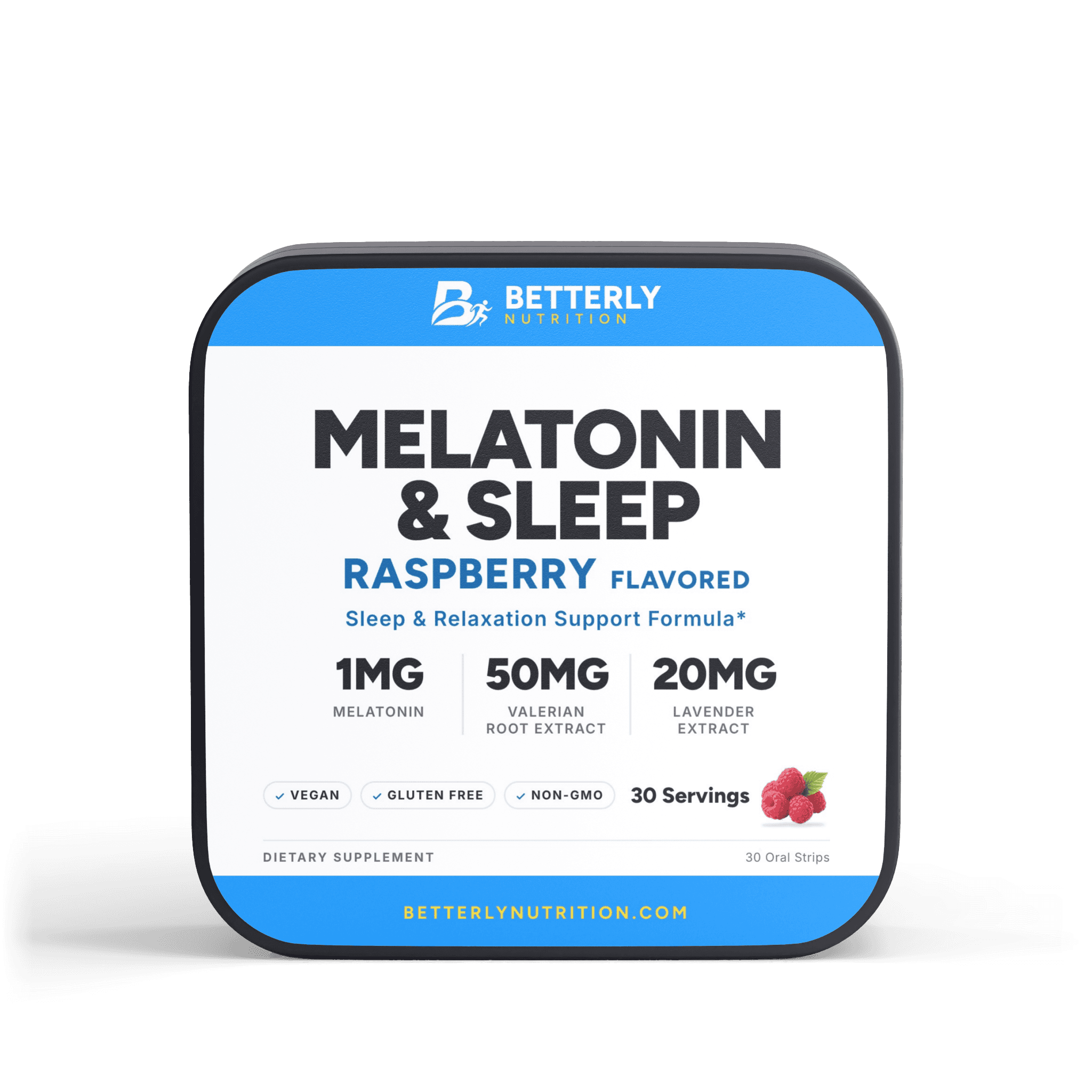
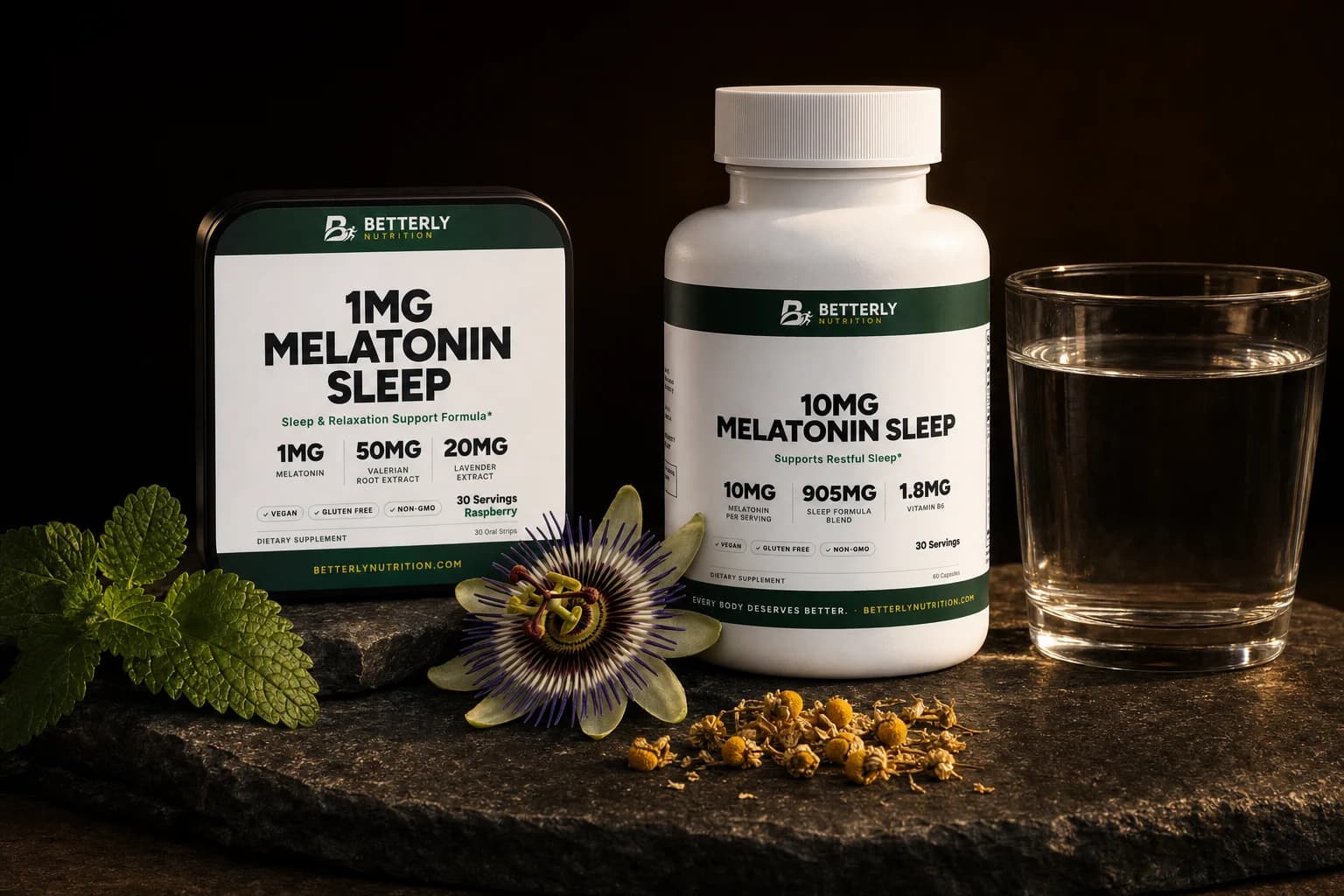
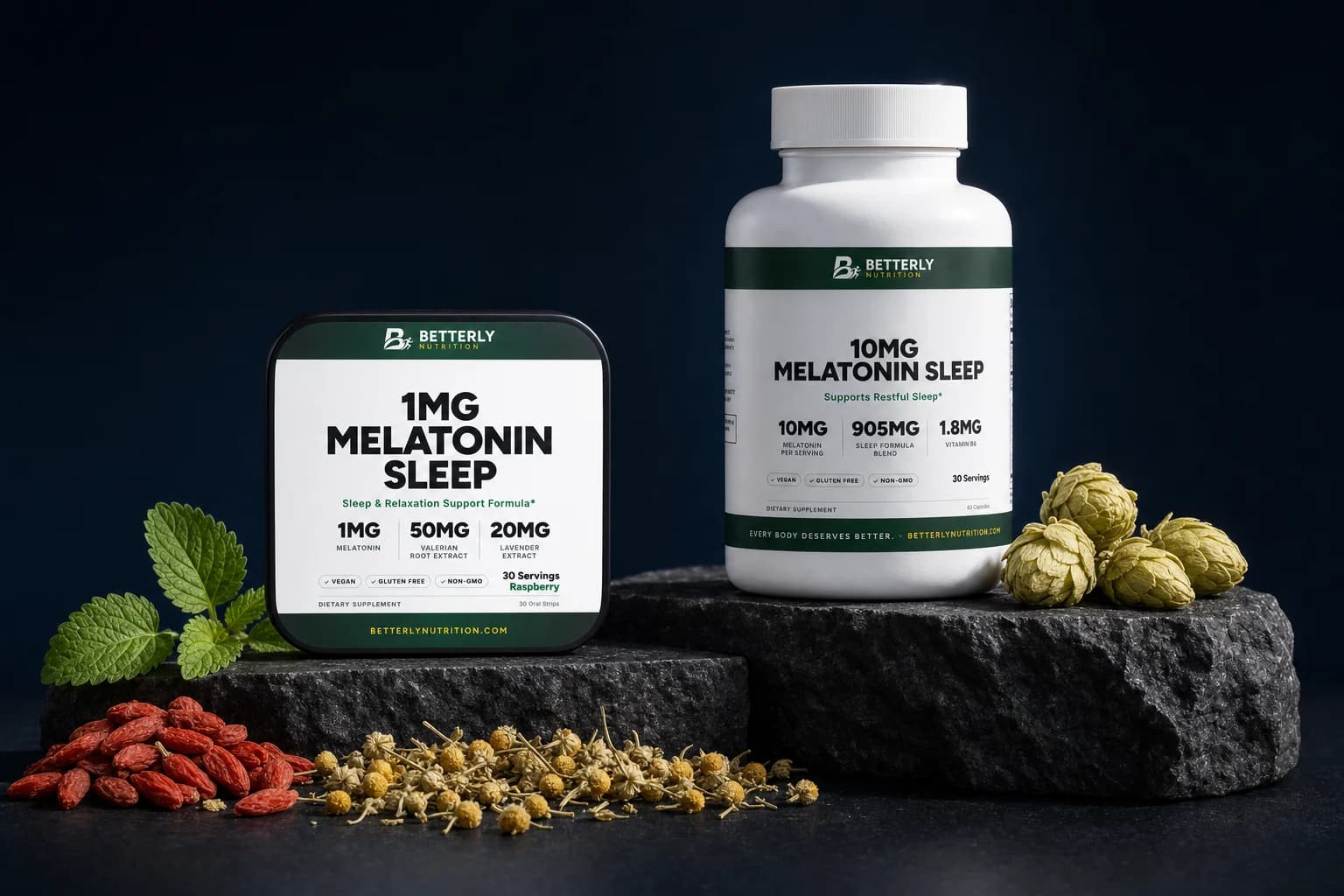
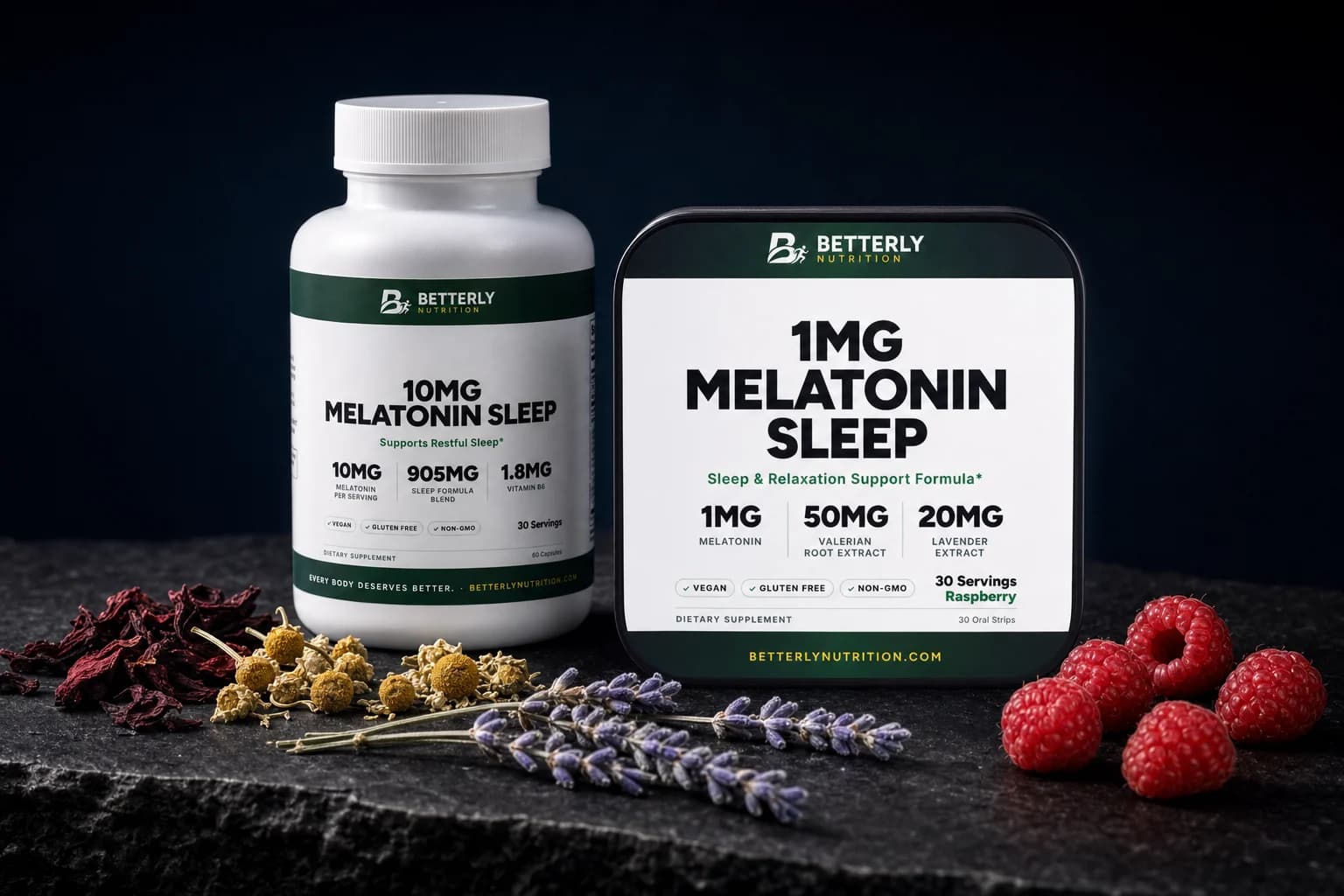
Melatonin is under half a percent of Betterly's 1mg Melatonin Sleep Strips: 1 mg per 1 Oral Strip (210 mg) serving, beside 90 mg of botanicals and four sweeteners.
Here's the label math. The five actives add up to 91 mg: valerian root extract 50 mg, lavender extract 20 mg, chamomile extract 10 mg, hibiscus extract 10 mg and melatonin 1 mg. That leaves about 119 mg of each strip for everything in the other-ingredients line: the film, flavor, sweeteners and the rest.
The other ingredients are pullulan, cellulose, raspberry flavor, malic acid, xylitol, lecithin, erythritol, sorbitol syrup, medium chain triglycerides and steviol glycosides. Xylitol, erythritol and sorbitol are sugar alcohols. No sweetener amount is printed, but all four sweeteners share that 119 mg with the film, flavor and other ingredients.
MedlinePlus's page on sugars and sugar alcohols as sweeteners says sorbitol, mannitol and xylitol may cause stomach cramps and diarrhea when eaten in large amounts, and that erythritol doesn't cause stomach upset. It doesn't define "large." A strip's share is small, but it adds to sugar-free gum and mints. Xylitol is also dangerous for dogs, which our guide on whether xylitol is good for teeth covers.
The strip's panel has no sugars row. We still don't call it sugar-free, because that claim isn't on the label. The claims it does carry are vegan, gluten free and non-GMO.
From our shop: 1mg Melatonin Sleep Strips — 30 raspberry oral strips, each listing 1 mg of melatonin plus valerian, lavender, chamomile and hibiscus extracts, taken on the tongue with no water.
How do our melatonin capsules compare with the strip?
Betterly's two melatonin capsules list 2 mg and 10 mg per 2-capsule serving, so moving from our strip to a capsule is mainly a change in dose.
| On the label | 1mg strips | Valerian & Chamomile capsules | 10mg capsules |
|---|---|---|---|
| Melatonin per serving | 1 mg | 2 mg | 10 mg |
| Servings per pack | 30 | 30 | 30 |
| Water in directions | None | 6-8 oz | 8 oz |
| Clock time in directions | None | None | 20-30 min before bed |
| Shell or base | Pullulan film | Gelatin capsule | Hypromellose capsule |
All three hold 30 servings, so shelf prices compare directly; the product cards below show today's prices. Only the 10mg capsule names a clock time. And only the strip skips the water glass, which is a dissolving format's practical edge once you're in bed or on a plane.
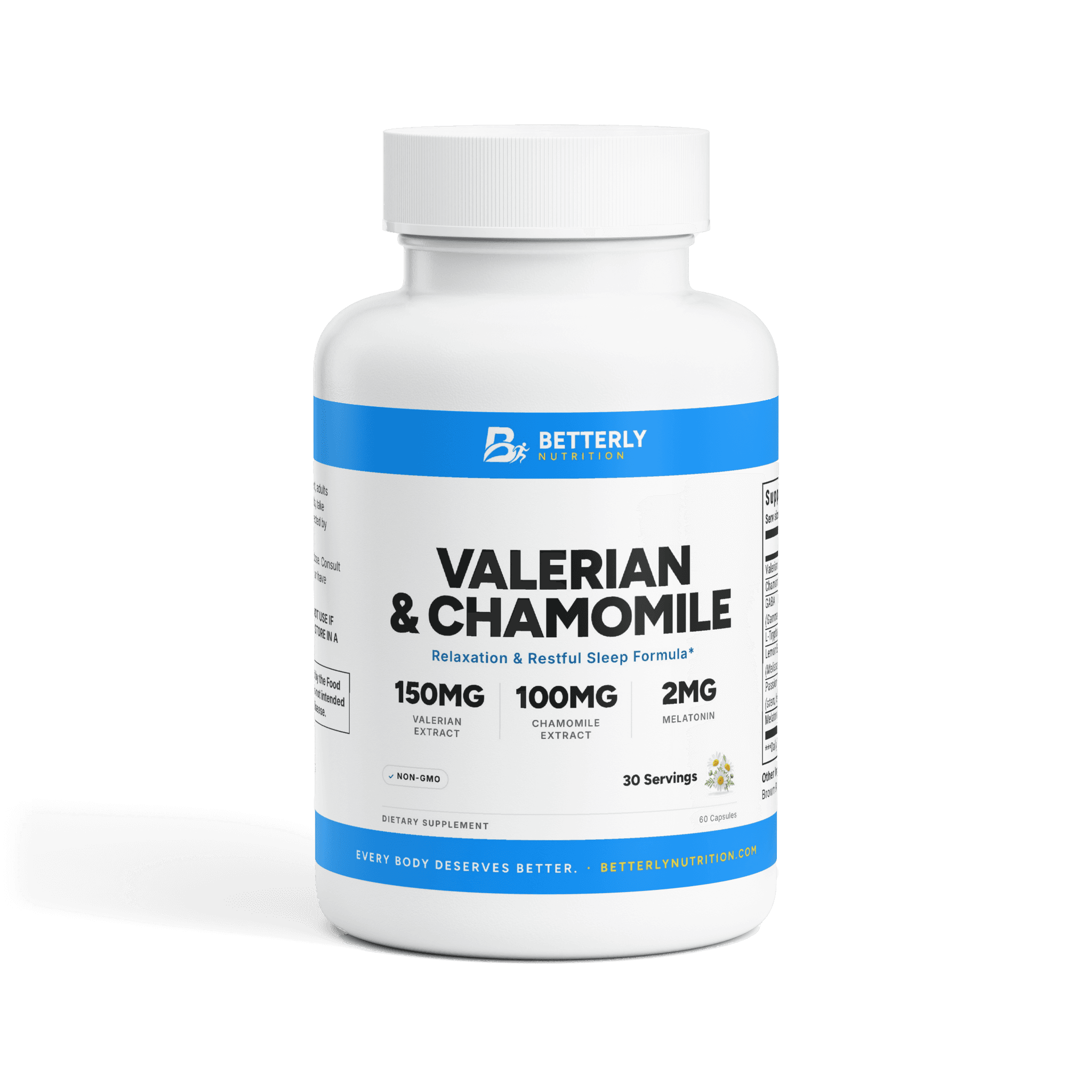
The Valerian & Chamomile Sleep Capsules pair 2 mg of melatonin with 150 mg of valerian extract and 100 mg each of chamomile extract, GABA, L-tryptophan, lemon balm extract and passion flower extract. The shell is gelatin, and the label carries a non-GMO claim only.
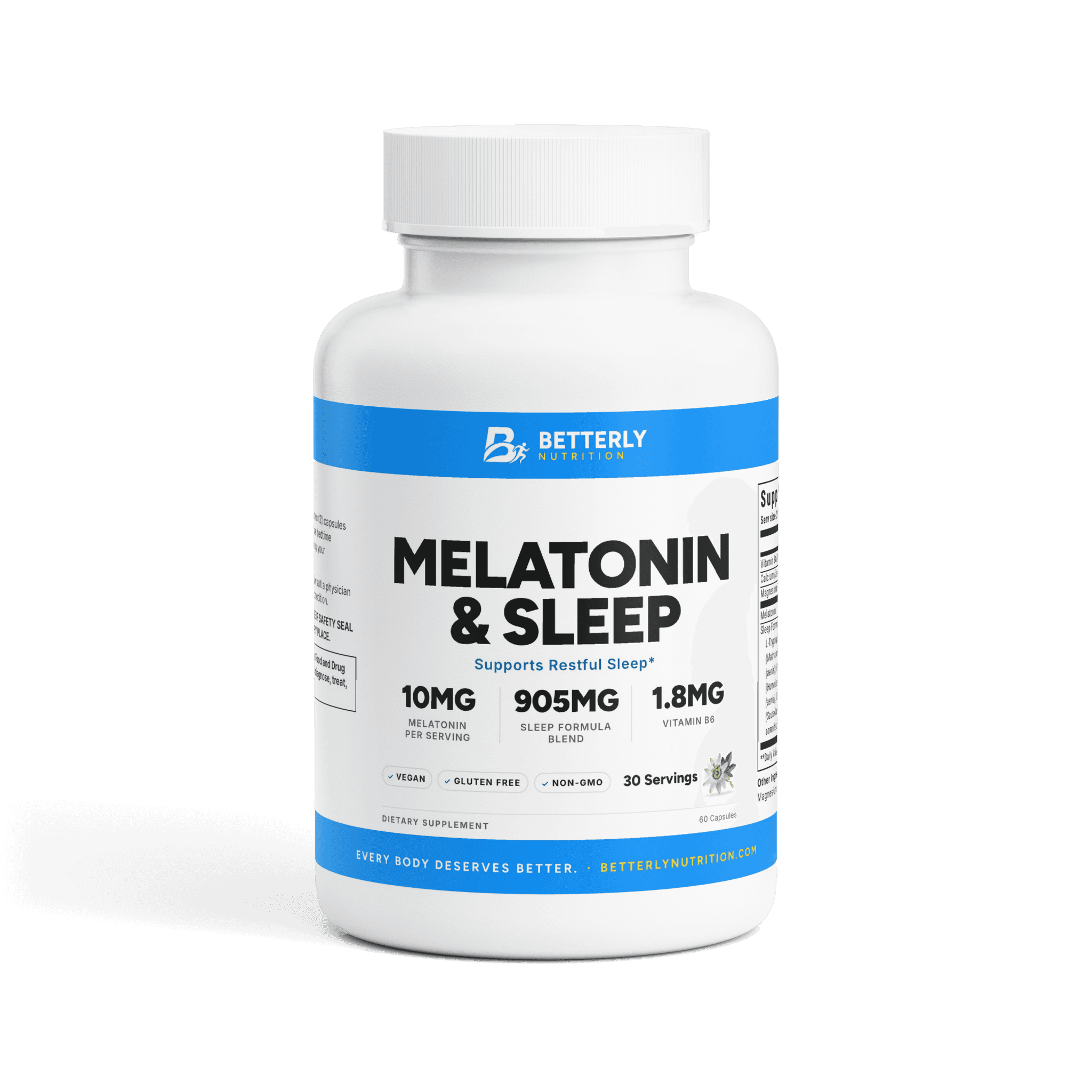
The 10mg Melatonin Sleep Capsules add 1.8 mg of vitamin B6, 17 mg of calcium and 13 mg of magnesium to a 905 mg proprietary blend of 14 ingredients, including L-tryptophan, St. John's wort and 5-HTP. The label doesn't break out how much of each is inside. Our look at whether 10mg melatonin is too much covers that blend's cautions.
A milligram is a milligram in any format. A 5 mg sublingual tablet holds five times our strip's melatonin, so when a format switch comes with a dose change, the dose is the bigger story.
From our shop: Valerian & Chamomile Sleep Capsules — the swallow-with-water middle option, listing 2 mg of melatonin alongside GABA, L-tryptophan, lemon balm and passion flower in every 2-capsule serving.
How do you take each format, going by the labels?
Take each Betterly melatonin product exactly as its own label says: one strip on the tongue, or two capsules with water, once a day.
- The strip. Place 1 oral strip on the tongue and let it dissolve. The label names no clock time, so pick one steady point in your evening. Store the pack somewhere cool and dry, as the label asks.
- The Valerian & Chamomile capsules. Adults take two capsules daily with 6-8 oz (177-237 ml) of water.
- The 10mg capsules. Take two capsules once a day, 20 to 30 minutes before bedtime, with an 8 oz (237 ml) glass of water.
- One product per night. All three labels say "Do not exceed recommended dose." Don't add a strip on top of a capsule to chase a quicker start.
Our guide on how long before bed to take melatonin goes through each label's timing. NCCIH also notes that light at night can block your body's own melatonin production, and no pack format changes that.
When don't you need a dissolving melatonin format?
You don't need a dissolving melatonin format if capsules go down easily for you, because no federal page we read shows a strip or sublingual tablet working better.
- You're fine with pills and water. The strip's real advantage is one less step. If that step never bothered you, there's little to gain.
- You hope a new format fixes a dose problem. Swapping a 3 mg tablet for a 3 mg strip leaves the dose unchanged. Talk to a provider about the dose instead.
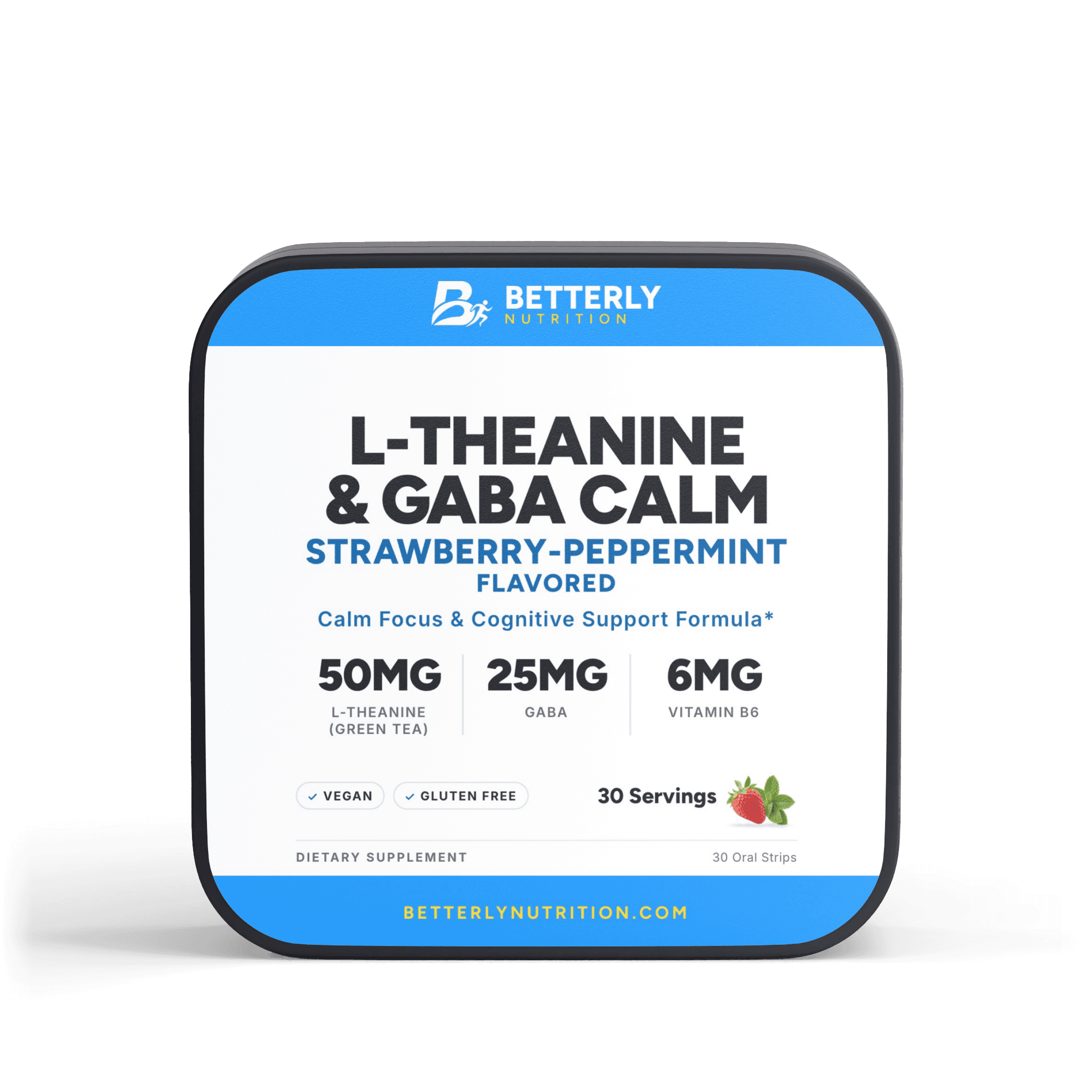
- You'd rather skip melatonin. Our Sleep & Stress Relief shelf has melatonin-free options, including the L-Theanine & GABA Calm Strips: 50 mg of L-theanine, 25 mg of GABA and 6 mg of vitamin B6 per 1 Oral Strip (290 mg) serving.
Who should check with a healthcare provider first?
Check with a healthcare provider before any melatonin format if you're pregnant, nursing, under 18, managing a medical condition or taking any medicine.
The first four come from the caution on all three of our labels. NCCIH's melatonin page adds:
- Medicines. People taking blood thinner medications need medical supervision when taking melatonin. Show your pharmacist the actual pack, since our 10mg capsule's blend also lists St. John's wort, 5-HTP and L-tryptophan.
- Pregnancy and nursing. Research on melatonin safety in pregnant or breastfeeding women is lacking.
- Older adults. Melatonin can linger longer in older bodies, which may mean drowsiness during the day.
- Longer use. Short-term use appears safe for most people, while information on months or years of use is lacking.
For children, the under-18 caution applies, and the CDC report is a reason to keep every flavored melatonin product out of reach and sight. NCCIH says short-term studies in adults reported only mild side effects, such as headache, dizziness, nausea and sleepiness.
FAQ: sublingual and oral melatonin
Should you put a melatonin strip under your tongue?
No, not ours. The 1mg Melatonin Sleep Strips label says to place the strip "on the tongue" and let it dissolve, and we found no federal source showing that moving it underneath changes how much melatonin you absorb or how fast. If you buy a product labeled sublingual, follow that maker's directions instead.
How long does sublingual melatonin take to kick in?
We couldn't find a verified onset time for sublingual melatonin. NCCIH's melatonin page gives none for any format, and the quick numbers online come from sellers. Among our labels, only the 10mg capsule names timing: 20 to 30 minutes before bedtime. The strip and valerian capsule labels leave the clock open.
Are melatonin strips better than gummies?
Melatonin strips aren't proven better than gummies, but the two differ on sweeteners and labeling record. The gummy study NCCIH describes found most products off their labels, and we found no similar federal study of strips. Our strip's sweetness comes from sugar alcohols and steviol glycosides, with no sugars row on the panel. Both formats are flavored, so store both out of reach.
Is it okay to use a melatonin strip after a melatonin capsule?
Don't combine them unless a healthcare provider tells you to. Each of our labels says "Do not exceed recommended dose," and none mentions pairing with another melatonin product. A strip plus our 10mg capsule would put 11 mg of melatonin into one evening, more than either label describes. If one product isn't working, raise it with a provider instead of stacking.
Sources
- Melatonin: What You Need To Know (NCCIH)
- Guidance for Industry: Orally Disintegrating Tablets (U.S. Food and Drug Administration)
- Notes from the Field: Emergency Department Visits for Unsupervised Pediatric Melatonin Ingestion, United States, 2019 to 2022 (CDC, MMWR)
- Sweeteners: sugars (MedlinePlus Medical Encyclopedia)
If this left you looking for somewhere to start, read dissolvable 1mg melatonin strips — its amounts per serving are listed on the page. For the practical questions this raises, how dosing, sourcing and subscriptions work is answered in one place.