On this page
- Key takeaways
- Does melatonin help with jet lag?
- When should you take melatonin for jet lag?
- How do you time melatonin when flying east?
- Does melatonin help when you fly west?
- What melatonin dose do travel guidelines point to?
- Is taking melatonin on a plane a good idea?
- How do you take our melatonin strip on a trip?
- When can you skip melatonin after a flight?
- Who should check with a healthcare provider first?
- FAQ: melatonin for jet lag
- Sources
The short answer: Melatonin for jet lag fits best after flying east. Take a low dose about 90 minutes before bedtime in your new time zone (the CDC's eastward example), and get daylight at your destination. The CDC's travel guide says 0.5 to 1 mg is often enough and advises against more than 5 mg. Westbound trips usually lean on light instead. Stop once you're sleeping on local time.
Key takeaways
- The CDC says melatonin is less effective while your body clock reads roughly midnight to 5 a.m., so the hour you take it counts for more than the dose.
- Flying east is usually the harder adjustment, and a dose before your new local bedtime fits that trip best. For flights west, the CDC's tips lean on light and a later bedtime instead.
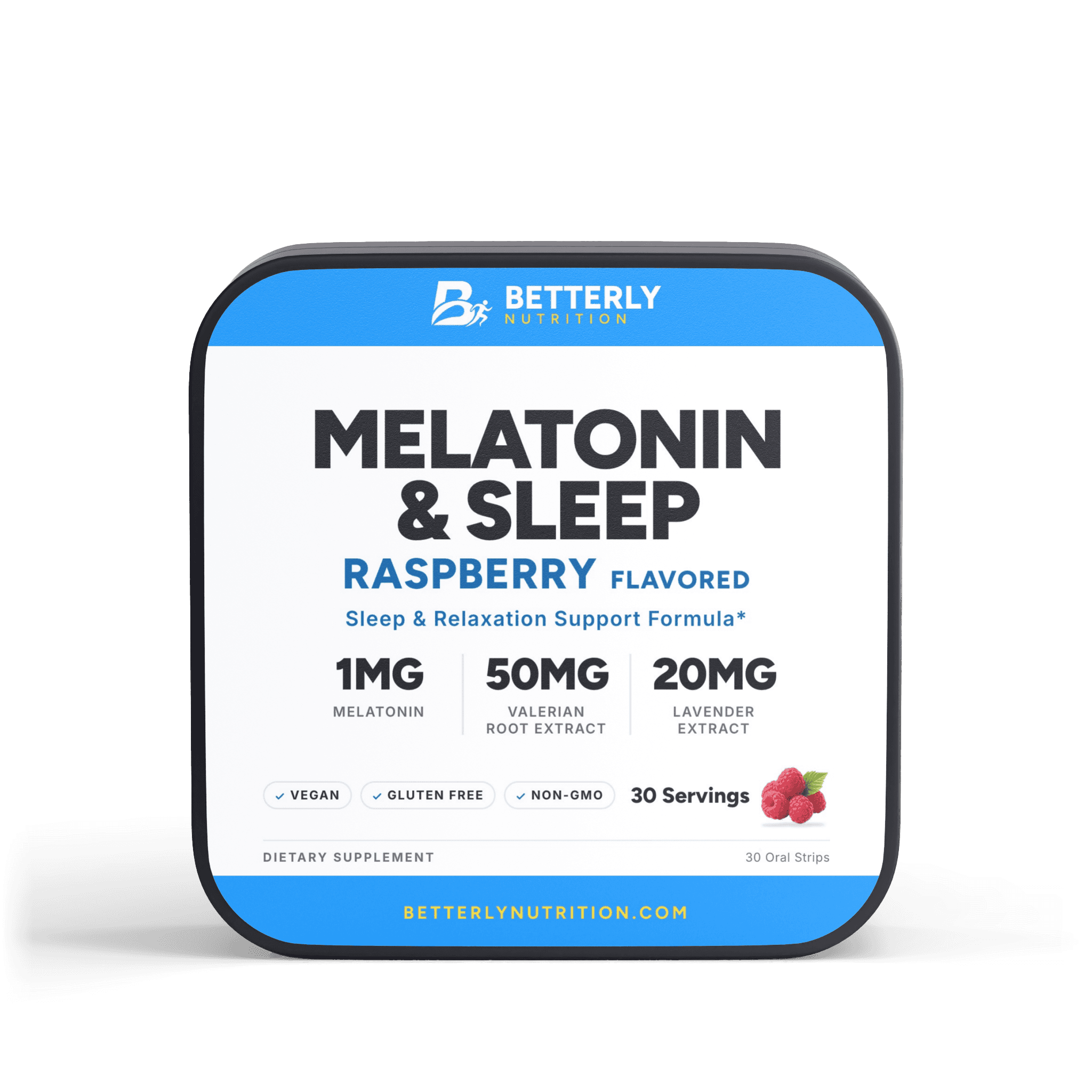
- Betterly's 1mg Melatonin Sleep Strips hold 1 mg of melatonin per 1-strip serving and dissolve on the tongue with no water.
We sell a 1 mg melatonin strip and a caffeine strip, and both ingredients show up in the CDC's jet lag tips, so we benefit if you pack ours. The timing advice below comes from federal pages, the product numbers from our Supplement Facts panels, and we'll name the one bottle of ours we'd keep out of a carry-on.
Does melatonin help with jet lag?
Melatonin may help travelers adjust after crossing several time zones, and the studies NCCIH summarizes are a little larger for eastward flights than westward ones.
On its page Melatonin: What You Need To Know, the National Center for Complementary and Integrative Health (NCCIH) describes four studies with 142 travelers in total. In them, melatonin may have done better than a placebo for overall jet lag after eastward flights. Two more studies, with 90 travelers, pointed the same way after westward flights. NCCIH calls these medium-sized reviews, and the traveler counts are modest, so read the results as promising rather than settled.
NCCIH calls melatonin a darkness-triggered hormone that helps set the timing of your 24-hour internal clock. Jet lag is that clock still running on your home city's hours. Taken at the right local hour, a dose lines up with your new city's evening.
The CDC Yellow Book's jet lag chapter ties jet lag to crossing at least two time zones. For most people, it explains, the internal clock runs slightly longer than 24 hours, so pushing it later is easier than pulling it earlier. That's why the CDC puts average adjustment at about 1.5 hours a day after flying west, but only about 1 hour a day after flying east.
When should you take melatonin for jet lag?
Take melatonin for jet lag about 90 minutes before bedtime in your new time zone, the CDC's eastward example, mainly after flights heading east.
The CDC warns that a mistimed dose can make the mismatch worse, and that melatonin does less while your body clock reads roughly midnight to 5 a.m., when your own melatonin is already high.
Fly from New York to London and aim for a 10 p.m. London bedtime. A dose at 8:30 p.m. local lands at 3:30 p.m. on a body still set to New York, well clear of that midnight-to-5 a.m. stretch.
Now flip the trip. Fly from London to New York, and a dose 90 minutes before a 10 p.m. New York bedtime lands at 1:30 a.m. on your body clock, right inside the window where melatonin does less. That's why westbound travelers need a different plan.
For ordinary nights at home, see our guide to how far ahead of bedtime to take melatonin.
When should you stop taking melatonin for jet lag?
Stop once you're falling asleep and waking up on local time without help. The CDC doesn't set a number of days, and NCCIH says information on long-term melatonin safety is lacking, so keep it short and purposeful.
How do you time melatonin when flying east?
When you fly east, take melatonin before your new, earlier bedtime and get daylight at your destination, following the CDC's eastward tips.
The CDC sorts its eastward tips by when you do them:
- In the days before. Move your sleep 1 hour earlier each day for the 2 to 3 days before you leave, which may shorten the adjustment.
- On the day you fly, still on your home clock. The CDC suggests bright light and caffeine early in the morning and dim light in the evening.
- After you land. Get outside in daylight at your destination. Use caffeine during local daylight as needed, and stop 6 hours before bed.
- At local bedtime. Take melatonin before bed. The Yellow Book's eastward example puts the dose about 90 minutes ahead.
- Keep naps short. The CDC says 20 to 30 minute naps can help you stay alert, while longer ones may cut into that night's sleep.
The CDC adds that the best light timing depends on your direction and the number of time zones crossed, and it points to jet lag calculators for trip-specific plans.
Say you're flying from Chicago to Paris, 7 time zones east. At the CDC's average of about 1 hour a day, an unaided adjustment could take close to a week. On a trip that size, melatonin for jet lag going east can earn its place.
Does melatonin help when you fly west?
Melatonin is often optional after flying west, because westward shifts come easier and the CDC's westward tips rely on light and a later local bedtime instead.
The CDC's westward list is short. On the day you fly, still on home time, it says to avoid bright light and caffeine in the early morning and to nap early if you need to. At your destination, try to stay up until local bedtime. A bedtime melatonin dose isn't on it.
The CDC explains that melatonin helps a westward shift when taken while your body clock thinks it's morning, a window that's easy to miss without a calculator. Light is simpler. Evening light generally shifts the clock later, the CDC says, and later is where you're headed. New York to Los Angeles crosses 3 time zones, which works out to roughly 2 days at the CDC's westward average.
| Step | Flying east | Flying west |
|---|---|---|
| Your clock needs to move | Earlier | Later |
| CDC average adjustment | About 1 hour a day | About 1.5 hours a day |
| Travel day, home clock | Bright light and caffeine early | Skip both early |
| At your destination | Daylight, then melatonin before bed | Daylight, stay up until bedtime |
| Melatonin | Before local bedtime | Not on the CDC's westward list |
In short: melatonin is mostly an eastbound tool, while westbound trips run on light, a late bedtime and a couple of days' patience.
What melatonin dose do travel guidelines point to?
The CDC Yellow Book says 0.5 to 1 mg of melatonin is often enough to shift the body clock, and it recommends against high doses above 5 mg.
Its reasoning fits a timing tool: a large dose can leave extra melatonin in your system at the wrong time of day. Here's how our three strengths line up, including the Valerian & Chamomile Sleep Capsules and the 10mg Melatonin Sleep Capsules.
| Betterly product | Melatonin per serving | Vs. the CDC's range |
|---|---|---|
| 1mg Melatonin Sleep Strips | 1 mg per 1-strip serving | Top of 0.5 to 1 mg |
| Valerian & Chamomile Sleep Capsules | 2 mg per 2-capsule serving | Above 1 mg, under 5 mg |
| 10mg Melatonin Sleep Capsules | 10 mg per 2-capsule serving | Twice the 5 mg line |
Only the strip falls inside the range the CDC calls often sufficient. By that standard, our 10 mg capsules aren't a jet lag product. Our guide asking whether 10mg melatonin is too much explains who that bottle is for.
Both the CDC and NCCIH also note that the melatonin in a supplement may not match its label. That goes for our tin too. We don't make the strips, and the 1 mg printed on them is the manufacturer's declared amount, as our quality page explains.
From our shop: 1mg Melatonin Sleep Strips — a raspberry strip with 1 mg melatonin per serving that melts on the tongue, so you can take it in a plane seat or hotel room with no water.
Is taking melatonin on a plane a good idea?
Taking melatonin on a plane makes sense only when it's nighttime at your destination and you have several hours left to sleep before landing.
Take it at 2 p.m. destination time just to pass a long flight, and you're sending a night signal at the wrong hour. Try any sleep product at home before trying it in a middle seat.
A few things matter more in the air:
- Skip the wine. Our strip contains valerian root extract, and NCCIH's valerian safety page says valerian shouldn't be taken with alcohol or sedatives.
- Think about landing. NCCIH lists sleepiness among melatonin's reported mild side effects, so plan around any driving after you land.
- Prescription sleep medicine is its own question. Ask whoever prescribed it before mixing it with melatonin or valerian.
NCCIH notes that in several other countries melatonin is prescription-only, so check your destination's rules before you pack.
How do you take our melatonin strip on a trip?
The label's suggested use for Betterly's 1mg Melatonin Sleep Strips is to place 1 oral strip on the tongue daily and allow it to dissolve. The tin gives no clock time, so the timing here comes from the CDC.
The panel lists, per 1-strip serving (1 oral strip, 210 mg), 1 mg melatonin, 50 mg valerian root extract, 20 mg lavender extract, 10 mg chamomile extract and 10 mg hibiscus extract, with 30 servings per tin. The label's claims are vegan, gluten free and non-GMO. Those botanicals come in small amounts, and every jet lag study mentioned above tested melatonin, not them.
On a trip, that means:
- One strip on each adjustment night, timed to your destination bedtime. If it doesn't seem to help, don't add a second. The label says not to exceed the recommended dose.
- Keep the tin dry. The label says to store it in a cool, dry place.
The morning side of an eastward trip is where our Caffeine & L-Theanine Energy Strips fit. Each 1-strip serving pairs 50 mg caffeine with 30 mg L-theanine, plus 1000 mcg vitamin B12 (methylcobalamin), and the label's suggested use is one strip daily.
The CDC's arrival tip uses 200 mg servings of caffeine as needed during local daylight, stopping 6 hours before bed, so one 50 mg strip is a small, easy-to-track amount. The FDA's page Spilling the Beans: How Much Caffeine Is Too Much? cites 400 mg a day for most adults as an amount not generally associated with negative effects, so count your hotel coffee too. Our guide to how caffeine strips work covers the format.
From our shop: Caffeine & L-Theanine Energy Strips — 50 mg of caffeine and 30 mg of L-theanine per strip, a measured morning option for your first days at a destination.
When can you skip melatonin after a flight?
You can usually skip melatonin on short trips, one-time-zone hops, and westward flights where daylight and a late bedtime already do the job.
Good reasons to leave the tin at home:
- The trip is under about 2 days. The CDC suggests keeping your sleep, meals and activity on home time rather than adapting.
- You're crossing one time zone. The CDC ties jet lag to crossing at least two.
- You sleep fine once you land. There's nothing to fix.
- Your mind is busy, but your clock is fine. Melatonin deals with what hour your body thinks it is, and our magnesium vs melatonin comparison covers wind-down options.
Our sleep and stress relief collection includes melatonin-free evening options too.
Who should check with a healthcare provider first?
Talk to a healthcare provider before packing melatonin if you're pregnant or nursing, younger than 18, living with a medical condition, or on any regular medication.
Pregnancy, nursing, being under 18 and having a medical condition come straight from our strip's label caution. The medication advice comes from NCCIH, the CDC and the FDA below. NCCIH says that anyone on blood thinners should use melatonin only under medical supervision, and that pregnancy and breastfeeding research is lacking. It also notes that in older adults, melatonin can linger longer and leave you drowsy the next day.
The CDC says there's limited data on how melatonin interacts with other medications. NCCIH's valerian page asks anyone taking any medicine to talk with a provider before using the herb, and our strip contains it. For the caffeine strip, the FDA says people who are pregnant, trying to get pregnant or breastfeeding should ask a provider about caffeine, and that some medicines can make you more sensitive to it.
FAQ: melatonin for jet lag
How many days before a trip should I start taking melatonin?
The CDC Yellow Book doesn't give a pre-flight melatonin schedule. For the days before you leave, it suggests shifting your sleep 1 hour a day for 2 to 3 days: earlier for eastward trips, later for westward ones. In the CDC's eastward tips, melatonin comes in at your destination, before local bedtime. If a jet lag app suggests extra doses, never go beyond your product's label directions.
Can I drink alcohol on a flight if I take a melatonin strip?
No, skip the alcohol if you're using our strip. Betterly's 1mg Melatonin Sleep Strips contain 50 mg of valerian root extract per strip, and NCCIH says valerian shouldn't be taken with alcohol or sedatives. If you'd rather have the glass of wine, save the strip for your first night on the ground.
Can you take melatonin and caffeine on the same travel day?
Yes, melatonin and caffeine can share a travel day if caffeine comes early and melatonin comes late. For the day you fly east, the CDC suggests early-morning caffeine on your home clock. Its on-arrival tips allow caffeine during local daylight but say to stop 6 hours before bed, with melatonin before bedtime. A 50 mg caffeine strip at 9 a.m. and a melatonin strip before a 10 p.m. bedtime leave plenty of room.
Should I take melatonin after the flight home too?
It depends on direction: a flight home heading east is a fresh eastward shift, so melatonin before local bedtime fits again. A flight home heading west leans on daylight and staying up until your usual bedtime, and the CDC's westward tips don't include a bedtime dose. Either way, once you're falling asleep and waking on home time again, you can stop.
Sources
- Melatonin: What You Need To Know (NCCIH)
- CDC Yellow Book 2026, jet lag chapter (CDC)
- Valerian: Usefulness and Safety (NCCIH)
- Spilling the Beans: How Much Caffeine Is Too Much? (FDA)
If this left you looking for somewhere to start, read 1mg melatonin strips for a new time zone — its amounts per serving are listed on the page. For the practical questions this raises, how dosing, sourcing and subscriptions work is answered in one place.