On this page
- Key takeaways
- Which red superfood powder is best? Five labels compared
- Are the blend amounts disclosed, or only a total?
- Which reds powders add maltodextrin or sweeteners?
- Is the probiotic counted at manufacture or at expiry?
- Do reds powders contain caffeine from green tea or coffee?
- What does a reds powder cost per serving?
- How do you take a reds powder by the label?
- When don't you need a reds powder?
- Who should check with a healthcare provider first?
- FAQ: red superfood powders
- Sources
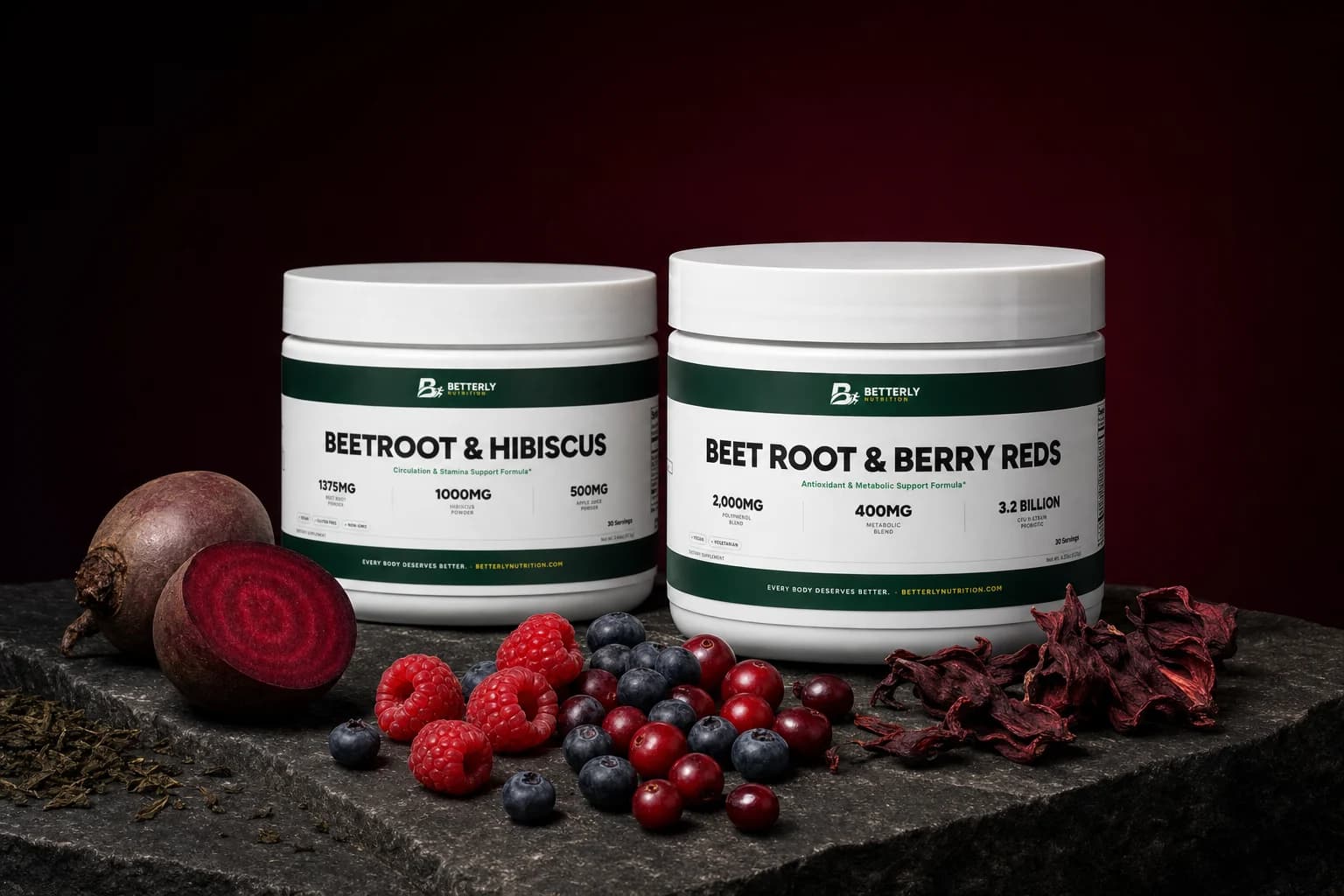
The short answer: The best red superfood powder is the tub whose back panel settles your doubts before you pay. We read five reds powders, ours included, against five checks: blend amounts, maltodextrin and sweeteners, when the probiotic was counted, caffeine sources and cost per serving. No tub passes all five. Our Beet Root & Berry Reds Powder prints four blend totals per 1-scoop (4 g) serving, but no amount for any single ingredient.
Key takeaways
- A blend total hides how much of each plant is inside, so labels that weigh each ingredient let you check far more.
- All five powders use a stevia sweetener, and two of them, ours and Opti-Reds 50, also list maltodextrin.
- Three of the five list a probiotic, and the two that say when they counted it both counted at manufacture, a number the NIH says can drop over time.
- Four of the five list green tea, and none of them prints how much caffeine a scoop holds.
- Servings run from about 3.5 g to 10 g, so price per serving and price per gram crown different winners.
We sell one of the five powders compared here, and two other scoops we sell come up along the way. Every competitor detail below was read on that brand's own product page on September 23 or 24, 2026.
Which red superfood powder is best? Five labels compared
No single red superfood powder is best on every check, and five reds powders range from a label that weighs 14 ingredients to one that weighs none.
A reds powder, sometimes sold as "super reds," is a scoop of dried red and purple plants like beet, berries and hibiscus. If you haven't settled on reds yet, our reds vs greens powder comparison covers that choice first.
| Reds powder (serving) | Amounts on the panel | Sweetener and add-ins | Probiotic count |
|---|---|---|---|
| Beet Root & Berry Reds (1 scoop, 4 g) | 4 blend totals only | Stevia, maltodextrin | 3.2 billion CFU at manufacture |
| BIOHM Super Reds (1 scoop, about 8 g) | 4 blend totals only | Stevia | 1 billion CFU, timing not stated |
| Earth Energy Daily Reds Energy Blend (1 scoop, about 3.5 g) | 14 ingredients weighed, plus 2 blends | Organic stevia leaf extract | 1.2 billion CFU at manufacture |
| 1st Phorm Opti-Reds 50 (2 scoops, 10 g) | None | Stevia, maltodextrin, guar gum | None listed |
| Bare Performance Nutrition Strong Reds (1 scoop, 5.8 g) | 5 rows with amounts, 7 blank | Steviol glycosides (Reb M) | None listed |
Earth Energy discloses the most, ours and BIOHM print totals only, and Opti-Reds 50 prints no ingredient amounts because it uses a food-style Nutrition Facts panel. Strong Reds figures come from the Supplement Facts image in its product gallery. The page's text facts tab shows a different 6.5 g panel.
Are the blend amounts disclosed, or only a total?
A reds powder that uses blends prints only each blend's total weight, so the beet or berry inside stays hidden unless the brand weighs every ingredient separately.
The FDA's supplement labeling rule, 21 CFR 101.36, requires a blend's ingredients to appear in descending order of predominance by weight, under one total. That order is the only math you get: the first ingredient is at least the average share, and the second can't exceed half. Our guide to how blend order caps each ingredient shows the method.
Beet comes first on four of these five labels. Here's what each proves. We've added our Beetroot & Hibiscus Powder, our one red scoop that weighs every active ingredient.
| Powder (serving) | How beet appears | What the label proves |
|---|---|---|
| Beetroot & Hibiscus (3.25 g) | Beet root powder, own row | 1375 mg |
| Earth Energy (about 3.5 g) | Beet root powder, own row | 975 mg |
| BIOHM (about 8 g) | Beet juice powder, 1st of 6 in a 6,453 mg blend | At least about 1,076 mg |
| Beet Root & Berry Reds (4 g) | Beet root powder, 1st of 11 in a 2,000 mg blend | At least about 182 mg |
| Strong Reds (5.8 g) | Beet root juice powder, own row | No amount on its panel image |
| Opti-Reds 50 (10 g) | Beet root powder, first in the first blend | No amount given |
Only two labels give an exact beet number, and one is our Beetroot & Hibiscus. Juice powder and whole root powder are different forms, though, so equal milligrams don't mean equal products.
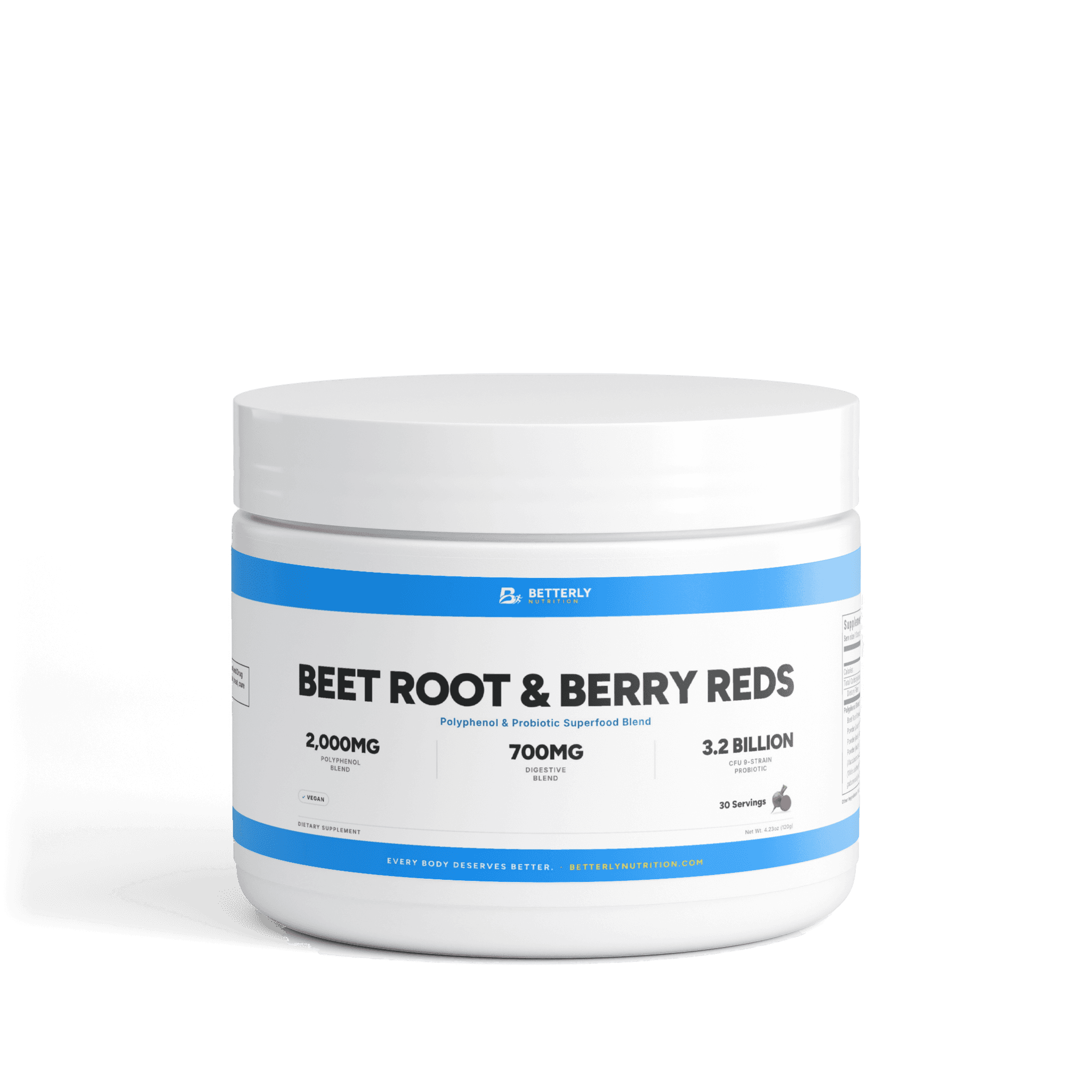
Here's our own limit. Beet Root & Berry Reds lists 11 plants in a 2,000 mg Polyphenol Blend, plus a 700 mg Digestive Blend and a 400 mg Metabolic Blend, and no plant gets its own number. We don't manufacture the powder, and our panel reprints the supplier's formula, which gives totals only.
On the Strong Reds panel image, the seven rows from baobab to cranberry show no amount, so ask the brand if one matters to you.
Which reds powders add maltodextrin or sweeteners?
Every reds powder in this comparison uses a stevia sweetener, and two of them, ours and Opti-Reds 50, also list maltodextrin, a carbohydrate powder made from starch.
Our Beet Root & Berry Reds lists maltodextrin, natural flavors, citric acid and stevia extract (leaf) as other ingredients. Opti-Reds 50 names maltodextrin twice, beside guar gum, silicon dioxide and sunflower lecithin. BIOHM lists natural flavors, citric acid and stevia, and Earth Energy lists stevia alone. Strong Reds pairs natural flavor, citric acid and Reb M with calcium silicate and silica.
On our scoop, the four blends add up to 3,200 mg. Take that from the 4 g serving and roughly 800 mg is left for maltodextrin and the other three add-ins, by our math. Per scoop, our panel shows 10 calories and 2 g of total carbohydrates, with 2 g of dietary fiber.
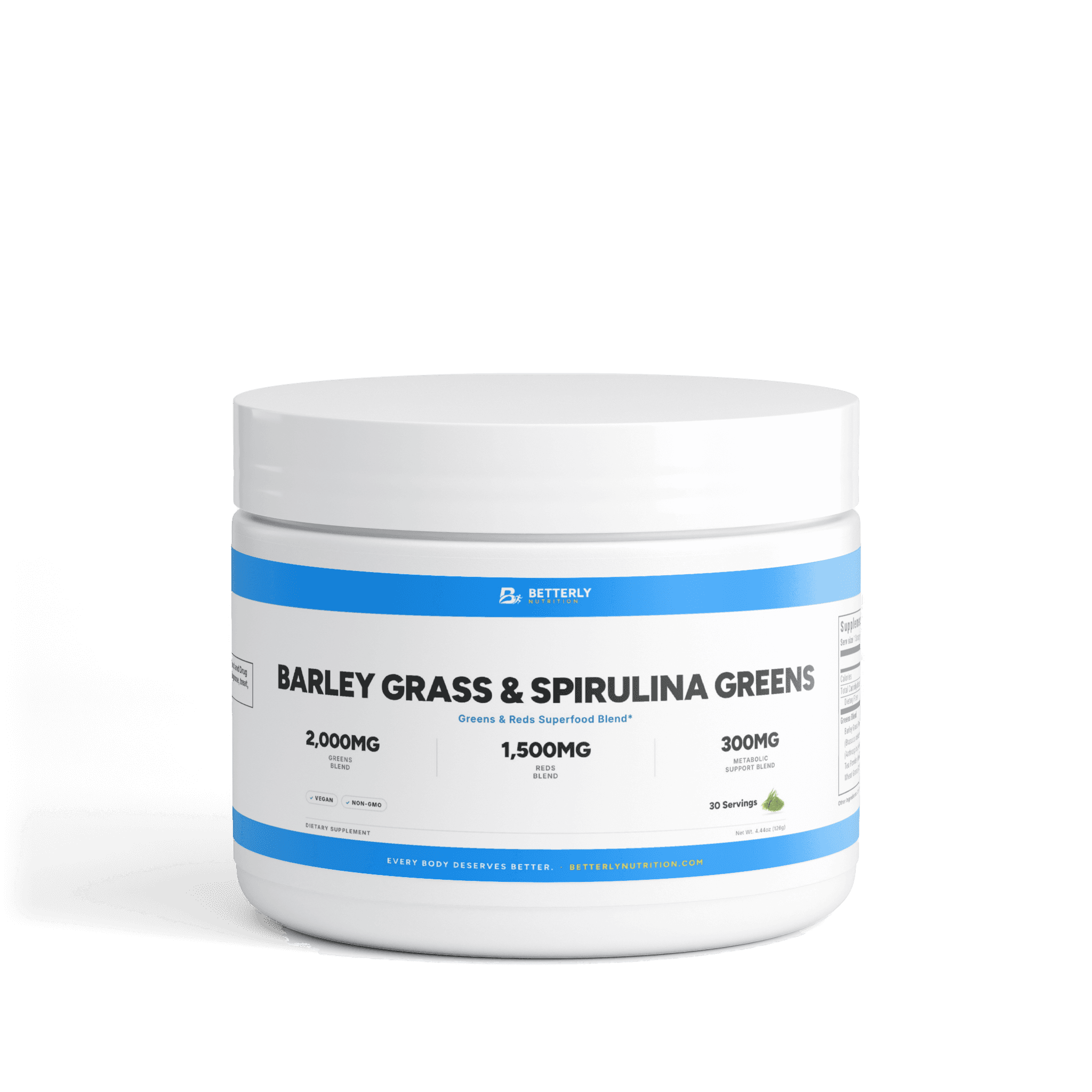
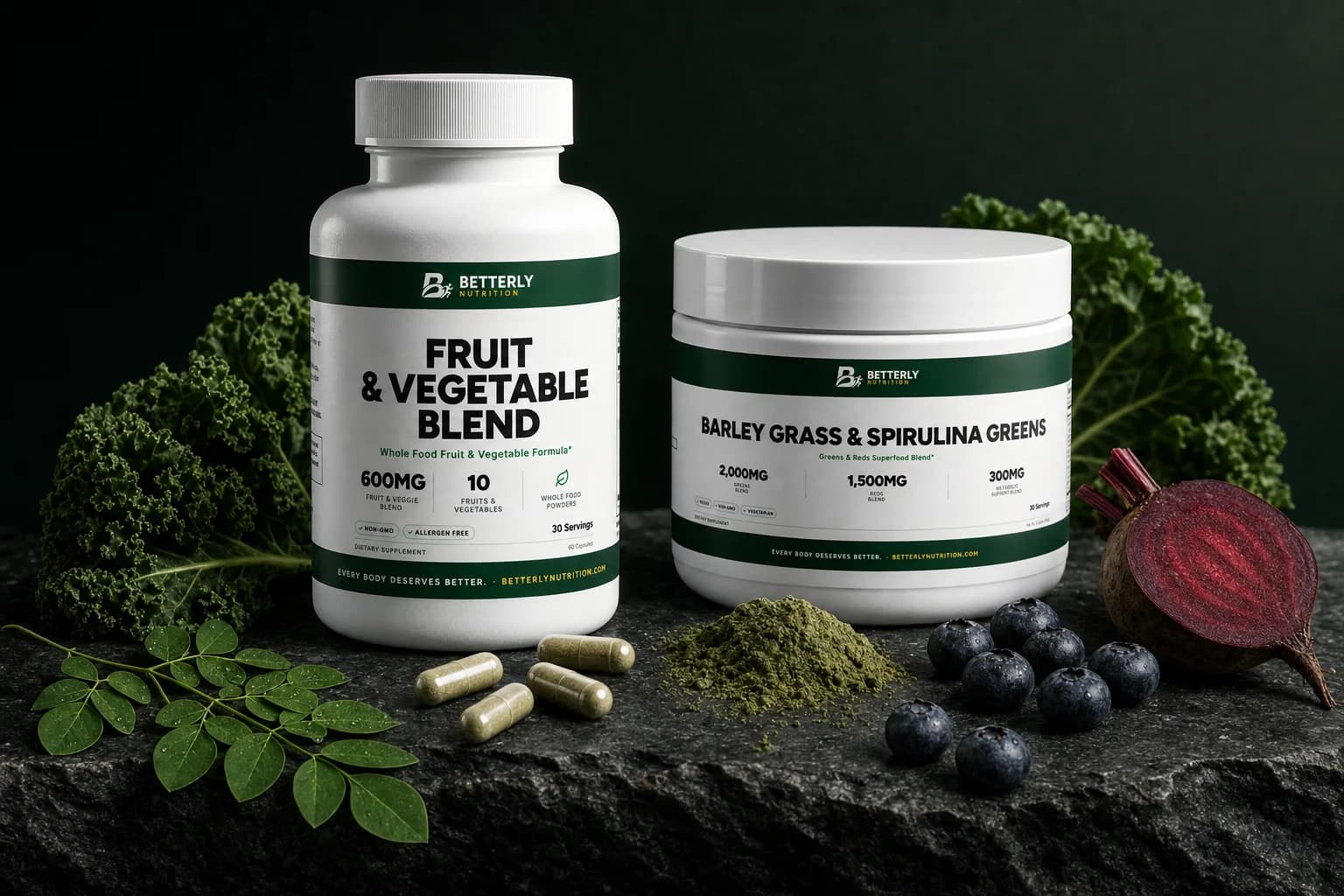
Is maltodextrin a deal breaker? If you avoid it, ours isn't your tub, and our Beetroot & Hibiscus Powder lists maltodextrin and stevia too. BIOHM, Earth Energy and Strong Reds skip it. So does our Barley Grass & Spirulina Greens Powder, which carries a 1,500 mg Reds Blend per 1-scoop (4.2 g) serving, though it's a greens powder first.
Is the probiotic counted at manufacture or at expiry?
Beet Root & Berry Reds and Earth Energy's powder count their probiotic at manufacture, BIOHM's panel doesn't say when, and the other two list no probiotic.
The NIH Office of Dietary Supplements explains why that matters in its probiotics fact sheet for consumers. Some labels give the count at manufacture, others through the expiration or use-by date, and "the number of CFUs in a probiotic can decline over time." So some experts prefer counts stated through expiration.
That's our label's honest limit. The 9 Strain Probiotic row reads 100 mg, footnoted as 3.2 billion live CFU at the time of manufacture, across nine species with no strain codes. That count describes the day the powder was made, not the day you open it.
Earth Energy lists 1.2 billion CFU at manufacture from five species. BIOHM lists 1 billion CFU across four coded strains, including the yeast Saccharomyces boulardii, without saying when the count applies.
Don't let the biggest number decide. More CFUs don't by themselves mean more benefit, the same ODS sheet adds, since the strains matter too. Here's what a CFU count can and can't tell you.
From our shop: Beet Root & Berry Reds Powder — one 4 g scoop lists a 2,000 mg Polyphenol Blend, 2 g of dietary fiber and a 9-strain probiotic at 3.2 billion live CFU at the time of manufacture.
Do reds powders contain caffeine from green tea or coffee?
Four of the five reds powders list green tea, which contains caffeine, and none of them prints a caffeine amount for a scoop.
The National Center for Complementary and Integrative Health confirms in its green tea overview that green tea "does contain caffeine." Here's where it turns up:
- Beet Root & Berry Reds: green tea powder sits second of seven in the 400 mg Metabolic Blend, so blend order caps it at 200 mg of powder. No caffeine amount is printed.
- BIOHM: coffee plant (Coffea arabica) extract and green tea extract lead a 100 mg blend of 29 ingredients, so together they weigh under 100 mg. No caffeine figure is printed.
- Earth Energy: 55 mg of green tea leaf extract. Its page mentions a small amount of caffeine but says it doesn't publish an exact figure.
- Opti-Reds 50: coffee fruit extract and green tea leaf extract, with no amounts.
- Strong Reds: neither green tea nor coffee appears on the panel.
For scale, the FDA's caffeine guide for consumers cites 400 milligrams a day, about two to three 12-ounce cups of coffee, as an amount not generally associated with negative effects for most adults. A reds scoop counts toward that total, and on all four that list green tea or coffee, you can't tell by how much.
Want no caffeine source? Our Beetroot & Hibiscus Powder lists no green tea or coffee.
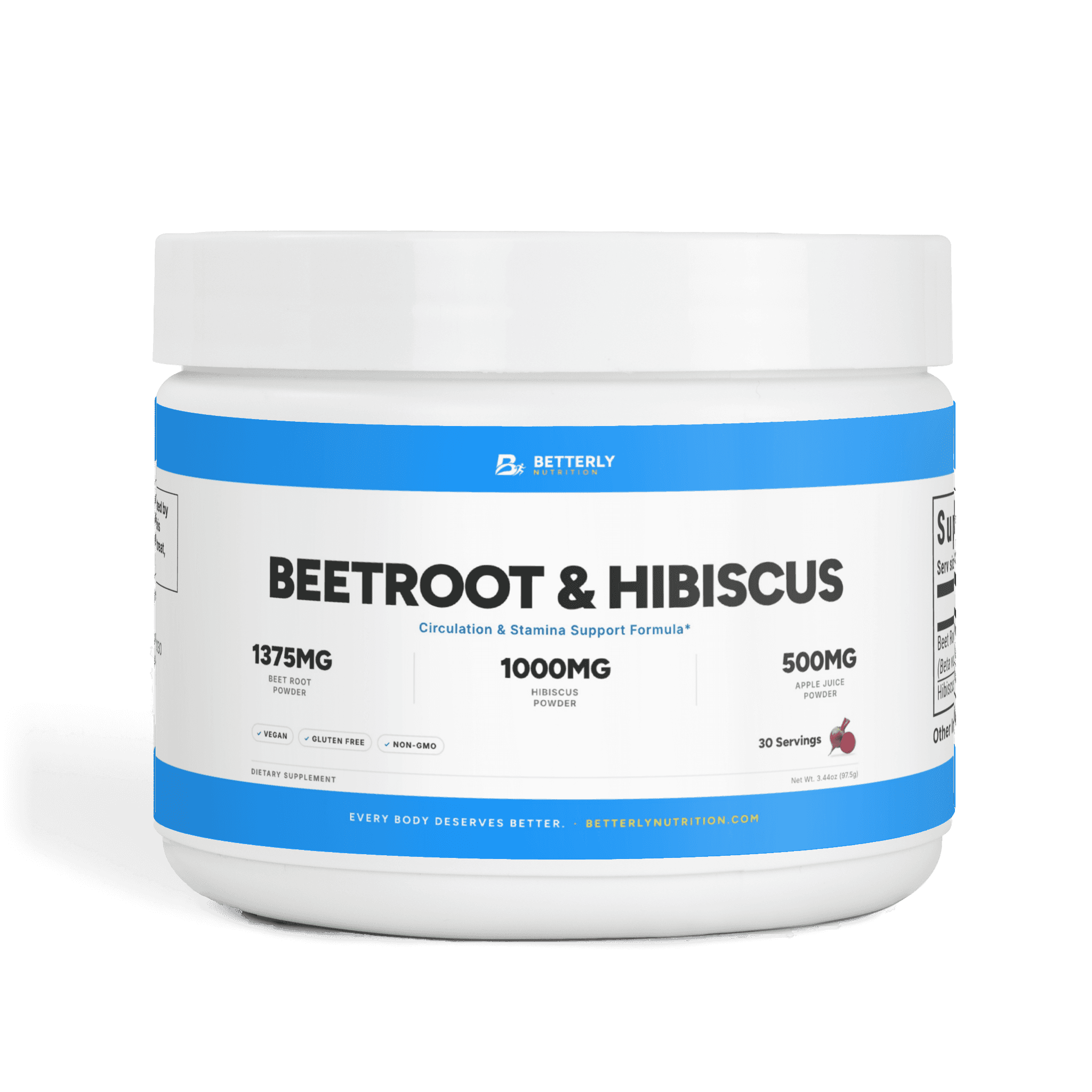
From our shop: Beetroot & Hibiscus Powder — 1375 mg of beet root powder, 1000 mg of hibiscus powder and 500 mg of apple juice powder per 1-scoop (3.25 g) serving, labeled vegan, gluten free and non-GMO.
What does a reds powder cost per serving?
A reds powder's cost per serving is its price divided by its servings. All five tubs list 30 servings, though an Opti-Reds 50 serving means two scoops. Use today's prices:
- Divide the price you'd pay by the servings per container.
- Divide that figure by the serving weight in grams for price per gram.
- Read the directions for servings per day. Opti-Reds 50 says "1 or more servings daily," which can raise the daily cost.
With one-time list prices from each brand's page on September 23, 2026, Earth Energy's single jar came out cheapest per serving, ours second and Opti-Reds 50 most expensive. Per gram, BIOHM and Opti-Reds 50, the heaviest servings, came out lowest, and ours landed in the middle.
Neither number settles it, since a gram of maltodextrin counts the same as a gram of beet. Use cost to break a tie between labels that pass your checks.
How do you take a reds powder by the label?
Take Beet Root & Berry Reds Powder as its label directs: adults mix one scoop into 6-8 ounces (177-237 ml) of cold water or a favorite beverage once daily.
- Drink it within 10 minutes of mixing, as the directions say.
- Stay at one scoop. The caution reads "Do not exceed recommended dose," and a second scoop doubles the green tea and herbs too.
- Pick a steady time. With green tea listed, morning or early afternoon is the cautious slot.
- Keep the tub in a cool, dry place, as the label says.
Follow the directions on the tub you own, and don't run two reds powders at once.
When don't you need a reds powder?
You don't need a reds powder if you already eat berries, beets or other red produce most days, or want a result no label promises.
- Your plate already has color. A scoop is a few grams of dried powder, and a bowl of berries is food.
- Your greens powder already has a reds blend, so a reds tub on top repeats many of the same plants.
- You already take a probiotic, which makes the one in a reds scoop a small extra.
- A tub would squeeze your grocery budget. Frozen berries are the better buy.
If you'd still like a scoop, our greens and superfoods shelf keeps our reds, beet and greens powders side by side.
Who should check with a healthcare provider first?
Check with a healthcare provider before starting a reds powder if you're pregnant or nursing, under 18, taking prescription medicine, facing surgery or managing a medical condition.
Our label asks you to consult a physician if you're pregnant, nursing, under 18 or have a medical condition. NCCIH says green tea may interact with some medicines and that caffeine during pregnancy should stay moderate. The ODS probiotics sheet cautions that people who are already seriously ill or have weak immune systems could face problems such as infections.
Bring the full panel along. Our Metabolic Blend lists cinnamon, green tea powder, ginger, turmeric, shilajit extract, bitter melon extract and black pepper extract.
FAQ: red superfood powders
What does a reds powder actually do?
A reds powder turns a few grams of dried beet, berry and hibiscus into a drink, often with fiber, a probiotic or herbs mixed in. It's a convenience, not a stand-in for the produce it's made from, and no label here promises a result you'll feel.
What are the benefits of a reds powder?
The benefits of a reds powder you can verify are the amounts on its panel. Per 1-scoop (4 g) serving, Beet Root & Berry Reds Powder lists 2 g of dietary fiber (6% DV) and a 9-strain probiotic at 3.2 billion live CFU at the time of manufacture. None of the five panels here measures polyphenols, so no label tells you how much of those compounds reaches your glass.
Is it safe to drink a reds powder every day?
A reds powder can fit a healthy adult's daily routine at its label's suggested use, which for Beet Root & Berry Reds is one scoop once daily. A second scoop or second reds product doubles the green tea and herbs. If you're pregnant, nursing, under 18, on medication or managing a medical condition, our label asks you to consult a physician first.
What time of day should you drink a reds powder?
Beet Root & Berry Reds fits any time of day you'll remember, since its label names no time. Green tea powder sits in its Metabolic Blend with no caffeine amount printed, so a morning or early-afternoon glass is the cautious habit if late caffeine keeps you up.
Does a reds powder with probiotics need to be refrigerated?
Beet Root & Berry Reds doesn't need a refrigerator: its label says to store it in a cool, dry place and gives no cold-storage instruction. The NIH Office of Dietary Supplements notes that some probiotics need refrigeration while others keep at room temperature. Follow the storage line on whichever tub you buy.
Sources
- Probiotics: Fact Sheet for Consumers, NIH Office of Dietary Supplements
- Green Tea: Usefulness and Safety, National Center for Complementary and Integrative Health
- Spilling the Beans: How Much Caffeine Is Too Much?, U.S. Food and Drug Administration
- 21 CFR 101.36, Nutrition labeling of dietary supplements, eCFR
- BIOHM Super Reds product page, biohmhealth.com, viewed September 23, 2026
- Earth Energy Daily Reds Energy Blend product page, earthenergysupplementstore.com, viewed September 23 and 24, 2026
- 1st Phorm Opti-Reds 50 product page, 1stphorm.com, viewed September 23, 2026
- Bare Performance Nutrition Strong Reds product page, bareperformancenutrition.com, viewed September 23 and 24, 2026
If this left you looking for somewhere to start, read reds superfood powder with a 9-strain probiotic — its amounts per serving are listed on the page. For the practical questions this raises, how dosing, sourcing and subscriptions work is answered in one place.