On this page
- Key takeaways
- Chlorella vs spirulina: what's the real difference?
- Which has more protein, spirulina or chlorella?
- Chlorella and spirulina benefits: what can a label back up?
- Chlorella powder, tablets or a greens blend: which form fits?
- What does our 900 mg Sea Vegetable Blend actually tell you?
- Chlorella vs spirulina: which is better for what you want?
- How do you take a chlorella and spirulina greens powder?
- Who can skip chlorella and spirulina?
- Who should check with a healthcare provider first?
- FAQ: chlorella and spirulina
- Sources
The short answer: Chlorella is a single-celled green alga, and spirulina (Arthrospira platensis) is a cyanobacterium sold as blue-green algae, so chlorella vs spirulina pits two different kinds of life against each other. USDA's FoodData Central lists dried spirulina at 57.5 g of protein per 100 g, but its standard tables have no chlorella entry. Pick by form, dose and what the label actually shows.
Key takeaways
- Chlorella is a green alga with a nucleus and a tough cell wall, while spirulina is a cyanobacterium, usually sold as blue-green algae.
- USDA lists 57.5 g of protein and 0 µg of vitamin B12 per 100 g of dried spirulina, and its standard reference tables list no chlorella at all.
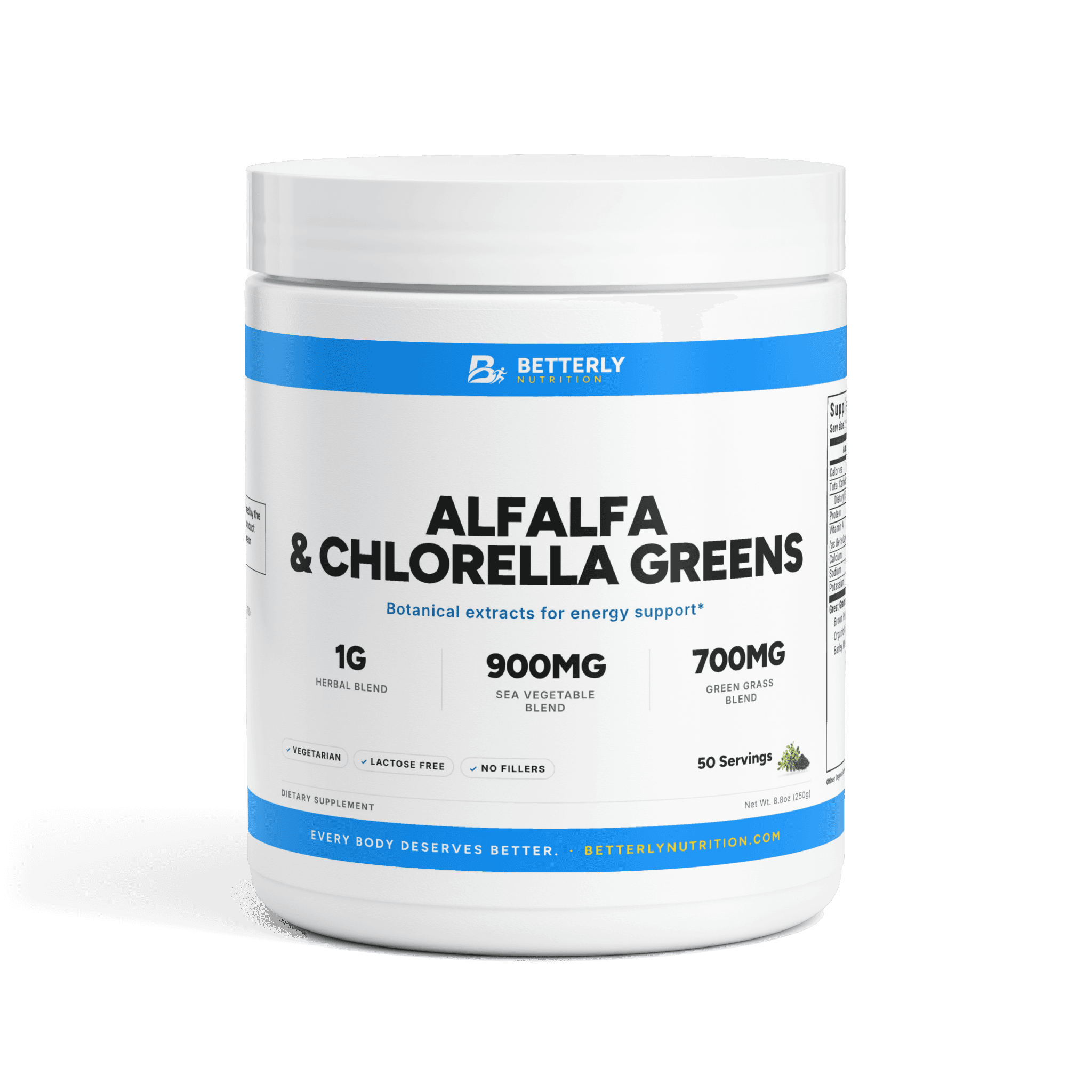
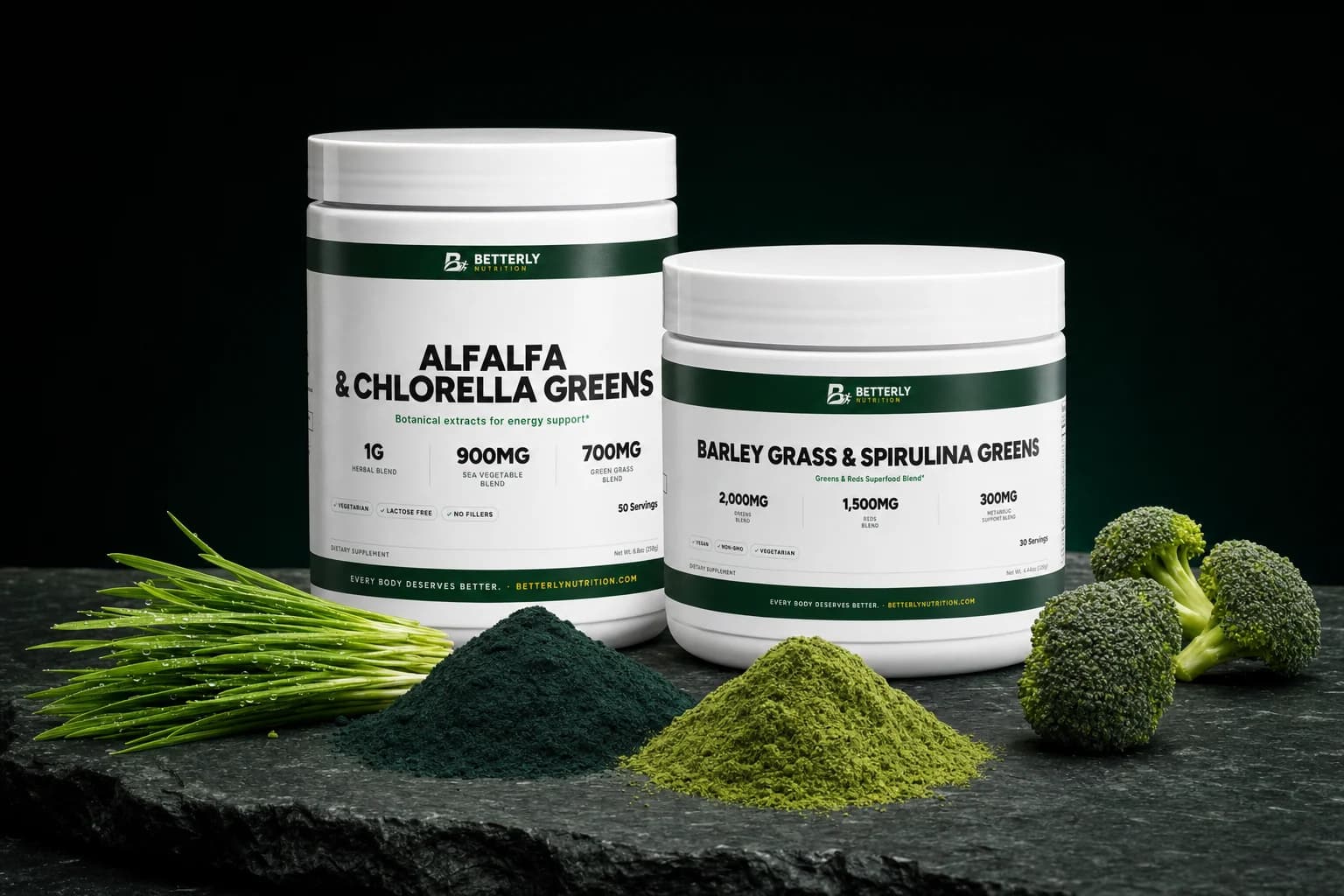
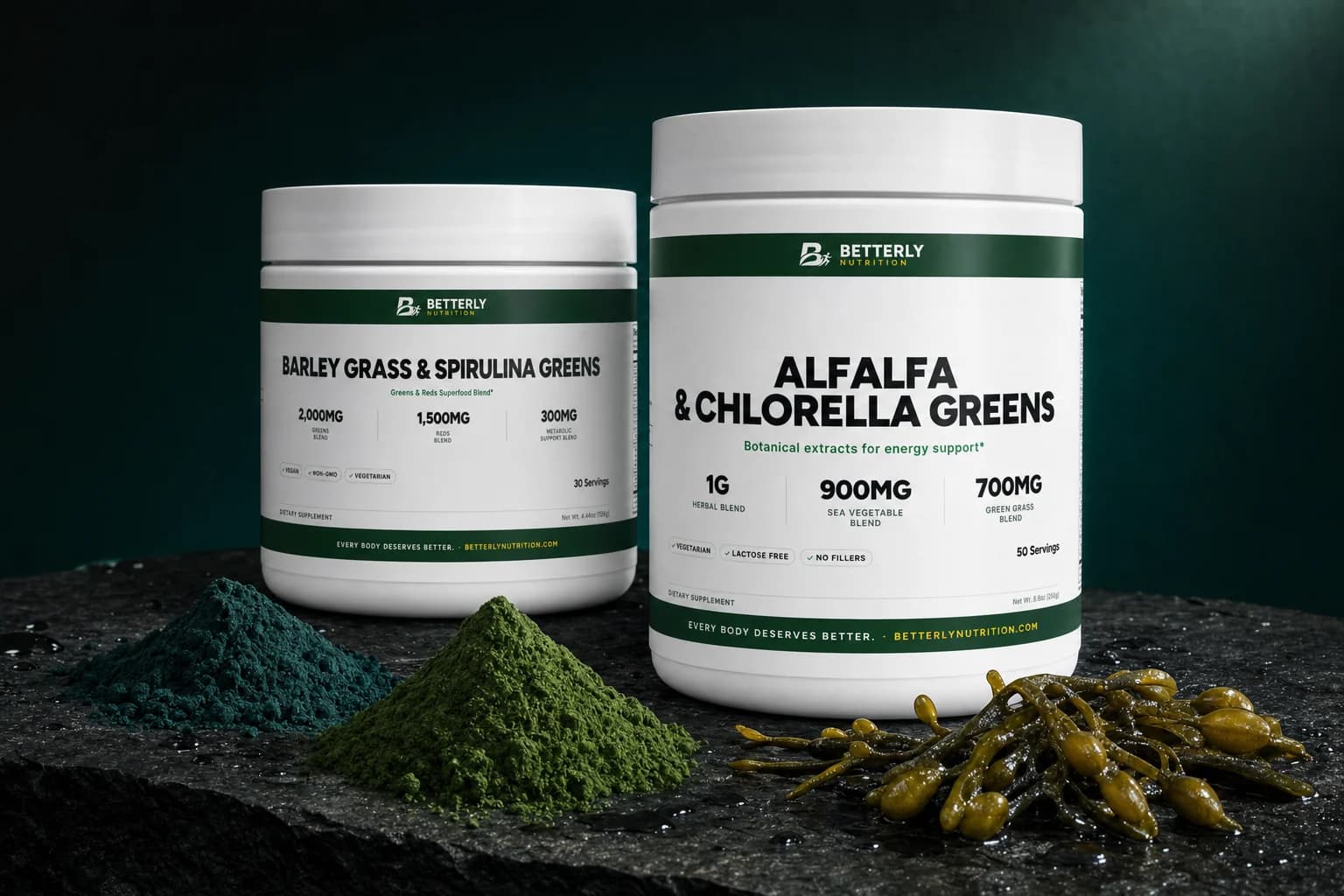
- Betterly's Alfalfa & Chlorella Greens Powder holds spirulina, chlorella and sea whistle in a 900 mg Sea Vegetable Blend per 2-teaspoon (about 5 g) serving, with no amount for each one.
- Blend ingredients are listed from most to least by weight, so spirulina, printed first, weighs at least as much as chlorella in that blend, even though chlorella is in the product's name.
We sell two greens powders with spirulina in them, and one also holds chlorella. Neither prints a separate amount for either ingredient, so when this guide says how much chlorella our powder holds, you'll get a range worked out from the label, not a single number.
Chlorella vs spirulina: what's the real difference?
Chlorella is a single-celled green alga with a nucleus, while spirulina is a cyanobacterium, a type of bacteria that makes its energy from sunlight.
Both are microscopic, and both get dried and sold as green powder or tablets, often in the same tub.
Up close, they're different kinds of life. Chlorella cells keep their DNA inside a nucleus, like plant cells. Spirulina has no nucleus, and its blue-green pigments gave cyanobacteria the nickname blue-green algae.
Chlorella cells also wear a tough outer wall. That's why many chlorella labels advertise a "broken" or "cracked" cell wall. Spirulina is usually sold as plain dried powder or tablets, without that phrase.
| Feature | Chlorella | Spirulina |
|---|---|---|
| What it is | Single-celled green alga | Cyanobacterium ("blue-green algae") |
| Name on our labels | Chlorella Powder (plant), no species | Spirulina (Arthrospira platensis) |
| Color | Deep green | Dark blue-green |
| Label phrase to check | "Broken cell wall" | Species name and mg per serving |
| USDA standard food entry | None | 57.5 g protein per 100 g |
| In our greens powders | Alfalfa & Chlorella only | Both powders |
In short: two different organisms, and only spirulina has a government nutrition profile you can check.
Which has more protein, spirulina or chlorella?
No federal food table settles whether spirulina or chlorella has more protein: USDA lists 57.5 g per 100 g of dried spirulina and has no chlorella entry.
That figure comes from USDA's FoodData Central. Scaled to the entry's 7 g tablespoon portion, our arithmetic gives about 4 g of protein, 20 calories, 2 mg of iron and 74 mg of sodium.
Search that database for chlorella and you'll find branded product listings, but nothing in its standard reference tables. So the chlorella protein percentages you see online come from brands or single studies, not a government food table.
Scale matters more than the percentage, though. Betterly's Alfalfa & Chlorella Greens Powder lists 1 g of protein per 2-teaspoon (about 5 g) serving, and that covers everything in the serving. Even if its whole 900 mg Sea Vegetable Blend were spirulina, USDA's ratio works out to roughly 0.5 g of protein.
Our Barley Grass & Spirulina Greens Powder has no protein line on its panel at all. If protein is your real goal, a protein powder is the honest tool. The Fava Bean Protein Isolate Powder (Vanilla) lists 20 g of protein per 2-scoop (35 g) serving, from fava bean and fermented yeast protein.
Chlorella and spirulina benefits: what can a label back up?
The chlorella and spirulina benefits a label can back up are nutritional: USDA documents spirulina's protein and minerals, while chlorella's nutrition data comes mostly from the brands selling it.
Spirulina vs chlorella benefits lists run long online. Before trusting one, check that it says how much algae it means and links to where each claim came from.
Our own panel has one vitamin line to point to. The Alfalfa & Chlorella Greens Powder lists 270 mcg of vitamin A as beta carotene (30% DV) per 2-teaspoon (about 5 g) serving. It doesn't say which ingredient supplies it, so don't credit the chlorella.
USDA's spirulina entry lists 0 g of EPA and DHA, the omega-3s people usually mean with fish oil, so a spirulina powder isn't a swap for those.
You'll also run into chlorella sold as a "binder" for heavy metals. We don't make that claim for either of our greens powders, and this guide won't make it either.
A greens powder with algae has a modest job: adding a spread of dried plants on days your meals run short on them. Our reds vs greens powder guide compares that job with a berry-based reds scoop.
Chlorella powder, tablets or a greens blend: which form fits?
Chlorella and spirulina powders suit smoothies, tablets suit people who'd rather not taste them, and a greens blend suits anyone happy with algae as one ingredient.
Single-ingredient powders and tablets have one big advantage: the panel prints milligrams per serving, so you know your dose. With chlorella, also check whether the label mentions a broken or cracked cell wall and whether it names a species, such as Chlorella vulgaris.
Tablets also skip the taste question. A powder has to go into a drink, and our Alfalfa & Chlorella label suggests apple juice or another favorite liquid.
A blend trades dose clarity for variety: algae plus grasses, fruit and herbs in one serving, with no amount for each. For more on all-in-one greens drinks, see our honest AG1 alternatives comparison.
You may also spot "blue spirulina" on a flavored drink's ingredient list. There it's a coloring, not a serving of algae: two of our flavored drink powders list "Blue Spirulina (for color)" among their other ingredients.
What does our 900 mg Sea Vegetable Blend actually tell you?
The 900 mg Sea Vegetable Blend in Betterly's Alfalfa & Chlorella Greens Powder shows the combined weight of spirulina, chlorella and sea whistle, but not how many milligrams of each.
Here's the line as printed on the Alfalfa & Chlorella Greens Powder panel, per 2-teaspoon (about 5 g) serving: Sea Vegetable Blend, 900 mg, made up of Spirulina (Arthrospira platensis) Powder, Chlorella Powder (plant) and Sea Whistle (Ascophyllum nodosum) Powder (plant). Sea whistle is a brown seaweed, also called knotted wrack.
So which is there more of in a powder with chlorella in its name? Spirulina, unless the two happen to tie. Federal rules make a blend name its contents by weight, biggest share first, as the FDA's Dietary Supplement Labeling Guide explains.
Read that way, the sub-line becomes a ranking. Spirulina, in first place, can't weigh under a third of 900 mg, so the serving holds at least 300 mg of it. Chlorella, in second, can't outweigh spirulina, which caps it at 450 mg, half the blend. Sea whistle comes last, so it's the smallest of the three.
Now for what the panel can't tell you: the exact milligrams of any of the three, which chlorella species is used, or whether its cell wall was broken. The panel also prints a dagger (†) after spirulina with no footnote to explain it. We'd rather flag that than guess.
All three together are 900 mg of a 2-teaspoon serving that weighs about 5 g, so they're under a fifth of it.
The rest is five more blends, from a 1.25 g Great Grains Blend down to a 265 mg Vegetable Blend, plus 98 mg of FOS (fructooligosaccharides, a type of fiber).
Chlorella vs spirulina: which is better for what you want?
Neither chlorella nor spirulina wins across the board: spirulina has better-documented nutrition, and chlorella makes sense when a label shows how much you're getting.
| If you want | Look for | Why |
|---|---|---|
| Protein you can count | Plain spirulina or a protein powder | USDA: 57.5 g per 100 g dried spirulina |
| A known chlorella dose | Single-ingredient chlorella with mg listed | Blends print only a total |
| Both algae plus grasses and herbs | Alfalfa & Chlorella Greens Powder | One 900 mg blend holds both |
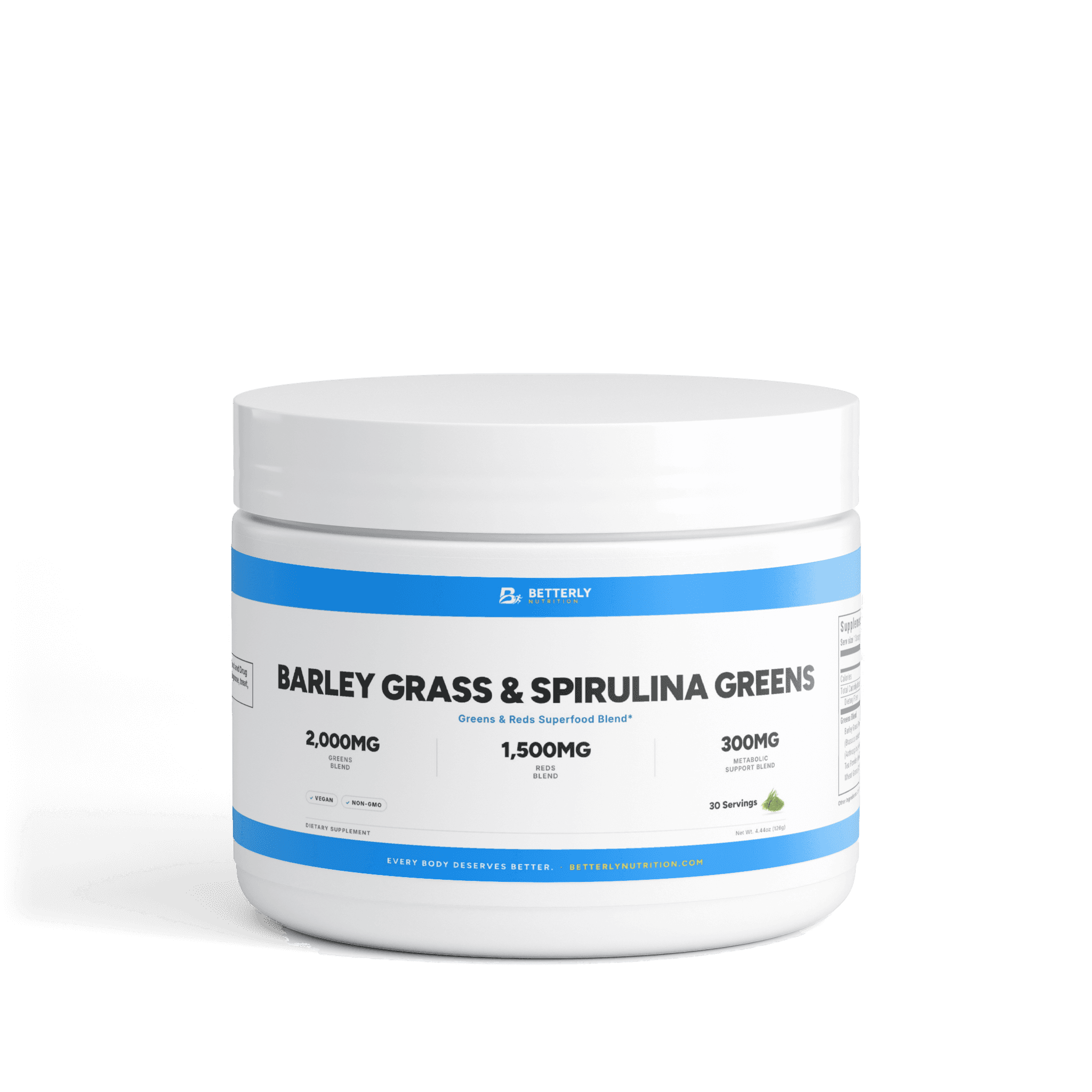
| A vegan-labeled scoop with spirulina | Barley Grass & Spirulina Greens Powder | Spirulina in a 2,000 mg Greens Blend |
| Vitamin B12 | A label listing B12 in mcg | USDA lists 0 µg in dried spirulina |
The pattern in that middle column: the more exactly you want to know your dose, the further you should move from blends, ours included.
One more label difference: the Barley Grass & Spirulina Greens Powder is labeled vegan, while the Alfalfa & Chlorella powder is labeled vegetarian and lists bee pollen and royal jelly powder.
If moringa is also on your list, keep in mind that moringa vs spirulina sets a leaf against a cyanobacterium, so the same label-first reading applies.
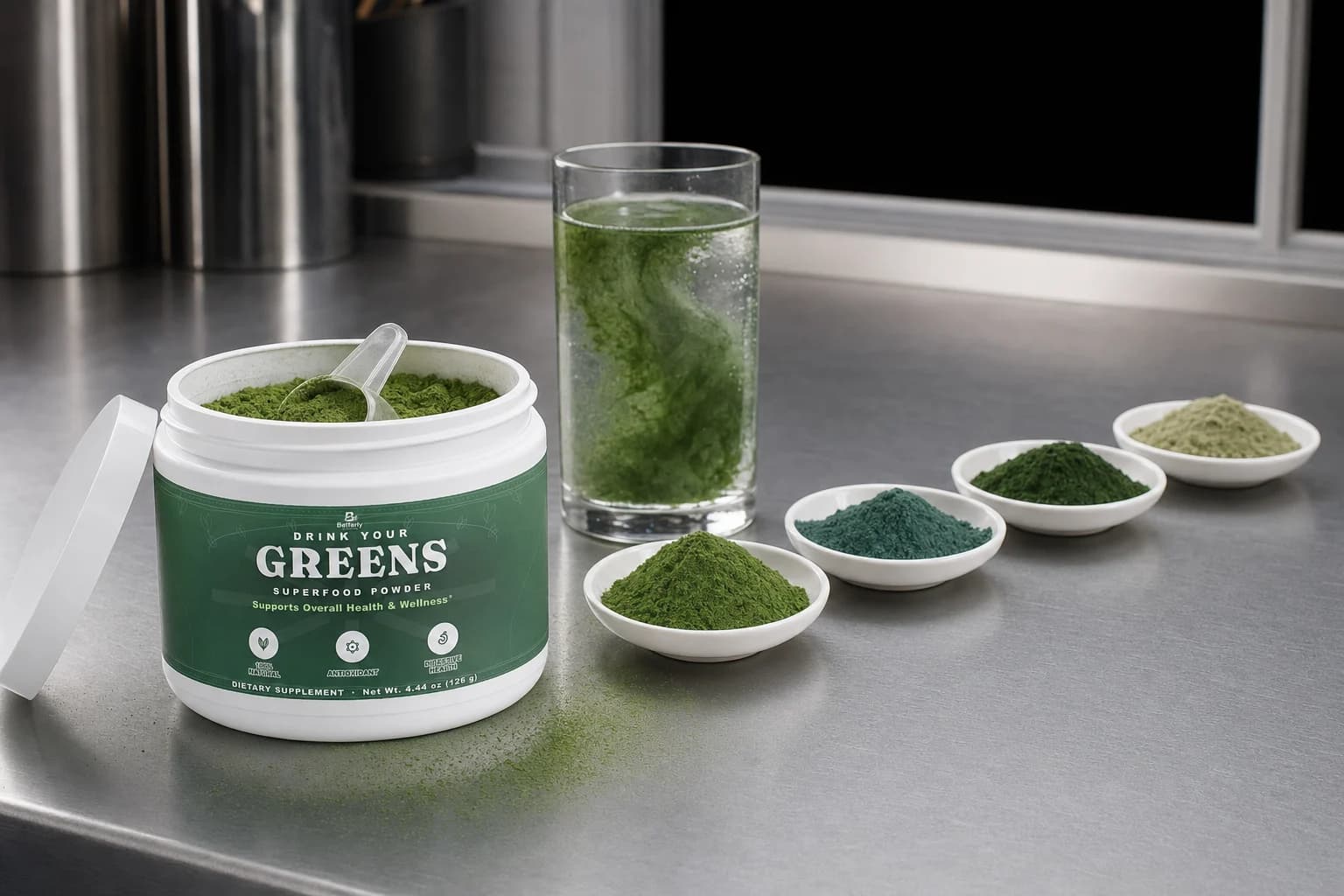
From our shop: Alfalfa & Chlorella Greens Powder — spirulina and chlorella in one 2-teaspoon (about 5 g) serving, plus five cereal grasses in a 700 mg Green Grass Blend, labeled vegetarian.
How do you take a chlorella and spirulina greens powder?
Betterly's Alfalfa & Chlorella Greens Powder label suggests that adults mix 2 teaspoons into 8 oz (237 ml) of apple juice or another favorite liquid.
The Barley Grass & Spirulina Greens Powder label's suggested use is 1 scoop in 6-8 ounces (177-237 ml) of cold water or a favorite beverage, once daily. It also says to drink it within 10 minutes of mixing. Both cautions open with the same line: "Do not exceed recommended dose."
Two more label details:
- The Alfalfa & Chlorella tub is filled by weight rather than volume, and its caution warns the powder can settle, which is why a new tub may look less than full.
- Both panels list green tea powder, and neither gives a caffeine figure.
We'd pick one powder rather than using both. At least eight ingredients show up on both panels, including spirulina, barley grass, wheat grass, alfalfa and green tea. Taking both in one day doubles up on ingredients whose amounts you can't count.
From our shop: Barley Grass & Spirulina Greens Powder — spirulina sits third in its Greens Blend, after barley grass and broccoli, in a 1-scoop (4.2 g) serving labeled vegan and non-GMO.
Who can skip chlorella and spirulina?
You can skip chlorella and spirulina if your meals already include a range of vegetables, or if what you really want is a precise dose of one nutrient.
You can pass if:
- Vegetables already show up on your plate most days. A greens serving adds variety, but it doesn't replace food.
- You're after protein, which a protein powder counts in real grams.
- You need vitamin B12. The FAQ below explains why algae isn't the answer.
- The heavy-metal pitch is what drew you in. We don't sell either powder on it.
Still curious? The Greens & Superfoods collection also carries reds powders and capsules.
Who should check with a healthcare provider first?
Show a chlorella or spirulina greens powder's label to your healthcare provider first if you're pregnant or nursing, under 18, have a medical condition or take prescription medication.
All but the last come from the caution on both of our labels. Mention the powder before any scheduled surgery, too, and raise these:
- Iodine: sea whistle is a seaweed, and the NIH Office of Dietary Supplements' iodine fact sheet says seaweed is generally rich in iodine. Our panel doesn't list iodine, so if a provider has asked you to limit iodine, check before using the Alfalfa & Chlorella powder. Our sea moss guide covers seaweed and iodine in more depth.
- Herbs: the Alfalfa & Chlorella herbal blend lists ginkgo, Siberian ginseng, licorice and milk thistle. The Barley Grass & Spirulina panel lists Panax ginseng, ashwagandha and turmeric extract. Bring the panel along if you take any medication.
- Bee products: bee pollen and royal jelly powder sit in the Alfalfa & Chlorella herbal blend.
- Gluten: neither label claims to be gluten-free. Both list wheat grass and barley grass, and the Alfalfa & Chlorella panel adds barley malt powder.
FAQ: chlorella and spirulina
Can you take chlorella and spirulina together?
Yes, chlorella and spirulina are often sold together, and our Alfalfa & Chlorella Greens Powder already combines them in one 900 mg blend. The practical risk is stacking: a chlorella-and-spirulina powder on top of separate algae tablets adds amounts you can't total. Use one product at the amount its label suggests, and run it past your provider if you're on medication.
Is chlorella the same as chlorophyll?
No, chlorella is a whole single-celled alga, and chlorophyll is the green pigment inside it, inside spirulina and inside every green plant. Liquid chlorophyll drops are a separate product, and their labels may list chlorophyllin, a water-soluble, semi-synthetic form made from chlorophyll. Neither of our greens panels lists chlorophyll or chlorophyllin as a separate ingredient.
Does spirulina have vitamin B12?
Don't count on spirulina for vitamin B12. USDA's FoodData Central entry for dried spirulina lists 0 µg of B12 per 100 g. A consumer page on vitamin B12 from the NIH Office of Dietary Supplements says only animal foods have B12 naturally, and that vegetarians and vegans might not get enough from their diets. Neither of our greens panels lists B12, so if that's your gap, choose a product that prints B12 in mcg.
Is chlorella safe during pregnancy?
We can't tell you chlorella is safe during pregnancy, and we won't guess. The caution on both of our greens labels names pregnancy and nursing as reasons to see a physician, and we found no federal fact sheet on chlorella or spirulina that covers pregnancy. Our Alfalfa & Chlorella powder also holds a brown seaweed and several herbs, which gives your provider more to review. Ask before starting.
Does it matter what time you take chlorella or spirulina?
Not much: neither of our chlorella or spirulina labels names a time of day, so pick a time you'll remember. The Barley Grass & Spirulina label does add one timing rule: drink it within 10 minutes of mixing. Both panels list green tea powder without a caffeine figure. If caffeine tends to keep you up, a morning or midday glass is the cautious choice.
Sources
- U.S. Department of Agriculture, FoodData Central: Seaweed, spirulina, dried (SR Legacy, FDC ID 170495)
- U.S. Food and Drug Administration: Dietary Supplement Labeling Guide: Chapter IV. Nutrition Labeling
- NIH Office of Dietary Supplements: Iodine: Fact Sheet for Consumers
- NIH Office of Dietary Supplements: Vitamin B12: Fact Sheet for Consumers
If this left you looking for somewhere to start, read chlorella and spirulina greens powder — its amounts per serving are listed on the page. For the practical questions this raises, how dosing, sourcing and subscriptions work is answered in one place.