On this page
- Key takeaways
- What's the difference between wheatgrass and barley grass?
- Is wheatgrass the same as wheat, and barley grass the same as barley?
- Wheatgrass vs barley grass nutrition: which has more?
- Are wheatgrass and barley grass gluten free?
- How much wheatgrass and barley grass is in each of our tubs?
- Wheatgrass or barley grass: which should you pick?
- How do you take a wheatgrass and barley grass powder?
- When don't you need a grass powder at all?
- Who should check with a healthcare provider first?
- FAQ: wheatgrass and barley grass
- Sources
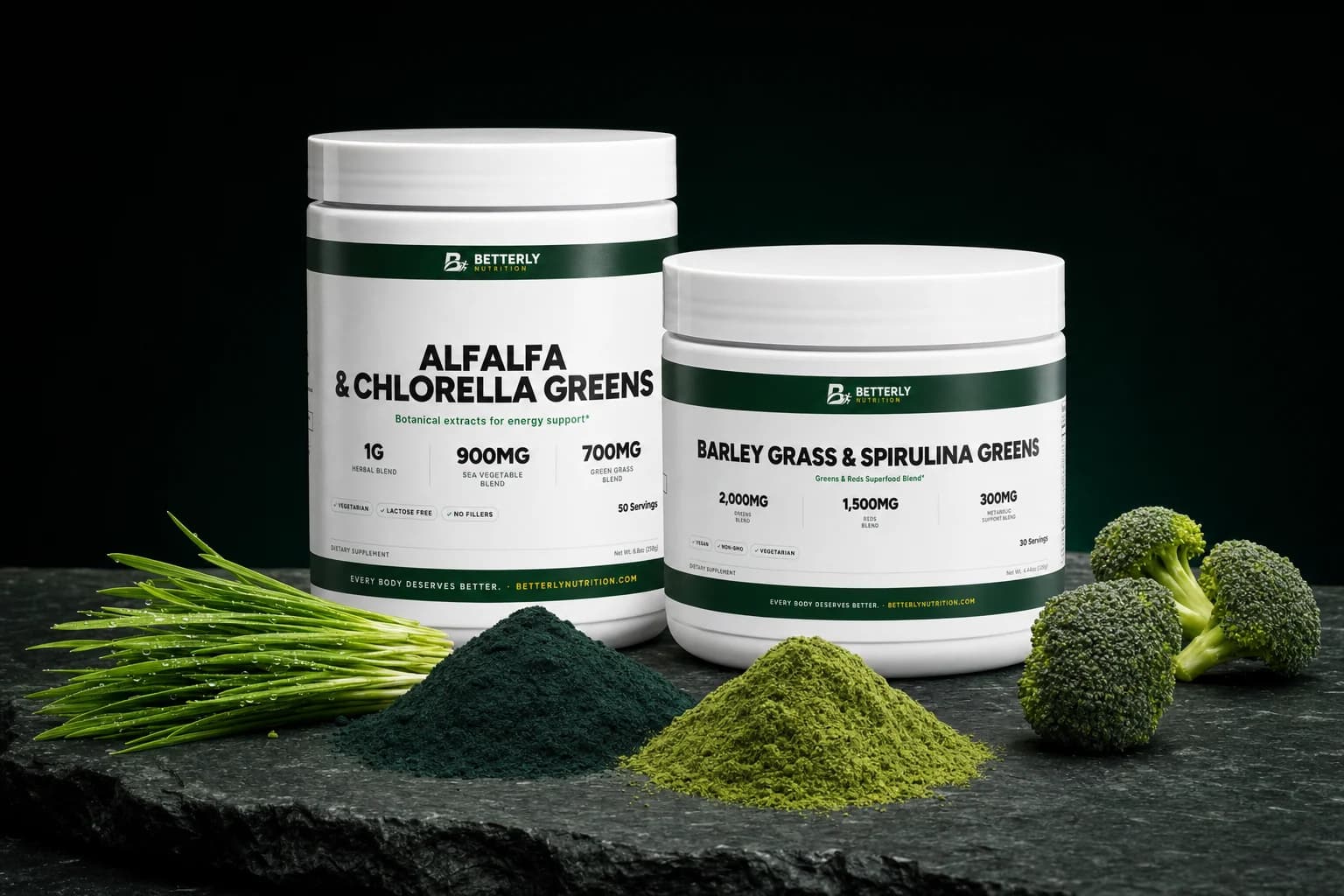
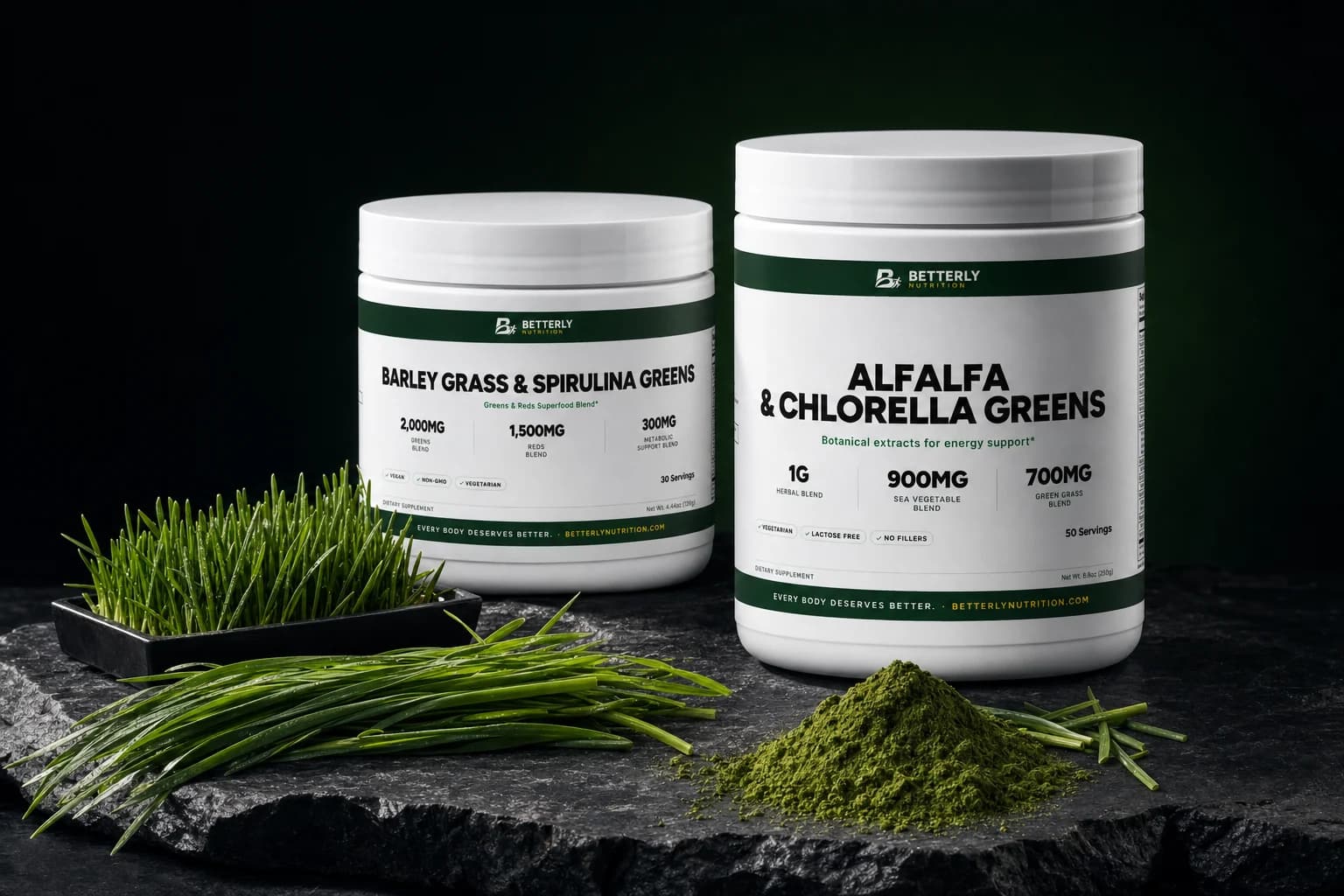
The short answer: Wheatgrass vs barley grass is a closer contest than the marketing suggests. Both are the young leaves of a cereal plant, common wheat (Triticum aestivum) or barley (Hordeum vulgare), cut long before any grain forms. We haven't found research in people that ranks one above the other. And on our Alfalfa & Chlorella Greens Powder, you don't have to choose: its 700 mg Green Grass Blend holds five grasses, wheat and barley among them.
Key takeaways
- Wheatgrass and barley grass are the young leaves of two different cereal plants, harvested as grass before the plant sets seed.
- In one 2021 growth-chamber study, wheatgrass measured higher for phenolic compounds, flavonoids and vitamin C, yet growing temperature moved both grasses' numbers.
- Neither of our greens powders is labeled gluten-free, and the Alfalfa & Chlorella Greens Powder also lists barley malt powder, made from barley grain.
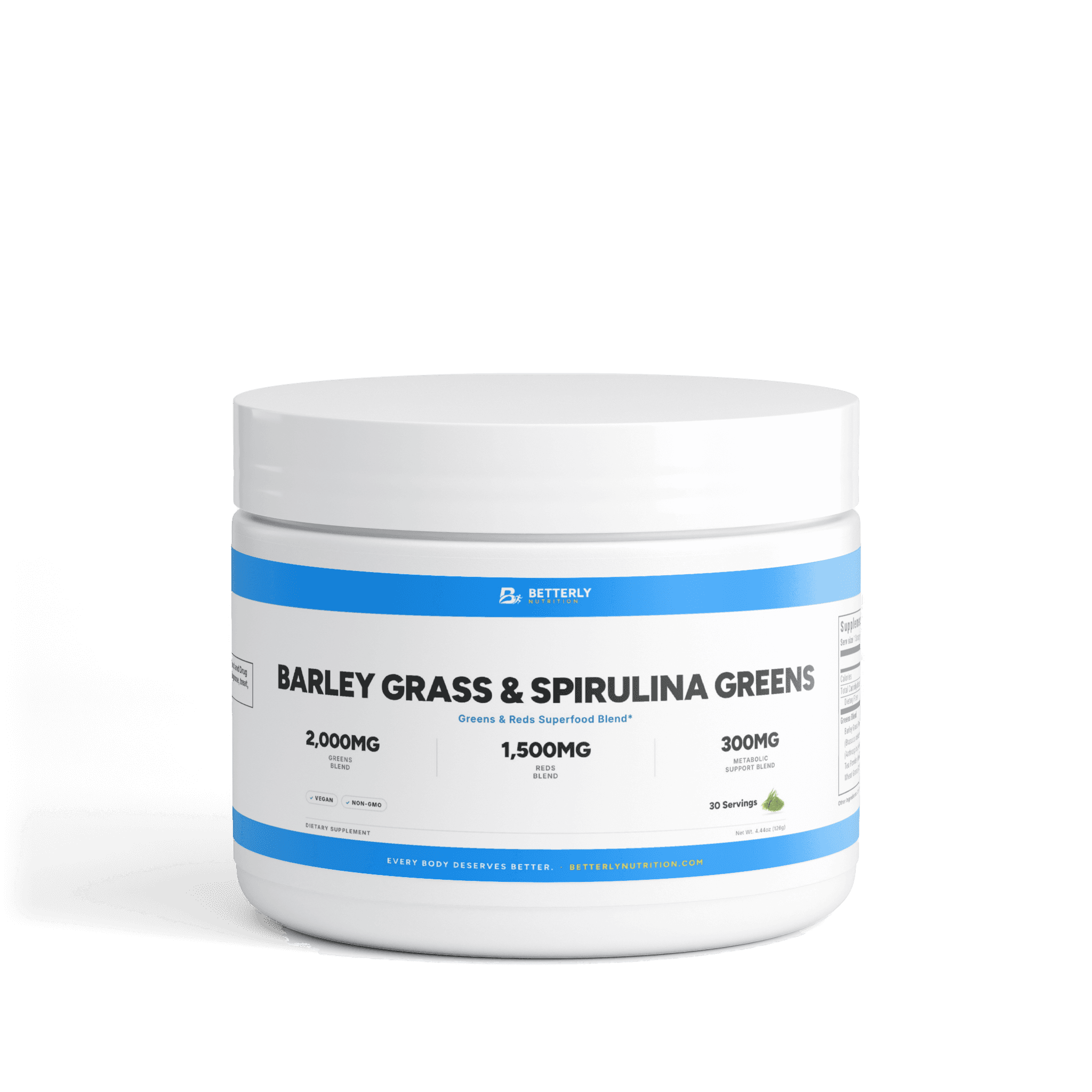
- Our Barley Grass & Spirulina Greens Powder label lists barley grass first and wheat grass last in its 2,000 mg blend, so under FDA's order-by-weight rule the barley grass weighs at least as much.
Full disclosure: Betterly sells both greens powders in this comparison, and each one contains wheat grass and barley grass. So we gain nothing if either grass wins. We just want you reading our labels, and anyone else's, correctly.
What's the difference between wheatgrass and barley grass?
Wheatgrass comes from the common wheat plant and barley grass from the barley plant, and both are tender young leaves cut long before the grain forms.
They're close cousins. Both belong to the grass family, and both are ready to cut within weeks of sowing. Our Barley Grass & Spirulina Greens Powder prints wheat grass with its botanical name, Triticum aestivum L., right on the panel.
The differences are practical rather than dramatic:
- The two plants sit in different genera, Triticum for wheat and Hordeum for barley.
- Either grass can be sold as fresh juice, dried leaf powder or dried juice powder.
- Flavor notes vary by seller, and the rest of the tub shapes what you taste. Our guide to making a grassy scoop easier to drink covers that part.
Is wheatgrass the same as wheat, and barley grass the same as barley?
Wheatgrass is the same plant as wheat, and barley grass the same plant as barley, picked at a different stage: young leaves instead of mature seed kernels.
A leaf and a seed do different jobs. The leaf gathers sunlight. The seed stores food for the next plant, and that's what becomes flour, pearled barley or malt.
That split is why gluten comes up. FDA's gluten-free Q&A names the grains, wheat, rye and barley, and doesn't mention the young grass on its own.
A label can carry both stages of one plant. Our Alfalfa & Chlorella Greens Powder lists organic barley grass powder in its Green Grass Blend and barley malt powder in a separate 1.25 g Great Grains Blend. Malt comes from barley grain, so that tub holds barley as leaf and as grain.
Wheatgrass vs barley grass nutrition: which has more?
Wheatgrass vs barley grass nutrition depends heavily on how the crop was grown: in one controlled study wheatgrass measured higher, but temperature changed both grasses' results.
The study, published in the journal Foods in 2021, grew one wheat variety and one barley variety in plant growth chambers at three day-and-night temperature settings: 10/5, 20/15 and 30/25 °C. The young leaves were cut 13 days after sowing, at 6 to 15 cm tall.
Two findings matter here:
- Wheatgrass had higher phenolic, flavonoid and vitamin C contents than barley grass.
- Both grasses swung with temperature, peaking at the coolest setting and bottoming out at the middle one.
It's a real result but a narrow one. One indoor-grown variety of each plant can't predict another farm's tub.
What about barley grass vs wheatgrass benefits?
We haven't found head-to-head research in people comparing wheatgrass and barley grass benefits, so we won't hand either grass a win. When a chart online says one grass beats the other on a vitamin, ask where the numbers came from and whether both grasses were grown the same way.
Our panels can't settle it either. The Barley Grass & Spirulina scoop prints no vitamin or mineral rows. The Alfalfa & Chlorella prints four, led by vitamin A: 270 mcg, as beta carotene, for 30% DV in each 2-teaspoon (about 5 g) serving. That figure covers a 2-teaspoon serving of more than 30 ingredients, alfalfa and spinach among them, so none of it can be credited to the grasses.
Are wheatgrass and barley grass gluten free?
A wheatgrass or barley grass product counts as gluten-free only when its finished label says so, and neither of our greens powders carries a gluten-free claim.
FDA's Questions and Answers on the Gluten-Free Food Labeling Final Rule describes "gluten-free" as a voluntary claim. When a maker uses it, the food must contain less than 20 parts per million (ppm) of gluten, and the rule covers dietary supplements too. The grains it covers are wheat, rye, barley and their crossbreeds, such as triticale. The same page says the rule doesn't require manufacturers to test.
So where does "grass is gluten-free" come from? Partly from the leaf itself. A USDA Agricultural Research Service summary of a 2017 study reports that gluten in wheatgrass leaf tissue fell below the detection limit of both lab tests used, in commercial and home-grown samples.
That's a finding about leaves. A tub is leaves plus everything else the maker blends in. On our labels:
- The Alfalfa & Chlorella names five grasses, including barley, kamut, rye and wheat, and lists barley malt powder.
- The Barley Grass & Spirulina names barley grass and wheat grass.
- Neither panel claims gluten-free, so we don't either.
If you avoid gluten, pick a product whose label makes the gluten-free claim, and run it past your healthcare provider. If wheat itself is off your menu, remember that wheatgrass is still wheat.
How much wheatgrass and barley grass is in each of our tubs?
Neither of our tubs prints a separate wheatgrass or barley grass amount; both list the grasses inside a blend, with barley grass ahead of wheat grass on each label.
List order can carry real information. FDA's Dietary Supplement Labeling Guide says a blend's ingredients go under one total weight, in order of weight with the heaviest first.
| Label line | Barley Grass & Spirulina | Alfalfa & Chlorella |
|---|---|---|
| Serving | 1 scoop (4.2 g) | 2 teaspoons (about 5 g) |
| Blend holding the grasses | Greens Blend, 2,000 mg | Green Grass Blend, 700 mg |
| Grasses named | Barley, wheat | Barley, kamut, oat, rye, wheat |
| Barley grass | 1st of 6, at least 333 mg | 1st of 5 |
| Wheat grass | 6th of 6, at most 333 mg | 5th of 5 |
| Barley grain on the panel | None listed | Barley malt powder |
| Label claims | Vegan, non-GMO | Vegetarian, lactose free |
For the Barley Grass & Spirulina, the math is simple. The heaviest of six ingredients must be at least an even share, and the lightest can't top one. Split 2,000 mg six ways and you get about 333 mg.
We haven't put per-grass numbers on the Alfalfa & Chlorella; its panel shows the five grasses sharing one 700 mg total, with barley grass listed first and wheat grass last.
The takeaway: we've done the floor-and-ceiling math only for the Barley Grass & Spirulina. For the Alfalfa & Chlorella, we stick to the printed 700 mg the five grasses share.
Wheatgrass or barley grass: which should you pick?
Choose by the product around the grass, not the grass itself, because we know of no human evidence that wheatgrass outperforms barley grass or the reverse.
| If this sounds like you | Look for | Why |
|---|---|---|
| You want a known amount of one grass | A single-grass product that prints mg per serving | Blends show only a total |
| You avoid gluten | A label with a gluten-free claim | Neither of our tubs has one |
| You want range over depth | Alfalfa & Chlorella Greens Powder | Five grasses in one 700 mg blend |
| You want barley grass up front, labeled vegan | Barley Grass & Spirulina Greens Powder | Barley grass leads a 2,000 mg blend |
Every row turns on a label detail you can check before you buy, not on which grass you prefer.
A blend suits you if you'd rather have grasses, algae and other plants in one glass and can live without per-ingredient amounts. You can read both full panels side by side on our greens and superfoods shelf.
From our shop: Alfalfa & Chlorella Greens Powder — five cereal grasses, wheat and barley included, share a 700 mg Green Grass Blend in every 2-teaspoon (about 5 g) serving of this 50-serving tub.
How do you take a wheatgrass and barley grass powder?
Take a wheatgrass and barley grass powder the way its label directs; for our Barley Grass & Spirulina Greens Powder, that's one scoop in cold water, once a day.
Both sets of directions, as printed:
- Barley Grass & Spirulina Greens Powder: adults use one scoop in 6 to 8 oz (177 to 237 ml) of cold water or a favorite beverage, once daily, and the label says, "Consume within 10 minutes of mixing." A tub holds 30 servings.
- Alfalfa & Chlorella Greens Powder: adults stir two teaspoons into 8 oz (237 ml) of apple juice or another favorite liquid. How often isn't stated. The only other instruction is "or use as directed by a health care professional," and we'd lean on that rather than guess at a second glass. A tub holds 50 servings.
The Alfalfa & Chlorella caution adds, "This product is sold by weight, not volume. Settling may occur." So headspace in a new tub is normal, not a missing serving.
Both cautions open with "Do not exceed recommended dose." Treat it as your daily ceiling. A wheatgrass shot or a second tub stacks on top, and our two powders already share several ingredients. Pick one.
From our shop: Barley Grass & Spirulina Greens Powder — barley grass comes first and wheat grass last in a 2,000 mg Greens Blend, one 4.2 g scoop a day, with vegan and non-GMO claims on the label.
When don't you need a grass powder at all?
You don't need wheatgrass or barley grass powder if leafy vegetables already show up most days, or if you're hoping one grass will do something the other can't.
We'd also skip it if:
- You want a nutrient in a counted amount. Neither of our panels lists the grasses' nutrients, so buy a product that prints the one you're after.
- You already have a greens powder. A second tub mostly buys the same grasses again.
- Juice-bar shots are already your habit. A powder on top means two sources of the same grass.
Who should check with a healthcare provider first?
Ask a healthcare provider before using wheatgrass or barley grass powder if you've been told to keep wheat, rye or barley out of your diet. The same goes if you're pregnant, nursing, under 18, on prescription medicine, heading into surgery or managing a medical condition.
Start with the grain plants. Wheat grass is on both of our panels, and the Alfalfa & Chlorella adds kamut grass (from a wheat variety), rye grass and barley malt powder. If your provider's advice covers every part of those plants, show them these lines first.
Both labels print this caution: "Consult a physician if pregnant, nursing, under 18, or have a medical condition." It says nothing about medicines or surgery, so raise those yourself, and tell whoever is planning an operation for you that you take the powder.
Each serving also carries herbs. The Barley Grass & Spirulina tucks six botanicals into its 300 mg Metabolic Support Blend, and the Alfalfa & Chlorella packs 16 ingredients into a 1 g Herbal Blend, two of them from the hive: bee pollen powder and royal jelly powder. Our label-by-label look at greens powder side effects goes through those herbs one at a time.
And if a glass ever leaves you feeling off, stop the daily scoop and check in with your provider.
FAQ: wheatgrass and barley grass
Can you take wheatgrass and barley grass together?
Yes, wheatgrass and barley grass can share a glass, and both of our greens powders already combine them. The Barley Grass & Spirulina lists both in its 2,000 mg Greens Blend, and the Alfalfa & Chlorella lists both among five grasses in a 700 mg blend. Follow one label's suggested use and stick to one tub, since two powders double what they share.
Is spirulina a grass like wheatgrass and barley grass?
No, spirulina isn't a grass. Spirulina (Arthrospira platensis) is a microscopic organism grown in water and often called a blue-green alga, while wheatgrass and barley grass are cereal leaves. Both of our greens powders list spirulina beside the grasses. Our comparison of chlorella and spirulina explains how the two algae differ.
What time of day should you drink wheatgrass or barley grass powder?
No hour is printed on either of our grass powders, so the best time is whenever the habit sticks. Two label details still shape it. The Barley Grass & Spirulina asks you to finish the glass within 10 minutes of mixing. And green tea appears on both panels with no caffeine number, so an evening glass is a poor bet if you're caffeine-sensitive.
Can kids drink wheatgrass or barley grass powder?
Not without a provider's input. Both of our labels write their directions for adults, and both cautions say to consult a physician if you're under 18. The blends also go well beyond grass, with green tea on both panels and herbs such as ginkgo or ashwagandha. A pediatrician is the right first stop.
Is barley grass powder the same as barley grass juice powder?
No, they're made differently. Barley grass juice powder starts as pressed juice that's then dried, so most of the leaf pulp is left out. Whole-leaf powder is the dried, ground leaf itself, and wheatgrass comes both ways too. Our Barley Grass & Spirulina label lists Barley Grass Powder (leaf), and our Alfalfa & Chlorella lists organic barley grass powder. Neither lists a grass juice powder.
Sources
- Influence of Temperature Conditions during Growth on Bioactive Compounds and Antioxidant Potential of Wheat and Barley Grasses, Foods, 2021 (PubMed Central)
- Questions and Answers on the Gluten-Free Food Labeling Final Rule, U.S. Food and Drug Administration
- Confirmation of Gluten-Free Status of Wheatgrass, USDA Agricultural Research Service
- Dietary Supplement Labeling Guide: Chapter IV. Nutrition Labeling, U.S. Food and Drug Administration
If this left you looking for somewhere to start, read greens powder with wheatgrass and barley grass — its amounts per serving are listed on the page. For the practical questions this raises, how dosing, sourcing and subscriptions work is answered in one place.