On this page
- Key takeaways
- Is colostrum the same as collagen?
- Colostrum vs collagen peptides: how do our labels compare?
- What do you get in a scoop of colostrum powder?
- What do you get in a scoop of collagen peptides?
- Colostrum vs collagen benefits: which one fits your reason for buying?
- Can you take colostrum and collagen together?
- How do the labels say to take colostrum and collagen?
- When don't you need colostrum or collagen?
- Who should check with a healthcare provider first?
- FAQ: colostrum vs collagen
- Sources
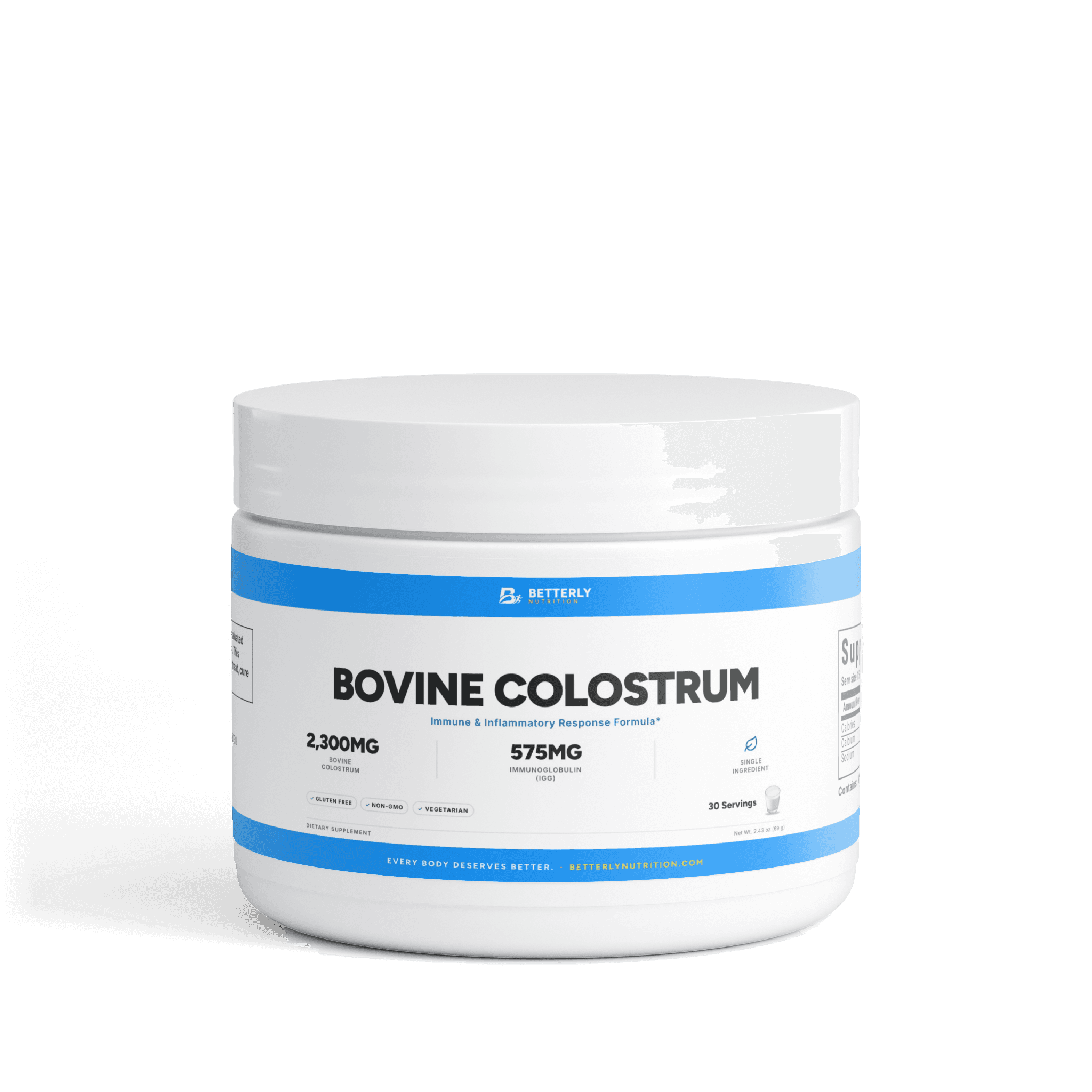
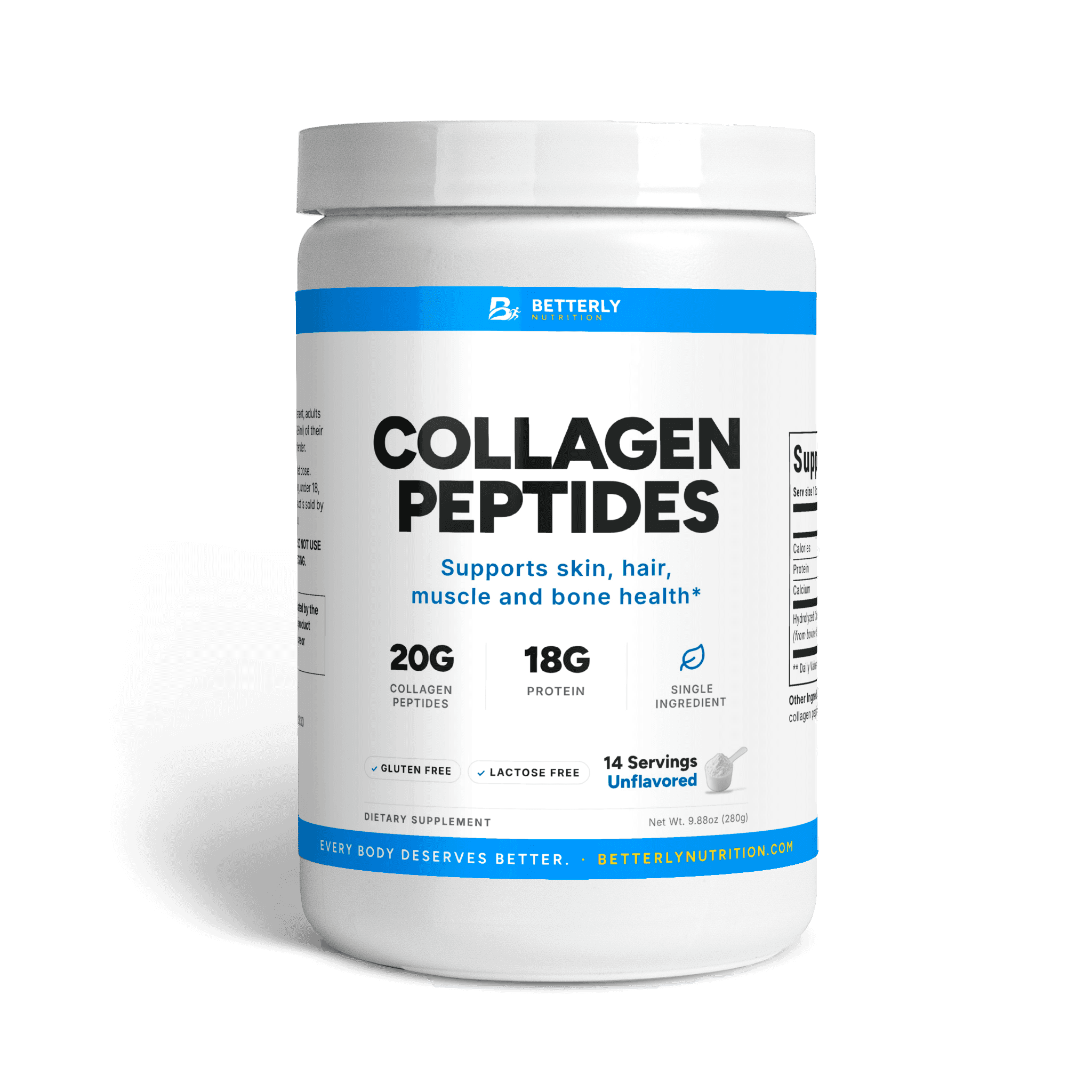
The short answer: Colostrum vs collagen compares two unrelated ingredients. Colostrum is a cow's dried early milk, valued for its antibodies: one 2.3 g scoop of our 2,300mg Bovine Colostrum Powder carries 575 mg of IgG. Collagen peptides are a structural protein in short chains, and ours come from bovine hide: a 20 g scoop of our Collagen Peptides Powder (Unflavored) gives 20 g of collagen peptides and 18 g of protein. One can't replace the other.
Key takeaways
- Colostrum isn't collagen: colostrum is a cow's earliest milk after calving, while collagen peptides are a structural protein (Betterly's comes from cattle hide).
- Betterly's colostrum powder packs 2,300 mg of bovine colostrum, including 575 mg of immunoglobulin G (IgG), into each 1-scoop (2.3 g) serving.
- Betterly's unflavored collagen gives 20 g of hydrolyzed collagen peptides, with 18 g of protein, in a 1-scoop (20 g) serving, about 8.7 times the weight of the 2.3 g colostrum scoop.
- Both colostrum labels declare milk, and only the unflavored collagen label says lactose free.
- Neither label mentions the other product, so taking both means following two separate sets of directions.
We sell all three products compared here: the colostrum powder, the colostrum capsules and the unflavored collagen. Every figure below comes from their Supplement Facts panels, and where a label is silent, we tell you instead of guessing.
Is colostrum the same as collagen?
No, colostrum and collagen are different substances: colostrum is a cow's first milk after calving, while collagen is the protein that gives connective tissue its structure.
The mix-up makes sense. Ours are both pale powders from cattle, both get scooped into drinks, and a few brands even sell the two blended in one tub.
Supplement makers dry that early milk into a powder, and its headline component is immunoglobulin G, or IgG. The National Library of Medicine's immunoglobulins test page on MedlinePlus explains that immunoglobulins are also called antibodies, proteins your immune system makes. The IgG in a colostrum scoop is the cow's own antibodies, though, and our label makes no claim about what they do once you swallow them.
Collagen belongs to a different family. According to MedlinePlus Genetics, collagens are proteins that strengthen and support many tissues, including cartilage, bone, tendon and skin, and type I is the most abundant form in the human body. Supplement collagen is usually hydrolyzed, meaning it's been cut into short chains called peptides. Ours comes from bovine hide.
Our Collagen 101 guide covers collagen types and sources, so we won't repeat them here.
Colostrum vs collagen peptides: how do our labels compare?
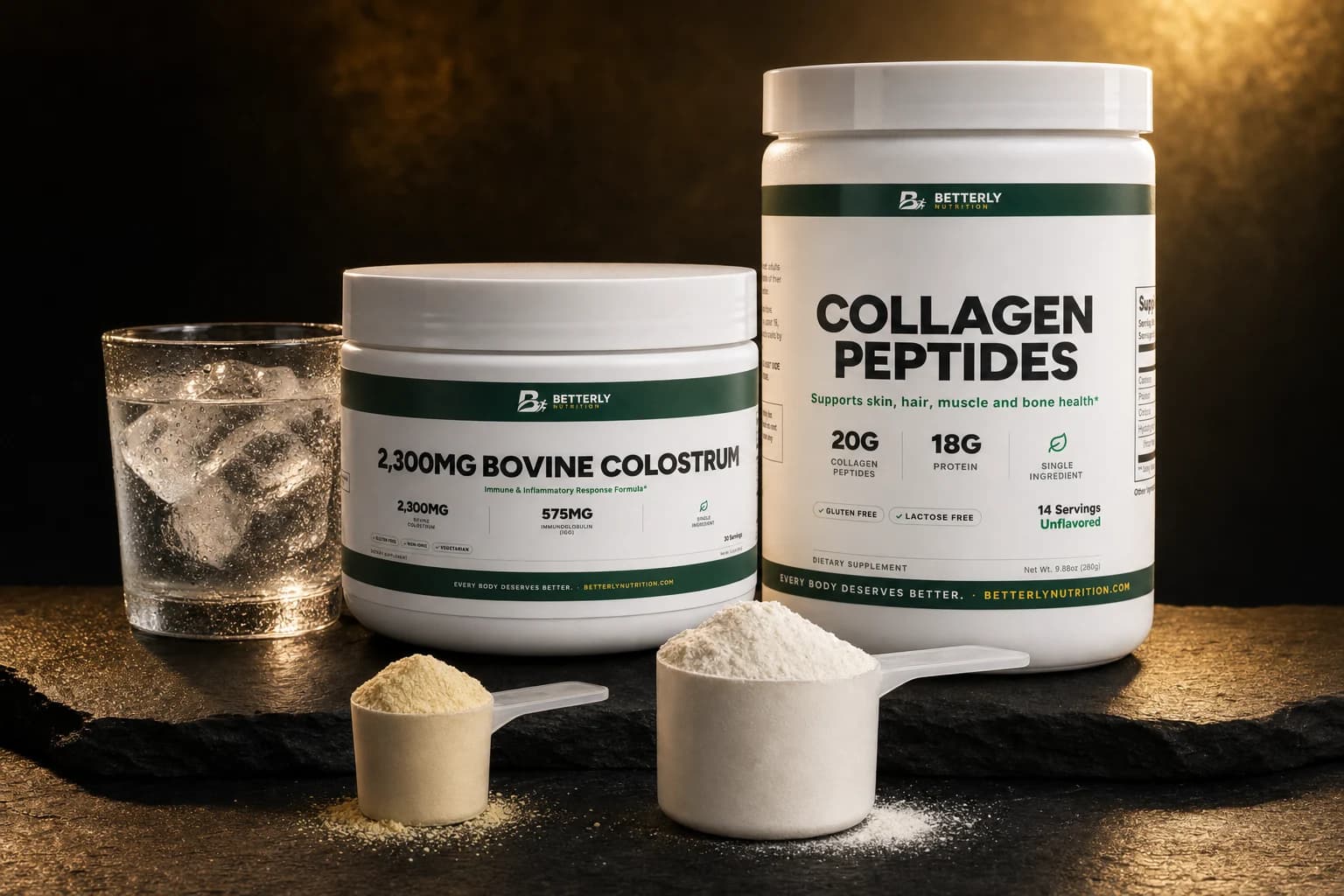
Compare colostrum powder vs collagen peptides line by line, and Betterly's two labels differ almost everywhere, from serving weight to allergens and mixing.
| Label line | 2,300mg Bovine Colostrum Powder | Collagen Peptides Powder (Unflavored) |
|---|---|---|
| Serving | 1 scoop (2.3 g) | 1 scoop (20 g) |
| Main active | 2,300 mg colostrum, 575 mg IgG | 20 g collagen peptides |
| Protein row | None printed | 18 g |
| Calories | 10 | 70 |
| Calcium | 20 mg (2% DV) | 26 mg (2% DV) |
| Servings per tub | 30 | 14 |
| Allergen line | Contains: Milk (Colostrum) | None printed |
| Label claims | Gluten free, non-GMO, vegetarian | Gluten free, lactose free |
| Liquid | 6-8 oz "cold water or favorite beverage," within 10 min | 8-10 oz "favorite beverage," shaker or blender |
The biggest gap is scale. A collagen serving weighs 20 g, about 8.7 times the 2.3 g colostrum scoop, because collagen is sold by the gram as a protein while colostrum is sold by the milligram for its IgG.
Both are single-ingredient powders. The colostrum panel has no other-ingredients line at all, and the collagen's only listed ingredient is "Bovine hide collagen peptides." One detail may catch your eye: the collagen panel prints 20 g of peptides but 18 g of protein. The label gives no reason for the 2 g difference, and we'd rather leave it unexplained than guess.
What do you get in a scoop of colostrum powder?
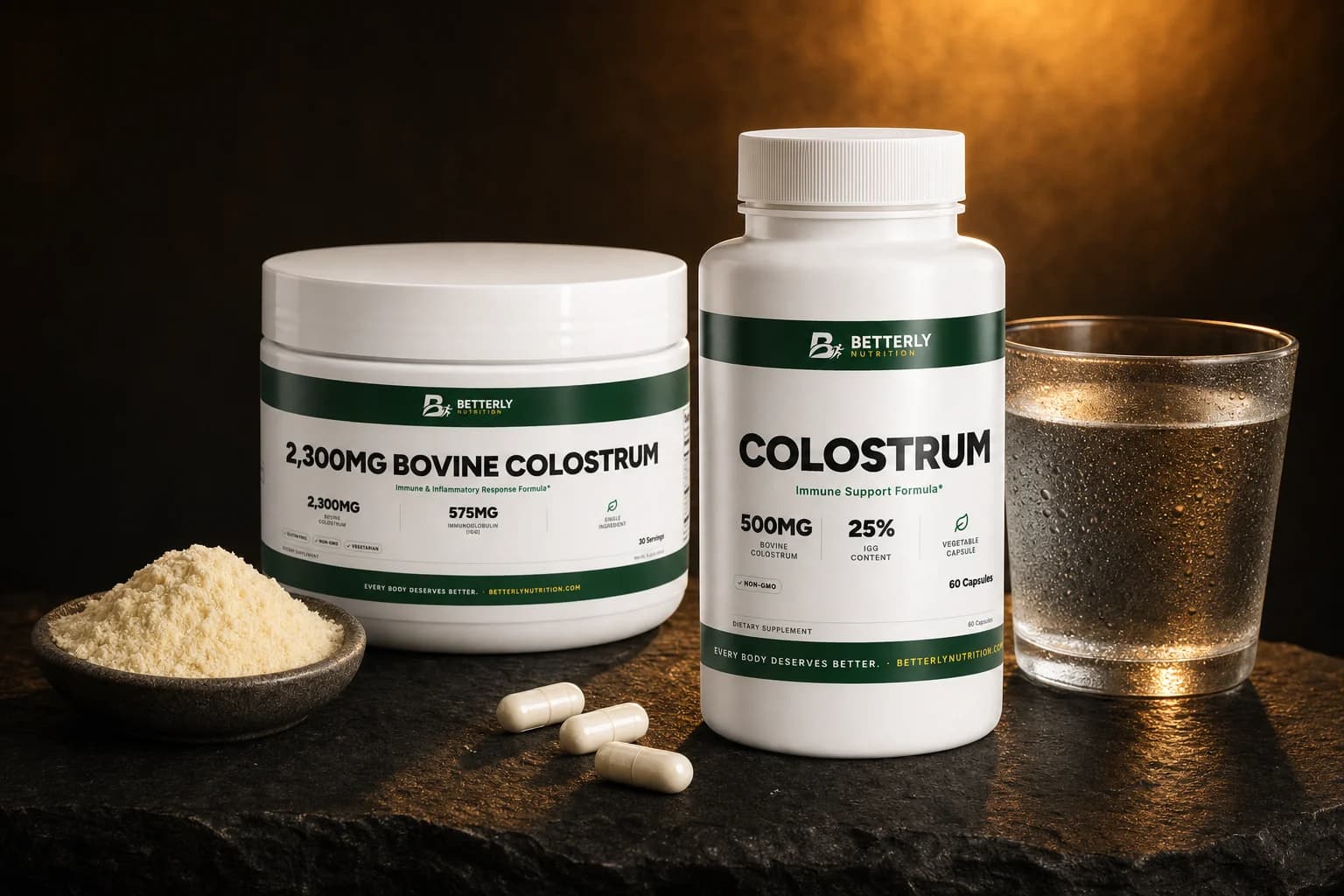
One scoop of Betterly's colostrum powder gives you 2,300 mg of bovine colostrum, listed at 25% immunoglobulin G, and the panel prints that IgG as 575 mg.
Set beside collagen, two things on this panel stand out. It closes with "Contains: Milk (Colostrum)," an allergen line the collagen tub doesn't print. And it has no protein row. Its 575 mg of IgG is a protein, but at well under a gram, it's a small fraction of collagen's 18 g.
Neither colostrum row carries a percentage, either. Both point to one footnote instead: "Daily Value (DV) not established."
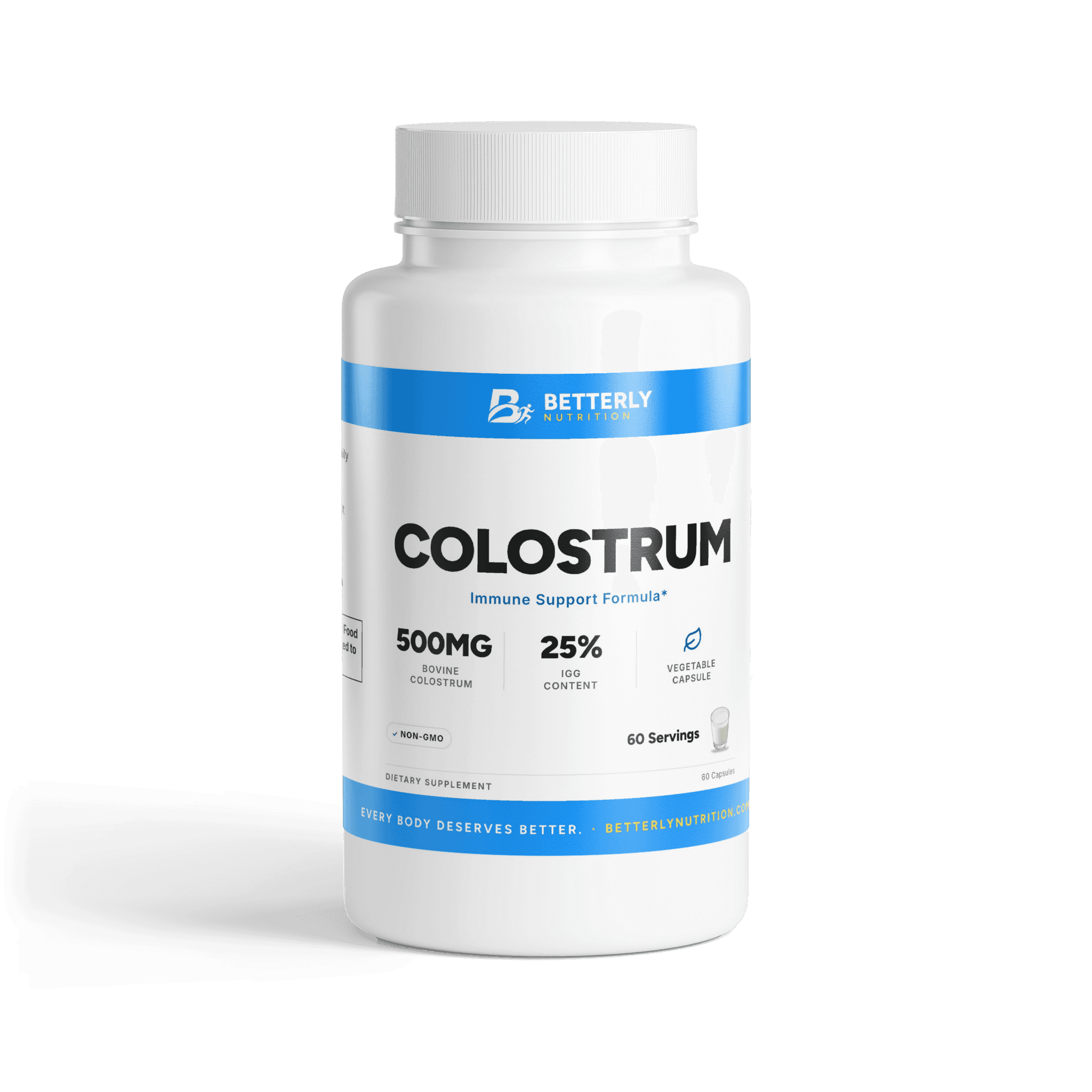
Prefer swallowing to stirring? Our Colostrum Capsules hold 500 mg of bovine colostrum each, listed at 25% IgG, and carry the same milk statement. We line up tub and bottle number by number, mineral rows and IgG math included, in our guide to colostrum powder vs capsules.
What do you get in a scoop of collagen peptides?
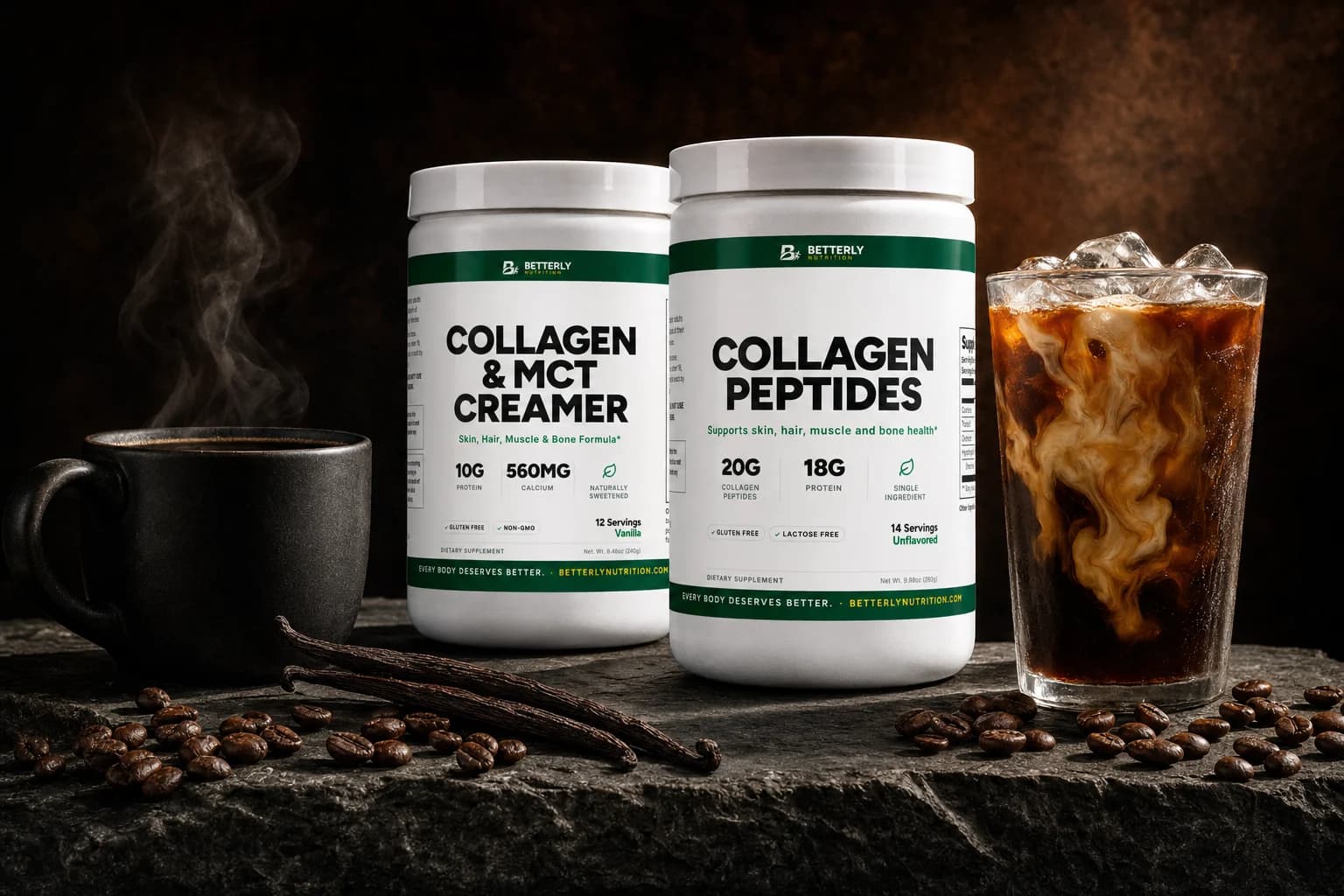
One scoop of Betterly's unflavored collagen gives you 20 g of hydrolyzed collagen peptides, sourced from bovine hide, plus 18 g of protein, 70 calories and 26 mg of calcium.
That makes our collagen a protein powder in a practical sense. The tub's front statement reads "Supports skin, hair, muscle and bone health*". We stick to that wording and won't promise any visible change from a scoop, because no label or federal source we've read gives one.
Your body also builds its own collagen. The NIH Office of Dietary Supplements' vitamin C fact sheet lists making collagen among vitamin C's jobs in the body, so a tub of peptides is one source of raw protein, not the only route.
Want a flavor? The Collagen Peptides Powder (Chocolate) needs 2 scoops (27 g) to deliver its 20 g of collagen peptides. Its label claims gluten free and non-GMO, but not lactose free.
Colostrum vs collagen benefits: which one fits your reason for buying?
Colostrum fits an immune support routine, while collagen fits someone who wants a protein scoop that its label ties to skin, hair, muscle and bone.
Match your goal to a label:
| If you want | Look at | What the label says |
|---|---|---|
| Immune support in your routine | Colostrum | Capsule front: "Immune Support Formula*" |
| A protein top-up in a drink | Collagen | 18 g protein per 20 g scoop |
| No milk in the tub | Collagen | No allergen line; lactose free claim |
| A vegetarian claim | Colostrum powder | Claims vegetarian; our collagen comes from hide |
| Nothing to mix | Colostrum Capsules | 1 capsule, 1 to 3 times daily, preferably with meals |
| The fewest calories | Colostrum powder | 10 per scoop, against 70 |
Collagen takes the protein and milk-free rows, and colostrum takes the other four: the immune support label, the vegetarian claim, the capsule option and the lower calorie count.
From our shop: 2,300mg Bovine Colostrum Powder — 575 mg of IgG in every 2.3 g scoop, gluten free and vegetarian on the label, with a 10-minute window between stirring and the last sip.
Can you take colostrum and collagen together?
Neither Betterly label mentions the other product or warns against it, so taking colostrum and collagen together means following two separate sets of directions, one serving of each.
They're different ingredients, so pairing them isn't doubling up on one thing. What adds up is modest: one serving of each comes to 80 calories and 46 mg of calcium (each label lists 2% of the Daily Value per scoop), plus the 18 g of protein printed on the collagen panel.
Both labels list one scoop per serving and say "Do not exceed recommended dose." Neither sets a daily count, so this guide sticks to one scoop of each a day. We also won't sketch a combined routine that neither label describes.
Can you mix colostrum and collagen in the same drink?
Neither Betterly label covers putting both scoops in one drink, so we'd keep them apart. Even the amounts of liquid differ. Colostrum's directions ask for 6-8 oz of "cold water or favorite beverage," finished within 10 minutes. Collagen's ask for 8-10 oz of "their favorite beverage," mixed in a shaker cup or blender.
Temperature is where the two tubs part ways. The collagen label names no temperature, which is why our guide to stirring collagen into hot coffee can cover a steaming mug. The colostrum label pairs its liquid with the word "cold" and says nothing about heat, so a hot latte sits in a gap its directions don't clearly address.
Two drinks keep you inside both labels: a cold glass for the colostrum scoop and whatever you like for the collagen. Or skip the second glass with the Colostrum Capsules, whose label prefers a meal instead.
How do the labels say to take colostrum and collagen?
Betterly's labels put one 2.3 g colostrum scoop in 6-8 oz of "cold water or favorite beverage," and one 20 g collagen scoop in 8-10 oz of any drink.
- 2,300mg Bovine Colostrum Powder: "adults use one (1) scoop of powder in 6-8 oz (177-237ml) of cold water or favorite beverage. Consume within 10 minutes of mixing." Mix it fresh each time.
- Collagen Peptides Powder (Unflavored): "adults mix one (1) scoop with 8-10 oz (237-296ml) of their favorite beverage in a shaker cup or blender." The label adds that it "is sold by weight, not volume," so a tub that looks less than full may simply have settled.
- Colostrum Capsules: "Take 1 (one) capsule 1 to 3 times daily preferably with meals or as directed by a healthcare professional." The label prefers a meal for each one.
Neither powder label says how many times a day, so this guide counts each as one scoop daily.
How long does each tub last, and what does a serving cost?
At one serving a day, the colostrum tub lasts 30 days and the collagen tub lasts 14. The 60-capsule bottle runs 60 days at one capsule a day, or 20 days at three.
Comparing tub prices head to head tells you little, because the tubs are sized so differently: 280 g of collagen powder in 14 scoops, against 69 g of colostrum in 30. A fairer yardstick is what you're buying each one for. The collagen tub holds 252 g of protein in all (14 servings of 18 g), so its current price over 252 is your cost per gram of protein. For the colostrum, its price over 30 is what each day's 575 mg of IgG costs you.
From our shop: Collagen Peptides Powder (Unflavored) — a 14-serving tub whose only ingredient is bovine hide collagen peptides, with 18 g of protein in each 20 g scoop.
When don't you need colostrum or collagen?
Colostrum and collagen are both optional, because neither label gives its main ingredient a Daily Value, and vitamin C from food already helps your body make collagen.
You can reasonably pass on one or both in these cases:
- Milk is off your list. Both colostrum products declare it, which narrows this choice to the unflavored collagen, labeled lactose free with no allergen line.
- You avoid anything from cattle. Our colostrum and our collagen both come from cows, so neither side of this comparison works for you.
- You eat vegetarian. Hide-based collagen doesn't fit, while the colostrum powder's label does claim vegetarian.
- Your plate already gives you plenty of protein. That removes collagen's main draw, its 18 g per scoop, and colostrum was never a protein pick to begin with.
To see what else sits beside colostrum on our shelves, browse the Immune Support category.
Who should check with a healthcare provider first?
Anyone pregnant, nursing or under 18 should talk to a provider before trying colostrum or collagen, as should anyone on a prescription, with surgery ahead or managing a health condition.
All three labels carry an identical caution: "Do not exceed recommended dose. Consult a physician if pregnant, nursing, under 18, or have a medical condition."
Pregnancy and nursing. The NIH Office of Dietary Supplements' guide Dietary Supplements: What You Need to Know warns that many supplements haven't had much safety testing in kids or in women who are pregnant or nursing. The labels hand that decision to a physician, which is where it belongs.
Milk. Colostrum is milk, and its label says so. Whatever your reason for skipping milk, neither of our colostrum products fits.
Surgery and medication. ODS suggests telling your provider about every supplement you take before any surgical procedure. On a prescription? Show both labels to your pharmacist.
FAQ: colostrum vs collagen
Which is better, colostrum or collagen?
Neither colostrum nor collagen is better across the board, because they aren't competing for the same job. Colostrum is bought for its antibodies, 575 mg of IgG per scoop on our label. Collagen is bought as protein, 18 g per scoop, with a label that names skin, hair, muscle and bone. Decide by your reason for buying, then by what you avoid: if milk is out, so is our colostrum, and if cattle products are out, so are both of ours.
Does colostrum contain collagen?
Not according to Betterly's label: our colostrum's Supplement Facts panel lists no collagen. It shows bovine colostrum, IgG, calories and three minerals, and nothing else. The label also says nothing about colostrum and your body's own collagen production. If collagen is what you're after, look for its grams on a collagen label, such as the 20 g of peptides per scoop on our unflavored powder.
Is collagen dairy like colostrum?
No, collagen peptides aren't dairy. Our unflavored collagen comes from bovine hide, is labeled lactose free and prints no allergen line. Colostrum is dairy, milk a cow makes just after giving birth, and our colostrum labels say "Contains: Milk (Colostrum)." Our chocolate collagen claims gluten free and non-GMO but not lactose free, so check the exact flavor's label if lactose matters to you.
What time of day should you take colostrum and collagen?
Any time of day works for our colostrum and collagen powders, because neither label sets a clock. The colostrum powder only asks you to drink it within 10 minutes of stirring, and the collagen label only asks for 8-10 oz of any drink. Our Colostrum Capsules are the one product whose label mentions food: preferably with meals. Choose a slot you'll remember.
Can you take colostrum and collagen while pregnant or breastfeeding?
Only with your healthcare provider's okay: both our colostrum and collagen labels ask pregnant or nursing adults to consult a physician. The NIH's Office of Dietary Supplements adds a broader caution, noting that many supplements lack good safety data for pregnancy and nursing. Take both tubs' labels with you when you ask.
Sources
- Immunoglobulins Blood Test, MedlinePlus, National Library of Medicine
- COL1A1 gene, MedlinePlus Genetics, National Library of Medicine
- Vitamin C: Fact Sheet for Consumers, NIH Office of Dietary Supplements
- Dietary Supplements: What You Need to Know, NIH Office of Dietary Supplements
If this left you looking for somewhere to start, read bovine colostrum powder, 2,300 mg per scoop — its amounts per serving are listed on the page. For the practical questions this raises, how dosing, sourcing and subscriptions work is answered in one place.