On this page
- Key takeaways
- How do you take colostrum powder, step by step?
- What can you mix colostrum powder into?
- Can you put colostrum powder in coffee or hot drinks?
- Why does the label give you only 10 minutes to drink it?
- How do you keep the powder from clumping?
- Can you take more than one scoop of colostrum a day?
- How long does a 30-scoop tub last?
- When is colostrum powder a poor fit for your routine?
- Who should check with a healthcare provider first?
- FAQ: how to take colostrum powder
- Sources
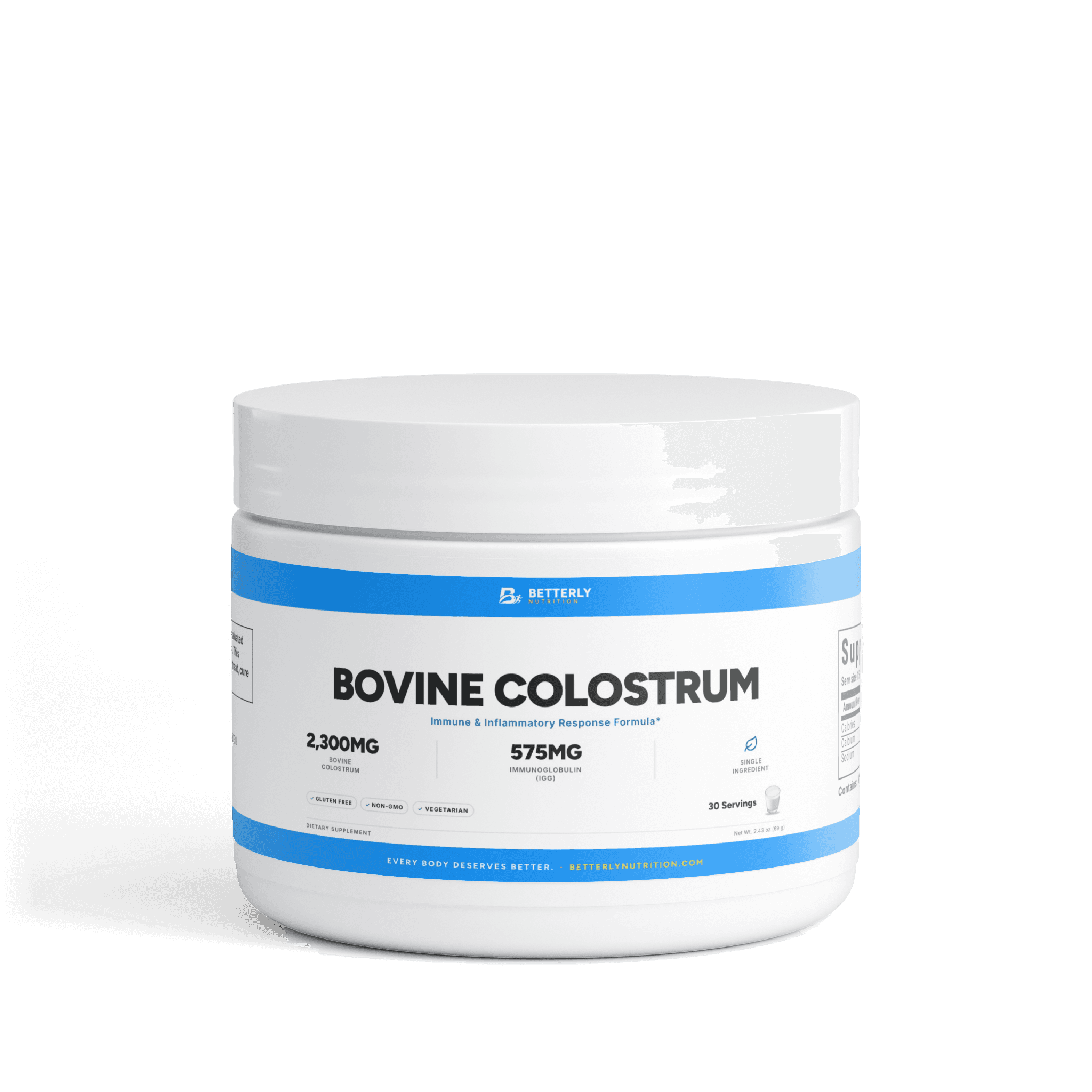
The short answer: How to take colostrum powder is spelled out in the label's directions: stir one 2.3 g scoop into 6-8 oz (177-237 ml) of cold water or a favorite beverage, then drink it within 10 minutes of mixing. That scoop of our 2,300mg Bovine Colostrum Powder holds 2,300 mg of bovine colostrum, with 575 mg of immunoglobulin G (IgG), and no other ingredient. We suggest one scoop a day at most.
Key takeaways
- Betterly's colostrum powder label directs adults to use one 2.3 g scoop in 6-8 oz (177-237 ml) of cold water or a favorite beverage.
- The label allows 10 minutes from mixing to the last sip, so a glass made the night before falls outside the directions.
- Iced coffee and cold brew match the label's wording; by our reading, a hot mug doesn't.
- With no frequency printed and a "Do not exceed recommended dose" line, we suggest one scoop a day, so the 30-serving tub lasts a month.
Full disclosure: Betterly sells this powder and a separate colostrum capsule with its own formula. The quoted directions below are the powder label's, and the tips we add on top are marked as ours.
How do you take colostrum powder, step by step?
To use colostrum powder from Betterly, add one 2.3 g scoop to 6-8 oz of a cold drink, mix it, and finish the glass within 10 minutes.
The tub's directions read, in full: "As a dietary supplement, adults use one (1) scoop of powder in 6-8 oz (177-237ml) of cold water or favorite beverage. Consume within 10 minutes of mixing." Here's how that plays out, with our suggestions labeled:
- Measure 6-8 oz of a cold drink. On a US measuring cup, 8 oz is the 1-cup line. Our tip: pour the liquid before the powder.
- Add one scoop. The panel lists the serving as 1 Scoop (2.3 g). Our tip: keep the scoop out of the drink so it stays dry.
- Mix it. The label says "mixing" but not how. We'd shake it in a lidded cup or stir with a fork until no dry powder shows.
- Drink it within 10 minutes. We start that clock the moment the powder meets the liquid.
- Put the tub away cool and dry. The label reads "STORE IN A COOL, DRY PLACE." Snapping the lid shut after each scoop is our addition.
The first words that matter are "adults use," which answers how to take colostrum as an adult: one scoop, mixed cold. There are no directions for children, and the tub reads "KEEP OUT OF THE REACH OF CHILDREN."
Prefer something with no glass involved? Our Colostrum Capsules are a separate formula with meal-based directions, which the when to take colostrum guide walks through.
What can you mix colostrum powder into?
Most cold drinks of 6-8 oz qualify, from plain milk to a single-glass smoothie, because the colostrum powder label allows "cold water or favorite beverage."
| Drink | Fits the label? | Why | Watch for |
|---|---|---|---|
| Cold water | Yes | Named in the directions | You taste the powder alone |
| Cold milk or oat milk | Yes | A favorite beverage | The milk's own calories |
| Single-glass smoothie | Yes | Cold, if kept to 6-8 oz | Finish it within 10 minutes |
| Iced coffee or cold brew | Yes | Cold, and a favorite beverage | The caffeine is the coffee's |
| Hot coffee, tea or cocoa | Not what we'd suggest | We read "cold" as covering every drink | Switch to an iced version |
| Yogurt, oats or baking | Not covered | The label describes a drink | Keep it to a glass |
| Mixed the night before | No | Breaks the 10-minute window | Mix fresh each time |
Temperature, volume and timing decide the fit, and flavor never does. Any cold drink you'll empty in one sitting works, while heat, food and making it ahead all fall outside the directions.
If you choose milk, know whose numbers you're drinking. Per 1-scoop (2.3 g) serving, the powder adds only 10 calories and 20 mg of calcium (2% DV). The NIH Office of Dietary Supplements' calcium fact sheet for consumers names milk, yogurt and cheese as the main food sources of calcium for most people in the US. It lists 1,000 mg a day as the recommended amount for adults aged 19 to 50. If you track calcium, read the carton, because the scoop's share is small.
With smoothies, watch the size. A blender batch that fills two big glasses leaves a second glass that misses the 10-minute window. Make one glass and drink it at the counter.
Can you put colostrum powder in coffee or hot drinks?
Iced coffee, yes; hot coffee, not by our reading, because we take the colostrum powder label's "cold" to cover the whole drink, not just the water.
Read strictly, "cold water or favorite beverage" might attach "cold" to the water alone. Heat is the one case that wording leaves open, so we take the careful reading: cold, whatever the drink.
Online answers disagree. Some brands say to keep colostrum away from hot liquids, while others call a hot mug fine. We won't add a temperature figure or claim heat harms colostrum, since we can't source either.
If coffee anchors your morning, you still have options:
- Switch to cold brew or iced coffee. The panel lists no caffeine, so all of it comes from the coffee.
- Keep your hot mug as it is, and drink the colostrum from a small glass of cold water or milk beside it.
- Take a capsule instead, which skips the mixing question entirely.
Collagen peptides are a different ingredient with different labels, and our look at collagen in coffee covers that case. We don't carry its reasoning over to colostrum, which has directions of its own.
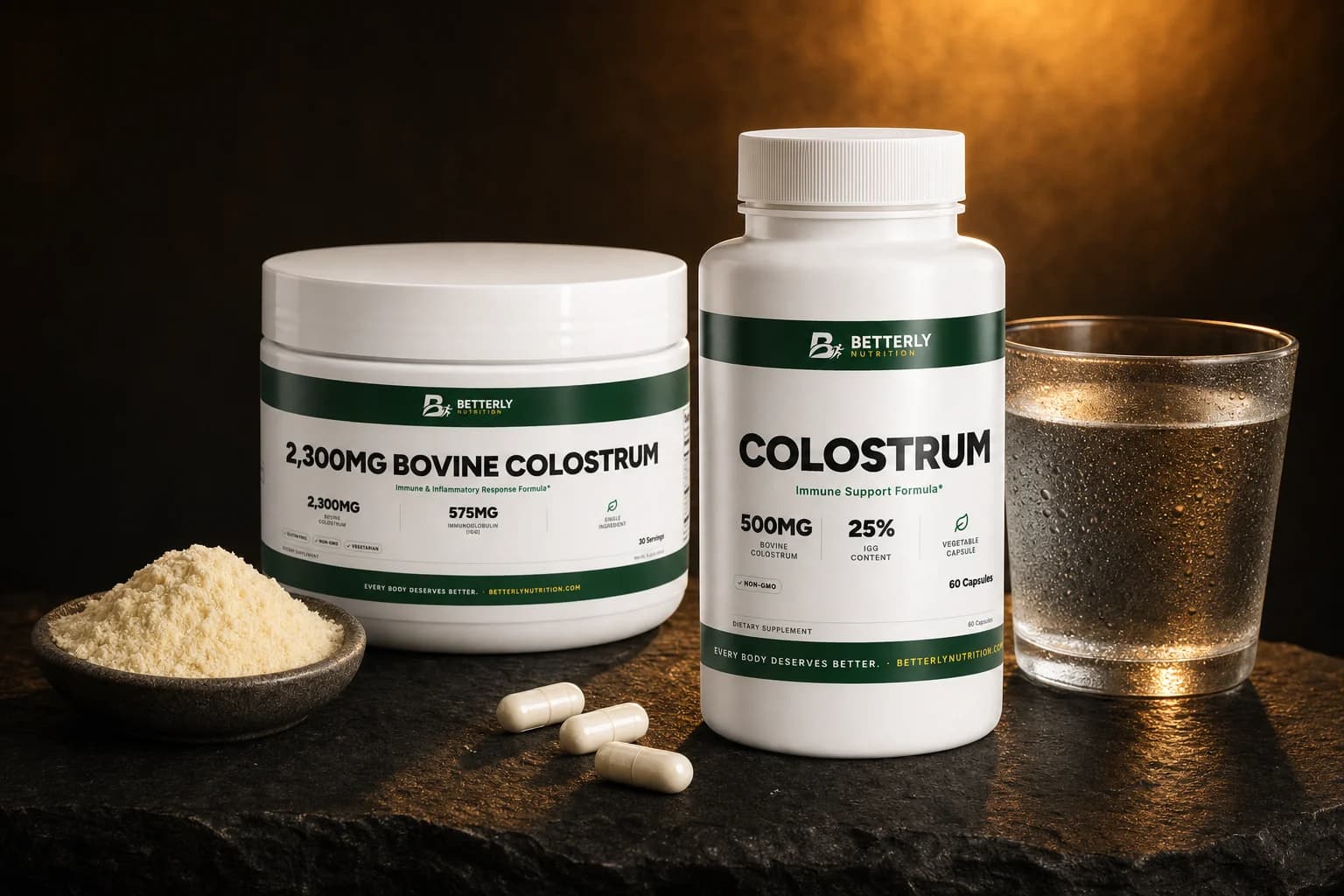
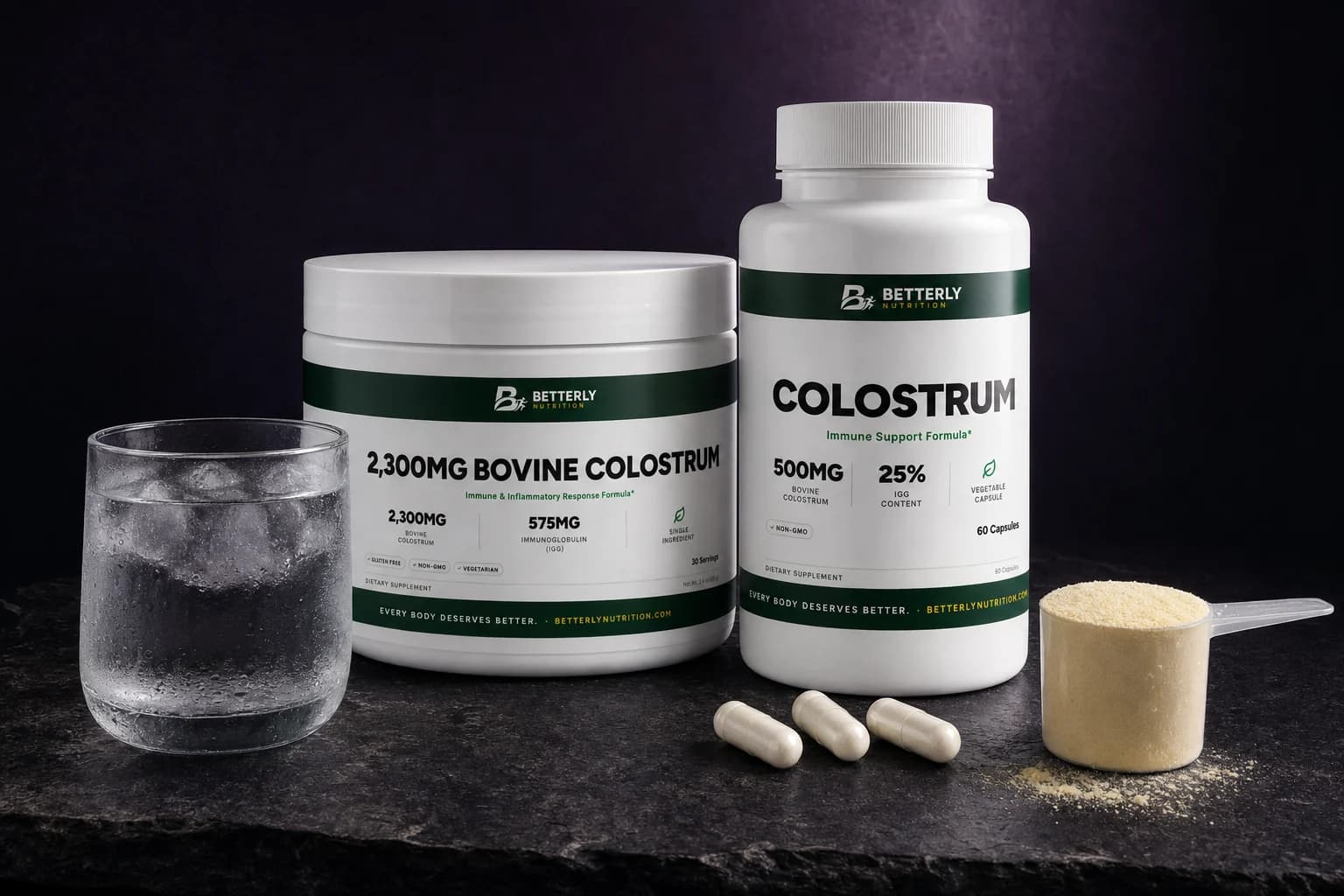
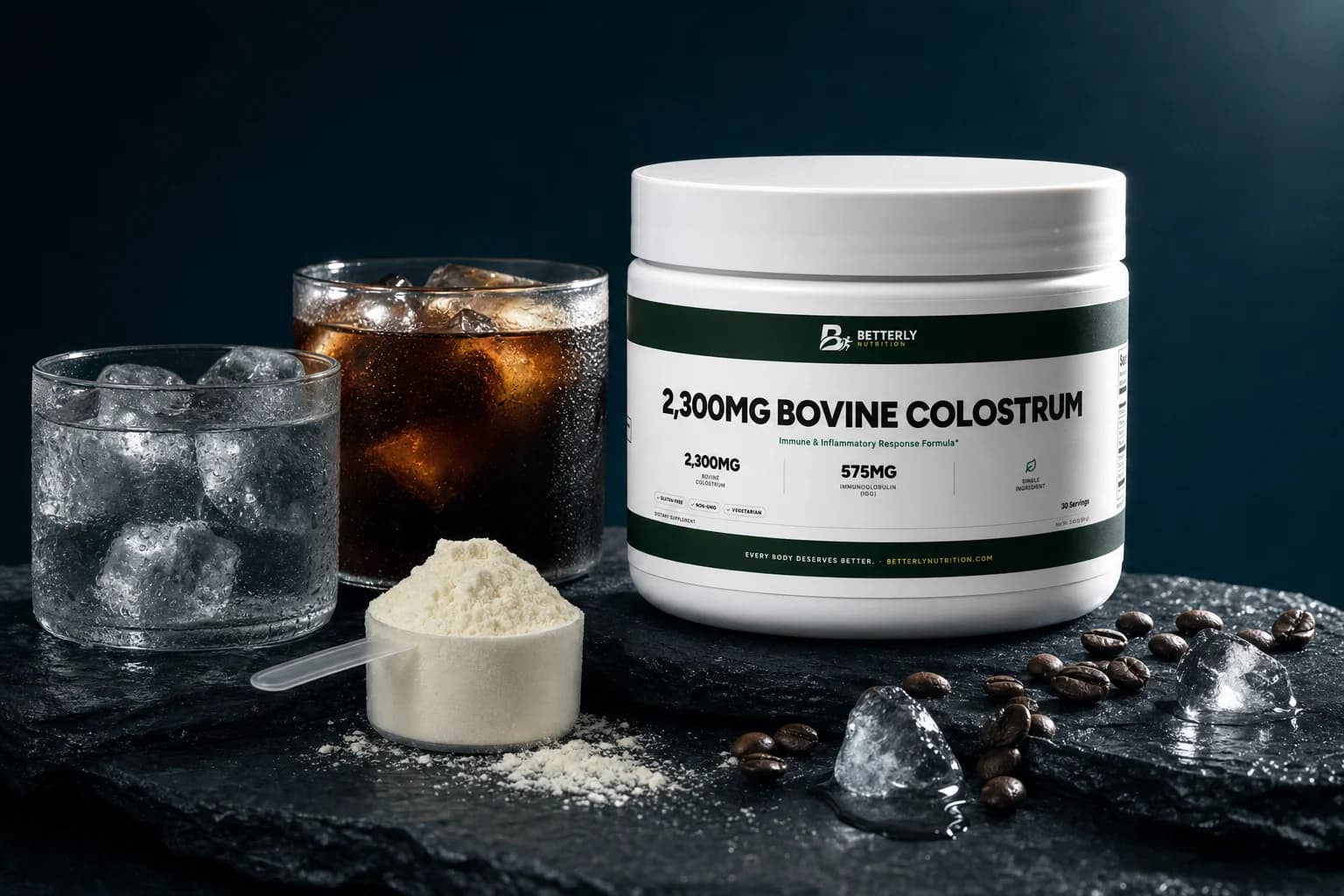
From our shop: 2,300mg Bovine Colostrum Powder — a 69 g tub of 30 single-scoop servings, with no flavoring, sweetener or other ingredient listed beside the colostrum.
Why does the label give you only 10 minutes to drink it?
The 10-minute limit is printed on Betterly's colostrum powder label without a reason, so we follow it as written rather than guess at the cause.
Here's what the rule changes in an ordinary week.
It rules out:
- Mixing a bottle at night so it's ready in the morning.
- Filling a shaker at home and drinking it an hour later at the gym.
- Sipping one glass across a long morning at your desk.
It still leaves room for:
- Mixing at the moment you'll drink, wherever you are.
- Carrying one dry scoop in a small, clean, lidded container and adding cold water when you're ready. That's our idea, not the label's, so keep the container bone dry.
- Switching to capsules on days away from a kitchen.
How do you keep the powder from clumping?
Colostrum powder's label doesn't mention clumps, so our suggestion is to pour the cold liquid first, add the scoop on top and shake it in a lidded cup.
These habits are ours, not the label's:
- Put the liquid in before the powder, since powder sitting in an empty glass tends to cake when liquid lands on it.
- Shake rather than stir. A jar or shaker cup with a tight lid usually mixes more evenly than a spoon.
- Use a fork if you're stirring in a glass, because its tines break up small lumps.
- Keep the tub dry. A wet scoop or damp fingers carry moisture inside, which works against the label's "cool, dry place" line.
A few flecks usually just need a few more seconds of shaking, not extra liquid beyond the label's 6-8 oz.
Can you take more than one scoop of colostrum a day?
No, the colostrum powder label names one scoop as its serving, prints no frequency and says "Do not exceed recommended dose," so we suggest one scoop a day at most.
One scoop a day is our reading, not a printed line. When a label leaves frequency open, we'd rather point you to the smaller amount than to a scoop in every drink you make.
Some brands online call for several scoops a day, but those directions belong to their products, and a scoop isn't a standard unit. Ours holds 2.3 g; another brand's could hold far more. Compare grams of colostrum per serving, never scoops.
The NIH Office of Dietary Supplements makes the case against extra in Dietary Supplements: What You Need to Know. Taking more than you need, it says, costs more and might raise your risk of side effects.
It also suggests asking a provider about the proper dose and how long to take a supplement. Start there if you're wondering whether a different amount suits you. Our guide to colostrum dosage for adults digs into the numbers.
How long does a 30-scoop tub last?
Thirty days, if you use one scoop a day, because a tub of Betterly's colostrum powder holds 30 servings of 2.3 g each.
The label gives the net weight as 2.43 oz (69 g). A few ways to plan around that:
- Write the opening date on the lid (our suggestion). A tub opened on the 1st runs out around the 30th.
- Skipped days stretch it. Weekdays only? Then 30 scoops cover six weeks.
- Sharing halves it. Two adults at one scoop each empty a tub in 15 days.
ODS recommends a written record of every supplement you use, with the dose and how often. A phone note like "colostrum powder, 1 scoop, daily, opened on the 3rd" doubles as your reorder reminder.
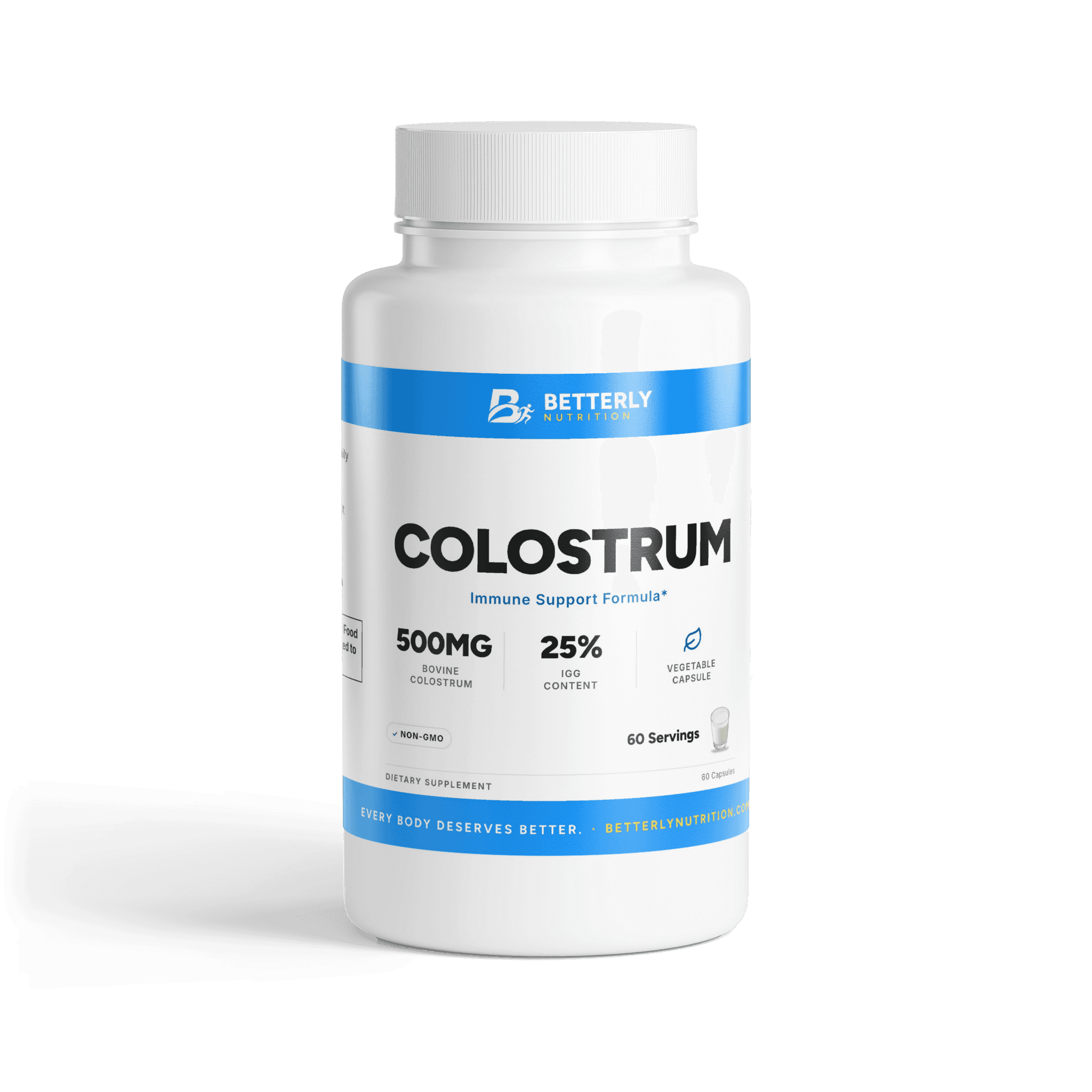
The capsules aren't a one-for-one swap, though. Each 1-capsule serving holds 500 mg of colostrum, against 2,300 mg per 2.3 g scoop, and our side-by-side of the powder and the capsules runs those numbers in full.
From our shop: Colostrum Capsules — 60 capsules of 500 mg bovine colostrum (IgG 25%) each, for days when mixing a drink within 10 minutes isn't practical.
When is colostrum powder a poor fit for your routine?
Colostrum powder is a poor fit when its routine won't happen: a fresh cold drink of 6-8 oz, finished within 10 minutes of mixing, every time you take it.
A tub that sits unopened does nothing for you. Here's where the preparation itself tends to get in the way:
- Your only morning drink is a hot coffee, and a second, cold glass won't happen.
- You're rarely near a sink or a fridge, so a 6-8 oz drink on a 10-minute clock is hard to fit into a day on the road.
- You like to stretch a single drink over an hour, which runs well past the window.
- You were planning to bake it into muffins or stir it into oatmeal. The label describes a drink, and we won't write food directions it doesn't give.
The capsules get around the first three, though they're a different formula with their own directions. If none of it seems worth the effort, skipping colostrum leaves no daily target unmet, since the colostrum and IgG rows on its panel read "Daily Value (DV) not established." Our immune support range also includes options that come as capsules, with no glass to mix.
Who should check with a healthcare provider first?
Get a healthcare provider's okay before starting colostrum powder if you're pregnant, nursing or under 18, take any prescription, have a procedure scheduled or are managing a medical condition.
The tub's caution reads: "Do not exceed recommended dose. Consult a physician if pregnant, nursing, under 18, or have a medical condition."
The FDA's consumer update Mixing Medications and Dietary Supplements Can Endanger Your Health says to call your health care professional before adding a supplement, and to mention everything else you take. The phone note from the tub section already holds the details they'll want.
Surgery adds a deadline. That FDA page explains that a provider may want supplements paused two or three weeks before a procedure, so raise the colostrum early in your pre-op conversation.
One more label line matters here: "Contains: Milk (Colostrum)." Our guide to bovine colostrum side effects covers who that rules out.
Tell your healthcare provider about any reaction you didn't expect. ODS adds that you can report it to the FDA yourself at 800-FDA-1088 or online.
FAQ: how to take colostrum powder
What does colostrum powder taste like?
Colostrum powder's taste in the glass depends mostly on your drink, because Betterly's label lists no flavoring, sweetener or other ingredient beside the colostrum. Cold water leaves the powder's own taste front and center. Cold milk, a fruit smoothie or cold brew each bring their own flavor. Using the full 8 oz instead of 6 oz spreads the same 2.3 g through more liquid.
Can you dry scoop colostrum powder?
No, dry scooping skips the step the colostrum powder directions are built around: one scoop mixed into 6-8 oz of cold water or a favorite beverage. The powder is meant to be sipped in a drink, not swallowed dry. If mixing is the sticking point, the simplest way to take a colostrum supplement without a glass is a capsule, which has its own directions.
Can you mix colostrum powder into the same glass as another supplement powder?
We don't suggest it, because the colostrum powder directions describe one scoop in 6-8 oz of cold liquid and mention no other product. A second powder's label sets its own amount of liquid and its own timing, so a shared glass follows neither label exactly. Drink them one after the other instead. If you take prescription medication or several supplements already, check with your pharmacist or provider before adding colostrum.
Does colostrum powder need to be refrigerated?
No, the tub doesn't need the fridge: the colostrum powder label says "STORE IN A COOL, DRY PLACE," so a cupboard away from the stove works. A mixed glass shouldn't go into the fridge for later either, since the 10-minute window still applies. The label also says not to use a tub whose safety seal is damaged or missing.
Is colostrum powder the same as milk powder?
No, colostrum powder isn't ordinary milk powder, though both start as dairy. Colostrum comes from a narrow window just after a cow gives birth, while milk powder is dried from the everyday milk that follows. Our tub's panel lists its colostrum at 25% immunoglobulin G, or 575 mg of IgG per scoop. The label describes one scoop in a cold drink, not a cup of powder for baking.
Sources
- Calcium: Fact Sheet for Consumers, NIH Office of Dietary Supplements
- Dietary Supplements: What You Need to Know, NIH Office of Dietary Supplements
- Mixing Medications and Dietary Supplements Can Endanger Your Health, U.S. Food and Drug Administration
If this left you looking for somewhere to start, read single-ingredient bovine colostrum powder in 2.3 g scoops — its amounts per serving are listed on the page. For the practical questions this raises, how dosing, sourcing and subscriptions work is answered in one place.