On this page
- Key takeaways
- What is the colostrum dosage for adults?
- What does IgG mean on a colostrum label?
- How do you turn a colostrum IgG percentage into milligrams?
- Why does "IgG 40%" mean little without the milligrams?
- What can a colostrum Supplement Facts panel leave out?
- Why aren't research doses of bovine colostrum a recommendation?
- How do you take colostrum at the label's dose each day?
- When is a daily colostrum dose not worth taking?
- Who should ask a provider about a colostrum dose first?
- FAQ: colostrum dosage
- Sources
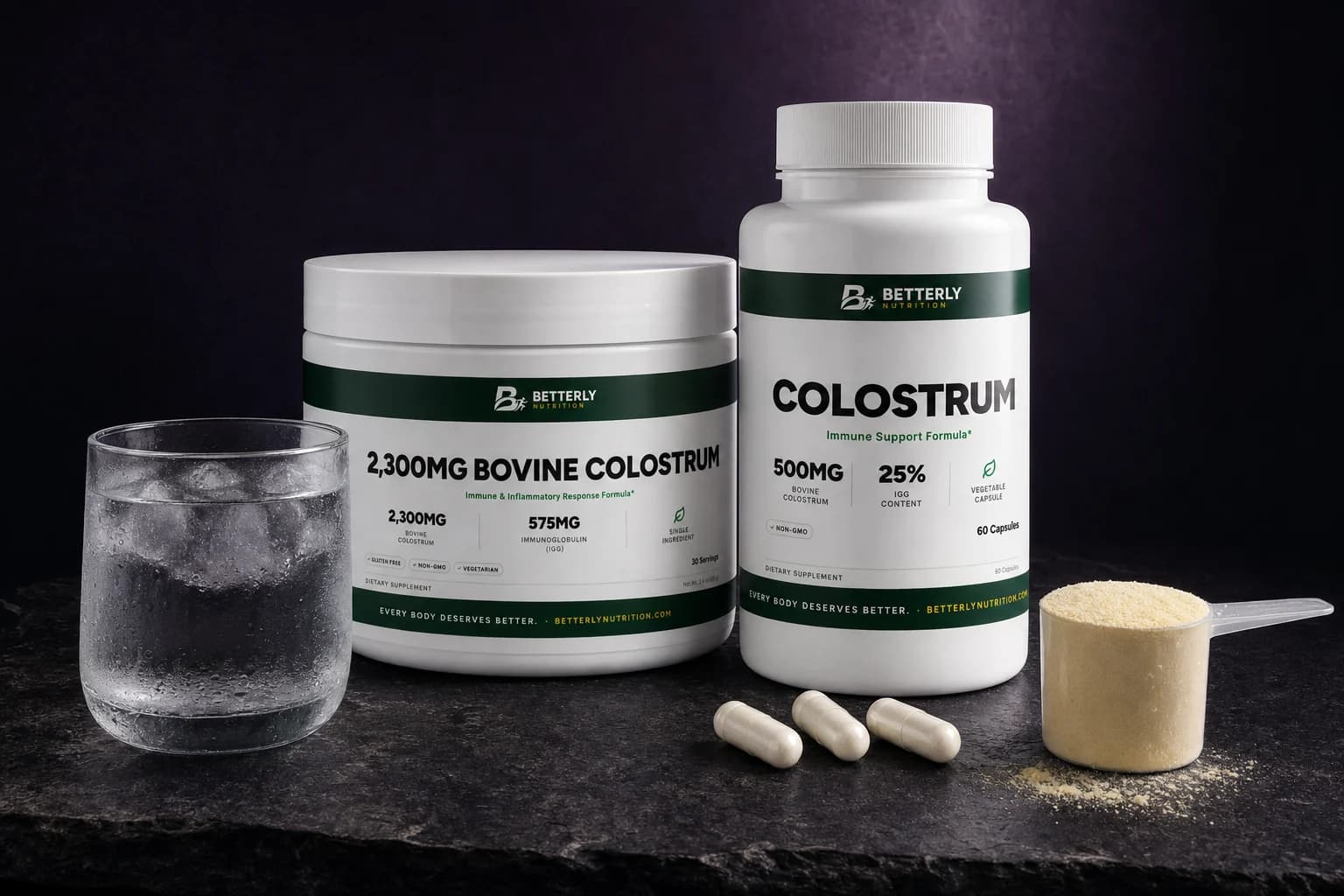
The short answer: Colostrum dosage for adults is whatever the product's suggested use says, because colostrum has no Daily Value to measure against. Betterly's Colostrum Capsules allow 1 to 3 capsules a day, which is 500 to 1,500 mg of colostrum. One scoop of our 2,300mg Bovine Colostrum Powder gives 2,300 mg, with 575 mg of IgG. On any brand, read two numbers: colostrum milligrams per serving, and IgG.
Key takeaways
- Colostrum has no Daily Value, so an adult colostrum dose comes from the suggested use on the product you buy.
- Two numbers on a Supplement Facts panel matter most: colostrum milligrams per serving, and IgG, shown as milligrams or a percentage.
- Multiply the colostrum milligrams by the IgG percentage to get IgG milligrams, so 500 mg at 25% is about 125 mg.
- A higher IgG percentage doesn't guarantee more IgG per serving, because a smaller serving can cancel it out.
- Adult trials in a 2021 review used 1 to 60 g of colostrum a day, and those amounts belong to the studies that tested them.
We sell both products we use as worked examples here, a capsule and a powder. The math works on any brand's panel, though, and we'll flag the spot where our own capsule label leaves the IgG arithmetic to you.
What is the colostrum dosage for adults?
An adult's colostrum dose is the label's suggested use: 1 to 3 capsules a day on Betterly's bottle, or one 2.3 g scoop on our tub.
That can sound like a dodge, but vitamin C and zinc have Daily Values you can hold a label up against, and colostrum doesn't. Both of our panels put three asterisks beside it, leading to one footnote: "Daily Value (DV) not established." So the serving is the brand's call. Here's what ours say:
- Capsules: "Take 1 (one) capsule 1 to 3 times daily preferably with meals or as directed by a healthcare professional." At 500 mg per capsule, that's 500 mg, 1,000 mg or 1,500 mg of colostrum a day.
- Powder: "adults use one (1) scoop of powder in 6-8 oz (177-237ml) of cold water or favorite beverage." The label prints no number of times a day, so we read it as one scoop, or 2,300 mg, daily.
Your own situation still counts. The NIH Office of Dietary Supplements (ODS), in Dietary Supplements: What You Need to Know, lists questions to settle with a healthcare provider before starting any supplement. Two fit here: "What is the proper dose to take?" and how long to take it.
What does IgG mean on a colostrum label?
IgG on a colostrum label stands for immunoglobulin G, a type of antibody protein. The number beside it tells you how much of the colostrum is IgG.
MedlinePlus, the National Library of Medicine's health site, has a page on the immunoglobulins blood test. It defines antibodies, also called immunoglobulins, as proteins your immune system makes. IgG, it adds, is far more common and more specialized than IgM, the type your body makes first. That page is about your own blood, though. The IgG in a colostrum supplement is the cow's, made for her calf.
Why do brands print IgG and skip the other antibody types? A 2021 systematic review in the journal Nutrients explains that IgG1, one subtype of IgG, leads the antibodies in cow's milk and colostrum. IgA and IgM turn up in far smaller amounts.
The same review stresses that colostrum's makeup swings a lot. The individual cow, her breed, how many calves she's had, her feed before calving and the time since calving all shift it. Batches differ, so the IgG figure is the maker's statement of what ended up in the finished powder.
One limit: IgG tells you what's in a serving. What it does once swallowed is a separate question, and the adult research on that is thin. Our look at what trials have found for adults goes through it.
How do you turn a colostrum IgG percentage into milligrams?
To turn a colostrum label's IgG percentage into milligrams, multiply the colostrum milligrams per serving by the percentage as a decimal: 500 mg × 0.25 = 125 mg.
On any panel, find the serving size at the top, then the colostrum row and its milligrams. If IgG has its own milligram row, you're done. If it's a percentage, multiply, then scale by the servings the directions allow each day.
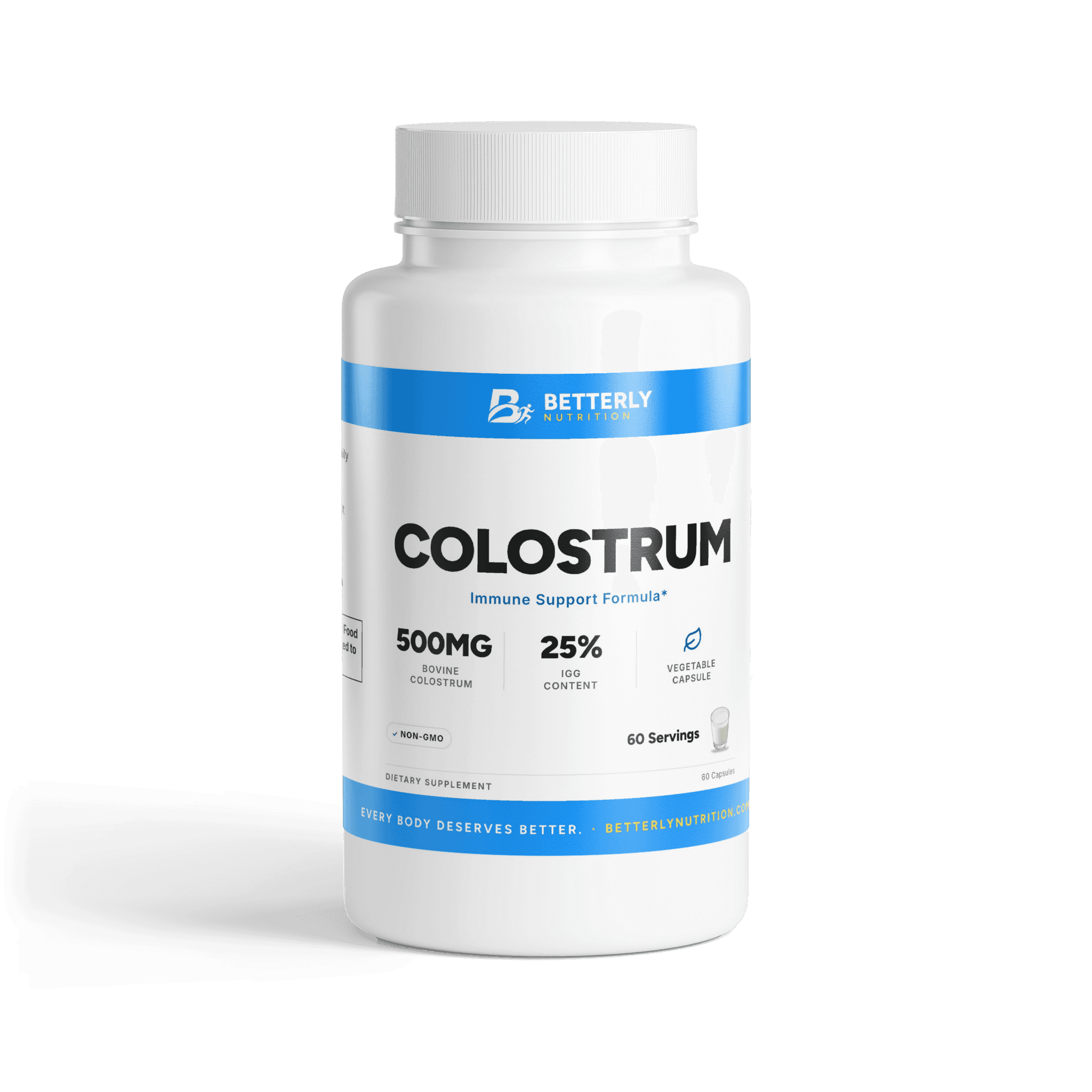
Our capsule panel shows the percentage route. Its only row reads "Bovine Colostrum Powder, 500 mg (IgG 25%)," so each capsule holds about 125 mg of IgG. Nowhere on the bottle will you see 125 mg; we got there by multiplying.
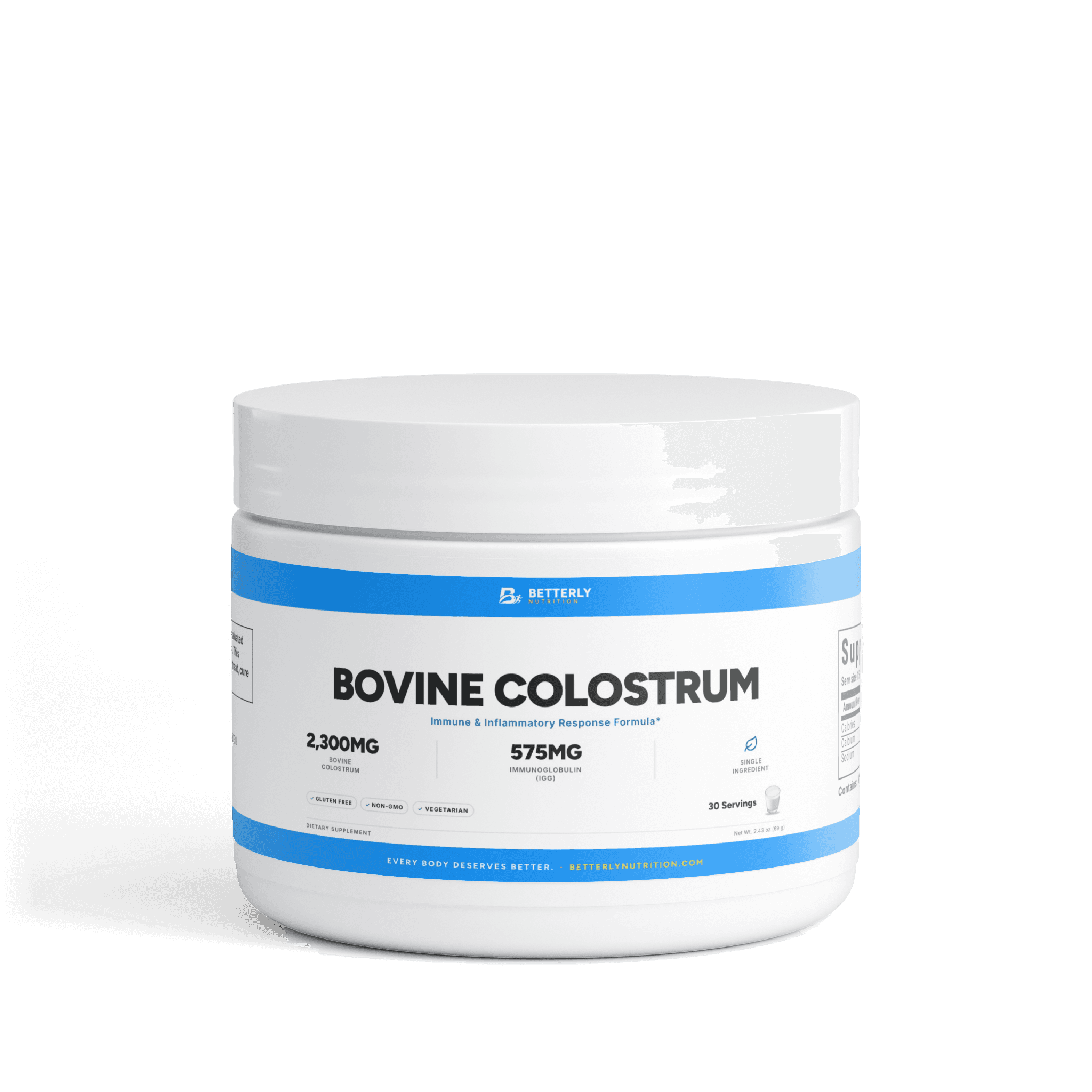
Our powder panel prints both: "Bovine Colostrum (25% Immunoglobulin G), 2,300 mg" and "Immunoglobulin (IgG), 575 mg." Since 2,300 × 0.25 is exactly 575, the lines agree. When a label prints both, run that check yourself, and if they don't match, ask the brand which is right.
| Daily amount, per the label | Colostrum | IgG | Where the IgG figure comes from |
|---|---|---|---|
| 1 capsule | 500 mg | About 125 mg | Our math |
| 2 capsules | 1,000 mg | About 250 mg | Our math |
| 3 capsules, the label's limit | 1,500 mg | About 375 mg | Our math |
| 1 scoop (2.3 g) | 2,300 mg | 575 mg | Printed on the panel |
Only the scoop's IgG figure is printed; the three capsule rows come from the 25% math. Which format suits your routine is a separate question, and our capsule-or-powder comparison covers it.
Why does "IgG 40%" mean little without the milligrams?
An "IgG 40%" claim describes how concentrated the colostrum is. The IgG you actually swallow depends on the colostrum milligrams in each serving.
A made-up example shows why. Say a capsule holds 300 mg of colostrum at 40% IgG. That's 120 mg of IgG, a little under the roughly 125 mg in one of our 25% capsules. The higher percentage lost because the capsule held less colostrum.
Flip it, and the percentage wins. At the same 500 mg, a 40% capsule would carry 200 mg of IgG against our 125 mg. So a percentage only settles the comparison when the milligrams match.
Two habits keep a big percentage from steering you. First, turn the package around, because the serving size and milligrams live on the Supplement Facts panel. Second, don't chase a number. No source we cite sets an IgG target for adults, so this math is a tool for comparing labels.
What can a colostrum Supplement Facts panel leave out?
A colostrum Supplement Facts panel must show colostrum's weight per serving, but federal rules let it skip IgG milligrams, a per-day total and, inside a blend, colostrum's own amount.
The FDA's rule for supplement panels, 21 CFR 101.36, covers each piece:
- Colostrum's weight is required. For an ingredient with no Daily Value, the rule wants the whole ingredient's weight per serving, never just one component's.
- IgG milligrams are optional. The rule allows a brand to list an ingredient's parts, with their weights, indented beneath it. IgG is part of colostrum, so in our reading, printing its milligrams is the brand's choice. Our powder does; our capsule doesn't.
- A per-day column is optional. Ours have none, so the capsule's 500 mg is per capsule, and your daily total depends on your count.
- Blends hide single amounts. A "proprietary blend" must give its total weight, but it doesn't have to break out each ingredient inside.
| What the panel prints | Can you know IgG per serving? | What to do |
|---|---|---|
| Colostrum mg and IgG mg | Yes, it's printed | Check the two agree |
| Colostrum mg and IgG % | Yes, with one step | Multiply mg by the percentage |
| IgG % with no colostrum mg | No | Find the colostrum mg first |
| Colostrum in a blend with one total weight | No | Ask the brand |
The first two rows let you finish the math at the shelf. The last two don't, and no front-label claim fills that gap.
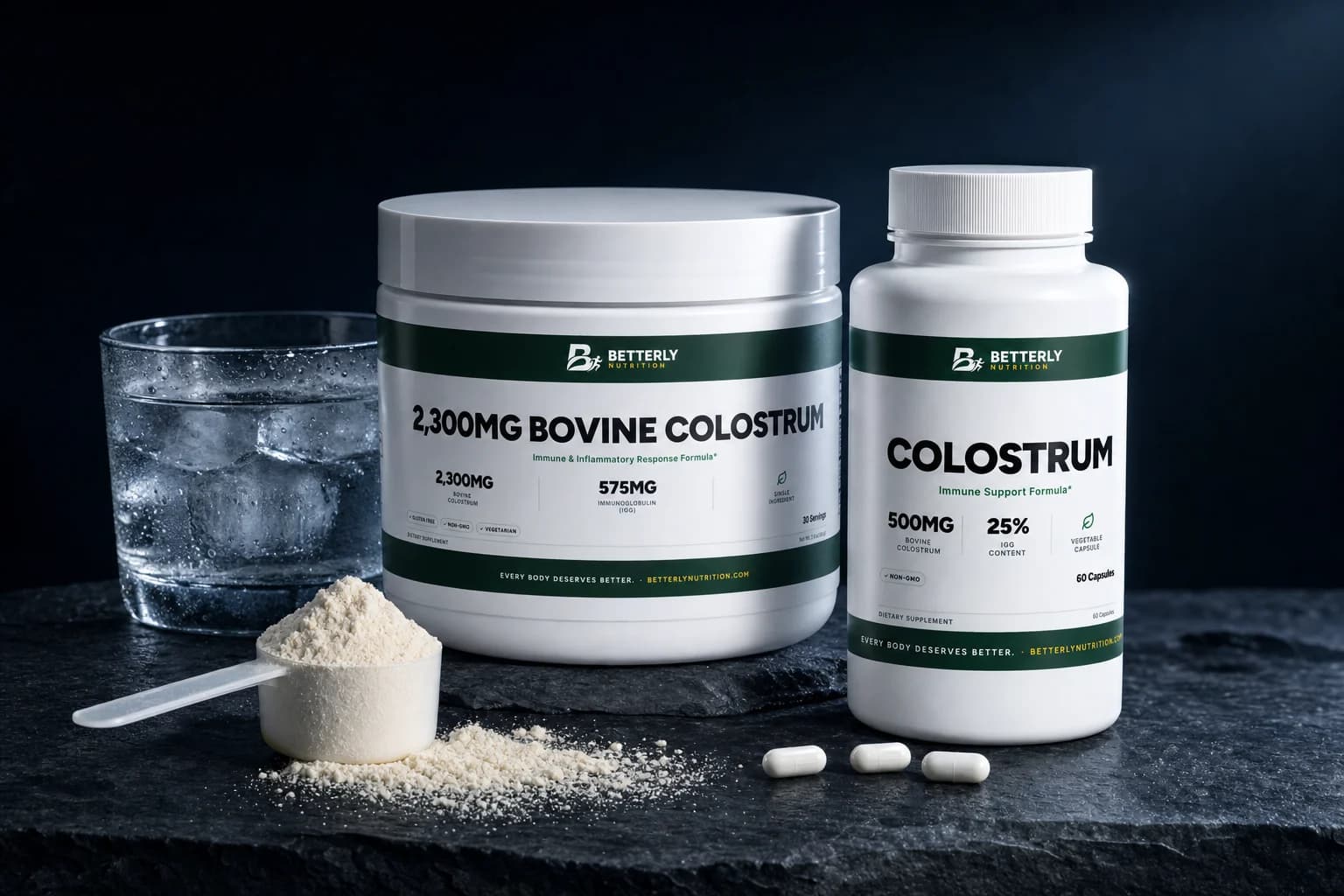
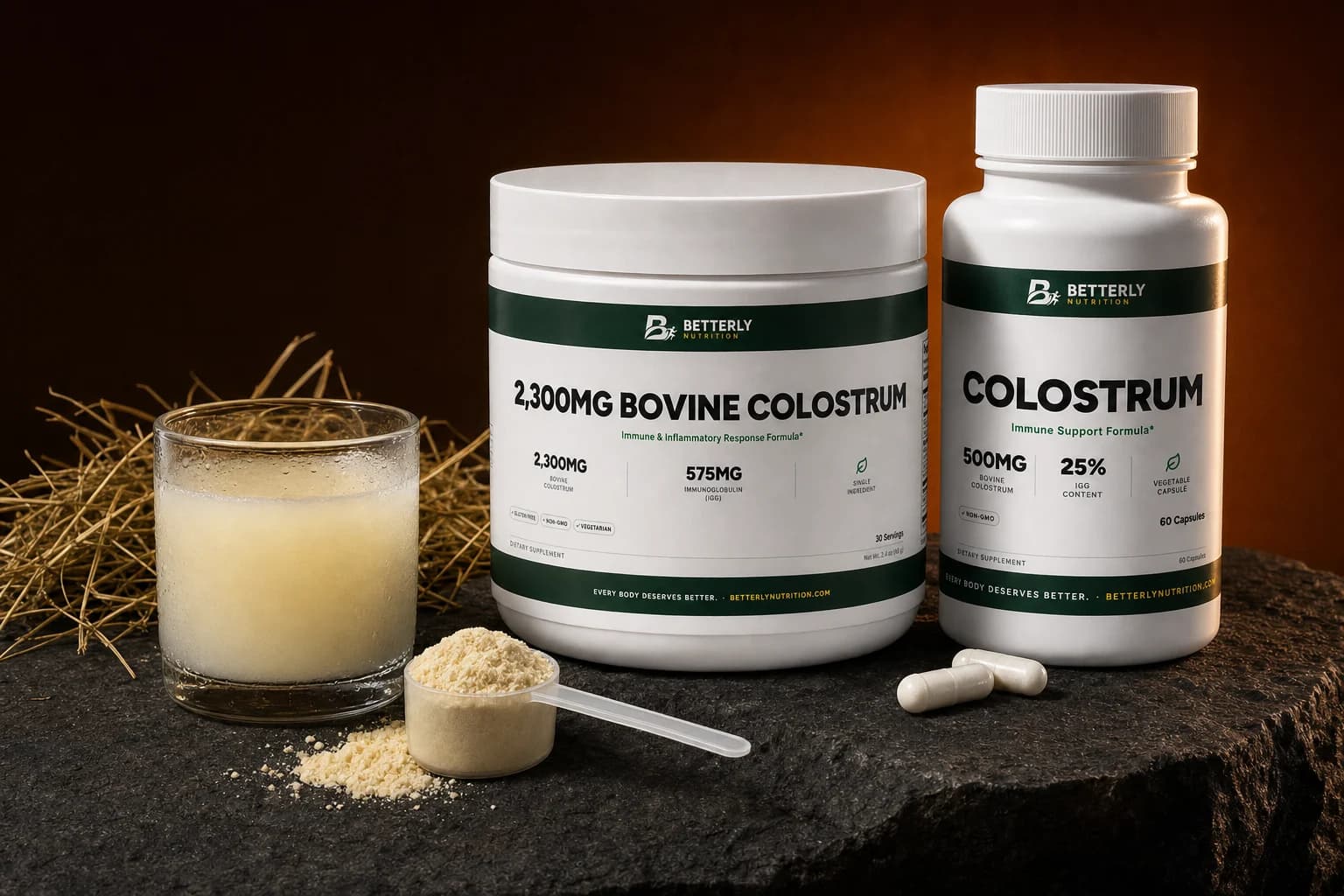
From our shop: 2,300mg Bovine Colostrum Powder — a panel that prints both numbers, 2,300 mg of bovine colostrum and 575 mg of IgG, per 1-scoop (2.3 g) serving.
Why aren't research doses of bovine colostrum a recommendation?
Research doses of bovine colostrum, such as 20 g a day, describe what particular trials tested with their own products, and they sit far above our labels.
Search for bovine colostrum dosage and you'll meet gram amounts from studies. The 2021 Nutrients review, Bovine Colostrum Applications in Sick and Healthy People, found 13 adult trials giving 1 to 60 g a day. Several used 20 g a day, mostly in physically active men.
Those grams don't carry over to a supplement shelf:
- The products differed. The review counted 11 commercial colostrum formulas across its studies, and one it described listed IgG at 15.3%, well under our 25%. A gram of one colostrum isn't a gram of another.
- The evidence is still open. The authors closed by calling for better-designed studies before colostrum use can be supported in any setting.
- Your label has a ceiling. Both of ours say "Do not exceed recommended dose."
For scale, 20 g would be about 40 of our capsules, more than 13 times the label's limit of three a day. Don't try to match a trial. ODS puts the general point plainly: "Taking more than you need costs more and might also raise your risk of side effects."
How do you take colostrum at the label's dose each day?
Take one Betterly colostrum capsule per meal, up to 3 a day, or stir one level powder scoop into 6-8 oz of cold water and drink it within 10 minutes.
A few habits keep your daily amount where the label puts it:
- Use one colostrum product at a time. Each label sets its own daily amount, and the two amounts were never meant to be added together.
- Pick a capsule count of one, two or three and keep it steady. If lunch goes by without one, dinner still gets just one.
- Level the scoop. The panel's figures describe a 2.3 g scoop, and a heaped one holds more.
- Count forward from the servings per container. At three a day, the bottle's 60 capsules cover 20 days, and at one a day, the tub's 30 scoops cover 30.
That last habit doubles as a check. If a bottle empties faster than your count allows, your daily amount has crept up.
From our shop: Colostrum Capsules — 500 mg of bovine colostrum per capsule, listed at IgG 25%, with directions that let you take 1, 2 or 3 a day with meals.
When is a daily colostrum dose not worth taking?
A daily colostrum dose isn't worth taking if you avoid milk, already get colostrum from another product, or want vitamins and minerals, which our colostrum panels barely list.
Skipping it makes sense if:
- Dairy doesn't suit you. Each of our colostrum labels declares milk as its allergen.
- You already get colostrum from a blend or another brand. Adding ours puts two servings into one day.
- You're hoping a larger serving will do more. Neither label promises a result at any amount, and the review we cite judged the evidence too weak to back colostrum for any use.
- You're after vitamins or minerals. Our powder lists 20 mg of calcium, 2% of the Daily Value, per 1-scoop (2.3 g) serving, and the capsule panel lists none.
To see what else fits an everyday routine, our immune support collection sets colostrum beside mushroom blends and a multivitamin.
Who should ask a provider about a colostrum dose first?
A provider should weigh in on your colostrum dose before day one if you're pregnant or nursing, under 18, taking medication, scheduled for surgery or managing a medical condition.
Word for word, both of our labels caution: "Do not exceed recommended dose. Consult a physician if pregnant, nursing, under 18, or have a medical condition." With a milk allergy, skip colostrum altogether.
ODS names high doses as one of the situations where supplement side effects become more likely. On our labels, the step past the suggested dose is easy to spot: a fourth capsule in one day, or a second scoop by our one-a-day reading of the powder label.
When you ask about a dose, bring the container. A provider can only judge an amount they can see: the serving size, the colostrum milligrams and the IgG line. If you're tested under an anti-doping program, our guide to colostrum side effects covers the anti-doping question.
FAQ: colostrum dosage
How much colostrum is too much?
Any colostrum intake above the label's suggested use is too much, which on Betterly's labels means more than 3 capsules or 1 scoop a day. Both labels say "Do not exceed recommended dose." Trials have used up to 60 g a day, but those amounts belonged to studies testing their own products. Wanting more than the label allows is a question for your healthcare provider.
How many colostrum capsules can you take a day?
On Betterly's Colostrum Capsules label, the most is three: 1 capsule, 1 to 3 times daily, preferably with meals. That's 1,500 mg of colostrum and about 375 mg of IgG by our arithmetic. Other brands fill capsules differently, so a count that fits one bottle may not fit another. Read each label's serving size first.
How long can you keep taking colostrum?
Neither of Betterly's colostrum labels sets an end date. Several adult trials in the 2021 Nutrients review ran for 4 to 12 weeks, so long-term daily use goes beyond what they measured. ODS suggests asking your provider how, when and for how long to take any supplement, and that's a fair question to bring about colostrum.
Does colostrum dosage depend on body weight?
No, Betterly's colostrum labels don't scale the dose to body weight. The capsule and powder directions each give a fixed serving with no weight chart, and we won't invent a per-pound formula. Some trials in the 2021 Nutrients review set amounts by body weight, but those figures belong to those trials. If you wonder whether the label amount suits your size, ask your healthcare provider.
Is the IgG in colostrum the same as IgA?
No, IgG and IgA are separate antibody classes, and IgG is the main one in bovine colostrum. In the 2021 Nutrients review, IgA and IgM sit far below IgG1, the leading subtype, in cow's milk and colostrum. That's why labels, ours included, report IgG. Neither of our panels prints an IgA or IgM amount.
Sources
- Bovine Colostrum Applications in Sick and Healthy People: A Systematic Review, Guberti M. et al., Nutrients, 2021
- 21 CFR 101.36, Nutrition labeling of dietary supplements, Electronic Code of Federal Regulations
- Immunoglobulins Blood Test, MedlinePlus, National Library of Medicine
- Dietary Supplements: What You Need to Know, NIH Office of Dietary Supplements
If this left you looking for somewhere to start, read 500 mg colostrum capsules at 25% IgG — its amounts per serving are listed on the page. For the practical questions this raises, how dosing, sourcing and subscriptions work is answered in one place.