On this page
- Key takeaways
- What's the difference between colostrum and probiotics?
- Is colostrum a probiotic?
- Why is colostrum measured in milligrams and probiotics in CFU?
- Colostrum vs probiotics: how do our three capsule labels compare?
- Is colostrum or probiotics better?
- Can you take colostrum and probiotics together?
- What are the label directions for colostrum and probiotics?
- When can you skip both colostrum and probiotics?
- Who should check with a healthcare provider first?
- FAQ: colostrum and probiotics
- Sources
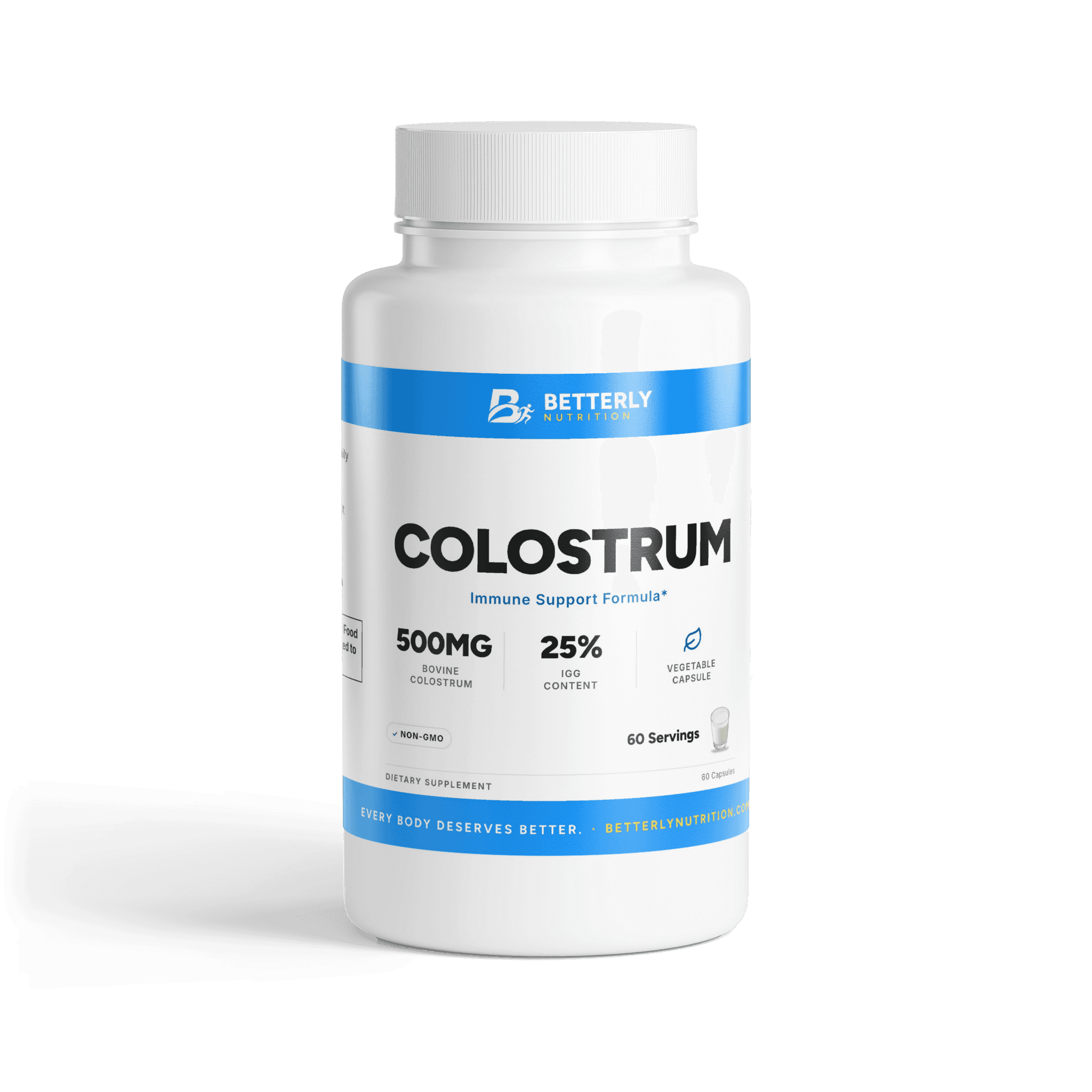
The short answer: Colostrum vs probiotics compares two different kinds of ingredient. Colostrum is milk a cow makes in the first days after calving, dried and sold for antibodies such as IgG, and it's measured in milligrams. Probiotics are live microorganisms, counted in CFU. Each of our Colostrum Capsules lists 500 mg of bovine colostrum at 25% IgG, and its panel lists no bacteria at all, so it's no substitute for a probiotic.
Key takeaways
- Colostrum is dried early milk from cows, bought for its antibody content, while probiotics are live bacteria or yeasts bought for the microbes themselves.
- Betterly's Colostrum Capsules list 500 mg of bovine colostrum at 25% IgG per capsule, with no microorganism and no CFU count on the panel.
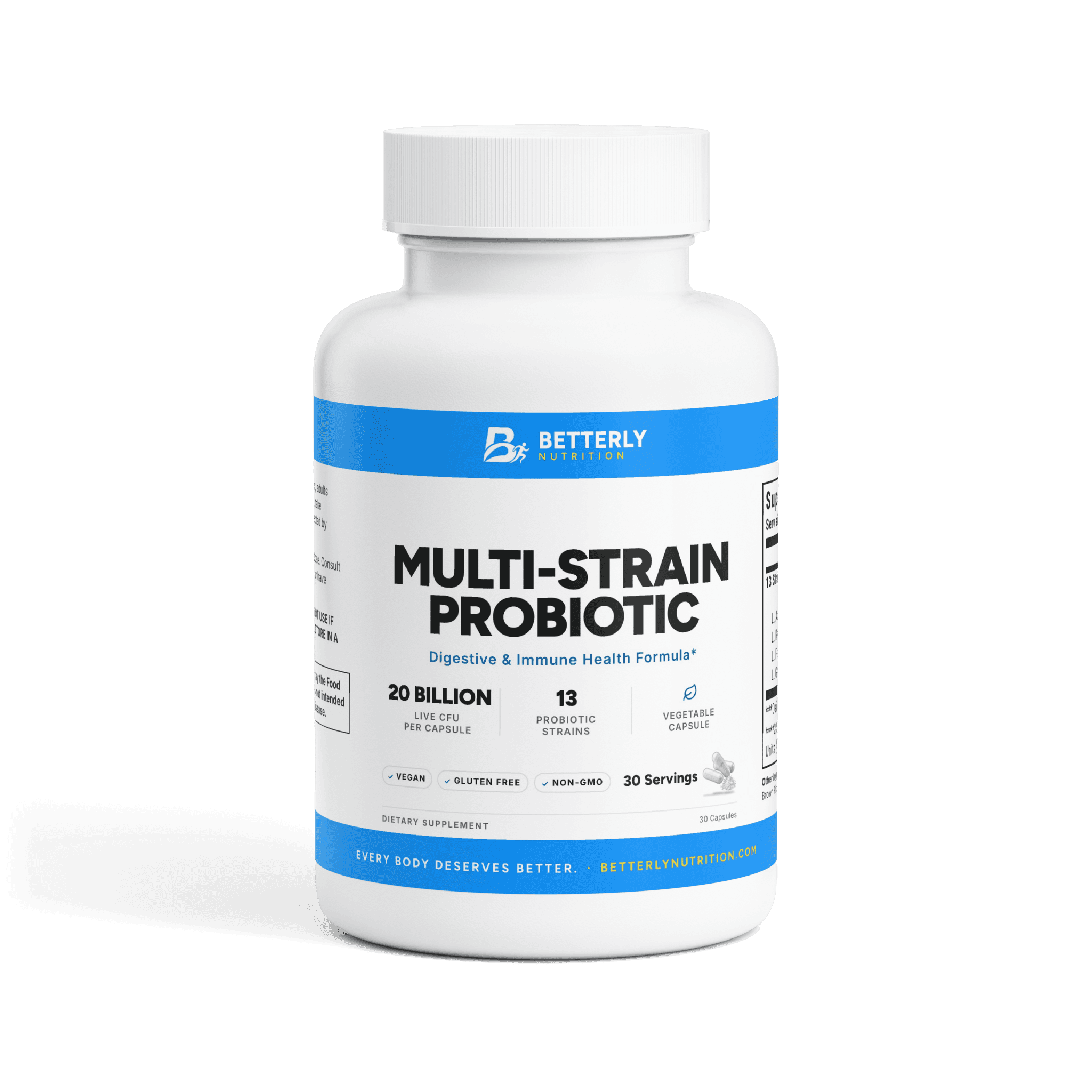
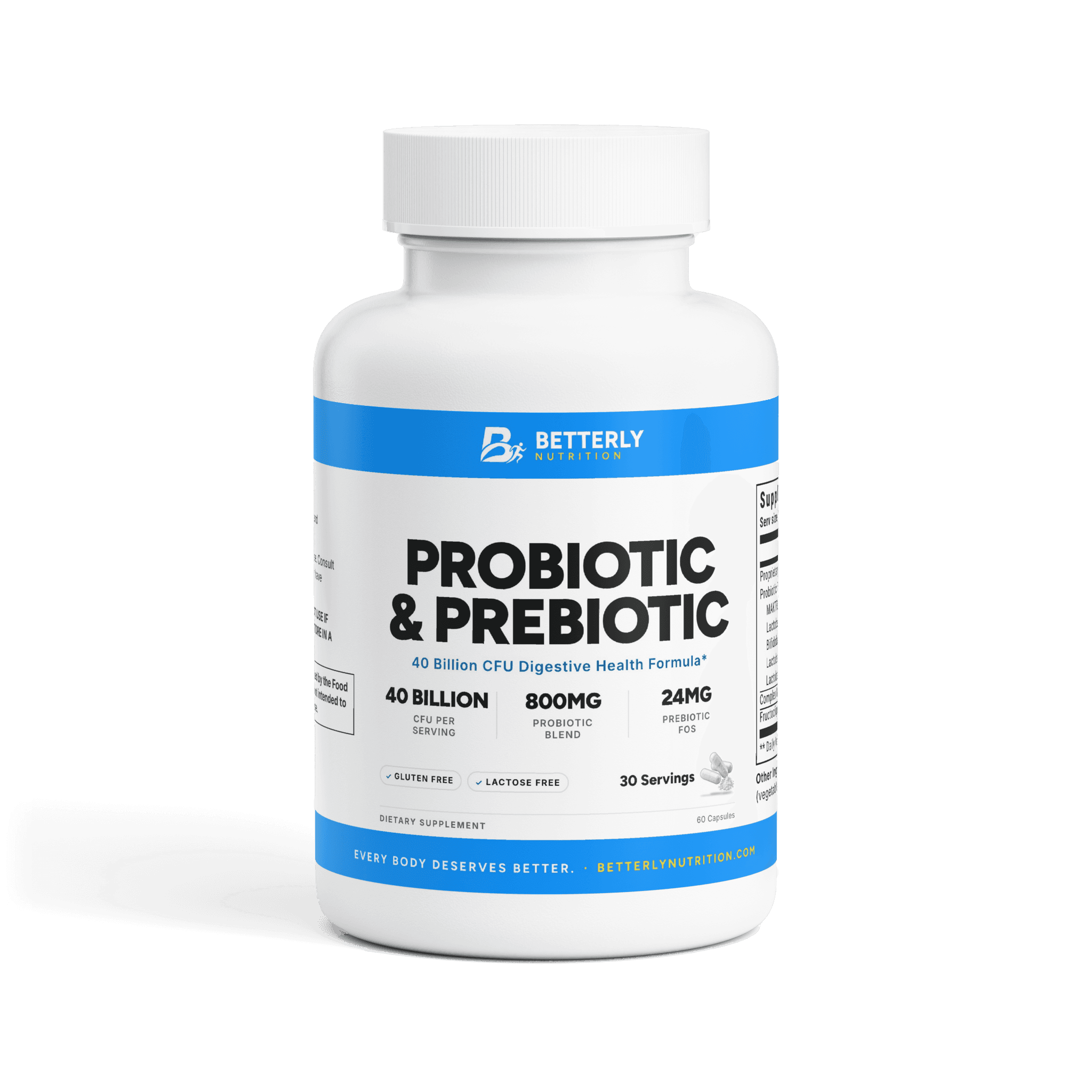
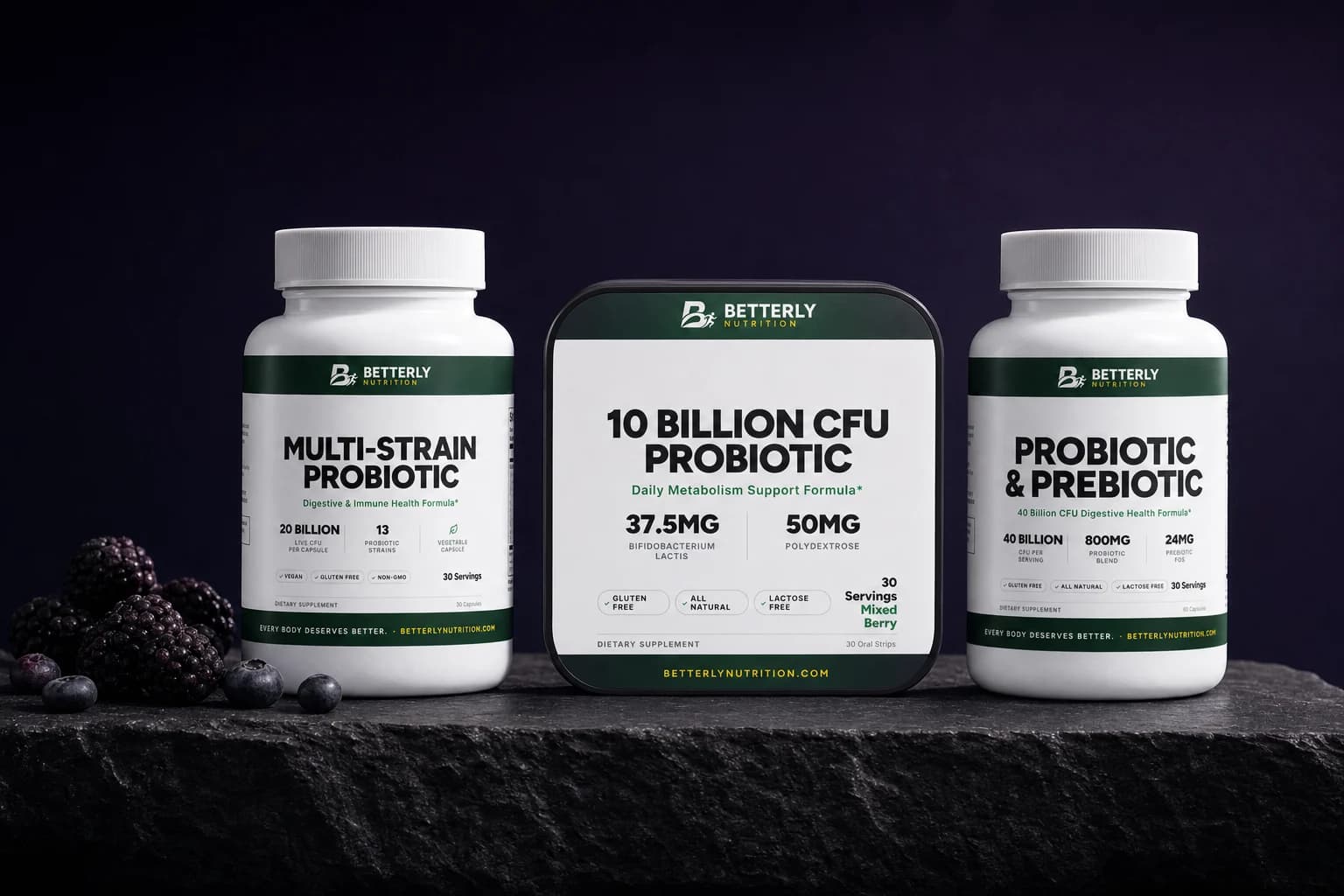
- Our Multi-Strain Probiotic Capsules list 20 Billion CFU from 13 strains per capsule, and our Probiotic & Prebiotic Capsules list 40 Billion CFU plus 24 mg of FOS per 2 capsules.
- None of Betterly's colostrum or probiotic labels mentions the others or warns against the pairing, so taking both on one day means following each label as written.
- Both of our colostrum products declare milk, so a lactose-free or vegan probiotic doesn't make the pair dairy-free.
Full disclosure: Betterly sells both colostrum and probiotics, so neither side needs to win for us. What you'll get here is each panel, number for number, and a plain note wherever a label leaves your question open.
What's the difference between colostrum and probiotics?
Colostrum is a food ingredient, the early milk mammals produce right after birth, while probiotics are living microorganisms. One brings milk proteins, and the other brings microbes.
The National Library of Medicine's MeSH vocabulary defines colostrum as a thin, yellow fluid the mammary glands make around birth, before regular milk comes in. Its listed parts include immunologically active substances, white blood cells, protein, fat and carbohydrates. Both of Betterly's colostrum products are bovine, which simply means the milk came from cows.
Probiotics sit in another category. The NIH Office of Dietary Supplements (ODS) probiotics fact sheet defines them as live microorganisms, bacteria or yeasts, that offer a health benefit when taken in a large enough amount. They act mainly in the digestive tract.
| Question | Colostrum | Probiotics |
|---|---|---|
| What is it? | Dried first milk from cows | Live bacteria or yeasts |
| Anything alive? | No live microbes listed | Yes, that's the point |
| Measured in | Milligrams, plus % IgG | CFU (colony-forming units) |
| Milk statement on ours | Yes | No |
The columns never agree, which is why one can't replace the other.
Is colostrum a probiotic?
No, colostrum isn't a probiotic. Neither of Betterly's colostrum panels lists a microorganism, a strain name or a CFU count.
According to ODS, a probiotic is identified by its genus, species and strain, as in Lacticaseibacillus rhamnosus GG. Our colostrum capsule panel has one active row, Bovine Colostrum Powder at 500 mg. The other ingredients are rice flour, MCT oil, silicon dioxide, L-leucine and a cellulose capsule. None of it is alive.
The mix-up is understandable, since some probiotic foods are dairy. ODS notes that yogurt starts as milk with live microorganisms, such as Streptococcus thermophilus, added to it. Colostrum powder skips that step: our two panels list dried colostrum and no cultures.
You may also read that colostrum's natural sugars feed gut bacteria. Our labels make no such claim, so we won't either.
Why is colostrum measured in milligrams and probiotics in CFU?
Colostrum labels give a weight because the ingredient is a dried food, while probiotic labels count CFU because a probiotic depends on how many microbes are alive.
Our colostrum capsule states 500 mg with "IgG 25%" printed under it. IgG, short for immunoglobulin G, is a type of antibody, and in colostrum it's the cow's own. The label gives a percentage, so do the math: 25% of 500 mg is 125 mg of IgG per capsule.
Probiotic panels print a weight too, but it's the less useful number. Our Multi-Strain Probiotic Capsules list their 13 Strain Probiotic blend at "317 mg (20 Billion CFU****)" per capsule. ODS says the CFU number reflects the count of active microbes better than the weight does. So read the CFU on a probiotic, and the milligrams and IgG on colostrum.
Those four asterisks lead to a footnote, copied exactly: "20 Billion Live Colony Forming Units (CFU) at the time of manufacture." ODS points out that the number of live cells can drop as a product ages. Our Probiotic & Prebiotic Capsules print 40 Billion CFU with no timing note at all. Our guide to CFU counts explains those footnotes. Colostrum carries no such footnote, since nothing in it is sold as alive.
Colostrum vs probiotics: how do our three capsule labels compare?
Betterly's Colostrum Capsules, Multi-Strain Probiotic Capsules and Probiotic & Prebiotic Capsules differ in serving size, unit, allergen line and label claims, though all three are capsules.
| Label line | Colostrum Capsules | Multi-Strain Probiotic | Probiotic & Prebiotic |
|---|---|---|---|
| Serving | 1 capsule | 1 capsule | 2 capsules |
| Main row | Colostrum, 500 mg (IgG 25%) | 317 mg (20 Billion CFU) | 800 mg (40 Billion CFU) |
| Also listed | Nothing else active | 13 named microbes | Marine polysaccharide, FOS |
| Servings | 60 | 30 | 30 |
| Milk statement | Yes | No | No |
| Label claims | Non-GMO | Vegan, gluten free, non-GMO | Gluten free, lactose free |
Only the colostrum column reads in milligrams alone, and only it declares milk. The lactose-free claim belongs to the Probiotic & Prebiotic bottle and says nothing about what you take beside it.
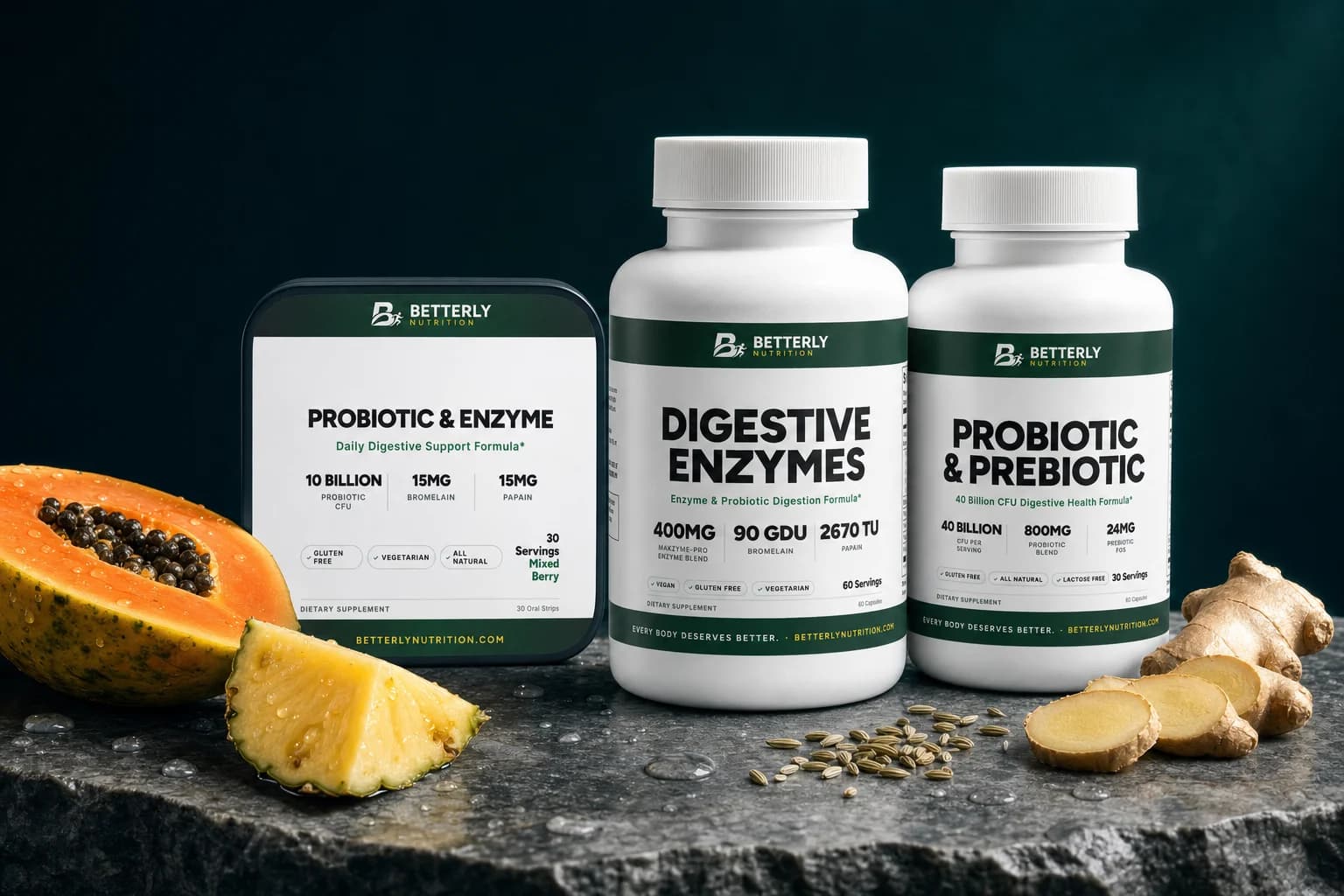
The probiotic panels name their microbes differently. The 13-strain capsule lists genus and species without strain codes. The 800 mg blend lists MAKTREK® (Bi-Pass Technology) above four coded strains, from Lactobacillus acidophilus La-14 to Lactobacillus paracasei Lpc-37, and doesn't say how its CFU splits among them.
That detail matters more on a probiotic than on colostrum. The National Center for Complementary and Integrative Health (NCCIH) page on probiotics usefulness and safety cautions that an effect seen with one kind of Lactobacillus can't be assumed for another kind, or for any Bifidobacterium. Our probiotic label primer explains strain names if they're new to you.
Where does colostrum powder fit?
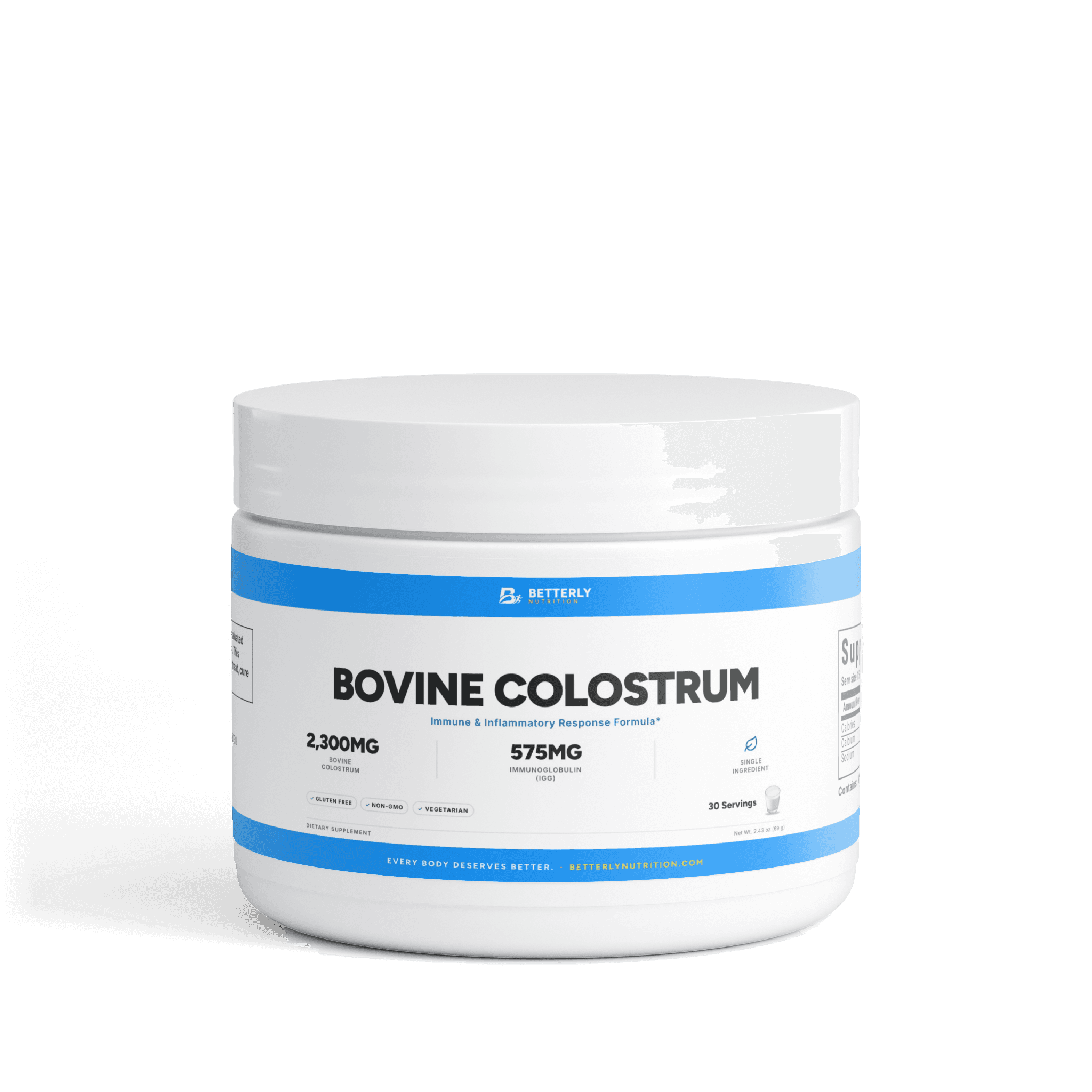
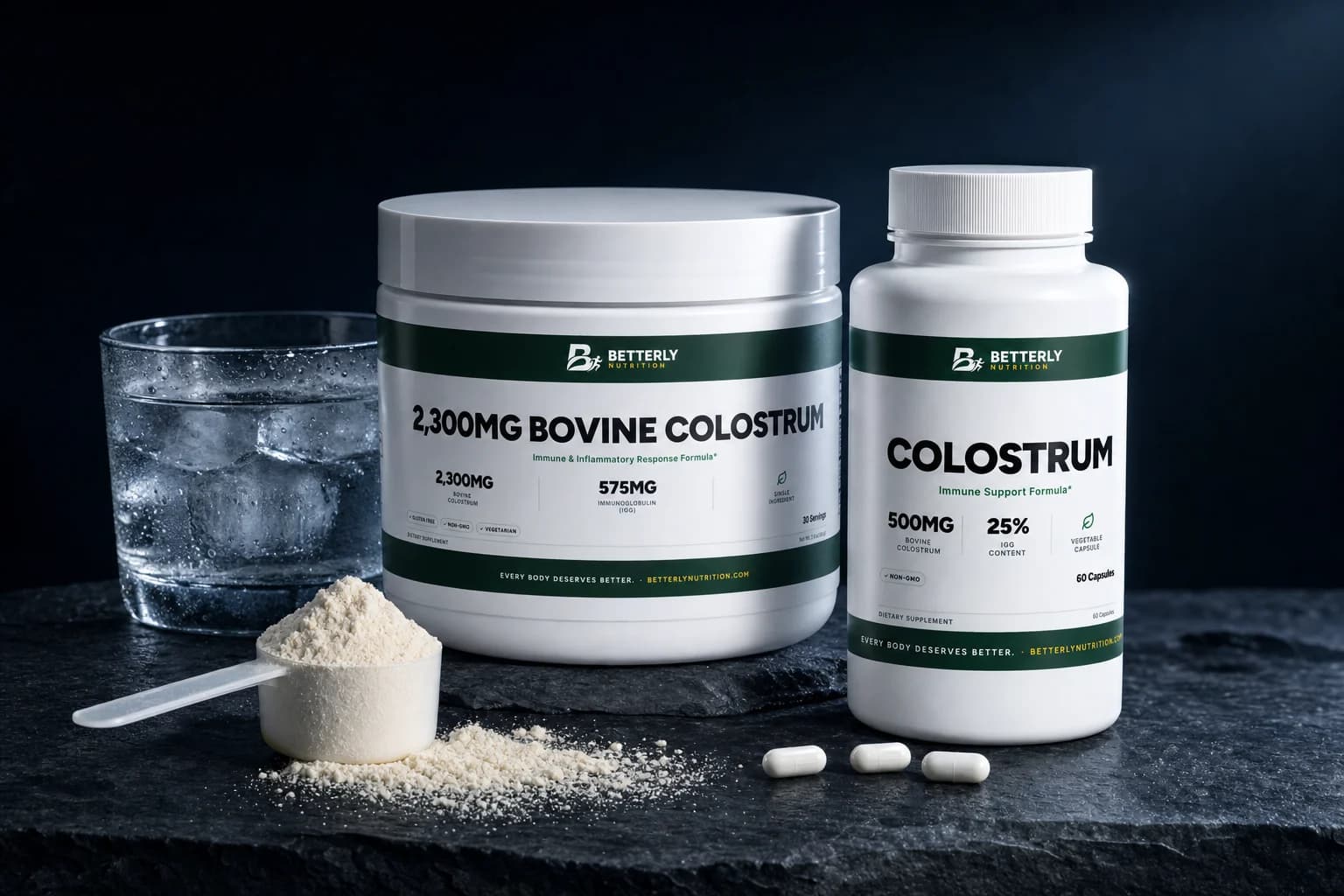
Our 2,300mg Bovine Colostrum Powder stays on the colostrum side, with 2,300 mg of bovine colostrum and 575 mg of IgG per 1-scoop (2.3 g) serving and no microbes on the panel.
So colostrum powder vs probiotics is the same comparison at a bigger serving. If you're torn between the tub and the bottle, our colostrum scoop-versus-capsule breakdown works through that choice. The tub's label claims are gluten free, non-GMO and vegetarian, but it's still milk, and its allergen line says so.
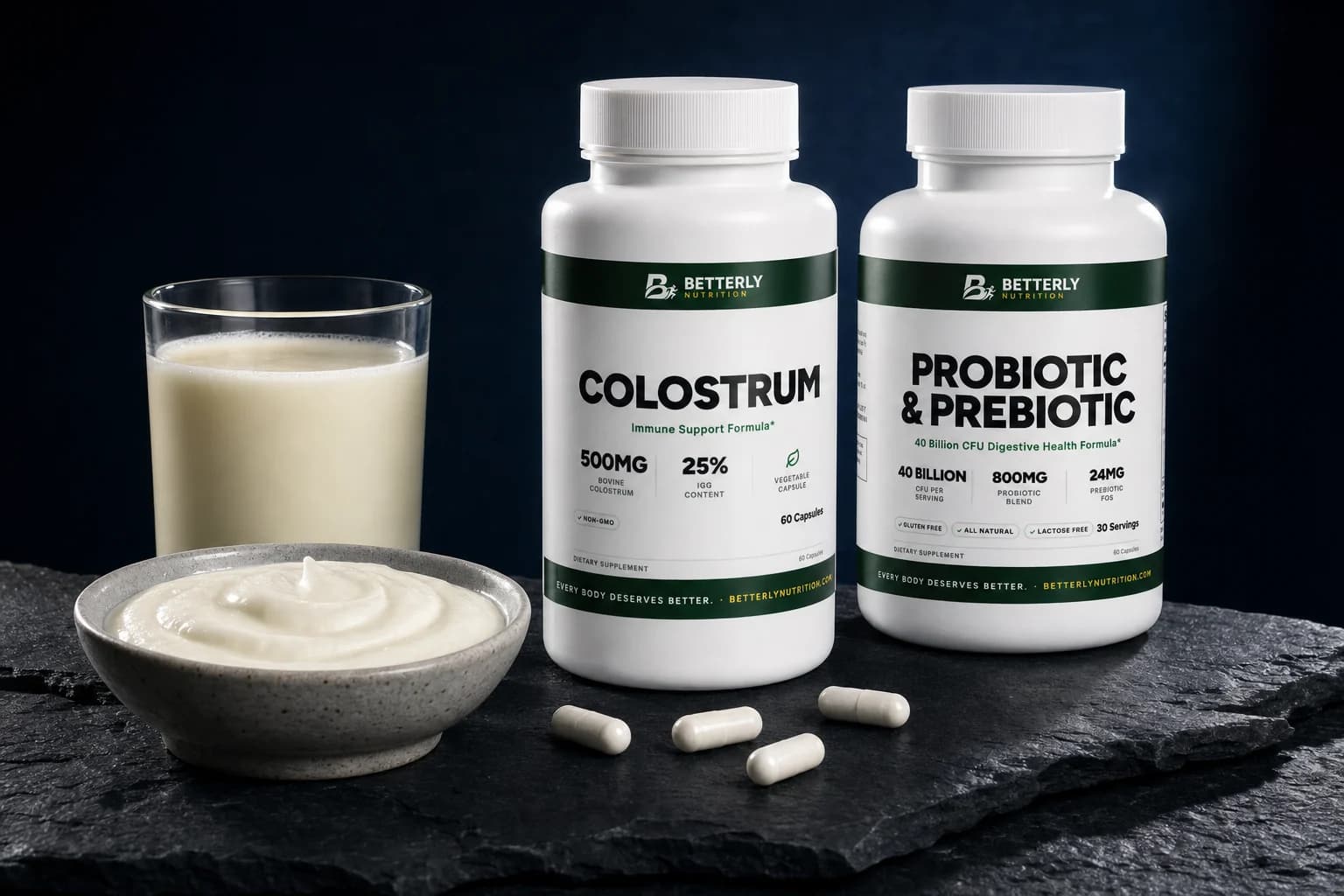
From our shop: Colostrum Capsules — each capsule lists 500 mg of bovine colostrum (IgG 25%), with 60 to a bottle and a label that suggests 1 to 3 a day, preferably with meals.
Is colostrum or probiotics better?
Neither colostrum nor a probiotic wins outright, since each does a different job. Choose by what you want to add and what you avoid.
Two of the bottle fronts even share a word, immune. The colostrum capsule says "Immune Support Formula," and the 13-strain probiotic says "Digestive & Immune Health Formula." Since the fronts can't tell them apart, the panels have to.
| If you want | Look at | Why |
|---|---|---|
| Live microbes | A probiotic | 20 or 40 Billion CFU per serving |
| A milk ingredient sold for IgG | Colostrum | 500 mg per capsule, IgG 25% |
| No milk statement | Either probiotic | Neither panel prints one |
| A vegan claim | Multi-Strain Probiotic | The only one of the four here labeled vegan |
| A small prebiotic alongside | Probiotic & Prebiotic | 24 mg FOS per 2 capsules |
Most rows point to a probiotic, but that isn't a quality ranking. Probiotic labels simply carry more details to match against. Colostrum wins one row, the one for people who want colostrum specifically.
That 24 mg of FOS is modest. Our guide to pairing prebiotics with probiotics sets it beside daily fiber targets.
Can you take colostrum and probiotics together?
Nothing on Betterly's colostrum or probiotic labels rules out taking them on the same day. None mentions the others, so you'd follow each label's directions separately.
Pairing them isn't doubling up. A colostrum capsule adds no CFU, and a probiotic adds no IgG. What repeats is the caution, identical on all four labels: "Do not exceed recommended dose."
No label sets a gap between products or names an order, and the government pages we checked are silent on this pairing. Some brands claim colostrum helps probiotics settle in. No federal page we read backs that up, and our labels don't claim it.
Each label's timing can still be met on one day, since the directions don't collide. We'd keep it to one colostrum product and one probiotic, each at its own label's serving.
What should you check on a colostrum and probiotic blend?
Some brands put both in one capsule or scoop. We don't sell one, but a blend's panel should carry both kinds of numbers:
- Colostrum milligrams in their own row, not folded into a blend total.
- IgG, as a percentage or in milligrams.
- CFU per serving, with a note saying whether the count holds at the factory or until the use-by date.
- Genus, species and strain for each microbe.
- A milk statement, since colostrum is milk.
What are the label directions for colostrum and probiotics?
Betterly's Colostrum Capsules label suggests 1 capsule, 1 to 3 times daily, preferably with meals, and our probiotics ask for 1 capsule daily or 2 split across the day.
- Colostrum Capsules: "Take 1 (one) capsule 1 to 3 times daily preferably with meals or as directed by a healthcare professional." Three capsules is the ceiling: 1,500 mg of colostrum, or about 375 mg of IgG by the 25% math.
- 2,300mg Bovine Colostrum Powder: "adults use one (1) scoop of powder in 6-8 oz (177-237ml) of cold water or favorite beverage. Consume within 10 minutes of mixing." No daily count is given, so we'd stick to one scoop.
- Multi-Strain Probiotic Capsules: "adults take one (1) capsule daily. For best results, take with 6-8 oz (177-237ml) of water or as directed by healthcare professional."
- Probiotic & Prebiotic Capsules: "take two (2) capsules once daily. For best results, take one (1) capsule during the day and one (1) capsule in the evening."
Neither product changes the other label's serving. All four labels also ask you to keep the product somewhere cool and dry, with no refrigeration line on any of them.
From our shop: Multi-Strain Probiotic Capsules — a single daily capsule taken with water, listing a 13 Strain Probiotic blend at 20 Billion CFU (at the time of manufacture) and carrying vegan, gluten free and non-GMO claims.
When can you skip both colostrum and probiotics?
You may not need colostrum or a probiotic at all. Each of our four panels marks its colostrum or probiotic row "Daily Value (DV) not established," so there's no daily target to hit. And the ODS fact sheet names no probiotic amount that healthy people are meant to take.
You can reasonably pass if:
- You avoid milk, which rules colostrum out, though a probiotic with no milk statement may still suit you.
- You'd rather get microbes from food. ODS lists yogurt, miso, kimchi and sauerkraut among foods made with microorganisms, while noting that not all contain probiotics with proven benefits.
- You hoped one would replace the other. Colostrum brings no microbes, and a probiotic brings no IgG.
- You want a change by a certain date. None of our four labels says when you'd notice anything.
To see colostrum beside our elderberry and mushroom formulas, browse everything in our immune support collection.
Who should check with a healthcare provider first?
Clear it with a healthcare provider before adding colostrum or a probiotic if you're pregnant, nursing, under 18, taking a prescription, planning surgery or managing a medical condition.
The caution is word for word the same on all four labels: "Do not exceed recommended dose. Consult a physician if pregnant, nursing, under 18, or have a medical condition."
Both colostrum products say "Contains: Milk (Colostrum)," so anyone allergic to milk should leave them on the shelf.
On the probiotic side, ODS says probiotics might cause problems for anyone who is seriously unwell or whose immune system is weakened. NCCIH advises consulting your health care provider first if you're considering a probiotic supplement.
On a prescription? Show both bottles to your pharmacist before adding either one.
FAQ: colostrum and probiotics
Does colostrum contain prebiotics?
Betterly's colostrum labels don't list one: neither panel prints a prebiotic, fiber or oligosaccharide row. Colostrum does naturally carry some milk carbohydrates, as the MeSH definition notes, but our labels make no prebiotic claim for them. NCCIH describes prebiotics as food components your body can't digest that selectively feed or activate helpful microbes. For one in a capsule, our Probiotic & Prebiotic Capsules list 24 mg of fructooligosaccharide (FOS) per 2-capsule serving.
Should colostrum and probiotics be taken at a certain time of day?
No single time is required: of the four products here, only the Colostrum Capsules label mentions food, asking for them "preferably with meals." The Multi-Strain Probiotic label asks for one capsule daily with water and names no hour, and the Probiotic & Prebiotic label splits its two capsules between day and evening. Past that, pick times you'll remember.
Does a lactose-free probiotic make colostrum dairy-free?
No. The lactose-free claim on our Probiotic & Prebiotic Capsules describes that bottle only, and both of our colostrum labels say "Contains: Milk (Colostrum)." The same logic applies to the vegan claim on our Multi-Strain Probiotic Capsules: add colostrum and the routine isn't vegan anymore, though our colostrum powder does claim vegetarian.
How long can you take colostrum and probiotics?
Our labels set no end date for colostrum or probiotics, and none says how soon you'd notice anything. ODS suggests letting your health care provider help choose the probiotic, how much to take and for how long, and that's a sensible talk for colostrum too. By the label, a 60-capsule colostrum bottle lasts 20 to 60 days, and each probiotic bottle holds 30 servings.
Can you take colostrum and probiotics while pregnant or breastfeeding?
Only after talking with your healthcare provider, because all four Betterly labels compared here send pregnant or nursing adults to a physician first. The colostrum products also declare milk, and ODS notes that probiotics aren't a safe fit for every person. Bring both bottles so your provider can read the exact panels.
Sources
- Probiotics: Fact Sheet for Consumers, NIH Office of Dietary Supplements
- Probiotics: Usefulness and Safety, National Center for Complementary and Integrative Health
- Colostrum, Medical Subject Headings (MeSH), National Library of Medicine
If this left you looking for somewhere to start, read bovine colostrum capsules, 500 mg each — its amounts per serving are listed on the page. For the practical questions this raises, how dosing, sourcing and subscriptions work is answered in one place.