On this page
- Key takeaways
- Is colostrum powder better than capsules?
- How much IgG do you get per capsule vs per scoop?
- What's in the capsule besides colostrum?
- Why does only the powder say gluten free and vegetarian?
- Are colostrum pills easier to take than powder?
- Which format gives you more colostrum per container?
- How do you take colostrum powder or capsules, per the label?
- When don't you need colostrum in either form?
- Who should check with a healthcare provider first?
- FAQ: colostrum powder vs capsules
- Sources
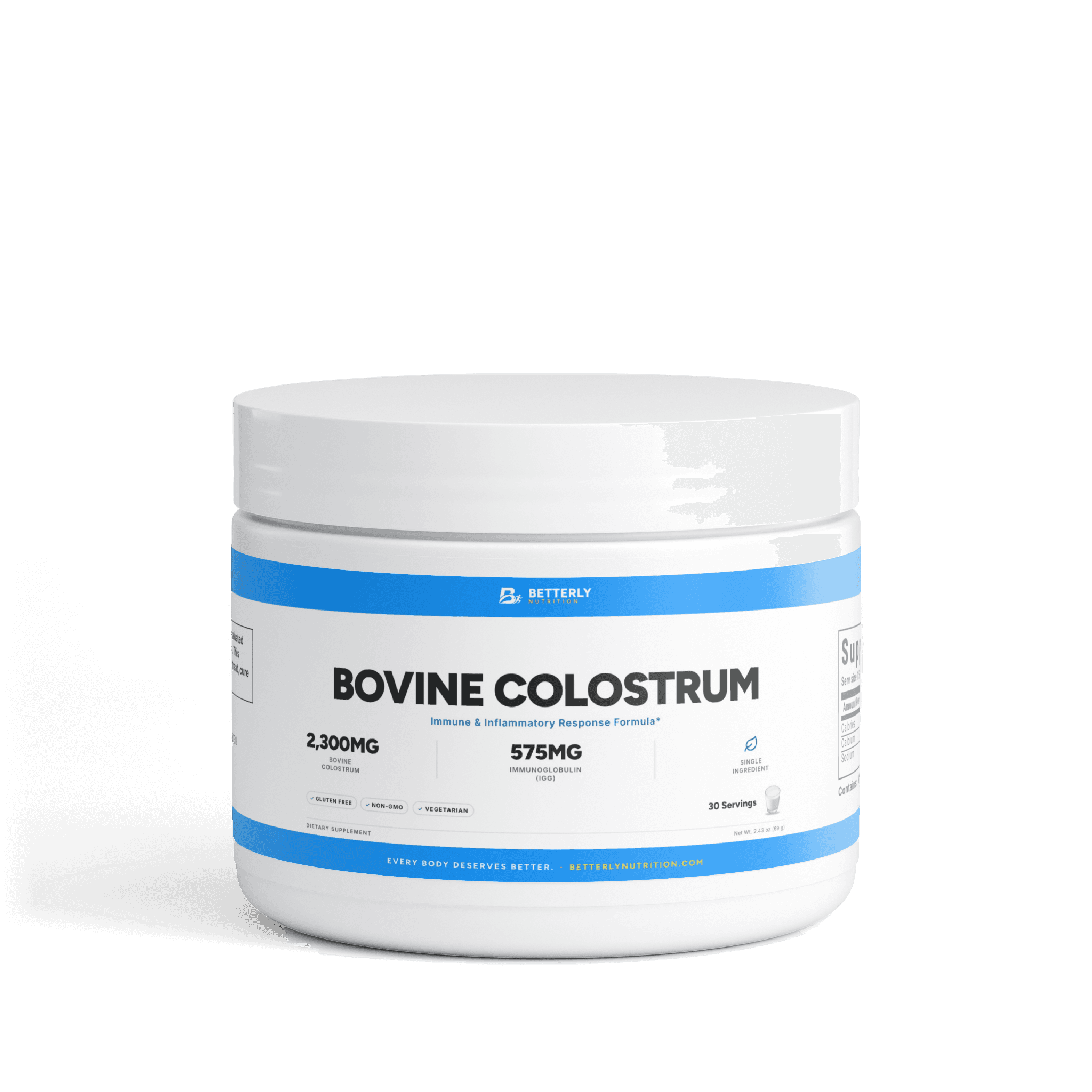
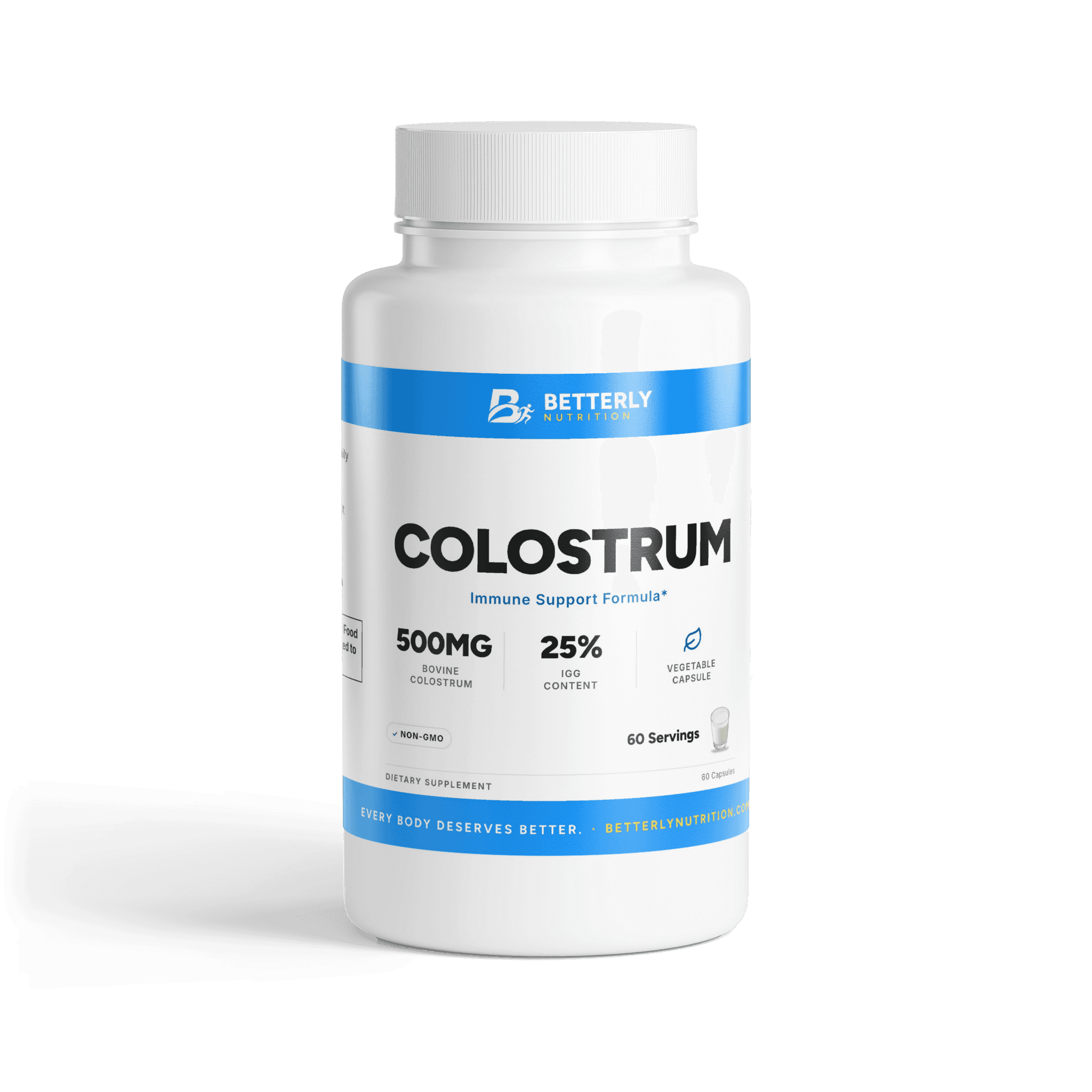
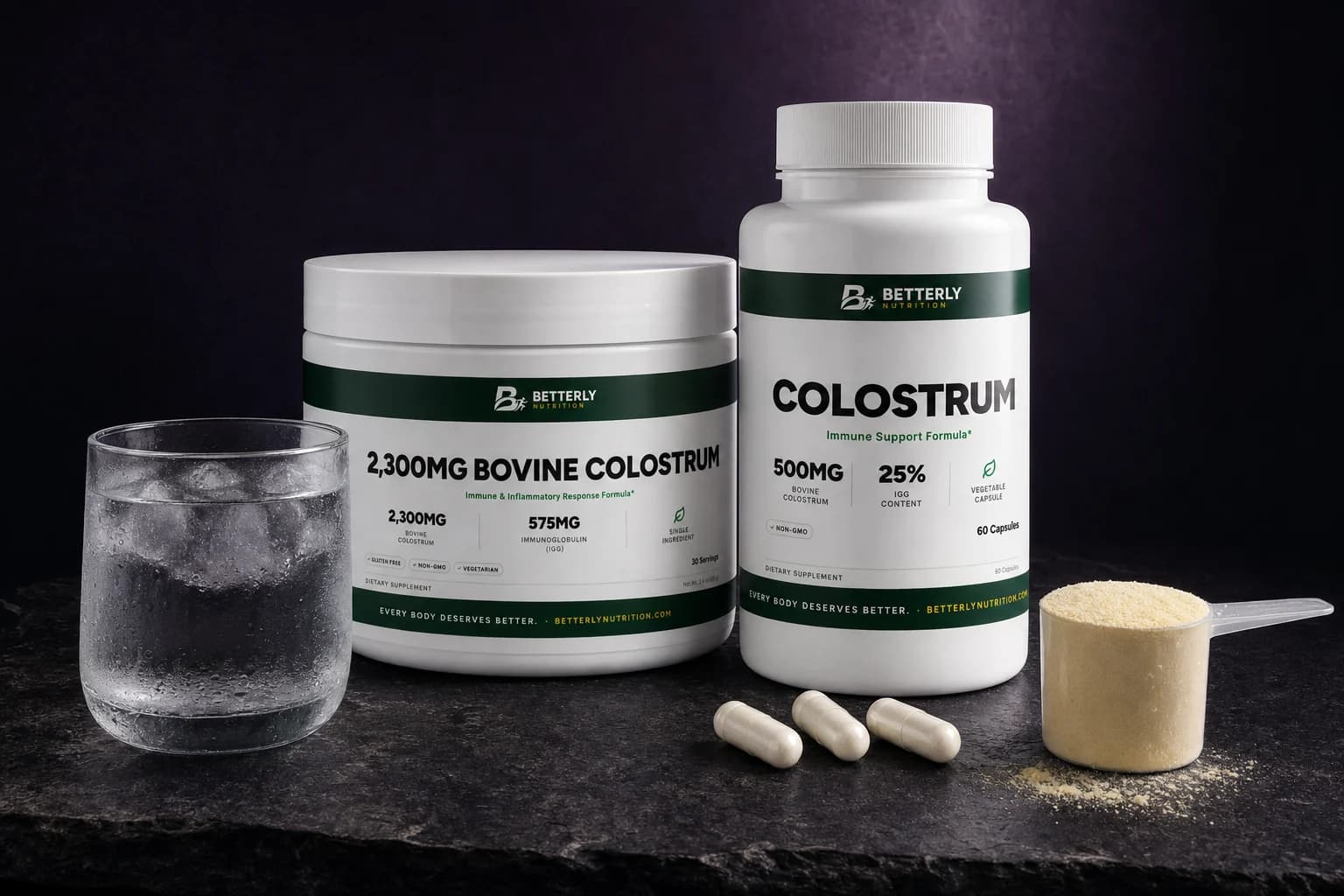
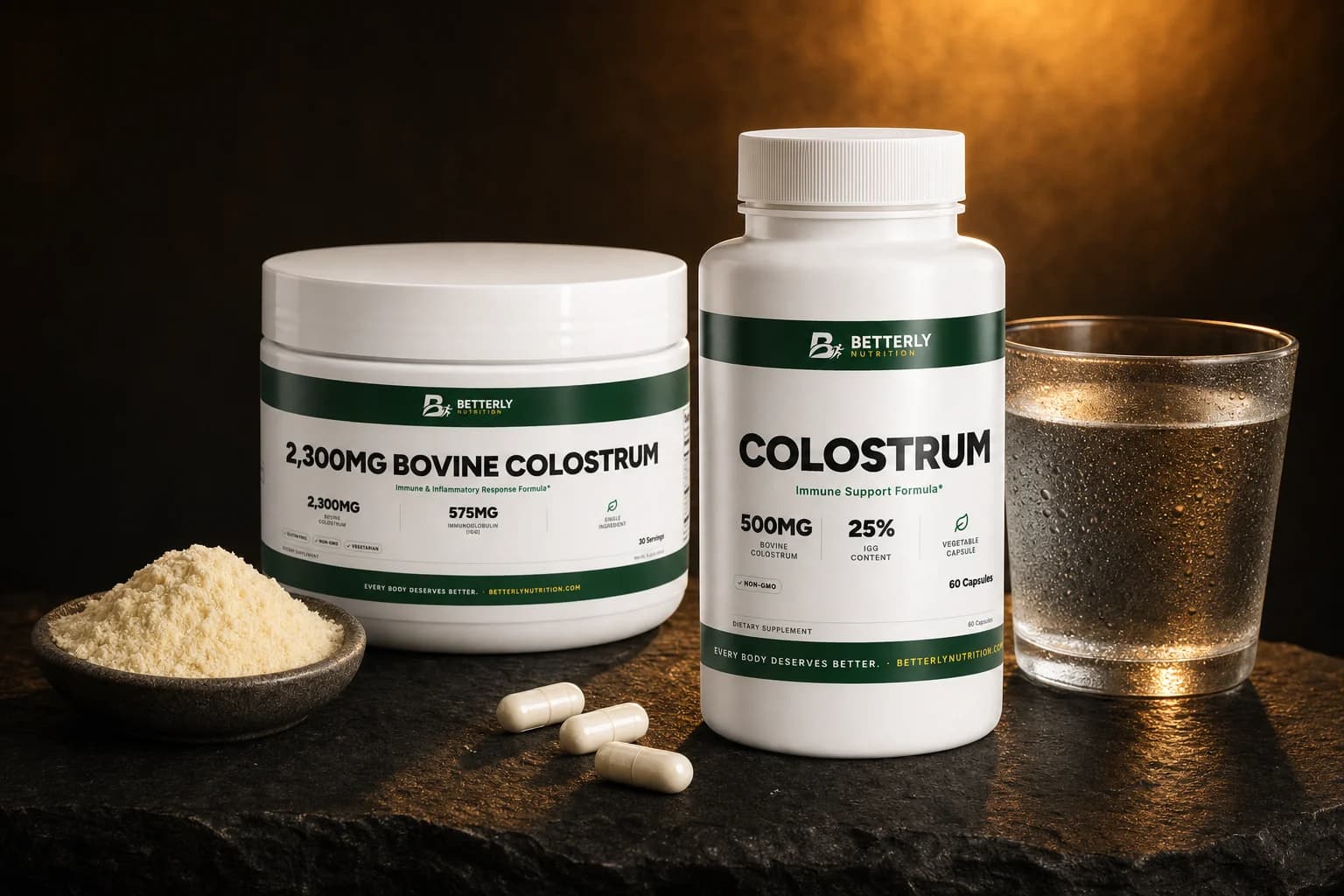
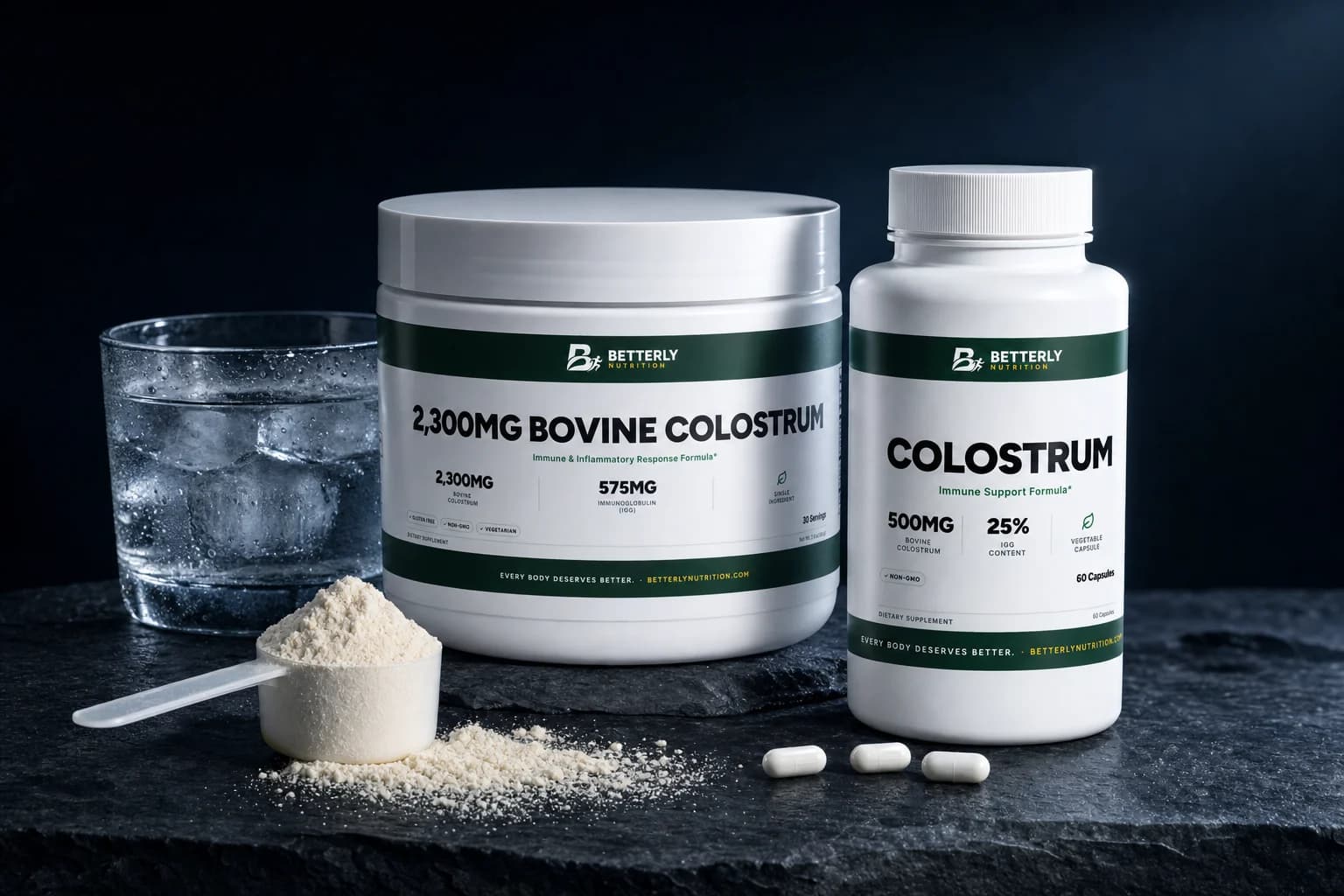
The short answer: Colostrum powder vs capsules is mostly a question of dose, not format. One 2.3 g scoop of Betterly's 2,300mg Bovine Colostrum Powder lists 2,300 mg of bovine colostrum and 575 mg of IgG. One of our Colostrum Capsules holds 500 mg at 25% IgG, which works out to about 125 mg. Even three capsules, the most the label allows in a day, add up to less than one scoop.
Key takeaways
- One 2.3 g scoop of our colostrum powder lists 575 mg of immunoglobulin G (IgG), about 4.6 times the roughly 125 mg in one Colostrum Capsule.
- Three capsules, our label's daily maximum, add up to 1,500 mg of colostrum and about 375 mg of IgG, still short of one scoop.
- The powder's label lists colostrum and nothing else, while the capsule adds five other ingredients.
- Only the powder label says gluten free and vegetarian, and both labels say "Contains: Milk (Colostrum)."
- Capsules suit you if you never want to mix a drink, and the powder suits you if you want the most colostrum per serving.
Betterly sells both products in this comparison, so you won't get a neutral referee here. What you will get is every figure from our two Supplement Facts panels, even where our capsule comes off second-best against our own tub.
Is colostrum powder better than capsules?
Betterly's colostrum powder isn't a better form of colostrum, but it holds far more per serving: 2,300 mg per scoop against 500 mg per capsule.
Colostrum is the early milk a cow produces in the first days after calving, and supplements sell it dried. Our capsule's facts panel calls its contents "Bovine Colostrum Powder," so the bottle holds powder too, just portioned into shells. Both labels list the colostrum at 25% IgG. What changes between tub and bottle is how much you get, what comes with it and how you take it.
Here's colostrum capsules vs powder, row by row, from the two labels:
| What you're comparing | Powder (1 scoop, 2.3 g) | Capsules (1 capsule) | Edge |
|---|---|---|---|
| Bovine colostrum | 2,300 mg | 500 mg | Powder |
| IgG | 575 mg, printed | About 125 mg (our math) | Powder |
| Other ingredients | None listed | Five listed | Powder |
| Label claims | Gluten free, non-GMO, vegetarian | Non-GMO | Powder |
| Preparation | 6-8 oz cold water or other drink, within 10 min | Swallow, preferably with meals | Capsules |
| Smallest daily amount | 2,300 mg | 500 mg | Capsules |
On the numbers, the powder takes four of the six rows. The capsule's wins are practical: nothing to mix, and a smaller amount if you want one. If a daily drink will never happen in your kitchen, the bottle is the one that fits.
How much IgG do you get per capsule vs per scoop?
A Betterly Colostrum Capsule gives about 125 mg of IgG, while one scoop of our colostrum powder lists 575 mg, so the scoop carries 4.6 times as much.
Immunoglobulin G, or IgG, is a type of antibody protein. It's the number most colostrum labels use to describe strength, and our two labels print it differently:
- The powder prints both figures: 2,300 mg of bovine colostrum "(25% Immunoglobulin G)" and a separate row for 575 mg of IgG. That's exactly 25% of 2,300 mg, so the panel checks out.
- The capsule prints only a percentage: 500 mg "(IgG 25%)." Multiply 500 by 0.25 and you get about 125 mg of IgG. That figure is our arithmetic, not a printed line.
So how many capsules equal one scoop? On paper, 4.6. But the capsule directions stop at three a day, which leaves you 800 mg of colostrum and 200 mg of IgG below a single scoop. Don't swallow extras to close that gap; the label says "Do not exceed recommended dose."
The same two steps work on any brand: find the colostrum milligrams per serving, then multiply by the IgG percentage if the milligrams aren't printed. Our guide to reading IgG on a colostrum label goes further.
What's in the capsule besides colostrum?
Betterly's Colostrum Capsules list five other ingredients: organic long grain white rice flour, MCT oil, silicon dioxide, L-leucine and a cellulose vegetable capsule. The powder lists none.
According to the NIH Office of Dietary Supplements' fact sheet Dietary Supplements: What You Need to Know, a Supplement Facts label shows the active ingredients, the amount per serving and "other ingredients, such as fillers, binders, and flavorings." Our capsule label doesn't say which job each item does, so we won't guess.
The order of that list does tell you something. The FDA's Dietary Supplement Labeling Guide, Chapter V says the heaviest ingredient goes first and the lightest goes last. So rice flour, listed first, outweighs the other four extras.
The same FDA chapter explains the blank space under the powder's panel. When every source ingredient already sits in the Supplement Facts box and there are no fillers or other additions, no ingredient statement is needed. That matches the "Single Ingredient" icon on the front of our tub.
Per scoop, the powder panel also lists 10 calories, 20 mg of calcium (2% DV), 5 mg of sodium and 25 mg of potassium, which come from the colostrum itself. The capsule panel lists no calories or minerals, and neither label lists a sweetener or flavoring.
From our shop: 2,300mg Bovine Colostrum Powder — a 30-serving tub where each 2.3 g scoop lists 2,300 mg of bovine colostrum, 575 mg of IgG and no other ingredients.
Why does only the powder say gluten free and vegetarian?
Each Betterly label makes its own claims: the powder's says gluten free, non-GMO and vegetarian, while the capsule's says non-GMO only.
A missing claim isn't proof of the opposite. It only means the capsule label doesn't make that promise, so we won't make it on the capsule's behalf. If gluten free matters to you, choose the powder.
Neither format is vegan or dairy free. Both labels print "Contains: Milk (Colostrum)." The FDA's guide Food Allergies: What You Need to Know names milk among the nine major food allergens, and a "Contains" statement beside the ingredients is one of two ways a label can flag it. A cellulose shell doesn't change the milk inside.
Check the fronts, too. The bottle's front reads "Immune Support Formula*," and the tub's front descriptor carries the same asterisk. That asterisk points to the FDA notice printed on both packs. ODS explains that when a label says a product supports a body function, such as the immune system, a notice must follow saying the FDA hasn't evaluated that statement.
Neither of our labels names a breed, a pasture or which milking the colostrum came from, so we don't claim any of those.
Are colostrum pills easier to take than powder?
For most routines, colostrum powder vs pills tips toward the pills: Betterly's capsules skip the scoop and the glass, and you swallow one, preferably with a meal.
The powder asks for a little setup. Its directions call for one scoop stirred into 6-8 oz (177-237 ml) of cold water or another favorite drink, then finished within 10 minutes. That's simple at a kitchen counter and clumsy in a car or at a desk.
Here's where each format tends to fit:
- Travel bags and desk drawers: capsules, with nothing to stir.
- A daily smoothie you already make: powder. The directions allow "cold water or favorite beverage," so the scoop can ride along.
- Starting small: capsules. One a day is 500 mg, and the label lets you stay there.
- Fewer things to swallow: powder. One drink covers more colostrum than three capsules.
- Not wanting to taste anything: capsules. The powder lists no flavoring, so the glass tastes of colostrum plus whatever you mix it into.
The capsule label also builds in steps the tub doesn't print. "1 to 3 times daily" lets you take 500 mg, 1,000 mg or 1,500 mg of colostrum, while the powder's directions don't describe a half scoop. For pairing capsules with meals, our guide on when to take colostrum covers the timing.
Which format gives you more colostrum per container?
Betterly's colostrum powder tub holds 69 g of colostrum across 30 scoops, while a 60-capsule bottle holds 30 g, so the tub carries 2.3 times as much.
The math comes straight from the labels. Thirty scoops at 2,300 mg each is 69 g, which matches the "Net Wt. 2.43 oz (69 g)" printed on the tub. Sixty capsules at 500 mg each is 30 g. Counted as IgG, the tub adds up to about 17.3 g (30 x 575 mg) and the bottle to about 7.5 g (60 x 125 mg).
How long each lasts depends on your count. The tub runs a month at one scoop a day. The bottle stretches or shrinks with you: two months at one capsule a day, one month at two, and just under three weeks at three.
We keep prices out of our guides because they change. To judge value, divide each product page's price by its grams of colostrum: 69 for the tub, 30 for the bottle.
How do you take colostrum powder or capsules, per the label?
Stir one scoop of Betterly's colostrum powder into 6-8 oz of cold water or another drink, or take 1 capsule 1 to 3 times daily, preferably with meals.
For the powder, the label says: "As a dietary supplement, adults use one (1) scoop of powder in 6-8 oz (177-237ml) of cold water or favorite beverage. Consume within 10 minutes of mixing." So pour cold water or another drink, add the 2.3 g scoop, stir or shake, and finish it within 10 minutes. Mix a fresh glass each time rather than making one ahead. Our colostrum powder mixing guide covers drink ideas.
For the capsules, the label reads: "Take 1 (one) capsule 1 to 3 times daily preferably with meals or as directed by a healthcare professional." One capsule with a meal is a complete serving. If you take more, give each its own meal and stop at three.
Pick one format rather than doubling up. The FDA's consumer page FDA 101: Dietary Supplements puts the rule plainly: "Take only as described on the label." To turn either one into a habit, our guide to building supplements into your day ties a scoop or a capsule to something you already do.
From our shop: Colostrum Capsules — a 60-capsule bottle for people who'd rather swallow than stir, with 500 mg of bovine colostrum at 25% IgG in each capsule.
When don't you need colostrum in either form?
Colostrum is optional: both Betterly labels mark it "Daily Value (DV) not established," so there's no daily target you'd fall short of by skipping it.
ODS also reminds readers that supplements can't stand in for a varied, healthy way of eating. Colostrum is an add-on, not a base layer.
You can reasonably skip both formats if:
- You avoid milk for any reason, since both labels declare it.
- You want something you'll feel within days. Neither label promises that, and neither do we.
- Your routine already feels crowded, and one more container would push out the ones you chose first.
- Your budget has to pick between colostrum and basics like sleep, fruit and vegetables, and regular movement.
The habits in our daily immune support routine come before any bottle. If you're weighing colostrum against other everyday options, our shortlist of everyday immune support supplements walks through them, and you can browse the whole immune support collection.
Who should check with a healthcare provider first?
Talk to a healthcare provider before starting either colostrum format if you're pregnant, nursing, younger than 18, on any prescription, facing surgery or living with a medical condition.
Our tub and bottle print one shared warning: "Do not exceed recommended dose. Consult a physician if pregnant, nursing, under 18, or have a medical condition." The FDA's consumer guide adds that some ingredients can be harmful in high amounts, over a long time, or combined with certain drugs or foods.
ODS notes that side effects are more likely at high doses or when you take many different supplements. It also asks you to tell your provider about any supplement before a surgical procedure, so put colostrum on that list.
If you notice a reaction you didn't expect after starting either format, stop taking it and call your healthcare provider.
FAQ: colostrum powder vs capsules
Is liquid colostrum better than powder?
We found no federal source showing liquid colostrum works better than powder or capsules, and Betterly doesn't sell a liquid. Several brand blogs quote absorption percentages and timing figures for each form without saying where those numbers came from, so we don't repeat them. What you can compare across any format is the label: colostrum milligrams per serving, the IgG amount or percentage, and what else is inside.
Can you open colostrum capsules and mix them into a drink?
Betterly's Colostrum Capsules label doesn't say to open them, so we can't recommend it. Opening one wouldn't give you the tub's formula either, since each capsule adds rice flour, MCT oil, silicon dioxide and L-leucine to its 500 mg of colostrum. If swallowing capsules is hard for you, ask your pharmacist, or consider the powder, which is meant to be mixed.
Does colostrum powder go bad after opening?
Colostrum powder can lose quality with time, so go by any date printed on the container and follow the label's storage line. Betterly's label asks you to keep it somewhere cool and dry, and to skip it if the safety seal is damaged or missing. Keep the lid tight and the scoop dry. Once mixed, the label gives you 10 minutes to drink it.
Can you take colostrum powder and capsules on the same day?
We'd pick one colostrum format rather than taking both. Each Betterly label gives its own serving and says "Do not exceed recommended dose," and neither was written with the other in mind. A scoop plus three capsules would come to 3,800 mg of colostrum, more than either label describes. If a provider suggests combining them, follow their advice and bring both labels along.
Is colostrum powder safe for kids?
Betterly's colostrum powder is labeled for adults, not children. Its directions say "adults use one (1) scoop," and both of our colostrum labels tell anyone under 18 to consult a physician first. The powder label also says "KEEP OUT OF THE REACH OF CHILDREN." For a child, colostrum is a question for their pediatrician rather than a supplement label.
Sources
- FDA 101: Dietary Supplements, U.S. Food and Drug Administration
- Dietary Supplement Labeling Guide: Chapter V. Ingredient Labeling, U.S. Food and Drug Administration
- Dietary Supplements: What You Need to Know, NIH Office of Dietary Supplements
- Food Allergies: What You Need to Know, U.S. Food and Drug Administration
If this left you looking for somewhere to start, read bovine colostrum powder with 575 mg IgG per scoop — its amounts per serving are listed on the page. For the practical questions this raises, how dosing, sourcing and subscriptions work is answered in one place.