On this page
- Key takeaways
- Chaga vs turkey tail: how do they compare on the tree and the label?
- Where do chaga and turkey tail grow, and what do they look like?
- Does the NIH immune fact sheet cover chaga or turkey tail benefits?
- Which Betterly products contain chaga, turkey tail or both?
- Chaga and turkey tail together: does adding a chaga single double up?
- Reishi, chaga and turkey tail on one panel: which gets a number?
- What daily serving do our chaga and turkey tail labels list?
- Who can skip chaga and turkey tail altogether?
- Who should check with a healthcare provider first?
- FAQ: chaga vs turkey tail
- Sources
The short answer: Chaga vs turkey tail pairs two wood-rotting fungi, and of the two, only chaga gets its own number on our labels: 1,000 mg per 2-capsule serving in our Organic Chaga Mushroom Capsules and 87 mg per 1-gummy serving in our Lion's Mane & Chaga Mushroom Gummies. Turkey tail (Trametes versicolor) turns up in five of our products, always as an unmeasured share of a blend. The NIH's fact sheet on immune function reviews neither one.
Key takeaways
- Turkey tail (Trametes versicolor) appears in five of our products, and none of those labels prints how much you get.
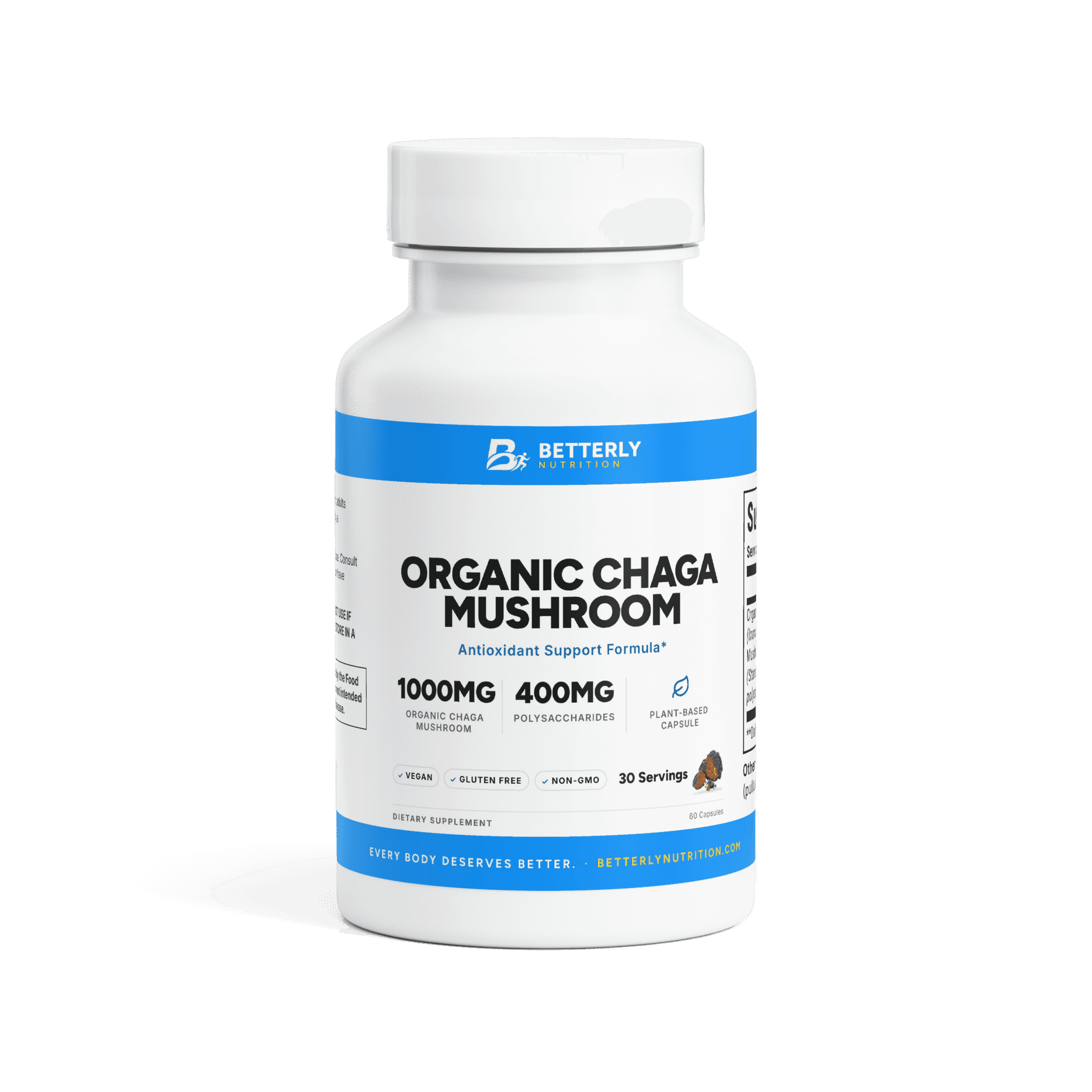
- Our Organic Chaga Mushroom Capsules list 1,000 mg of chaga mycelium powder per 2-capsule serving, and our Lion's Mane & Chaga Mushroom Gummies list 87 mg of chaga extract per 1-gummy serving.
- Blends list ingredients by weight, so turkey tail's share can only be capped: at most 10 mg per 1 ml of our reishi drops, just under 252 mg per 7 g scoop of our powder.
- The NIH Office of Dietary Supplements' consumer fact sheet on immune function reviews no mushroom at all.
Disclosure: Betterly sells chaga on its own and turkey tail inside several blends, so we have a stake on both sides. Every product figure below is printed on our Supplement Facts panels or worked out from them, and we flag the gaps.
Chaga vs turkey tail: how do they compare on the tree and the label?
On the tree, chaga is a black lump on birch and turkey tail a banded shelf on hardwood; on our shelf, only chaga comes as a single-ingredient product.
| Chaga | Turkey tail | |
|---|---|---|
| Scientific name | Inonotus obliquus | Trametes versicolor (also Coriolus versicolor) |
| Host | Living or recently dead birch, rarely poplar | Hardwood trees and logs |
| Looks like | Hard, cracked, black to dark brown mass | Thin, leathery bracket with colored bands |
| Inside or underneath | Yellow to rusty-brown interior | White to yellow pores |
| Our single-ingredient product | Organic Chaga Mushroom Capsules | None |
| Its own printed amount in our range | Yes: 1,000 mg (capsules), 87 mg (lion's mane gummies) | No |
The last two rows are where the fungi part ways for a shopper. You can buy a measured amount of chaga from us in the Organic Chaga Mushroom Capsules. A measured amount of turkey tail isn't something we sell.
Where do chaga and turkey tail grow, and what do they look like?
Chaga grows almost only on birch, while turkey tail breaks down many kinds of hardwood, and the two look nothing alike on a tree.
On its Alaska Region page about hardwood stem decays, the USDA Forest Service files chaga under the name cinder conk. Picture a hard, rough, deeply cracked lump, black to dark brown outside and yellow to rusty-brown inside. Its hosts are birch, living or recently dead, and rarely poplar. The page calls the black mass sterile: spore-bearing conks form only after the tree dies, and they don't last.
Turkey tail looks like the opposite. The Forest Service's Field Guide to Common Macrofungi in Eastern Forests describes a thin, leathery, bracket-like cap with a velvety surface and concentric bands of brown, red, yellow, gray and blue. Turn one over and you'll see white to yellow pores.
Those shapes carry over to ingredient lists. Turkey tail's shelves are its fruiting bodies, the spore-releasing part. Chaga is murkier. Two of our blend panels point to the fruit: the Mushroom Capsules print "(Fruit)" after chaga, and the Mushroom Gummies print "Chaga Fruiting Body." With a sterile lump and short-lived conks to pick from, those words leave you guessing which one went in. Our explainer on fruiting body and mycelium labels goes deeper on that wording.
The field guide also lists turkey tail as inedible and warns against eating any wild mushroom you can't identify with certainty.
Does the NIH immune fact sheet cover chaga or turkey tail benefits?
No, the NIH's consumer fact sheet on immune function doesn't review chaga or turkey tail, so talk of chaga vs turkey tail benefits has no federal summary behind it.
The immune-function sheet from the Office of Dietary Supplements (ODS, part of the NIH) walks through vitamins, minerals, six botanicals from andrographis to tea, and a few extras such as probiotics. No mushroom appears.
Its opening point is worth keeping: "Eating a variety of nutritious foods can give you enough vitamins, minerals, and other nutrients for a healthy immune system." A mushroom supplement comes after your plate, not in place of it.
That leaves label language, and ours doesn't give chaga and turkey tail separate jobs. The chaga capsules call themselves an "Antioxidant Support Formula." Three of the five products carrying turkey tail use immune wording in their formula line, and two of those three hold chaga too:
- Mushroom Capsules: "Immune & Mental Clarity Formula"
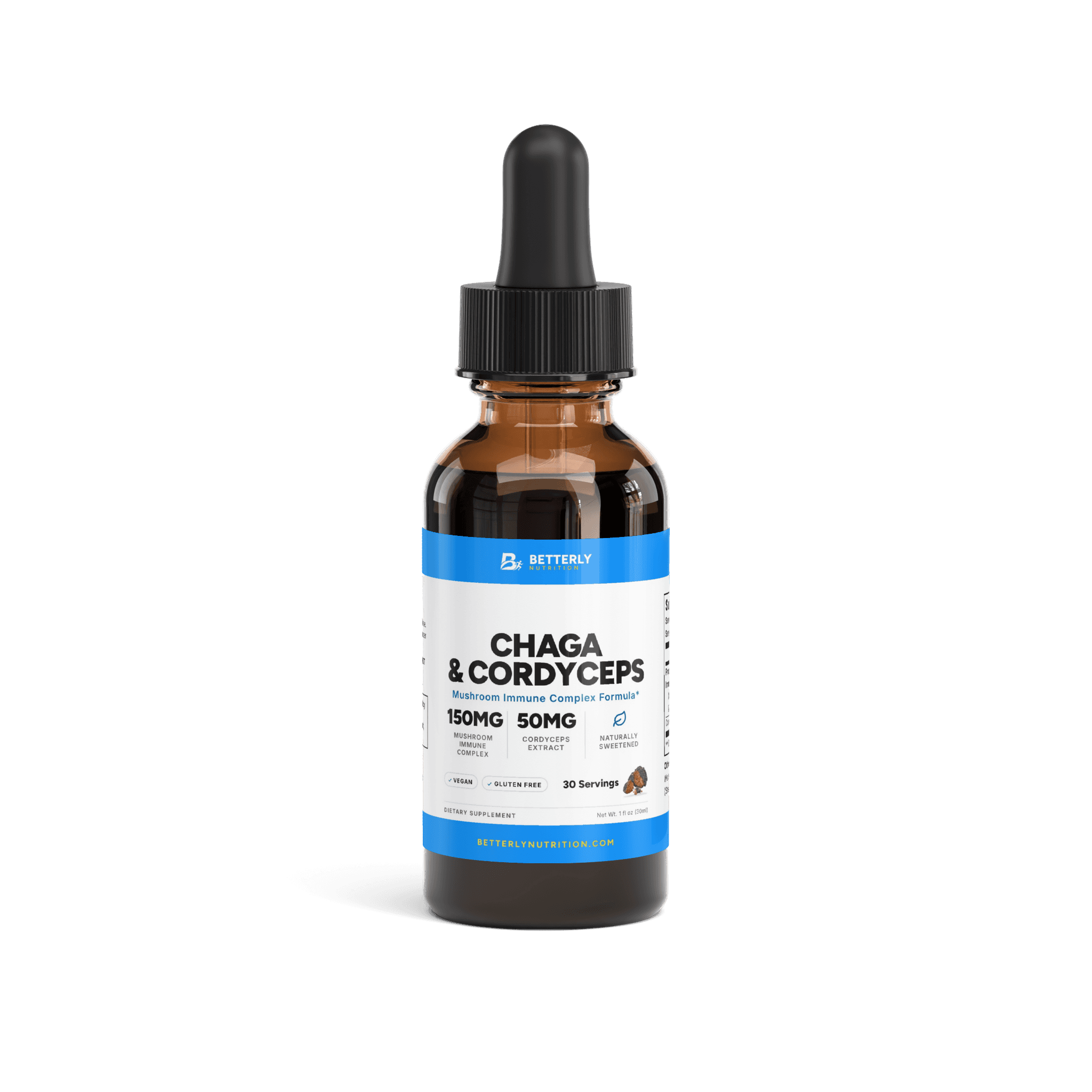
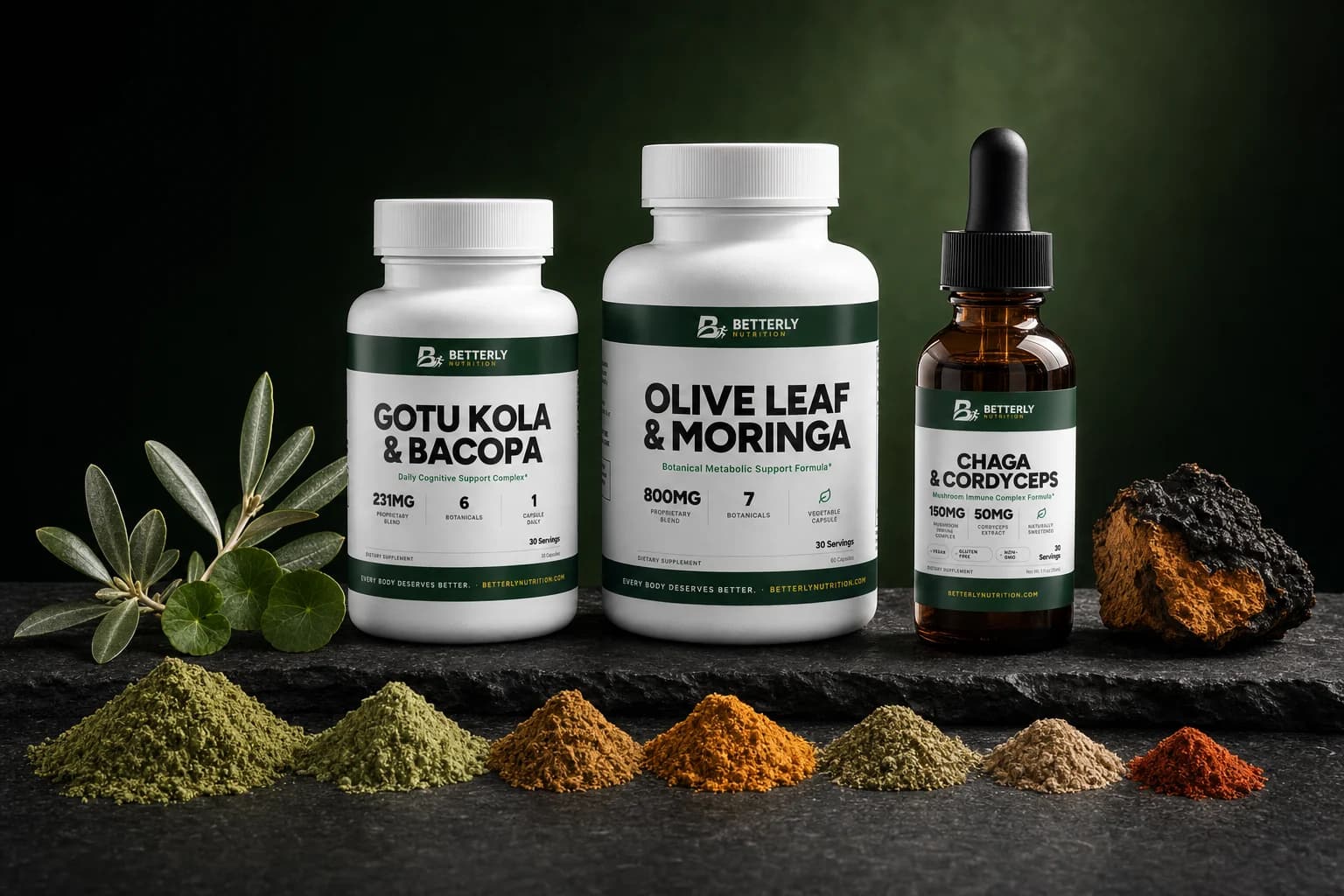
- Chaga & Cordyceps Mushroom Drops: "Mushroom Immune Complex Formula," with chaga named first
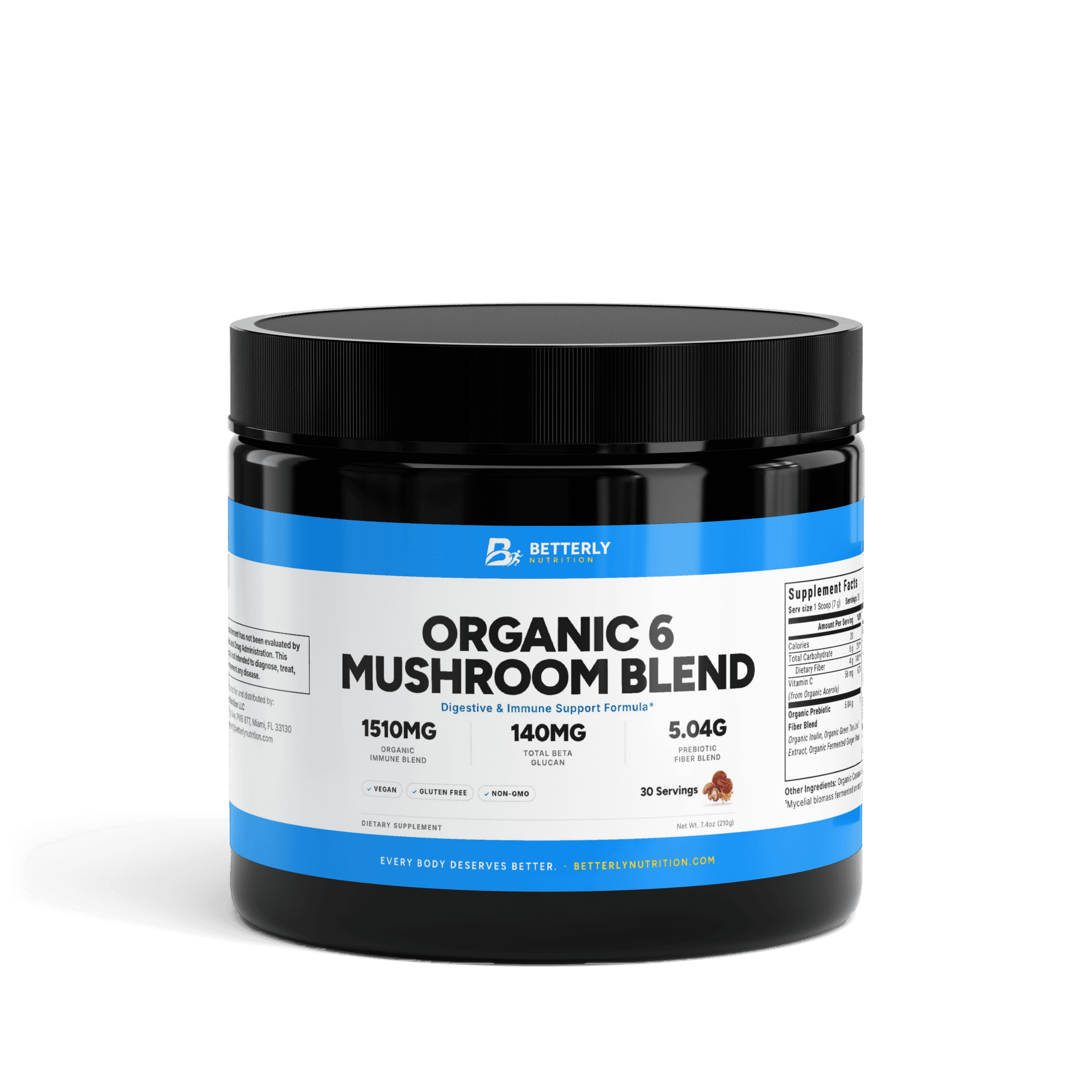
- Organic 6 Mushroom Blend Powder: "Digestive & Immune Support Formula," and no chaga
The other two, the Mushroom Gummies and the Reishi Mushroom Calm Drops, carry turkey tail under formula lines that never mention immunity. Where immune wording appears, it describes support for normal immune function, not an effect you'll feel.
Which Betterly products contain chaga, turkey tail or both?
Chaga appears in six of our products and turkey tail in five, but only chaga ever gets its own printed amount.
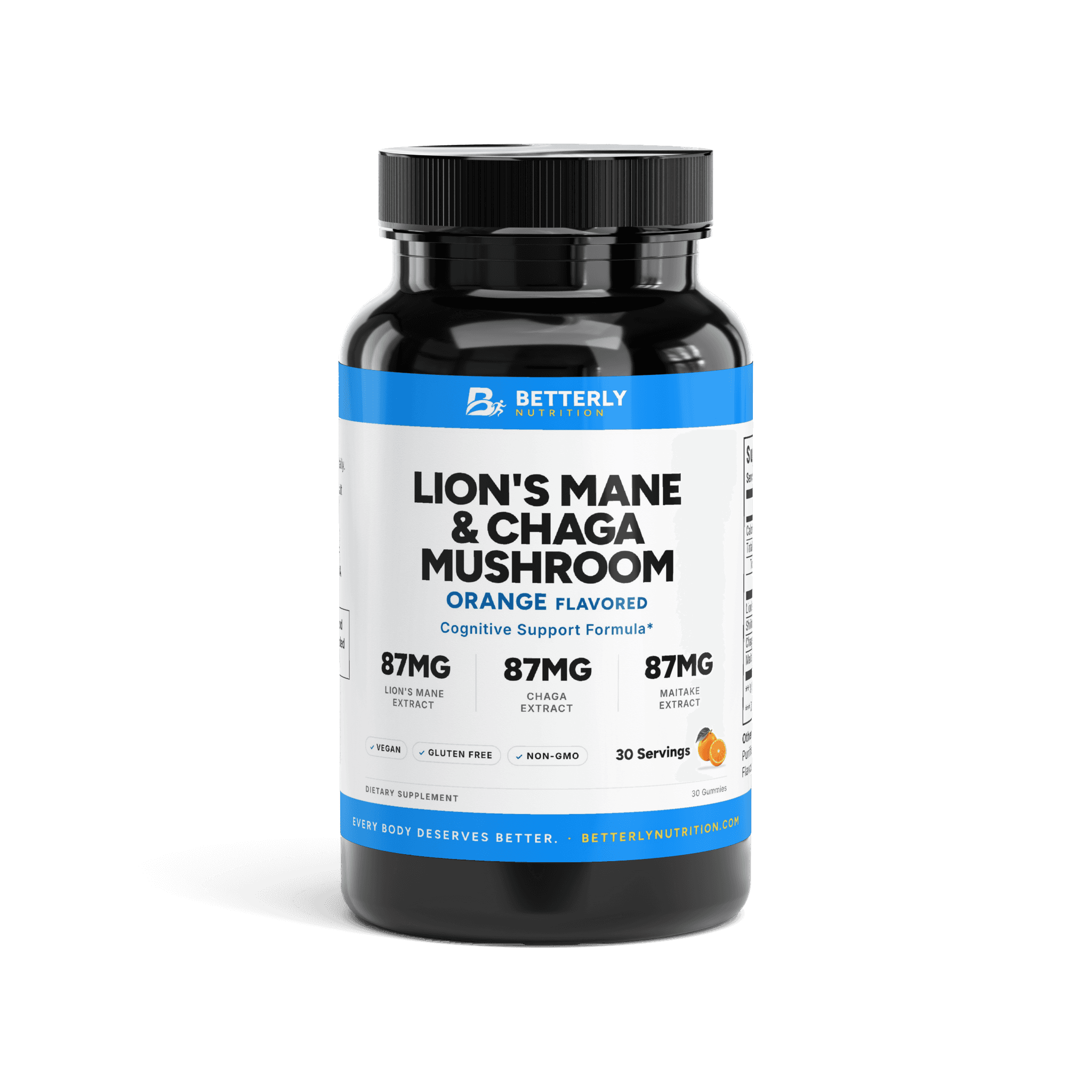
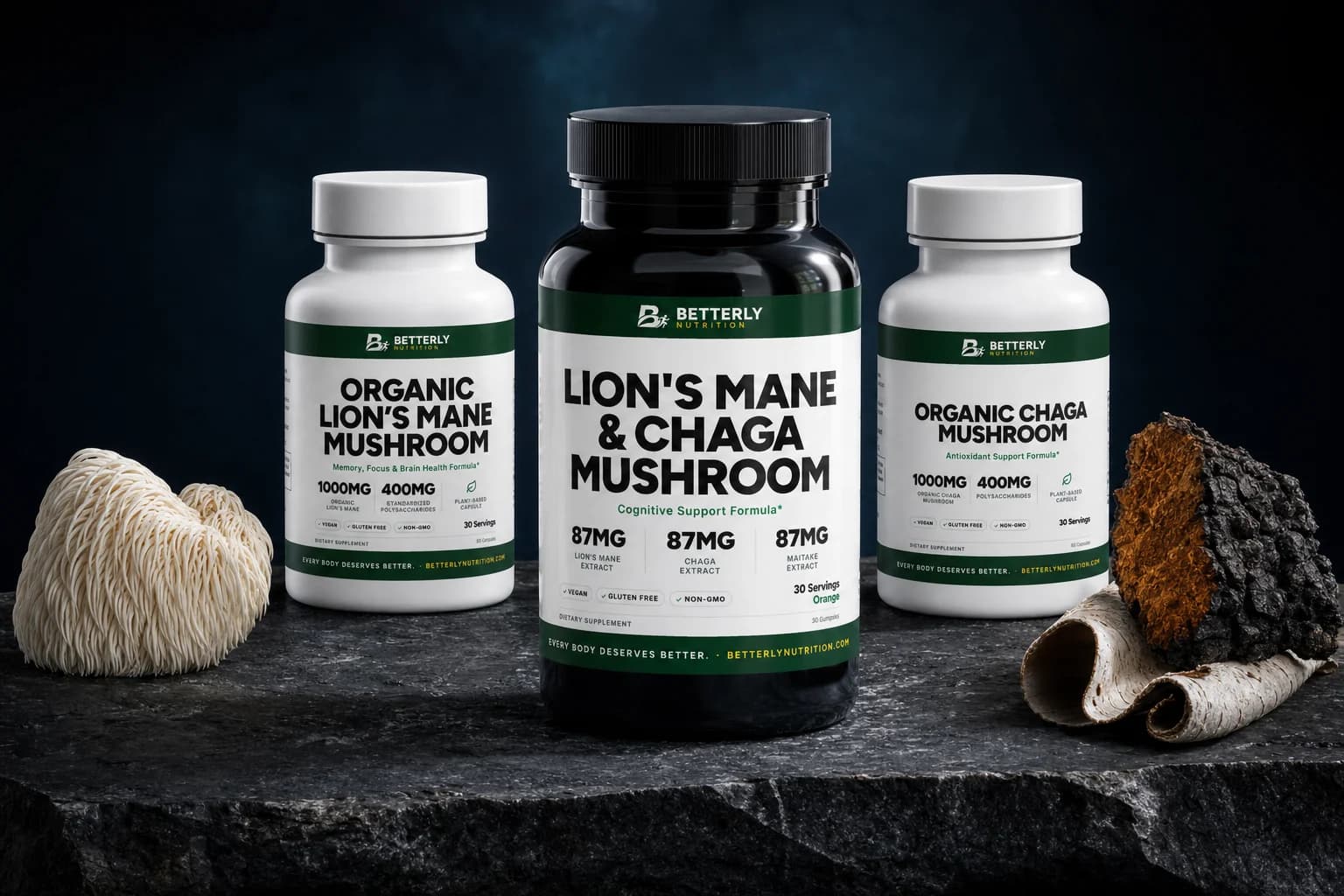
Beyond the capsules' 1,000 mg, chaga gets its own row on the Lion's Mane & Chaga Mushroom Gummies: 87 mg of chaga extract per 1-gummy serving, and no turkey tail. Their suggested use is one to two gummies daily.
The blends still allow a rough range. 21 CFR 101.36, the federal rule for supplement labels, has a blend name its contents "in descending order of predominance by weight." So second place can't exceed half the blend, third place can't top a third, and first place gives you a floor.
| Product (serving) | Chaga | Turkey tail |
|---|---|---|
| Organic Chaga Mushroom Capsules (2 capsules) | 1,000 mg, its own row | Not listed |
| Lion's Mane & Chaga Mushroom Gummies (1 gummy) | 87 mg, its own row | Not listed |
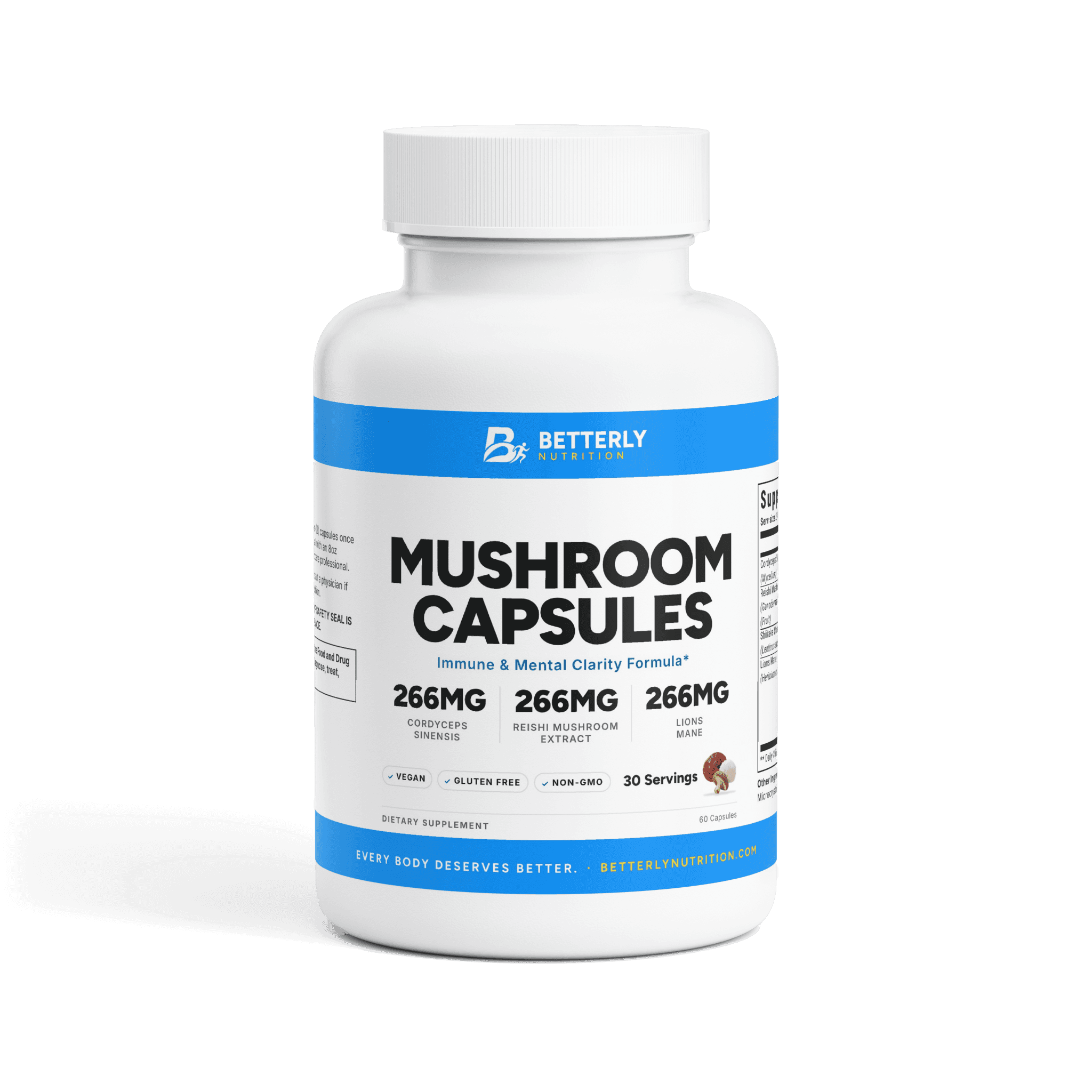
| Mushroom Capsules (2 capsules) | 3rd of 6 in a 266 mg blend: under 89 mg | 2nd of 6: 133 mg at most |
| Mushroom Gummies (2 gummies) | 6th of 10 in a 250 mg blend: under 42 mg | 7th of 10: under 36 mg |
| Chaga & Cordyceps Mushroom Drops (1 ml) | 1st of 5 in a 150 mg complex: 30 mg or more | 5th of 5: 30 mg at most |
| Reishi Mushroom Calm Drops (1 ml) | 1st of 5 in a 50 mg complex: 10 mg or more | 5th of 5: 10 mg at most |
| Organic 6 Mushroom Blend Powder (7 g scoop) | None | 6th of 6 in a 1,510 mg blend: under 252 mg |
Read the turkey tail column as ceilings, not doses; the real share could sit far below each one. The powder has the highest ceiling, but its footnote reads "Mycelial biomass fermented on organic oats," so grain counts toward that weight too.
Only two numbers here measure a compound rather than a weight. The chaga capsules are standardized to 40% polysaccharides, 400 mg per 2-capsule serving. The powder prints 140 mg of total beta-glucan per scoop for its whole 1,510 mg Organic Immune Blend, oats and all, so there's no way to assign it to one species, or even to the fungi alone. Our walkthrough of proprietary blend labels applies the same ranking logic to other formulas.
From our shop: Organic Chaga Mushroom Capsules — a single-ingredient chaga capsule with 1,000 mg of organic mycelium powder in each 2-capsule serving and polysaccharides printed at 400 mg.
Chaga and turkey tail together: does adding a chaga single double up?
Yes, adding a chaga single to any of our four chaga-and-turkey-tail blends doubles up on chaga, so one blend on its own is the simpler way to get both.
Our labels don't address stacking, so watch the chaga overlap. Adding the chaga capsules to the Mushroom Capsules means 1,000 mg of chaga mycelium plus up to about 89 mg more. With the Chaga & Cordyceps drops instead, the extra lands between 30 mg and just under 150 mg, and the lion's mane gummies add 87 mg per gummy.
Why track chaga? In a 2015 laboratory analysis, covered in our lion's mane and chaga guide, oxalic acid came out as chaga's most abundant organic acid. That guide also reviews a 2022 case report tied to months of very large daily chaga powder intake. So stick with a single chaga product at its label amount, and ask a healthcare provider before combining any of these.
Reishi, chaga and turkey tail on one panel: which gets a number?
Reishi does: of our four products listing reishi, chaga and turkey tail together, two print a reishi amount, and none prints a chaga or turkey tail amount.
- Mushroom Capsules: 266 mg of reishi extract on its own row, with chaga and turkey tail in the 266 mg blend.
- Reishi Mushroom Calm Drops: all three in a 50 mg complex, on top of 150 mg of reishi extract.
- Chaga & Cordyceps Mushroom Drops: all three share the 150 mg complex, and cordyceps extract gets its own 50 mg line.
- Mushroom Gummies: all three in a 250 mg blend, with 5 g of added sugars per 2 gummies.
The reishi drops aim at a different job, "Calm & Relaxation Support," so a three-mushroom bottle isn't three doses for one purpose.
What daily serving do our chaga and turkey tail labels list?
Each of our four main chaga and turkey tail products is labeled for one serving a day: 2 capsules, 1 ml of drops or one 7 g scoop.
- Organic Chaga Mushroom Capsules: "adults take two (2) capsules daily or as directed by a healthcare professional."
- Mushroom Capsules: 2 capsules, once daily. For best results, the label suggests 20 to 30 minutes before a meal with an 8 oz (237 ml) glass of water.
- Chaga & Cordyceps Mushroom Drops: "Shake well. Take 1 ml (30 drops) daily."
- Organic 6 Mushroom Blend Powder: one 7 g scoop a day, mixed into food or drinks. Each scoop also carries 56 mg of vitamin C from acerola (62% of the Daily Value) and 4 g of dietary fiber.
All four labels also print "Do not exceed recommended dose."
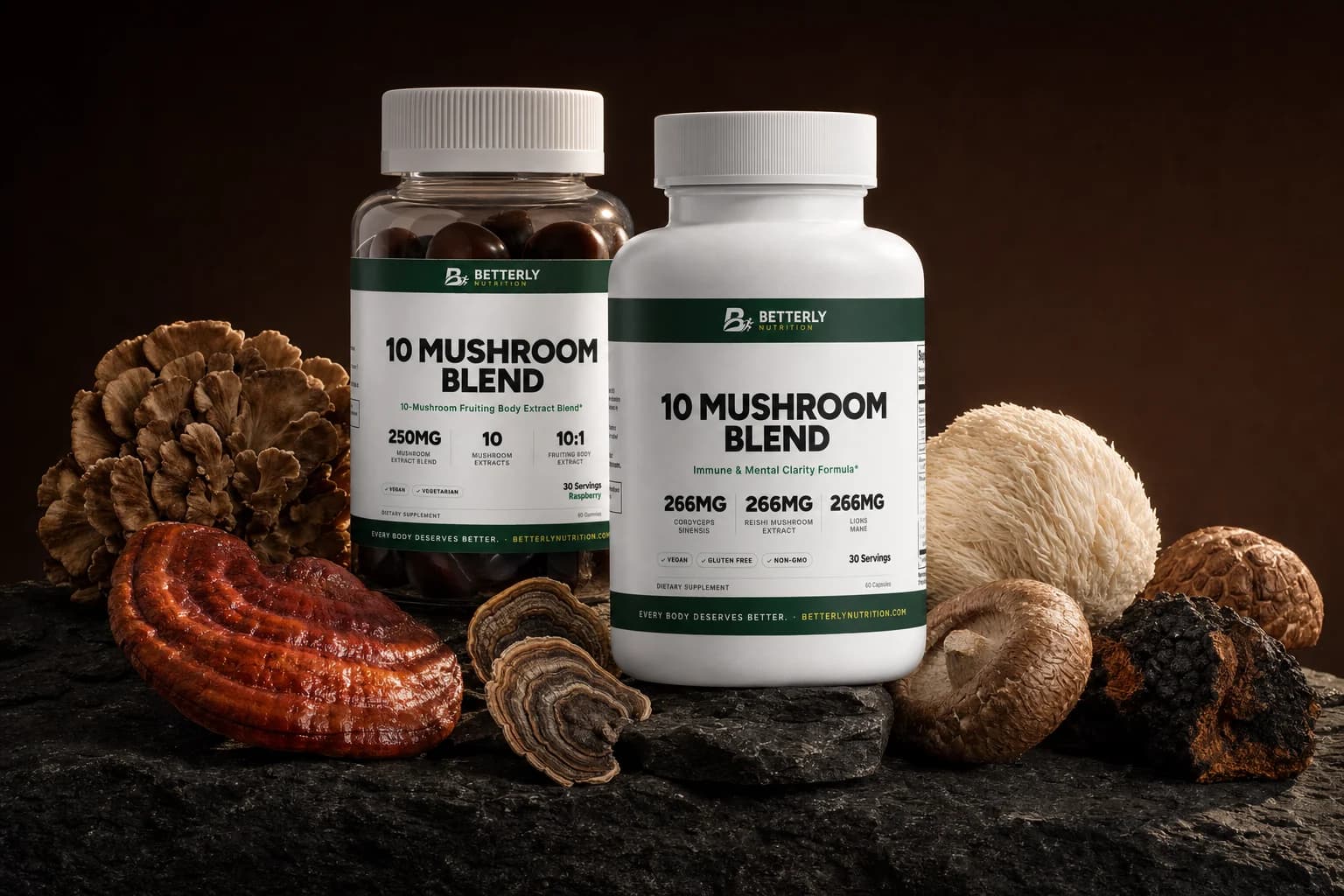
From our shop: Mushroom Capsules — chaga and turkey tail share its 266 mg six-mushroom blend, next to cordyceps, reishi, shiitake and lion's mane at 266 mg apiece per 2-capsule serving.
Who can skip chaga and turkey tail altogether?
Skip our chaga and turkey tail products if you want a measured turkey tail dose, which none of our labels prints, or if you already use a mushroom blend.
The blend table's ceilings can't tell you what's in your serving, and a new bottle may repeat species you already take or add a second chaga source.
If you're after the nutrients the ODS sheet names up front, such as vitamin C, vitamin D and zinc, look beyond mushrooms. Our Immune Support collection carries non-mushroom options too.
Who should check with a healthcare provider first?
Check with a healthcare provider before you start chaga or a turkey tail blend if you're pregnant or nursing, under 18, on any prescription or managing a medical condition.
All seven labels in this guide share one caution: "Consult a physician if pregnant, nursing, under 18, or have a medical condition." ODS adds that some supplements interact with medicines, so tell your doctor and pharmacist about everything you take. Also raise these:
- If a provider keeps an eye on your kidneys, show them your chaga products and their amounts from the table above (blends give only a range), since chaga contains oxalate.
- Booked for an operation or dental work? Mention your mushroom products at the planning stage, not that morning.
- If caffeine bothers you, note that the powder's fiber blend lists organic green tea leaf extract with no caffeine figure. ODS notes that tea contains caffeine and that some green tea extracts might harm the liver, especially on an empty stomach.
- If a mushroom dish or supplement has ever made you feel unwell, say so before starting either fungus.
FAQ: chaga vs turkey tail
Is turkey tail or chaga better for immune support?
Neither turkey tail nor chaga has earned that title. The NIH's immune-function fact sheet reviews neither mushroom, so there's no federal ranking to lean on. On our shelf, the chaga capsules are labeled for antioxidant support, while three of our turkey tail blends put immune wording in their formula line, two of them with chaga. If one blend holding both suits you, that's simpler than picking a winner.
Can you make chaga and turkey tail tea together?
Not with our products, because none of our chaga or turkey tail items is sold as a tea. The only one whose label says to mix it into food or drinks is the Organic 6 Mushroom Blend Powder, one 7 g scoop a day, and it holds turkey tail but no chaga. Please don't forage wild turkey tail for a home brew, since the Forest Service field guide lists it as inedible.
Does the Organic 6 Mushroom Blend Powder contain chaga?
No, the Organic 6 Mushroom Blend Powder has no chaga. Its panel names cordyceps, reishi, himematsutake (royal sun agaricus), shiitake, maitake and turkey tail, each grown as mycelium on organic oats. For both in one serving, look at the 10-mushroom products or either of our drops.
Is turkey tail safe to take every day?
Each of our turkey tail products is labeled for one serving a day, but no federal page we used reviews turkey tail's safety as a supplement, so we won't call daily use risk-free. The labels themselves are clear: don't exceed the recommended dose, and consult a physician first if you're pregnant, nursing, under 18 or have a medical condition. If you also take chaga, stick with a single chaga product.
Should you take chaga or turkey tail in the morning or at night?
Morning or night both work for chaga and turkey tail, since only one of our labels for them gives any timing. The Mushroom Capsules suggest 20 to 30 minutes before a meal, with water. For the chaga capsules, drops and powder, tie your serving to a habit you already keep.
Sources
- Hardwood Stem Decays (USDA Forest Service, Alaska Region)
- Field Guide to Common Macrofungi in Eastern Forests, GTR NRS-79 (USDA Forest Service)
- Dietary Supplements for Immune Function, Consumer Fact Sheet (NIH Office of Dietary Supplements)
- 21 CFR 101.36, Nutrition labeling of dietary supplements (eCFR)
If this left you looking for somewhere to start, read single-ingredient chaga mushroom capsules — its amounts per serving are listed on the page. For the practical questions this raises, how dosing, sourcing and subscriptions work is answered in one place.