On this page
- Key takeaways
- What mushrooms are in a 10 mushroom blend?
- What are the real 10 mushroom blend benefits?
- What are the benefits of each mushroom in a 10 mushroom complex?
- Is 266 mg of each mushroom enough to matter?
- How are the Mushroom Gummies different from the capsules?
- How do you take a mushroom complex, per the label?
- What are the side effects of a mushroom complex?
- When is a multi-mushroom blend the wrong pick?
- Who should check with a healthcare provider first?
- FAQ: 10 mushroom blend
- Sources
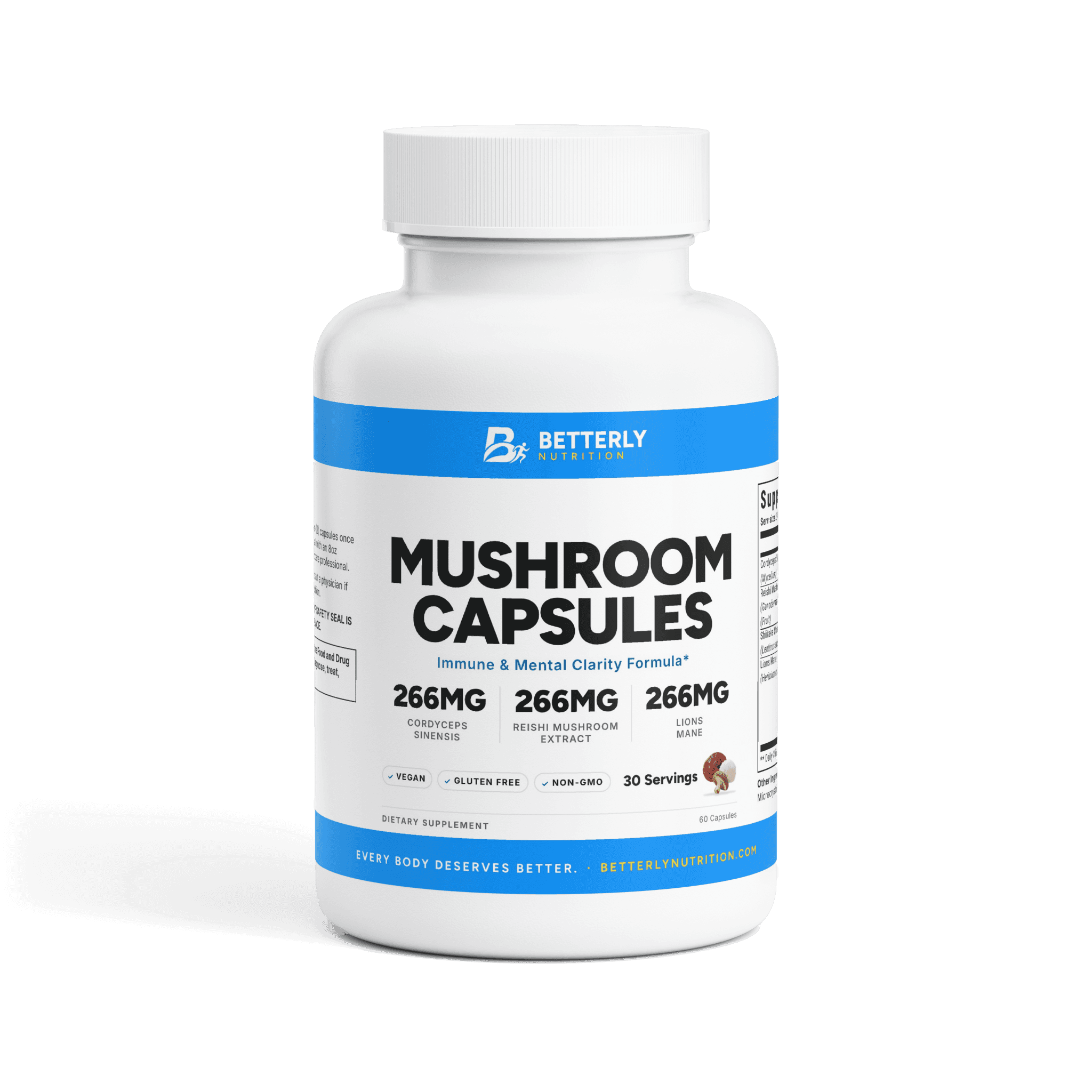
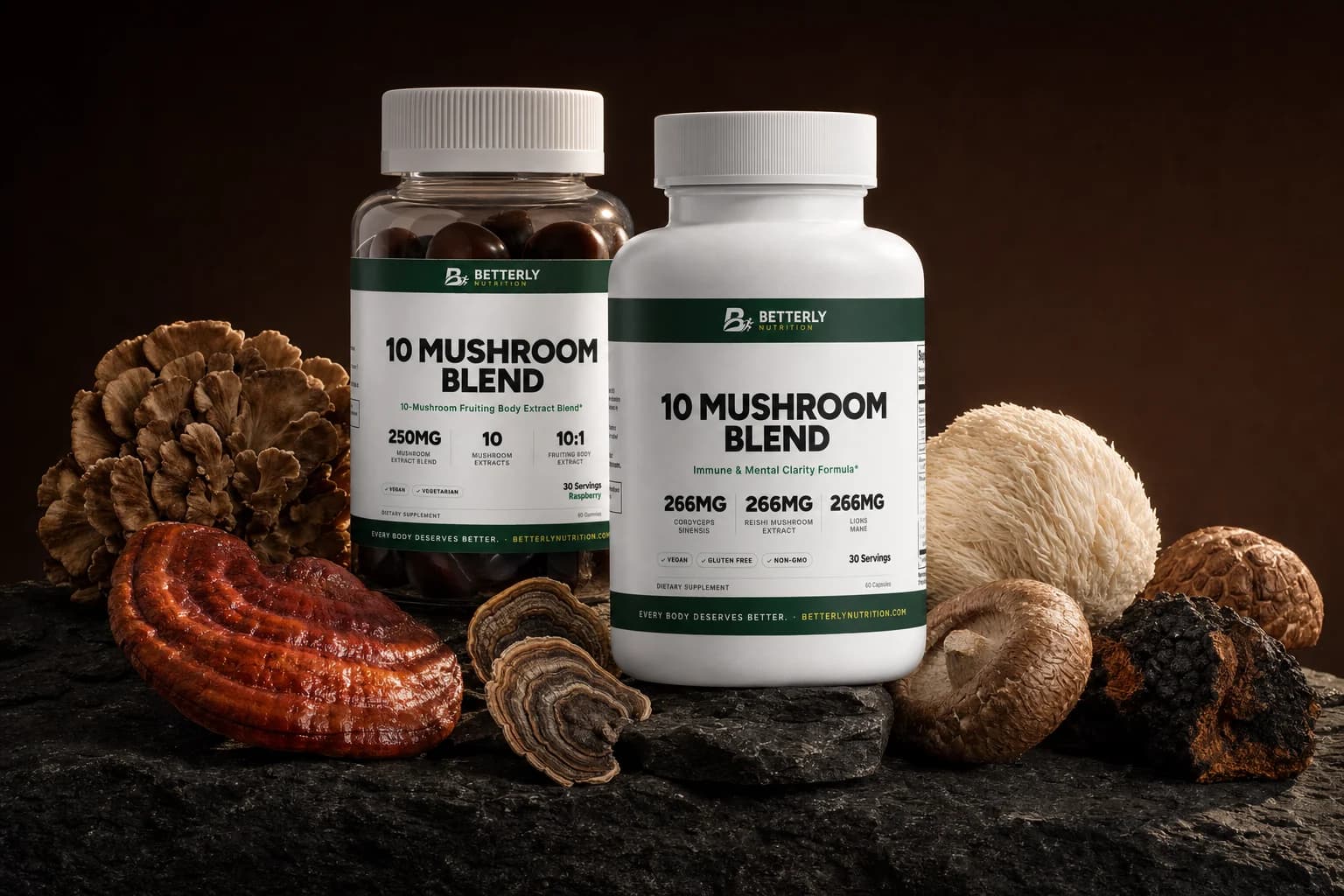
The short answer: No federal source we read confirms 10 mushroom blend benefits in people, and a U.S. military supplement-safety program says evidence is lacking for functional mushrooms used as anything but food. Our Mushroom Capsules print 266 mg each of cordyceps, reishi, shiitake and lion's mane per 2-capsule serving, then put six more mushrooms in one 266 mg proprietary blend.
Key takeaways
- Our Mushroom Capsules name ten species, but only four get their own amount: 266 mg each of cordyceps, reishi, shiitake and lion's mane per 2-capsule serving.
- Maitake, turkey tail, chaga, royal sun agaricus, white button and black fungus share one 266 mg proprietary blend, so each one's share isn't printed.
- NIH's LiverTox database says the effects sold for reishi, cordyceps and lion's mane haven't been shown in well-run human trials.
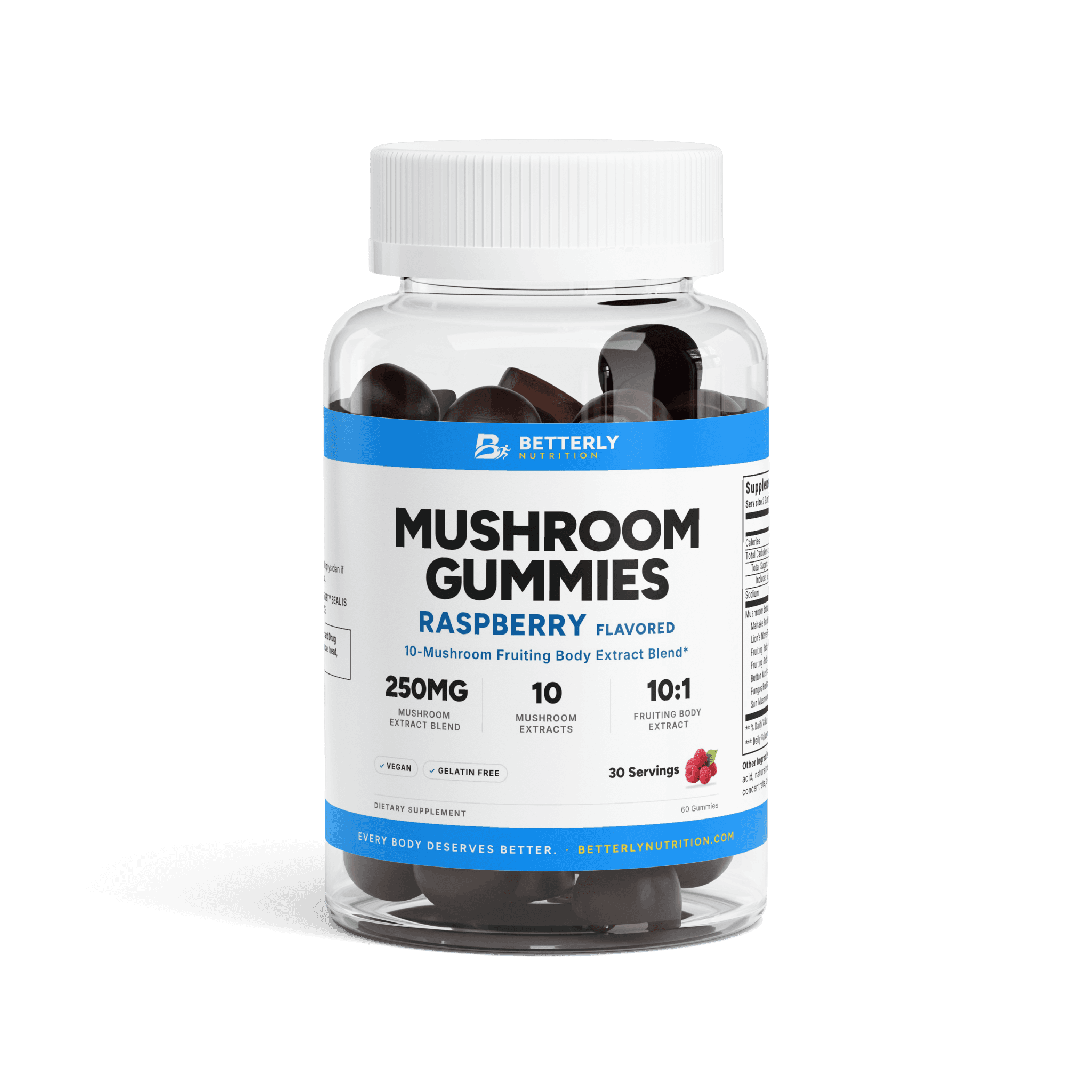
- The Mushroom Gummies list the same ten as 10:1 fruiting body extracts, 250 mg in total per 2 gummies, with 5 g of added sugars.
- The capsule label sets a ceiling of two capsules once a day, and suggests taking them 20-30 minutes before a meal.
Betterly sells both ten-mushroom products covered here, so we'll show what our panel leaves blank as plainly as what it prints.
What mushrooms are in a 10 mushroom blend?
Our Mushroom Capsules contain cordyceps, reishi, shiitake, lion's mane, maitake, turkey tail, chaga, royal sun agaricus, white button and black fungus.
There's no fixed recipe behind the phrase, so another brand's "ten" can be a different ten. Here's ours, copied from the Supplement Facts panel.
| Mushroom | Latin name as printed | Part | Per 2 capsules |
|---|---|---|---|
| Cordyceps | Cordyceps Sinensis | Mycelium | 266 mg |
| Reishi | Ganoderma lucidum karst | Fruit | 266 mg |
| Shiitake | Lentinus edodes | Fruit | 266 mg |
| Lion's mane | Hericium erinaceus | Fruit | 266 mg |
| Maitake | Polyporus frondosus | Fruit | In blend |
| Turkey tail | Coriolus versicolo | Fruit | In blend |
| Chaga | Inonotus obliquus | Fruit | In blend |
| Royal sun agaricus | Agaricus blazei | Fruit | In blend |
| White button | Agaricus bisporus | Fruit | In blend |
| Black fungus | Auricularia auricula | Fruit | In blend |
Four mushrooms get a number of their own, and six share one. Add up the five 266 mg lines and a serving holds 1,330 mg of mushroom ingredients, with 1,064 mg of it assigned to a named species.
What are the real 10 mushroom blend benefits?
The one 10 mushroom blend benefit you can count on is convenience, with several mushrooms in one daily serving. The health effects marketed with them aren't confirmed in people.
Our capsule's front label calls it an "Immune & Mental Clarity Formula." That phrase describes the formula's aim, and it's as far as the label goes. The capsules sit in our immune support collection.
Operation Supplement Safety (OPSS), the U.S. military's dietary supplement resource, covers the category in Mushroom Dietary Supplements. It states that "there is a lack of scientific evidence to support the use of functional mushrooms for any purpose other than as a food."
OPSS names seven species it sees often on supplement labels: lion's mane, turkey tail, reishi, cordyceps, shiitake, chaga and maitake. All seven are in our blend. Our other three, royal sun agaricus, white button and black fungus, aren't on that list.
What are the benefits of each mushroom in a 10 mushroom complex?
Each mushroom in a 10 mushroom complex has its own reputation, like energy for cordyceps or focus for lion's mane, yet none is proven in people. Only reishi, cordyceps and lion's mane have LiverTox entries, and all three say human proof is missing.
The four with printed amounts
Cordyceps. Wild cordyceps is a parasite of insect larvae from the high mountain country of China and Tibet, as NIH's LiverTox page on cordyceps explains. Today it's often sold for energy and exercise. The same entry says most supplements on the market use a lab-grown version rather than the wild fungus. It also notes that taxonomists moved Cordyceps sinensis to Ophiocordyceps sinensis. Ours is the only species on the panel listed as mycelium, the root-like network. LiverTox concludes that clinical trials haven't convincingly backed any of the effects cordyceps is promoted for.
Reishi. Reishi grows as a big, bitter, lacquered fan in shades of red-brown. The LiverTox reishi entry says traditional Chinese medicine prized it for general health and vitality. Its bottom line is that adequately sized, properly controlled human trials haven't demonstrated any of those reputed effects. The "karst" on our label isn't a typo. It's short for Karsten, the mycologist credited in the species' full scientific name.
Shiitake. Shiitake is the brown-capped mushroom sold fresh or dried in most grocery stores. Most references now file it as Lentinula edodes; our panel uses the older Lentinus edodes. With no LiverTox entry, the OPSS verdict is the best federal summary we have.
Lion's mane. Lion's mane looks like a white pom-pom of dangling spines on a dead hardwood trunk. LiverTox on lion's mane describes a long history as both a food and a traditional Chinese remedy, and today it's sold for memory and focus. The effects people credit it with were seen mostly in lab dishes and animal studies, LiverTox says, not in people.
The six inside the proprietary blend
These six share one 266 mg line, and how proprietary blends are labeled explains why they're listed heaviest first. That order is the only clue to their split. Maitake is the largest share or tied for it, and black fungus the smallest or tied for it. So if the panel follows the order rule, black fungus can't be more than about 44 mg. That's a ceiling, and the real amount could be lower. None of the six has a LiverTox entry.
- Maitake grows in ruffled clusters at the base of trees and is also called hen-of-the-woods. The panel's Polyporus frondosus is an older name for Grifola frondosa.
- Turkey tail is a thin, striped bracket fungus on dead wood, too tough to cook like a vegetable. The panel prints "Coriolus versicolo," dropping the last letter of versicolor; most references now use Trametes versicolor.
- Chaga looks like a black, cracked lump of charcoal on birch trunks. Our blend lists it as fruit, and our comparison of fruiting body vs mycelium explains why that word deserves a second look on chaga labels.
- Royal sun agaricus belongs to the same genus as the button mushroom. Our capsule calls it Agaricus blazei, while our gummies print Agaricus subrufescens.
- White button is the everyday supermarket mushroom, Agaricus bisporus, the same species sold as cremini and portobello.
- Black fungus, often called wood ear, is a rubbery, ear-shaped jelly fungus used in soups and stir-fries. Most references now call it Auricularia auricula-judae.
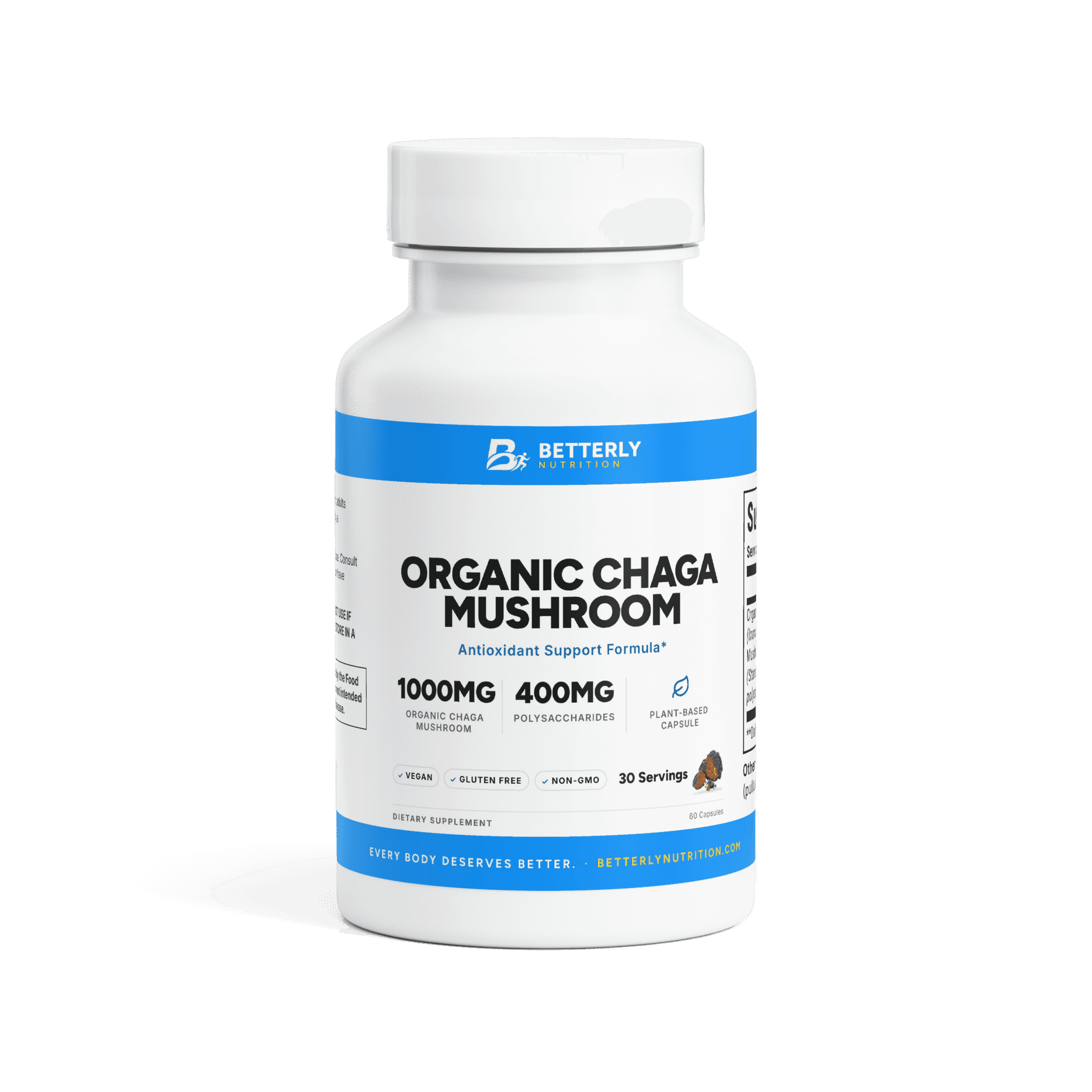
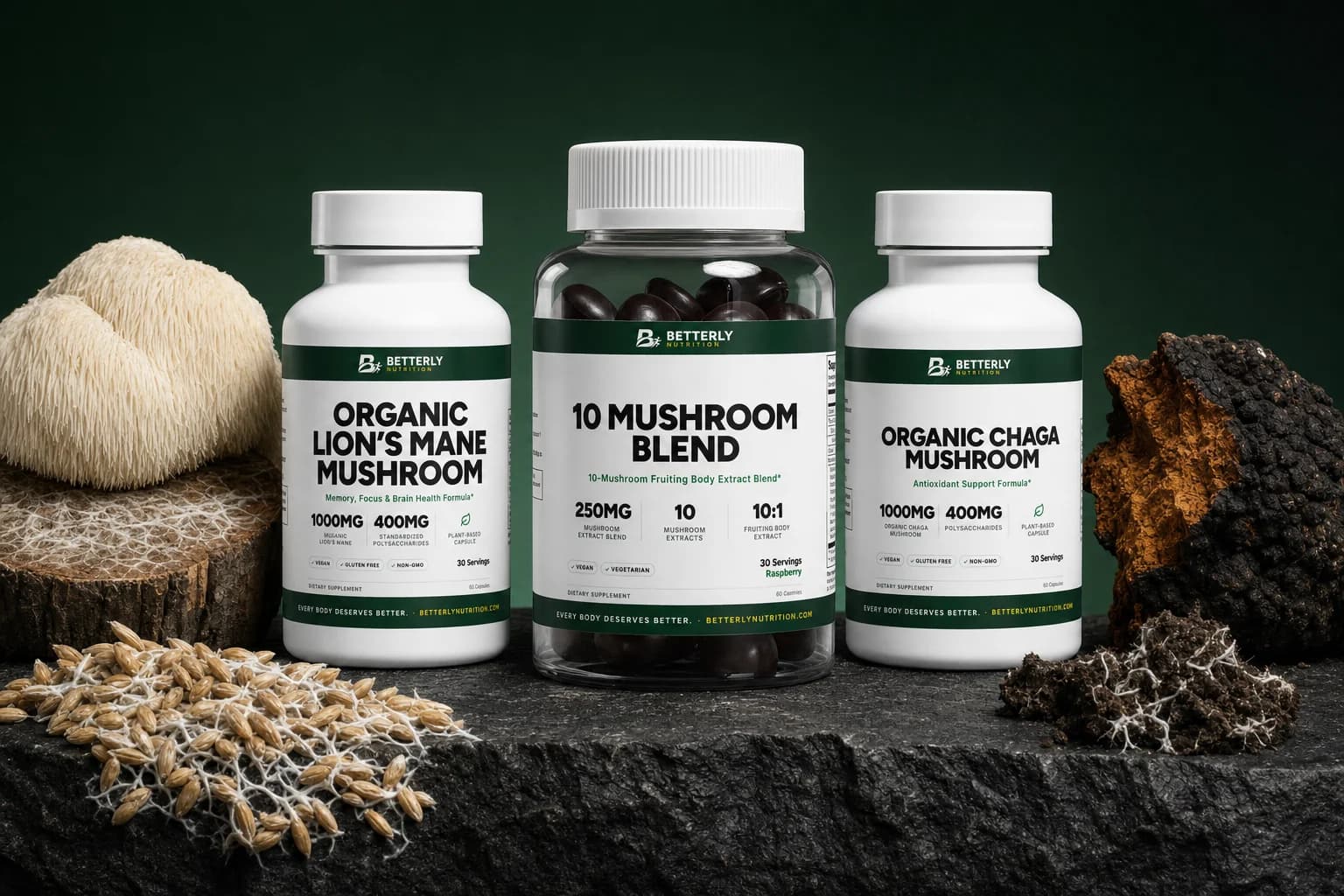
If chaga caught your eye, a single puts far more chaga in each serving by weight. Our Organic Chaga Mushroom Capsules hold 1,000 mg of organic chaga mycelium powder per 2-capsule serving, standardized to 40% polysaccharides (400 mg). That's mycelium powder, and the blend lists a chaga extract from the fruit, so the two weights aren't like-for-like.
Is 266 mg of each mushroom enough to matter?
No one can say whether 266 mg of each mushroom is enough, since the federal sources we read show no proven human effect to measure it against.
LiverTox puts reishi's usual daily dose at 500 mg to 3 g. For cordyceps, it says commercial products recommend 0.5 g to 4 g daily. Our 266 mg rows sit below both ranges, and six more species split one 266 mg line. Fitting ten species into two capsules leaves less room for any one of them.
That's no reason to take extra capsules, since the label says "Do not exceed recommended dose." If you want more of one species, that's the single-versus-blend decision, covered in our lion's mane versus ten-mushroom comparison.
From our shop: Mushroom Capsules — ten mushrooms per 2-capsule serving, with lion's mane, reishi, shiitake and cordyceps printed at 266 mg apiece and six more in a 266 mg blend.
How are the Mushroom Gummies different from the capsules?
The Mushroom Gummies name the same ten mushrooms, but as 10:1 fruiting body extracts in one 250 mg blend, with no amount for any single species.
| Label detail | Capsules (2 capsules) | Gummies (2 gummies) |
|---|---|---|
| Mushroom total | 1,330 mg over five lines | 250 mg Mushroom Extract Blend |
| Species with their own amount | 4 | 0 |
| Cordyceps form | Mycelium powder | Fruiting body 10:1 extract |
| Royal sun Latin name | Agaricus blazei | Agaricus subrufescens |
| Added sugars | No sugar row | 5 g (10% DV) |
| Printed claims | Vegan, gluten free, non-GMO | Vegan, gelatin free |
The capsules show you more of their math, while the gummies trade that for a chewable, raspberry-flavored format with sugar attached.
Don't set 250 mg against 1,330 mg as if they measure the same thing. The gummies list concentrated 10:1 extracts, and the capsule mixes extracts with a powder and states no extract ratios.
From our shop: Mushroom Gummies — raspberry-flavored gummies with the same ten mushrooms as 10:1 fruiting body extracts, 250 mg in total per 2-gummy serving.
How do you take a mushroom complex, per the label?
Take our Mushroom Capsules as two capsules once a day, 20-30 minutes before a meal with an 8 oz (237 ml) glass of water, per the label.
The gummy label says "2 gummies daily or as directed by a healthcare professional." The Organic Chaga Mushroom Capsules say adults take two capsules daily. All three labels add "Do not exceed recommended dose."
Pick one ten-mushroom format. Taking the capsules and gummies together would mean two daily servings of the same ten species, which neither label's directions allow for. Adding the chaga capsules to either means chaga from two sources in a day, so ask your provider or pharmacist first.
What are the side effects of a mushroom complex?
OPSS lists allergic reactions, dry mouth, nausea, vomiting, diarrhea and general stomach upset among the side effects reported with mushroom supplements.
In longer lion's mane studies, LiverTox says, mild tummy trouble usually showed up in under 10% of participants, rarely enough to stop. For cordyceps, it describes side effects as minimal or mild, from diarrhea and nausea to dry mouth and rash.
Reishi carries one rarer flag. A handful of case reports from Asia have linked reishi products to liver trouble, LiverTox says. Many were thinly documented, and it judges such cases very uncommon. Fatigue, nausea, dark-colored urine and a yellow tinge to the skin were among the signs reported. If you notice them, stop the supplement and phone your provider.
OPSS also notes there's "little to no safety data regarding how these combinations of mushrooms might interact in the body."
When is a multi-mushroom blend the wrong pick?
A multi-mushroom blend is the wrong pick if only one species interests you, if you want every species' amount printed, or if these mushrooms are already regular meals.
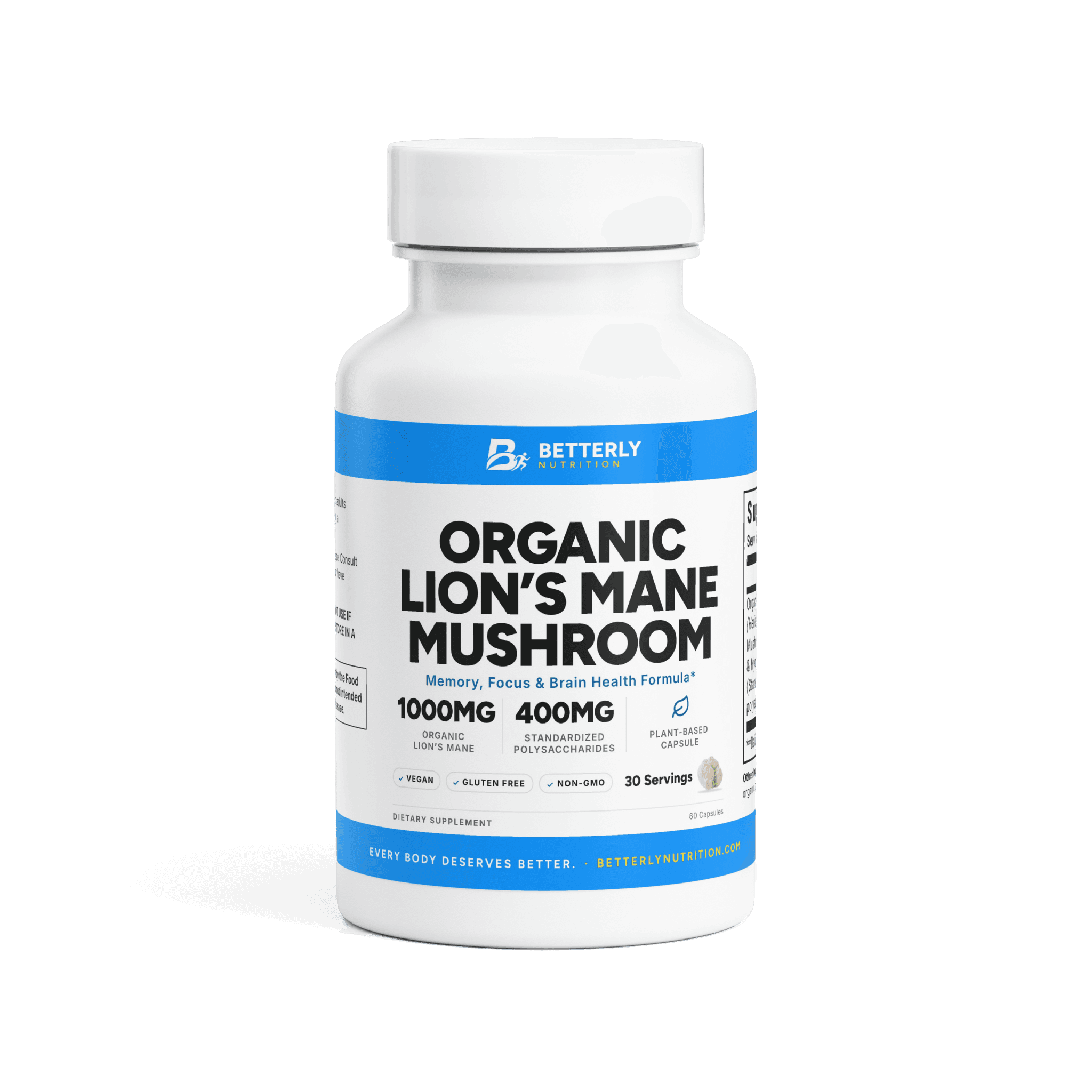
- Only lion's mane or chaga interests you. A single names one amount for one species, and our Organic Lion's Mane Mushroom Capsules and chaga capsules each print 1,000 mg of mushroom powder per 2-capsule serving.
- You want a number beside every mushroom. Six of the capsule's ten share one line, and the gummies give no species its own amount, so neither format will show you that.
- Shiitake, maitake and white button are already on your plate most weeks. All three are grocery staples, and wood ear turns up in plenty of soups, so your cooking may cover part of this roster.
Who should check with a healthcare provider first?
Talk to a healthcare provider before you try a 10 mushroom blend if you're pregnant, nursing, under 18, taking prescriptions, facing surgery or managing a medical condition.
Both ten-mushroom labels carry this caution word for word: "Do not exceed recommended dose. Consult a physician if pregnant, nursing, under 18, or have a medical condition."
- You take prescription medicine. Bring the label, since your pharmacist will see all ten names but not how the blend's 266 mg divides.
- You have surgery coming up. Mention the blend when you're asked what you take, even if it feels like "just mushrooms."
- Some mushrooms haven't agreed with you at meals. Shiitake, white button and wood ear are all on this panel, and OPSS counts allergic reactions among reported side effects.
- You've been asked to watch your liver. Mention the reishi reports above to whoever monitors it.
FAQ: 10 mushroom blend
Does a mushroom complex give you energy?
A mushroom complex isn't an energy product. Our capsule panel lists no caffeine source, and its front label reads "Immune & Mental Clarity Formula." Cordyceps is the species sold for energy, but LiverTox says its promoted effects haven't been shown convincingly in human trials. If you want a coffee-style lift, this isn't built for it.
Will a 10 mushroom blend make you sleepy?
A 10 mushroom blend isn't designed to make you sleepy. Reishi and cordyceps sit side by side at 266 mg each per 2-capsule serving, and neither our Mushroom Capsules label nor our Mushroom Gummies label mentions sleep, calm or rest. If any new supplement leaves you feeling off, stop taking it and ask your provider.
Can a mushroom complex make you high?
No, a mushroom complex like ours can't make you high. OPSS describes functional mushrooms as non-psychoactive species, and none of the ten on our panel is a psilocybin mushroom or Amanita muscaria. OPSS does warn that products sold with "trip" or "microdose" language may contain prohibited or harmful substances, so be wary of any label promising an altered state.
Is it safe to take a mushroom complex every day?
Daily use is what a mushroom complex like ours is labeled for, at one serving a day. Our Mushroom Capsules and Gummies both say not to exceed that serving. OPSS adds that safety information on functional mushrooms as supplement ingredients is limited, especially for blends. Stay at the label's amount, stop if your stomach objects, and ask a provider first if the label's caution applies to you.
Is a 10 mushroom blend vegan?
Our Mushroom Capsules and Gummies are both labeled vegan. The capsules also claim gluten free and non-GMO, and their shell is hypromellose, a vegetable capsule. The gummies claim vegan and gelatin free and are set with pectin. Their other ingredients include glucose syrup, sugar, and palm oil containing carnauba wax, so read that line if any of those matter to you.
Sources
- Mushroom Dietary Supplements, Operation Supplement Safety (OPSS)
- Lingzhi, Reishi, LiverTox, National Institutes of Health
- Cordyceps, LiverTox, National Institutes of Health
- Lion's Mane, LiverTox, National Institutes of Health
If this left you looking for somewhere to start, read 10 mushroom blend capsules listing all ten species — its amounts per serving are listed on the page. For the practical questions this raises, how dosing, sourcing and subscriptions work is answered in one place.