On this page
- Key takeaways
- Should you take digestive enzymes with a protein shake?
- What do protease and lactase do with a protein shake?
- How much lactose is in a whey protein shake?
- Do plant protein powders need digestive enzymes?
- Which shake ingredients does the capsule's label actually cover?
- Do digestive enzymes help you absorb more protein?
- When should you take digestive enzymes with a protein shake?
- When don't you need digestive enzymes for protein powder?
- Who should check with a healthcare provider first?
- FAQ: digestive enzymes and protein shakes
- Sources
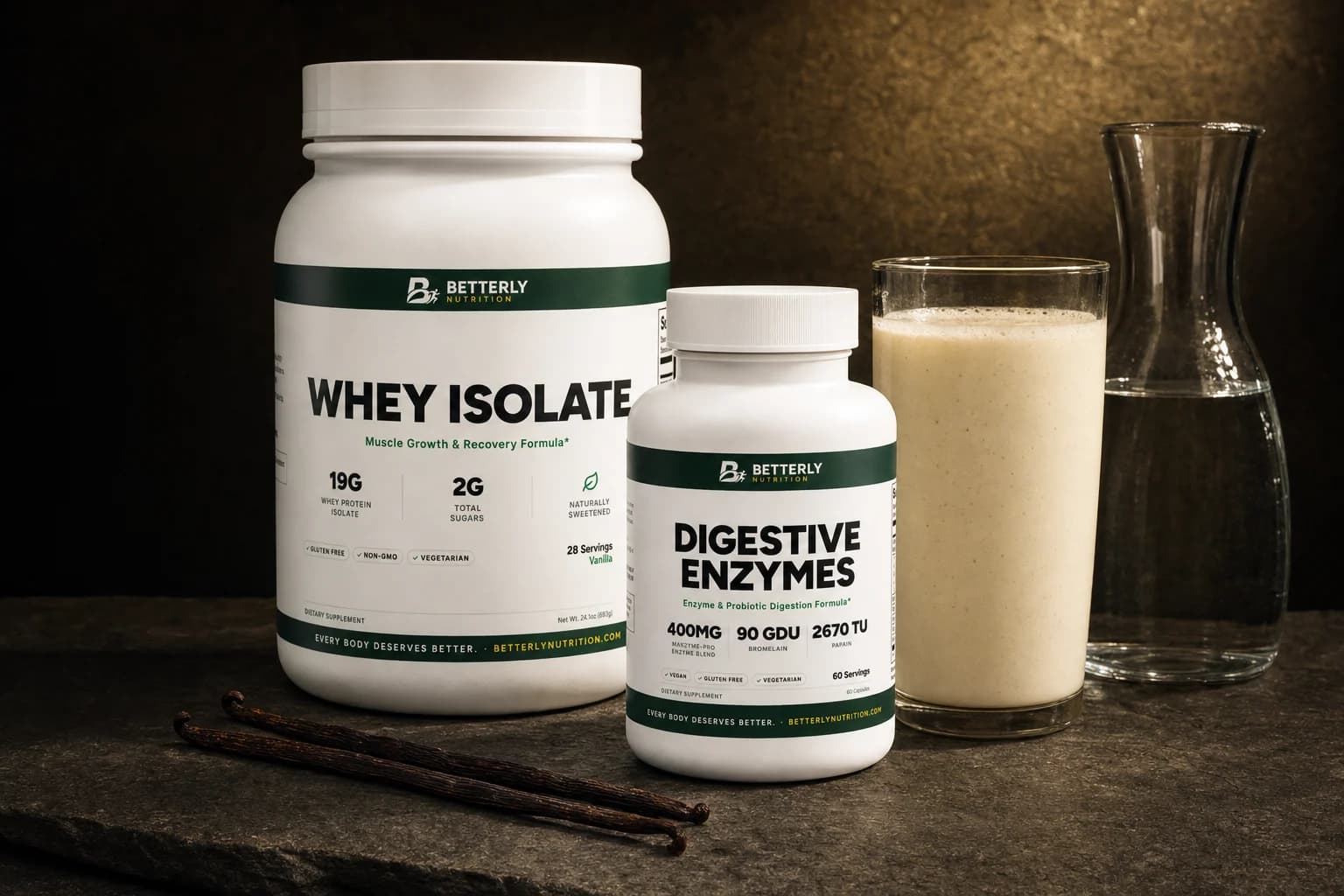
The short answer: Taking digestive enzymes with a protein shake is optional: your stomach, pancreas and small intestine already break protein down. A capsule only fits if a shake occasionally sits heavy and holds something its enzymes target. Our Digestive Enzyme & Probiotic Capsules list the Makzyme-Pro™ Enzyme Blend (2500 HUT/400mg), with protease and lactase among the enzymes inside it, per 1 Veggie Capsule serving. The label's suggested use is one capsule twice a day, for best results 20-30 minutes before a meal.
Betterly sells the enzyme capsule and all three protein tubs below, so a capsule with every shake would be good business for us. For most readers it's also more than they need, and we'll mark each spot where a label leaves a shake drinker's question unanswered.
Key takeaways
- Before adding a capsule, look at what's in the glass besides powder: milk brings lactose, nut butter brings fat, and oats bring starch, which our capsule lists no enzyme for.
- On our whey isolate and whey blend panels, any lactose from the powder is folded into one rounded figure, 2 g of total sugars per serving. Milk in the blender brings its own lactose on top.
- Our capsule label allows one capsule twice a day, so a shake uses one of your two capsules, never a third.
- None of our protein powders lists a digestive enzyme, and our capsule label makes no protein-absorption claim.
Should you take digestive enzymes with a protein shake?
Most people can skip digestive enzymes with a protein shake. A capsule is worth a look only if a shake occasionally sits heavy, not as a routine add-on to every scoop.
NIDDK, part of the National Institutes of Health, publishes a chart of what each organ breaks down. Proteins show up at three separate stops: stomach acid and enzymes, pancreatic juice, and the small intestine's own digestive juice.
So the case for a capsule is narrow: it's for the occasional shake that sits badly, not for getting more out of every scoop.
What do protease and lactase do with a protein shake?
Protease is the name for enzymes that split proteins into smaller pieces, and lactase is the enzyme that splits lactose, milk's natural sugar, into simpler sugars. Our capsule lists both, but its label doesn't say how much of a shake they're sized for.
Protease is an umbrella term covering many enzymes. Lactase has one narrow job. MedlinePlus Genetics, from the National Library of Medicine, explains that cells lining your small intestine make lactase, which breaks lactose into glucose and galactose. Lactase on a supplement panel names the same kind of enzyme, from a fungal source in our capsule's case.
Our capsule's panel is one row, the Makzyme-Pro™ Enzyme Blend (2500 HUT/400mg) per 1 Veggie Capsule serving, and three of the six enzymes it lists split protein: fungal protease from Aspergillus oryzae, bromelain and papain. Fungal lactase is the milk-sugar enzyme. The last two, fungal lipase and alpha galactosidase, aim at fat and at some carbohydrates in beans. The blend also lists three Lactobacillus species, and none of its nine ingredients gets an amount of its own.
For a shake, the missing number is capacity. The label never says how many grams of protein 2500 HUT is sized for, or how much lactose its lactase is meant to cover. So nobody can tell you whether one capsule is "enough" for a 19 g or 22 g scoop. For how activity units and probiotic counts are read on a label, see our guide to digestive enzymes vs probiotics.
How much lactose is in a whey protein shake?
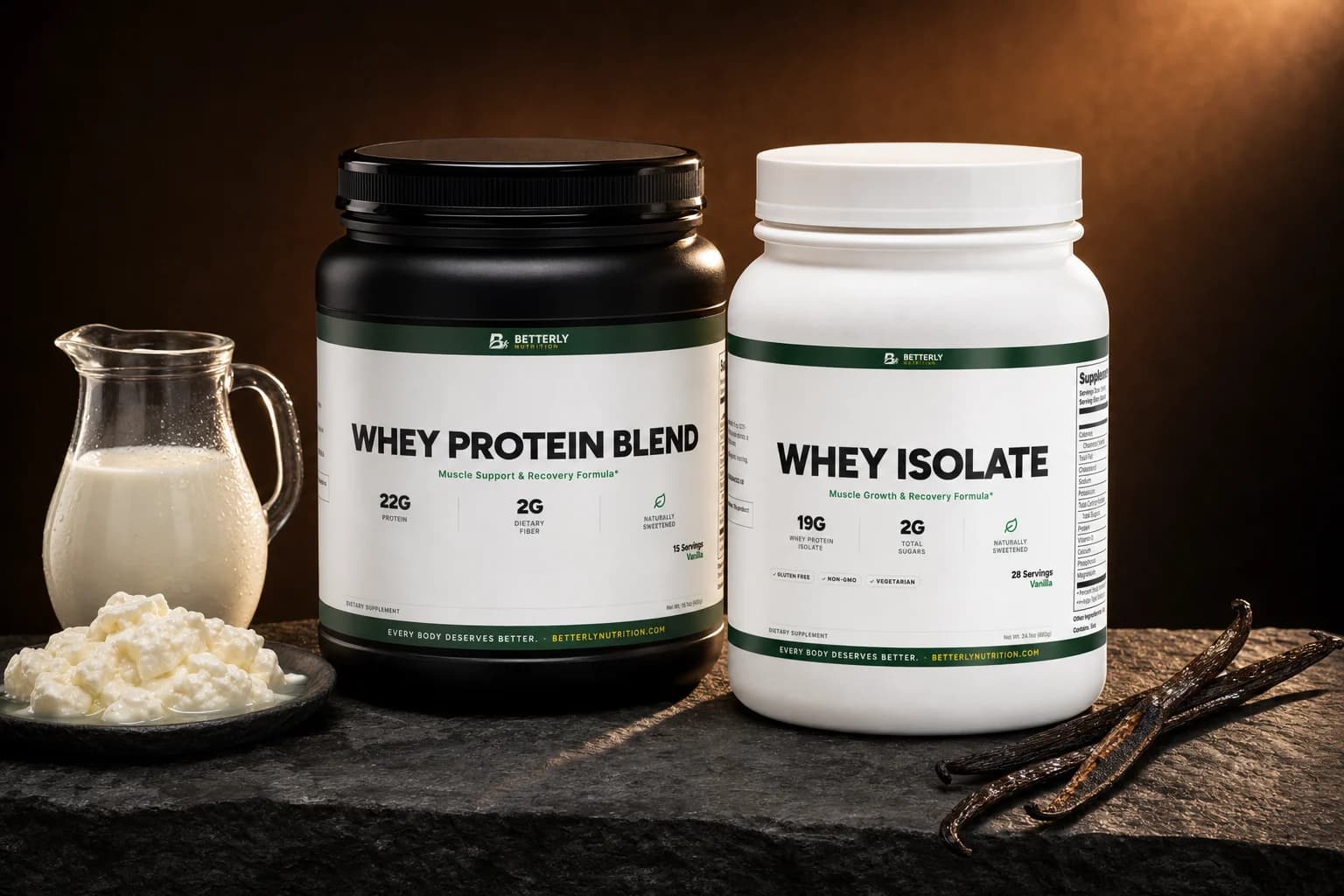
A whey protein shake's lactose isn't printed on our labels, but it sits inside Total Sugars: 2 g per serving on both our whey tubs, before any milk.
The name on the tub doesn't settle it. The FDA's regulation for whey protein concentrate (21 CFR 184.1979c) only requires it to be at least 25% protein, and it allows lactose up to 60% of the dry powder. We found no matching definition for whey protein isolate in the FDA's Title 21 rules. So "concentrate" alone covers a wide range.
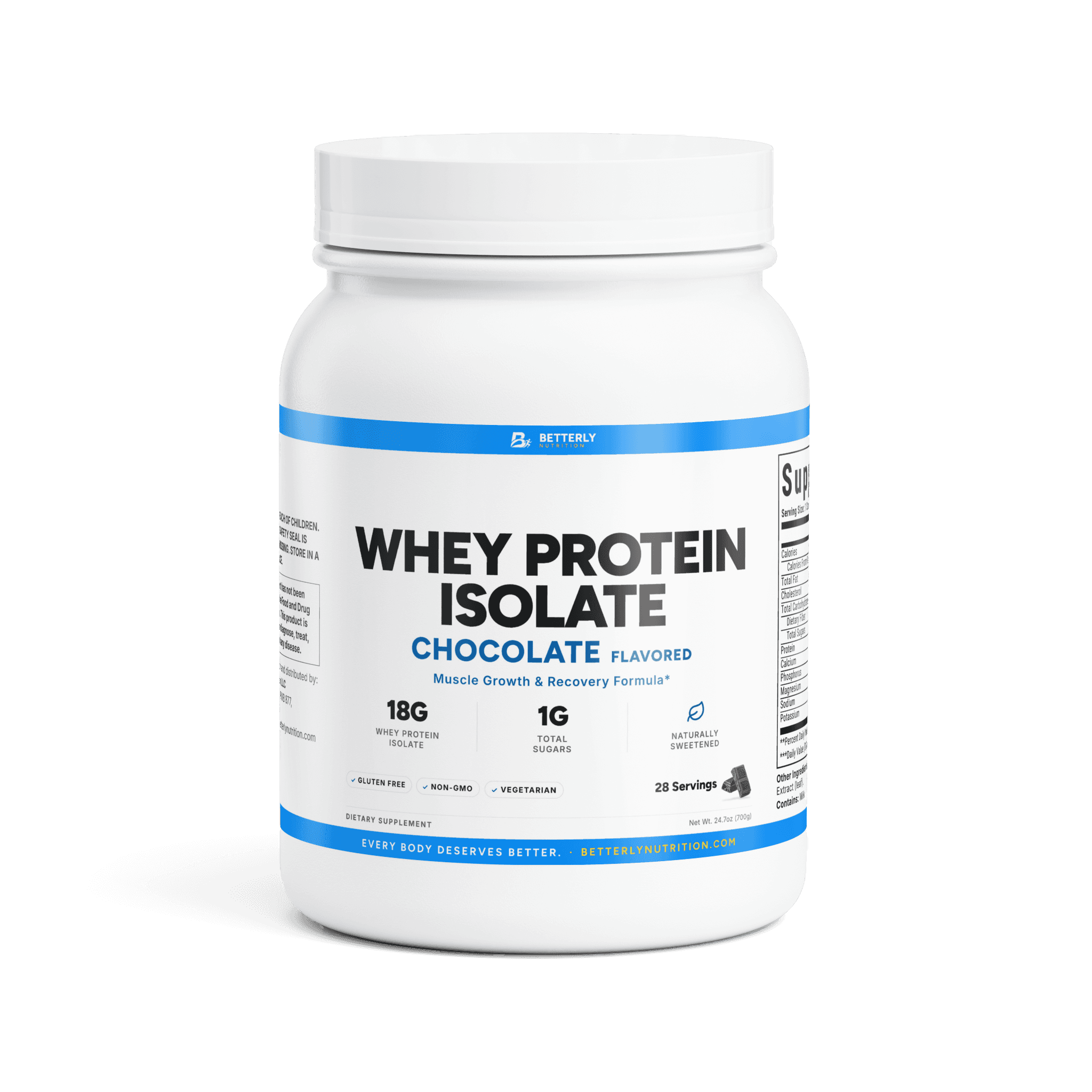
The panel tells you more than the front of the tub. Here's what our three vanilla powders print, starting with Whey Protein Isolate Powder (Vanilla):
| Our powder (serving) | Protein | Total sugars | Milk on label |
|---|---|---|---|
| Whey Protein Isolate, 1 Scoop (24.4g) | 19 g | 2 g | Yes |
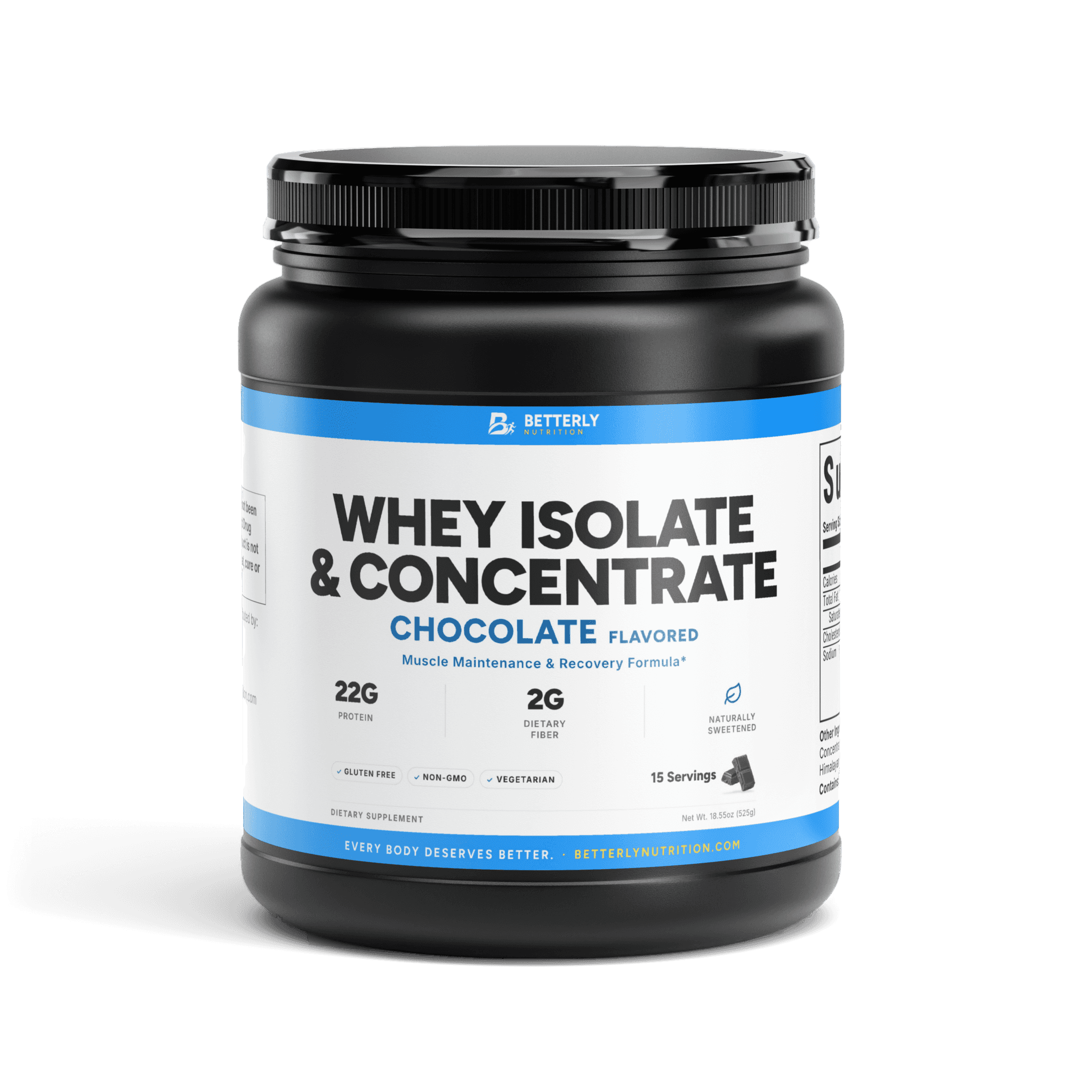
| Whey Isolate & Concentrate Blend, 2 scoops (approximately 32 g) | 22 g | 2 g | Yes |
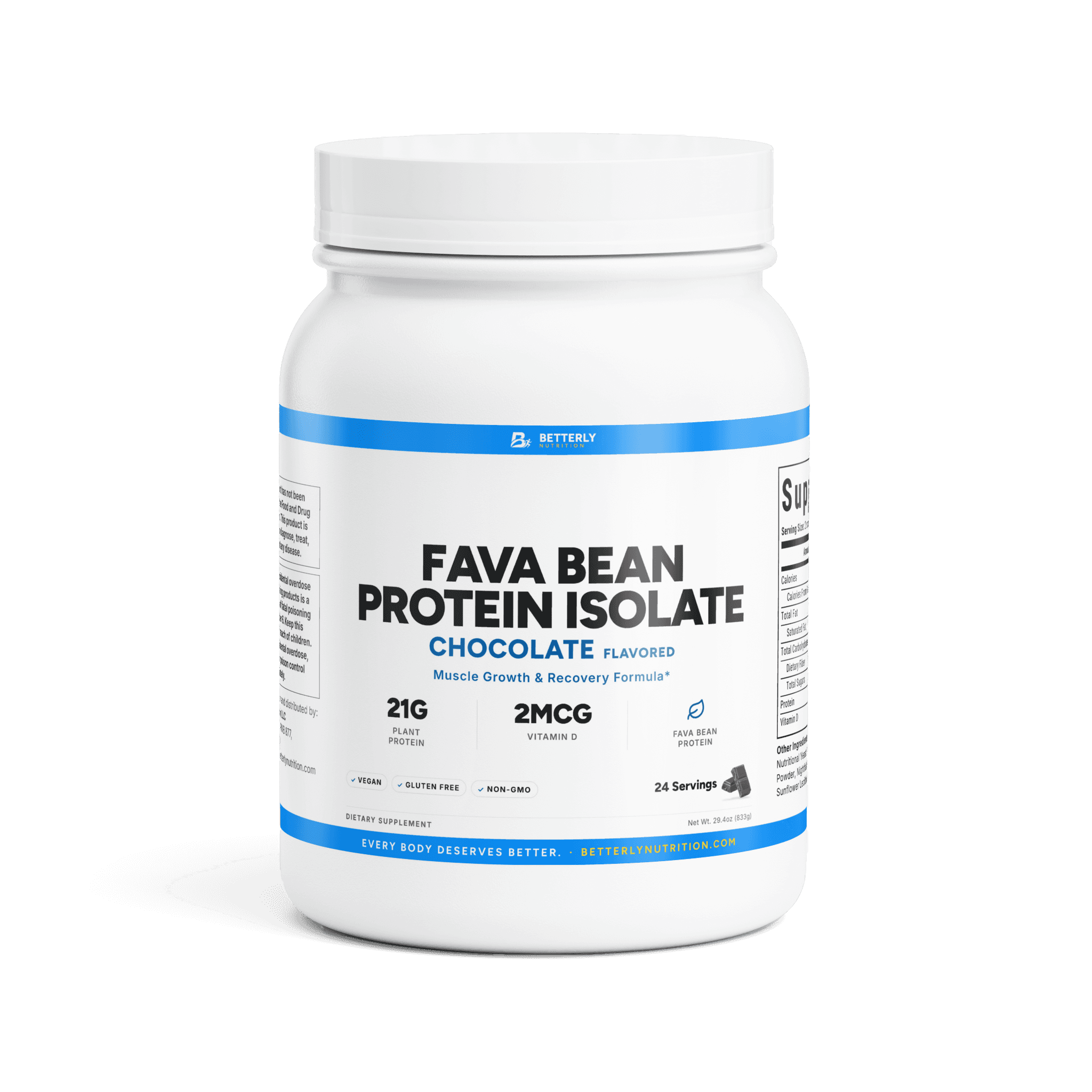
| Fava Bean Protein Isolate, 2 Scoops (35g) | 20 g | 4 g | None listed |
The FDA's supplement-panel rule, 21 CFR 101.36, lists total sugars among the rows a panel declares and ties the amount to the increments in the food labeling rule, 21 CFR 101.9. That rule defines total sugars as all free mono- and disaccharides, names lactose among them and rounds the figure to the nearest gram. What the panel can't show a milk-shake drinker is how much of that 2 g is lactose and how much is some other sugar.
Our Whey Isolate & Concentrate Blend Powder (Vanilla) mixes isolate with concentrate in a ratio the label doesn't give. It lists 2 g of dietary fiber, with Solnul® resistant potato starch and two gums among its ingredients. Yet its sugar line matches the isolate's.
For your glass, the liquid matters too. Shake either whey with milk instead of water, and milk's own lactose lands on top of whatever the scoop carries. Our look at whey protein blend vs isolate covers texture and protein per scoop.
Do plant protein powders need digestive enzymes?
Plant protein powders don't automatically call for digestive enzymes, and our Fava Bean Protein Isolate Powder (Vanilla) lists no milk, so lactase has little to do there.
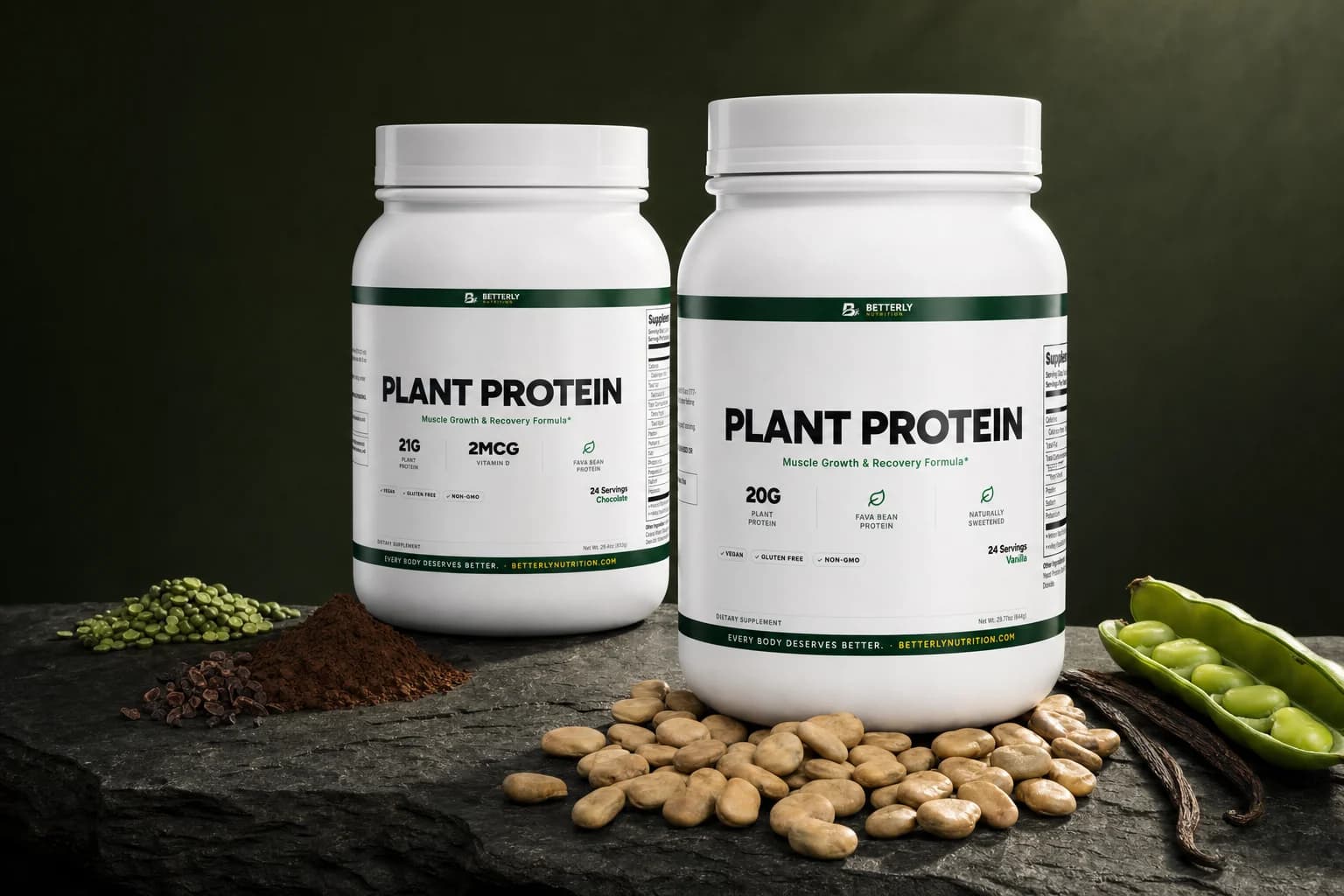
Pea is the plant protein most people picture, but ours isn't pea. It's built on fava bean protein isolate, with YESTEIN™ fermented nutritional yeast protein, MCT oil powder and apple pectin further down the list. Per 2 Scoops (35g) serving, it lists 20 g of protein, 6 g of total carbohydrates and 4 g of total sugars.
The protein-splitting enzymes apply, as with any protein, though your own enzymes handle that job too. Alpha galactosidase targets some bean carbohydrates, but the panel doesn't say whether any survive into an isolate, so we can't claim a match. If a plant shake sits heavy, check what else went into the blender first. Our fava bean vs pea protein breakdown compares the two legumes.
Which shake ingredients does the capsule's label actually cover?
The Digestive Enzyme & Probiotic Capsules label names enzymes for a shake's protein, milk's lactose and added fat, but none for oats or the fiber in our whey blend.
| Shake recipe | From the tub, per serving | Capsule enzymes that apply | Label gap |
|---|---|---|---|
| Whey isolate in water | 19 g protein, 2 g total sugars | Fungal protease, bromelain, papain | No protein capacity stated |
| Whey blend in cold water | 22 g protein, 2 g fiber | The same three protein enzymes | No enzyme for fiber |
| Plant protein in water | 20 g protein, 4 g total sugars | The same three protein enzymes | Bean carbs not broken out |
| Any of the three, made with milk | Milk's lactose on top | Fungal lactase | No lactose capacity stated |
| Nut butter blended in | Extra fat | Fungal lipase | No fat capacity stated |
| Oats blended in | Starch | None | No amylase listed |
The last column shows the pattern: the label names each enzyme, never how much of anything it's sized for. A water-mixed shake mostly lines up with the three protein enzymes, and your own digestion already handles protein. Milk is what gives a single enzyme a clear target, since lactase goes after the lactose milk brings.
Oats are the gap to notice in thick breakfast shakes, since this label lists no amylase, the enzyme for starch. You can compare the amounts per serving of every enzyme product we carry in our gut health and digestion collection.
From our shop: Digestive Enzyme & Probiotic Capsules — the Makzyme-Pro™ Enzyme Blend (2500 HUT/400mg), listing fungal protease and fungal lactase among its enzymes, per 1 Veggie Capsule serving in a vegan, gluten-free capsule.
Do digestive enzymes help you absorb more protein?
We can't say digestive enzymes help you absorb more protein: our Digestive Enzyme & Probiotic Capsules label makes no absorption claim, and neither do we.
"Better absorption" is all over enzyme marketing, but no federal page we've read backs that claim for enzyme supplements. NIDDK describes your own system instead: the walls of the small intestine absorb water and digested nutrients into your bloodstream. MedlinePlus Genetics says lactase works at that same lining, breaking lactose down for absorption.
So think of an enzyme capsule as something aimed at specific ingredients, like the lactose in a milk-based shake, not a way to get more protein from a scoop. If protein intake is your focus, the Protein line on the tub is the number that counts. Our post-workout recovery routine shows where a shake fits after training.
When should you take digestive enzymes with a protein shake?
Take our Digestive Enzyme & Probiotic Capsules as the label says: one capsule twice a day, for best results 20-30 minutes before a meal, and never more.
The label doesn't mention shakes, so you decide whether your shake counts as the meal. Two honest readings:
- Your shake is the meal. If it stands in for breakfast or lunch, count it as one: capsule first, then the shake 20-30 minutes later.
- Your shake comes before a meal. Our Whey Protein Isolate Powder and Fava Bean Protein Isolate Powder labels both say that, for best results, you take them 20-30 minutes before a meal with 8 oz (237ml) of water. That's the capsule's window too, so following both labels literally puts the capsule and the shake together.
Neither label ranks one reading above the other. Pick one and keep it steady.
The count isn't up for interpretation. Two capsules a day is the ceiling, and the caution says not to exceed the recommended dose. Those same two tub labels each call for one serving daily, so a second shake shouldn't be a second scoop of the same tub. With one shake and three meals, that's two capsules for four occasions.
The whey blend label gives no timing, only a mix: 2 scoops in 8–12 oz (240–355 ml) of cold water.
When don't you need digestive enzymes for protein powder?
You don't need digestive enzymes for protein powder when your shakes already sit fine, since your digestive system is built to handle protein.
Before you buy a capsule, try the changes the labels already point to:
- Mix with water instead of milk. All three of our protein labels list water, and milk adds its own lactose.
- Stick to one serving. Every label here says not to exceed the recommended dose, and a bigger scoop is simply more to digest.
- Read the whole ingredient list. The blend lists 2 g of fiber, and no row on our capsule targets fiber.
- Try a shorter list. Our isolate lists just whey protein isolate, natural flavors and stevia extract, so there are fewer things to rule out.
If your shakes don't bother you, a capsule adds a step and a cost without a clear job.
From our shop: Whey Protein Isolate Powder (Vanilla) — 19 g of protein and 2 g of total sugars per 1 Scoop (24.4g) serving, from a three-item ingredient list.
Who should check with a healthcare provider first?
Check with a healthcare provider before pairing digestive enzymes with protein shakes if you're pregnant, nursing, under 18, taking medication, or managing a medical condition.
- The capsule's caution, like every protein label in this guide, says to consult a physician if you're pregnant, nursing, under 18 or have a medical condition.
- On prescription medication? Show the capsule's label to your provider or pharmacist before you start.
- Avoiding milk as an allergen? Lactase acts on milk sugar, not milk protein, so a capsule doesn't make whey suitable for you. Both of our whey tubs print "Contains: Milk."
- Having surgery soon? Tell your care team about every supplement you take, this one included.
See a provider rather than adding products if discomfort follows nearly every shake whatever you change, or comes with pain, or if digestive changes are new or getting worse.
FAQ: digestive enzymes and protein shakes
Can you take digestive enzymes with a protein shake every day?
Yes, digestive enzymes can go with a daily protein shake, as long as you stay within both labels. Our Digestive Enzyme & Probiotic Capsules label's suggested use is one capsule twice a day, for best results 20-30 minutes before a meal. A daily shake that gets one capsule leaves one for the rest of your day. The tub sets a limit too: our Whey Protein Isolate Powder and Fava Bean Protein Isolate Powder labels each call for one serving daily.
Is protein powder with digestive enzymes built in better?
Protein powder with digestive enzymes built in isn't automatically better. A built-in enzyme comes with every scoop, whether that shake needs it or not. A separate capsule lets you save it for shakes that give it a target, like one made with milk, within its twice-daily limit. None of our protein powders lists enzymes. On any built-in label, look for each enzyme named with an activity unit.
Can you open a digestive enzyme capsule into your shake?
Our Digestive Enzyme & Probiotic Capsules label gives no directions for opening the capsule, so we don't suggest it. It's written for one capsule taken as a capsule, twice a day before meals. If capsules are tough for you to get down, ask a pharmacist before changing how you take any supplement.
Do digestive enzymes help with gas from protein shakes?
Digestive enzymes only have a logical role in gas from protein shakes when you can point to an ingredient the enzyme acts on. If milk or a milk-based powder seems to be the trigger, lactase is the matching enzyme, because it breaks down lactose. Our capsule label makes no gas claim, though. If gas follows almost every shake no matter what you change, talk with a healthcare provider.
Are digestive enzymes safe to take with whey protein?
None of our labels warns against taking digestive enzymes with whey protein, but read the cautions. Our capsule and both whey tubs carry the same one: consult a physician if you're pregnant, nursing, under 18 or have a medical condition. Stay at one capsule twice a day, and don't exceed either label's recommended dose. If you steer clear of milk as an allergen, whey belongs on that list too.
Sources
- Your Digestive System & How it Works (NIDDK, National Institutes of Health)
- LCT gene (MedlinePlus Genetics, National Library of Medicine)
- 21 CFR 184.1979c: Whey protein concentrate (eCFR, FDA regulation)
- 21 CFR 101.36: Nutrition labeling of dietary supplements (eCFR, FDA regulation)
- 21 CFR 101.9: Nutrition labeling of food (eCFR, FDA regulation)
If this left you looking for somewhere to start, read digestive enzymes with protease and lactase — its amounts per serving are listed on the page. For the practical questions this raises, how dosing, sourcing and subscriptions work is answered in one place.