On this page
- Key takeaways
- Ferrous vs ferric iron: what do the two names tell you?
- Is ferrous or ferric iron absorbed better?
- Ferrous sulfate vs ferrous gluconate: how much elemental iron do you get?
- How does ferrous bisglycinate compare with ferrous sulfate?
- What is ferric saccharate, the form in our iron strip?
- Which iron form should you buy?
- How do you take a ferrous or ferric supplement?
- When doesn't the iron form matter?
- Who should talk to a provider before picking an iron form?
- FAQ: ferrous and ferric iron
- Sources
The short answer: Ferrous vs ferric iron comes down to charge. Ferrous iron carries a 2+ charge, and ferric iron carries a 3+ charge. The NIH Office of Dietary Supplements says ferrous iron in supplements is more bioavailable because it dissolves more readily. Whichever form a product uses, the milligrams on its Supplement Facts iron row are the iron itself, so that's the number to compare.
Key takeaways
- Ferrous iron (Fe2+) and ferric iron (Fe3+) are the same mineral with different charges.
- The NIH Office of Dietary Supplements says ferrous iron in supplements is more bioavailable than ferric iron because it's more soluble.
- By weight, ferrous fumarate is 33% iron, ferrous sulfate 20% and ferrous gluconate 12%, and the panel's iron row already does that math for you.
- Betterly's iron strip is made with ferric saccharate, so the federal point in favor of ferrous iron doesn't work in our product's favor.
We sell an iron product, and it's the ferric kind. Our 19mg Iron & Folate Strips use ferric saccharate, a ferric form, and the federal fact sheet rates ferric iron as less bioavailable than ferrous. This guide doesn't bend the chemistry to suit our shelf.
Ferrous vs ferric iron: what do the two names tell you?
Ferrous and ferric describe iron's electrical charge: ferrous iron has a 2+ charge and ferric iron has a 3+ charge, but both are the same mineral.
Chemists also write them as iron(II) and iron(III). Both words come from ferrum, Latin for iron. An "-ous" ending marks the lower charge, and "-ic" marks the higher one.
In most supplements, iron arrives bound to a partner, forming what chemists call a salt. The second word names that partner: sulfate, gluconate, fumarate, citrate or saccharate. Together they make the names printed in parentheses on iron panels, such as "Iron (as ferrous sulfate)."
The NIH Office of Dietary Supplements (ODS) calls ferrous and ferric salts the most common supplement forms in its health professional fact sheet on iron. Its examples are ferrous sulfate, ferrous gluconate, ferric citrate and ferric sulfate.
| Form on the label | Charge | Iron by weight (ODS) | What ODS says |
|---|---|---|---|
| Ferrous fumarate | 2+ | 33% | Richest of the three it lists |
| Ferrous sulfate | 2+ | 20% | A frequently used form |
| Ferrous gluconate | 2+ | 12% | A frequently used form |
| Ferric citrate, ferric sulfate | 3+ | Not given | Frequently used, less bioavailable |
| Ferrous bisglycinate (a chelate) | 2+ | Not given | Chelates might cause fewer stomach side effects |
Most of the familiar names are ferrous, and the sheet's supplement section gives weight figures for only three.
Is ferrous or ferric iron absorbed better?
Ferrous iron is absorbed better, according to ODS, which says ferrous iron in dietary supplements is more bioavailable than ferric iron.
The ODS health professional sheet puts it this way: "Because of its higher solubility, ferrous iron in dietary supplements is more bioavailable than ferric iron." Bioavailable means the share of a nutrient your body can absorb and use. Solubility is how easily something dissolves.
The sheet's supplement section stops there. It puts no number on the gap and doesn't rank one ferrous salt against another. Other sites print per-form absorption percentages; we found no federal page behind them, so none appear here.
ODS still lists two ferric salts among the frequently used forms, so ferric iron is a mainstream choice, just the less soluble one. If absorption per milligram is your top priority, ODS's bioavailability point favors a ferrous salt.
Ferrous sulfate vs ferrous gluconate: how much elemental iron do you get?
Ferrous sulfate gives you more iron per milligram than ferrous gluconate, since ODS puts sulfate at 20% elemental iron by weight and gluconate at 12%.
Elemental iron is the iron alone, without its partner, and ODS adds ferrous fumarate at 33%. The same weight of each compound holds very different amounts of iron.
| Iron form | Iron in 100 mg of the compound | Compound needed for 18 mg of iron |
|---|---|---|
| Ferrous fumarate | 33 mg | About 55 mg |
| Ferrous sulfate | 20 mg | 90 mg |
| Ferrous gluconate | 12 mg | 150 mg |
Gluconate takes well over twice as much material as fumarate for the same iron, which can mean a bigger tablet. We used 18 mg because the FDA's Daily Value for iron is 18 mg, the amount a panel prints as 100% DV. That's why our strip's 19 mg shows up as 106%.
Try it on a common front label. At ODS's 20% figure, a "325 mg ferrous sulfate" tablet carries 65 mg of iron, the amount ODS says many iron-only supplements provide. The consumer version of the ODS iron sheet lists 45 mg a day as the adult upper limit, so a tablet that size belongs on a provider's plan.
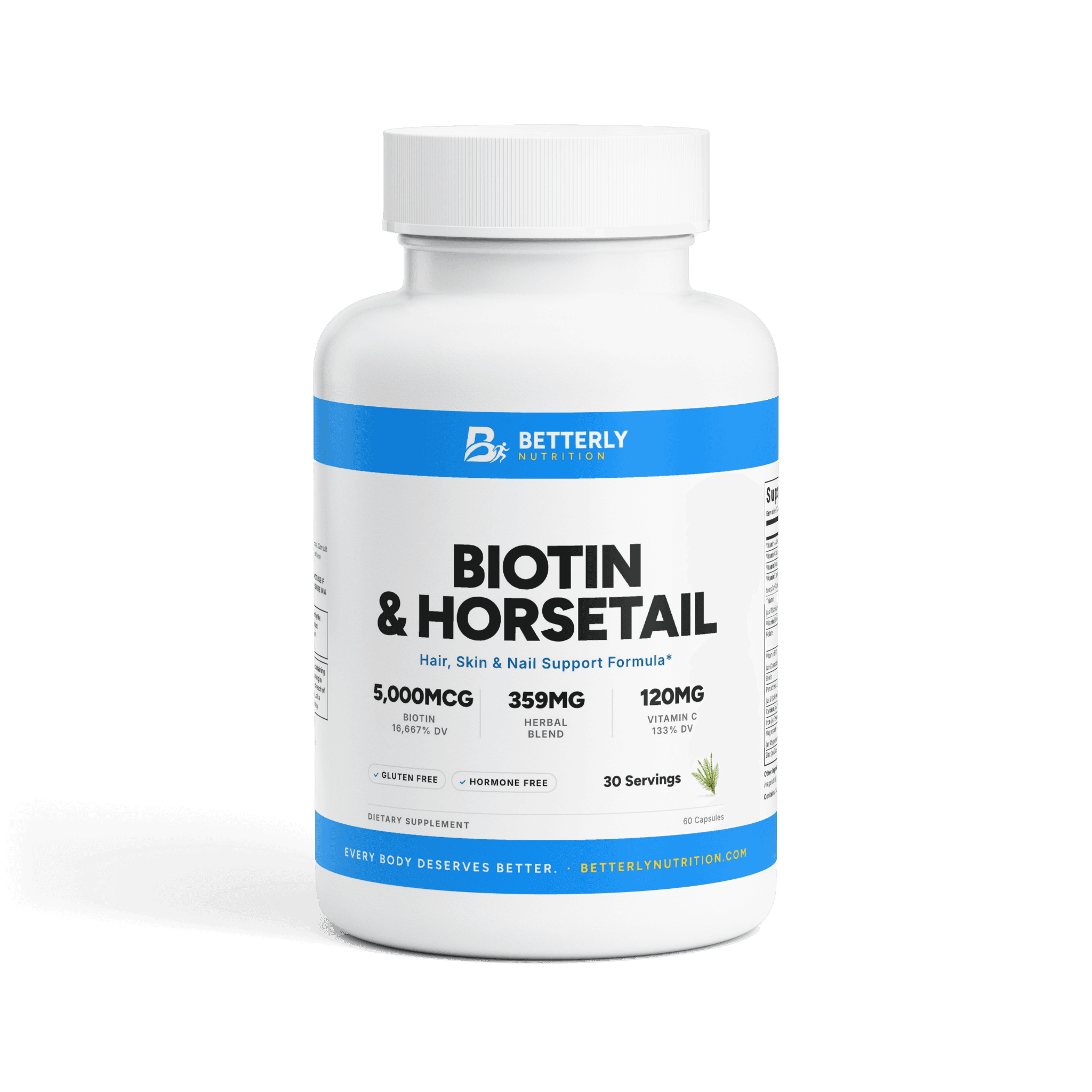
The math also runs backward. On our Biotin & Horsetail Hair Capsules panel, the ferrous fumarate row reads 14.5 mg of iron (81% DV) per 2-capsule serving. Divide by 33% and that row stands for roughly 44 mg of ferrous fumarate, of which only 14.5 mg is iron.
Luckily, you rarely need this math. ODS points out that the Supplement Facts panel already lists elemental iron, so "Iron (as ferrous gluconate) 18 mg" means 18 mg of iron.
How does ferrous bisglycinate compare with ferrous sulfate?
Ferrous bisglycinate and ferrous sulfate both supply ferrous iron, but bisglycinate is an amino-acid chelate, a group ODS says might cause fewer stomach side effects than salts like sulfate.
In bisglycinate, glycine, an amino acid, holds the iron. That's what makes it a chelate rather than a salt. ODS puts iron amino-acid chelates in one group with heme iron polypeptides, carbonyl iron and polysaccharide-iron complexes. "Might" is ODS's word: a possibility, not a promise.
ODS also ties high doses of supplemental iron, 45 mg a day or more, to stomach side effects such as nausea. So the dose on the panel deserves as much attention as the name in parentheses.
In its supplement section, ODS gives no elemental iron percentage for bisglycinate and no absorption figure against sulfate. The panel rule still holds, though. Whether a label says "iron bisglycinate" or "ferrous bisglycinate chelate," the iron row shows the iron itself.
What is ferric saccharate, the form in our iron strip?
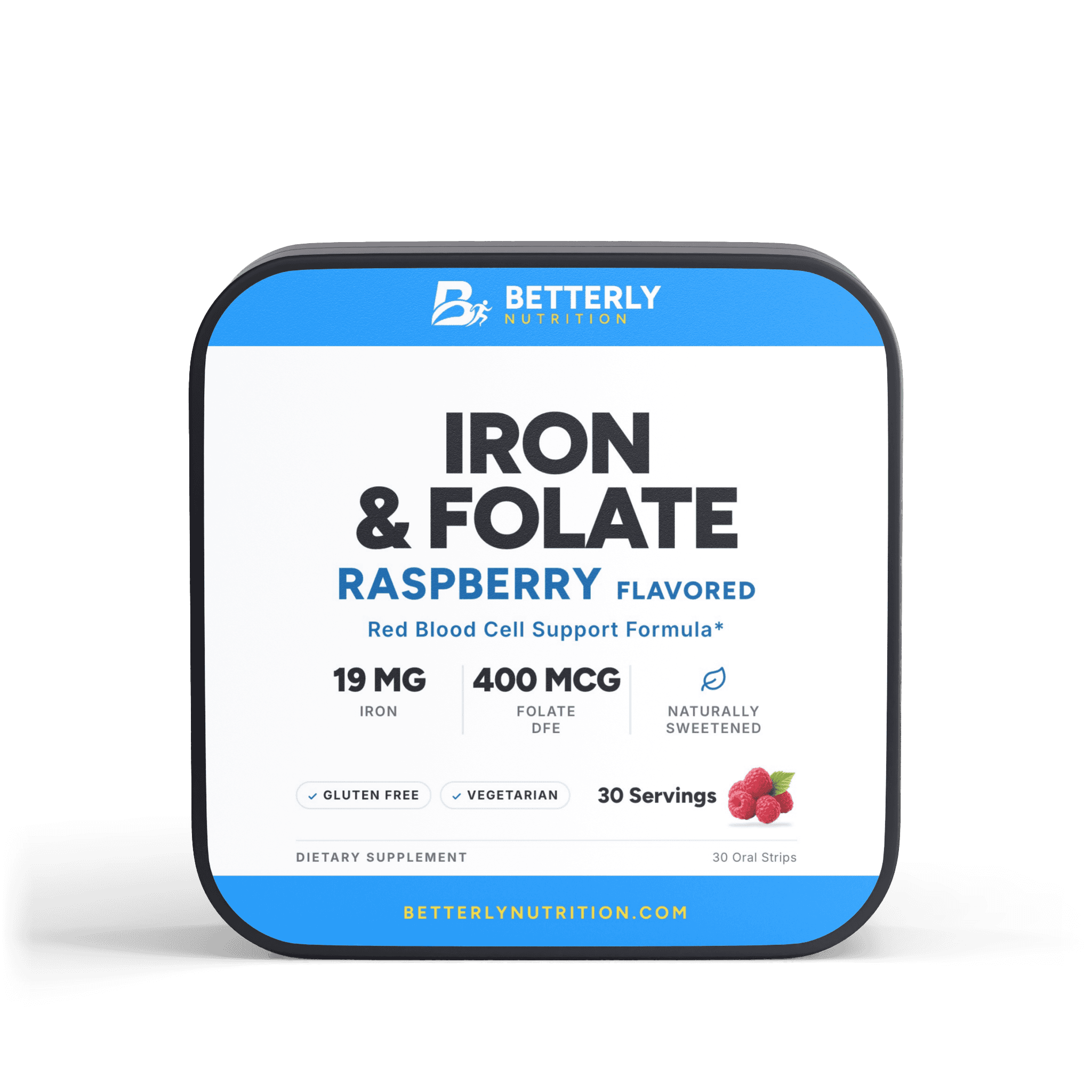
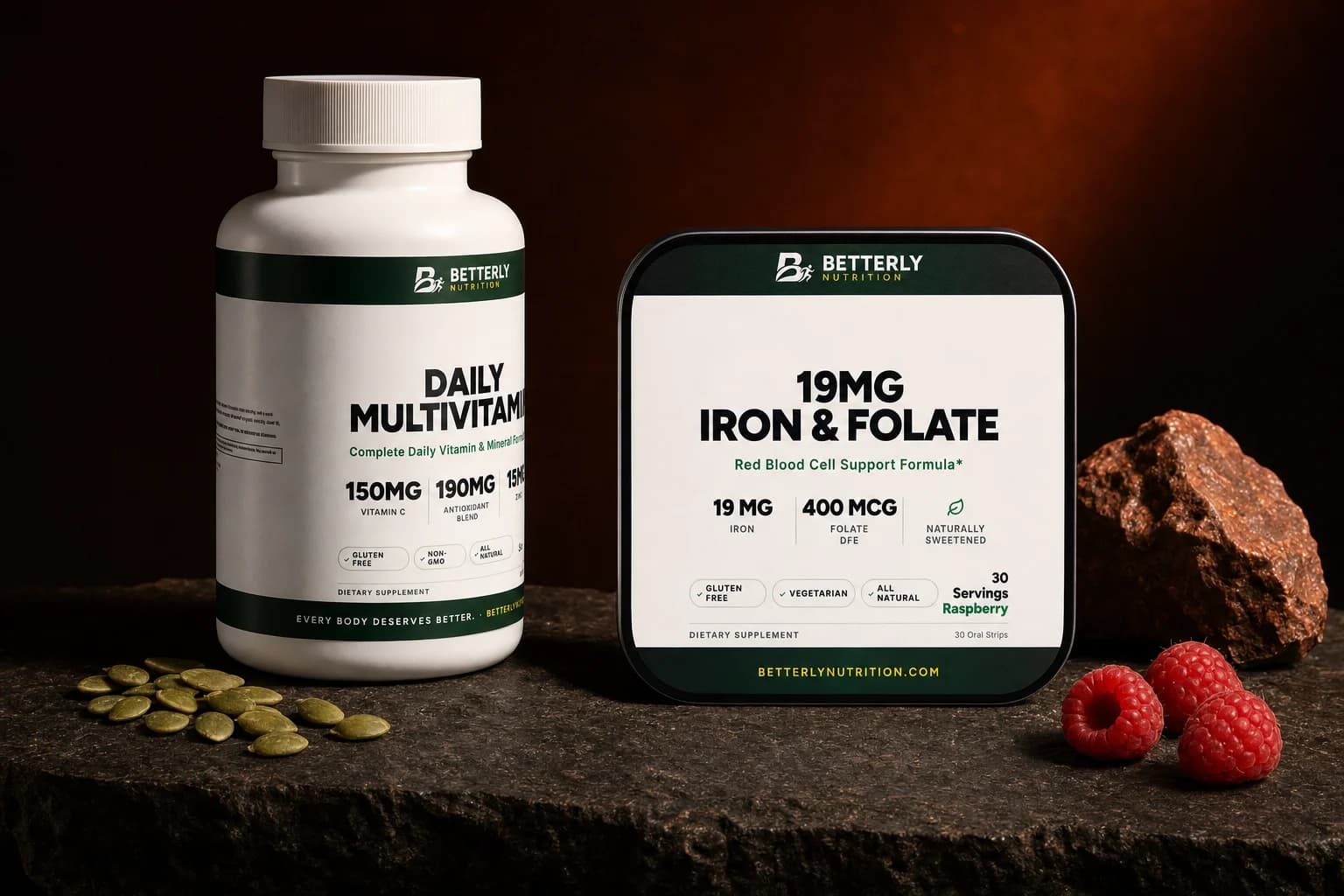
Ferric saccharate is a ferric iron compound, the 3+ form, and it's the iron source listed on the panel of Betterly's 19mg Iron & Folate Strips.
Look for "Ferric Sacharate" on the panel, spelled with a single c. The ODS pages we cite don't name it, but as a ferric form it sits on the side ODS rates less bioavailable. No federal source we've read says it absorbs better or sits easier than a ferrous salt, so we make neither claim.
Here's what the panel does say, per 1-strip (200 mg) serving:
- Iron, as ferric saccharate: 19 mg, 106% DV
- Folate: 400 mcg DFE, from 240 mcg of folic acid, 100% DV
The folate row is a second form story. The ODS folate fact sheet for consumers explains that 240 mcg of folic acid equals 400 mcg DFE, because your body absorbs folic acid better than food folate.
Of the strip's 200 mg, 19 mg is iron; the rest is iron's partner, the folic acid and a film led by pullulan. The label lists it as gluten free and vegetarian.
Who does it suit? Someone whose provider is comfortable with 19 mg of iron a day and who would rather dissolve a strip than swallow a tablet. The strip-or-tablet side of that choice has its own guide, iron strips vs pills.
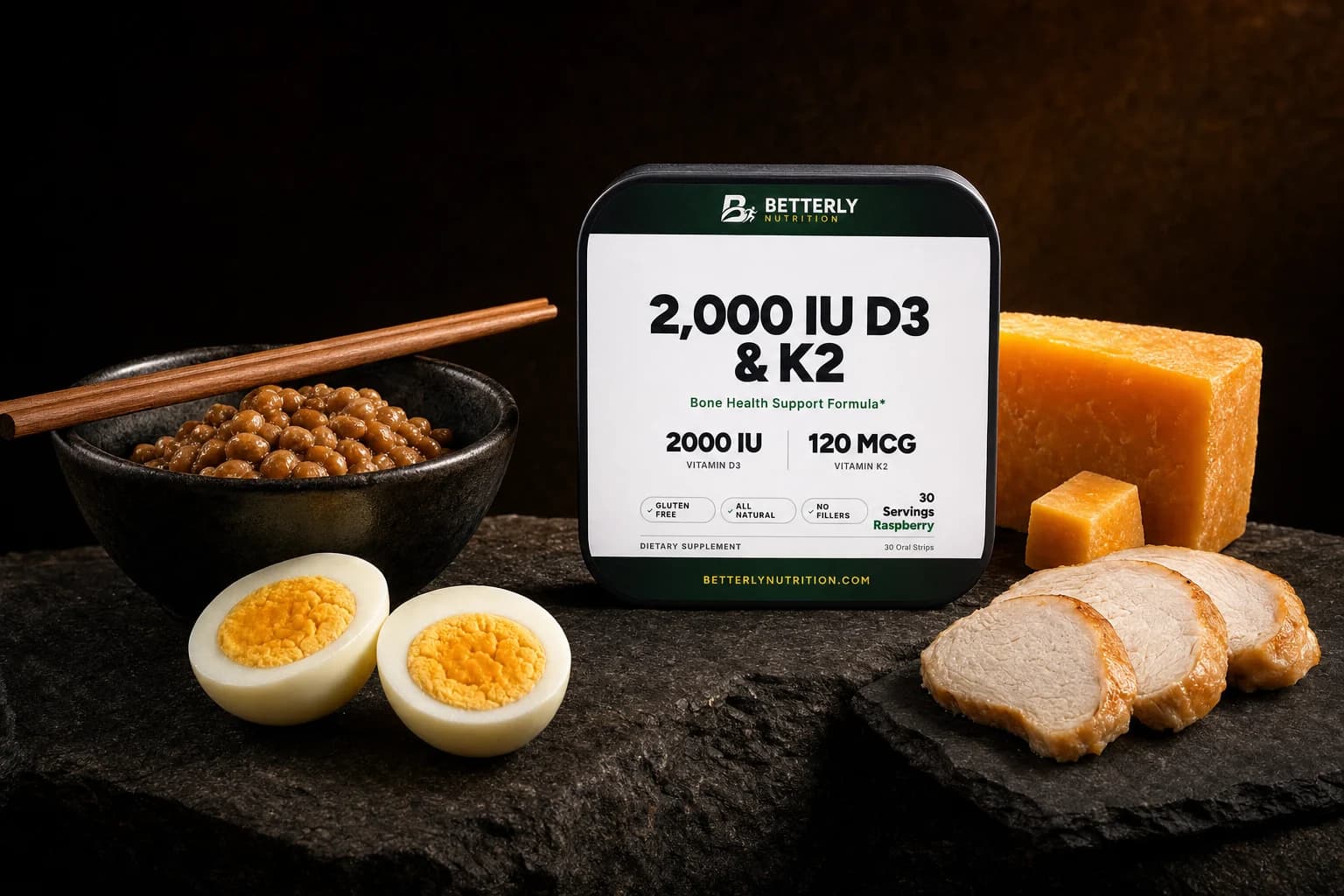
From our shop: 19mg Iron & Folate Strips — its panel prints the iron as ferric saccharate, the 3+ form, at 19 mg (106% DV) per 1-strip (200 mg) serving, dissolved on the tongue instead of swallowed.
Which iron form should you buy?
The right iron form depends on your situation: a ferrous salt if absorption per milligram matters most, or exactly what your provider named if you already have a plan.
| If this is you | Look for | Why |
|---|---|---|
| Your provider named a form and dose | That form and amount | Swapping changes the iron you get |
| You want the form ODS rates higher | A ferrous salt, such as sulfate | Ferrous beats ferric on bioavailability |
| High doses bother your stomach | A lower dose or a chelate, with your provider | ODS says chelates might cause fewer effects |
| You'd rather not swallow tablets | A strip, liquid or chewable, then its form | Format and form are separate choices |
| Your multivitamin already lists iron | Probably no second iron product | Every source counts toward 45 mg |
Notice that form usually comes second. The first question is whether an iron product belongs in your routine.
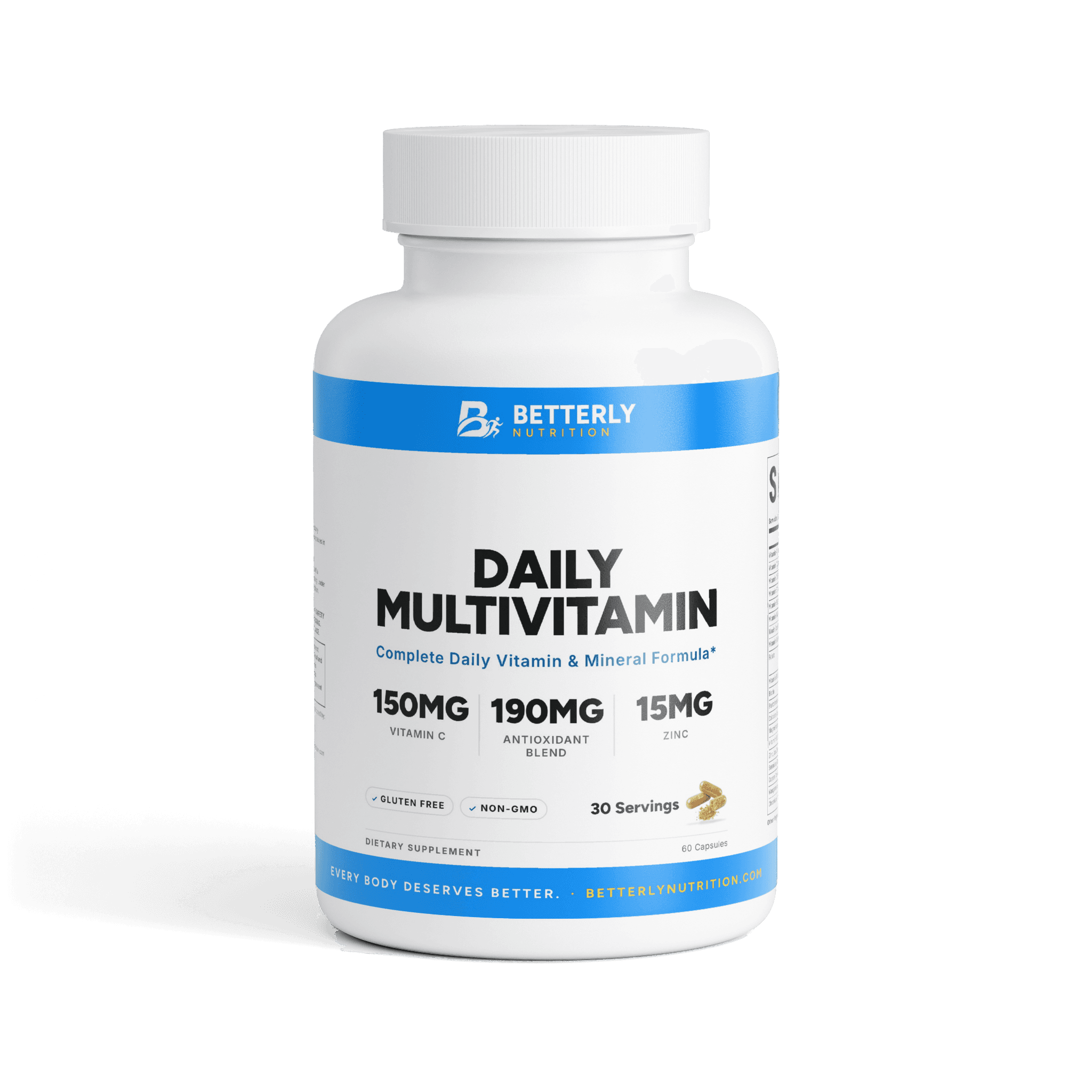
ODS says multis with iron, especially women's formulas, typically provide 18 mg, while men's and seniors' formulas often have less or none. Our Daily Multivitamin Capsules have no iron row, but the panel is good form practice: calcium as calcium carbonate, magnesium as magnesium oxide, copper as copper gluconate, chromium as chromium picolinate. The word after "as" names the mineral's partner, just as on an iron label.
You'll find the strip's neighbors on our targeted support shelf.
From our shop: Daily Multivitamin Capsules — per 2-capsule serving, the panel lists selenium (30 mcg) and manganese (2 mg) as amino acid chelates and zinc (15 mg) as zinc oxide, with no iron row.
How do you take a ferrous or ferric supplement?
Follow the label of the ferrous or ferric product you bought: our ferric saccharate strip's suggested use is 1 oral strip on the tongue daily, left to dissolve.
Directions belong to a product, not to a form. Two ferrous sulfate products can print different amounts and instructions, so go by the one in your hand. Our strip's caution begins "Do not exceed recommended dose," which caps it at 1 strip a day.
For when and with what to take iron, see our iron routine walkthrough; for our strip, follow its label.
Ferrous and ferric products do share one thing: the child warning. Our strip's label carries the standard iron warning about fatal poisoning in children under 6, and a raspberry-flavored film needs the same high shelf as any tablet.
When doesn't the iron form matter?
The iron form matters little once the milligrams on a panel's iron row fit your day and no provider has asked for a specific compound.
In these situations, the name in parentheses shouldn't drive your decision:
- Your provider already chose the form. Stick with it. A general ranking doesn't outrank a plan made for you.
- The iron row already fits your total. The panel converts every form to iron, so 18 mg from gluconate counts toward the 45 mg ceiling exactly like 18 mg from fumarate.
- Your multivitamin supplies your iron. Then the form is whatever that formula uses, and the useful question is whether you need anything more.
- You're really picking a format. If the goal is nothing to swallow, choose the format first and read the form off whichever product fits.
- You don't need extra iron. If meals cover you and no provider has suggested iron, there's no form to pick.
Who should talk to a provider before picking an iron form?
A healthcare provider should weigh in before you change iron forms, and before you start our ferric saccharate strip if you're pregnant, nursing, under 18 or managing a medical condition.
That second part is the caution printed on the strip. A few form-specific situations deserve the same call:
- You want to trade one form for another. Moving from sulfate to gluconate, or from ferrous to ferric, can change your iron intake even when the tablet count stays the same.
- Your supplements alone would reach 45 mg a day or more. ODS links that much supplemental iron to stomach side effects, and 45 mg is also the adult upper limit for all sources combined.
- Levodopa or levothyroxine is on your prescription list. The ODS consumer sheet names both as medicines iron can interfere with, with no exception for any form. A pharmacist can check your whole list.
- Iron build-up runs in your family. Ask your provider first: for people who have that inherited condition, ODS advises against iron supplements, and against vitamin C supplements too.
- An operation is scheduled. Take the product itself to your pre-surgery appointment so the team can read its exact form and dose.
FAQ: ferrous and ferric iron
What's the difference between ferrous sulfate and ferric sulfate?
Ferrous sulfate and ferric sulfate share one partner, sulfate, but carry iron at different charges: 2+ in ferrous, 3+ in ferric. ODS lists both as frequently used supplement forms and calls the ferrous kind more bioavailable. Its supplement section gives ferrous sulfate a by-weight figure, 20% iron, and none for ferric sulfate.
Is ferric saccharate the same as ferric citrate?
Ferric saccharate isn't the same compound as ferric citrate, though both are ferric iron, the 3+ form, with different partners. ODS names ferric citrate among frequently used supplement forms, while the ODS pages we cite don't mention ferric saccharate. Because both are ferric, ODS's point that ferrous iron is more bioavailable applies to each.
Is heme iron better than ferrous or ferric iron?
Heme iron absorbs more easily than plant iron in food, ODS says, but that's a food comparison, not a verdict on supplement forms. Meat, poultry and seafood carry heme iron; plants and fortified foods don't. In its supplement section, the professional sheet lists heme iron polypeptides among forms that might cause fewer stomach side effects than ferrous or ferric salts, without ranking their absorption.
Can you take a ferrous and a ferric iron supplement together?
Ferrous and ferric iron supplements belong in the same day only with your provider's okay, because upper limits count milligrams, not forms. Our ferric strip and ferrous-fumarate hair capsules show why an iron total alone isn't enough. Their iron rows add to 33.5 mg, but their folic acid comes to 1,120 mcg (240 plus 880), over the 1,000 mcg adult upper limit on the ODS folate sheet. Don't combine them without that okay. Our iron-per-day guide shows how to total every source.
Should you switch from a ferrous to a ferric iron supplement?
Switching from a ferrous to a ferric iron supplement isn't a move to make on your own. ODS rates ferrous iron as more bioavailable, so a ferric form, ours included, doesn't gain you absorption by that measure. If a ferrous tablet doesn't suit you, tell the provider who suggested it; they can weigh another form, dose or format.
Sources
- Iron: Fact Sheet for Health Professionals, NIH Office of Dietary Supplements
- Iron: Fact Sheet for Consumers, NIH Office of Dietary Supplements
- Folate: Fact Sheet for Consumers, NIH Office of Dietary Supplements
- Daily Value on the Nutrition and Supplement Facts Labels, U.S. Food and Drug Administration
If this left you looking for somewhere to start, read ferric saccharate iron strips — its amounts per serving are listed on the page. For the practical questions this raises, how dosing, sourcing and subscriptions work is answered in one place.