On this page
- Key takeaways
- Is holy basil the same as tulsi?
- What does research say about holy basil benefits?
- Are holy basil tea benefits the same as a capsule's?
- How do you read a holy basil label?
- Should you take holy basil at night or in the morning?
- Are there holy basil benefits for women?
- When don't you need holy basil?
- Who should check with a healthcare provider first?
- FAQ: holy basil and tulsi
- Sources
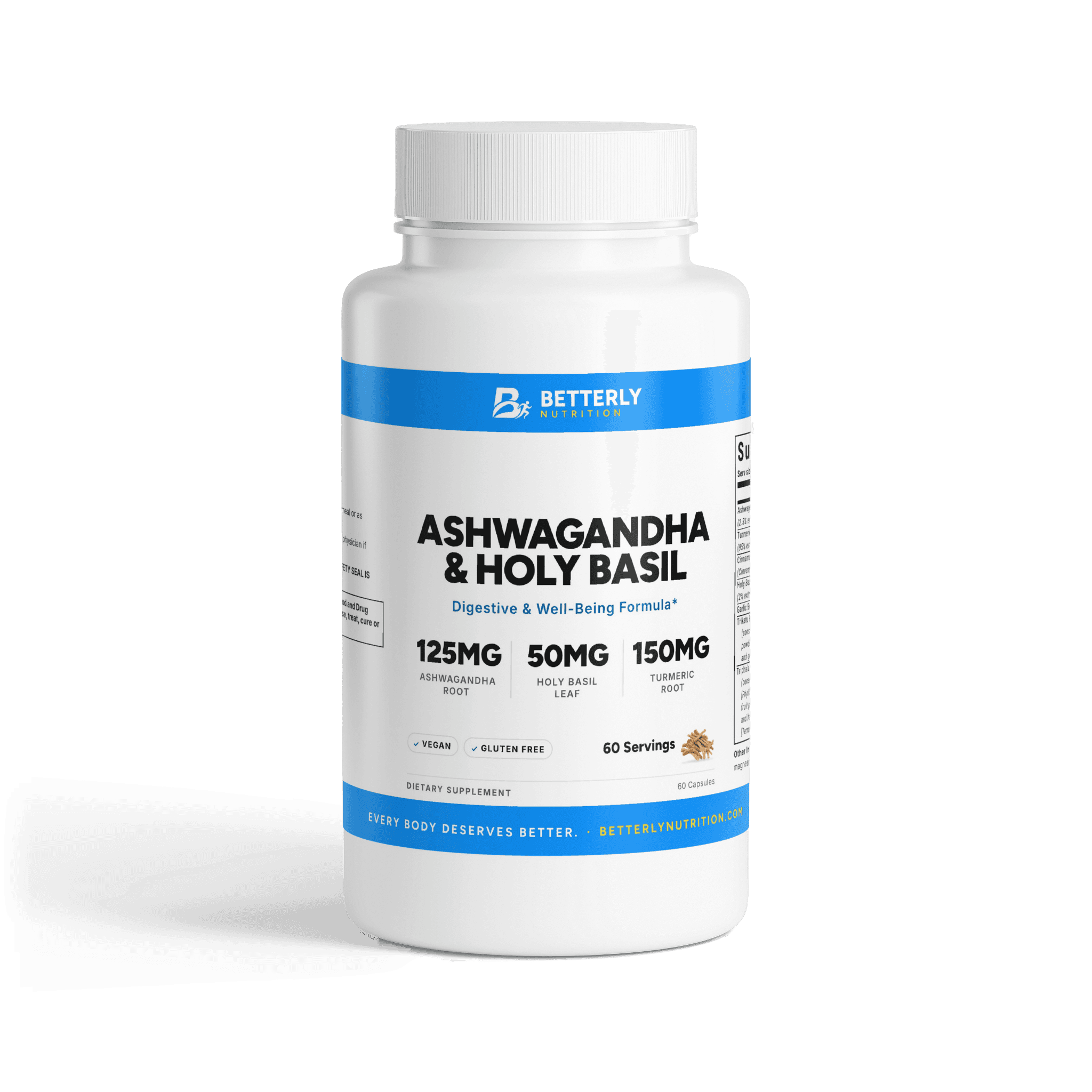
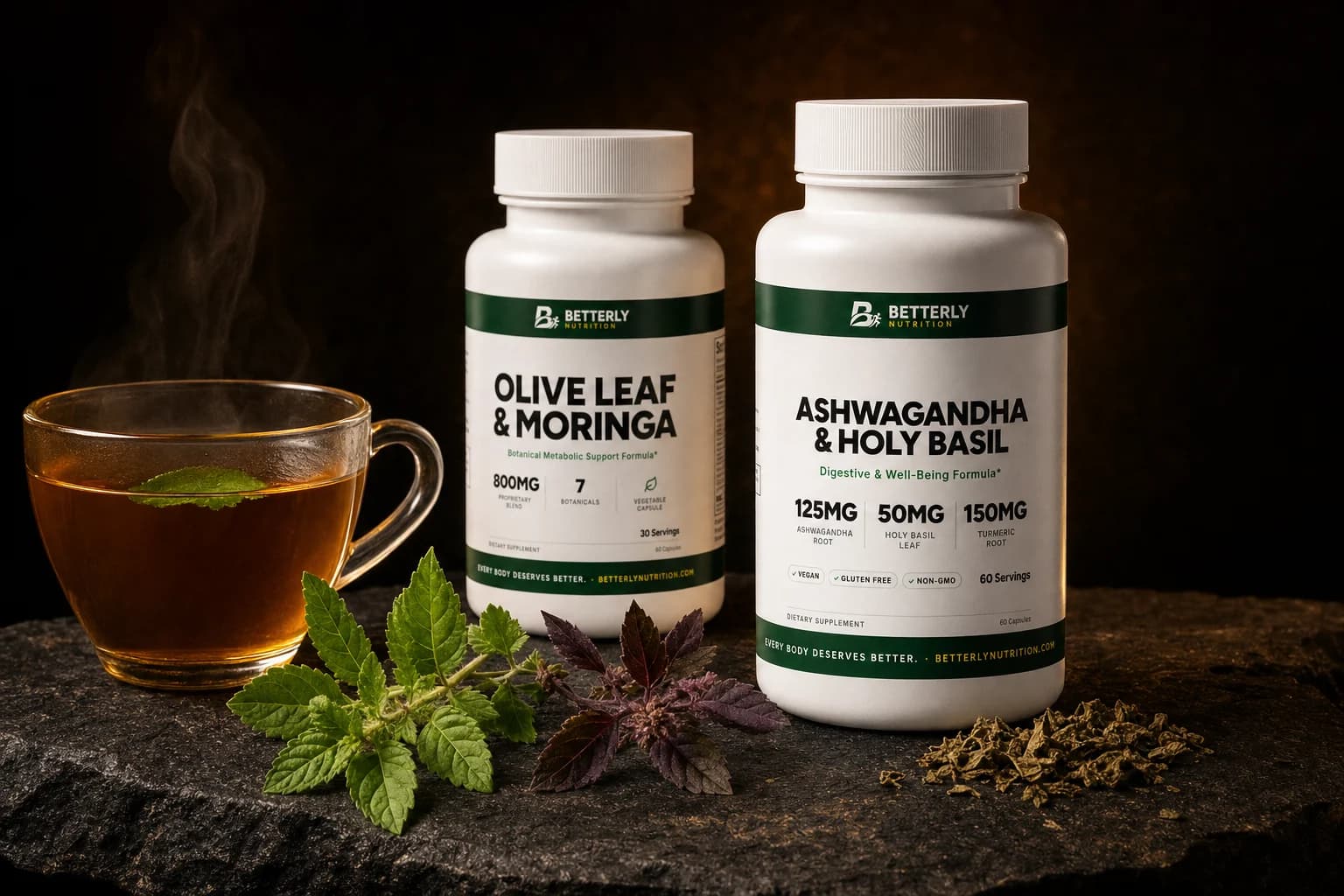
The short answer: The case for holy basil benefits rests mostly on tradition. Holy basil, also called tulsi (Ocimum tenuiflorum), is an Ayurvedic leaf traditionally taken daily to support a calm response to everyday stress, and a 2017 review found only 24 human studies of it, lasting 2 to 13 weeks. On timing, our Ashwagandha & Holy Basil Ayurvedic Capsules label says 1 capsule daily, preferably with a meal, and names no hour.
Key takeaways
- Holy basil and tulsi are the same plant, Ocimum tenuiflorum, also sold under the synonym Ocimum sanctum, which still appears on many labels and in research.
- A 2017 systematic review counted 24 human studies of tulsi, mostly small, short and run in India, and its authors warned the effects may be overstated.
- Leaf-extract amounts in that review started at 300 mg a day, while our Ashwagandha & Holy Basil Ayurvedic Capsules list 50 mg per 1-capsule serving.
- Neither of our holy basil labels names a time of day, so choose a daily slot you'll keep and follow each label's food or water direction.
- If you're pregnant, nursing, under 18, on medication or managing a health condition, get a healthcare provider's okay before starting holy basil in any form.
A note before we start: Betterly sells two capsules with holy basil in them. So further down, we grade both labels against the same four questions you could put to any tulsi product, and neither one answers all four.
Is holy basil the same as tulsi?
Yes, holy basil and tulsi are two names for one plant, Ocimum tenuiflorum, a fragrant mint-family herb indigenous to the Indian subcontinent.
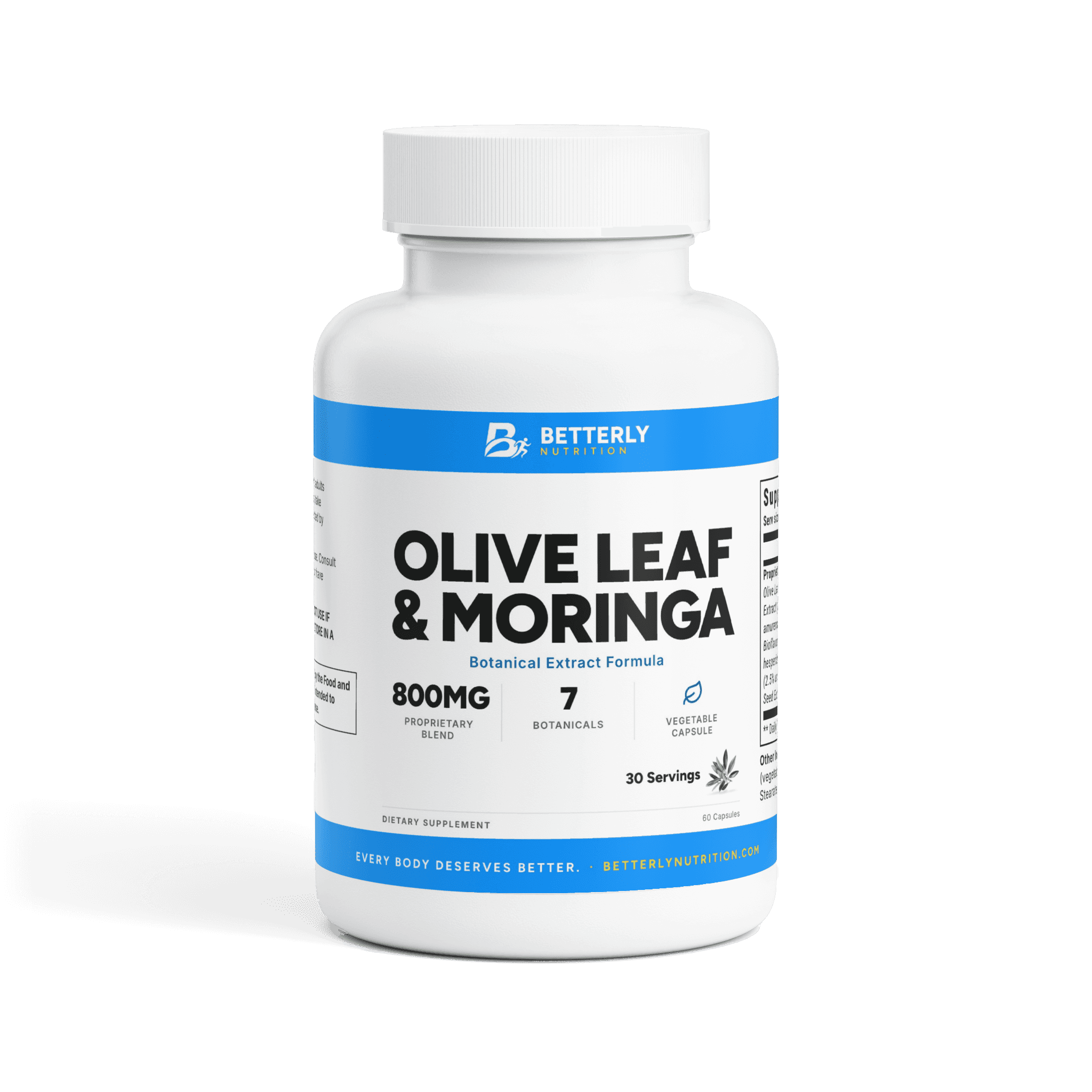
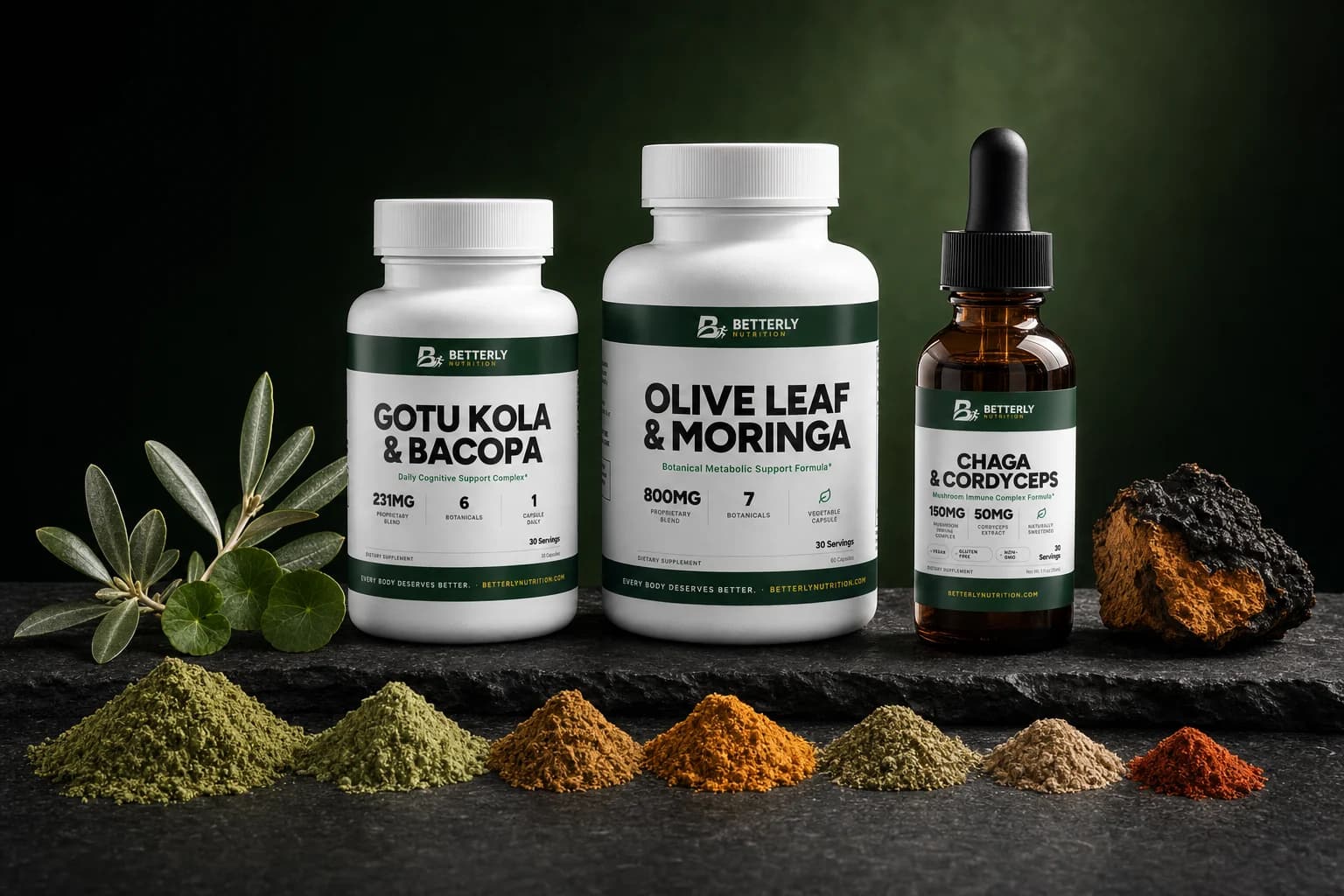
Tulsi is its Hindi name (tulasi in Sanskrit). Ocimum sanctum is a synonym that still appears on many labels and in research, including the panel of our Olive Leaf, Moringa & Holy Basil Capsules.
Its health use comes from Ayurveda. The NCCIH overview of Ayurvedic medicine calls Ayurveda one of the world's oldest medical systems. Separately, the 2017 review's authors describe the Ayurvedic habit of taking tulsi daily, and they name the leaf as the part people use most.
The 2017 review describes three types:
| Type | Leaves | Botanical name |
|---|---|---|
| Rama (Sri) tulsi | Green | Ocimum tenuiflorum |
| Krishna (Shyama) tulsi | Purplish | Ocimum tenuiflorum |
| Vana (wild or forest) tulsi | Dark green | Ocimum gratissimum |
So Rama and Krishna are two cultivars of one species. Vana is a separate species, Ocimum gratissimum, that's still traditionally called tulsi. Neither of our labels says which type it uses.
What does research say about holy basil benefits?
Research on holy basil benefits is thin: a 2017 systematic review found 24 human studies with 1,111 people in total, and only three enrolled 100 or more.
That review, by Negar Jamshidi and Marc Cohen in Evidence-Based Complementary and Alternative Medicine, is free to read on PubMed Central. It's the fullest summary we could find, because the federal shelf is empty: we found no holy basil page from the NIH Office of Dietary Supplements or NCCIH, and MedlinePlus doesn't list the herb.
Here's what the review reported that bears on everyday stress and focus:
- Three studies that gave larger amounts over longer stretches reported lower stress scores in people who already had stress-related complaints.
- A 4-week trial in 40 healthy young adults, using 300 mg of tulsi a day, reported better attention and short-term memory scores than placebo. It found no difference in stress levels.
- Most of the 24 studies enrolled people with specific health conditions. Only three looked at healthy people.
The authors were candid about the limits. Almost all the studies were run in India and published in local journals. All but three skipped double-blinding, and the authors wrote that tulsi's effects may have been overestimated as a result.
One author also disclosed paid consulting for a company that makes tulsi products. Weigh that stake the way you'd weigh ours.
Holy basil is often sold as an adaptogen, a modern term, coined in mid-20th-century research, for herbs traditionally used to help the body handle everyday stress. Our beginner's guide to adaptogens sets tulsi beside ashwagandha, rhodiola and eleuthero, and you can browse every adaptogen formula we carry in one place.
Are holy basil tea benefits the same as a capsule's?
Holy basil tea and holy basil capsules aren't interchangeable, because tea steeps the leaf itself while capsules often hold a concentrated extract.
The NIH Office of Dietary Supplements' background sheet on botanicals spells out the difference. Tea is made by pouring boiling water over the plant and letting it steep. For an extract, the plant soaks in water, alcohol or another liquid that draws out its compounds, and the result can be dried to a powder for capsules.
Here's what the review's studies used next to what our two labels list:
| Where the holy basil comes from | Form | Amount reported or labeled |
|---|---|---|
| Water-extract studies in the review | Leaf extract | 300 to 3,000 mg (taken 1 to 3 times a day) |
| Alcohol-extract studies in the review | Leaf extract | 300 to 1,000 mg (once or twice a day) |
| Whole-plant studies in the review | Whole-plant water extract | 6 to 14 g per day |
| Ashwagandha & Holy Basil Ayurvedic Capsules | Leaf, 2% extract | 50 mg (1 capsule) |
| Olive Leaf, Moringa & Holy Basil Capsules | Leaf extract, 2.5% ursolic acid | Not listed (2 capsules) |
Our blend's 50 mg is one-sixth of the smallest leaf-extract amount in that review. Matching that low end would take six capsules a day, which the label rules out ("Do not exceed recommended dose"), and it would multiply every other ingredient too. If a study-sized amount of tulsi is your goal, this blend isn't built for it.
How do you read a holy basil label?
A holy basil label should answer four questions: which species, which plant part, which marker compound, and how many milligrams of holy basil itself.
Each one matters for tulsi. A species name rules out vana, the separate species that shares the tulsi name. The part should be leaf. A marker, as that ODS sheet explains, is a chosen chemical that makers measure and adjust so batches match. And only milligrams let you compare a capsule with the review's amounts.
Here's how our two labels score:
| Question | Ashwagandha & Holy Basil | Olive Leaf, Moringa & Holy Basil |
|---|---|---|
| Species named? | No, just "Holy Basil Leaf" | Yes, Ocimum sanctum |
| Plant part named? | Yes, leaf | Yes, leaves |
| Marker named? | No, "2% extract" with no marker | Yes, 2.5% ursolic acid |
| Holy basil's own amount? | Yes, 50 mg per 1-capsule serving | No, it's inside an 800 mg blend per 2-capsule serving |
The olive leaf formula clears three questions and the Ashwagandha & Holy Basil capsule two, but the olive leaf miss is the one that counts most. Ursolic acid does occur in tulsi leaves, and the review lists it alongside eugenol. Still, ODS notes that the compounds behind most botanicals' effects aren't known, so a named marker speaks to batch consistency, not to what the herb does.
The olive leaf blend's list order does give a ceiling. Holy basil sits fifth of seven, and blend ingredients run heaviest first, so it can't top 160 mg per 2-capsule serving and could be far less. Our walk-through of proprietary blend labels explains that rule.
From our shop: Ashwagandha & Holy Basil Ayurvedic Capsules — the one holy basil label on our shelf that prints its milligrams: 50 mg of holy basil leaf (2% extract) per 1-capsule serving, in a vegan, gluten-free capsule.
Should you take holy basil at night or in the morning?
Holy basil has no known best hour, and our Ashwagandha & Holy Basil label doesn't name one: it says 1 capsule daily, preferably with a meal.
That one capsule is the whole day's serving, and a bottle holds 60 servings. The research can't settle the hour either. The 2017 review doesn't compare times of day, and only one of its 24 studies measured sleep at all. If you're hoping holy basil will help you wind down at night, that's a hope, not a finding.
So when to take holy basil comes down to your routine:
- Take 1 capsule once a day with a meal you rarely skip. The label doesn't say which meal.
- Don't make up a missed capsule by doubling the next day. Just carry on.
- Evening works too, since the panel lists no caffeine, coffee or green tea.
The olive leaf formula has different directions. Adults take 2 capsules daily with 6 to 8 oz (177 to 237 ml) of water, and that label doesn't mention food or a time. A bottle holds 30 servings.
From our shop: Olive Leaf, Moringa & Holy Basil Capsules — a 2-capsule serving built on an 800 mg proprietary blend of seven botanical extracts, with holy basil (standardized to 2.5% ursolic acid) as one part and its own amount not listed.
Are there holy basil benefits for women?
We found no women-specific holy basil benefits: the 2017 review says its mood and side-effect findings held regardless of gender, and no federal fact sheet covers tulsi.
What's specific to women is safety.
The NIH Office of Dietary Supplements' consumer page, Dietary Supplements: What You Need to Know, notes that safety testing for many supplements is thin in pregnant and nursing women. The tulsi review doesn't cover pregnancy at all. Both of our holy basil labels ask you to consult a physician first if you're pregnant or nursing.
Planning a pregnancy? Raise holy basil, tea included, with your provider before you start.
When don't you need holy basil?
Our holy basil capsules may not suit you if tulsi tea is already your daily habit, you take the olive leaf formula, or you want tulsi at study-sized amounts.
Tulsi tea drinkers are already following the tradition this herb comes from. The 2017 review didn't compare tea with capsules, so nothing in it says a capsule improves on the habit.
Already taking our Olive Leaf, Moringa & Holy Basil Capsules? Then holy basil is in your routine at an amount the panel never states. Adding the Ashwagandha & Holy Basil capsule would stack a known 50 mg on an unknown one, so get a provider's view before combining them.
Want tulsi on its own at research amounts? Neither of our labels reaches 300 mg (one lists 50 mg, and the other can't exceed 160 mg), and we don't sell a single-herb holy basil product. Look for a label that answers all four checklist questions above.
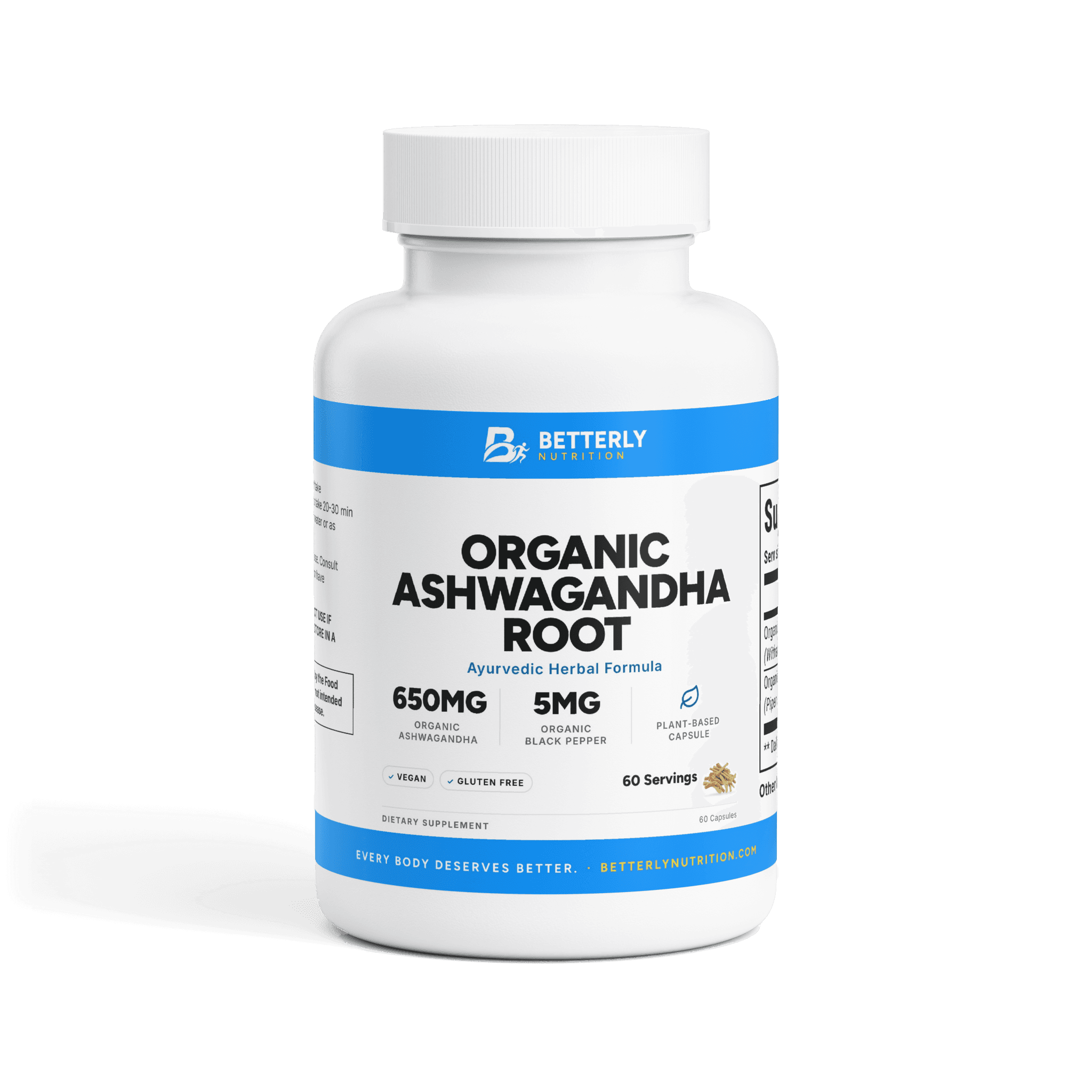
Some people would rather skip the company holy basil keeps. The Ashwagandha & Holy Basil capsule carries 16 other ingredients, including licorice root, shilajit and cordyceps. If ashwagandha is really the draw, our holy basil and ashwagandha comparison weighs the two herbs.
One last case: holy basil is traditionally used for everyday stress. If strain is changing how you eat or get through a workday, raise it with a healthcare provider, who can look at the whole picture.
Who should check with a healthcare provider first?
Talk with a healthcare provider before taking holy basil if you're pregnant, nursing or under 18, take any prescription, have surgery coming up, or manage a medical condition.
Both of our holy basil labels print that physician caution for pregnancy, nursing, under-18s and medical conditions. Beyond the label:
- Medicines. The ODS consumer page says supplements can interact with some medicines. We found no federal interaction list for holy basil.
- Surgery. The same ODS page notes that some supplements can raise bleeding risk, and some taken before surgery can change how you respond to anesthesia. Bring your supplement list to any pre-op visit.
- Berberine. The olive leaf blend includes Phellodendron amurense bark extract (std. to 8% berberine) with no amount of its own. If a berberine product is already part of your routine, there's no way to add the two together, so show your provider both labels.
Holy basil's side-effect record is short, and a short record isn't a clean one. In the 2017 review, one study reported occasional nausea, eight didn't report on side effects at all, and the longest ran 13 weeks.
Our blend is Ayurvedic, so one more NCCIH point applies: some Ayurvedic preparations may contain lead, mercury or arsenic, so show your provider any Ayurvedic product you use, ours included. Our guide to whether Ayurvedic supplements are safe goes deeper.
FAQ: holy basil and tulsi
Is holy basil an adaptogen?
Holy basil is widely called an adaptogen, a modern term coined in mid-20th-century research for herbs traditionally used to help the body cope with everyday stress. The word names a category, not a result: tulsi's human research is small and short, and it can't promise how the herb will feel for you.
Is holy basil the same as Thai basil?
No, the herb most stores label Thai basil is a different plant from holy basil. Thai cooks call holy basil kaphrao, the leaf in the stir-fry phat kaphrao, while store-bought Thai basil is horapha. A bunch of Thai basil from the market isn't a swap for tulsi tea or a holy basil supplement.
Can you drink holy basil tea every day?
Yes, holy basil tea every day fits Ayurvedic tradition, which takes tulsi daily, as the 2017 review describes. The studies in that review ran 2 to 13 weeks, though, so they can't speak to years of daily use. If you drink tulsi tea and also take a holy basil capsule, count both as holy basil. Mention the pair to your provider if you're pregnant, nursing or taking medication.
Is holy basil good for skin and hair?
We found no good evidence that holy basil supplements help skin or hair. None of the 24 human studies in the 2017 tulsi review measured skin or hair. Posts about tulsi for skin often describe face masks or oils, which is a different use from swallowing a capsule.
Can kids take holy basil?
Holy basil supplements aren't for kids without a doctor's okay. Both of our holy basil labels ask anyone under 18 to consult a physician first. The NIH Office of Dietary Supplements also urges care in giving children supplements unless their health care provider recommends them, because safety testing for many supplements in children is thin.
Sources
- The Clinical Efficacy and Safety of Tulsi in Humans: A Systematic Review of the Literature, Evidence-Based Complementary and Alternative Medicine (2017), via PubMed Central
- Botanical Dietary Supplements: Background Information, NIH Office of Dietary Supplements
- Dietary Supplements: What You Need to Know, NIH Office of Dietary Supplements
- Ayurvedic Medicine: In Depth, National Center for Complementary and Integrative Health
If this left you looking for somewhere to start, read holy basil capsules with ashwagandha — its amounts per serving are listed on the page. For the practical questions this raises, how dosing, sourcing and subscriptions work is answered in one place.