On this page
- Key takeaways
- How much resveratrol is in a glass of red wine?
- Which red wine has the most resveratrol?
- How much resveratrol is in grapes, blueberries and other foods?
- How many glasses of red wine equal one resveratrol capsule?
- Is resveratrol from red wine the same as a supplement's?
- What does "red wine extract" on a resveratrol label tell you?
- How should you take our resveratrol capsules?
- When don't you need a resveratrol supplement?
- Who should check with a healthcare provider first?
- FAQ: Resveratrol in red wine and everyday foods
- Sources
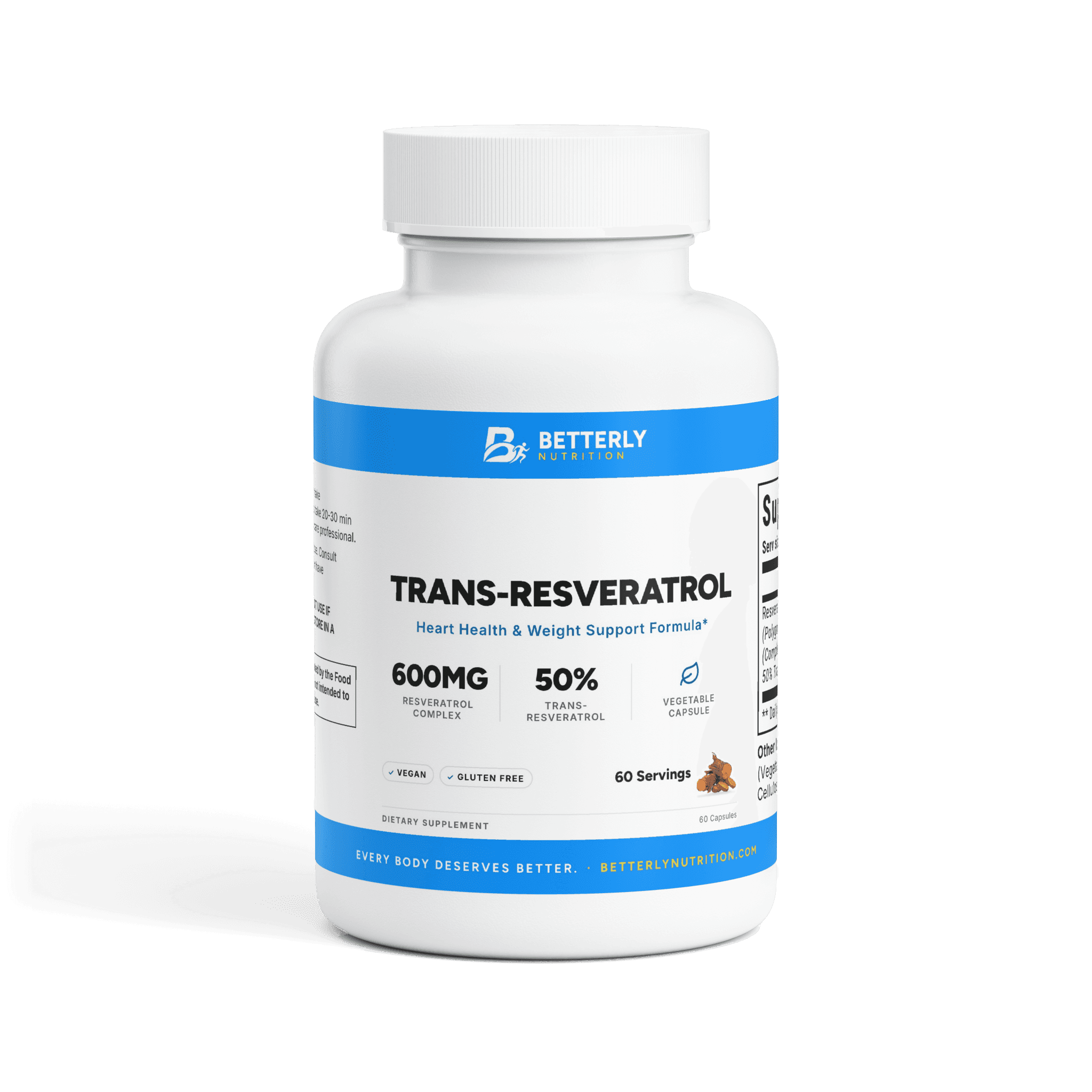
The short answer: How much resveratrol is in red wine? Very little. A 2016 review in Advances in Nutrition puts the average red at about 1.9 mg of trans-resveratrol per liter. That's roughly 0.28 mg in a 5-ounce glass and 1.4 mg in a 750 mL bottle, by our math. One capsule of our Trans-Resveratrol Capsules comes to roughly 300 mg of trans-resveratrol, the amount in some 1,070 average glasses.
Key takeaways
- An average red wine holds about 1.9 mg of trans-resveratrol per liter, so a 5-ounce glass carries roughly 0.28 mg.
- Resveratrol levels shift with region, vintage and winemaking, and no wine bottle prints the amount.
- Grapes, blueberries, peanuts and dark chocolate contain some resveratrol, but only fractions of a milligram per everyday portion.
- Matching one of our 600 mg-complex capsules would take about 158 liters of average red wine, so wine is a yardstick here, never a source.
We sell two resveratrol supplements, and one of them is the capsule this post keeps measuring wine against. The glass, bottle and capsule conversions are our own arithmetic, laid out step by step so you can redo any of them.
A note before the numbers: wine appears here only as a unit of measure. If you're under 21, the U.S. legal drinking age, or you don't drink, nothing in this post is a reason to start. The CDC's page on moderate alcohol use says it plainly: "If you don't currently drink, don't start for any reason."
How much resveratrol is in a glass of red wine?
A 5-ounce glass of red wine holds about 0.28 mg of trans-resveratrol on average, based on the 1.9 mg per liter figure in a 2016 research review.
That review, by Sabine and Ralf Weiskirchen in Advances in Nutrition, gathers resveratrol measurements from published wine and food studies, and 1.9 mg per liter is its expected average for red.
By our arithmetic, that average works out to:
- One 5-ounce (148 mL) glass: about 0.28 mg
- One 750 mL bottle, roughly five glasses: about 1.4 mg
- One liter: about 1.9 mg
The average hides a wide spread. One survey of French Pinot noir cited in the review ran from about 0.36 to 1.98 mg per liter, so a glass from those bottles could hold 0.05 to 0.29 mg. These are lab measurements, not a suggestion to drink.
They also count free trans-resveratrol only. The authors note that wine and food carry related forms, such as piceid (resveratrol with a sugar attached), whose pharmacology they call widely unknown.
Which red wine has the most resveratrol?
No single red grape reliably tops the resveratrol list, because the 2016 review says levels differ between countries, growing areas, vintages and production years.
Grapes make resveratrol almost entirely in their skins, the review explains, and the enzyme behind it switches on under stress such as UV light or fungal attack. So one variety can measure high in one vintage or region and low in another. In the cellar, temperature, pH and sulfur dioxide shift the figure again.
What does hold up is the color gap. Red grape varieties and red wines carry roughly 3 to 10 times more resveratrol than white ones, per the review. The review doesn't say why, but one bit of general winemaking background fits: red wine usually ferments on its grape skins, and white wine usually doesn't.
So the honest answer to "what's the best red wine for resveratrol?" is that the shelf can't tell you, because no bottle prints the amount. If you're of legal drinking age and already drink wine, choose it for flavor, since the gap between bottles is fractions of a milligram.
How much resveratrol is in grapes, blueberries and other foods?
Grapes, blueberries, peanuts and dark chocolate all contain resveratrol, from about 0.03 mg per kilogram in peanuts and blueberries to under 2 mg per kilogram in the richest grapes.
Grapes lead. The review cites a Japanese survey that found 92 to 1,604 micrograms per kilogram in red grapes, about 0.09 to 1.6 mg per kilogram (2.2 pounds). Its white grapes ranged from 59 to 1,759 micrograms, so single samples overlap.
Blueberries sit far lower. A 2003 study of raw and baked blueberries and bilberries in the Journal of Agricultural and Food Chemistry found its richest sample in highbush blueberries from Michigan. Converted from the study's lab units, that's roughly 0.03 mg per kilogram. Highbush blueberries from British Columbia had none detectable, and the authors put blueberries and bilberries at under 10% of the level reported for grapes.
The review also lists peanuts and chocolate. Here's every source set against one of our Trans-Resveratrol Capsules, at about 300 mg of trans-resveratrol. The last two columns are our arithmetic.
| Food or drink | Measured resveratrol | Per everyday portion | To match one capsule |
|---|---|---|---|
| Red wine, average | 1.9 mg per liter | 0.28 mg per 5-oz glass | About 1,070 glasses |
| White wine | 0 to 1.09 mg per liter | Up to 0.16 mg per glass | At least 1,860 glasses |
| Red grapes | 0.09 to 1.6 mg per kg | Up to 0.16 mg per 100 g | About 190 to 3,300 kg |
| Blueberries, richest sample | About 0.03 mg per kg | About 0.003 mg per 100 g | About 9,400 kg |
| Peanuts, skins removed | 0.03 to 0.14 mg per kg | Up to 0.004 mg per ounce | About 2,100 to 10,000 kg |
| Dark chocolate | 0.35 mg per kg | 0.035 mg per 100 g bar | About 8,600 bars |
Even the richest red grapes would take about 190 kilograms, over 400 pounds, to match one capsule, and every other row runs into the thousands. The review's authors hit the same wall for a 1 g daily amount: no conventional food, or mix of foods, gets there.
How many glasses of red wine equal one resveratrol capsule?
One capsule of Betterly's Trans-Resveratrol Capsules equals the trans-resveratrol in about 1,070 five-ounce glasses of average red wine, or roughly 210 bottles.
Here's the math:
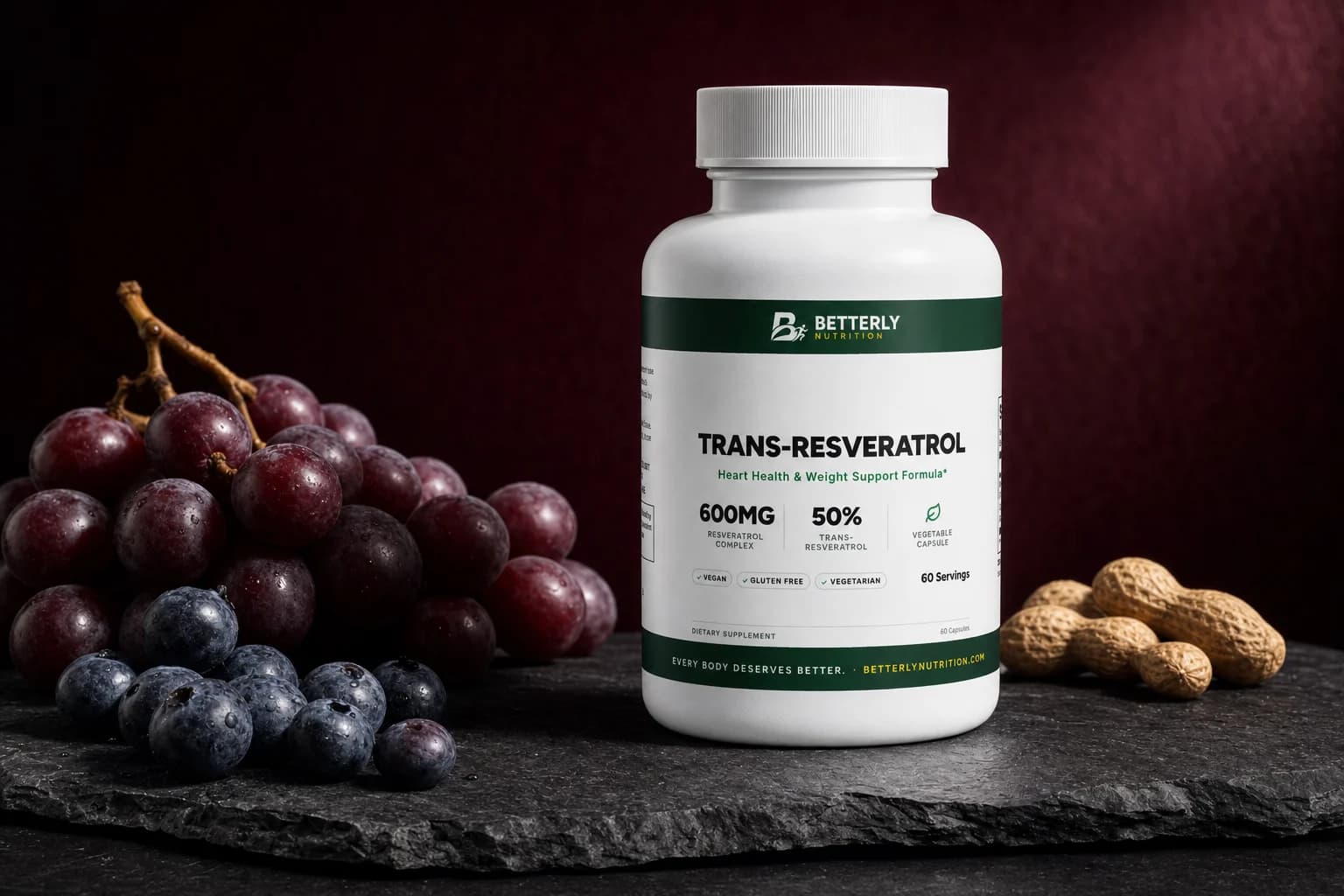
- The panel lists 600 mg of resveratrol complex from Polygonum cuspidatum (Japanese knotweed) root per 1-capsule serving, containing 50% trans-resveratrol.
- Half of 600 mg is 300 mg of trans-resveratrol.
- At 1.9 mg per liter, 300 mg would take about 158 liters of red wine.
- That's about 210 bottles of 750 mL, or about 1,070 glasses.
Our label directs a capsule twice daily, and a full day at that rate doubles everything to about 316 liters. Nobody, of any age, should try to drink toward those figures. They're here only to show scale.
Real diets land nowhere close. The review cites a study of 40,685 Spanish adults that estimated a median intake of about 0.1 mg a day of resveratrol and piceid combined, with wine supplying 98.4% of it. For France, which drank about 43.4 liters of wine per person in 2014, the authors estimate roughly 70 mg of resveratrol per person for the whole year. That's less than a quarter of one capsule.
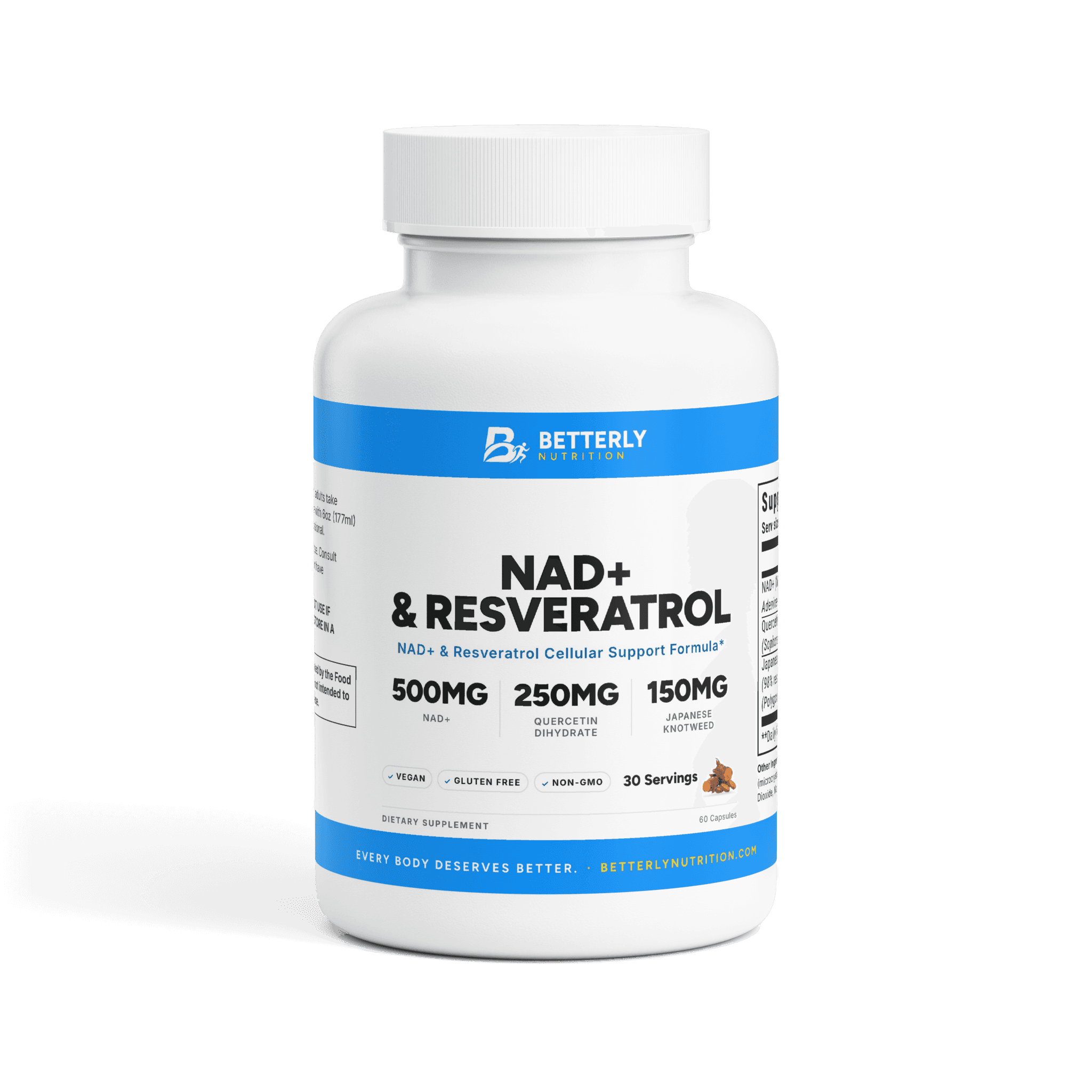
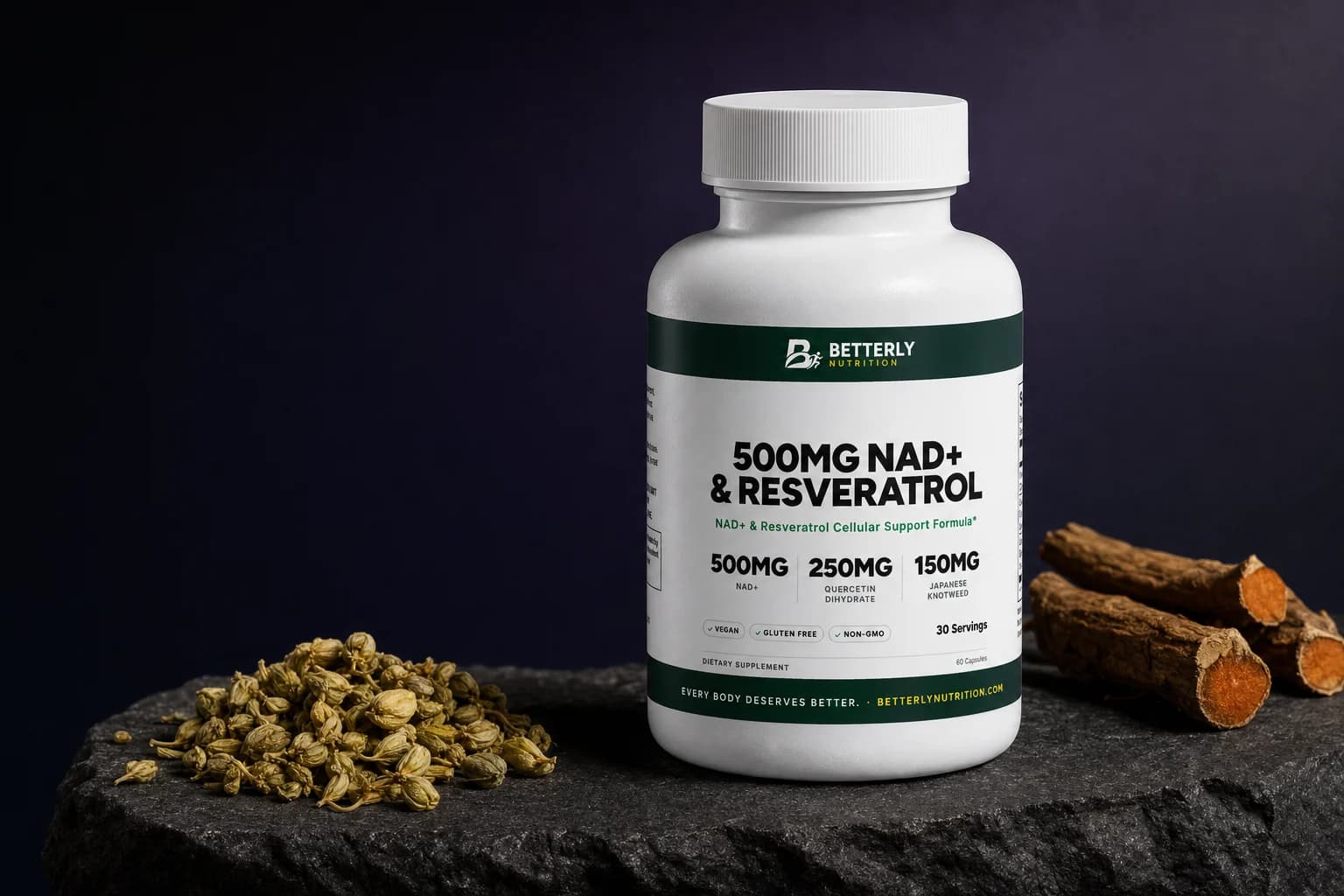
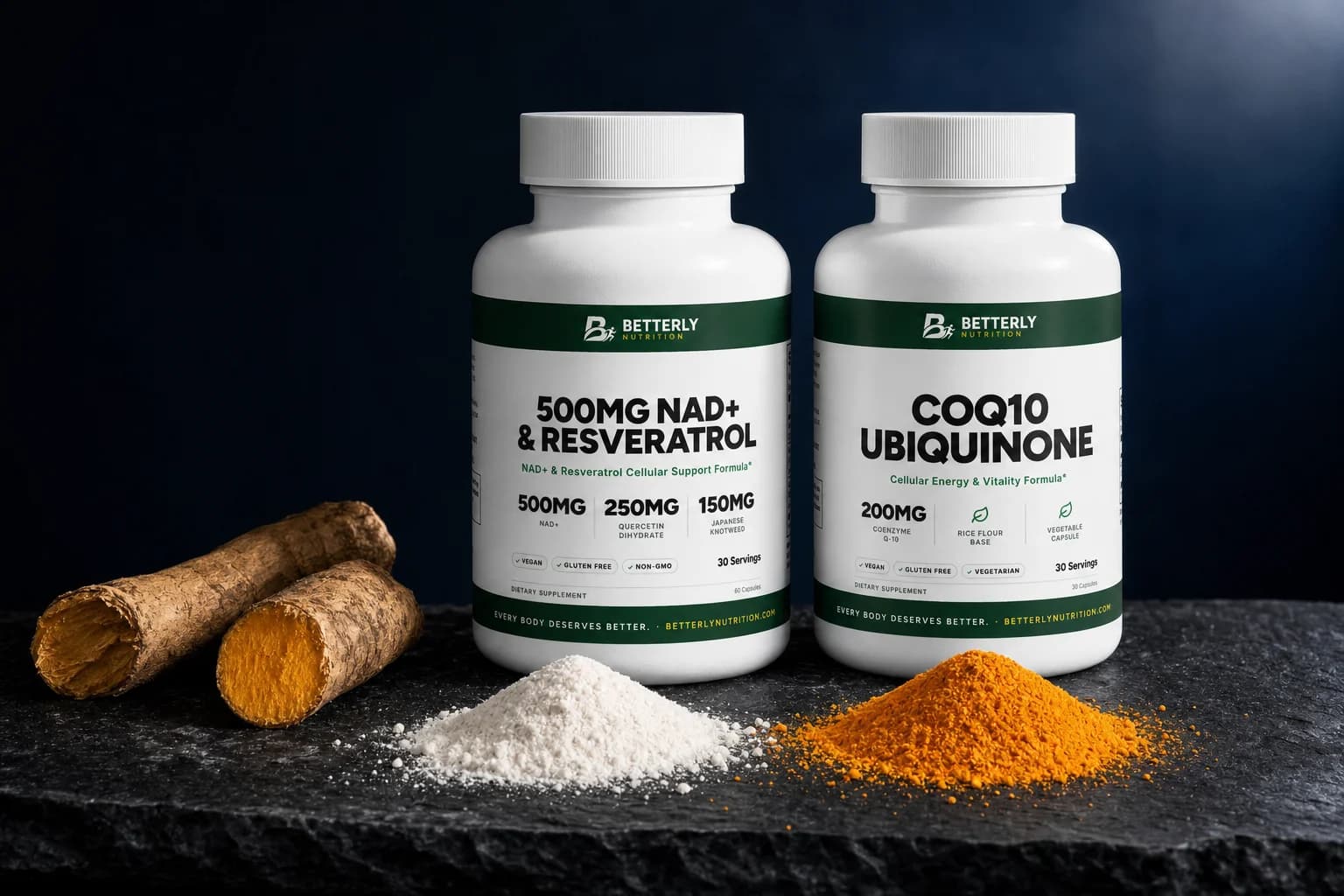
Our 500mg NAD+ & Resveratrol Capsules tell the same story. Their 2-capsule serving carries a 150 mg Japanese knotweed extract rated 98% resveratrol. That's about 147 mg by our math, or what 77 liters of average red would hold. The panel doesn't name the form, so read that match as rough.
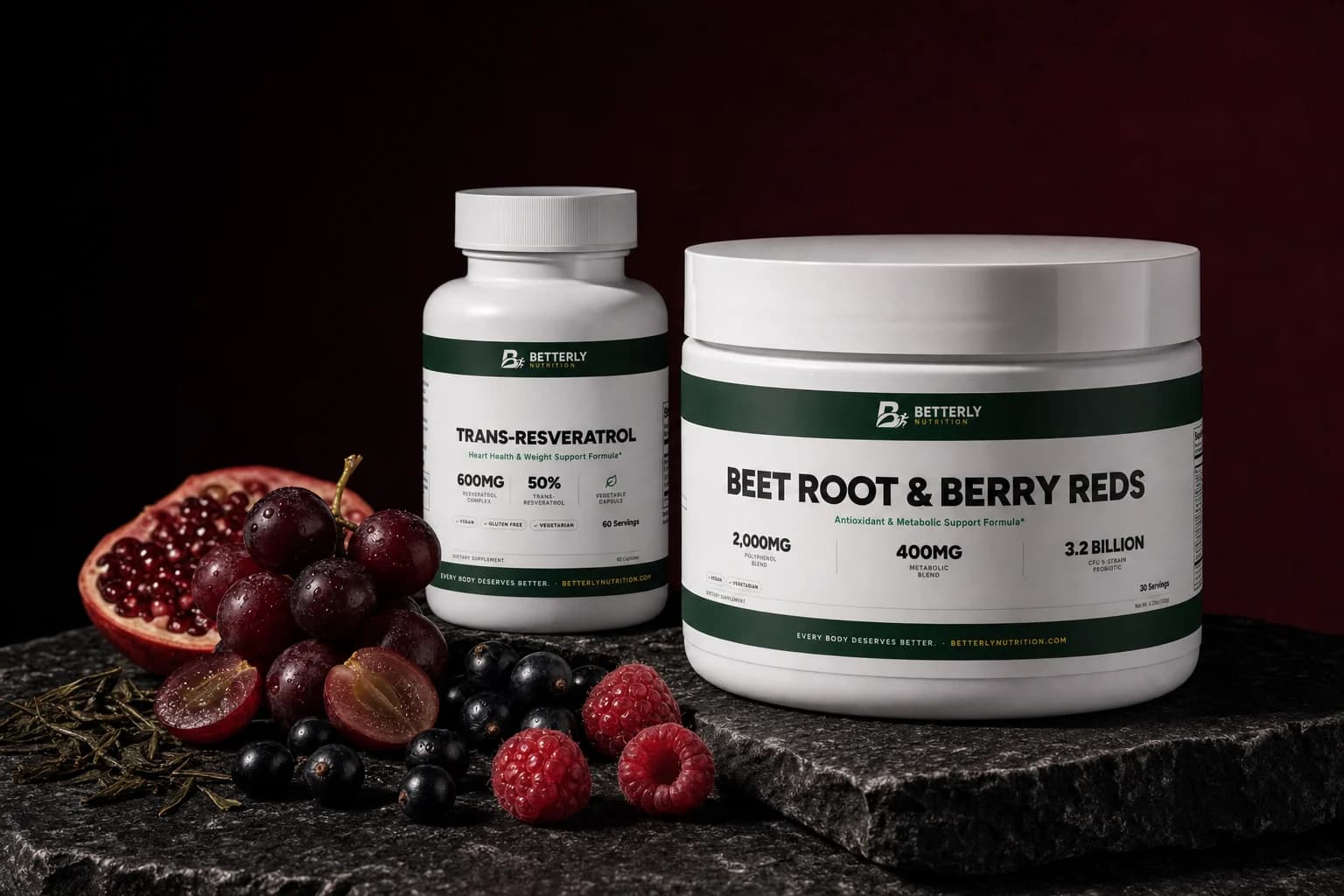
From our shop: Trans-Resveratrol Capsules — a 600 mg Japanese knotweed root complex, stated to be 50% trans-resveratrol, fills each vegan, gluten-free vegetable capsule.
Is resveratrol from red wine the same as a supplement's?
Red wine and a knotweed supplement both contain trans-resveratrol, the identical compound, but they deliver it in wildly different amounts and alongside very different ingredients.
Wine brings trans- and cis-resveratrol, piceid and other relatives at fractions of a milligram, plus alcohol. A capsule uses one source and states its amount. The review notes that many companies sell supplements with the resveratrol content spelled out. The same authors also call the clinical usefulness of those supplements questionable.
Research doses show the distance. LiverTox, the National Library of Medicine's reference on supplements and medicines, reports human trial doses from 20 mg to 5 g a day. The low end alone would take about 70 glasses of average red wine.
A printed amount still isn't a promise of results. LiverTox finds no conclusive evidence yet that resveratrol benefits people, a caveat that covers capsules and wine alike, and we make no health claim for red wine.
What does "red wine extract" on a resveratrol label tell you?
A "red wine extract" row tells you the ingredient's source, not its resveratrol content, unless the label also prints a milligram amount or a percentage.
The review notes that besides purified resveratrol, the market offers unspecified plant extracts, generally made from red wine or grapes. Since wine's own levels are low and uneven, the words "red wine" can't vouch for what's inside. Before you compare one with a knotweed product, look for:
- milligrams of resveratrol, or a percentage you can multiply by the extract's milligrams
- the word "trans," which pins down the molecule
- a blend total, which hides the extract's share
Both of our products name knotweed root, not wine or grapes. Our explainer on trans-resveratrol versus plain resveratrol goes deeper into what a panel's percentage actually counts.
How should you take our resveratrol capsules?
Betterly's Trans-Resveratrol label asks for two separate capsules a day, each swallowed 20-30 minutes before you eat, unless your healthcare professional advises differently.
- Per day: 2 capsules, which adds up to 1,200 mg of complex, or near 600 mg of the trans form by our arithmetic.
- Per bottle: 60 capsules, which the panel counts as 60 servings, so it lasts 30 days at label use.
- Ceiling: "Do not exceed recommended dose," says the caution.
- Label claims: vegan and gluten-free.
The NAD+ formula's directions differ: adults swallow two capsules daily alongside 6 oz (177 ml) of water, and the label doesn't tie them to food. Both carry knotweed resveratrol, so check with a pharmacist before taking the two together. Both sit in our NAD+ & Longevity collection.
Neither label pairs the capsules with wine or grapes, and our guide to resveratrol timing shows how to fit two before-meal windows into a real day.
From our shop: 500mg NAD+ & Resveratrol Capsules — built around 500 mg of NAD+ per 2-capsule serving, with 250 mg of quercetin dihydrate extract and a 150 mg knotweed extract at 98% resveratrol alongside.
When don't you need a resveratrol supplement?
Skip a resveratrol supplement if wine's numbers were all you wanted, you're hoping for "red wine in a pill," or you want resveratrol sourced from grapes.
- You came for the arithmetic. If the question was how much a glass holds, you have the answer, and a number doesn't call for a purchase.
- You were counting on wine. The table above shows why that was never a real route.
- You'd be buying red wine's image in capsule form. Neither of our labels makes that pitch, and nothing in this post supports it.
- You want grape- or wine-sourced resveratrol. Ours comes from knotweed root in both bottles, so neither fits.
For the wider family of plant compounds in fruit, tea and cocoa, our overview of polyphenol supplements shows where resveratrol fits.
Who should check with a healthcare provider first?
A healthcare provider should weigh in before your first resveratrol capsule when pregnancy, nursing, age under 18, daily medication, an ongoing medical condition or upcoming surgery applies to you.
The caution on both of our resveratrol bottles covers pregnancy, nursing, under-18s and medical conditions, sending those readers to a physician. If surgery is scheduled, name the capsules to your surgeon's team ahead of time.
Prescriptions are where the capsule and the glass meet. LiverTox names estrogens and anticoagulants (blood thinners) as medicines resveratrol may interact with. Separately, the CDC says anyone taking a medication that can interact with alcohol shouldn't drink. So if you're on a prescription and also drink wine, ask your pharmacist about both.
The CDC's no-alcohol list also includes anyone pregnant or who might be, and anyone under 21. If that's you, wine has no place in this picture.
FAQ: Resveratrol in red wine and everyday foods
How much resveratrol is in a bottle of red wine?
A 750 mL bottle of average red wine holds about 1.4 mg of trans-resveratrol, using the 1.9 mg per liter figure from a 2016 review in Advances in Nutrition. Real bottles vary, and none lists its amount. That's under half a percent of the trans-resveratrol in one of our capsules, by our math. A bottle from the low end of the review's French Pinot noir range would hold closer to 0.27 mg.
Does white wine have resveratrol?
Yes, white wine has resveratrol, but usually much less than red. The 2016 review cites white wines at 0 to 1.09 mg per liter, while red wines generally carry 3 to 10 times more. By our math, a 5-ounce glass of white holds at most about 0.16 mg. Serbian rosé wines in the review measured about 0.29 mg per liter, or roughly 0.04 mg per glass.
Does baking destroy the resveratrol in blueberries?
Baking breaks down part of the resveratrol in blueberries. In the 2003 blueberry and bilberry study, 18 minutes at 190°C (374°F) degraded 17% to 46% of it, depending on the species. The authors concluded that baked or heat-processed berries should be expected to hold less than raw fruit. Raw blueberries start with so little that a baked batch holds even less of a tiny amount.
Is there resveratrol in peanuts?
Peanuts contain only a trace of resveratrol. The 2016 review lists peanuts with their seed coats removed at 0.03 to 0.14 micrograms per gram, which works out to no more than about 0.004 mg in a 1-ounce handful, by our math. Matching one of our capsules would take at least 2,100 kilograms of them. We didn't find a verified peanut butter figure, so we won't guess at one.
Can you drink red wine while taking a resveratrol supplement?
Ask your healthcare provider before pairing red wine with a resveratrol supplement, because neither of our resveratrol labels says anything about alcohol. If you're under 21, the U.S. legal drinking age, or you don't drink, a resveratrol capsule is no reason to start. The question matters most if you take prescription medicine, since some medicines may interact with resveratrol and others with alcohol. Bring the Supplement Facts panel and an honest count of your usual drinks, and let your provider weigh the two together.
Sources
- Resveratrol: How Much Wine Do You Have to Drink to Stay Healthy? (Advances in Nutrition, 2016, PubMed Central)
- Resveratrol in raw and baked blueberries and bilberries (Journal of Agricultural and Food Chemistry, 2003, PubMed)
- Resveratrol (LiverTox, National Library of Medicine, National Institutes of Health)
- About Moderate Alcohol Use (CDC)
If this left you looking for somewhere to start, read 600 mg resveratrol complex capsules — its amounts per serving are listed on the page. For the practical questions this raises, how dosing, sourcing and subscriptions work is answered in one place.