On this page
- Key takeaways
- Alpha-GPC vs L-theanine: what does each one do?
- Can you take alpha-GPC and L-theanine together?
- Can you take alpha-GPC with coffee?
- What does alpha-GPC add to a caffeine and L-theanine drink?
- How much choline is in alpha-GPC?
- Alpha-GPC vs caffeine: which one will you actually feel?
- How do you take the Focus Powder?
- When don't you need alpha-GPC in your stack?
- Who should check with a healthcare provider first?
- FAQ: alpha-GPC and L-theanine
- Sources
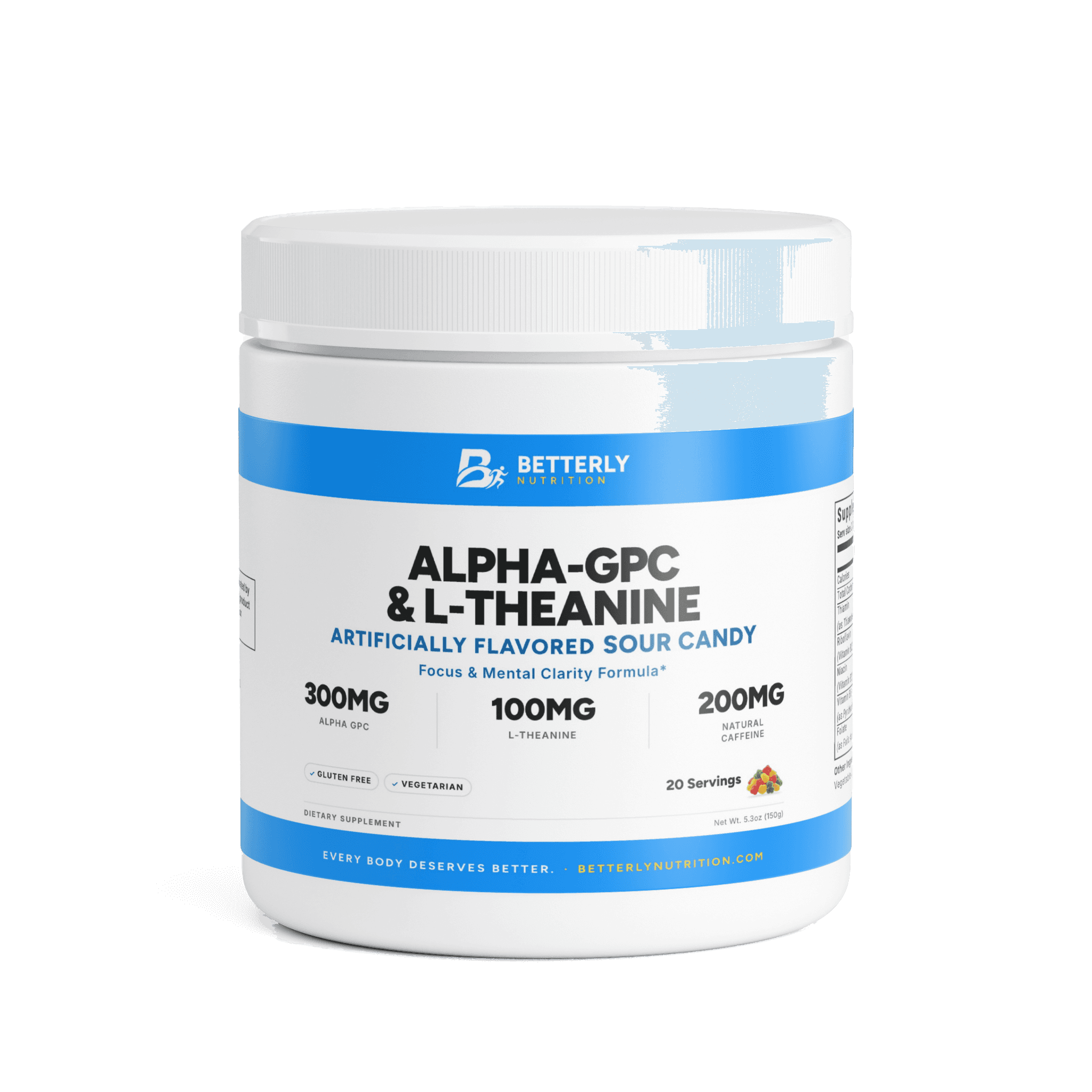
The short answer: Focus drinks stack alpha-GPC and L-theanine around caffeine: L-theanine is the tea amino acid usually paired with caffeine, and alpha-GPC adds a choline compound. No label or federal source we checked warns against the pair, but research on it is thin. Our Focus Powder holds 300 mg of alpha-GPC, 100 mg of L-theanine and 200 mg of caffeine per 2-scoop serving, and that caffeine is what you'll notice first.
Key takeaways
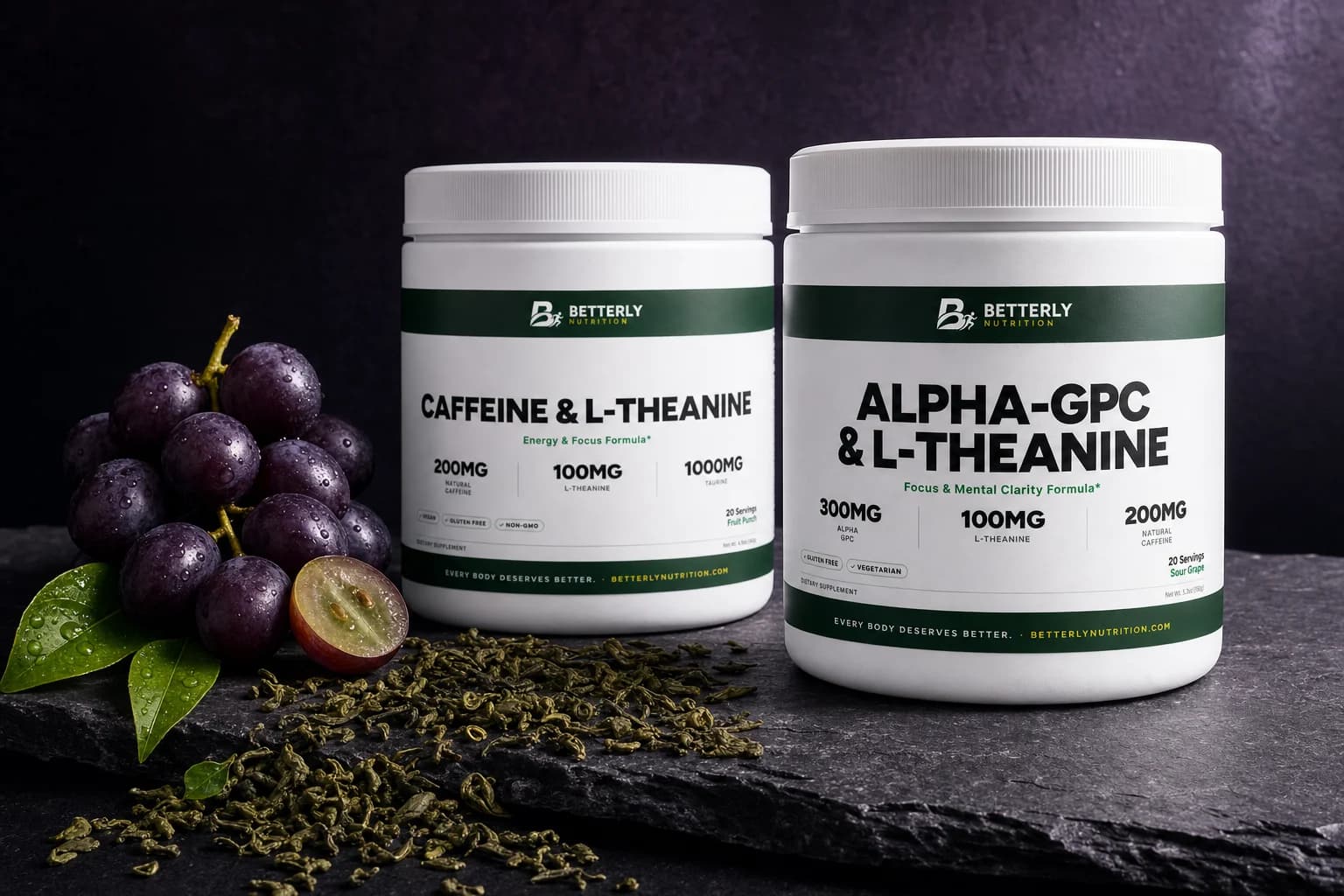
- Betterly's Alpha-GPC & L-Theanine Focus Powder (Sour Grape) lists 300 mg of Alpha GPC, 100 mg of L-theanine and 200 mg of natural caffeine per 2-scoop (7.5 g) serving.
- The Focus Powder label caps use at 5 scoops daily. That's 500 mg of caffeine, above the FDA's 400 mg daily figure for most adults.
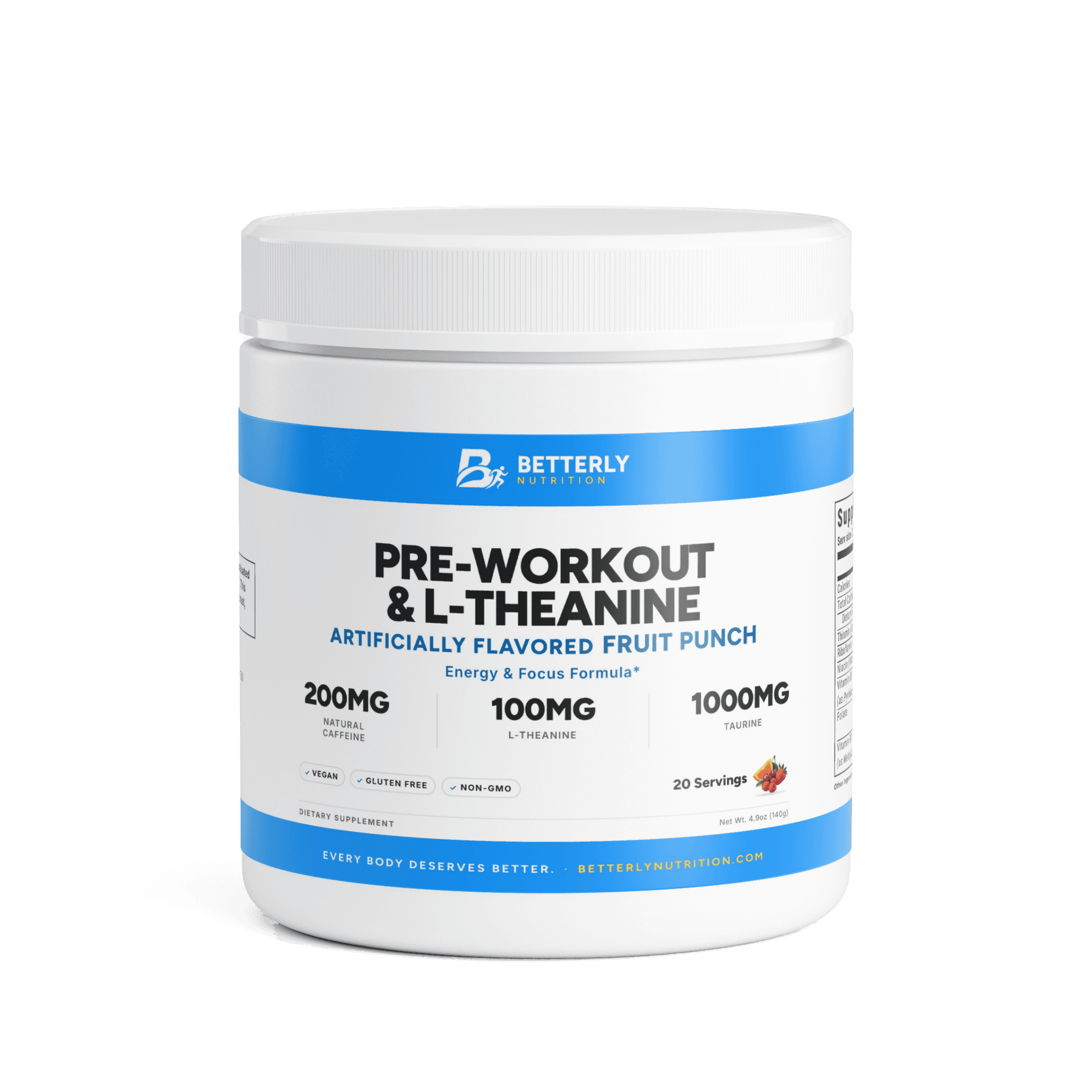
- Our Pre-Workout Caffeine & L-Theanine Energy Powder (Fruit Punch) has the same caffeine and L-theanine per 2-scoop (7 g) serving and the same 5-scoop cap, with no alpha-GPC.
- The Focus Powder panel lists Alpha GPC with no Daily Value and states no choline amount, and the NIH says most of your body's choline comes from food.
Our side of this, up front: we sell the caffeine-and-L-theanine base two ways, with 300 mg of alpha-GPC per serving and without, so either tub is a sale for us. Product figures come straight off our labels; what we say about choline, caffeine and ginseng rests on the four federal pages under Sources.
Alpha-GPC vs L-theanine: what does each one do?
Alpha-GPC is a choline compound, while L-theanine is an amino acid from tea leaves that drink makers usually pair with caffeine.
Alpha-GPC is short for L-alpha-glycerylphosphorylcholine, also sold as choline alfoscerate. According to the NIH Office of Dietary Supplements choline fact sheet, your brain and nervous system need choline to regulate memory, mood, muscle control and other functions.
Focus formulas often pitch alpha-GPC as raw material for acetylcholine, a chemical messenger in the brain. The federal sources we rely on don't make that claim for alpha-GPC, so we won't either.
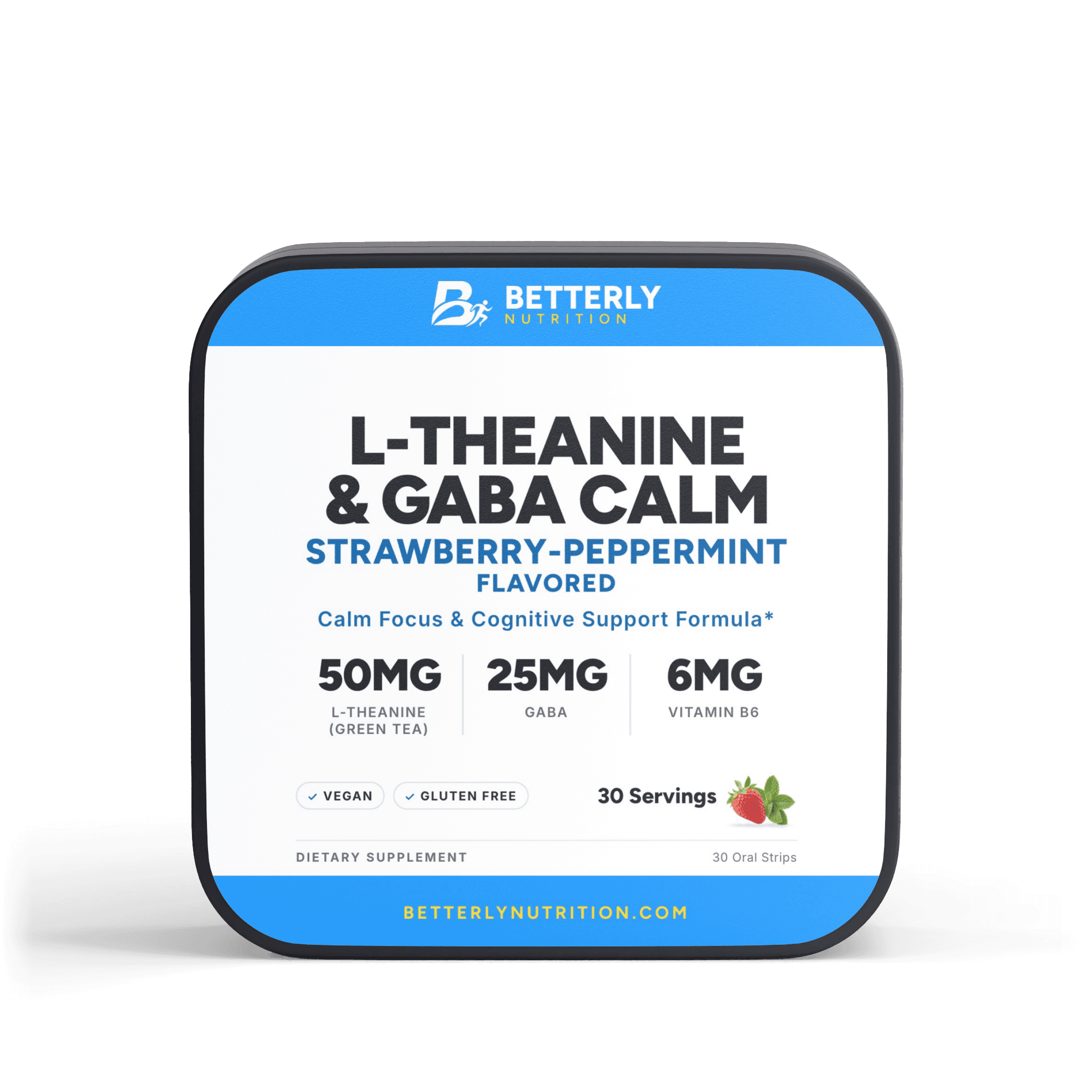
L-theanine is an amino acid found in tea leaves. Our L-Theanine & GABA Calm Strips list theirs as "Green Tea (L-Theanine)." It has no caffeine of its own but often sits beside caffeine in drinks, ours included. We cover that pairing, ratio debate and all, in our L-theanine and coffee guide.
Can you take alpha-GPC and L-theanine together?
Many focus products combine alpha-GPC and L-theanine, and nothing on our labels warns against taking them together. What's missing is solid research on the pair, or on the trio with caffeine.
We couldn't find a large trial of all three together to point you to, so anyone calling this stack proven is ahead of the evidence.
The NIH's view of choline research is mixed. Some studies link higher choline intakes with better memory scores, while others found choline supplements didn't improve thinking skills in healthy adults. That's choline broadly, not alpha-GPC, but it argues for modest expectations.
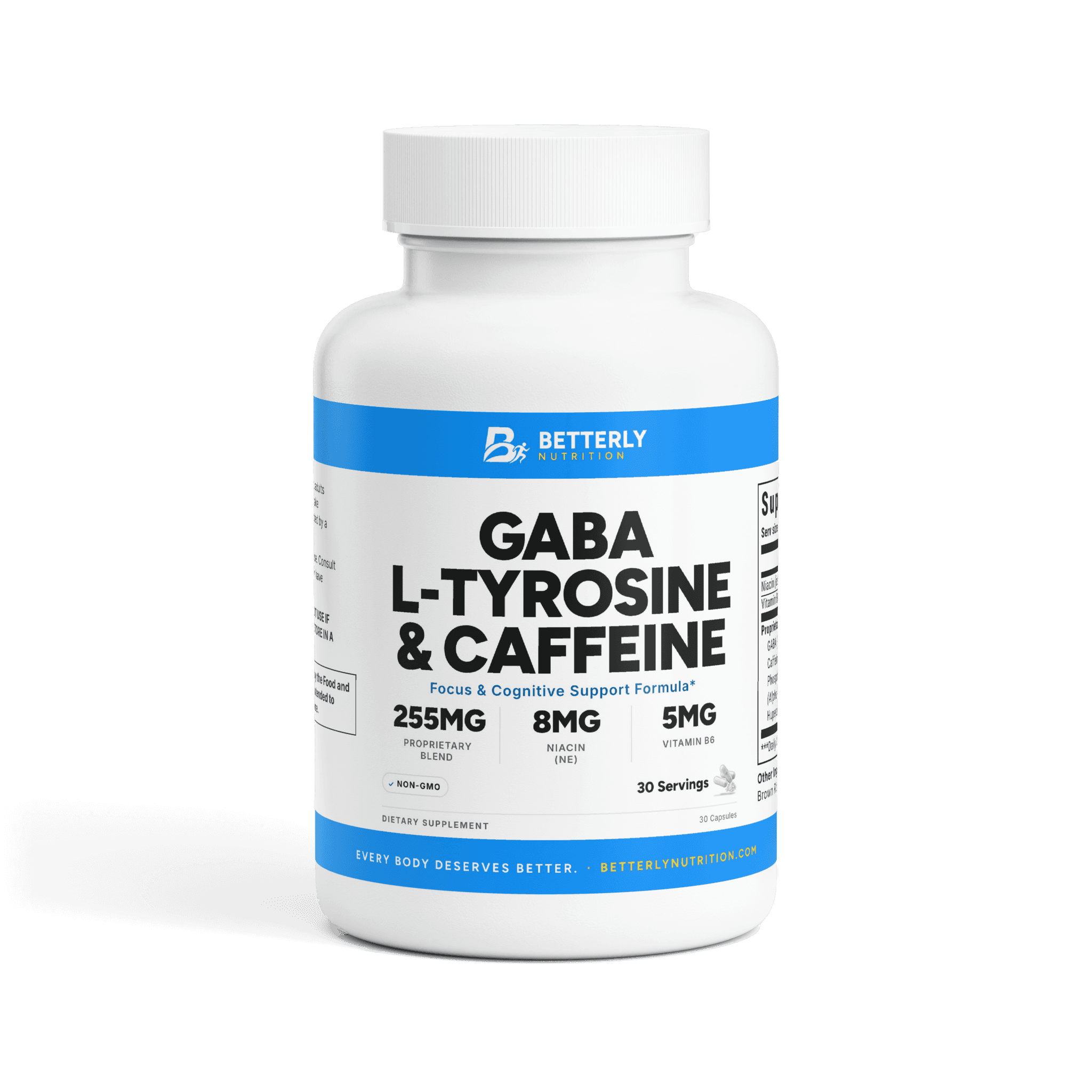
Our GABA, L-Tyrosine & Caffeine Capsules carry the trio too, listing Alpha GPC, L-theanine and caffeine inside a 255 mg proprietary blend per 1-capsule serving, so you can't see how much of each you get.
Can you take alpha-GPC with coffee?
Yes, you can take alpha-GPC with coffee, but our Focus Powder already carries 200 mg of caffeine per 2-scoop serving, so let it stand in for your coffee.
Plain alpha-GPC with no caffeine on its panel leaves your coffee as the only number to count. Our Alpha-GPC & L-Theanine Focus Powder (Sour Grape) brings its own.
The FDA's consumer page Spilling the Beans: How Much Caffeine Is Too Much? cites 400 mg a day for most adults as "an amount not generally associated with negative effects." It puts a 12-ounce cup of regular brewed coffee at 113 to 247 mg, so one serving plus that cup lands at 313 to 447 mg. Our pre-workout vs energy drink guide runs the fuller daily math.
The tub's own ceiling matters more. The label's suggested use is 2 scoops, and its caution says not to exceed 5 scoops daily. Here's what that ceiling adds up to; read it as a limit, not a menu of doses.
| Scoops in one day | Caffeine | Alpha GPC | L-theanine |
|---|---|---|---|
| 2 (the suggested serving) | 200 mg, half the FDA figure | 300 mg | 100 mg |
| 4 | 400 mg, right at the FDA figure | 600 mg | 200 mg |
| 5 (the label's ceiling) | 500 mg, over the FDA figure | 750 mg | 250 mg |
So 4 scoops reach the FDA's 400 mg figure and the 5-scoop ceiling passes it, with no coffee at all. That's why we don't recommend more than one 2-scoop serving a day. Our Energy Powder's label has the same 5-scoop cap, also 500 mg of caffeine, and the same advice applies.
What does alpha-GPC add to a caffeine and L-theanine drink?
On our labels, the Focus Powder adds 300 mg of alpha-GPC, plus L-arginine HCl, inositol and Asian ginseng extract, to the same caffeine and L-theanine our Energy Powder carries.
Here it is next to our Pre-Workout Caffeine & L-Theanine Energy Powder (Fruit Punch). Both tubs hold 20 servings; the Focus Powder costs more, and the cards below show today's prices.
| Per 2-scoop serving | Focus Powder (Sour Grape) | Energy Powder (Fruit Punch) |
|---|---|---|
| Natural caffeine (from green tea) | 200 mg | 200 mg |
| L-theanine | 100 mg | 100 mg |
| Alpha GPC | 300 mg | Not listed |
| L-Arginine HCl | 1,000 mg | Not listed |
| Inositol | 600 mg | Not listed |
| Asian ginseng extract | 50 mg | Not listed |
| Taurine | Not listed | 1,000 mg |
| Magnesium, sodium, potassium | Not listed | 36 mg, 60 mg, 130 mg |
| Seven B vitamins | 33% DV each | 33% DV each |
The caffeine, L-theanine and B-vitamin rows match exactly. For the higher price, the Focus Powder adds five rows the Energy Powder lacks: Alpha GPC, L-arginine HCl, inositol, Asian ginseng and a 5 mg black pepper extract. The Energy Powder spends its panel on taurine, three electrolytes and 2 g of fiber instead.
On the Focus Powder panel, L-arginine HCl (1,000 mg) and inositol (600 mg) both outweigh the alpha-GPC, yet neither is named on the front. The label doesn't say what either is for, so we make no focus claim for them.
The 50 mg of Asian ginseng matters more for safety than size. The National Center for Complementary and Integrative Health (NCCIH) says trouble sleeping is the herb's most common side effect, and that it might interact with certain medications.
The Focus Powder is labeled gluten free and vegetarian; the Energy Powder carries vegan, gluten free and non-GMO claims. Both use sucralose. More formulas like these sit in our Nootropics & Focus collection.
From our shop: Alpha-GPC & L-Theanine Focus Powder (Sour Grape) — 300 mg of Alpha GPC, 100 mg of L-theanine and 200 mg of natural caffeine per 2-scoop (7.5 g) serving, with 20 servings per tub.
How much choline is in alpha-GPC?
Choline makes up about 40% of the alpha-GPC molecule by weight, but our Focus Powder panel doesn't state a choline amount.
Alpha-GPC weighs about 257 grams per mole and choline about 104, so choline is roughly 40.5% of the molecule. Our panel lists Alpha GPC as an ingredient with no Daily Value and has no choline row, so we don't turn a scoop into a choline number or a share of any daily target.
If you're tracking choline, the NIH says most of it comes from food, such as meat, eggs, fish, dairy, broccoli, beans, nuts and whole grains. The NIH sets the adult upper limit at 3,500 mg a day, counting food, drinks and supplements together.
Some multivitamins contain choline, often as choline bitartrate, phosphatidylcholine or lecithin, per the NIH. We compare the forms in our guide to alpha-GPC vs citicoline.
Alpha-GPC vs caffeine: which one will you actually feel?
In the Focus Powder, caffeine is the ingredient you're most likely to notice, since MedlinePlus says caffeine reaches its peak blood level within one hour.
MedlinePlus describes caffeine as a central nervous system stimulant that can make you feel more awake, with effects that can linger four to six hours. None of our sources describes alpha-GPC as a stimulant, and the NIH describes choline as a nutrient found in many foods.
So if you feel more awake within an hour of a serving, you're most likely feeling the 200 mg of caffeine. The first hour tells you about the caffeine, not the alpha-GPC.
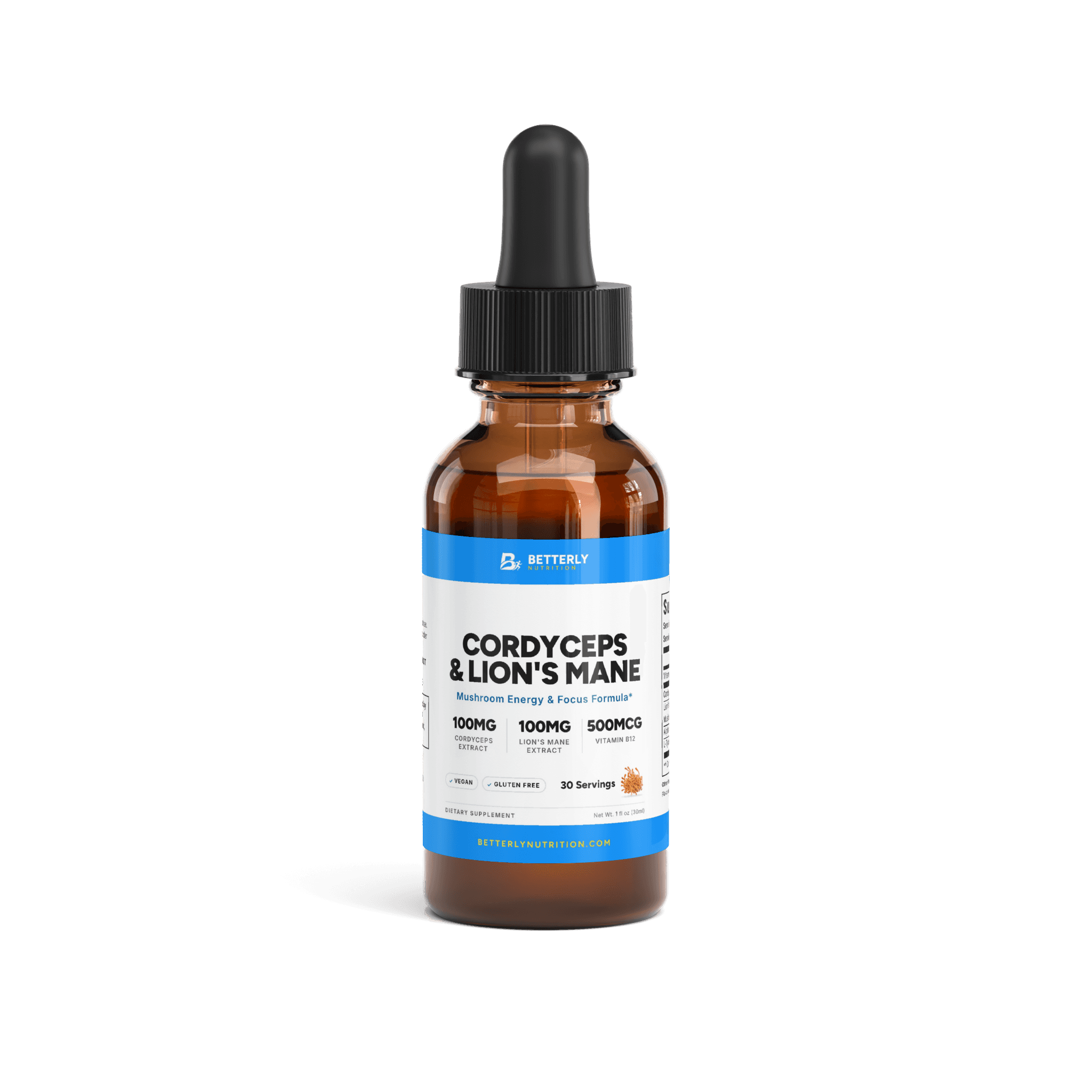
Want alpha-GPC without caffeine? Our Cordyceps & Lion's Mane Energy Drops list 25 mg of Alpha GPC per 1 ml (30-drop) serving, with no caffeine on the panel. That's far less than 300 mg, alongside cordyceps, lion's mane, L-tyrosine and vitamin B12.
For more picks, our roundup of focus supplements without caffeine has more options.
How do you take the Focus Powder?
The Focus Powder's suggested use is 2 scoops (7.5 g) in 16 fl oz (480 ml) of water, and one serving a day is plenty.
Pointers from the label:
- The label says you can adjust to taste, but we wouldn't add scoops.
- Drink it in the morning or early afternoon, because its caffeine can linger for hours.
- Skip other caffeine in the same stretch, or count it toward the FDA's 400 mg figure.
- Don't pair it with our Energy Powder or the GABA, L-Tyrosine & Caffeine Capsules on the same day, since each brings its own caffeine.
- Store the tub somewhere cool and dry, and use it within the 90 days the label gives.
All three flavors, Sour Grape, Sour Candy and Sour Gummi Worm, print the same Supplement Facts amounts. Their other ingredients differ slightly: Sour Grape alone lists natural flavor only, Sour Gummi Worm adds malic acid and blue spirulina color, and Sour Candy swaps silicon dioxide for calcium silicate. Check that short list for anything you avoid, then pick by taste.
When don't you need alpha-GPC in your stack?
You probably don't need alpha-GPC if what you really want is caffeine with L-theanine, because our Energy Powder gives you the same 200 mg and 100 mg without it.
A simpler choice makes sense when:
- Your coffee covers your caffeine and you're only curious about L-theanine. A plain L-theanine product is simpler.
- Caffeine doesn't agree with you. The Focus Powder can't come without its 200 mg, while the Calm Strips carry 50 mg of L-theanine and 25 mg of GABA per 1-strip serving, with no caffeine on the panel.
- You're after choline as a nutrient. The NIH's food list comes first.
- You're hoping for a big, felt change from the alpha-GPC itself. Nothing on this label or in our sources promises one.
From our shop: Pre-Workout Caffeine & L-Theanine Energy Powder (Fruit Punch) — 200 mg of natural caffeine from green tea and 100 mg of L-theanine per 2-scoop (7 g) serving, with 1,000 mg of taurine and no alpha-GPC.
Who should check with a healthcare provider first?
Ask a healthcare provider first if you're pregnant or nursing, take any medication, or have a medical condition; the Focus Powder's own label names all three.
Federal sources add detail for this formula:
- If you're pregnant, NCCIH says some studies suggest Asian ginseng may be unsafe taken by mouth during pregnancy. The FDA also suggests asking your provider about caffeine if you're pregnant, trying to be, or breastfeeding.
- If you take medication, NCCIH notes Asian ginseng might interact with certain medicines, and MedlinePlus lists certain medicines among the reasons to talk with a provider about caffeine.
- If you're under 18, note that the label states no age, but MedlinePlus says children and teens shouldn't have as much caffeine as adults. We'd keep a 200 mg serving for adults.
- If you have surgery scheduled, tell your care team you take it, since NCCIH says Asian ginseng may interfere with blood clotting.
If a serving leaves you jittery or with a faster heart rate, two of the FDA's signs of too much caffeine, stop and check in with your provider.
FAQ: alpha-GPC and L-theanine
Is an alpha-GPC focus drink good for you?
Possibly, but no one can promise an alpha-GPC focus drink will do much. Research on alpha-GPC alongside L-theanine is thin, and the NIH reports that choline supplements didn't improve thinking skills in some studies of healthy adults. In our Focus Powder, the 200 mg of caffeine per 2-scoop serving matters more day to day, so judge the drink by how that caffeine fits your routine.
What are the side effects of a caffeine and alpha-GPC drink?
Our federal sources cover the caffeine and Asian ginseng in a drink like our Focus Powder, but they don't list side effects for alpha-GPC or L-theanine, so ask your provider about those two. The FDA's signs of too much caffeine include a faster heart rate, jitters, sleep disruptions, an upset stomach and headache. NCCIH says trouble sleeping is Asian ginseng's most common side effect. Our guide to alpha-GPC benefits and side effects goes further.
How long does the Focus Powder's caffeine last?
The Focus Powder's 200 mg of caffeine can be felt for four to six hours, according to MedlinePlus, which also puts caffeine's peak blood level within one hour. So a serving fits the morning or early afternoon best. Our labels give no duration for alpha-GPC or L-theanine, and we won't guess one.
Can you add L-tyrosine to this stack?
You can find L-tyrosine, alpha-GPC and L-theanine together, including in our GABA, L-Tyrosine & Caffeine Capsules, but don't take those capsules on a Focus Powder day. Their 255 mg proprietary blend also holds caffeine in an amount the label doesn't disclose, so you couldn't add up your day's total. Pick one caffeine product and follow its label.
Can you take the Focus Powder every day?
The Focus Powder label sets no limit on days in a row, but one serving a day still means 200 mg of caffeine daily. NCCIH describes Asian ginseng's safety for short-term use of up to 6 months, so daily use beyond that is worth raising with your provider.
Sources
- NIH Office of Dietary Supplements: Choline, Fact Sheet for Consumers
- U.S. Food and Drug Administration: Spilling the Beans: How Much Caffeine Is Too Much?
- MedlinePlus: Caffeine
- National Center for Complementary and Integrative Health: Asian Ginseng: Usefulness and Safety
If this left you looking for somewhere to start, read alpha-GPC and L-theanine focus powder with caffeine — its amounts per serving are listed on the page. For the practical questions this raises, how dosing, sourcing and subscriptions work is answered in one place.