On this page
- Key takeaways
- DMAE vs choline: what's the difference?
- Does DMAE turn into choline once you swallow it?
- Is DMAE the same as DMAA?
- Is DMAE banned in the US?
- What does "DMAE bitartrate" mean on a label?
- What's actually known about DMAE for the brain?
- How do you take DMAE or choline products, going by the label?
- Who can skip DMAE without missing anything?
- Who should check with a healthcare provider first?
- FAQ: DMAE vs choline
- Sources
The short answer: DMAE vs choline isn't a contest between two forms of one nutrient. Choline is an essential nutrient with a Daily Value and an adult upper limit of 3,500 mg a day. DMAE (dimethylaminoethanol) is a look-alike with neither, and a 2019 study done for the National Toxicology Program found no sign it became choline in rats and mice. DMAA, the name people confuse it with, is a stimulant the FDA calls illegal in supplements.
Key takeaways
- Choline is a nutrient with official daily targets, while DMAE is a separate compound with no recommended intake at all.
- DMAE is one methyl group short of choline, yet in a 2019 rodent study done for NIH's National Toxicology Program, blood choline didn't rise after DMAE.
- DMAE and DMAA are unrelated despite the shared letters, and the FDA's ingredient directory lists DMAA but not DMAE.
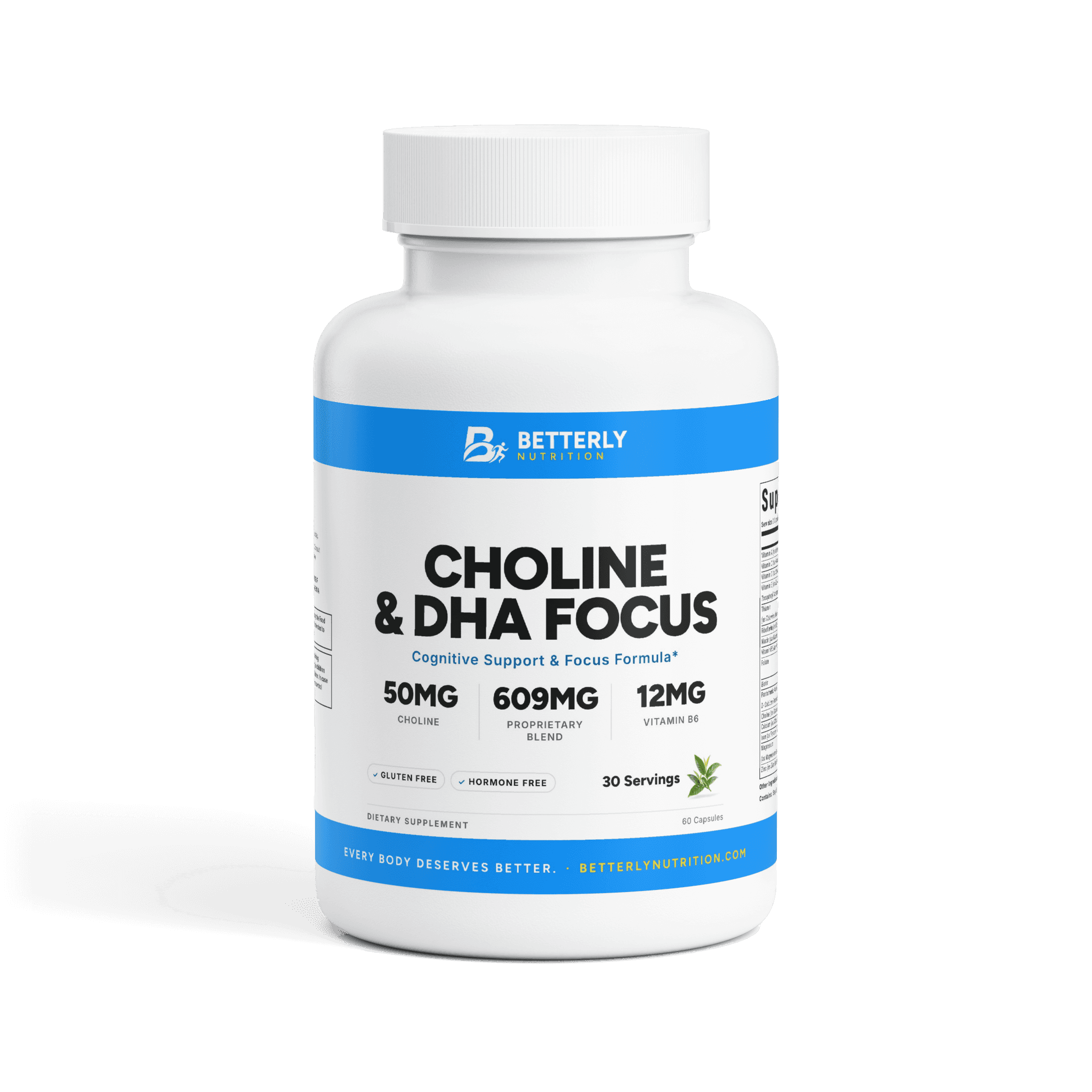
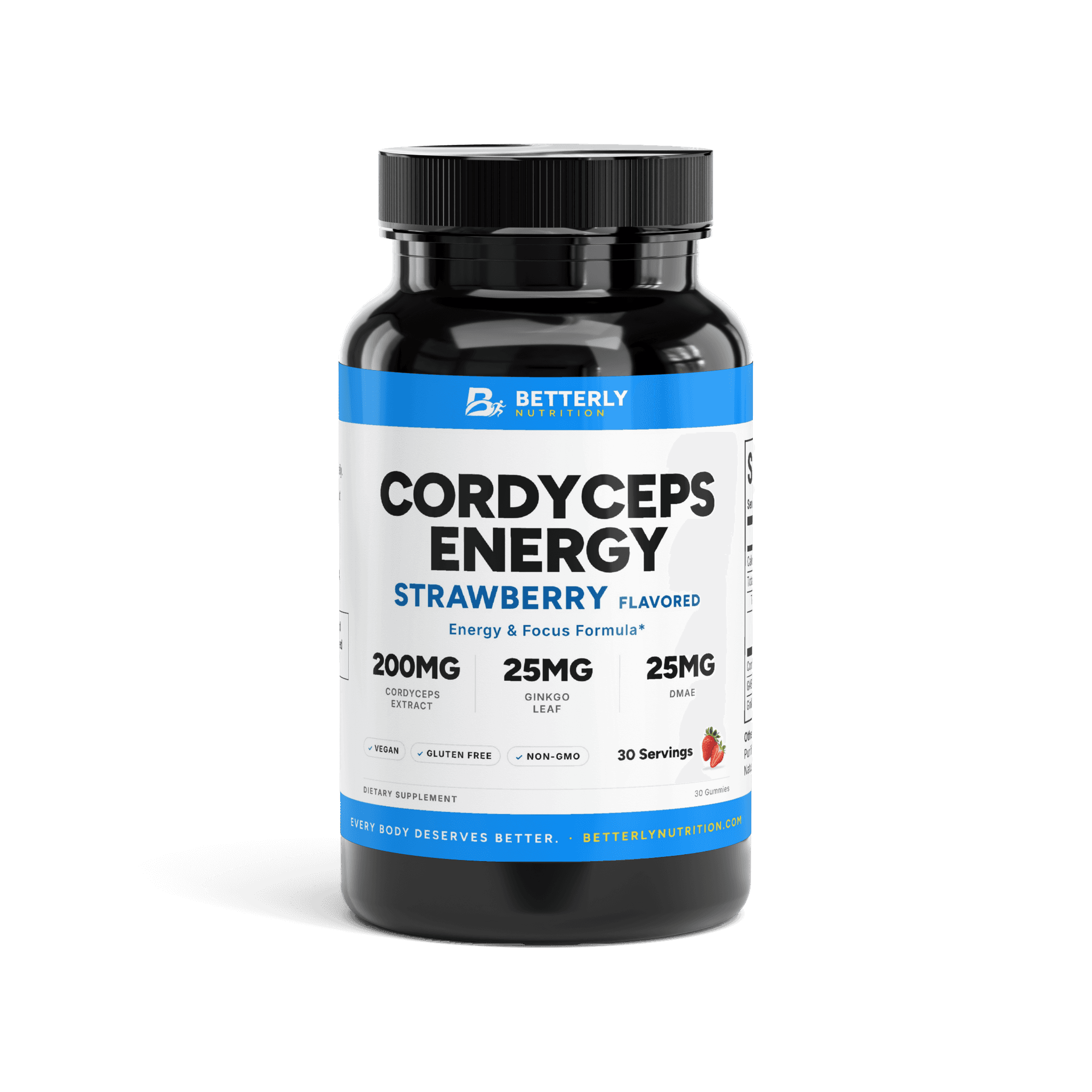
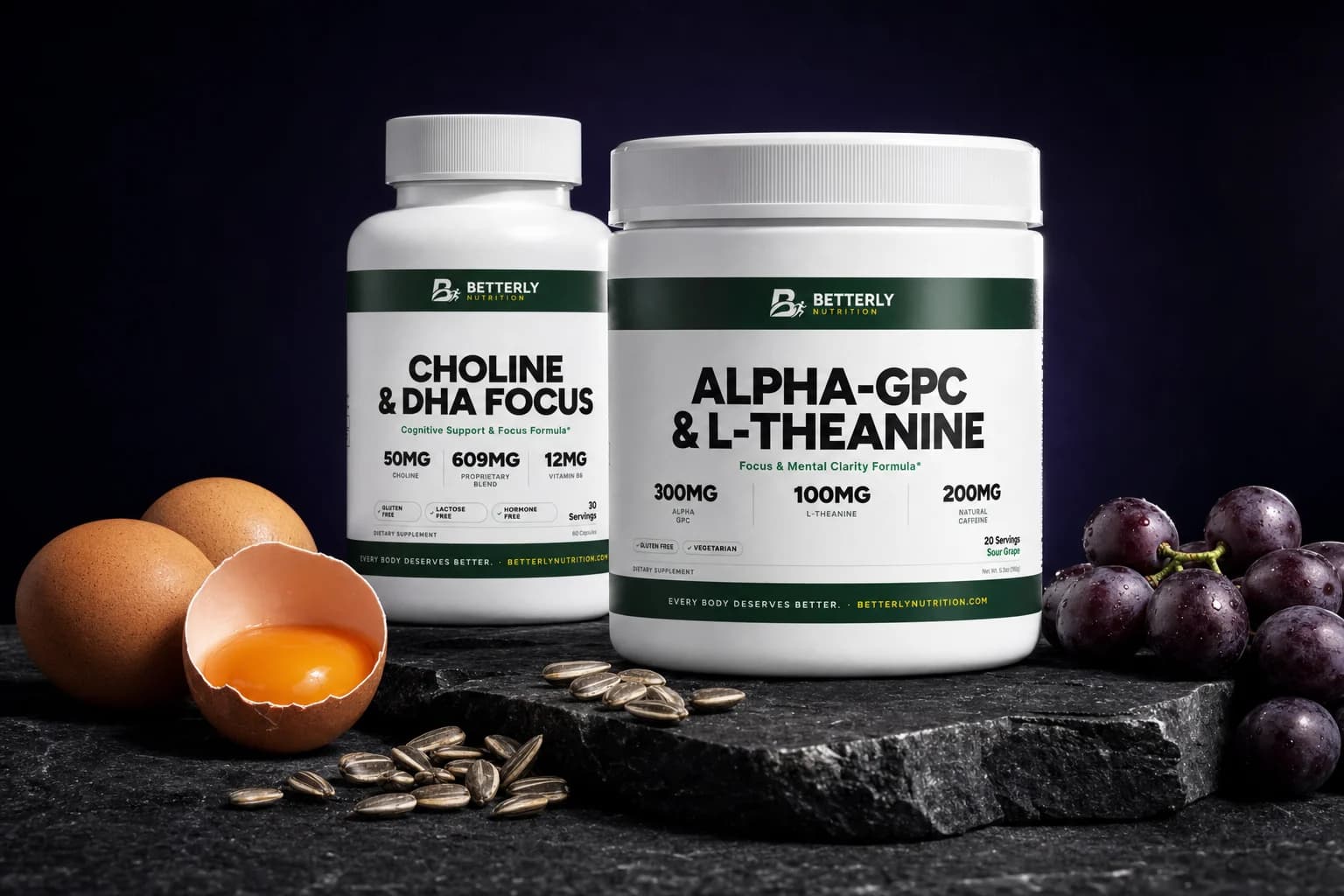
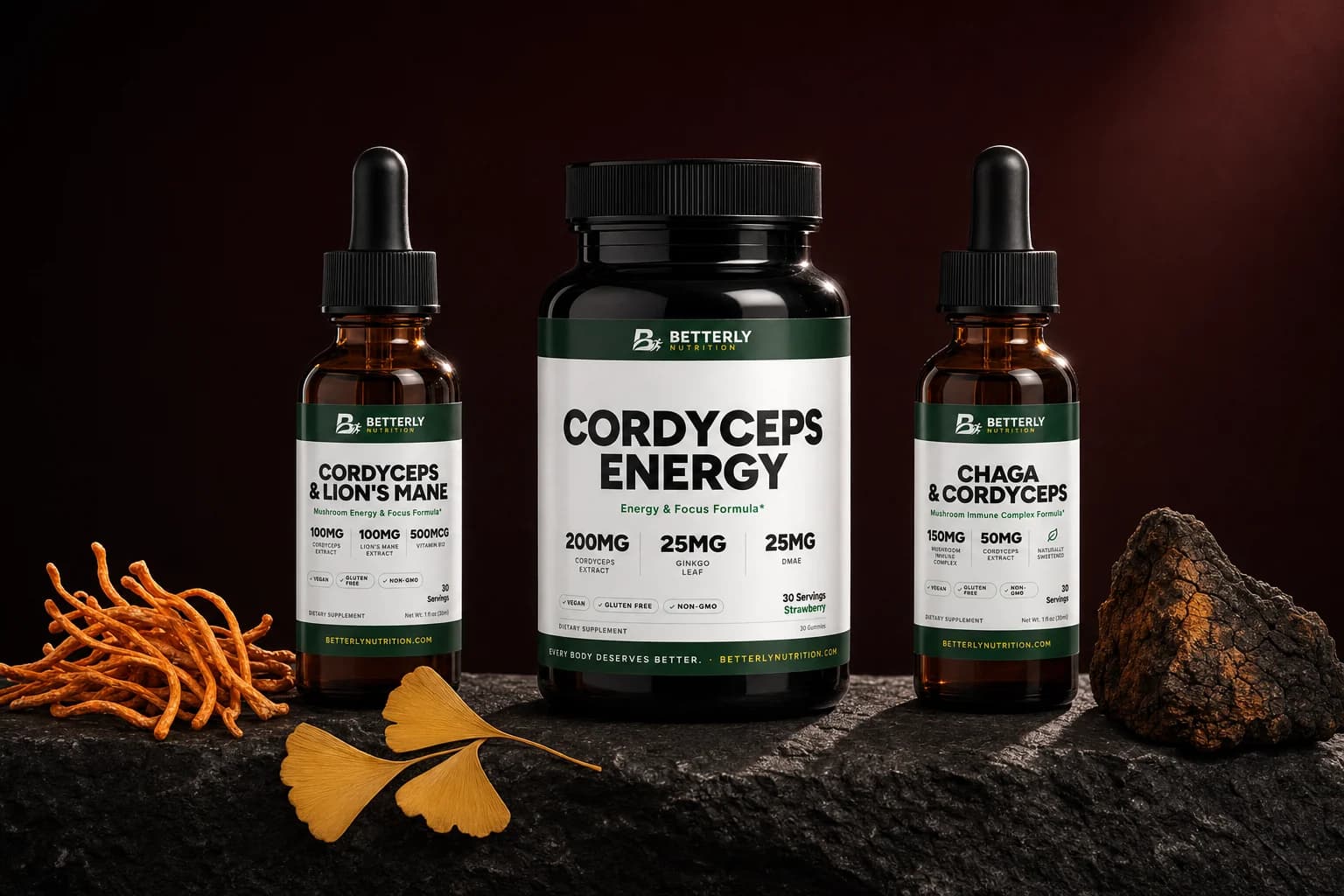
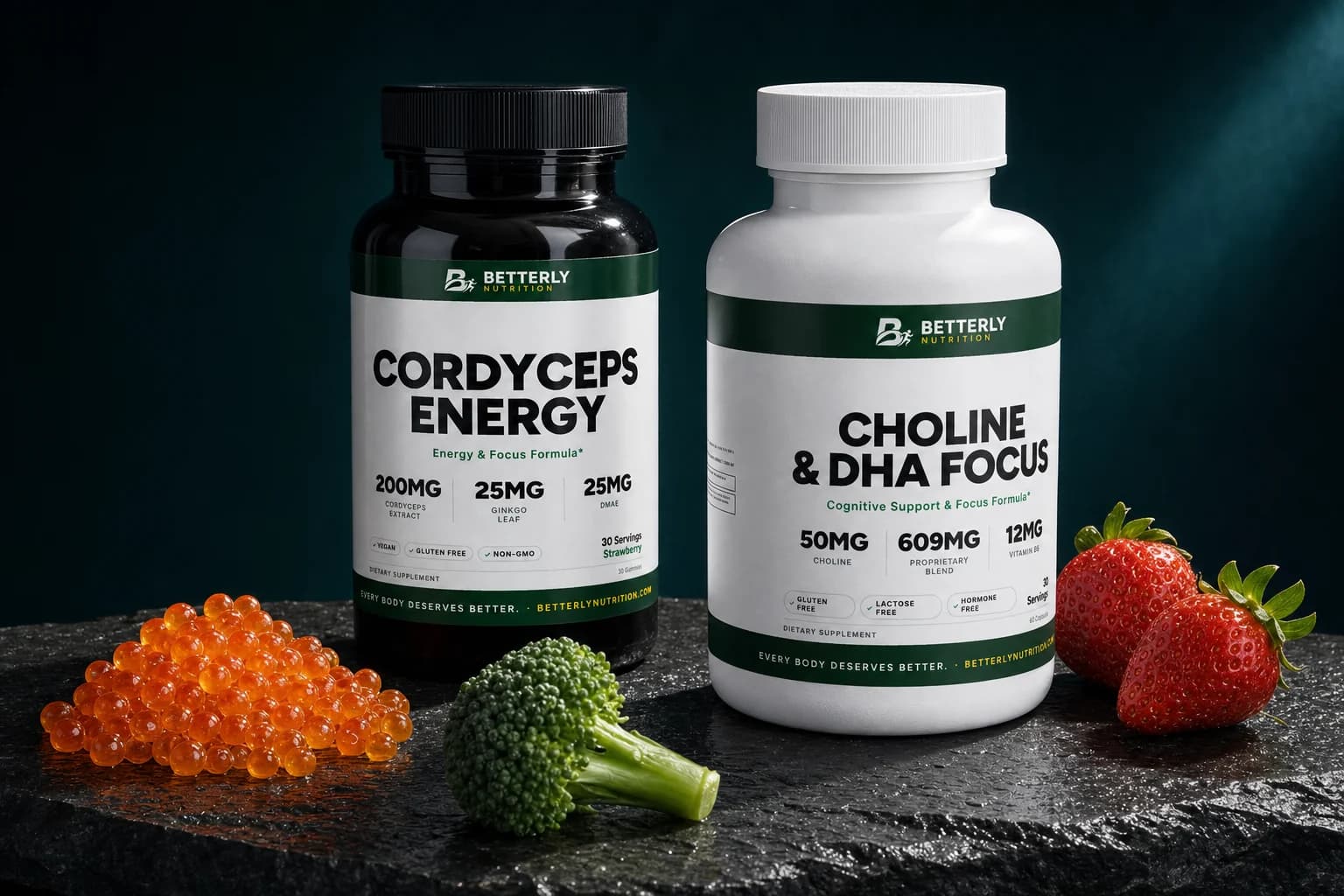
- Two Betterly labels list DMAE: Cordyceps Mushroom Energy Gummies print 25 mg per gummy, and Choline & DHA Focus Capsules fold it into a blend with no amount.
We sell products with DMAE and products with choline, and nothing with DMAA. Of our two DMAE labels, only one prints how much DMAE is inside.
DMAE vs choline: what's the difference?
DMAE is a compound that resembles choline on paper, while choline is a nutrient your body needs every day and can only partly make itself.
Choline's place is settled. The NIH Office of Dietary Supplements (ODS) fact sheet on choline names memory, mood and muscle control among the jobs your brain and nerves need it for. It's also raw material for the membrane around each of your cells. ODS recommends 550 mg daily for adult men and 425 mg for adult women.
DMAE's place is far less settled. It also goes by deanol and dimethylethanolamine. A 2002 toxicology review of DMAE prepared for NIH's National Institute of Environmental Health Sciences (NIEHS) found it in a large number of supplements, usually as DMAE bitartrate when the form was named.
| DMAE | Choline | DMAA | |
|---|---|---|---|
| Full name | Dimethylaminoethanol (deanol) | Choline | 1,3-dimethylamylamine |
| What it is | A choline look-alike | An essential nutrient | A stimulant, per the FDA |
| % Daily Value on labels | None set | Yes | None |
| In this guide's products | Gummies and capsules | Capsules: 50 mg per 2 capsules | None |
| Federal picture | Not in FDA's ingredient directory; thin safety data | Adult upper limit 3,500 mg a day | FDA: illegal in supplements |
Only choline comes with a daily target and a ceiling you can check. DMAE is sold openly but thinly studied, and DMAA sits outside the law for supplements.
Does DMAE turn into choline once you swallow it?
DMAE showed no sign of turning into choline in a 2019 rat-and-mouse study done for the National Toxicology Program, and blood choline didn't rise after the animals received it.
On paper, the conversion looks simple. Choline carries three methyl groups (a carbon with three hydrogens) on its nitrogen, and DMAE carries two. The 2002 review says choline may be formed by adding that missing group, but it called the extent unclear.
The 2019 study, led by National Toxicology Program scientists at NIEHS, traced labeled DMAE through rats and mice. Brain levels stayed low and didn't build up. The breakdown products found in their urine were DMAE N-oxide and dimethylglycine, not choline. The authors wrote that their data didn't support earlier reports that DMAE becomes choline in the body.
Two limits apply: these were rodents, and even the smallest dose tested, 10 mg per kilogram of body weight, far exceeds what a 25 mg gummy gives an adult. Still, if choline is what you're after, look for a choline line on the label.
Is DMAE the same as DMAA?
No. DMAE is dimethylaminoethanol, a choline look-alike, while DMAA is 1,3-dimethylamylamine, a stimulant the FDA says doesn't qualify as a dietary ingredient.
The FDA's page on DMAA in products marketed as dietary supplements describes it as an amphetamine derivative that has been marketed in sports-performance and diet products. Its position is blunt: DMAA products marketed as supplements are illegal. The agency also ties it to serious heart and circulation problems.
DMAA also hides behind other names. The FDA says it's known as "geranium extract" too and is often promoted as natural, yet the agency isn't aware of reliable science showing DMAA occurs naturally in plants. So read the full name, not just the four letters:
- DMAE usually appears as "DMAE," "DMAE bitartrate" or "dimethylaminoethanol."
- DMAA can appear as "geranium extract," "methylhexanamine," "geranamine" or "1,3-dimethylamylamine," all names the FDA's page gives for it.
Is DMAE banned in the US?
None of the FDA pages we opened bans DMAE, and the FDA's ingredient directory lists DMAA, DMHA and DMBA but not DMAE.
That directory, Information on Select Dietary Supplement Ingredients and Other Substances, links to the FDA's actions and communications on specific ingredients. The version current as of May 2026 includes DMAA and 1,4 DMAA, but DMAE, deanol and dimethylaminoethanol don't appear, and the DMAA page never mentions DMAE.
Keep that in proportion: the directory also covers nutrients like biotin and magnesium, and staying off it isn't a safety review. The 2002 review does note 1990s FDA warning letters to a few DMAE sellers, over drug claims and under-the-tongue directions rather than DMAE itself.
Our sources don't cover other countries or sport, so tested athletes should check their prohibited list first.
What does "DMAE bitartrate" mean on a label?
DMAE bitartrate is DMAE bound to tartaric acid as a salt, and by our math from molecular weights, only about 37% of its weight is DMAE itself.
The 2002 review explains that the bitartrate forms when DMAE reacts with tartaric acid. It gives DMAE bitartrate a molecular weight of about 239, and DMAE by itself comes in just under 90. That works out to roughly 37%, a bit over a third.
"Bitartrate" names the tartaric acid partner, not a family tie, which is why DMAE bitartrate and choline bitartrate look so alike on a shelf.
Our two DMAE labels handle this differently:
- Choline & DHA Focus Capsules give choline its own line, "Choline (as Choline Bitartrate)," listing 50 mg and 9% DV per 2-capsule serving. That number counts only the choline. "DMAE Bitartrate (Dimethylaminoethanol)" opens the 609 mg proprietary blend without an amount of its own.
- Cordyceps Mushroom Energy Gummies print "DMAE" at 25 mg per 1-gummy serving but don't name the form, so you can't tell whether that's DMAE alone or a salt's full weight.
Blend order still tells you something. A proprietary blend lists its ingredients heaviest first, so none of the other 17 in the capsules' blend outweighs DMAE bitartrate. Our proprietary blend guide walks through what that ordering can and can't reveal.
From our shop: Choline & DHA Focus Capsules — our only formula that lists DMAE and a counted choline line on the same panel, with 50 mg of choline in each 2-capsule serving.
What's actually known about DMAE for the brain?
Little is known about DMAE and the brain: we found no NIH fact sheet on it, and the federal work we opened centers on safety gaps rather than benefits.
NIEHS nominated DMAE for further testing partly because its safety database was thin, the 2002 review explains, and it describes the human research as mixed. Most of what it summarizes is now decades old. The 2019 rodent study adds that DMAE reached the brain only at low levels.
Choline has a clearer role but no guaranteed effect, and ODS reports mixed findings. Some studies tie higher choline intake to better results on memory tests, but in others, choline supplements left healthy adults' thinking skills unchanged. So don't expect any capsule to do more than help fill a nutrient gap.
Our Choline & DHA label calls itself a "Cognitive Support & Focus Formula." That descriptor covers the whole formula, and no source we cite ties it to DMAE.
How do you take DMAE or choline products, going by the label?
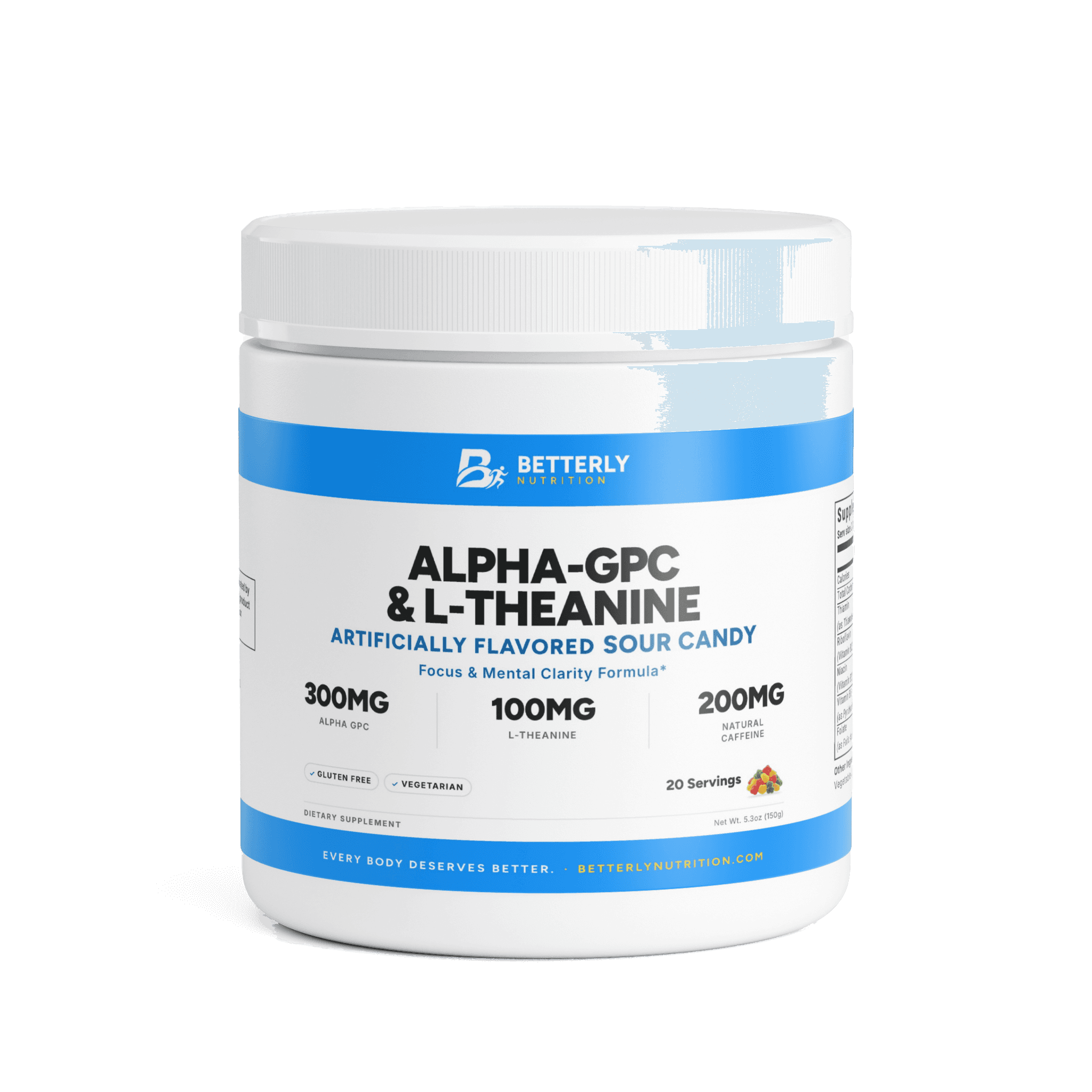
Stick to each label: two Choline & DHA capsules once daily, one or two Cordyceps gummies daily (we'd stay at one), or 2 scoops of Alpha-GPC & L-Theanine Focus Powder (Sour Grape) in water.
- Choline & DHA Focus Capsules: The label calls for two capsules once a day. Each serving also brings 12 mg of vitamin B6 and 2.6 mg of iron, so check your multivitamin for overlap.
- Cordyceps Mushroom Energy Gummies: The label suggests one or two gummies daily, at 25 mg of DMAE per gummy. The 2002 review summarizes a human report suggesting that 20 mg a day of DMAE tartrate may carry added risk for people with certain neurological conditions. Our panel names no form, so the numbers don't match exactly, but one gummy already lists more. That's why we'd stay at one gummy. If that risk could apply to you, ask a healthcare provider before your first.
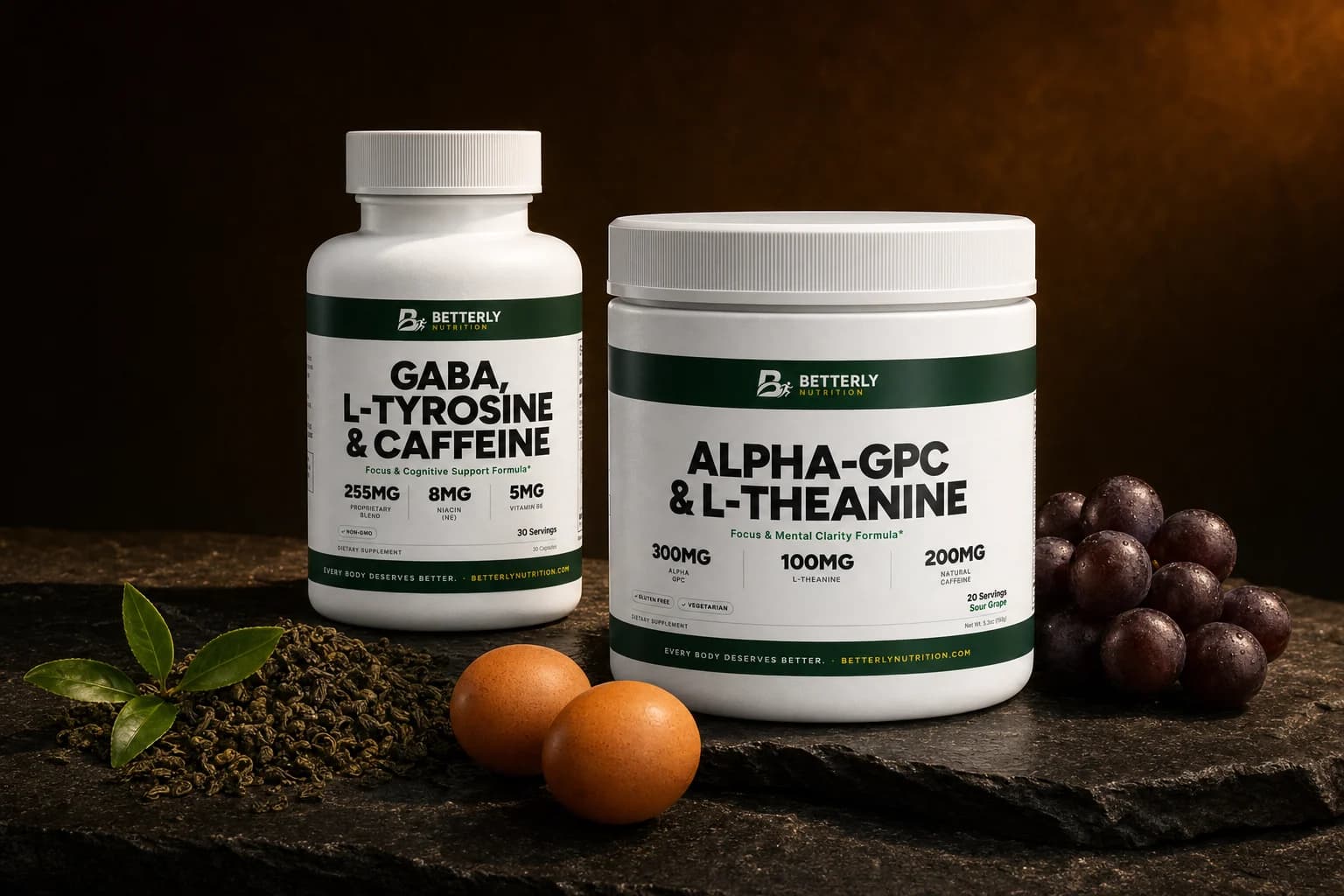
- Alpha-GPC & L-Theanine Focus Powder: Mix 2 scoops (7.5 g) with 16 fl oz (480 ml) of water, per the label. Every 2-scoop serving lists 300 mg of alpha-GPC, plus 200 mg of natural caffeine from green tea. The caution line says not to go past 5 scoops daily, which works out to 500 mg of caffeine. That's above the 400 mg a day that FDA caffeine guidance gives as generally not linked to negative effects in most adults, so we'd stick to 2 scoops.
Use one DMAE product at a time. The capsules don't say how much DMAE their blend holds, so adding the gummies makes your total impossible to count.
From our shop: Cordyceps Mushroom Energy Gummies — strawberry gummies that print their DMAE, 25 mg per 1-gummy serving, beside 200 mg of cordyceps extract.
Who can skip DMAE without missing anything?
You can skip DMAE without leaving any nutrient gap, because DMAE has no Daily Value or recommended intake for your diet to fall short of.
Our panels add a reason to hold off if you like exact numbers: the capsules list no DMAE amount, and the gummies list 25 mg without naming the form.
Choline is a real nutrient, but ODS says food supplies most of what your body has. Next to the 425 to 550 mg adult targets, the capsules' 50 mg is a sliver.
A few label details are practical reasons to pass:
- the capsules contain soy and fish (tuna);
- the gummies list 2 g of added sugars apiece;
- the powder has 200 mg of caffeine per 2-scoop serving, and the capsules' green tea extract comes with no caffeine figure.
If you'd like a focus formula without DMAE, most of our focus and nootropics shelf fits the bill.
Who should check with a healthcare provider first?
DMAE needs a healthcare provider's look more than choline does if you're facing surgery, on a prescription, under 18, pregnant, breastfeeding or managing a health condition.
- Pregnant or nursing: Both DMAE labels say to consult a physician. The 2002 review is stricter still and rules DMAE out for pregnancy and breastfeeding. Pregnancy also raises choline needs to 450 mg a day, per ODS.
- Under 18: Both DMAE labels name this group in their caution line.
- Taking medication: ODS lists no medicines that choline is known to interact with. For DMAE, the 2002 review flags more than one possible drug interaction. DMAE opposes the depressant effect of barbiturates, a type of sedative, and theory and animal studies point to others. If you take any prescription, ask before adding DMAE.
- Managing a medical condition: Every one of the three caution lines covers this. For DMAE, the 2002 review also lists certain neurological or mental health conditions as reasons not to use it.
- Food allergies: The capsules contain soy and fish (tuna).
Bring the actual bottles. The capsules' blend lists huperzine A and green tea extract with no amounts, and the gummies add ginkgo leaf. Our cordyceps side effects guide goes through the gummy's DMAE and ginkgo lines. The capsules' iron also means keeping them away from children.
FAQ: DMAE vs choline
Is DMAE a stimulant?
DMAE isn't caffeine and isn't DMAA, but the 2002 review prepared for NIEHS does summarize an old human report of "mild mental stimulation" from DMAE tartrate taken by mouth. That same report describes muscle tone creeping up at 20 mg a day, a level the review suggests may be riskier for people with certain neurological conditions, and poorer sleep at larger amounts. Neither of our DMAE labels prints a caffeine line, though the capsules' blend includes green tea extract.
Can you take DMAE and choline together?
DMAE and choline already share a serving in our Choline & DHA Focus Capsules, but whether DMAE changes how people use choline hasn't been settled. The 2002 review said DMAE appears to interfere with choline uptake and called for more study. The 2019 NTP rodent study then found that giving DMAE first didn't significantly change how the animals absorbed, distributed or cleared choline, and we found no human data either way. What we'd skip is adding a second DMAE product on top.
Is DMAE better than alpha-GPC?
DMAE and alpha-GPC aren't substitutes, so neither is better across the board. Alpha-GPC carries choline in its structure, whereas DMAE showed no sign of becoming choline in the 2019 NTP rodent data. Our focus powder's 2 scoops bring 300 mg of alpha-GPC along with 200 mg of caffeine. For how much of alpha-GPC's weight is choline, see our alpha-GPC vs citicoline comparison.
How much choline do you need a day?
ODS recommends 550 mg of choline daily for adult men and 425 mg for adult women. Pregnancy lifts the target to 450 mg, and breastfeeding to 550 mg. The adult upper limit, 3,500 mg a day, includes choline from food as well as supplements. Our capsules supply 50 mg per 2-capsule serving, so most of your choline will still come from food.
How long does a bottle of Choline & DHA Focus Capsules last?
A bottle of Choline & DHA Focus Capsules lasts one month at the label's directions: 30 servings of 2 capsules, one serving a day. The label sets no limit on how many months in a row you can take it, so for longer use, show the panel, especially its B6 and iron, to your healthcare provider.
Sources
- Choline: Fact Sheet for Consumers, NIH Office of Dietary Supplements
- Dimethylethanolamine (DMAE): Review of Toxicological Literature (Update), 2002, prepared for NIEHS, NIH
- Comparative Disposition of Dimethylaminoethanol and Choline in Rats and Mice (2019), study performed for the National Toxicology Program, NIEHS, via PubMed Central
- DMAA in Products Marketed as Dietary Supplements, U.S. Food and Drug Administration
- Information on Select Dietary Supplement Ingredients and Other Substances, U.S. Food and Drug Administration
- Spilling the Beans: How Much Caffeine Is Too Much?, U.S. Food and Drug Administration
If this left you looking for somewhere to start, read choline bitartrate capsules with DMAE — its amounts per serving are listed on the page. For the practical questions this raises, how dosing, sourcing and subscriptions work is answered in one place.