On this page
- Key takeaways
- What's the difference between elderberry and echinacea?
- What does the research say about elderberry vs echinacea?
- Which is better, elderberry or echinacea?
- Can you take elderberry and echinacea together?
- Why 500 mg elderberry and 200 mg echinacea per 2 capsules?
- How do elderberry and echinacea syrups, tinctures and capsules compare?
- How do you take an elderberry and echinacea capsule?
- Do you need elderberry and echinacea at all?
- Who should check with a healthcare provider before taking the pair?
- FAQ: elderberry vs echinacea
- Sources
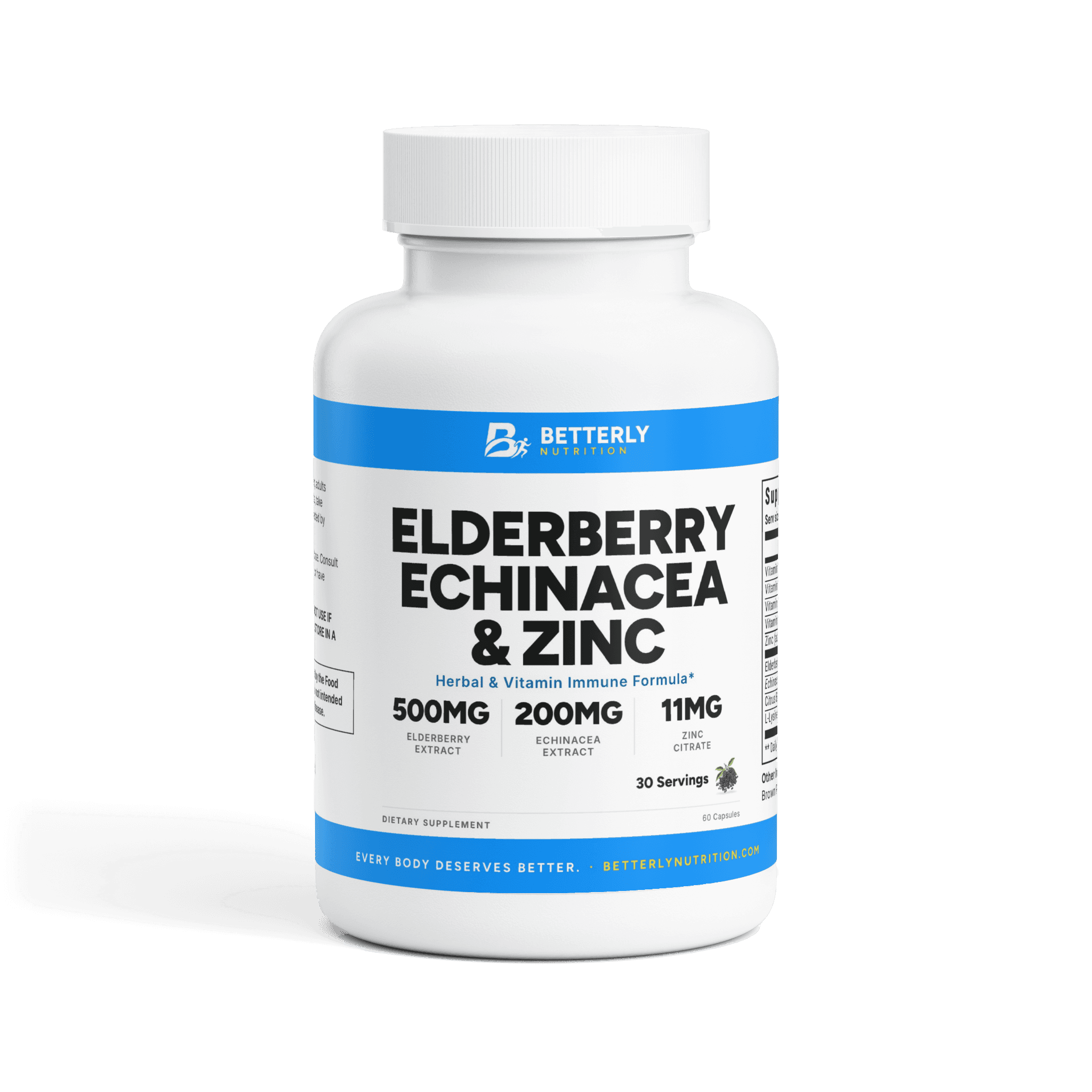
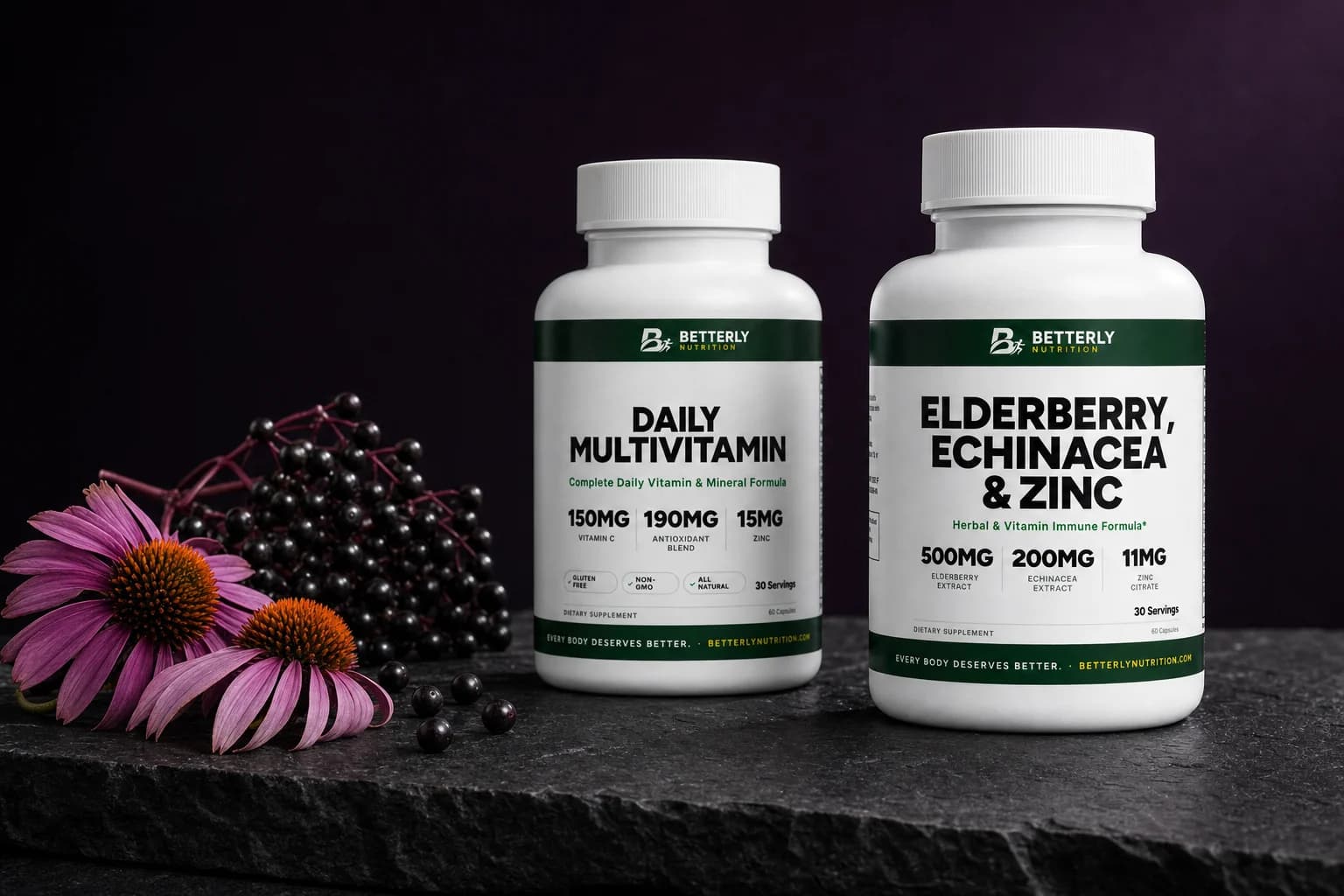
The short answer: Elderberry vs echinacea compares the black elder's fruit, Sambucus nigra, with Echinacea purpurea, a coneflower related to daisies and sunflowers. NCCIH counts many human studies of echinacea but only a small number of elderberry. You don't need either herb, and no NIH page shows the pair beats one alone. Our Elderberry, Echinacea & Zinc Capsules hold 500 mg of elderberry extract and 200 mg of echinacea extract per 2-capsule serving.
Key takeaways
- Elderberry supplements start from the fruit of a tree, while echinacea extracts can come from the whole flowering plant or only its above-ground parts.
- NCCIH describes a larger research record for echinacea and a smaller one for elderberry, and neither record tells you what a daily capsule does for a healthy adult.
- You can take elderberry and echinacea together, as combination products do, but the two herbs share one medicine caution from the NIH Office of Dietary Supplements.
- Betterly's combination capsule also lists vitamin C, vitamin D3, vitamin E, vitamin B6 and zinc, and all five appear on the ODS list of nutrients that matter for a healthy immune system.
Fair warning: we sell a capsule with both herbs in it, and our Daily Multivitamin Capsules contain echinacea too. A seller shouldn't crown the winner, so the evidence here comes from two NIH agencies, and every product amount is copied from a printed Supplement Facts panel.
What's the difference between elderberry and echinacea?
Elderberry is the fruit of a tree, and echinacea is a flowering perennial from a different plant family, so the two share little beyond a spot on the same shelf.
The NCCIH page on elderberry traces the berry to the European or black elder, a tree found across Europe, North America, Western Asia and North Africa. Black elderberry, European elder and common elder all name this one species, Sambucus nigra, the name printed on our label.
Echinacea is a group of perennial plants native to the U.S. east of the Rockies, according to NCCIH's echinacea page, which adds that they're closely related to sunflowers, daisies and ragweed. NCCIH lists three species, Echinacea purpurea, E. angustifolia and E. pallida, and common names that include purple coneflower.
| Elderberry | Echinacea | |
|---|---|---|
| Species on our labels | Sambucus nigra | Echinacea purpurea |
| What it is | Berry of the elder tree | Flowering perennial |
| Close relatives (NCCIH) | Not stated | Sunflowers, daisies, ragweed |
| Human studies (NCCIH) | A small number | Many |
| Part in our capsule | Fruit | Whole plant |
| Per 2-capsule serving | 500 mg extract | 200 mg extract |
| Headline caution | Raw berries, leaves, stems | Allergic reactions |
The table's takeaway: echinacea has more research and an allergy caution from NCCIH, while elderberry has less research and one strict kitchen rule about raw fruit.
What does the research say about elderberry vs echinacea?
The research on elderberry vs echinacea is lopsided: NCCIH says many studies in people have tested echinacea, while only a small number have tested elderberry.
Most of those trials looked at short-term uses a supplement label can't speak to, and NCCIH calls the findings preliminary, unclear or in need of more research.
For elderberry, the short record comes with a marketing warning. NCCIH reports that the FDA and the Federal Trade Commission have taken action against companies that marketed elderberry products with unsubstantiated claims. Be wary of any elderberry label that promises an outcome, ours included.
For echinacea, the record is deeper but narrow. NCCIH says much less research exists on echinacea for any other purpose. It also flags a finding that matters at the store: research it sponsored suggests soil conditions, by shaping the bacteria that live with the plant, influence how active an echinacea extract is. Two extracts with the same species name may not be interchangeable.
The NIH Office of Dietary Supplements (ODS) is just as careful. Its fact sheet on supplements and immune function says, "Herbal supplements, probiotics, and other dietary supplement ingredients might also affect your immune system." Its separate entries on the two herbs report mixed results, which is why we won't pick a winner on research alone.
Which is better, elderberry or echinacea?
Neither elderberry nor echinacea has been shown to be the better daily pick for a healthy adult, so your allergies, other supplements and preferred form should decide.
| Your situation | Better fit | Reason |
|---|---|---|
| Research depth is your tiebreaker | Echinacea | NCCIH counts many human studies |
| You've reacted to echinacea before | Elderberry, after asking an allergist | NCCIH notes allergic reactions |
| You already take our multivitamin | Check your echinacea first | Its 110 mg blend lists echinacea |
| You want both herbs in one bottle | A combination capsule | One serving instead of two products |
| You avoid gelatin | Read the capsule line | Our combination capsule is gelatin |
The takeaway: whether you frame it as echinacea vs elderberry or the other way round, your allergy history and what's already in your cabinet matter more than the research, which doesn't favor either herb. One catch for allergy-cautious readers: we sell just one elderberry product, and it also contains echinacea.
Can you take elderberry and echinacea together?
Yes, you can take elderberry with echinacea; combination products like ours pair them, and no NIH page we read warns against the combination itself.
In practice, a paired product gives you one 2-capsule serving, one set of directions and one caution line to read. The NCCIH pages and the ODS sheet look at each herb separately and say nothing about the two as a pair.
The caution the herbs share is about medicines. ODS says both elderberry and echinacea might make immune-suppressing medicines less effective. If you take both herbs, that caution comes from two ingredients, not one.
Why 500 mg elderberry and 200 mg echinacea per 2 capsules?
Betterly's Elderberry, Echinacea & Zinc Capsules list 500 mg of elderberry extract and 200 mg of whole-plant echinacea extract per 2-capsule serving; the label never says why.
No NIH page we read sets an amount for either herb, so there's no official ratio to match. The two rows on the panel tell you this much:
- They measure extract, not raw plant, and neither row prints an extract ratio (dried plant per unit of finished extract). So 500 mg can't be converted into berries or compared with another brand's syrup.
- Neither row names a standardization marker. ODS's background sheet on botanical supplements says standardization isn't required under U.S. law and has no legal definition here, so a missing marker isn't a red flag on its own.
- They name the plant part: fruit for elderberry and whole plant for echinacea.
The rest of the panel explains the "why pair them" question better than the herbs do. Per 2-capsule serving, it adds 180 mg of vitamin C (200% DV), 40 mcg of vitamin D3 (200% DV), 15 mg of vitamin E (100% DV), 1.7 mg of vitamin B6 (100% DV) and 11 mg of zinc as zinc citrate (100% DV). ODS names all five among the vitamins and minerals it calls especially important to get enough of for a healthy immune system.
Two extras without a Daily Value round out the panel: 100 mg of citrus bioflavonoid 50% and 100 mg of L-lysine. The other ingredients are gelatin, which forms the capsule, and brown rice flour, so this product isn't vegetarian. The label makes no vegan, gluten-free or similar claim.
If you also take a multivitamin or a vitamin D product, our stack math for elderberry with zinc and vitamin C adds up vitamin C, zinc and vitamin D against their adult upper limits.
From our shop: Elderberry, Echinacea & Zinc Capsules — both herbs plus vitamins C, D3, E and B6 and 11 mg of zinc in one 2-capsule daily serving, with 30 servings per bottle.
How do elderberry and echinacea syrups, tinctures and capsules compare?
Elderberry and echinacea syrups, tinctures, gummies and capsules don't line up by the milligram, because each form carries a different amount of plant into what you swallow.
The ODS botanical sheet explains why. A tincture soaks the plant in alcohol and water, and a label may state its strength as a botanical-to-extract ratio. A dry extract has its soaking liquid evaporated so it fits in a capsule. ODS notes that one amount of plant "may be contained in a cup of tea, a few teaspoons of tincture, or an even smaller amount of an extract."
Whatever the form, check five details on the panel:
- The species: for elderberry, Sambucus nigra, the species NCCIH covers; for echinacea, E. purpurea, E. angustifolia or E. pallida.
- The plant part, often printed in parentheses: fruit, whole plant, aerial parts or root.
- Whether the amount is extract or raw plant, and a ratio if the maker gives one.
- Whether an herb is folded into a blend that prints one combined amount. Our walkthrough of proprietary blend labels explains what a blend total can and can't reveal.
- What else rides along: added vitamins, zinc and the capsule material.
How do you take an elderberry and echinacea capsule?
Take Betterly's elderberry and echinacea capsule the way its label says: adults take two capsules daily, and for best results, with 6-8 oz (177-237 ml) of water.
The directions stop there, apart from "or as directed by healthcare professional," and the caution opens with "Do not exceed recommended dose." Neither names a time of day, a meal or a break schedule. At two capsules a day, a 60-capsule bottle lasts 30 days.
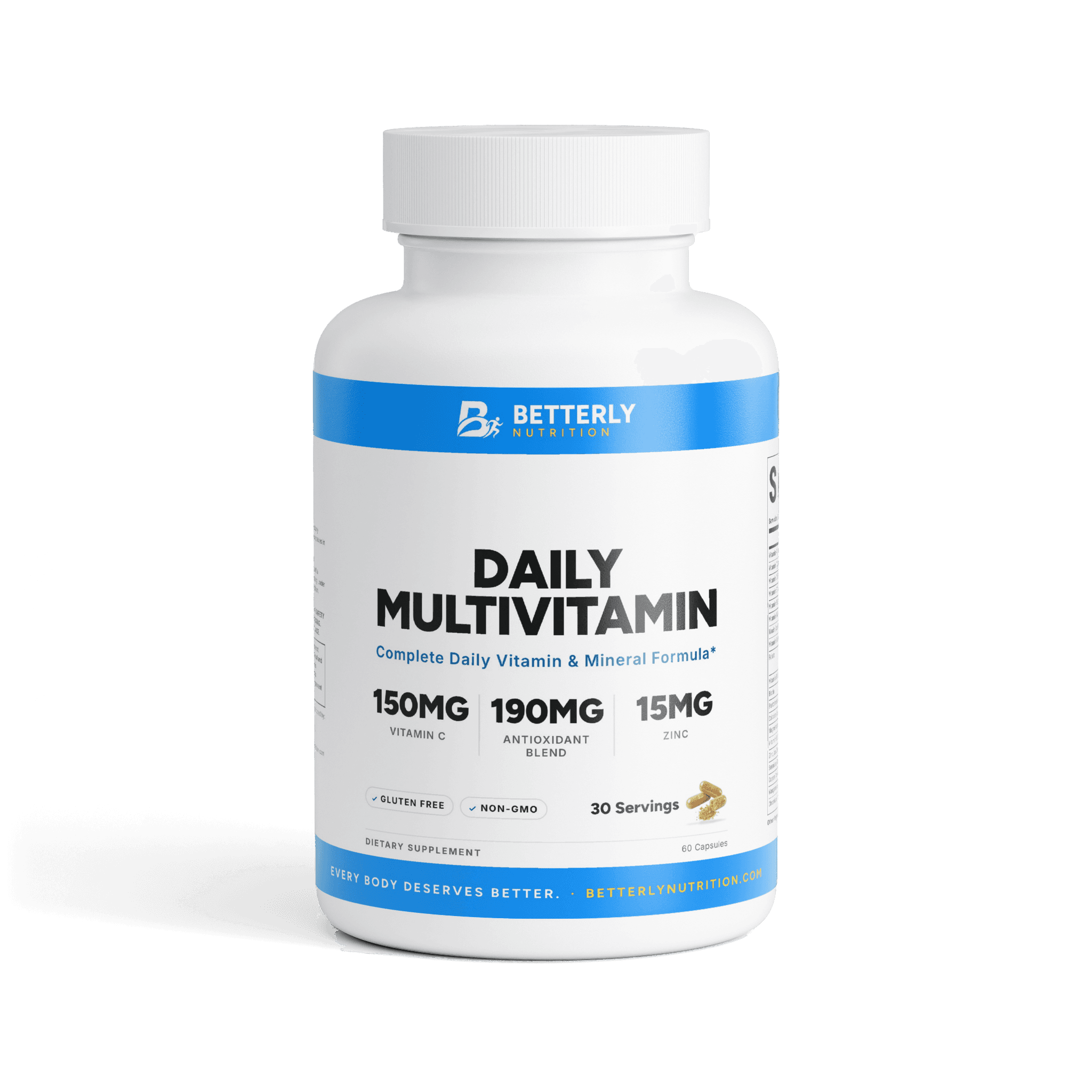
Our Daily Multivitamin Capsules are the pairing to plan around. Their 110 mg Immune Support blend lists Echinacea purpurea extract (aerial parts) alongside beta glucan, spirulina and garlic, with no per-ingredient amounts.
Taking both gives you echinacea from two plant parts, whole plant and aerial, one in an unprinted amount. None of the NIH pages we used puts a ceiling on echinacea, so count the second bottle as a second source worth naming when you talk with your provider.
From our shop: Daily Multivitamin Capsules — two capsules with a morning meal, in a hypromellose (vegetable) capsule, with a 110 mg Immune Support blend that lists echinacea.
Do you need elderberry and echinacea at all?
You can pass on elderberry and echinacea entirely, and a combination bottle makes the least sense when your vitamins are already covered or you only want one herb.
Much of our combination panel is vitamin C, vitamin D3 and zinc. If your meals or a multivitamin already cover those, a second bottle mostly adds two herbs with no daily requirement, plus vitamin D you'd have to count toward your total.
Wanting just one herb is the next snag, since we don't sell either on its own. Across our immune support collection, echinacea appears on two panels and elderberry on just one, the combination capsule. Echinacea without elderberry means our multivitamin's blend, in an unprinted amount. Elderberry without echinacea isn't something we carry.
The research itself can be your reason to pass. Echinacea's record is the larger one, but NCCIH still calls parts of it unclear, and elderberry's is small and preliminary. If you buy herbs only when firm answers stand behind them, neither clears that bar.
And if you avoid gelatin, the combination capsule's shell rules it out.
Who should check with a healthcare provider before taking the pair?
Check with a healthcare provider before starting Betterly's Elderberry, Echinacea & Zinc Capsules if the label's caution describes you or you take any medicine.
The caution is short: "Do not exceed recommended dose. Consult a physician if pregnant, nursing, under 18, or have a medical condition." On medicines, the shared immune-medicine note from ODS is the one to raise by name.
For the detail behind each of those points, from interactions to pregnancy, breastfeeding and surgery, see our guide to elderberry side effects and echinacea safety.
FAQ: elderberry vs echinacea
Can you drink elderberry and echinacea tea?
Yes, elderberry and echinacea both come as teas, but a mug isn't a stand-in for a capsule. ODS says teas, tinctures and extracts have different strengths, and that some roots, bark and berries need a decoction, boiled and then simmered, rather than a simple steep. If you brew elderberry at home, NCCIH says cooking eliminates the cyanide-producing substances in raw or unripe berries. Our capsule's directions cover the capsule only.
What are elderberry and echinacea good for?
Elderberry and echinacea are marketed for immune support, but neither has an established role the way vitamins and minerals do. NCCIH's elderberry page rests on a small number of studies, and its echinacea page says some findings are still unclear. ODS says herbal ingredients "might" affect your immune system, and its herb-by-herb entries stay just as cautious. The vitamin C, vitamin D and zinc in formulas like ours are nutrients ODS says your immune system needs to work properly.
Should you take elderberry and echinacea in the morning or at night?
Either works for Betterly's Elderberry, Echinacea & Zinc Capsules, because the label names no time or meal, only two capsules daily with 6-8 oz of water. Timing matters only if you also take our Daily Multivitamin Capsules, whose directions say two capsules in the morning with a meal. Taking both at breakfast fits both labels. Whatever time you pick, keep each bottle to its own 2-capsule serving.
Can children take elderberry or echinacea?
Betterly's Elderberry, Echinacea & Zinc Capsules carry adult-only directions, and the caution asks anyone under 18 to consult a physician first. NCCIH says E. purpurea extract is possibly safe for children for short periods, but some children in a clinical trial developed rashes that may have been allergic. NCCIH's elderberry page gives no child-specific guidance. Ask your child's provider before giving either herb.
Is elderflower the same as elderberry?
No, elderflower and elderberry come from the same tree, Sambucus nigra, but they're different parts: the blossom and the fruit. ODS says elder flowers and ripe fruit appear to be safe to eat, but raw or unripe berries can be poisonous; NCCIH says cooking eliminates their cyanide-producing substances. Our label lists elderberry extract from the fruit only, so there's no elderflower in the capsule. If a product lists elder flower, it's a different ingredient from a berry extract, even when the species name matches.
Sources
- Elderberry: Usefulness and Safety, National Center for Complementary and Integrative Health
- Echinacea: Usefulness and Safety, National Center for Complementary and Integrative Health
- Dietary Supplements for Immune Function: Fact Sheet for Consumers, NIH Office of Dietary Supplements
- Botanical Dietary Supplements: Background Information for Consumers, NIH Office of Dietary Supplements
If this left you looking for somewhere to start, read elderberry and echinacea capsules — its amounts per serving are listed on the page. For the practical questions this raises, how dosing, sourcing and subscriptions work is answered in one place.