On this page
- Key takeaways
- How much lion's mane per day should you take?
- How many lion's mane capsules, gummies or drops a day?
- Is lion's mane extract the same as lion's mane powder?
- What amounts of lion's mane did human studies use?
- Is a bigger lion's mane dosage better?
- How much lion's mane is too much?
- How do you take lion's mane, going by the label?
- Do you need a lion's mane supplement at all?
- Who should check with a healthcare provider first?
- FAQ: how much lion's mane to take
- Sources
The short answer: How much lion's mane per day is right comes down to your product's label, because no Daily Value or recommended intake has been set for lion's mane. Our labels list from 30 mg per strip to 1,000 mg per 2-capsule serving. Most human trials summarized in the NIH's LiverTox reference used 1 to 3 grams a day, and the biggest, 10 grams, found no differences from placebo on the measures tested.
Key takeaways
- We found no Daily Value, recommended intake or government upper limit for lion's mane (Hericium erinaceus), so a product's suggested use is the number to follow.
- At label directions, Betterly's lion's mane products supply 30 mg (strip), 87 to 174 mg (gummies), 100 mg (drops) or 1,000 mg (capsules) of lion's mane a day.
- The human trials summarized in LiverTox gave lion's mane in amounts from one 1-gram dose to 10 grams daily, in forms ranging from powdered mushroom to cookies.
- A milligram of lion's mane extract and a milligram of lion's mane powder aren't the same measure. Only our Mushroom Gummies print an extract ratio (10:1), and that label doesn't show lion's mane's share of its 250 mg blend, so no label of ours converts one into the other.
- Each of our lion's mane labels warns "Do not exceed recommended dose," which rules out stacking products or adding capsules to reach a study's amount.
We sell all six lion's mane products compared here, with printed amounts from 30 mg to 1,000 mg a day, so we'd come out ahead if you simply grabbed the biggest number. That's why the trial amounts below come from the NIH's LiverTox database, not from us.
How much lion's mane per day should you take?
Take the amount on your lion's mane product's label, since no Daily Value or recommended daily intake has been set for lion's mane.
Vitamins and minerals come with government numbers. Lion's mane doesn't. On any Supplement Facts panel, the lion's mane row carries a symbol where the % Daily Value would sit, pointing to a footnote that says the Daily Value isn't established. The FDA's Dietary Supplement Labeling Guide requires that footnote for any ingredient without one.
That leaves two kinds of numbers: the label's suggested use, which is a direction, and the amounts given in trials, which only describe what was tested.
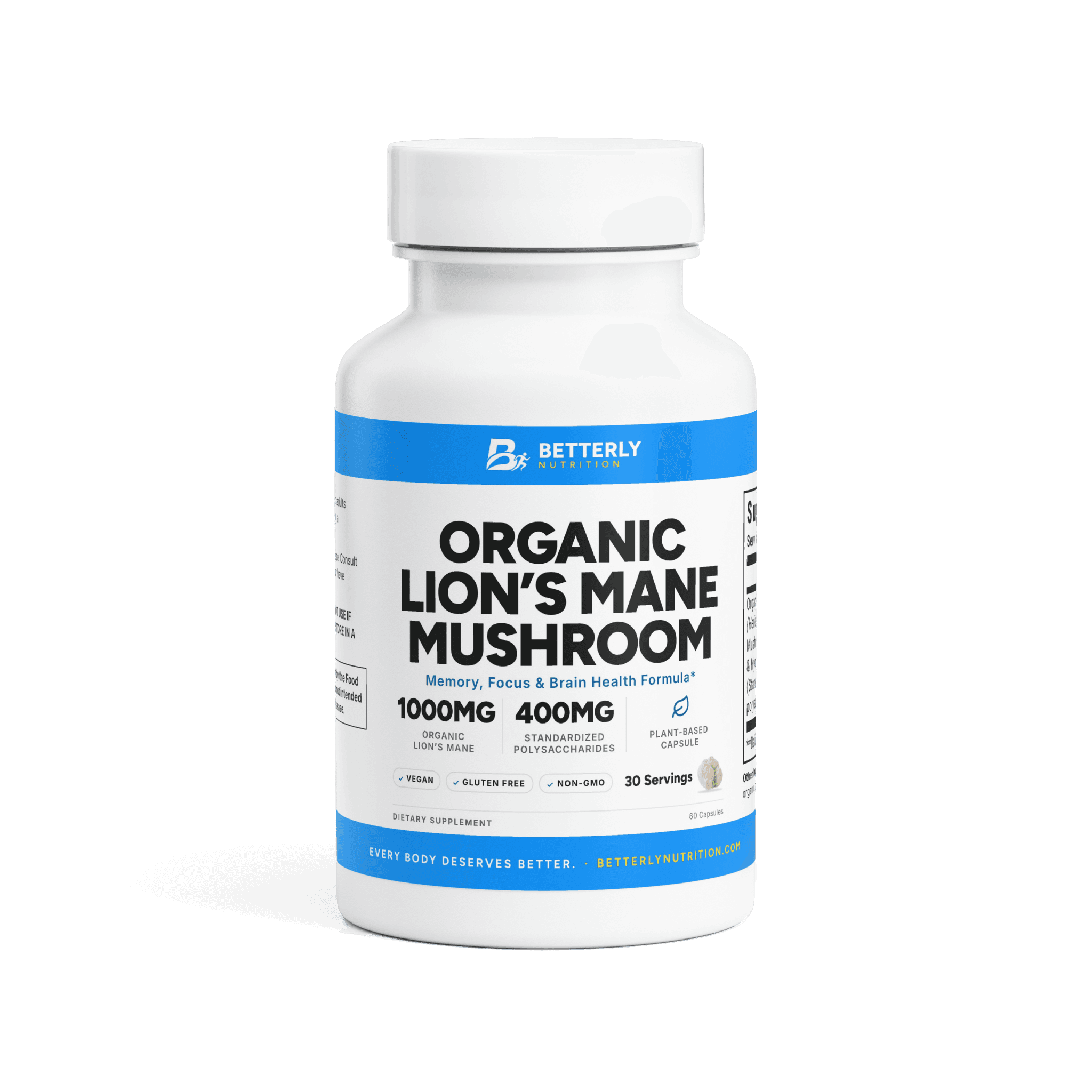
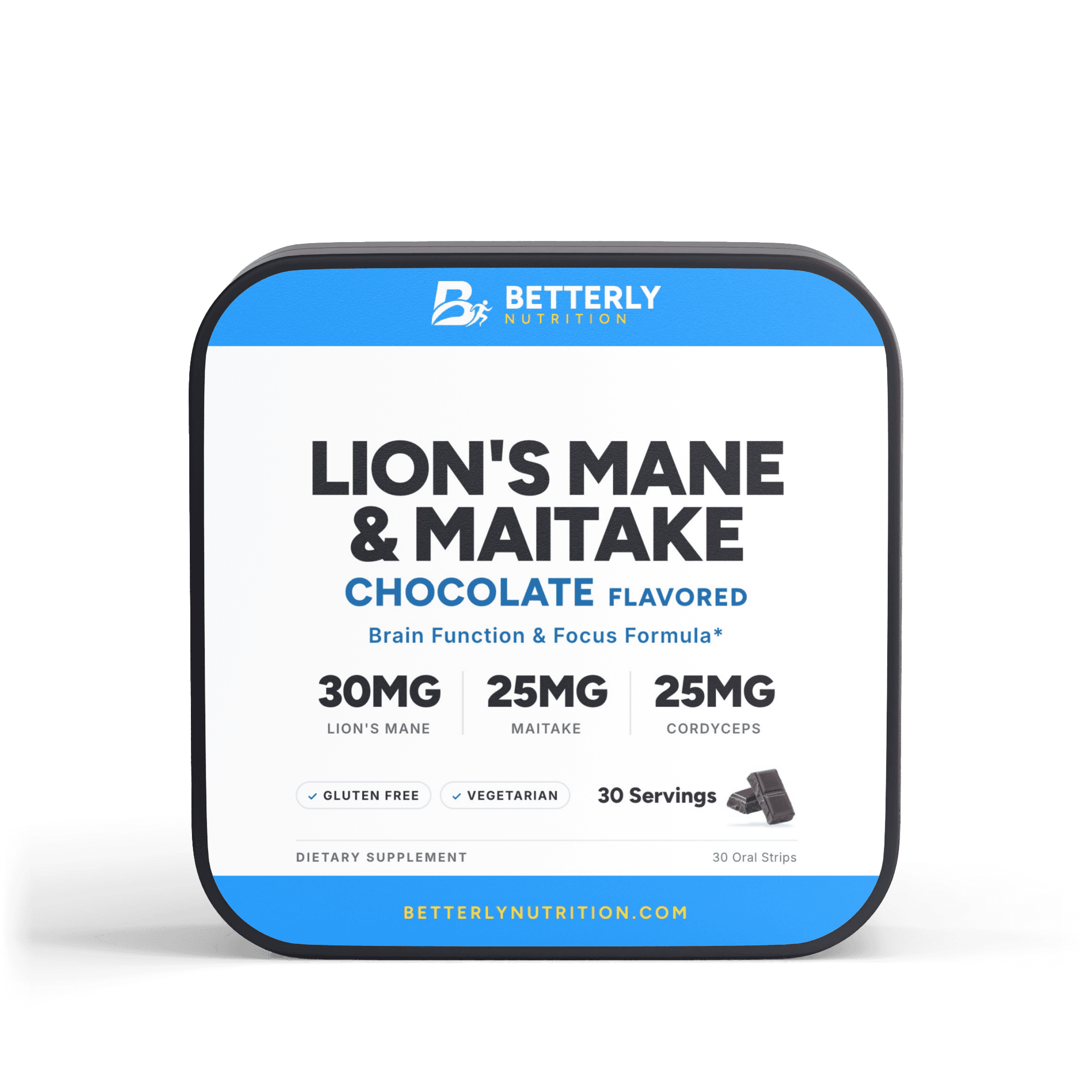
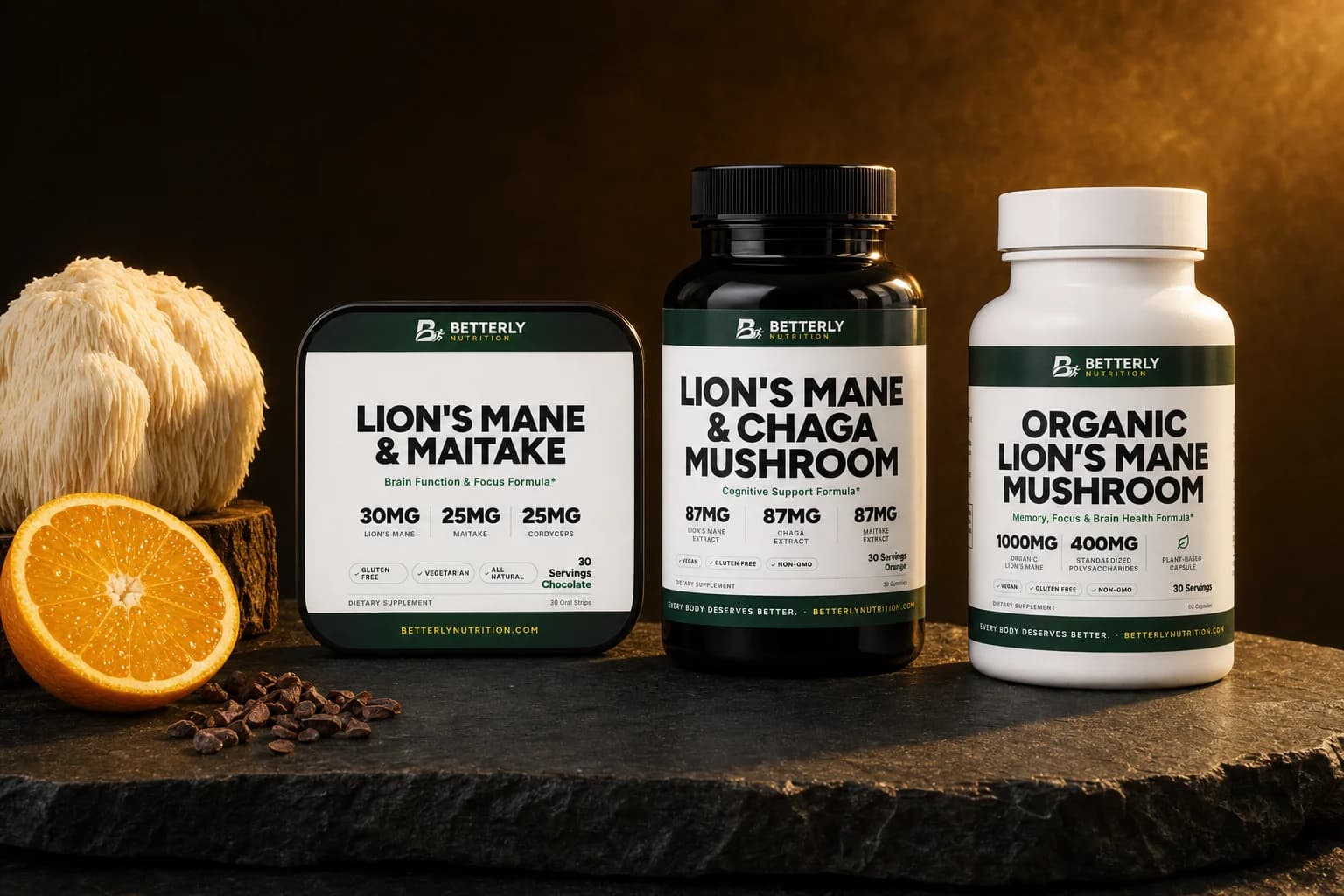
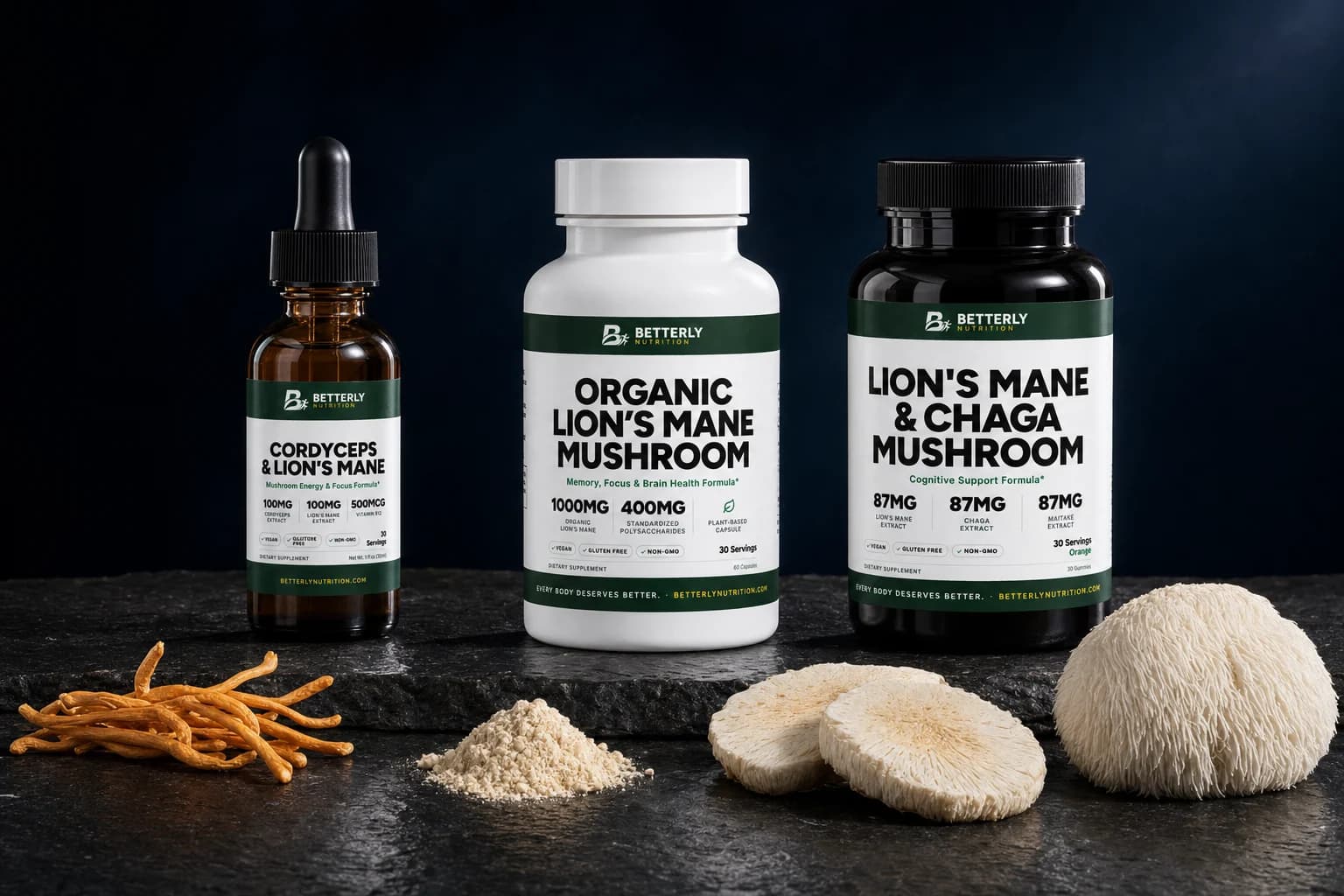
Even within one brand, the spread is wide. Our Organic Lion's Mane Mushroom Capsules provide 1,000 mg per 2-capsule serving, while our Lion's Mane & Maitake Focus Strips list 30 mg per strip. By printed weight, that's about 33 times as much lion's mane.
How many lion's mane capsules, gummies or drops a day?
Betterly's lion's mane labels call for two capsules, one or two gummies, 1 ml of drops or one strip daily.
| Product (serving) | Lion's mane per serving | Label's daily amount | Lion's mane per day |
|---|---|---|---|
| Organic Lion's Mane capsules (2 capsules) | 1,000 mg powder | 2 capsules | 1,000 mg |
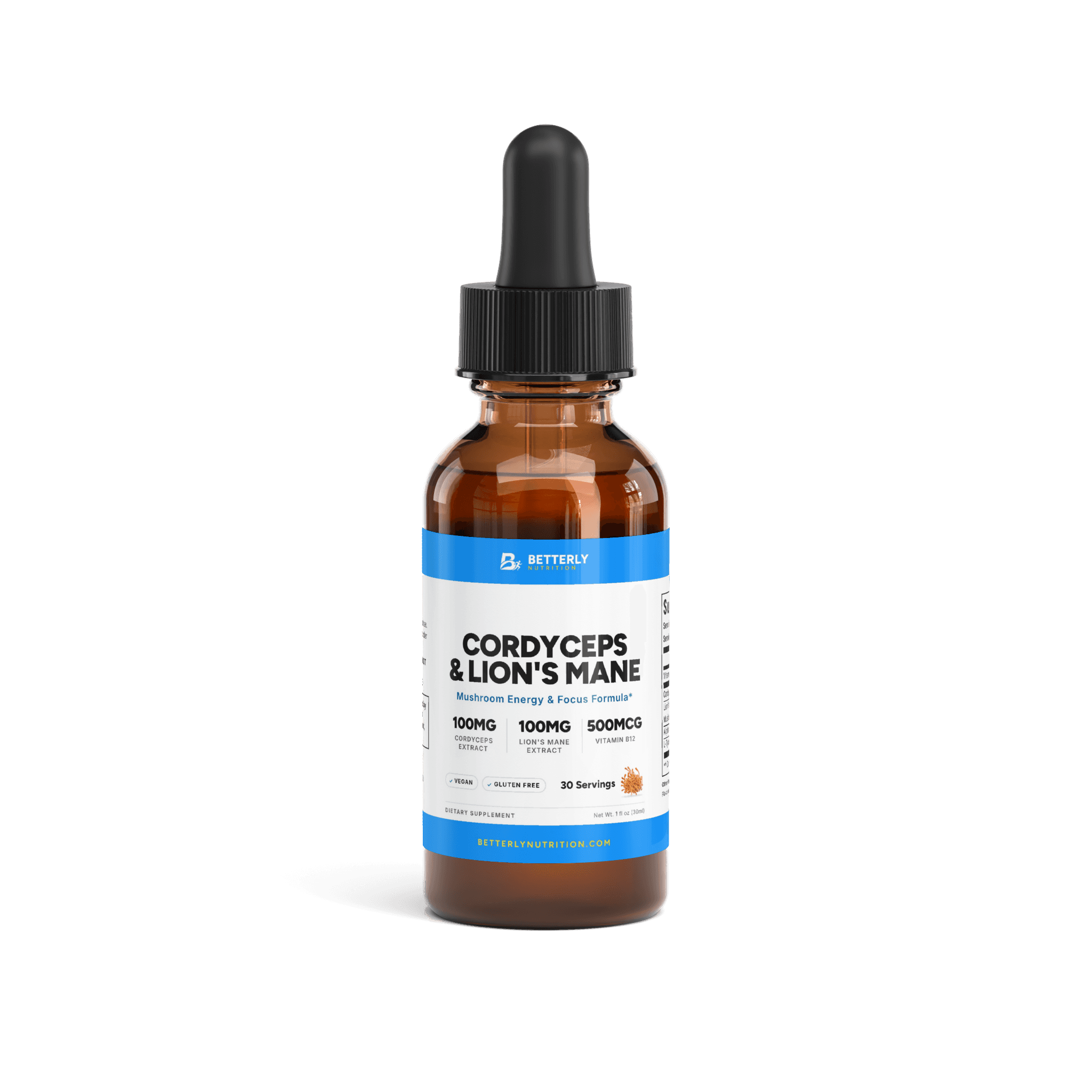
| Cordyceps & Lion's Mane drops (1 ml) | 100 mg extract | 1 ml (30 drops) | 100 mg |
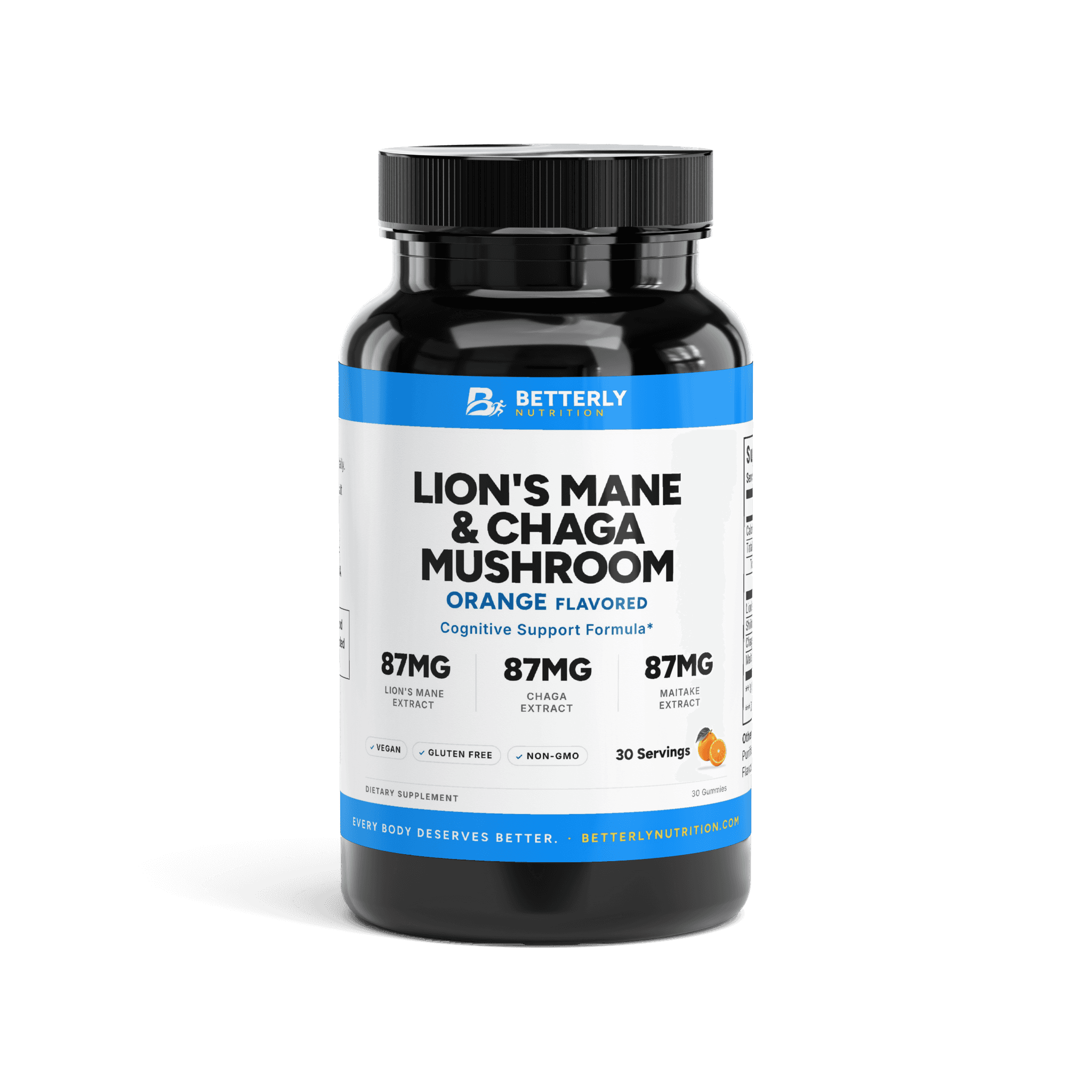
| Lion's Mane & Chaga gummies (1 gummy) | 87 mg extract | 1 to 2 gummies | 87 to 174 mg |
| Lion's Mane & Maitake strips (1 strip) | 30 mg, form not stated | 1 strip | 30 mg |
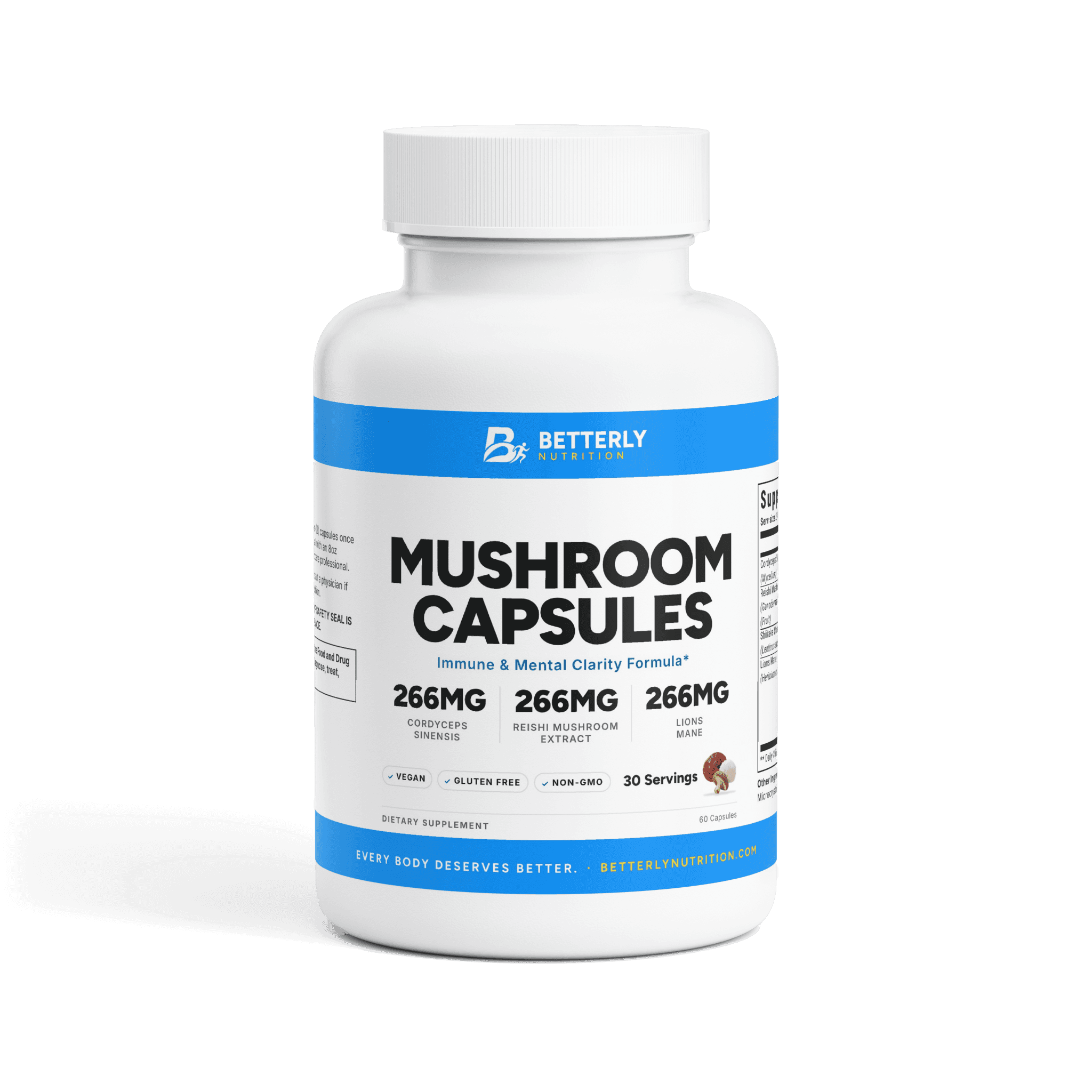
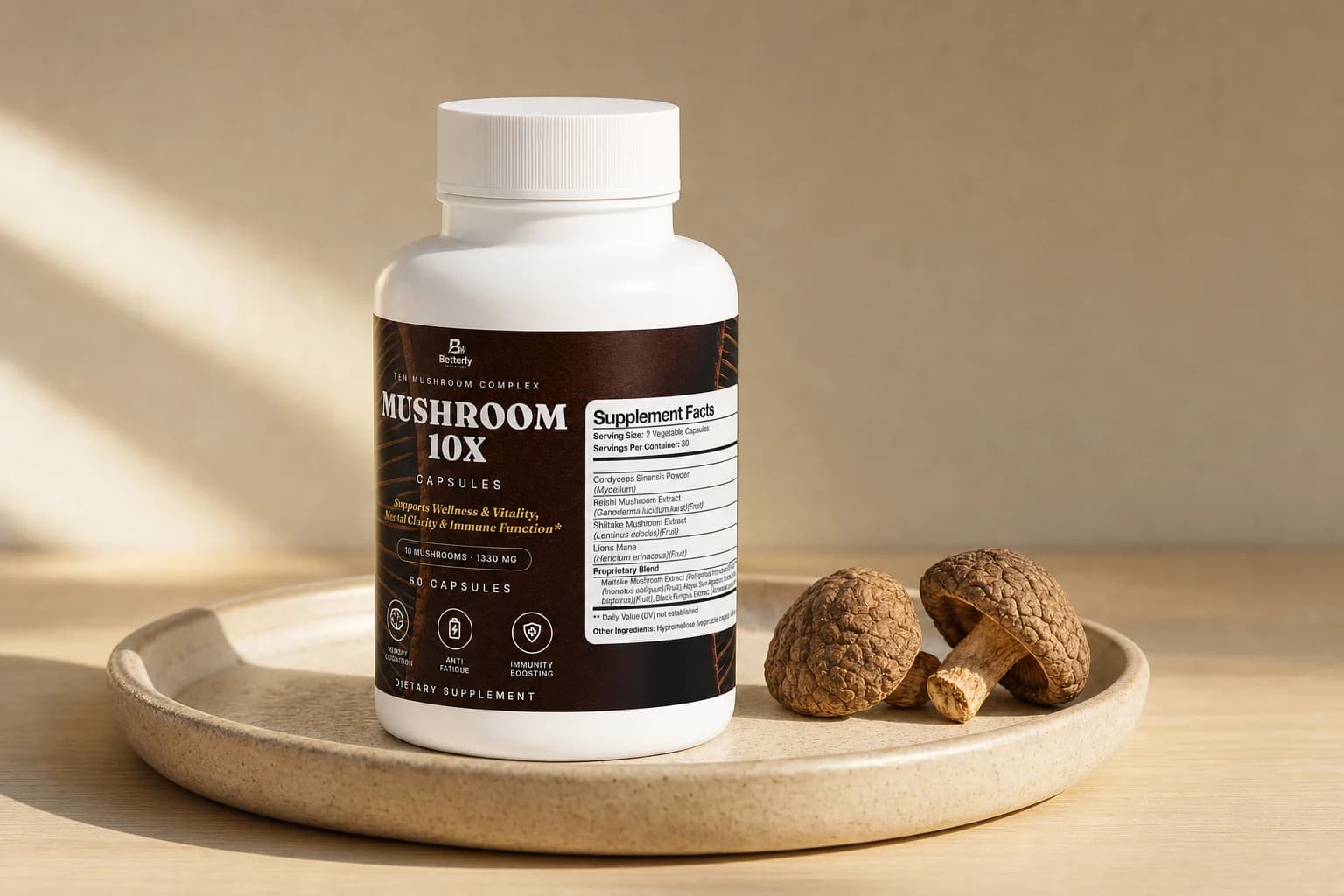
| Mushroom Capsules (2 capsules) | 266 mg, fruit | 2 capsules | 266 mg |
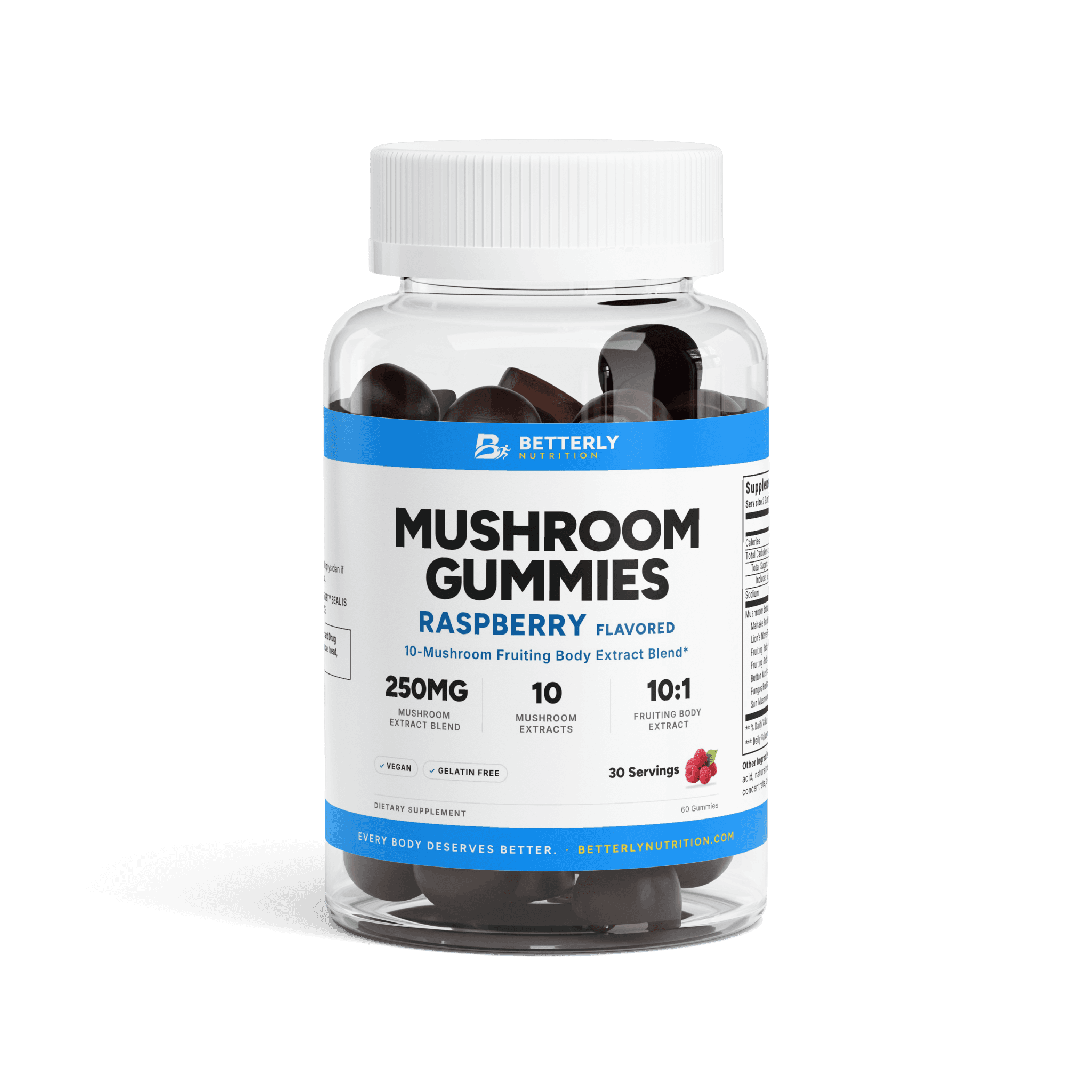
| Mushroom Gummies (2 gummies) | Not listed separately | 2 gummies | Share of a 250 mg blend |
By label weight, the capsules are the only product here that reaches a full gram a day, and the strip lists the least. The gummies are the one label with a range, so they're the only product where "how many a day" has two correct answers.
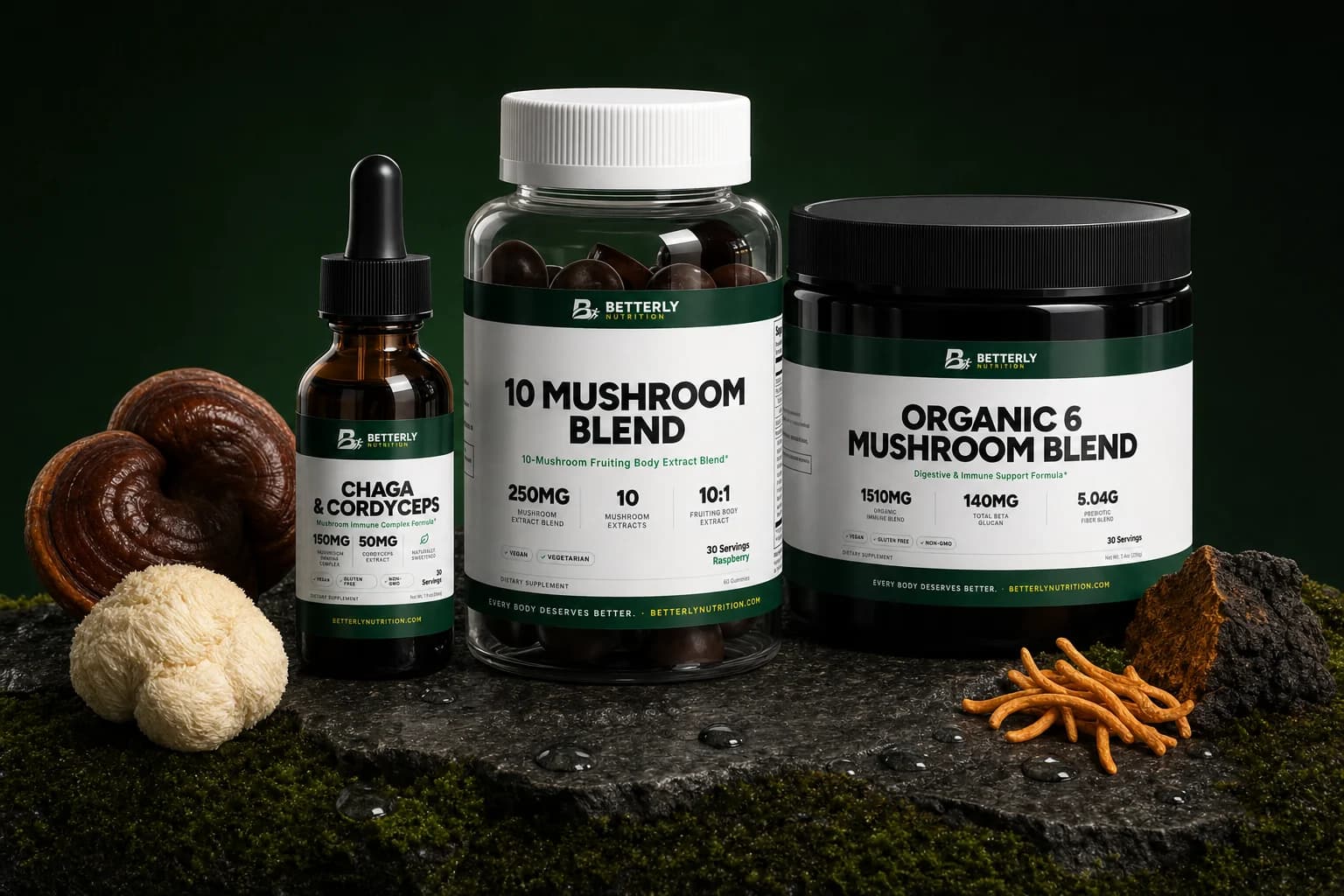
Lion's mane rarely travels alone in this lineup. The Lion's Mane & Chaga Mushroom Gummies share each gummy with 87 mg apiece of shiitake, chaga and maitake extract. The Cordyceps & Lion's Mane Energy Drops pair it with 100 mg of cordyceps extract, and the strips add maitake, cordyceps and shiitake.
Our Mushroom Capsules give lion's mane its own row. The Mushroom Gummies don't: their lion's mane fruiting body 10:1 extract sits inside a 250 mg blend with no share listed.
Is lion's mane extract the same as lion's mane powder?
No. Lion's mane powder is the dried, ground mushroom, while a lion's mane extract is made by soaking the mushroom in a liquid to draw out its compounds.
That changes what a milligram means. The NIH Office of Dietary Supplements (ODS) gives an example in its background sheet on botanical supplements: the plant material in one cup of tea could fit into a few teaspoons of tincture, or into an even smaller amount of extract. So a small extract number can stand for more starting mushroom than a powder number of the same size.
How much more depends on a ratio, which ODS describes as the weight of the dried plant compared with the finished product. The FDA's labeling guide adds that a dried extract is listed by its own weight. So the 87 mg on our gummy is extract weight, not mushroom weight, and our drops list 100 mg of extract per 1 ml. Neither label prints a ratio, so neither converts into a powder amount, and we won't guess one.
Our capsules are the simpler case. Their label lists 1,000 mg of lion's mane fruiting body and mycelium powder per 2-capsule serving, 400 mg of it polysaccharides, a type of complex carbohydrate. That 400 mg is part of the gram, not added to it.
How much lion's mane powder should you take?
Take the amount of lion's mane powder its own label gives per scoop or serving. A teaspoon measures volume, not weight, and two powders can fill the same spoon at different weights. We don't sell a loose lion's mane powder, so if you want powder in a fixed amount, our capsules hold it pre-measured.
From our shop: Organic Lion's Mane Mushroom Capsules — the biggest lion's mane figure printed on any of our labels, with 1,000 mg of organic lion's mane powder per 2-capsule serving.
What amounts of lion's mane did human studies use?
The human trials summarized in LiverTox gave lion's mane in amounts ranging from a single 1-gram dose up to 10 grams a day.
LiverTox is an NIH database, hosted on the National Library of Medicine's Bookshelf, that tracks the liver safety of drugs and supplements. Its lion's mane entry, last updated in January 2024, summarizes these trials.
| Daily amount | Form, as LiverTox describes it | Length | Participants |
|---|---|---|---|
| 1 g, one dose | Extract | Single dose | 40 healthy adults |
| 1,050 mg (350 mg three times) | Mycelia enriched with erinacine A | 48 weeks | 49 adults |
| 1.8 g | Lion's mane | 28 days | 41 healthy adults, 18 to 45 |
| 2 g | Baked into cookies | 4 weeks | 30 adult women |
| 3 g | Powdered mushroom | 16 weeks | 30 adults, 50 to 80 |
| 10 g | Lion's mane | 4 weeks | 24 healthy college-age adults |
Five of the six amounts fall between 1 and 3 grams a day. The forms don't match each other, though, or most store products. Several trials also enrolled older adults or people with specific health concerns, so their amounts don't carry over neatly to a healthy adult.
One oddity if you read the entry yourself: its overview gives the typical dose as "1 to 3 mg daily." Every trial on that page measured lion's mane in hundreds of milligrams or in grams, so that line reads like a unit error.
By printed weight, only our capsules reach the bottom of that range. The strip, gummies and drops list far less, though their milligrams can't be converted to powder, and LiverTox describes no trial of a strip, gummy or drop.
Is a bigger lion's mane dosage better?
We found no evidence that a bigger lion's mane dosage works better. The largest amount LiverTox lists, 10 grams daily for four weeks, showed no differences from placebo on the measures tested.
The other trials are mixed, with some reporting changes on a few measures and others finding no significant differences. None compared one amount of lion's mane against another, so there's no dose curve to read. LiverTox adds that the effects on nerve cells and learning seen in animals "have not been shown to any great extent in humans."
What a larger amount does add is exposure. ODS points out that a botanical's safety depends partly on how much you take.
How much lion's mane is too much?
For a lion's mane supplement, too much means anything past its label's suggested use. We found no government upper limit for lion's mane to use instead.
Every product in our first table prints "Do not exceed recommended dose." The ODS botanical sheet says the same in general terms: follow the maker's directions unless your provider tells you otherwise.
Stacking is the easy way to overshoot. Pair our lion's mane capsules with our Mushroom Capsules and the total reaches 1,266 mg of lion's mane a day, from two labels that each assume they're your only source. The gummies plus the strips double up on maitake and shiitake as well.
Stomach upset is what trials report most. LiverTox's summary of longer trials puts mild nausea, diarrhea or abdominal discomfort at under 10% of participants in most cases, and it records at least one allergic reaction. If that happens, stop, and call your provider if it doesn't settle. Our guide to lion's mane side effects covers who should skip it altogether.
How do you take lion's mane, going by the label?
Follow each lion's mane label as written: two capsules, one to two gummies, 1 ml of drops after shaking, or one strip on the tongue, all daily.
- Capsules: "adults take two (2) capsules daily or as directed by a healthcare professional." The label lists vegan, gluten free and non-GMO.
- Gummies: "Take one (1) to two (2) gummies daily." Each orange gummy carries 2 g of added sugars (4% DV).
- Drops: "Shake well. Take 1 ml (30 drops) daily." Each 1 ml also holds 500 mcg of vitamin B12, 25 mg of Alpha GPC and 25 mg of L-Tyrosine.
- Strips: "Place 1 oral strip on the tongue daily and allow it to dissolve." The chocolate-flavored strip gets its sweetness from monk fruit extract and steviol glycosides.
None of these four labels names a time of day; our guide on taking lion's mane morning or night covers timing. Our mushroom supplement collection lists every format side by side.
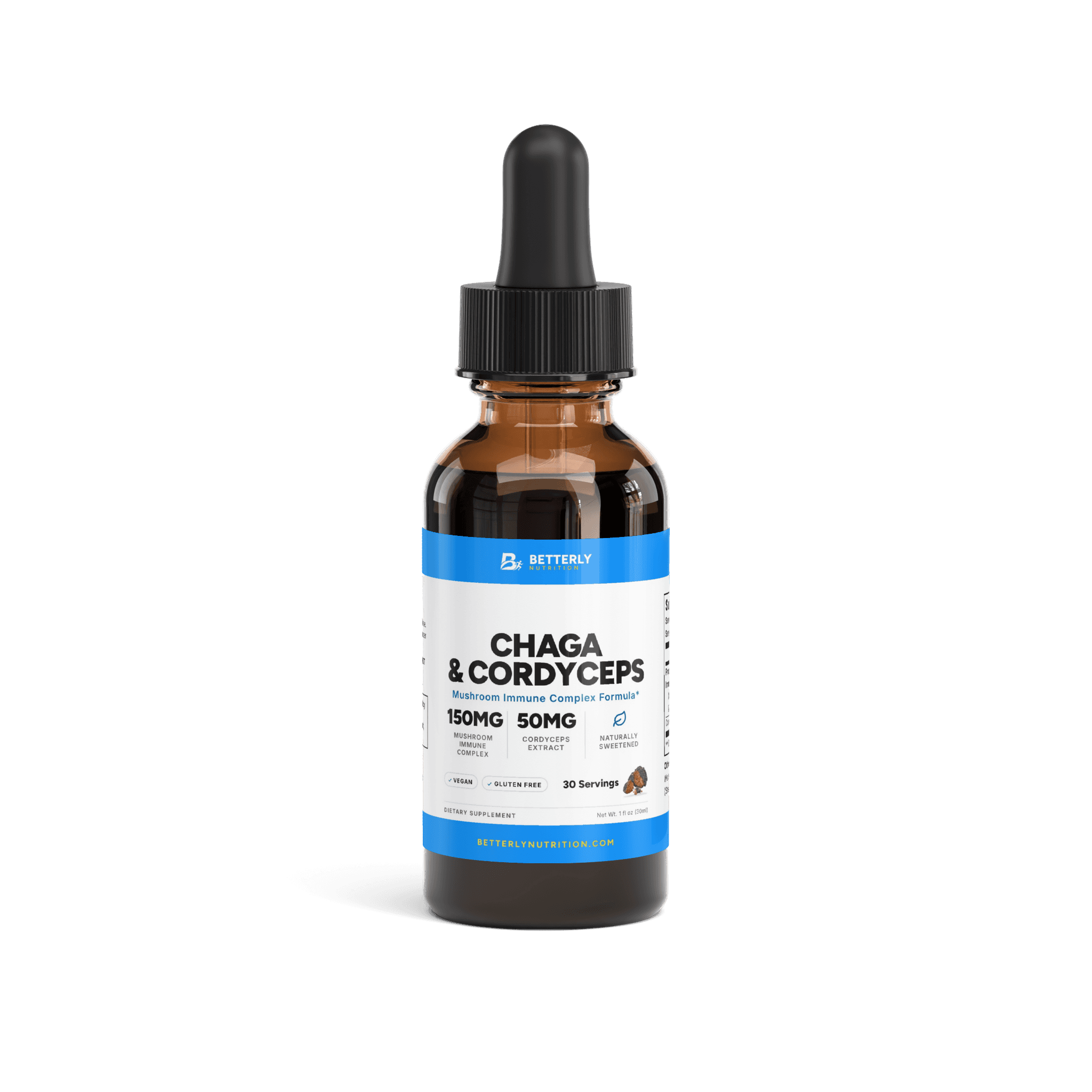
From our shop: Cordyceps & Lion's Mane Energy Drops — 100 mg of lion's mane extract and 100 mg of cordyceps extract per 1 ml serving, in a stevia-sweetened liquid labeled vegan and gluten free.
Do you need a lion's mane supplement at all?
Skip a separate lion's mane supplement if a blend you take already lists it, or if you'd only be content taking more than a label allows.
Start with the panel you already own. Plenty of mushroom blends include lion's mane, and adding a single-mushroom bottle on top makes your total harder to track. Our comparison of single lion's mane and mushroom complexes helps you pick one route.
Then be honest about the number you're chasing. If a trial's 3 grams is your target, no product of ours gets there within its directions. We'd rather you know that now than take four capsules instead of two.
Who should check with a healthcare provider first?
Before you pick a lion's mane dose, talk it through with a doctor or pharmacist if you're pregnant, nursing, under 18, on prescriptions, facing surgery or managing a health condition.
Each of our lion's mane labels prints the same caution: "Do not exceed recommended dose. Consult a physician if pregnant, nursing, under 18, or have a medical condition."
ODS's fact sheet Dietary Supplements: What You Need to Know flags two situations worth a call, among others. If you take prescription medicine, your provider should approve any supplement before you start. If surgery is on the calendar, every supplement you use belongs in that conversation.
Skip lion's mane if eating mushrooms has ever caused a reaction.
FAQ: how much lion's mane to take
How much lion's mane tincture should you take a day?
Take the amount of lion's mane tincture printed on its label, because strength varies by brand. ODS explains that tincture strength is written as a ratio of dried plant to finished liquid, so two droppers can hold very different amounts. Our Cordyceps & Lion's Mane Energy Drops use a glycerin and water base rather than the alcohol-and-water mix ODS describes, and the label calls for 1 ml (30 drops) daily, or 100 mg of lion's mane extract per 1 ml serving.
How much lion's mane is in a mushroom blend?
The amount of lion's mane in a mushroom blend depends on the brand, and some blends don't say. Our Mushroom Capsules list 266 mg per 2-capsule serving, next to cordyceps, reishi and shiitake at the same amount. Our Mushroom Gummies don't list lion's mane's share of their 250 mg blend. When a blend hides the split, you can't total your lion's mane.
Should you start with a smaller lion's mane dose?
You can start with a smaller lion's mane dose only when the label allows one. Our Lion's Mane & Chaga Mushroom Gummies say one to two gummies daily, so starting with one gummy (87 mg of lion's mane extract) stays within the directions. Our capsule, drop and strip labels each set a single daily amount. To take less than a label says, ask your healthcare provider first.
How long can you take lion's mane daily?
We found no official limit on how long you can take lion's mane daily, and our lion's mane labels give daily directions with no end date. The trials LiverTox summarizes ran from a single dose to 48 weeks. LiverTox adds that lion's mane hasn't been put through dedicated safety trials. If you plan to take it for months, add it to the list your provider reviews at checkups.
Can a doctor recommend a different lion's mane dose?
Yes, a healthcare provider can recommend a different lion's mane amount, and our capsule label allows for it with "or as directed by a healthcare professional." ODS goes further for supplements in general: before starting one, it suggests asking your providers what the proper dose is for you.
Sources
- Lion's Mane, LiverTox (NCBI Bookshelf), National Library of Medicine
- Botanical Dietary Supplements: Background Information, NIH Office of Dietary Supplements
- Dietary Supplements: What You Need to Know, NIH Office of Dietary Supplements
- Dietary Supplement Labeling Guide: Chapter IV. Nutrition Labeling, U.S. Food and Drug Administration
If this left you looking for somewhere to start, read lion's mane capsules with 1,000 mg per serving — its amounts per serving are listed on the page. For the practical questions this raises, how dosing, sourcing and subscriptions work is answered in one place.