On this page
- Key takeaways
- What does lion's mane do, in plain terms?
- What does lion's mane do for the brain in lab studies?
- Does lion's mane work in healthy adults?
- Does lion's mane help you focus or remember more?
- Can lion's mane affect mood or everyday stress?
- Can you match a lion's mane capsule to a trial dose?
- What's the right way to take a lion's mane supplement?
- When is lion's mane the wrong pick for you?
- Who should check with a healthcare provider before starting?
- FAQ: what lion's mane does
- Sources
The short answer: What does lion's mane do? In lab and animal studies, its compounds, hericenones and erinacines, prompt cells to make more nerve growth factor. In people, the proof is thin. A handful of small trials in healthy adults, using amounts between a one-time 1 g dose and 10 g daily, found a few better test scores, a few worse ones, and no steady change in focus, memory or mood.
Key takeaways
- Lion's mane (Hericium erinaceus) is an edible white mushroom, and supplements made from it are sold to support focus, memory and clear thinking.
- Two compound families set lion's mane apart: hericenones, richest in the fruiting body, and erinacines, richest in the mycelium, the threadlike network the mushroom grows from.
- The brain effects that made lion's mane famous come mostly from cell and animal work, and the NIH's LiverTox reference says they haven't been shown to any great extent in humans.
- In four small trials of healthy adults, lion's mane changed a handful of individual test scores at most, and some results favored the placebo.
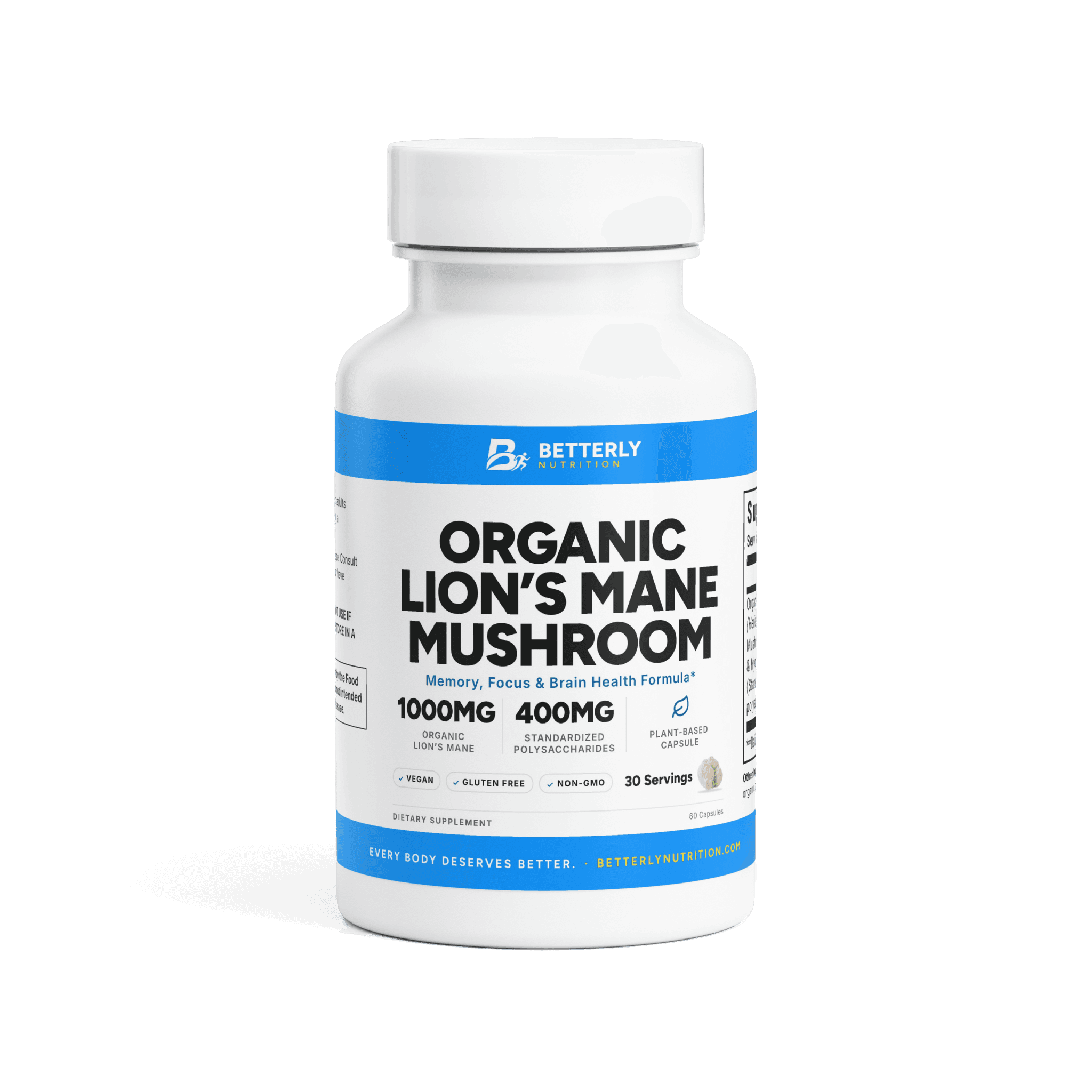
- Betterly's largest lion's mane serving, 1,000 mg of powder per 2 capsules, has the same label weight as one trial's single 1 g extract dose, but powder and extract grams differ, so it isn't an equivalent dose.
We sell lion's mane in capsules, gummies, oral strips and drops, so we'd love this mushroom to have a spotless record. It doesn't yet. Here's what the trials measured, and why no label, ours included, lines up neatly with them.
What does lion's mane do, in plain terms?
Lion's mane is an edible mushroom sold to support focus, memory and clear thinking, but its effects in people remain unproven and, where they've shown up, small.
The part you'd spot at a market is the fruiting body: a white mass of long spines that hang down. Cooks in East Asia have used it for a long time, and so has traditional Chinese medicine, according to the NIH's LiverTox entry on lion's mane.
It's a real food, too: a 2025 study noted that people often eat up to 300 g of the fresh mushroom as "steaks." Supplements instead dry it into a powder or turn it into an extract, then put a set amount into each capsule, gummy, strip or dropper.
What does lion's mane do for the brain in lab studies?
In lab and animal studies, lion's mane compounds prompted cells to make more nerve growth factor, and mice given erinacines showed better alertness and learning.
Where hericenones and erinacines come from
Lion's mane makes two families of compounds that LiverTox describes as unique to it. The 2025 study's authors describe the split: the fruiting body you'd cook and eat is rich in hericenones, while the mycelium carries more erinacines.
LiverTox also lists beta-glucan polysaccharides (complex carbohydrates), phenolic acids and sterols, and it cites a 2023 analysis that found more than 800 compounds unique to lion's mane. Which one drives the purported effects, LiverTox says, is unknown.
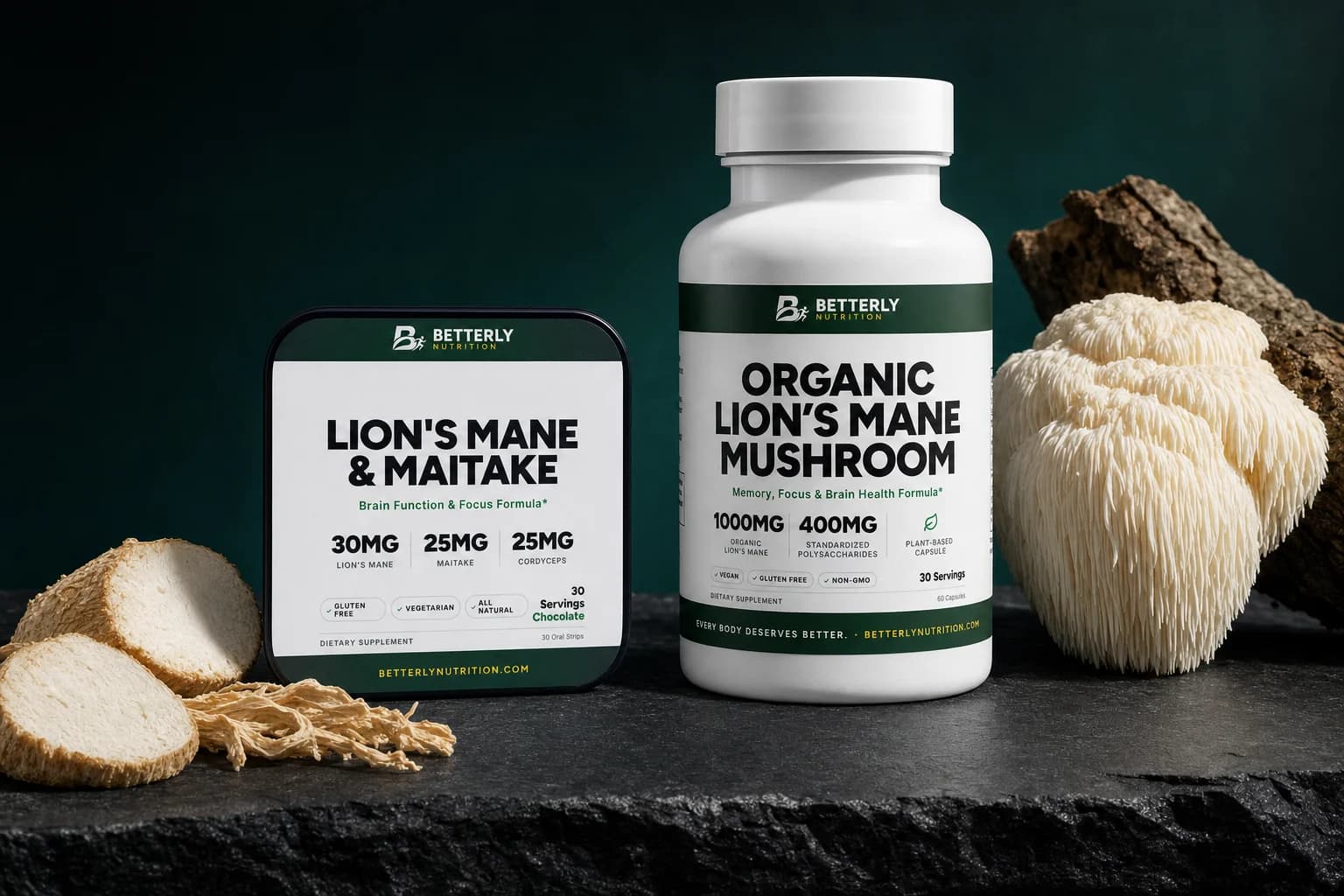
That matters when you read a label. Our Organic Lion's Mane Mushroom Capsules contain fruiting body and mycelium powder "Standardized to 40% polysaccharides," or 400 mg per 2-capsule serving. ODS, the NIH Office of Dietary Supplements, explains in its fact sheet on botanical supplements that standardizing means measuring a marker compound so batches match. Ideally the marker is the compound behind the effect, but for most botanicals that compound isn't known. So our 400 mg shows batch consistency, not your hericenone or erinacine intake, and none of our panels lists either one.
What the lab and animal work shows
Nerve growth factor is a signaling protein that certain nerve cells rely on. LiverTox reports that erinacines crossed into the brain in rats, stimulated the making of nerve growth factor, and improved alertness and learning in mice. Then comes the line that matters most: these effects "have not been shown to any great extent in humans."
Most lion's mane mushroom supplement benefits you see advertised lean on work like this, and animal results don't carry over neatly. LiverTox credits the rodent findings to erinacines specifically, not to the whole mushroom. The 2025 study's authors add that no one yet knows how long erinacine S, one of those compounds, takes to peak in human blood.
Does lion's mane work in healthy adults?
Lion's mane benefits in healthy adults are mixed at best: four small, placebo-controlled trials found a few better scores, a few worse ones, and mostly no difference.
This table skips trials in older people or groups with particular health concerns, which say little about a healthy 30-year-old.
| Trial (group, length) | What people took | What looked better | What didn't |
|---|---|---|---|
| 41 adults aged 18 to 45, 28 days | 1.8 g a day in capsules | Stroop task speed an hour after the first dose | Word recall; most other tests |
| 40 adults, single dose | 1 g of a lion's mane extract, once | Minor gains on some tests | Not detailed in LiverTox's summary |
| 18 adults aged 18 to 35, single dose, crossover | 3 g of a 10:1 fruiting-body extract in a drink, once | A pegboard test of hand speed | Overall thinking and mood scores; two tests got worse |
| 24 college-age adults, 4 weeks | 10 g a day in muffins | Nothing | Thinking tests; metabolism measures |
Read down the "better" column and no single benefit repeats, and the biggest amount, 10 g a day, did no better than placebo.
We read the first trial, a 2023 pilot, in full on PubMed Central, along with the third, a 2025 single-dose study whose authors called their own results inconclusive. The other two rows come from LiverTox's summaries; the 2023 authors supply the muffin detail.
Why so messy? The groups were tiny, and each trial used different tests. Industry is involved, too, as it is with us: the maker of the lion's mane blend supplied the 2023 pilot's capsules, and a drinks company helped pay the 2025 study's publication fee. For balance, LiverTox also summarizes two 2023 reviews that called lion's mane "promising" or found some evidence for it.
Does lion's mane help you focus or remember more?
Lion's mane hasn't reliably improved focus or memory in healthy adults; the clearest signal is one faster attention score after a single 1.8 g dose.
That score came from the Stroop task, where you see a color word like "red" printed in a different ink and name the ink as fast as you can. An hour after the first dose, the lion's mane group answered about 50 milliseconds faster than before, roughly one-twentieth of a second.
The same study pointed the other way on memory. An hour after the first dose, the lion's mane group recalled fewer words on an immediate word-recall test. After 28 days, the placebo group recalled more words on a delayed test than it had on day one, and the lion's mane group didn't. In the 2025 study, lion's mane scored worse on a flanker test, another focus measure.
The 2023 authors offered a fair reason effects are hard to catch: healthy young adults are near their peak thinking ability, so any gain would be subtle. Subtle fits what they found, too: one small speed gain, and memory scores that leaned toward placebo.
Can lion's mane affect mood or everyday stress?
Lion's mane's mood evidence is thin: one 28-day pilot saw a lower stress rating on one of two stress questionnaires, and two other studies found no overall mood change.
In the 2023 pilot, people marked their stress on a simple line scale, and after 28 days the lion's mane group's average was lower than the placebo group's. On a second, standard stress questionnaire, the groups didn't differ. The authors called it a trend worth testing further.
LiverTox summarizes a 2010 Japanese study of 30 adult women who ate cookies with 2 g of lion's mane a day for 4 weeks. Unlike the healthy young adults in the table, these women had reported a mix of vague, everyday complaints. Their main mood and sleep scales showed no differences from placebo cookies, though a few single checklist items, such as feeling irritable, improved. On the evidence so far, lion's mane isn't a mood supplement.
Can you match a lion's mane capsule to a trial dose?
Not closely, because each lion's mane trial used a different material. Betterly's Organic Lion's Mane Mushroom Capsules list 1,000 mg per 2-capsule serving, the same label weight as one trial's single 1 g extract dose but not an equivalent dose.
What each trial gave people:
- 1.8 g a day (2023): a proprietary lion's mane blend in capsules; the paper doesn't say whether it's fruiting body, mycelium or extract.
- 1 g, once: an extract, per the study's title in LiverTox. No ratio is given, so our 1,000 mg of powder matches it by label weight only.
- 3 g, once (2025): a 10:1 fruiting-body extract made with water and ethanol, stirred into a drink. In ODS's terms, the first number is dried plant and the second is finished product, so those 3 g began as roughly 30 g of dried mushroom.
- 10 g a day: muffins, with no word on which part of the mushroom.
Gummies and strips are harder still to line up. An extract weight printed without a ratio can't be turned back into mushroom weight, and a blend that gives lion's mane no number of its own can't be compared with anything. Our lion's mane dose guide walks through each of our labels.
The 10 g group took ten times our capsule serving and did no better than placebo, so there's no reason to go past any label's directions.
From our shop: Organic Lion's Mane Mushroom Capsules — the pick if you want lion's mane on its own, with fruiting body and mycelium powder at 1,000 mg per 2-capsule serving.
What's the right way to take a lion's mane supplement?
Follow the label: Betterly's lion's mane capsules, gummies and strips each print a daily amount, and sticking to one product makes lion's mane easier to judge.
If you want to judge lion's mane by itself, the capsules make the fairest test. Their label reads "adults take two (2) capsules daily or as directed by a healthcare professional," and no other mushroom shares the panel.
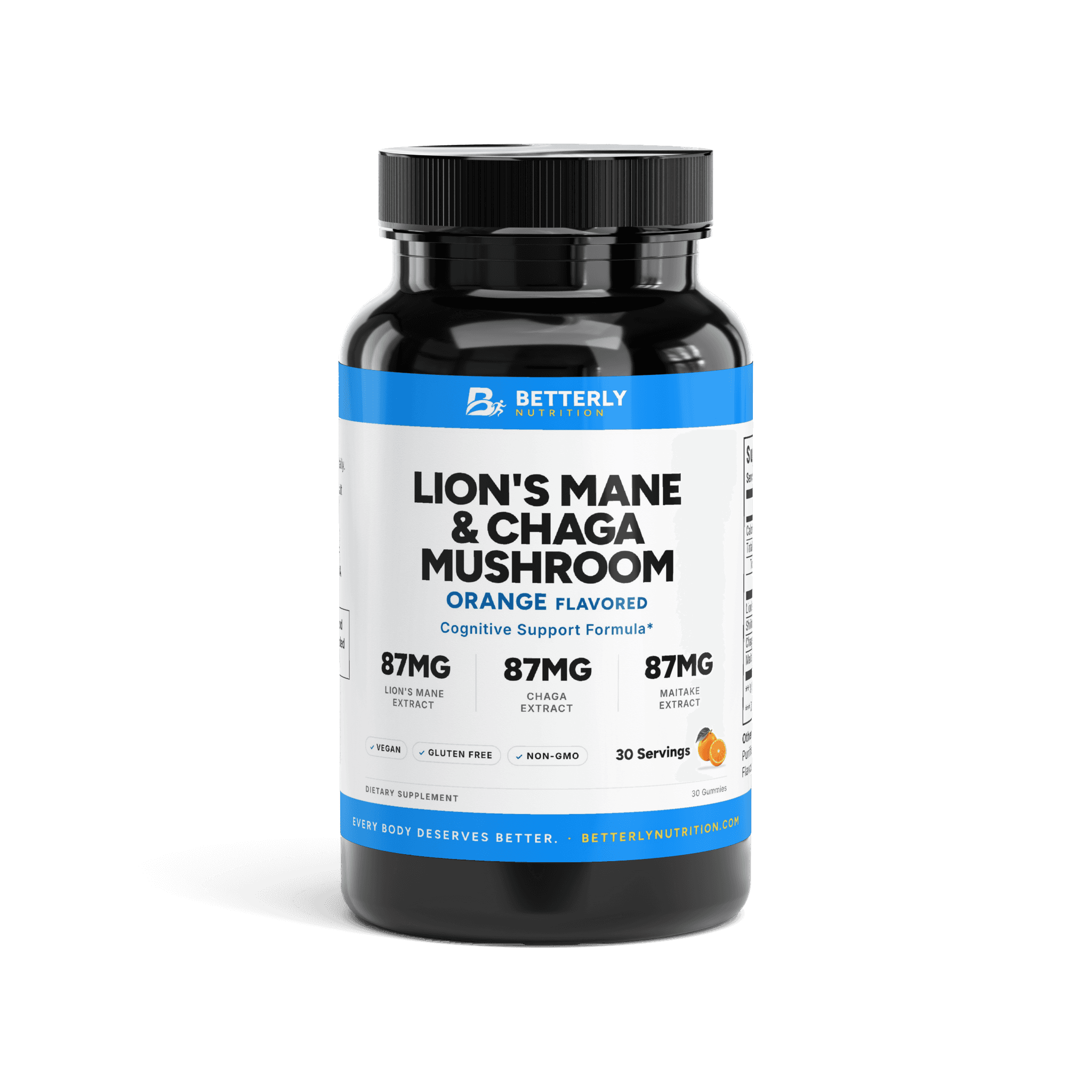
Our combination products blur that picture, since anything you notice could come from a companion ingredient. The Lion's Mane & Chaga Mushroom Gummies say "Take one (1) to two (2) gummies daily," and each gummy pairs 87 mg of lion's mane extract with three other mushroom extracts at the same amount.
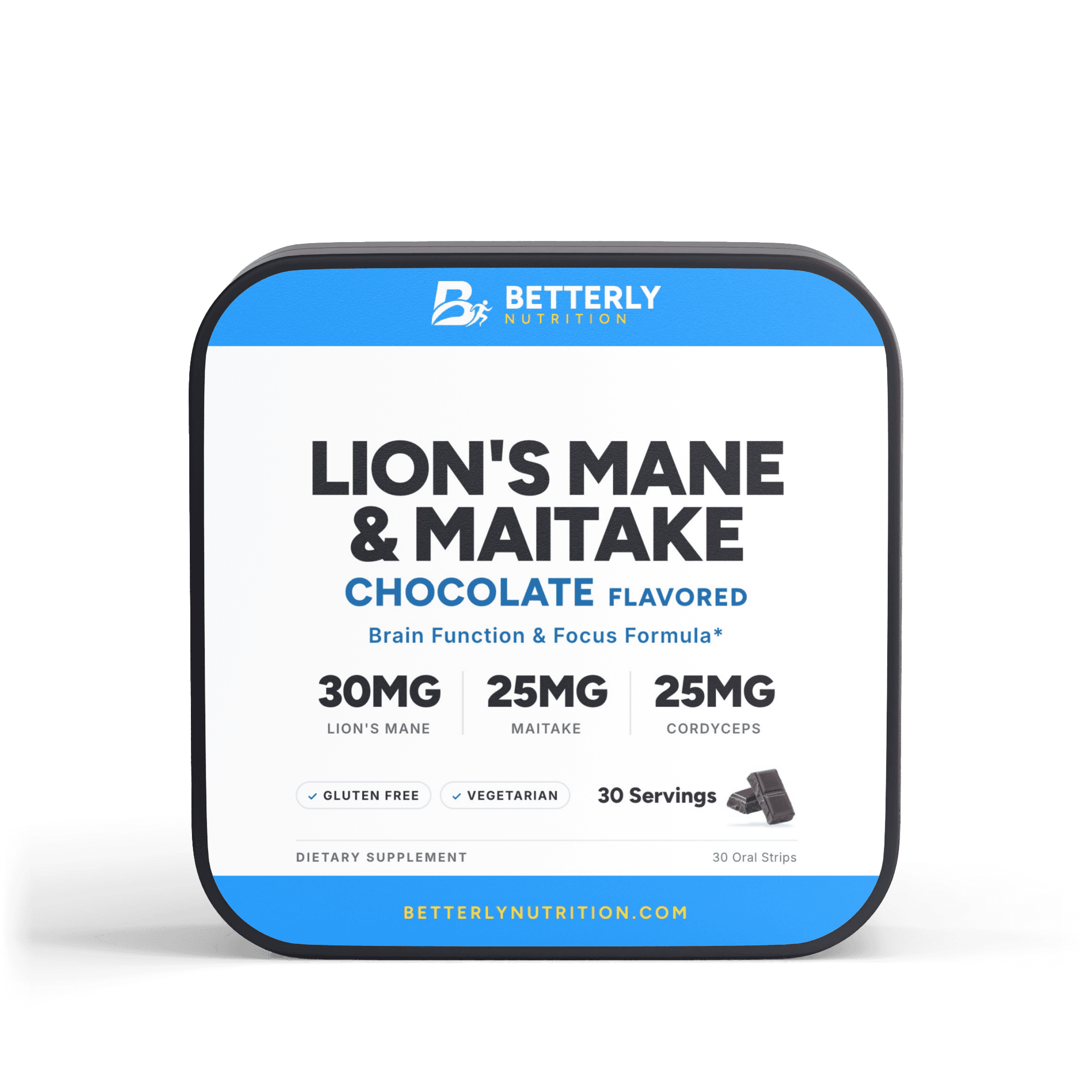
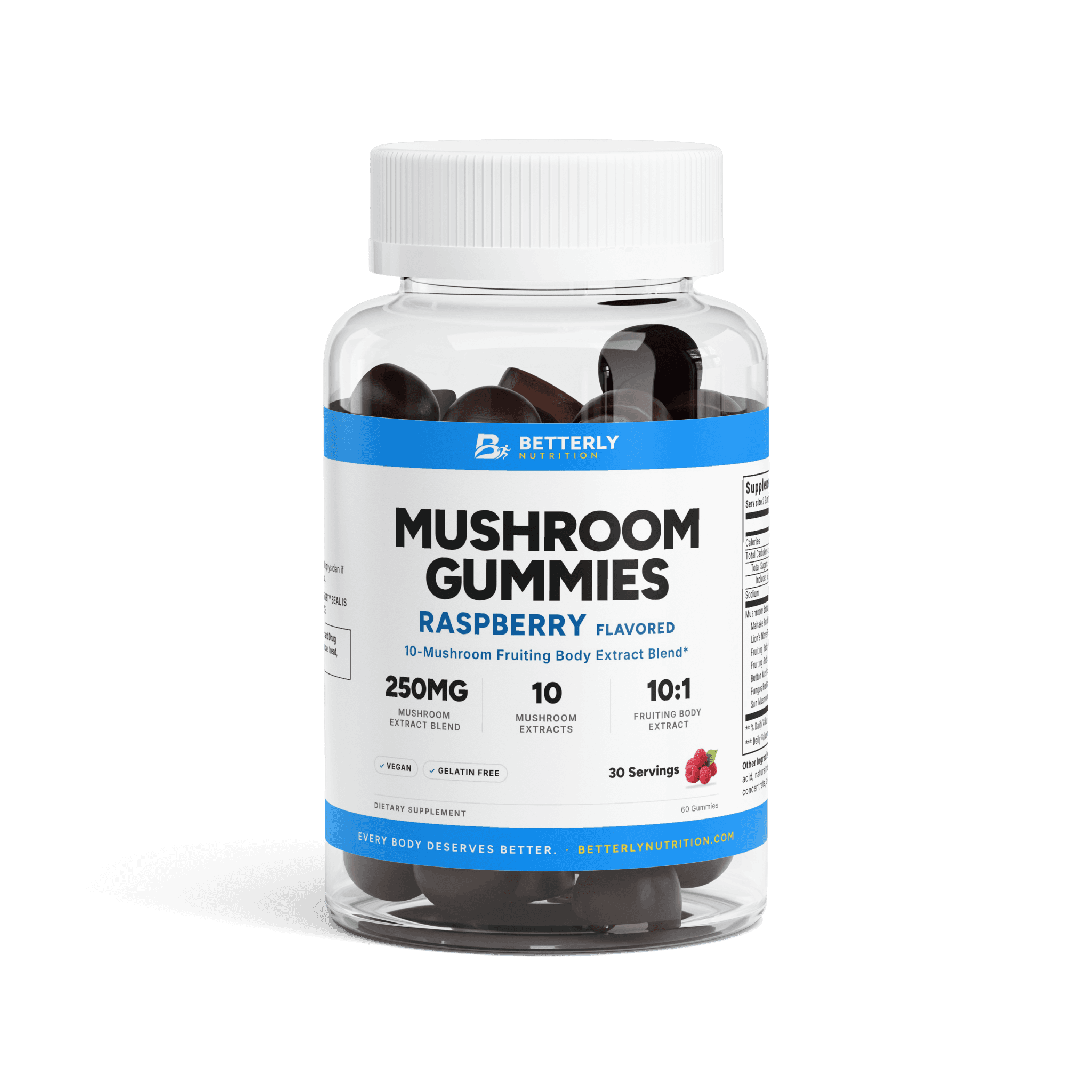
The Lion's Mane & Maitake Focus Strips say "Place 1 oral strip on the tongue daily and allow it to dissolve," with three other mushrooms sharing the strip. The Mushroom Gummies call for "2 gummies daily" and split a 250 mg blend across ten mushrooms. Stick to one of these, since the two gummies and the strip all carry lion's mane, maitake and shiitake. For the time-of-day question, see our lion's mane timing guide.
Be a little skeptical of your own impressions: in the 2023 pilot, it was the placebo group that improved on the delayed memory test. Noticing nothing isn't a sign you need more. All six of our lion's mane products, drops included, sit on our mushroom supplement shelf.
From our shop: Lion's Mane & Maitake Focus Strips — a no-swallow option whose 1-strip serving carries 30 mg of lion's mane, 25 mg each of maitake and cordyceps, and 20 mg of shiitake.
When is lion's mane the wrong pick for you?
Lion's mane is the wrong pick if you want a lift you'll feel today or a better mood, and lion's mane gummies suit poorly if you're cutting sugar.
- You want quick energy. The 1 g trial also tested a caffeinated guayusa tea extract, and LiverTox notes caffeine may account for that drink's effects on thinking. Lion's mane's gains were minor.
- You're after a better mood. The studies above found a stress trend at most, not a clear mood change.
- You're watching added sugar. Our gummies add 2 g per gummy or 5 g per 2-gummy serving.
Who should check with a healthcare provider before starting?
Check with a healthcare provider before starting lion's mane if you're pregnant, nursing, under 18, take prescription medicine, have surgery planned, manage a medical condition or react to mushrooms.
Each label named in this post carries the same caution, word for word: "Do not exceed recommended dose. Consult a physician if pregnant, nursing, under 18, or have a medical condition."
Allergies, stomach upsets and surgery each get fuller treatment in our rundown of lion's mane side effects and who should skip it.
FAQ: what lion's mane does
How does lion's mane make you feel?
Most people shouldn't expect to feel lion's mane much at all. Lion's mane isn't a stimulant, and caffeine appears on none of our lion's mane labels. In the healthy-adult trials, the changes that turned up were shifts on lab tests, not a feeling anyone could name. The clearest, a Stroop speed-up of about 50 milliseconds, is likely far too small to notice in daily life.
Does lion's mane work right away?
Lion's mane doesn't reliably work right away. Within 60 to 90 minutes of a single dose, it nudged a few test scores up and pushed others down. Daily use for 28 days or 4 weeks didn't produce a benefit that repeated across studies either. There's no established timeline for lion's mane, and we won't invent one. If you're unsure it's worth continuing, ask your provider.
What does lion's mane do for men and women?
Lion's mane hasn't been shown to do anything different for men and women. The 2023 and 2025 trials we read in full enrolled both, and neither reported separate results by sex. Our labels give the same directions to every adult, so read sex-specific promises about lion's mane with care.
Is lion's mane hard on your liver?
Lion's mane has not been linked to liver problems in the records LiverTox reviewed. The NIH reference gives it a likelihood score of E, meaning an unlikely cause, and found no liver cases in its small trials or large case collections. That's reassuring, not a guarantee, because no one has run a dedicated safety trial of lion's mane yet.
Sources
- Lion's Mane, LiverTox (NCBI Bookshelf), National Library of Medicine, NIH
- The Acute and Chronic Effects of Lion's Mane Mushroom Supplementation on Cognitive Function, Stress and Mood in Young Adults, Nutrients (2023), PubMed Central
- Acute Effects of a Standardised Extract of Hericium erinaceus (Lion's Mane Mushroom) on Cognition and Mood in Healthy Younger Adults, Frontiers in Nutrition (2025), PubMed Central
- Botanical Dietary Supplements: Background Information, NIH Office of Dietary Supplements
If this left you looking for somewhere to start, read organic lion's mane capsules, 1,000 mg per serving — its amounts per serving are listed on the page. For the practical questions this raises, how dosing, sourcing and subscriptions work is answered in one place.