On this page
- Key takeaways
- What does L-tyrosine do, and where does it come from?
- Which foods are high in L-tyrosine?
- L-tyrosine benefits: does it work under stress?
- L-tyrosine vs NALT: which form is better?
- How much L-tyrosine is in Betterly's products?
- How should you take an L-tyrosine product?
- What are the side effects of L-tyrosine?
- Who doesn't need an L-tyrosine supplement?
- Who should check with a healthcare provider first?
- FAQ: L-tyrosine
- Sources
The short answer: L-tyrosine benefits start with your own chemistry. Your body builds this amino acid from phenylalanine, then uses it for proteins, melanin and the messengers dopamine, norepinephrine and epinephrine. A U.S. military nutrition review found its clearest results in people thinking under acute stress, such as cold alone or cold at high altitude. One large hard-boiled egg holds about 257 mg, roughly 10 times the 25 mg in 1 ml of our Cordyceps & Lion's Mane Energy Drops.
Key takeaways
- Your body makes L-tyrosine from phenylalanine, found in foods like meat, eggs, nuts and milk, and protein foods supply tyrosine directly too.
- The L-tyrosine research reviewed for the U.S. military tested thinking under demanding conditions: cold, cold and high altitude together, or a stressful attention test.
- In a small 1989 IV study of N-acetyl L-tyrosine (NALT), 56% of the dose left the body unchanged in urine within 4 hours.
- Four Betterly labels list L-tyrosine, and only the Energy Drops print an amount: 25 mg per 1 ml serving.
Before we go further: Betterly sells all four tyrosine products in this guide and profits when you buy one. So every number below traces to a printed Supplement Facts panel or a named public source, and we flag where our labels stay silent.
What does L-tyrosine do, and where does it come from?
L-tyrosine is an amino acid your body assembles from phenylalanine, then puts to work in proteins, melanin, several hormones and the messengers dopamine, norepinephrine and epinephrine.
The MedlinePlus Genetics page on the PAH gene lays out the first step. An enzyme called phenylalanine hydroxylase turns phenylalanine, which you get from foods such as meat, eggs, nuts and milk, into tyrosine.
From there, the page says, tyrosine goes into several types of hormones, into melanin (the pigment that gives hair and skin their color) and into neurotransmitters, the chemicals that carry signals in your brain. Cells can also break it down for energy.
Why dopamine gets all the attention
A 1999 chapter by researcher Harris Lieberman, written for the Institute of Medicine's Committee on Military Nutrition Research, calls tyrosine the precursor of norepinephrine, dopamine and epinephrine. A precursor is a starting ingredient, not a guaranteed boost, and that gap is where a lot of tyrosine marketing overreaches.
The chapter adds that tyrosine usually isn't classed as essential, because people make it from phenylalanine. Weighing it against L-theanine, the tea compound? Our L-tyrosine and L-theanine comparison handles that choice.
Which foods are high in L-tyrosine?
Protein foods are high in L-tyrosine, and an ordinary portion of chicken, tofu, milk, pumpkin seeds or eggs supplies hundreds of milligrams, based on USDA FoodData Central figures.
FoodData Central lists tyrosine per 100 g of food, such as 0.513 g in a hard-boiled egg. We multiplied each figure by a portion size USDA offers on that same entry, then rounded.
| Food (USDA portion) | L-tyrosine, about | Next to 25 mg of drops |
|---|---|---|
| Chicken breast, roasted (half breast, 86 g) | 900 mg | 36 times more |
| Firm tofu, raw (quarter block, 81 g) | 570 mg | 23 times more |
| Whole milk (1 cup, 244 g) | 390 mg | 16 times more |
| Pumpkin seed kernels, dried (1 oz, 28 g) | 310 mg | 12 times more |
| Egg, hard-boiled (1 large, 50 g) | 257 mg | 10 times more |
The last column makes the point: one protein portion carries hundreds of milligrams, far beyond the one amount our labels print, and tofu and pumpkin seeds cover plant eaters.
L-tyrosine benefits: does it work under stress?
Does L-tyrosine work? In studies, L-tyrosine looked most promising for people thinking under acute stress, such as cold alone or cold with high altitude, and far less convincing in calm conditions.
Soldiers still have to think clearly in freezing mountain terrain, which is why Lieberman's chapter, free on the National Library of Medicine's NCBI Bookshelf, reviews this work.
In the human studies it summarizes, tyrosine had positive effects on thinking tasks during cold combined with high altitude, and during cold alone. It also seemed to help people through a stressful attention and memory test called the Stroop task. You name the ink of a clashing color word, like "green" printed in purple.
The theory behind it: nerve cells that make these messengers aren't normally thought to depend on how much tyrosine is around. Researchers have proposed that when those cells fire hard during acute stress, they may need extra raw material.
What about an ordinary workday?
The case gets thin when life isn't extreme. The chapter describes a 31-day field study in which soldiers on a calorie-short lightweight ration saw their blood tyrosine fall, yet those changes didn't line up with their reaction-time scores.
The author notes the study ran in a temperate, relatively nonstressful setting, where tyrosine wouldn't be expected to matter much. His summary: ideal tyrosine levels may be less critical than those of tryptophan, the amino acid behind serotonin, except under stressful conditions. So if you're hoping for a sharper Tuesday at your desk, this research doesn't promise one, and neither do we.
How big were the research doses?
The Stroop study in the chapter used 100 mg of tyrosine per kilogram of body weight. For a 150-pound (68 kg) adult, that's about 6,800 mg, or roughly 270 times the 25 mg our drops print per serving. That's context, not a dose we suggest, and no label we sell directs anything near it.
L-tyrosine vs NALT: which form is better?
L-tyrosine is the plain amino acid, while NALT, short for N-acetyl L-tyrosine, carries an added acetyl group, and the human data we found doesn't favor NALT.
Some labels pitch NALT as the better form. The one human study we could open doesn't back that up. Published in the journal Metabolism in 1989 and indexed on PubMed, it gave 11 healthy volunteers 5 g of either NALT or a related compound, N-acetyl cysteine, as a 4-hour IV drip.
With NALT, blood tyrosine rose by 25%, but 56% of the infused NALT turned up in urine within those 4 hours, still in its acetylated form. The authors concluded that, under those conditions, they couldn't see a clear use for NALT as a source of tyrosine.
Keep that in proportion: it tested an IV drip, not a capsule, and never compared NALT with plain L-tyrosine. Still, it's a fair reason not to pay extra for NALT on a promise of more.
On a label, "L-tyrosine" and "tyrosine" name the same ingredient; the "L" marks the version proteins are built from. NALT's milligrams include the acetyl group's weight, so 100 mg of NALT isn't 100 mg of tyrosine. All four of our tyrosine labels print L-Tyrosine.
How much L-tyrosine is in Betterly's products?
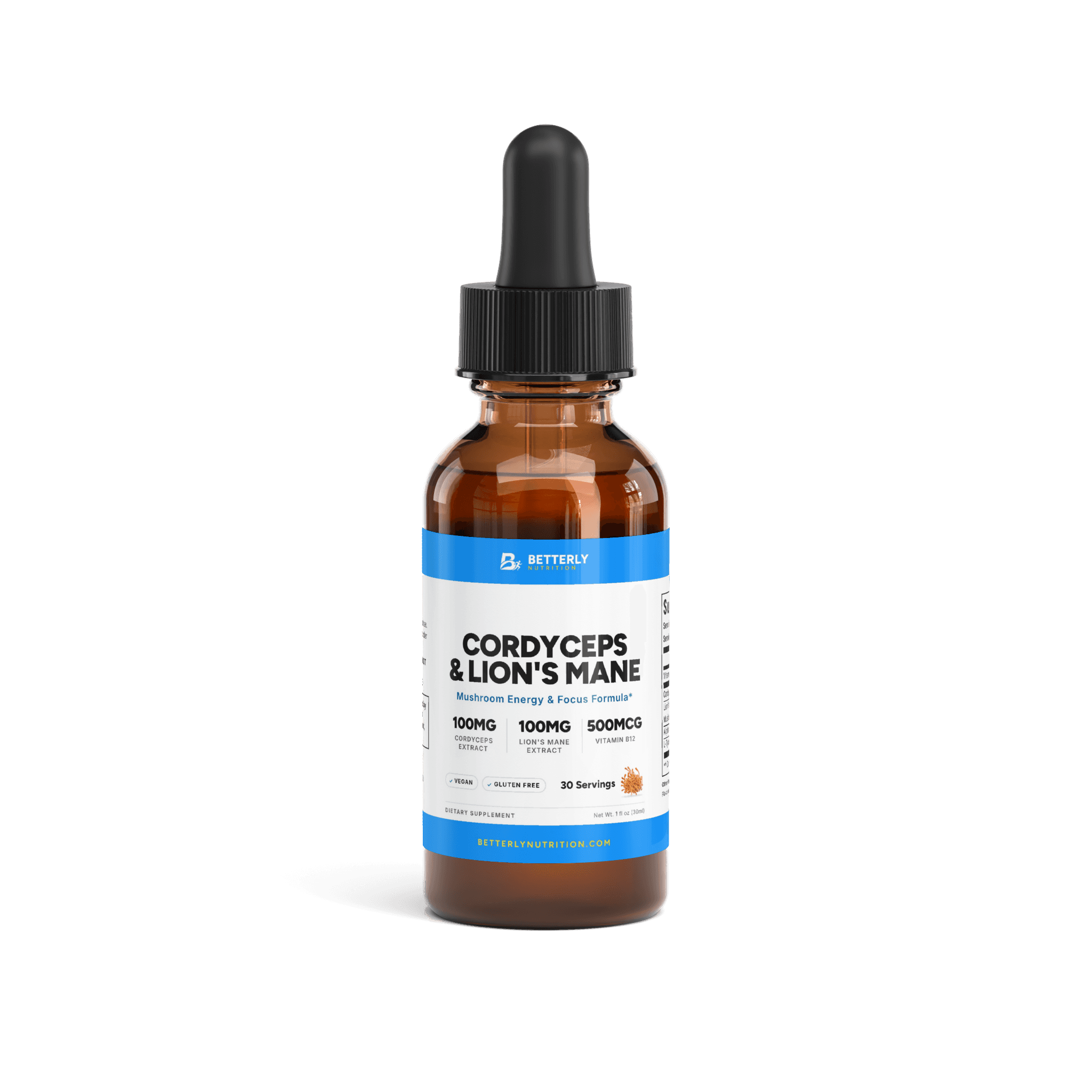
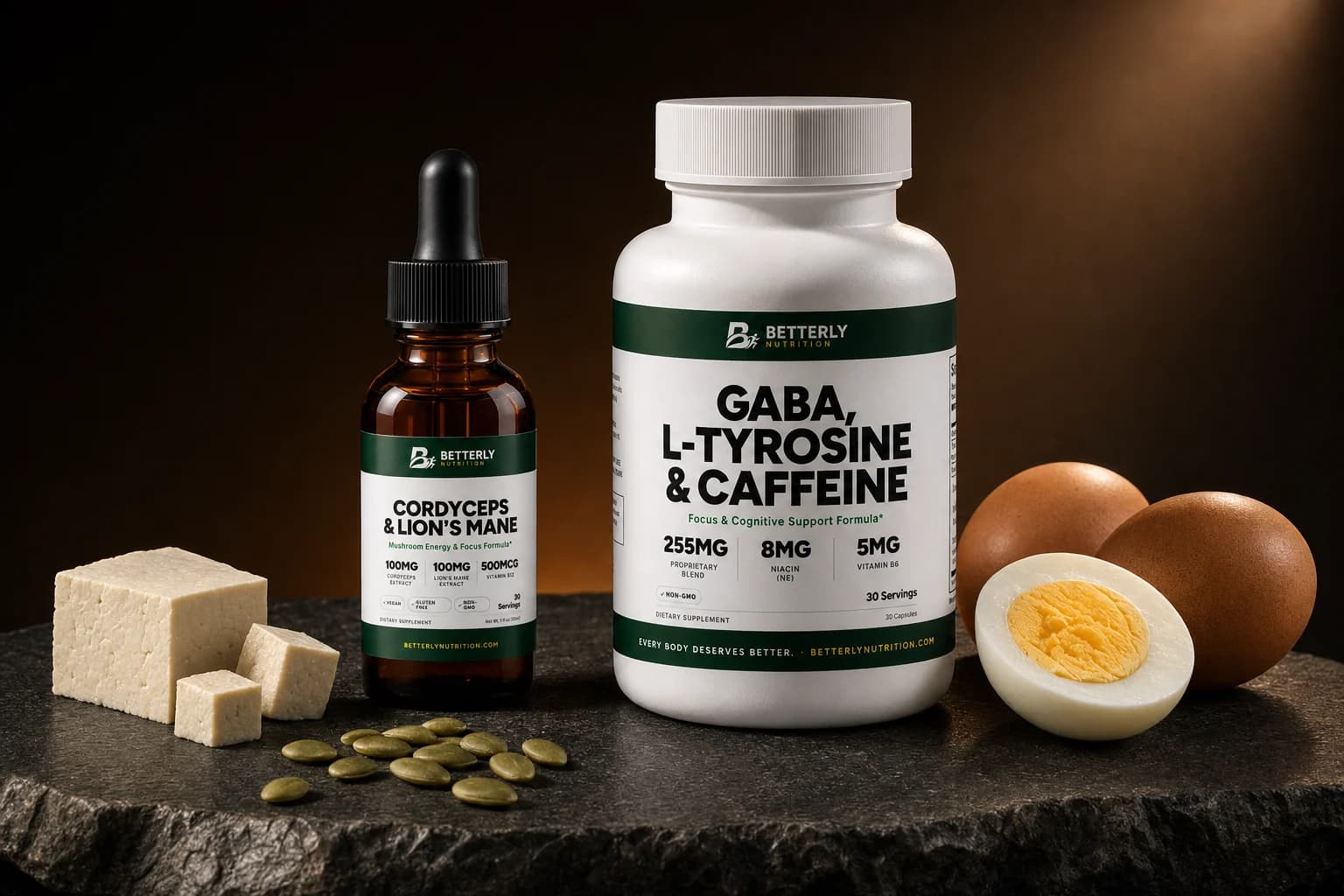
Only our Cordyceps & Lion's Mane Energy Drops print an L-tyrosine amount, 25 mg per 1 ml serving, while our three other tyrosine labels fold it into proprietary blends.
In a proprietary blend, several ingredients share one weight on the panel and must appear heaviest first, as our guide to proprietary blends explains. That order sets a ceiling. An ingredient in second place can't weigh more than half the blend, and one in third place can't pass a third.
| Product (serving) | Where L-tyrosine sits | Most it could be |
|---|---|---|
| Cordyceps & Lion's Mane Energy Drops (1 ml) | Its own row | 25 mg, printed |
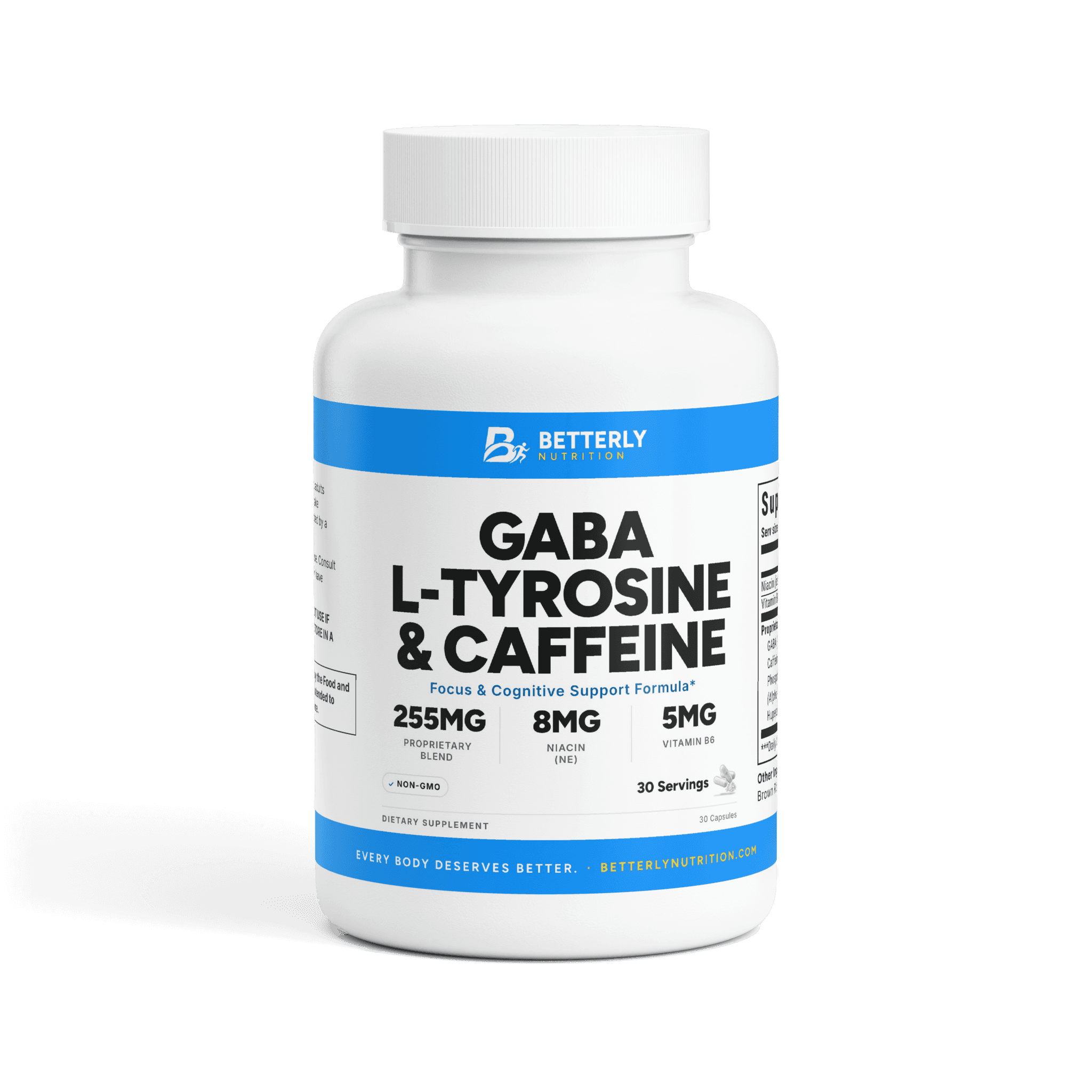
| GABA, L-Tyrosine & Caffeine Capsules (1 capsule) | 2nd of 8 in a 255 mg blend | 127.5 mg |
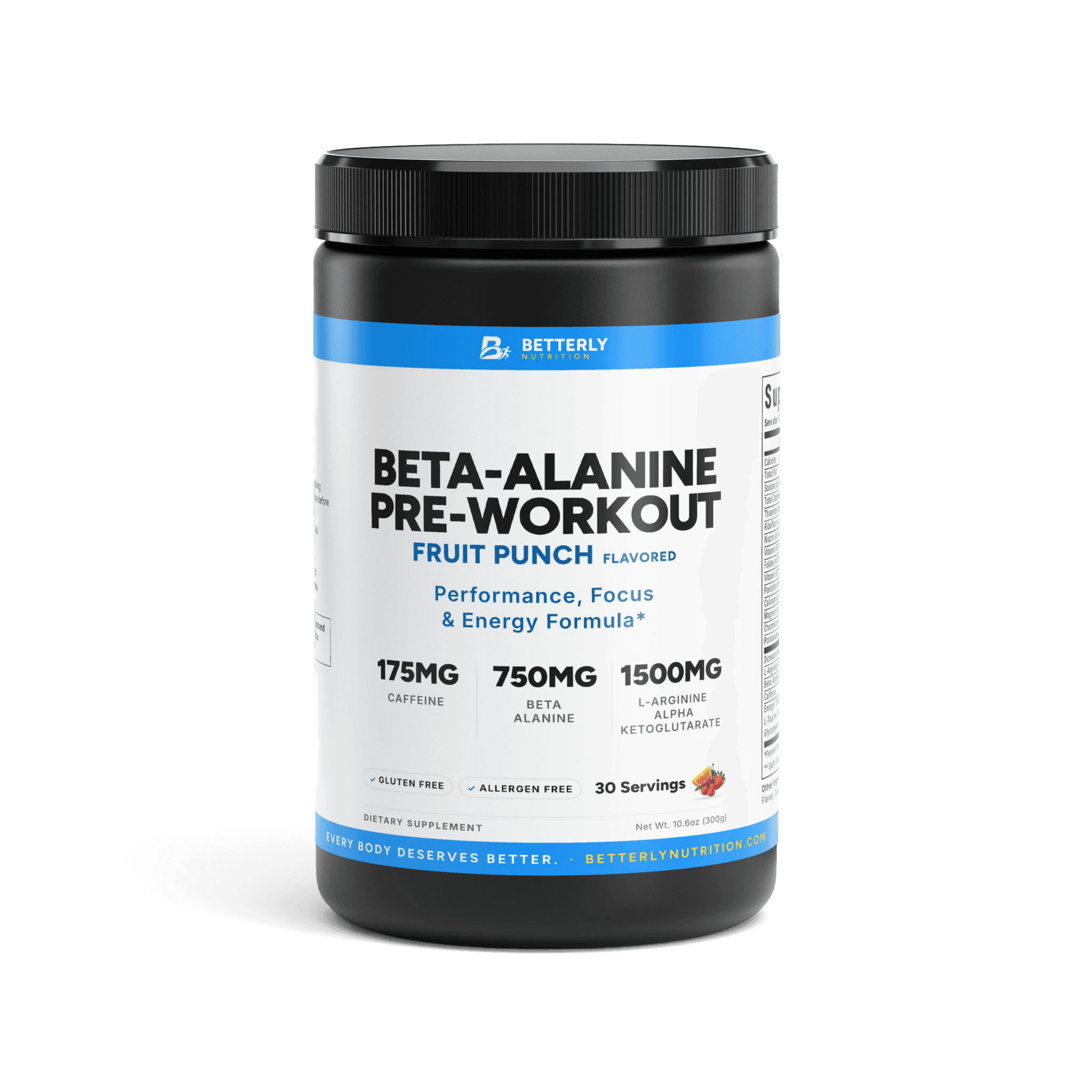
| Beta-Alanine & Caffeine Pre-Workout Powder (Fruit Punch) (1 scoop, 10 g) | 7th of 7 in a 550 mg matrix | 78.6 mg |
| MCT Oil & L-Carnitine Capsules (4 capsules) | 3rd of 15 in a 631 mg blend | 210.3 mg |
Read the last three figures as upper bounds, since the real amounts could sit well under them. Even the biggest, 210.3 mg, falls short of the tyrosine in half a roasted chicken breast.
From our shop: Cordyceps & Lion's Mane Energy Drops — the one tyrosine label on our shelf with its own milligram line: 25 mg per 1 ml (30-drop) serving, next to 100 mg apiece of cordyceps and lion's mane extracts.
How should you take an L-tyrosine product?
Take an L-tyrosine product within its label's directions, and keep our pre-workout at 1 scoop; none of our four labels gives tyrosine instructions of its own.
- Energy Drops. "Shake well. Take 1 ml (30 drops) daily." They're the only one of the four with a vegan claim, and no caffeine appears on the panel.
- GABA, L-Tyrosine & Caffeine Capsules. The label asks adults for one capsule daily, taken with 6-8 oz (177-237 ml) of water. The blend holds caffeine at an unprinted amount, so keep it early in your day. The shell is gelatin.
- Pre-Workout Powder. Its label opens with a tolerance test: 1 scoop (10 g, 175 mg caffeine) stirred into 6-8 oz of a cold drink, 30 minutes ahead of your session. It later allows 2 scoops a day, but those carry 40 mg of niacin, and the NIH Office of Dietary Supplements' niacin fact sheet puts the daily upper limit for adults at 35 mg from supplements. Stay at 1 scoop.
- MCT Oil & L-Carnitine Capsules. The label asks for 4 capsules daily with meals and suggests taking 2 with water before breakfast and the other 2 before dinner.
Stick to one tyrosine product, and never take the capsule and the pre-workout on the same day, since both bring caffeine. Our guide to what 50 mg of caffeine equals helps you tally a day's intake, and our guide to taking L-tyrosine with caffeine covers that pairing.
From our shop: GABA, L-Tyrosine & Caffeine Capsules — a once-a-day capsule where L-tyrosine ranks second of eight blend ingredients (255 mg total), with caffeine third and 5 mg of vitamin B6 on the panel.
What are the side effects of L-tyrosine?
L-tyrosine's side effects aren't described in any source we checked, so on our shelf, the ones worth watching come from the ingredients that share each label.
We found no government upper limit for tyrosine supplements either. A missing number is a gap in the record, not proof of safety. Here's what the panels themselves point to:
- Caffeine sits in two products. The capsule's amount isn't printed, and each pre-workout scoop lists 175 mg.
- Niacin shows up at 20 mg per pre-workout scoop. The same ODS sheet says supplements with 30 mg or more of nicotinic acid can turn skin red and make it burn, tingle and itch. One scoop stays under that mark.
- The MCT capsules' label says the formula contains fish and shellfish, and their shell is bovine gelatin.
Feel off after a serving? Stop the product, read its whole panel before blaming the amino acid, and tell your healthcare provider what you took.
Who doesn't need an L-tyrosine supplement?
Most people who eat protein foods regularly don't need an L-tyrosine supplement, because their meals and their own bodies already supply it.
You can probably skip it if:
- Eggs, dairy, meat, soy or seeds are regulars on your plate. One portion from the table above beats the 25 mg on our drops many times over.
- You're after a better ordinary workday. The research rests on cold, cold at altitude and a stressful attention test.
- You'd rather avoid stimulants. Two of our four tyrosine products contain caffeine.
- You want exact milligrams. Three of our four labels list tyrosine inside a blend with no amount.
Our Nootropics & Focus collection shows every focus product we carry, with or without tyrosine.
Who should check with a healthcare provider first?
Talk with a healthcare provider before any L-tyrosine product if you're pregnant, nursing, under 18 or managing a medical condition, as all four of our labels say.
These product-specific situations call for the same talk:
- Anyone taking thyroid or other prescription medication should ask first. The capsule's blend also names huperzine A (from Huperzia serrata) with no amount, so point a pharmacist to that line.
- You already take a multivitamin or B-complex. ODS notes niacin turns up in both, and it counts toward the same 35 mg adult limit as the pre-workout's 20 mg per scoop or the capsule's 8 mg NE (niacin equivalents).
- Fish or shellfish doesn't agree with you. The MCT capsules' label lists both, so ask before trying them.
FAQ: L-tyrosine
Is L-tyrosine a stimulant?
No, L-tyrosine is an amino acid, not a stimulant. It's in everyday foods like eggs and tofu, and your body makes it too. The wired feeling some people pin on it can trace back to caffeine sharing the label, as it does in our GABA, L-Tyrosine & Caffeine Capsules and our pre-workout. If a tyrosine formula leaves you jittery, check its panel for caffeine first.
Does L-tyrosine increase dopamine?
Not necessarily: your body uses L-tyrosine to make dopamine, but that doesn't mean a supplement raises it. Lieberman's chapter says dopamine-making nerve cells aren't normally thought to depend on tyrosine supply, except possibly when they fire hard under acute stress. None of our labels claims a dopamine effect, and neither do we.
Is L-tyrosine safe to take every day?
Our sources don't settle daily L-tyrosine safety. Lieberman's chapter says brain requirements for specific amino acids haven't been systematically investigated, so even the need is an open question. Our four labels differ too: three set a daily serving, the pre-workout ties its scoop to training, and three bury tyrosine in a blend. For use over months, the drops are the only label that lets you tell a provider your exact tyrosine intake.
Does L-tyrosine work right away?
There's no onset time for L-tyrosine that we can point to, since none of our labels states one and the research chapter we cite doesn't report one. Two of our four labels do set timing. The MCT Oil & L-Carnitine Capsules go with meals, 2 before breakfast and 2 before dinner, and the pre-workout goes 30 minutes before training. Neither is about tyrosine alone; each covers a whole multi-ingredient serving.
Sources
- PAH gene (MedlinePlus Genetics, National Library of Medicine)
- Amino Acid and Protein Requirements: Cognitive Performance, Stress, and Brain Function (Harris R. Lieberman; Institute of Medicine, 1999; NCBI Bookshelf)
- N-acetyl-L-tyrosine and N-acetyl-L-cysteine as tyrosine and cysteine precursors during intravenous infusion in humans (Metabolism, 1989; PubMed)
- Niacin: Fact Sheet for Consumers (NIH Office of Dietary Supplements)
- USDA FoodData Central, SR Legacy entries: egg, hard-boiled; chicken breast, roasted; tofu, raw, firm; whole milk; pumpkin seed kernels, dried
If this left you looking for somewhere to start, read L-tyrosine capsules with GABA and caffeine — its amounts per serving are listed on the page. For the practical questions this raises, how dosing, sourcing and subscriptions work is answered in one place.