On this page
- Key takeaways
- What are the most common maca root side effects?
- Is maca root safe to take daily?
- Does maca cause different side effects in women and men?
- Is maca root safe while pregnant or breastfeeding?
- Can maca interact with medicines or hormone-sensitive conditions?
- Could a maca supplement contain heavy metals or hidden ingredients?
- What does each maca label add to your day, and how do you take it?
- When should you stop taking maca, or not start?
- Which medicines and situations call for a provider check before maca?
- FAQ: maca root safety
- Sources
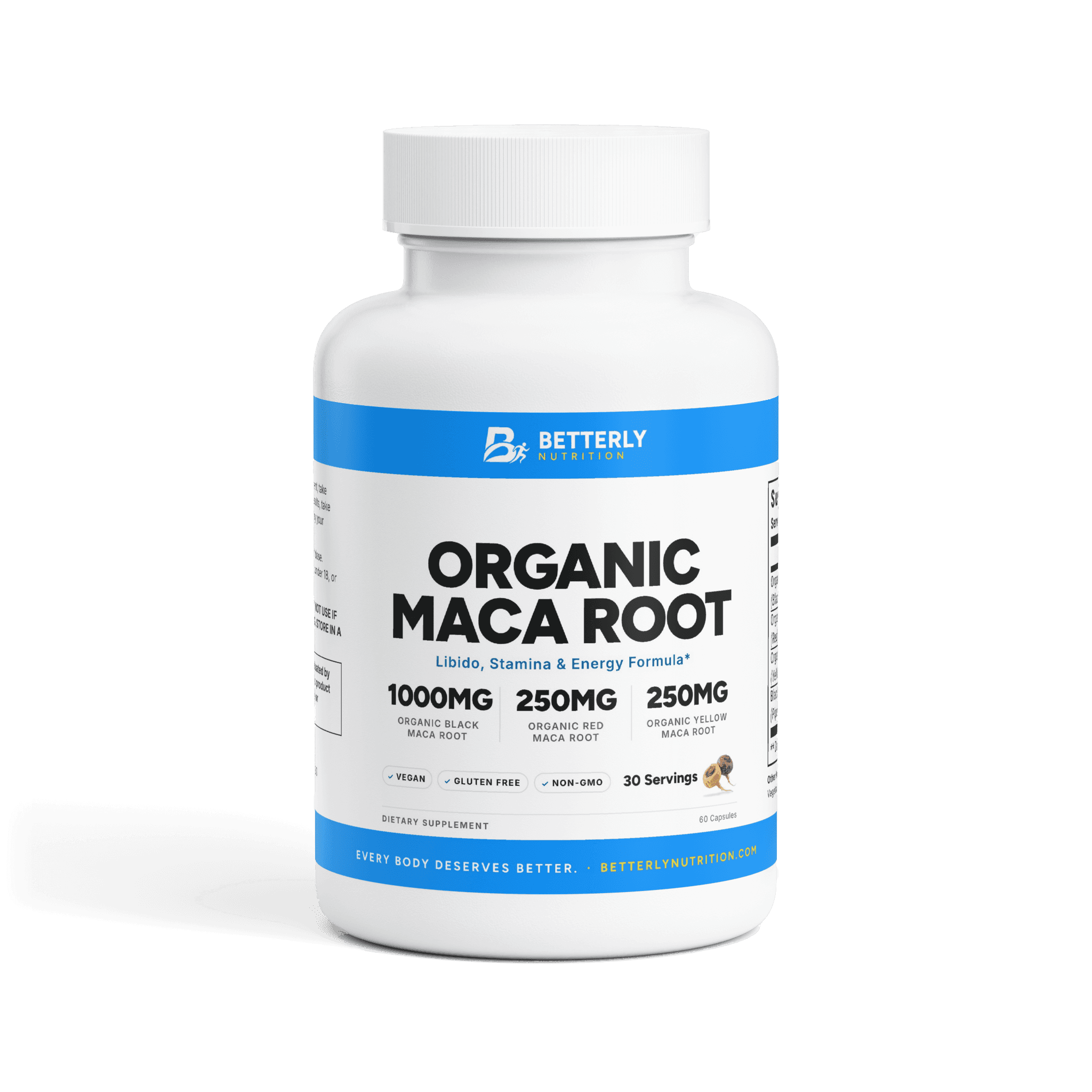
The short answer: Maca root side effects in the small human trials were mostly brief stomach complaints and headaches, and NIH's LiverTox database scores maca E, its grade for an unlikely cause of liver injury. The larger unknowns are pregnancy, breastfeeding, long-term daily use and interactions with medicines, where data are thin or missing. Our Organic Maca Root Capsules list 1,500 mg per 2-capsule serving. That's the bottom of the 1.5 to 3 g daily range that a 2026 review calls moderate.
Key takeaways
- LiverTox, an NIH database, describes maca's side effects as infrequent and minor, led by gut complaints and headaches.
- No safety source we checked has maca data for pregnancy or breastfeeding, so hold off on maca through both unless a provider approves it.
- A 2026 review in the journal Foods says maca's drug interactions haven't been systematically evaluated, and it flags hormone-modulating and brain-acting medicines for caution.
- Betterly's tri-color maca label lists 1,500 mg per 2-capsule serving and says, "Do not exceed recommended dose."
We sell maca, alone and in blends, so we'd love this answer to sound reassuring. We've stuck to the safety records instead, gaps included. For what maca might do rather than what it might cause, see what the small maca trials found for women and men.
What are the most common maca root side effects?
The most common maca root side effects are stomach or gut complaints and headaches, which NIH's LiverTox database describes as uncommon and mild.
LiverTox, an NIH database of liver reactions to medicines and supplements, also sums up maca's small human trials. In them, it says, maca extracts "have been reported to be safe, well tolerated and with only minor, transient adverse effects." Transient means short-lived. Several trials in its reference notes didn't report side effects at all, though.
A 2026 review in the journal Foods adds detail. At typical supplement amounts of 2 to 3 g a day over 12 weeks, it notes occasional stomach discomfort, headache and irritability. At higher intakes, around 5 g a day, it mentions mild digestive upset. Our 1,500 mg serving sits below the 2 g end of that range, but the pilot described below gave some people 1.5 g, so a smaller serving is no promise of a settled stomach.
| What's been reported | Where it's recorded | How it's described |
|---|---|---|
| Stomach or gut upset | LiverTox; 2026 review | Most frequent; mild |
| Headache | LiverTox; 2026 review | Occasional; mild |
| Irritability | 2026 review | Occasional, over 12 weeks |
| Liver injury | LiverTox | No convincing reports; one case after a maca liquor |
| Serious reactions | 2026 review | Rare, single-person reports |
That's a short list of mild, passing complaints, not proof that maca is harmless. The review warns that many maca studies are small, short and designed differently.
In one small pilot from LiverTox's notes, 16 people took 1.5 or 3 g of maca a day, and gut symptoms were the most frequent side effect, at 31%. Both groups got maca, with no placebo for comparison, and everyone was already on a prescription medicine that acts on the brain, so that rate can't be pinned on maca alone.
Is maca root safe to take daily?
Maca root has been eaten in Peru for centuries, but the supplement trials in our sources ran 6 to 12 weeks, so long-term daily safety is an open question.
The 2026 review calls maca (Lepidium meyenii), a mustard relative grown high in the Andes, generally safe in moderate amounts of 1.5 to 3 g a day, then admits that evidence-based, standardized dosing guidelines are lacking. LiverTox says recommended daily doses range from 500 to 3,000 mg, depending on the preparation.
Duration is the real gap. The review says robust data on prolonged or high-dose use remain limited, and LiverTox adds that as a supplement, maca "has had limited use."
Our 1,500 mg serving sits at the low end of that moderate range, which says the amount isn't high, not that years of daily use are proven fine. Planning on months of maca? Tell your provider.
Does maca cause different side effects in women and men?
The safety records we read don't split maca's side effects by sex, but small trials in women and in men found no change in hormone levels.
For women
LiverTox summarizes a 6-week trial of 29 postmenopausal women taking 3.3 g of maca a day, more than twice our serving. Their hormone levels didn't change.
The 2026 review also mentions rare single-person reports of more serious events, one of them vaginal bleeding. A single report proves very little. Still, if your cycle changes unexpectedly after you start maca, stop and call your provider.
For men
In a LiverTox-summarized trial, 56 healthy men took 1.5 or 3 g of maca daily for as long as 12 weeks with no change in sex or pituitary hormone levels. That trial didn't report side effects, so it speaks to hormones, not to how well the men tolerated maca.
Is maca root safe while pregnant or breastfeeding?
Maca root's safety during pregnancy or breastfeeding is unknown: none of our sources has maca-specific data for either. Don't start it unless a provider who knows your history approves.
We searched LactMed, the NIH database on medicines and supplements during breastfeeding, and it has no maca entry. LiverTox's maca page doesn't address pregnancy either.
In its fact sheet Dietary Supplements: What You Need to Know, the NIH Office of Dietary Supplements (ODS) sets a standard prenatal apart and urges caution with other supplements during pregnancy and nursing. Its reason is a testing gap: in pregnant and nursing women, many supplements haven't been well tested. Our maca label sends both groups to a physician first.
One lab finding adds weight to waiting: the review notes that high concentrations of a maca extract cut egg production in tiny lab worms. Worms aren't people, and rats showed no organ damage at doses far above human intake.
Can maca interact with medicines or hormone-sensitive conditions?
Maca might interact with some medicines, but the 2026 Foods review says its herb-drug interactions haven't been systematically studied.
Citing maca's hormone-related, brain-related and metabolic effects, the review says caution may be warranted with two kinds of medicine:
- Hormone-modulating therapies, meaning medicines that change hormone levels or how hormones act.
- Centrally acting medicines, meaning ones that act on the brain and nervous system.
That's also why a hormone-sensitive condition belongs on your ask-first list: the trials that found no hormone shifts ran only 6 to 12 weeks in small groups of volunteers.
LiverTox also lists glucosinolates among maca's compounds, and the review says these may affect thyroid function at excessive intakes. It doesn't define excessive, so if you take thyroid medicine, ask first.
Could a maca supplement contain heavy metals or hidden ingredients?
Heavy metals and adulteration are both real concerns for maca: the 2026 Foods review lists soil-related lead, cadmium and arsenic among the markers safety checks focus on.
The review ties those metals to accumulation from the soil the root grows in, a category-wide issue that includes ours. It also lists these kinds of economically motivated adulteration:
- Other powdered root crops passed off as maca
- Spiking with synthetic PDE5 inhibitors, a class of prescription drug compounds
- Synthetic macamides added to mimic the root's own compounds
- Maca grown outside Peru sold as Peruvian
What can you check? ODS names ConsumerLab.com, NSF International and U.S. Pharmacopeia among groups whose quality seal signals a properly made product that holds its listed ingredients without harmful contaminant levels. Even so, ODS says, a seal is no guarantee that a product is safe or that it works.
Our honest position: our maca bottle carries no seal, and we have no batch documents to post. Our quality page explains that contract manufacturers make our products and that we haven't independently audited our supplier. From any brand, a useful document names the lab, the lot number and the issue date.
What does each maca label add to your day, and how do you take it?
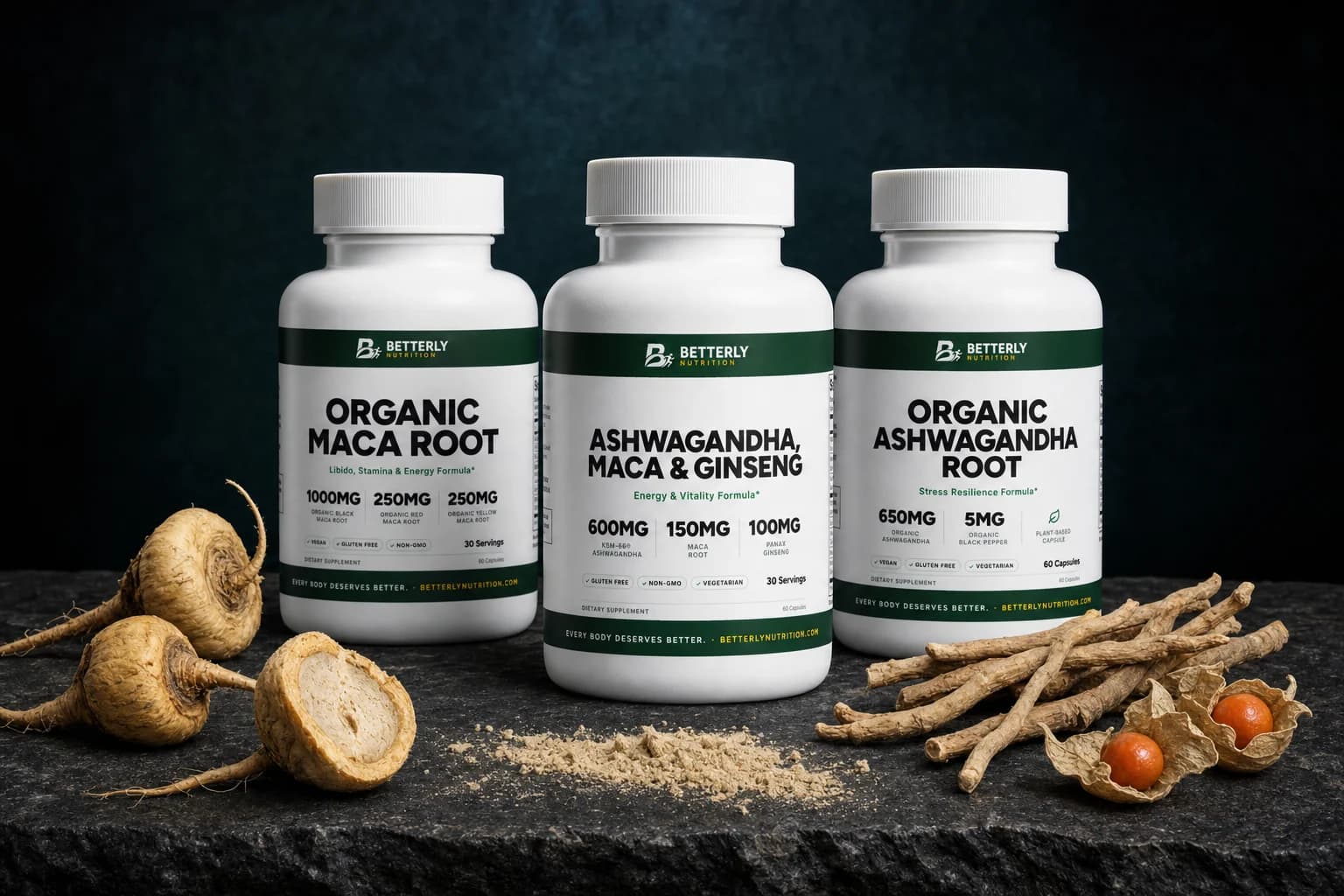
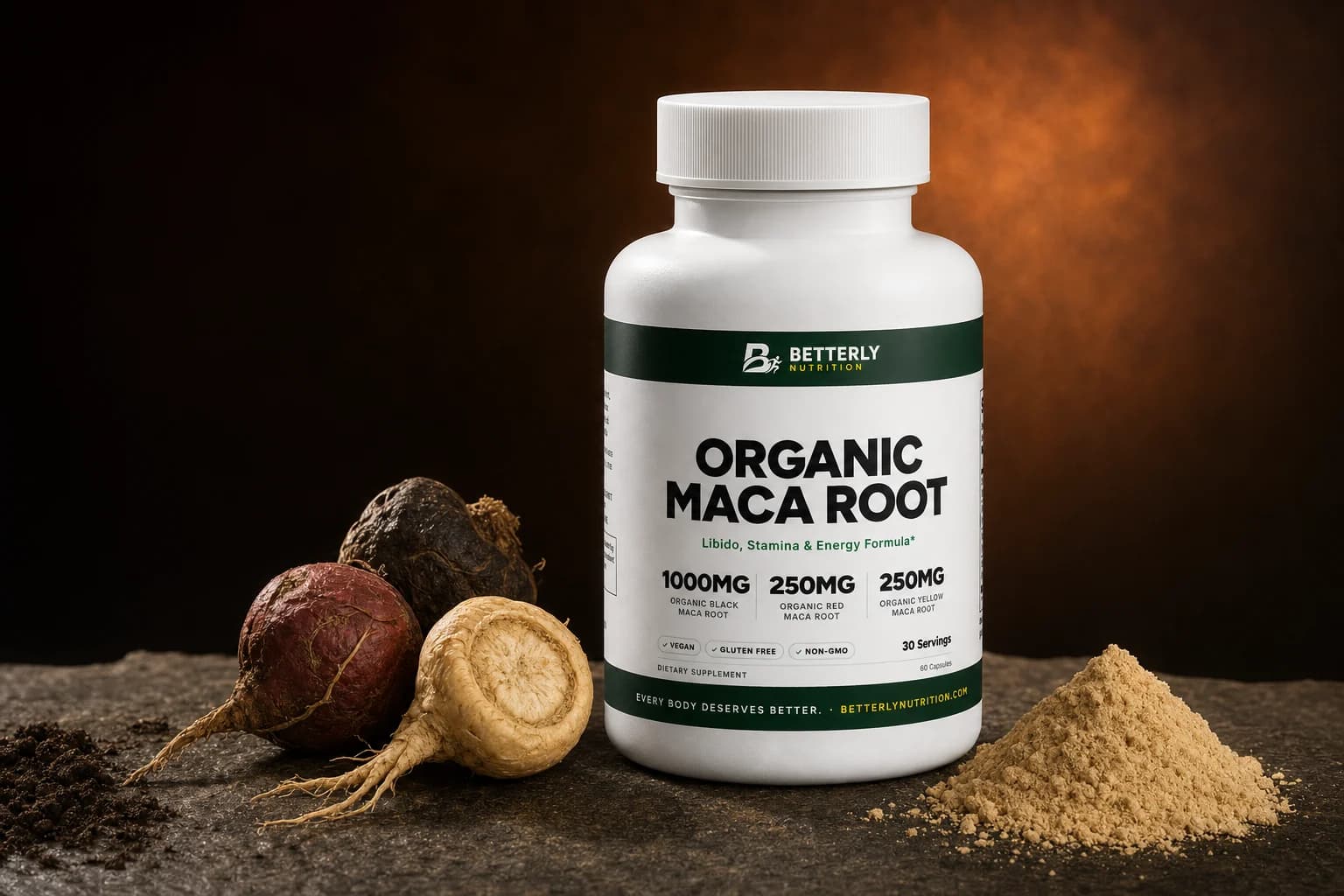
Betterly's Organic Maca Root Capsules carry 1,500 mg of maca per 2-capsule serving, far more than the blends below, which list 250 mg or less or give no amount.
| Product | Maca per serving | Maca a day with the tri-color serving | Safety line to read |
|---|---|---|---|
| Organic Maca Root Capsules | 1,500 mg per 2 capsules | 1,500 mg on its own | Only other active: 5 mg black pepper |
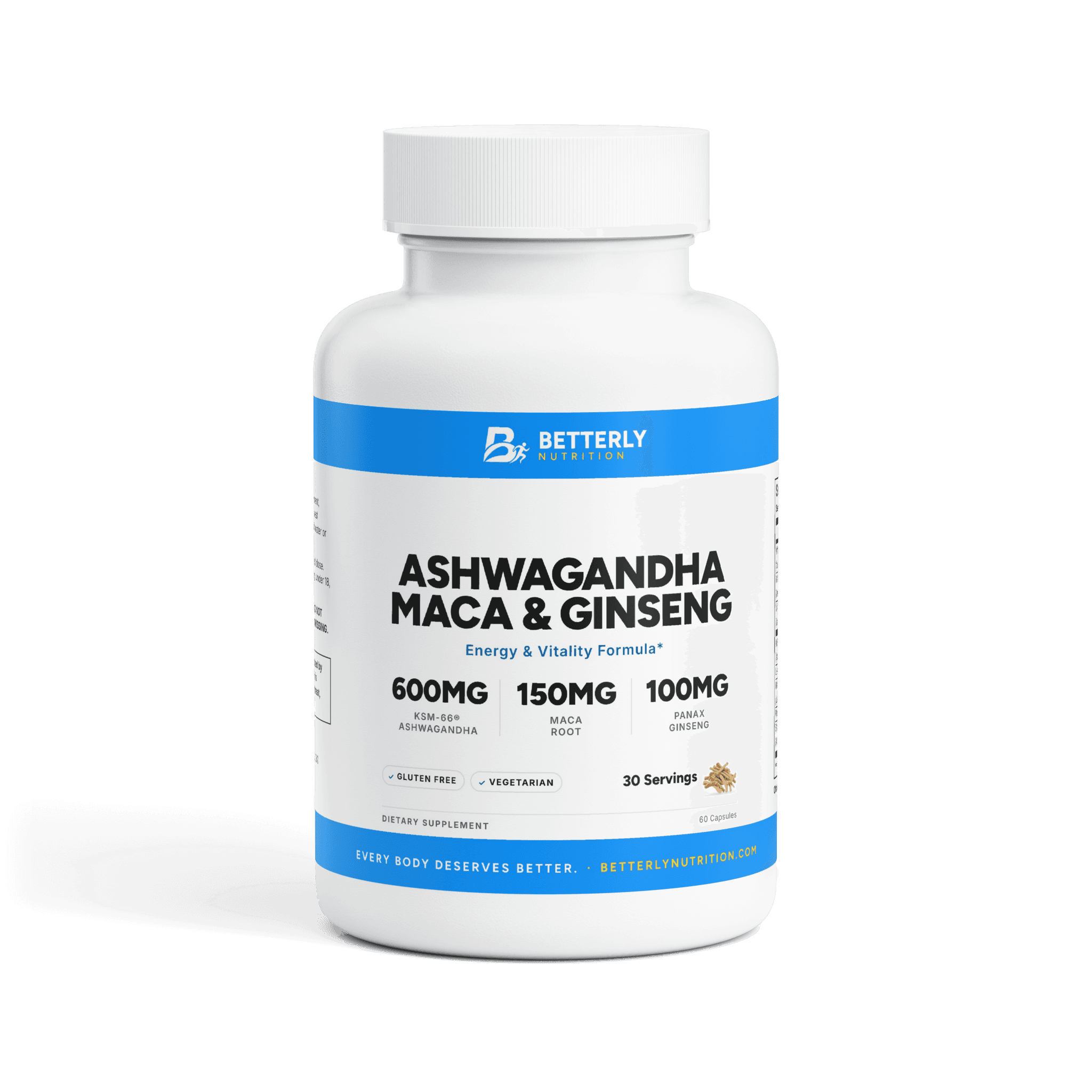
| Ashwagandha, Maca & Ginseng Capsules | 150 mg per 2 capsules | 1,650 mg | Also 600 mg KSM-66® ashwagandha |
| Tongkat Ali, Maca & Ginseng Capsules | 250 mg per 2 tablets (the panel says tablets) | 1,750 mg | 50 mg zinc; contains shellfish (oyster) |
| Horny Goat Weed & Maca Capsules | 62.5 mg per 2 capsules | 1,562.5 mg | 1,000 mg Epimedium extract; gelatin capsule |
| Tribulus & Ginseng Women's Libido Capsules | Not listed | Can't be totaled | 26 mg zinc; maca's share of the 802 mg blend isn't given |
Read the last column first: what rides along with the maca can matter more, and zinc shows why. Adults have a 40 mg daily upper limit in the ODS zinc fact sheet, and food and drinks count toward it along with pills. The tongkat ali blend lists 50 mg in its 2-tablet serving, so it passes that ceiling before breakfast adds any. We can't recommend that blend as labeled unless your provider has checked your total zinc and okayed it.
The third column totals your maca if you stack, and none of our sources studied those pairings. Choose one.
From our shop: Organic Maca Root Capsules — three maca colors adding up to 1,500 mg per 2-capsule serving, packed in hypromellose (vegetable) capsules and labeled vegan.
The tri-color label's suggested use, word for word: "As a dietary supplement, take two (2) capsules once a day. For best results, take 20-30 min before a meal or as directed by your healthcare professional."
- The label offers no smaller serving for a sensitive stomach, so ask your provider before changing how you take it.
- The caution, in full: "Do not exceed recommended dose. Consult a physician if pregnant, nursing, under 18, or have a medical condition."
Our guide on when to take maca root covers which meal to pair it with.
When should you stop taking maca, or not start?
Stop maca if a side effect lingers or keeps coming back, and hold off while a blend already supplies maca or a provider check is still pending.
- A gut or head complaint won't settle. The records describe mild, passing effects, so a lingering or recurring one means stop and tell your provider.
- A blend already puts maca in your day. Adding the tri-color bottle means 1,562.5 to 1,750 mg a day, plus the blend's other actives.
- You're on the next section's list and haven't asked yet. That covers the label's caution groups and hormone-modulating or brain-acting prescriptions.
If maca doesn't sit well with you, our adaptogens shelf has maca-free roots too. Ashwagandha is one, but first read the people who should skip ashwagandha.
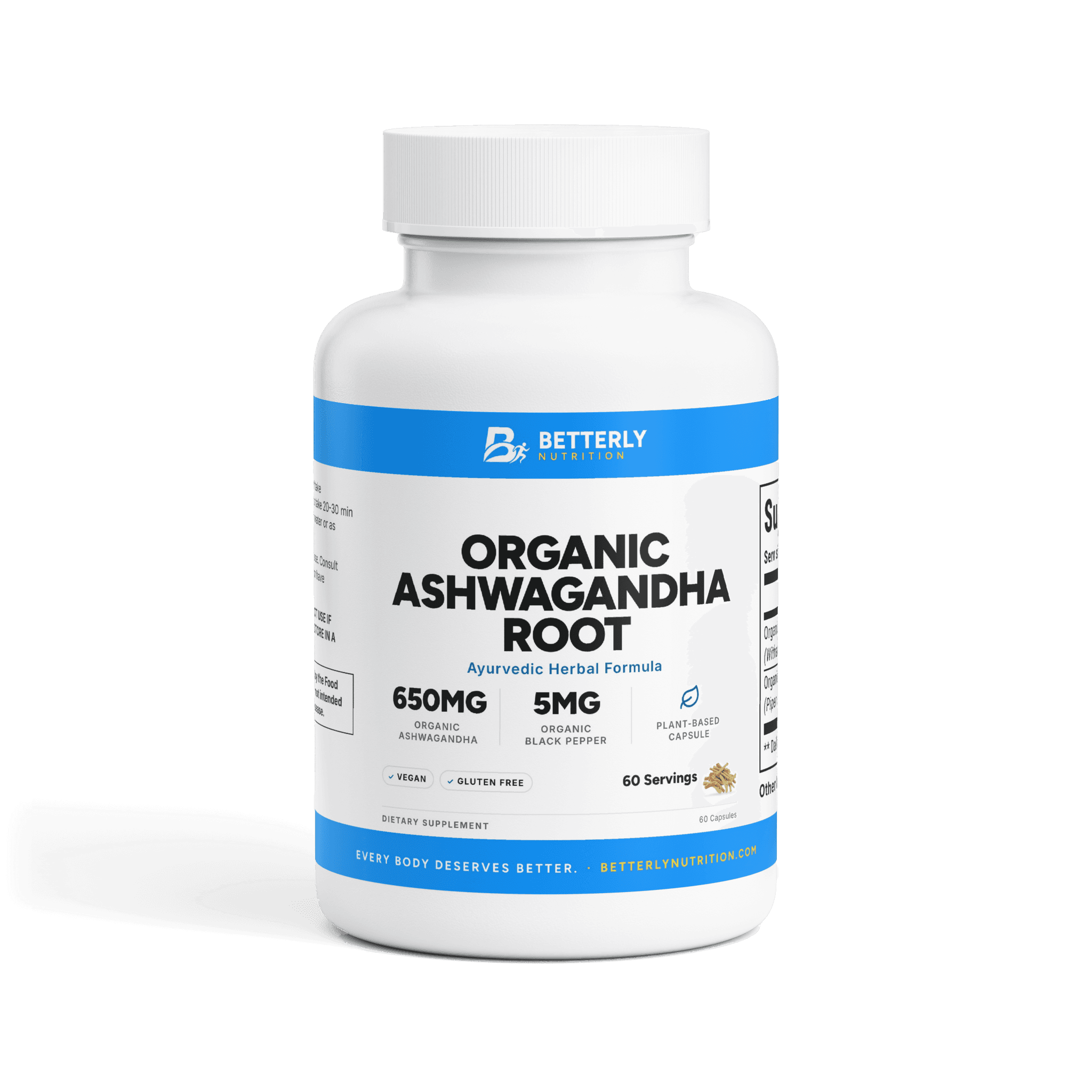
From our shop: Organic Ashwagandha Root Capsules — a maca-free adaptogen, with organic ashwagandha root at 650 mg per 1-capsule serving and a label that says one capsule twice a day.
Which medicines and situations call for a provider check before maca?
Hormone-modulating or brain-acting prescriptions, thyroid medicine, upcoming surgery and the four groups on our maca label all call for a provider check first.
- The label's four groups: pregnant, nursing, under 18, or managing a medical condition.
- Any prescription, above all a hormone-modulating or brain-acting one. ODS says your provider should approve any supplement you plan to take alongside prescribed medicines.
- Thyroid medicine or a hormone-sensitive condition, for the reasons covered above.
- A procedure on the calendar. ODS says some supplements can change how you react to anesthesia if taken before an operation, so list maca for your surgical team.
- Allergic to shellfish, if the tongkat ali blend is on your list. Its label says, "Contains: Shellfish (Oyster)."
- A crowded supplement routine. ODS puts a shelf full of different supplements in the same side-effect risk bracket as high doses.
Bring the bottle to that appointment. If maca does disagree with you, ODS notes the FDA takes reaction reports at 800-FDA-1088, from you or your provider.
FAQ: maca root safety
Can maca root cause diarrhea, bloating or headaches?
Maca root can cause gut upset and headaches in some people, which NIH's LiverTox database describes as infrequent and mild. Neither LiverTox nor the 2026 Foods review says whether that means loose stools, bloating or cramps. The review notes occasional stomach discomfort at 2 to 3 g a day and mild digestive upset around 5 g a day, and no source shows that a 1,500 mg serving is free of gut effects. If any of these start after you begin maca, stop and check with your provider.
How long do maca side effects last?
Maca side effects are usually short-lived, but none of our sources gives a timeline in days. LiverTox and the 2026 review both call the effects seen at typical doses transient, meaning they pass. If one lingers after you stop maca, or feels more than mild, call your healthcare provider.
Does maca affect the liver?
Maca hasn't been convincingly linked to liver injury, and NIH's LiverTox database rates it an unlikely cause. Its notes include one liver injury report in a man who drank 300 mL of a maca medicinal liquor; it cleared over 1 to 3 months. That was a liquor, not a capsule or powder.
Is maca root safe for your kidneys?
No federal source we checked covers maca and kidney function, so nobody can honestly promise it's safe or unsafe for your kidneys. LiverTox covers the liver only, and the 2026 Foods review doesn't discuss kidneys. If your provider monitors your kidney function, our label's "medical condition" caution applies, so ask first.
Is maca root safe for kids?
No one has shown maca supplements to be safe for children. None of our sources covers kids, and our label's caution lists under-18s among those who should consult a physician. ODS gives a general rule too: be careful giving a child any supplement their own provider hasn't recommended, because many haven't been well tested in kids. So a child's provider should weigh in before maca does.
Sources
- NIH LiverTox: Maca, NCBI Bookshelf, last updated April 10, 2019
- Wasilewicz A, Grienke U. Maca (Lepidium meyenii) as a Functional Food and Dietary Supplement: A Review on Analytical Studies, Foods, 2026 (PubMed Central)
- NIH Office of Dietary Supplements: Dietary Supplements: What You Need to Know, Fact Sheet for Consumers
- NIH Office of Dietary Supplements: Zinc: Fact Sheet for Consumers
If this left you looking for somewhere to start, read vegan maca root capsules, 1,500 mg per serving — its amounts per serving are listed on the page. For the practical questions this raises, how dosing, sourcing and subscriptions work is answered in one place.