On this page
- Key takeaways
- What is royal jelly, and what's actually in it?
- Why do people expect royal jelly benefits for humans?
- Is royal jelly good for you, based on the research so far?
- What did a six-month royal jelly trial in healthy adults find?
- Are royal jelly powder (lyophilized) benefits different from fresh?
- Does royal jelly give you energy?
- How much royal jelly is in our sachet, and what are its directions?
- When is a royal jelly supplement not worth it?
- Who should check with a healthcare provider before trying our sachet?
- FAQ: royal jelly benefits
- Sources
The short answer: Royal jelly benefits for people remain largely unproven. Young worker bees secrete this milky food from glands in their heads, and larvae chosen to become queens get it in large amounts. NIH's LiverTox database says the claims made for it haven't been substantiated, and a 2024 review notes most of its effects were studied in animals and cell cultures. Our sachet lists 500 mg of freeze-dried (lyophilized) royal jelly per 1-sachet (4 g) serving.
Key takeaways
- In honey bees, a royal jelly diet helps turn a larva into a queen, and that bee-world effect is where the supplement's reputation starts.
- Royal jelly's popular health claims lack proof in people, according to NIH's LiverTox database, and a 2024 review says most of its effects were studied in animals and cell cultures.
- In a six-month trial of 61 healthy adults, royal jelly shifted a handful of lab values and one survey score, while most measures, including vitality, weren't significantly different from placebo.
- Freeze-drying removes most of royal jelly's water, so a milligram of lyophilized powder carries more of the jelly's protein than a milligram of fresh jelly.
Full disclosure: royal jelly is one of three hive ingredients in Bee Bread, Royal Jelly & Propolis Powder, a sachet we sell. That gives us a reason to talk it up, so we've kept every product number to what its Supplement Facts panel prints and linked each research point to where we read it.
What is royal jelly, and what's actually in it?
Royal jelly is a milky secretion from two sets of glands in young worker honey bees, used to feed every larva in the hive for a short time.
NIH's LiverTox record for royal jelly spells out the split. Larvae that will become workers or drones get it for 3 days only. Larvae picked to become queens get large amounts until they're fully developed.
Beekeepers collect it by copying that choice. The method appears in a 2024 review in the International Journal of Molecular Sciences, Royal Jelly: Biological Action and Health Benefits. Larvae less than a day old go into artificial wax queen cells. Worker bees fill those cells, and the royal jelly is collected about 3 days later.
LiverTox lists its makeup as water, proteins, amino acids, fatty acids, simple sugars, vitamins and minerals. The review singles out a fatty acid called 10-HDA, which it calls the best marker of royal jelly quality.
You'll also read that royal jelly is loaded with B vitamins. The review's table does list about 42 mg of niacin (vitamin B3) per 100 g. Our sachet's 500 mg is 1/200 of 100 g, so by our math its royal jelly carries roughly 0.2 to 0.7 mg of niacin, depending on whether the table's figure is for fresh or dried jelly. The NIH Office of Dietary Supplements (ODS) niacin fact sheet lists 14 mg of niacin equivalents a day for adult women and 16 mg for adult men, with more during pregnancy and breastfeeding. Our panel lists no B vitamins at all.
Why do people expect royal jelly benefits for humans?
People expect royal jelly benefits because of the queen bee, who eats large amounts as a larva and grows bigger and far longer-lived than the workers around her.
The biology in bees is real. LiverTox says the key players are believed to be a family of major royal jelly proteins, which change how a larva's genes are switched on. The 2024 review points to one of them, nicknamed royalactin, as a protein that pushes larvae toward becoming queens. It also reports that royal jelly lengthened lifespan in studies of bees, tiny worms, crickets and mice.
Here's the catch. A larva lives on royal jelly during its key days of growth. A result in a larva or a mouse isn't evidence it carries over to an adult stirring half a gram into a smoothie.
That same queen story powers the boldest royal jelly marketing: fertility, hormone balance, turning back the clock, even helping kids grow taller. We won't repeat those claims here, and the next two sections show how little has been tested in people.
Is royal jelly good for you, based on the research so far?
Royal jelly hasn't been shown to deliver a clear benefit for healthy people. It's generally well tolerated, and most of the research behind its reputation used cells and animals.
LiverTox notes that royal jelly goes into supplements "purported to be beneficial for general health and well being." In the same passage, it says the grounds for those claims haven't been established. It also mentions lab and animal work suggesting some components have antioxidant properties. That's a finding about chemistry and animals, not about how you'll feel.
The 2024 review is broadly upbeat, yet its authors admit there isn't enough data on how well royal jelly works for people.
Human trials do exist, but they're a patchwork. The ones in LiverTox's reference list mostly enrolled people with a particular health concern or women at a particular life stage. Daily amounts ranged from 150 mg to 3,000 mg, and one study gave a single 20 g dose.
What did a six-month royal jelly trial in healthy adults find?
A six-month Japanese trial in 61 healthy adults found that royal jelly nudged a few lab values and one survey score, while most measures weren't significantly different from placebo.
The study, by Morita and colleagues, appeared in Nutrition Journal in 2012 as Effect of royal jelly ingestion for six months on healthy volunteers. Volunteers aged 42 to 83 drank 100 ml a day of a liquid holding 3,000 mg of royal jelly, or a look-alike placebo. Neither they nor the researchers knew who got which. API Co., Ltd., the company that prepared both drinks, also helped fund the trial.
| What they measured | Royal jelly vs placebo | What it means |
|---|---|---|
| Red blood cell count | +0.16 vs −0.01 million per µL | A rise the authors called modest |
| Hematocrit (red cells' share of blood) | +0.9% vs −0.8% | Moves with the count above |
| Mental health score on a quality-of-life survey | +4 vs −7 points | Royal jelly group started lower |
| Vitality score on the same survey | +7 vs −1 points | Not a significant difference |
| BMI, waist, blood fats, liver, kidney and bone tests | No significant difference | Most measures didn't budge |
Read across the rows and the pattern is thin: two blood counts that move together, plus the mental health scale, separated from placebo. The royal jelly group started lower on that scale. The authors adjusted for starting scores, but it's still one scale out of the survey's eight.
The paper also reports small shifts in a few metabolic and hormone lab values. We don't turn those into claims. The authors themselves called their sample small and wrote that they don't know the most effective amount of royal jelly for a person.
Three people on royal jelly and 5 on placebo quit early, citing a full stomach, loose stools or the taste. The paper also doesn't say whether its 3,000 mg meant fresh or freeze-dried royal jelly, so there's no fair way to compare it with the 500 mg in our sachet.
Are royal jelly powder (lyophilized) benefits different from fresh?
Royal jelly powder, sold as lyophilized royal jelly, is fresh jelly with the water freeze-dried out, and no source we read shows its benefits differ from fresh.
What changes is how much jelly each milligram represents. The 2024 review's composition table shows the shift. Fresh royal jelly is 60% to 70% water, while the lyophilized form is under 5%. Protein climbs from 9% to 18% of fresh jelly to 27% to 41% of the powder.
The review's authors say the difference between fresh and lyophilized royal jelly needs to be clearly stated, so look for that word on any royal jelly powder. Our panel has it: the row reads "Lyophilized royal jelly," at 500 mg per sachet.
That same table hides a useful shopping tip. It lists 10-HDA at more than 1.4% of fresh royal jelly but more than 3.5% of the lyophilized form. So if a powder's label prints a 10-HDA percentage, hold it to the powder figure, not the fresh one. Our panel prints neither.
Jars versus powders, and how to use each, belong to our guide on how to take royal jelly.
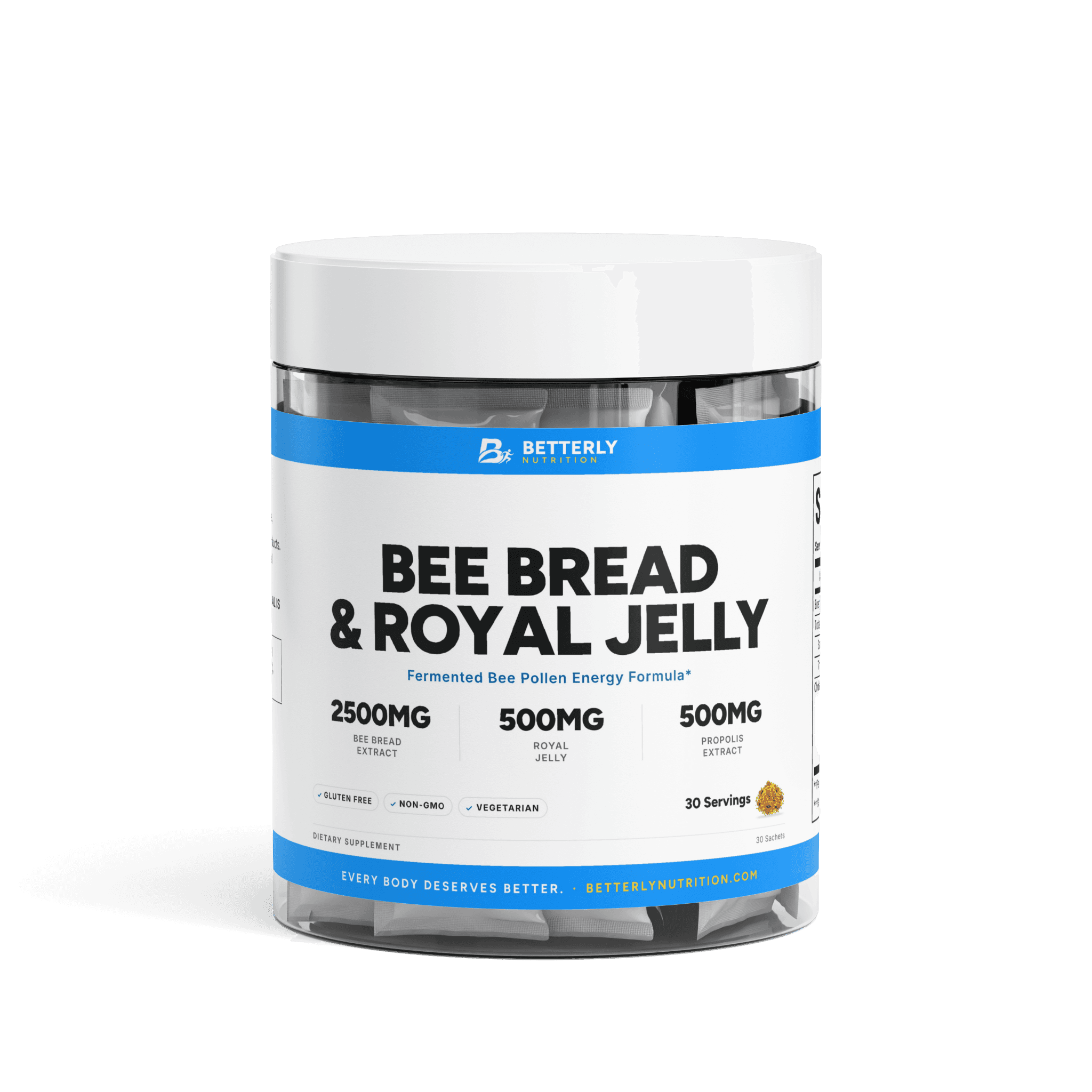
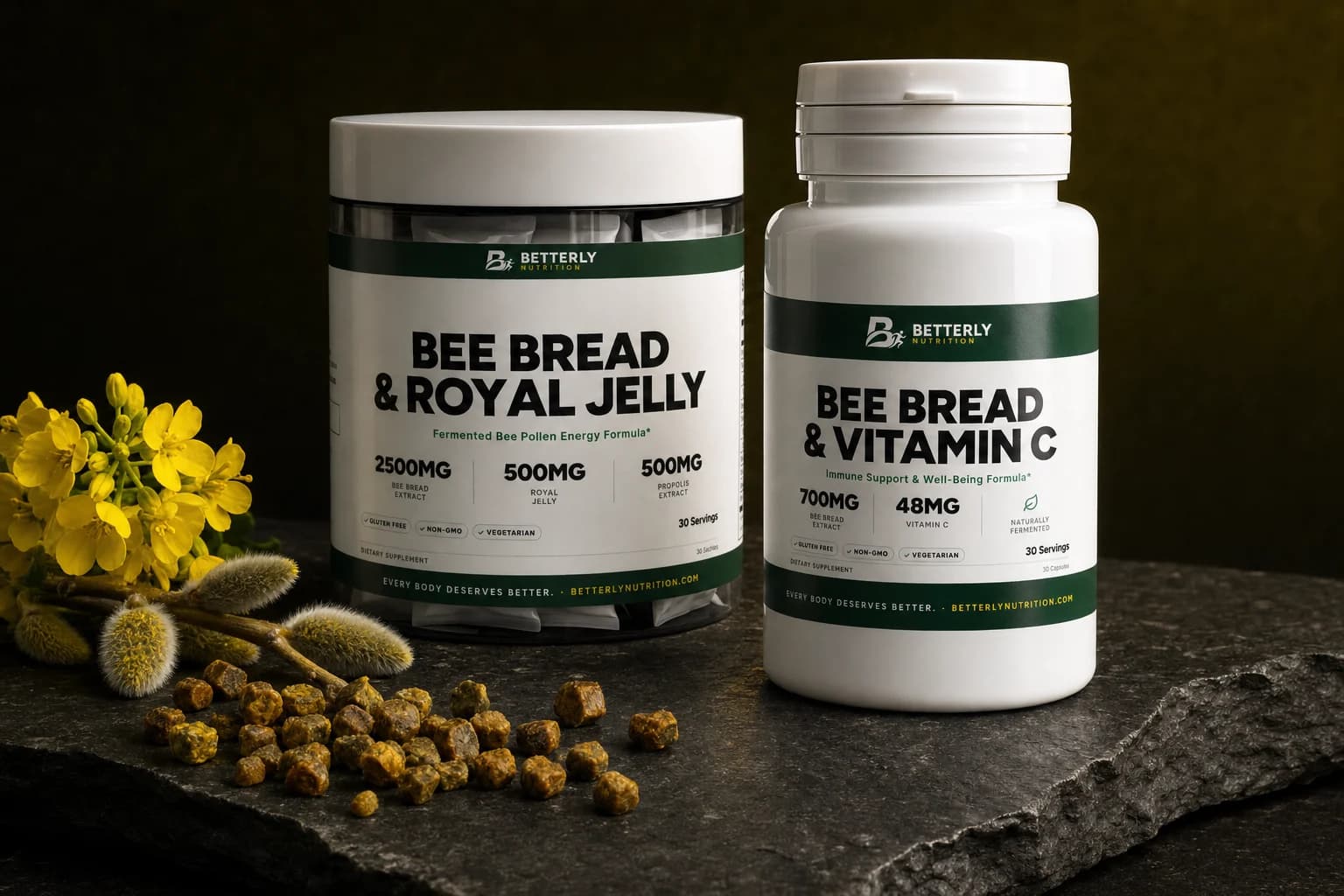
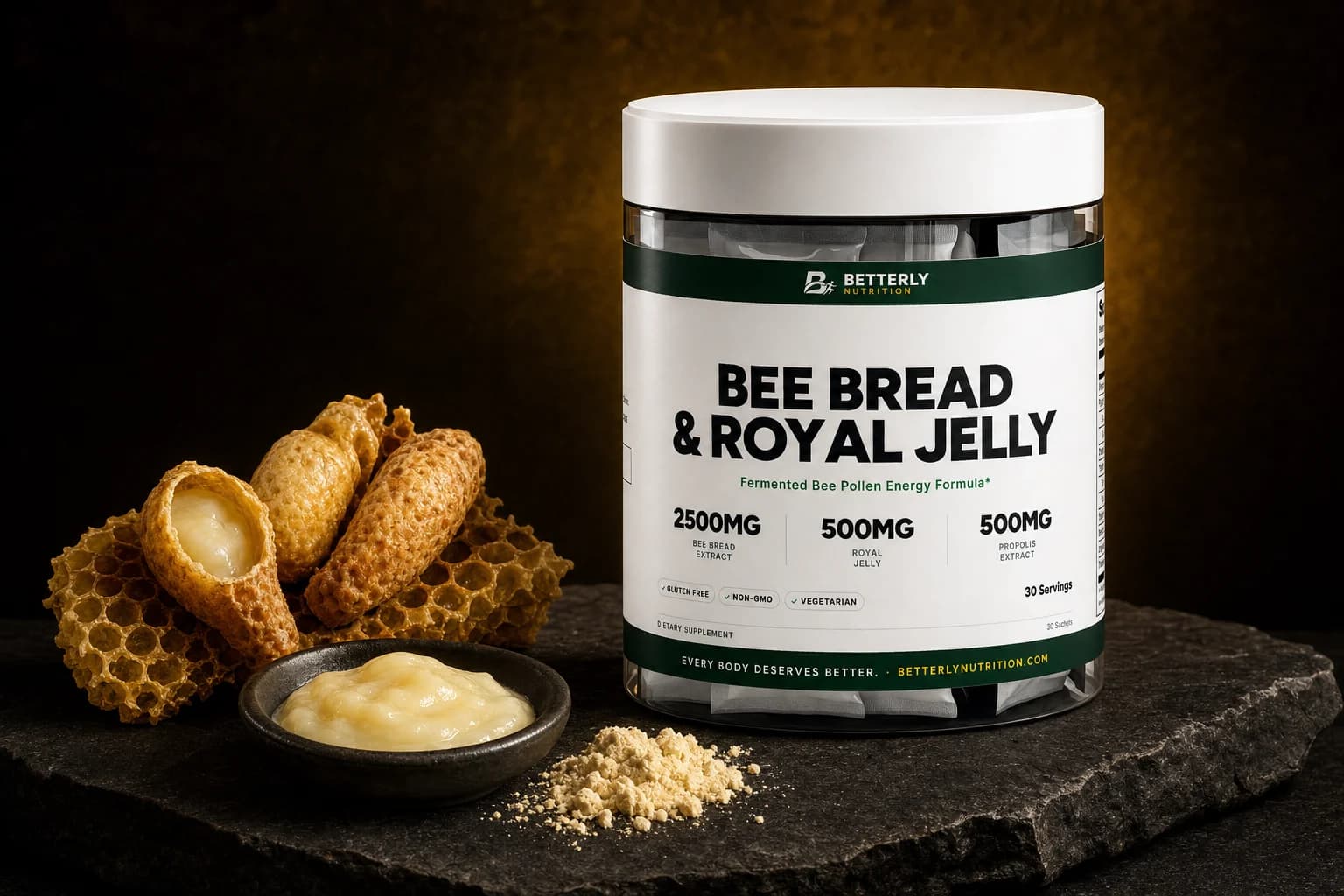
From our shop: Bee Bread, Royal Jelly & Propolis Powder — royal jelly is the 500 mg lyophilized row in each 1-sachet (4 g) serving, beside propolis extract powder (500 mg) and bee bread extract (2,500 mg), stirred into one drink a day.
Does royal jelly give you energy?
In a six-month trial, royal jelly didn't change vitality scores significantly compared with placebo, so we can't promise it will make you feel more energetic.
Energy claims for royal jelly often lean on its B vitamins. The ODS niacin sheet does say niacin "helps turn the food you eat into the energy you need." By the math above, though, a sachet's royal jelly supplies less than a milligram of it.
On our panel, the only row named "Energy" is the calorie count: 8 kcal per 1-sachet (4 g) serving. There's no caffeine row. The tub's tagline, "Fermented Bee Pollen Energy Formula," carries an asterisk that points to the FDA disclaimer, and no study we cite tested our sachet itself. Please don't buy it expecting a lift the research hasn't shown.
How much royal jelly is in our sachet, and what are its directions?
Our Bee Bread, Royal Jelly & Propolis Powder lists 500 mg of lyophilized royal jelly per 1-sachet (4 g) serving, taken as 1 sachet a day in a drink.
Royal jelly makes up one-eighth of the sachet by weight. Most of the weight is bee bread, listed as Bee Bread Extract (Naturally Fermented Pollen) at 2,500 mg. Propolis extract powder adds 500 mg, and vitamin C adds 12 mg, 13% of the Daily Value. Each tub holds 30 sachets.
The label's exact direction is "Mix 1 sachet daily into a smoothie or beverage." No time of day appears on the label, and the caution warns, "Do not exceed recommended dose."
The other two ingredients have their own evidence stories, in our look at bee bread research and how royal jelly compares with propolis.
When is a royal jelly supplement not worth it?
A royal jelly supplement isn't worth it for a vitality lift or B vitamins, when a label hides the royal jelly amount, or if hive products have bothered you.
Here's where the evidence above points:
- You're after more vitality. On that survey scale, the six-month trial found no significant gap between royal jelly and placebo.
- You hope to copy the trial. Its volunteers took 3,000 mg a day in a form the paper doesn't name, while our label's one sachet holds 500 mg. Adding sachets to close that gap would ignore the label's "Do not exceed recommended dose."
- You want B vitamins. By our math, a sachet's royal jelly supplies under 1 mg of niacin, and ODS says most people in the US get enough niacin from food.
- The label hides the amount. The studies in this guide measured royal jelly in milligrams, from 150 mg to 3,000 mg a day, so a royal jelly row with no number of its own leaves you nothing to compare. That's the case in our Alfalfa & Chlorella Greens Powder, where it sits inside a blend. On our greens and superfoods shelf or anywhere else, look for royal jelly with its own milligram figure.
- You've reacted to a sting, honey or pollen before. Our guide to royal jelly side effects lists the warning signs.
If this list rules out royal jelly but not bee products, our capsule's panel has no royal jelly row to weigh.
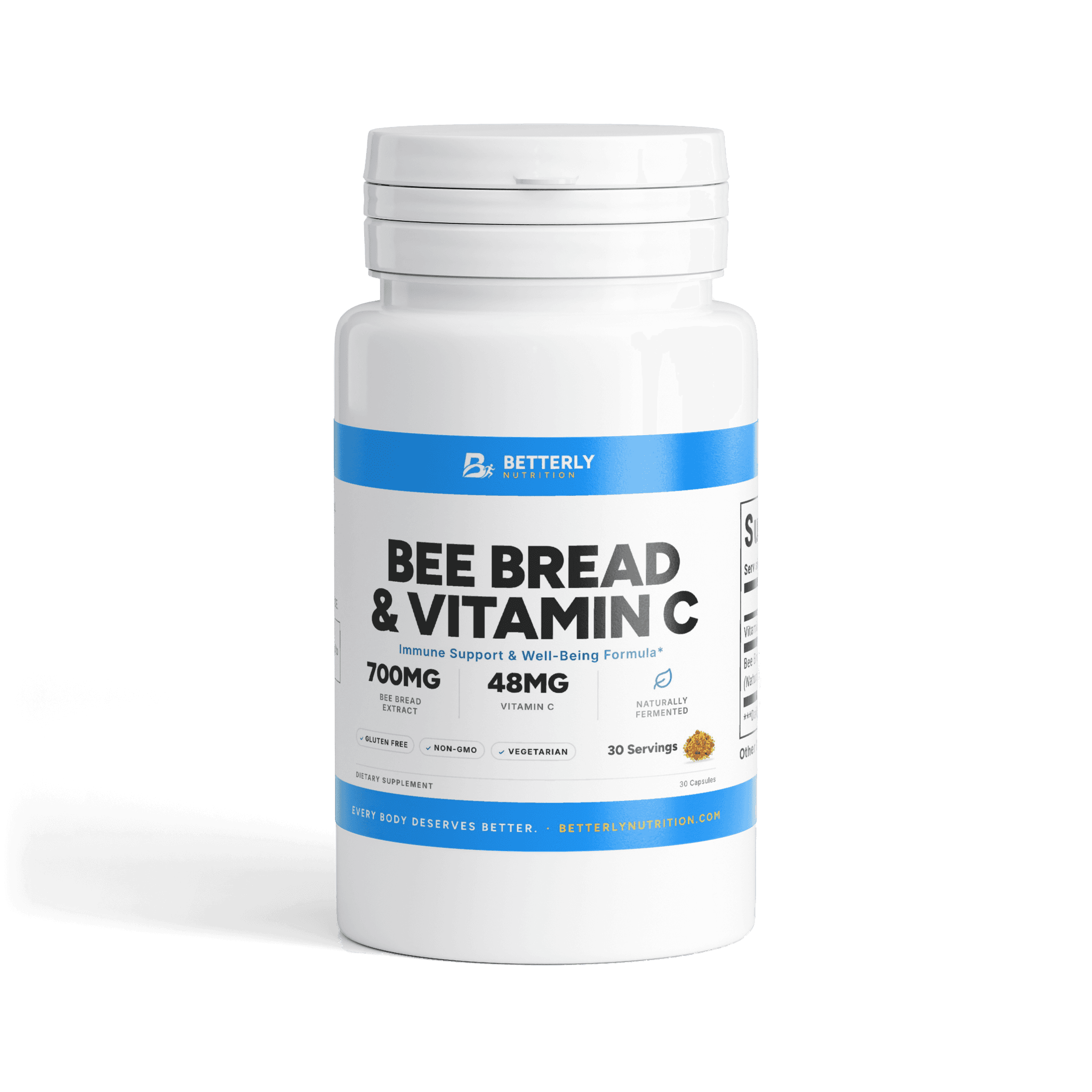
From our shop: Bee Bread & Vitamin C Capsules — the label directs one capsule daily with a meal, and each 1-capsule serving pairs bee bread extract (700 mg) with vitamin C (48 mg).
Who should check with a healthcare provider before trying our sachet?
Bee Bread, Royal Jelly & Propolis Powder's caution names who should ask a physician first, and past trouble with any hive product means seeing an allergist too.
The caution's words are "Consult a physician if pregnant, nursing, under 18, have a medical condition, or allergic reactions." Just before that sentence, it says "Contains bee products."
Allergy is the one risk our sources document well. LiverTox describes rare reactions that come on within minutes of swallowing royal jelly and can be severe.
What's known about royal jelly and medicines is covered in the interactions section of our side effects guide.
FAQ: royal jelly benefits
Is royal jelly bee sperm?
No, royal jelly isn't bee sperm. It's a secretion from glands in young worker bees, which the 2012 Nutrition Journal paper says make it mainly between their sixth and twelfth days of life. LiverTox notes that worker bees are infertile females. The hive's males, called drones, eat royal jelly as larvae rather than make it.
Is royal jelly good for your skin?
Royal jelly hasn't been shown to help your skin when you swallow it. LiverTox says it's used in skin creams as an emollient, an ingredient that softens skin. The 2024 review describes cell and rat studies of royal jelly and skin collagen, then says further clinical research is needed. Our sachet is a drink powder, and we make no skin claims for it.
Does royal jelly have side effects?
Yes, royal jelly can have side effects, though NIH's LiverTox database calls it generally well tolerated and names rare allergic reactions as the main concern. In the six-month trial of healthy adults, the authors saw nothing serious and no difference in side effects between royal jelly and placebo. People with bee or pollen allergies should ask an allergist first.
Can children take royal jelly?
Children shouldn't take royal jelly without a pediatrician's okay. Our sachet's label asks anyone under 18 to consult a physician first, and it gives no children's serving. Royal jelly marketed to parents with promises about growing taller deserves extra doubt. A child's growth is a conversation for their doctor.
Is royal jelly vegan?
No, royal jelly isn't vegan. It's an animal secretion, and the 2024 review describes the harvest step of lifting larvae out of their queen cells with tweezers. The claims printed on our sachet's label are gluten free, non-GMO and vegetarian, and vegan isn't among them.
Sources
- Royal Jelly, LiverTox (NIH National Library of Medicine, NCBI Bookshelf)
- Royal Jelly: Biological Action and Health Benefits (International Journal of Molecular Sciences, 2024, via PubMed Central)
- Effect of royal jelly ingestion for six months on healthy volunteers (Nutrition Journal, 2012, via PubMed Central)
- Niacin: Fact Sheet for Consumers (NIH Office of Dietary Supplements)
If this left you looking for somewhere to start, read 500 mg freeze-dried royal jelly sachets — its amounts per serving are listed on the page. For the practical questions this raises, how dosing, sourcing and subscriptions work is answered in one place.