On this page
- Key takeaways
- What does "lyophilized royal jelly" mean?
- Royal jelly powder vs fresh: which form fits your routine?
- How should you take royal jelly powder from a sachet?
- Can you put royal jelly in coffee or a hot drink?
- Is morning, night or an empty stomach best for royal jelly?
- Can you take royal jelly every day?
- Does royal jelly need to be refrigerated?
- Who doesn't need a royal jelly sachet?
- Who should talk to a doctor before a first royal jelly sachet?
- FAQ: how to take royal jelly
- Sources
The short answer: How to take royal jelly depends on the form you buy. Fresh royal jelly is a perishable jelly you keep cold and measure yourself. Freeze-dried (lyophilized) royal jelly is a dry powder that keeps at room temperature and comes in capsules and sachets. Our sachet's label says "Mix 1 sachet daily into a smoothie or beverage," and each 1-sachet (4 g) serving lists 500 mg of lyophilized royal jelly.
Key takeaways
- "Lyophilized" means freeze-dried: the water is drawn off as vapor, leaving a royal jelly powder that keeps at room temperature.
- Fresh royal jelly is roughly two-thirds water, so fresh and powder milligrams can't be compared one-for-one.
- One sachet a day, mixed into a smoothie or beverage, is the entire direction on our Bee Bread, Royal Jelly & Propolis Powder, with no set time, meal rule or temperature.
- Anyone who has reacted to pollen, honey, propolis or a bee sting should talk to an allergist before a first serving.
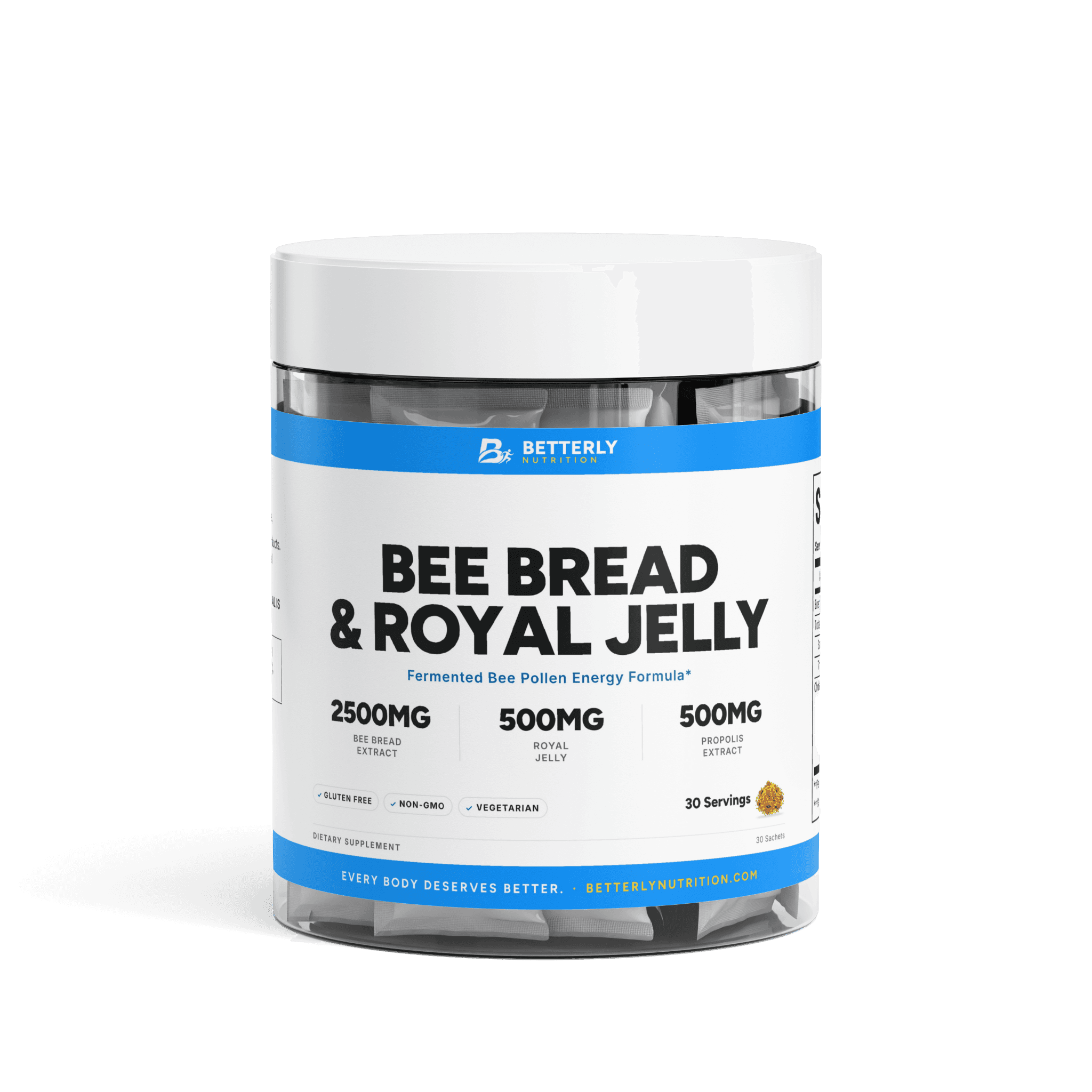
Our only product that gives royal jelly its own measured line is freeze-dried: it shares a sachet with bee bread and propolis in Bee Bread, Royal Jelly & Propolis Powder. Our Alfalfa & Chlorella Greens Powder also lists royal jelly, but only inside a blend. Since we'd profit from you choosing powder, the fresh jar gets a fair hearing below, and every product number comes from our own Supplement Facts panels.
What does "lyophilized royal jelly" mean?
Lyophilized royal jelly is fresh royal jelly that has been freeze-dried, a process that removes almost all of its water and leaves a dry powder.
Young worker bees secrete royal jelly as larval food, and straight from the hive it's mostly water. In a 2015 lab paper, The Lyophilization Process Maintains the Chemical and Biological Characteristics of Royal Jelly, Nascimento and colleagues measured 69.21% moisture in their fresh sample and 0.96% in the freeze-dried one.
The jelly is frozen, then held under a vacuum so the ice turns straight into vapor. A 2025 review in Foods, Monitoring and Maintaining the Freshness of Royal Jelly, explains the payoff: with the water gone, most of the chemical and microbial changes that spoil royal jelly can't get going.
In the Nascimento study, fresh and freeze-dried samples showed similar chemical fingerprints, and both contained 10-HDA, the fatty acid quality standards measure. That's one lab comparing its own samples, not a guarantee for every powder.
No source we opened gives an official conversion between the two forms, so we won't print one. For what royal jelly does and doesn't do in people, read our look at the research on royal jelly benefits.
Royal jelly powder vs fresh: which form fits your routine?
Freeze-dried royal jelly powder fits a routine built on a shelf-stable, pre-measured serving, while fresh royal jelly fits only if you'll keep it cold and measure it yourself.
| Form | Storage | How a serving is measured | What to check |
|---|---|---|---|
| Fresh jelly in a jar | Fridge, or freezer for longer | A small spoon, by eye | Storage line and date |
| Powder in sachets | Cool, dry cupboard | One sealed sachet | "Lyophilized" and a mg figure |
| Powder in capsules | Cool, dry cupboard | A fixed amount per capsule | Powder weight or fresh equivalent |
| Stirred into honey | As the jar directs | A spoonful | Royal jelly mg per serving |
| Inside a greens blend | Cool, dry cupboard | Only the blend total | Whether it has its own row |
Fresh jelly is the only form here that needs the fridge. Sachets and capsules measure for you; honey mixes and blends don't. Whatever the form, look for how many milligrams of royal jelly the label lists, and in which form.
Fresh jars. Nascimento's team writes that fresh royal jelly, at around 66% water, is perishable and must stay refrigerated to keep its nutritional value.
Capsules. The same paper notes freeze-dried royal jelly is usually sold in capsules for convenience. You may see a capsule label give the powder's own weight, or a figure for the fresh jelly it was made from. Don't compare one figure with the other.
Honey mixes and blends. A spoonful of honey mix is a guess, and a blend can hide the amount entirely. In our Alfalfa & Chlorella greens, Royal Jelly Powder is one of 16 ingredients, Bee Pollen Powder among them, sharing a 1 g Herbal Blend per 2-teaspoon (about 5 g) serving, with no amount of its own.
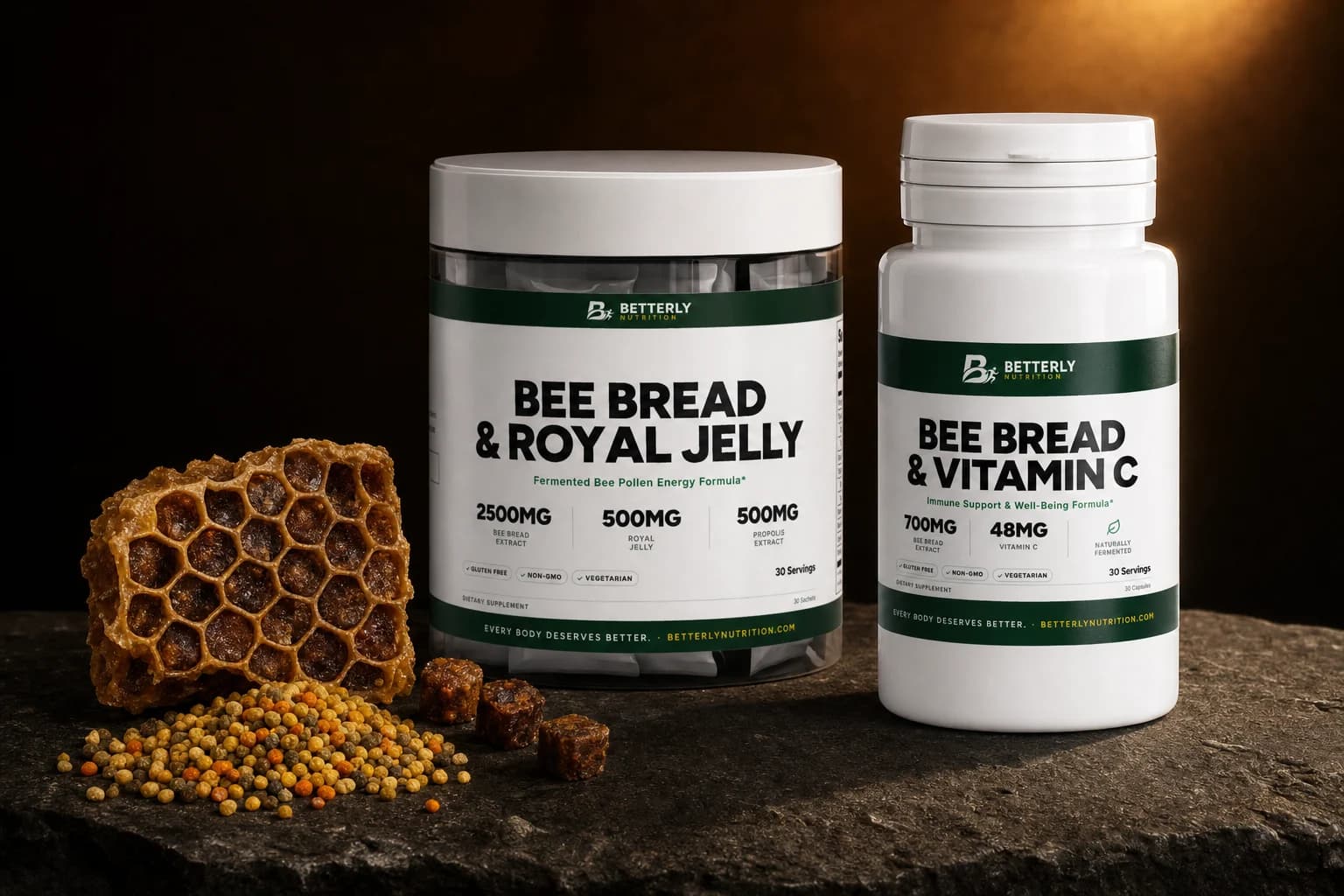
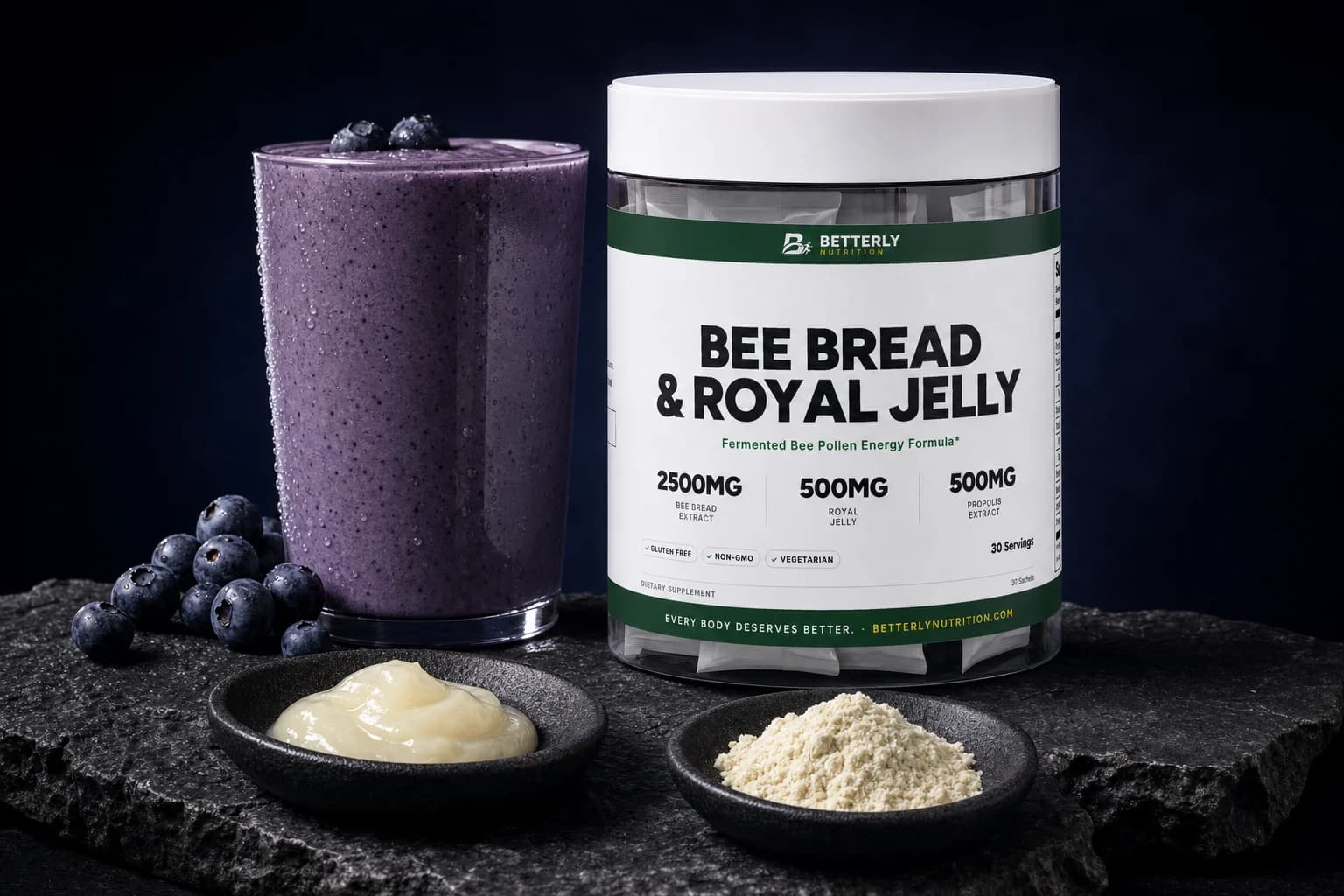
Our sachet sits in the second row. Its panel gives royal jelly its own line, 500 mg of lyophilized royal jelly per 1-sachet (4 g) serving, alongside 2,500 mg of Bee Bread Extract (Naturally Fermented Pollen) and 500 mg of Propolis Extract Powder. Our royal jelly vs propolis comparison explains how those partners differ.
How should you take royal jelly powder from a sachet?
Take Bee Bread, Royal Jelly & Propolis Powder the way its label says: once a day, empty one whole 4 g sachet into a smoothie or beverage.
The full direction reads "Mix 1 sachet daily into a smoothie or beverage," and it stops there. It names no amount of liquid, no temperature, no time and no rule about food. Anything beyond that is our suggestion, not the label's:
- Pick a drink you'll finish in one go, so the whole serving goes down.
- Empty the entire sachet. It's one serving, so saving half for tomorrow doesn't match "1 sachet daily."
- Check the tub first. It reads "DO NOT USE IF SAFETY SEAL IS DAMAGED OR MISSING."
The panel lists no flavoring or sweetener, so your drink carries the taste. Each sachet adds 8 kcal.
A tub holds 30 sachets, or 30 days at one a day. Bee bread makes up most of each sachet's weight, so the bee bread how-to covers that side of the routine.
From our shop: Bee Bread, Royal Jelly & Propolis Powder — freeze-dried royal jelly already portioned for you, at 500 mg per 1-sachet (4 g) serving, with 30 sealed sachets per tub for one drink a day.
Can you put royal jelly in coffee or a hot drink?
Iced coffee fits the label's word "beverage," but we'd keep royal jelly powder out of hot drinks, because heat speeds the breakdown of royal jelly's proteins.
Our caution comes from the 2025 Foods review, which says higher temperatures speed up protein damage, browning and fat breakdown in royal jelly. It singles out MRJP1, one of the major royal jelly proteins, as more prone to permanent heat damage than the sturdier fatty acid 10-HDA.
That review covers storage and processing, though. It didn't test a mug of coffee, so we can't say how much changes in the minutes a drink stays hot. Letting coffee, tea or cocoa cool first, or pouring it over ice, avoids the question entirely.
Is morning, night or an empty stomach best for royal jelly?
No time of day is best for royal jelly on the evidence we read, and the sachet's label names none, so choose a slot you'll actually keep.
You may run into advice to take royal jelly first thing in the morning, before breakfast. No study we opened compared one hour with another, so we won't invent an absorption claim. The sachet's panel lists no caffeine, so a bedtime smoothie follows the directions as well as a breakfast one.
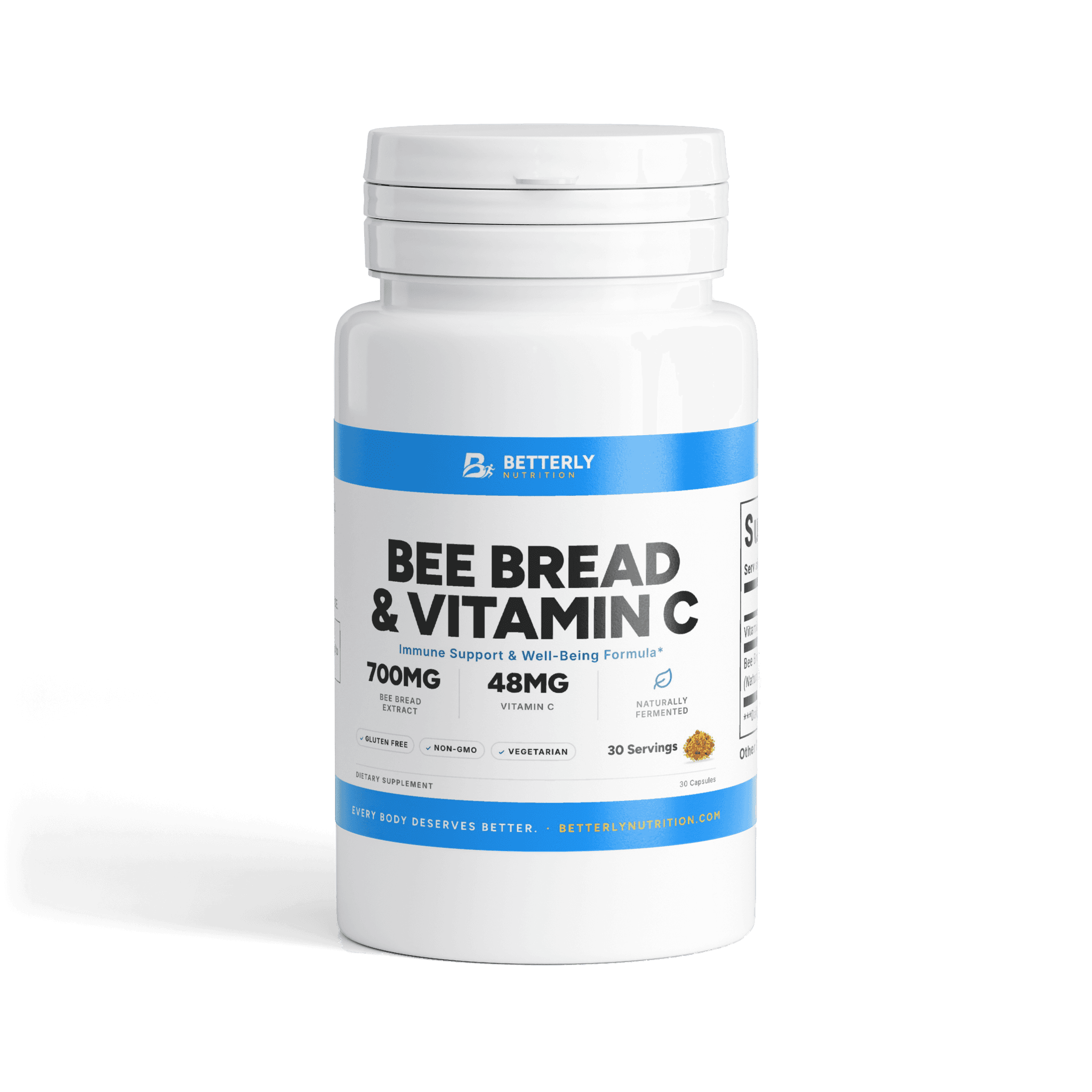
Food is your call. If a drink on an empty stomach doesn't sit well, have it with a meal. Our Bee Bread & Vitamin C Capsules differ here: that label says "Take one (1) capsule daily with a meal."
Can you take royal jelly every day?
Yes, daily use is what the Bee Bread, Royal Jelly & Propolis Powder label describes: one sachet a day, never a second one to top up or catch up.
The one trial in healthy adults we opened also used a daily routine. In Effect of royal jelly ingestion for six months on healthy volunteers, a 2012 Nutrition Journal paper, Morita and colleagues gave volunteers a 100 ml drink each day holding 3,000 mg of royal jelly. The authors described the complaints of the few who quit early as not severe.
That's one trial, not a long-term safety promise, and our review of what the six-month trial found covers the rest. The paper never says whether its 3,000 mg meant fresh or freeze-dried jelly, so it doesn't line up against the sachet's 500 mg, and it's no reason to go past the label's single sachet. Our label sets no break or cycling pattern, so we don't suggest one.
Daily use calls for one check. Our greens blend would add an unmeasured amount of royal jelly, plus bee pollen, on top of the sachet's 500 mg, with no bee-products warning on its label.
Does royal jelly need to be refrigerated?
Fresh royal jelly needs refrigeration, or freezing for longer keeping, while freeze-dried royal jelly powder keeps at room temperature in a cool, dry place.
The 2025 Foods review cites a lab study in which royal jelly's proteins stayed stable for 3 days at room temperature, 7 weeks at 4 °C (about 39 °F) and 21 weeks at −20 °C (−4 °F). The review adds that room-temperature storage can noticeably degrade royal jelly within weeks, and that freezing slows those changes most.
By our reading, that's a case for buying fresh jelly in amounts you'll finish within weeks and freezing the rest in single portions, so you're not thawing and refreezing the jar. The Foods review warns that repeated freeze-thaw cycles can permanently damage royal jelly's proteins. It also names oxygen and light as triggers for rancid flavors and browning, so a tightly closed, opaque jar suits it.
How do you know a jar has turned? The review describes long storage darkening royal jelly's color, changing its texture and bringing rancid odors. Any of those means the jar is done.
Powder is simpler. Nascimento's paper says freeze-dried royal jelly can be stored at room temperature, and our tub asks for nothing colder: "STORE IN A COOL, DRY PLACE." Pick a spot that stays dry, and leave each sachet sealed until it's going straight into your glass.
Who doesn't need a royal jelly sachet?
You can skip royal jelly if hive products have made you react before, if another supplement already supplies it, or if you're hoping to fill a nutrient gap.
- You're after nutrients. Royal jelly isn't an essential nutrient. On our sachet's panel, the only row with a Daily Value is vitamin C, at 12 mg (13% DV).
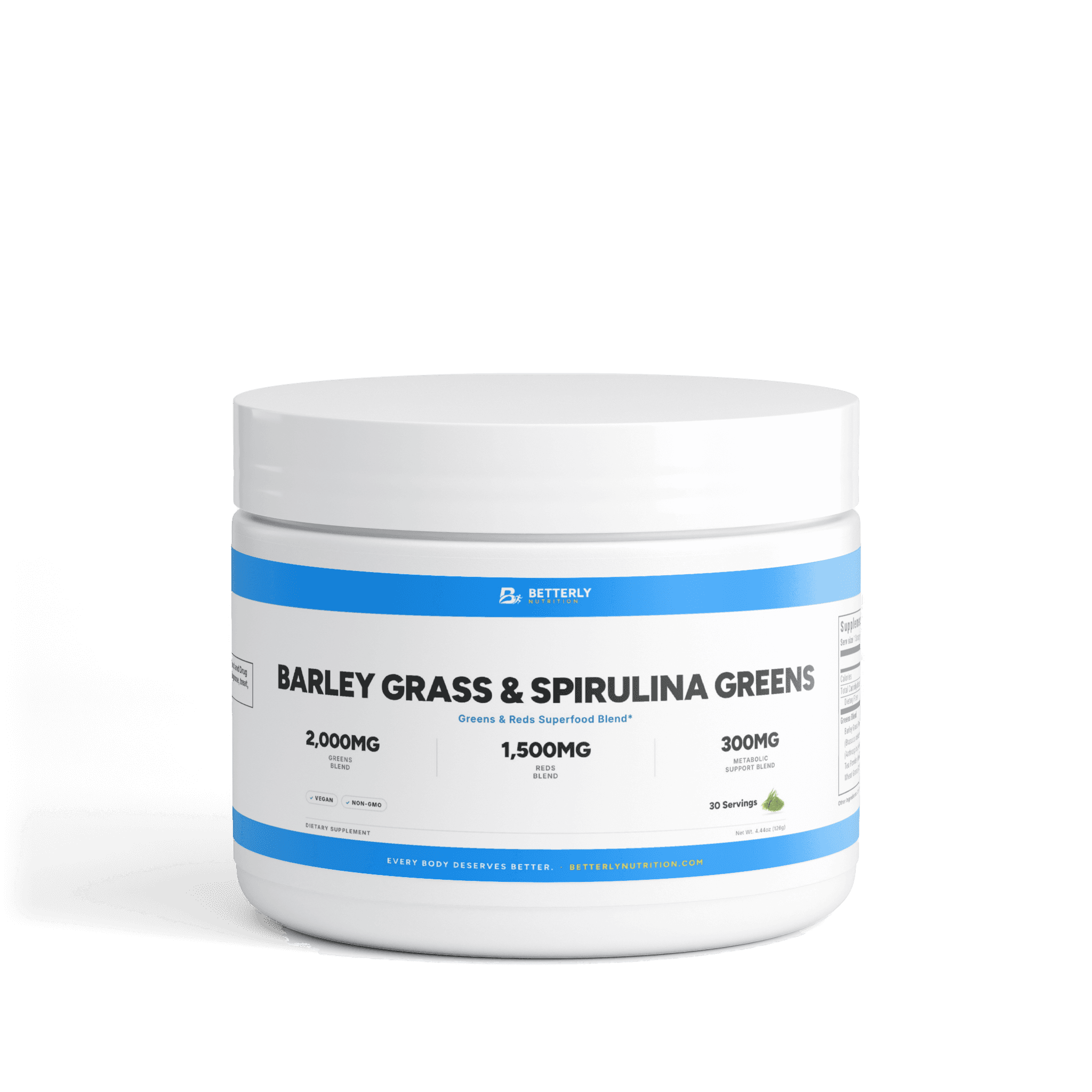
- You'd like nothing from the hive. That rules out both our bee products, the capsule included, plus our Alfalfa & Chlorella blend, which lists bee pollen and royal jelly. Barley Grass & Spirulina Greens Powder is one panel on our greens and superfoods shelf with no bee ingredient.
- You already get it elsewhere. A greens blend with royal jelly in its herbal mix makes a second source pointless.
- You'd rather swallow than stir. Our capsule skips the drink, but with no royal jelly it isn't a stand-in.
From our shop: Bee Bread & Vitamin C Capsules — no royal jelly and nothing to mix, with 700 mg of bee bread extract (fermented pollen) and 48 mg of vitamin C per 1-capsule serving, taken once daily with a meal, under the same "Contains bee products" caution as the sachet.
Who should talk to a doctor before a first royal jelly sachet?
Ask a physician before starting royal jelly if you're pregnant or nursing, under 18, managing a health condition, on any medicine, or have reacted to a hive product.
That list builds on our label's caution: "Do not exceed recommended dose. Contains bee products. Consult a physician if pregnant, nursing, under 18, have a medical condition, or allergic reactions."
Allergy is the risk to take most seriously. The National Center for Complementary and Integrative Health (NCCIH) includes a safety note on bee products: products such as bee pollen, honey, royal jelly and propolis may cause allergic reactions in people with pollen allergies. Our sachet holds three hive ingredients in every serving.
If you've reacted to pollen, honey, propolis or a sting before, see an allergist before your first sachet. Stop at any sign of hives or swelling, and get emergency help if breathing gets hard. For the warning signs, read what royal jelly reactions look like.
Taking prescription medicine or planning surgery? Add the sachet to the supplement list your care team keeps, naming all three bee ingredients.
FAQ: how to take royal jelly
How much royal jelly should you take a day?
There's no official daily amount of royal jelly. Our panel marks it "Daily Value not established," and the 2012 six-month trial's authors said the most effective dose for people is still unknown. So follow the label in your hand. For our sachet, that's 1 sachet a day, listing 500 mg of lyophilized royal jelly, with a caution not to exceed it.
Can you take royal jelly under your tongue?
Royal jelly can be held under the tongue, but we found no evidence it works better that way. For Bee Bread, Royal Jelly & Propolis Powder, the label settles the question: mix the sachet into a smoothie or beverage. Holding 4 g of dry powder in your mouth isn't what those directions describe, so stick with the drink.
Can you mix royal jelly powder with honey?
Yes, royal jelly powder can go into a drink sweetened with honey, as long as it's a smoothie or beverage the label allows. Honey is a bee product too, so the same allergy caution covers it. NCCIH also notes that children under 1 year of age shouldn't eat honey, one more reason to keep these products away from babies.
Can you take royal jelly with other supplements?
Royal jelly can share a routine with other supplements, but none of our sources lists its interactions, and silence isn't a safety record. Read your other labels for royal jelly, bee pollen or propolis so hive ingredients don't pile up, and ask a pharmacist to review the full list if you take any medicine.
What if you miss a day of royal jelly?
If you miss a day of royal jelly, carry on with one sachet the next day and skip the catch-up. Two at once goes past the label's one sachet daily, and the caution begins "Do not exceed recommended dose." A missed day just means your 30-sachet tub lasts a day longer.
Sources
- The Lyophilization Process Maintains the Chemical and Biological Characteristics of Royal Jelly (2015)
- Monitoring and Maintaining the Freshness of Royal Jelly (Foods, 2025)
- Effect of royal jelly ingestion for six months on healthy volunteers (2012)
- Seasonal Allergies at a Glance (NCCIH)
If this left you looking for somewhere to start, read lyophilized royal jelly powder in single-serve sachets — its amounts per serving are listed on the page. For the practical questions this raises, how dosing, sourcing and subscriptions work is answered in one place.