On this page
- Key takeaways
- What should you check before your first serving of bee bread?
- How to take bee bread capsules: how many a day?
- When is the best time to take bee bread?
- How do you use bee bread powder in a drink?
- Capsules, sachets or raw granules: which bee bread form fits you?
- Does bee bread go bad, and how should you store it?
- What does a simple bee bread routine look like?
- Who should skip bee bread, or just the sachet?
- Who should check with a healthcare provider before taking bee bread?
- FAQ: how to take bee bread
- Sources
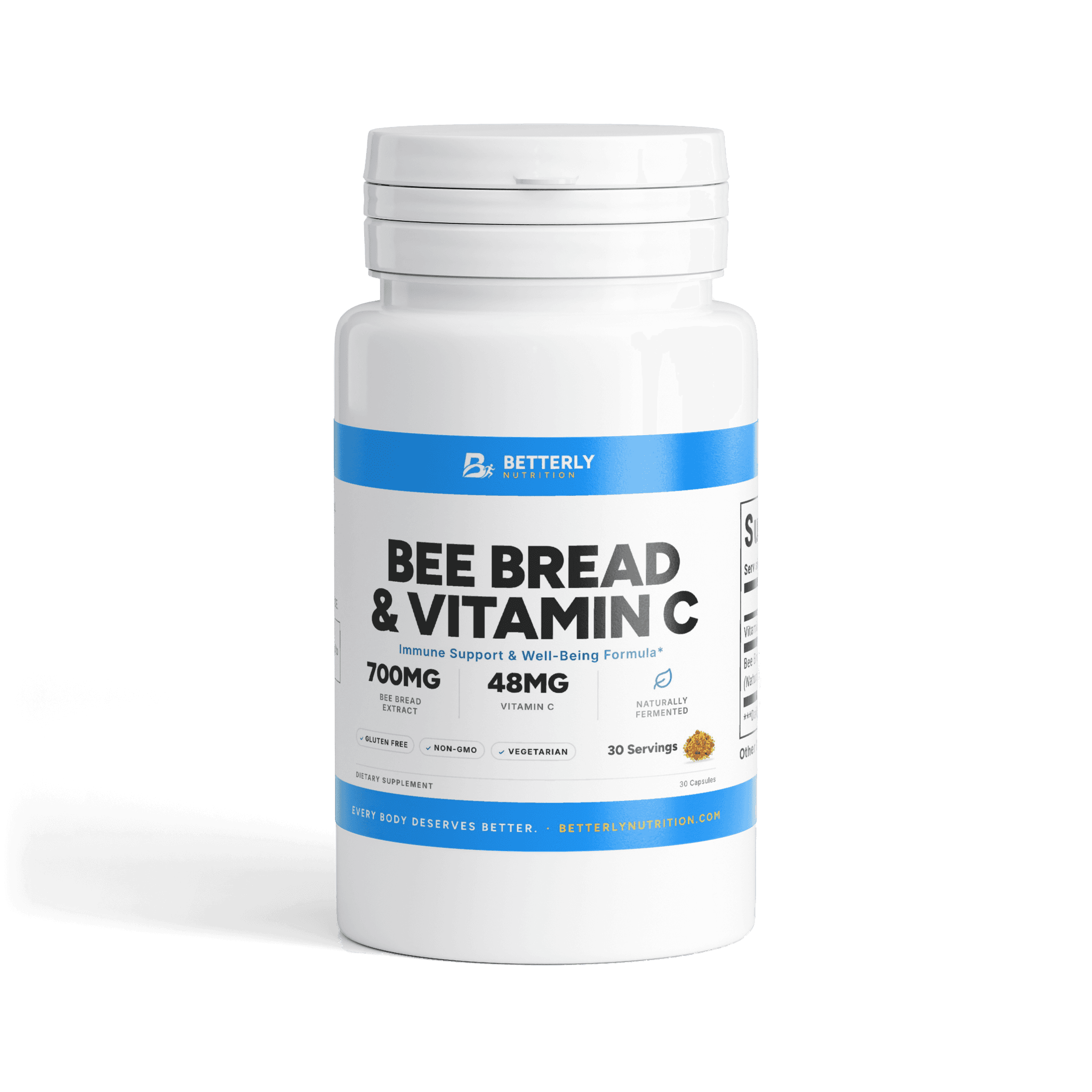
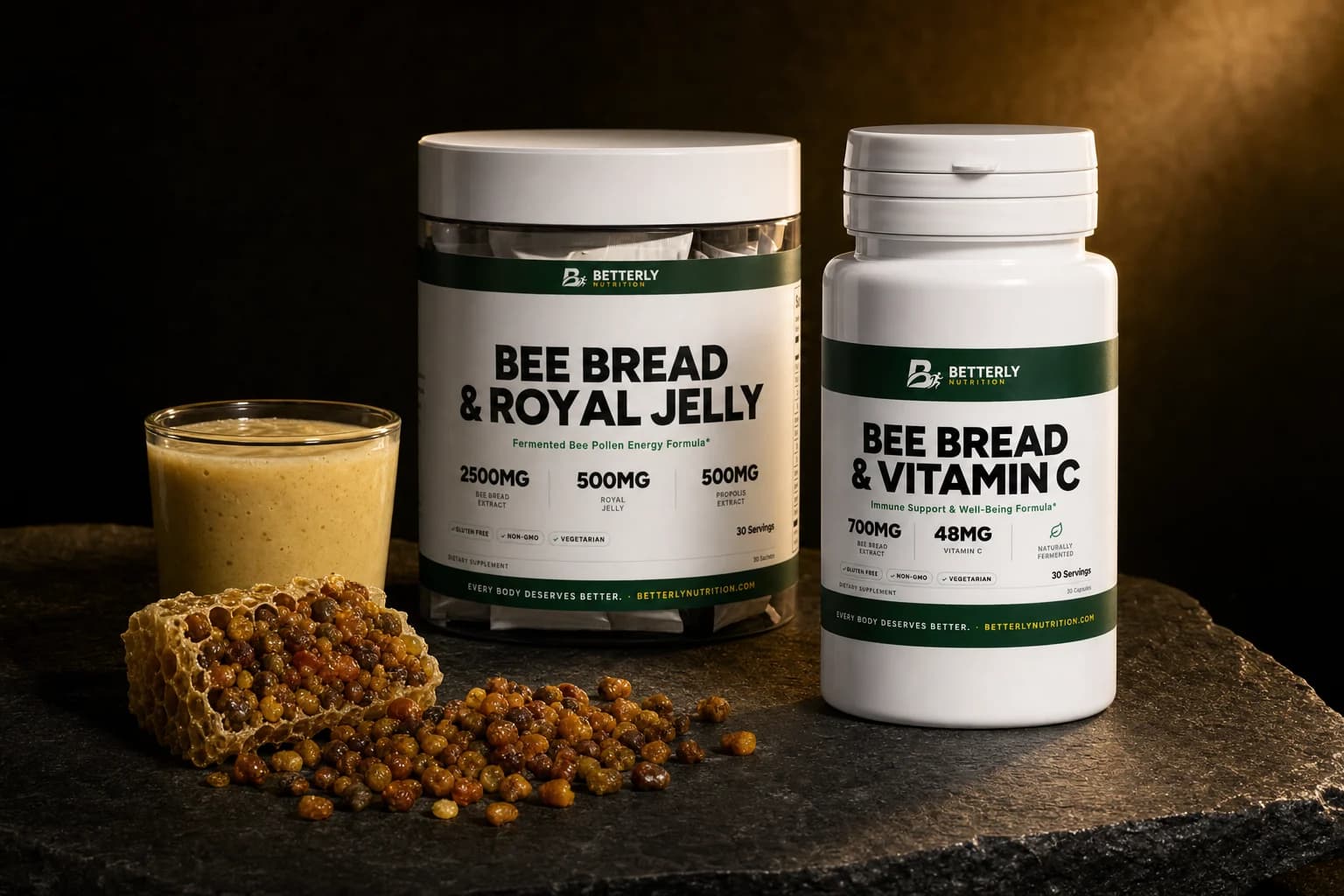
The short answer: How to take bee bread depends on its form, so start with the label. The label on our Bee Bread & Vitamin C Capsules says one capsule daily with a meal, which gives you 700 mg of bee bread extract per 1-capsule serving. Our sachet powder is stirred into a smoothie or another beverage once a day. Raw granules follow their own jar's directions. Whatever the form, read the "Contains bee products" caution first.
Key takeaways
- The Bee Bread & Vitamin C Capsules label calls for one capsule a day, taken with a meal, and its caution says not to go past that dose.
- "With a meal" is the capsule label's only timing rule, and caffeine doesn't appear on either of our bee bread panels, so any meal works.
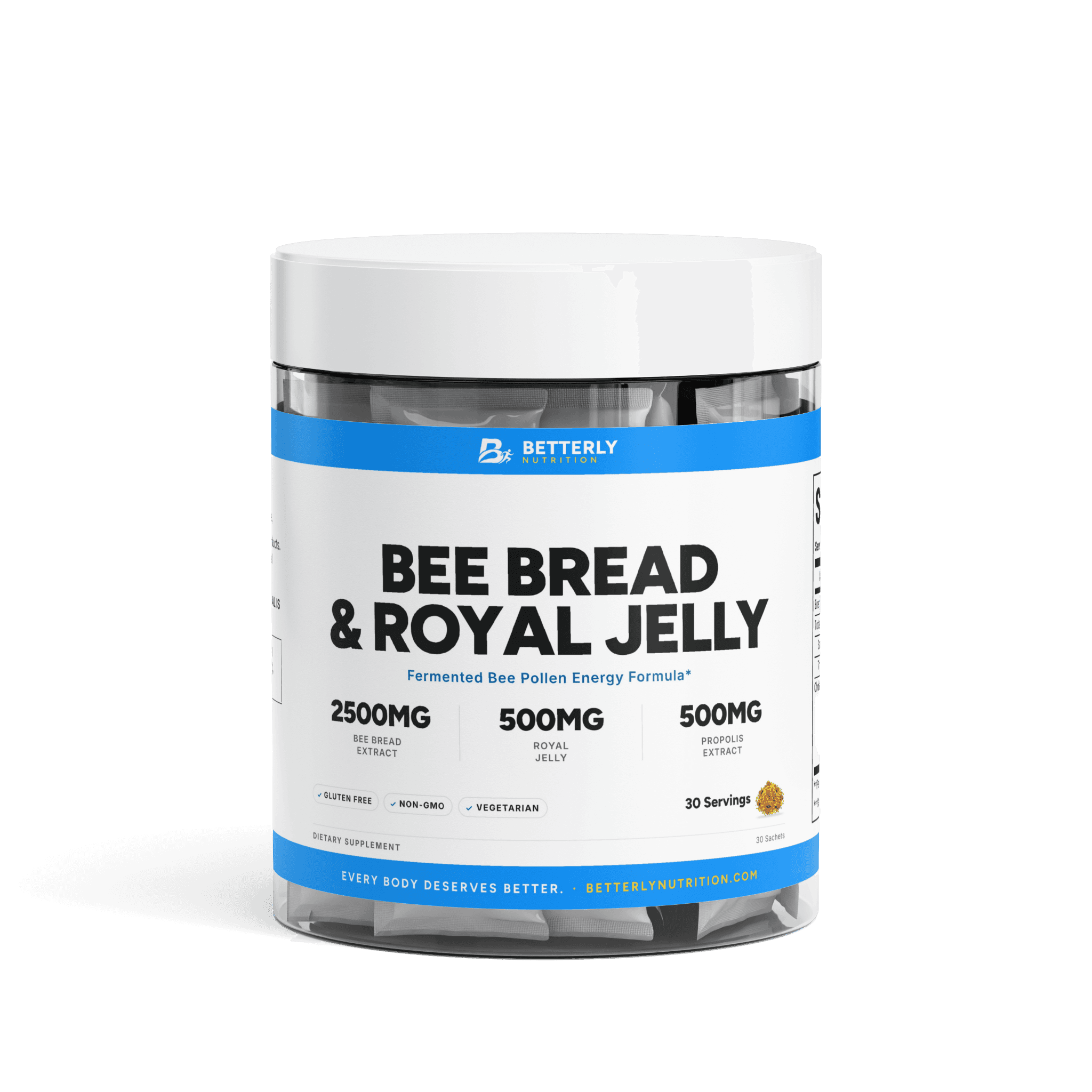
- Our bee bread sachet holds 2,500 mg of bee bread extract per 1-sachet (4 g) serving and is made to be mixed into a drink.
- Our capsules and sachets both print "Store in a cool, dry place," while a raw bee bread jar's storage needs depend on how its seller processed it.
Where we stand: we sell two of the three forms in this guide, the capsule and the sachet, and no raw bee bread. Weigh our comparison with that in mind. Our product numbers come straight off the printed labels.
What should you check before your first serving of bee bread?
Before your first bee bread serving, check the label's caution against your history with pollen, honey and other hive products, since both of our labels print "Contains bee products."
Bee bread starts as flower pollen that honey bees press into comb cells with nectar or honey, so a past reaction to pollen or anything from a hive matters more than any timing tip here. The full caution reads: "Do not exceed recommended dose. Contains bee products. Consult a physician if pregnant, nursing, under 18, have a medical condition, or allergic reactions."
Some raw bee bread sellers suggest holding a granule or two in your mouth as a home allergy check. That step isn't on our labels, we don't recommend it, and we won't invent a trial schedule. If you're unsure how hive products agree with you, ask your provider or an allergist before the first capsule.
The NIH Office of Dietary Supplements (ODS) consumer guide, Dietary Supplements: What You Need to Know, says to stay alert to the possibility of a bad reaction, especially with a new product.
MedlinePlus, from the National Library of Medicine, puts trouble breathing and a swollen face, eyes or tongue on its list of signs of a life-threatening allergic reaction. Its first step is to call 911 or your local emergency number.
How to take bee bread capsules: how many a day?
Take one Bee Bread & Vitamin C capsule a day with a meal; that's the suggested use printed on the label, and one capsule is the whole daily serving.
- Choose a meal that happens every day, even the busy ones.
- Swallow one capsule with water as part of that meal. Its shell is hypromellose, the one ingredient the bottle lists outside the Supplement Facts box.
- Close the cap and put the bottle back somewhere cool and dry.
- Stop at one. A skipped day doesn't mean two capsules tomorrow, because two would go past the label's dose.
Raw bee bread sellers often talk in teaspoons or grams a day, but those figures belong to a different product. Our label doesn't state a raw-to-extract ratio, so a teaspoon of granules and a capsule aren't interchangeable.
If capsules are hard for you to swallow, the sachet below is the form meant for a drink, and our guide to supplement formats that skip the pill covers other choices.
When is the best time to take bee bread?
Any meal you eat daily is the best time to take bee bread capsules, because "with a meal" is the label's only timing instruction.
The label names no particular meal, and neither bee bread panel lists caffeine or another stimulant, so mornings have no edge over evenings.
You'll see raw bee bread sold as an energizing morning food, sometimes eaten on an empty stomach. That advice was written for a different form, and our capsule's label asks for a meal.
What really decides your timing is memory, so keep the bottle where your steadiest meal happens. The sachet is different: its directions tie it to a drink rather than a meal, so it fits whenever your smoothie usually happens.
How do you use bee bread powder in a drink?
Use bee bread powder by mixing one sachet into a smoothie or another beverage once a day, as our sachet's label directs.
Our Bee Bread, Royal Jelly & Propolis Powder is the bigger serving. Its panel shows 2,500 mg of bee bread extract per 1-sachet (4 g) serving, 1,800 mg more than a capsule. It also brings two hive ingredients the capsule lacks, 500 mg of propolis extract powder and 500 mg of lyophilized (freeze-dried) royal jelly, while its vitamin C is lower, at 12 mg.
- Pour a smoothie, the label's first suggestion, or any beverage you like.
- Tear open one sachet and add all 4 g.
- Run it through the blender with the rest of your smoothie, or shake it in a bottle with a tight lid.
- Drink it once mixed, and stop at one sachet for the day.
Can it go into hot tea or coffee? The label doesn't rule that out. But the ODS consumer fact sheet on vitamin C notes that heat can destroy vitamin C. If the sachet's 12 mg of vitamin C matters to you, an iced or chilled drink is the safer bet.
From our shop: Bee Bread, Royal Jelly & Propolis Powder — a tub of 30 pre-measured sachets for a daily smoothie, each listing 2,500 mg of bee bread extract alongside 500 mg apiece of royal jelly and propolis extract powder.
Capsules, sachets or raw granules: which bee bread form fits you?
Bee bread capsules suit a fixed, taste-free dose, sachets suit daily smoothie drinkers, and raw granules suit people who want to eat bee bread as food.
| What to compare | Our capsule | Our sachet | Raw granules |
|---|---|---|---|
| Bee bread per serving | 700 mg extract | 2,500 mg extract | Varies by spoon |
| Other hive ingredients | None | Royal jelly, propolis | Depends on the jar |
| How you measure | 1 capsule | 1 pre-filled sachet | Teaspoon or scoop |
| Vitamin C per serving | 48 mg | 12 mg | Check the jar |
| Printed claims | Gluten free, non-GMO, vegetarian | Gluten free, non-GMO, vegetarian | Check the jar |
| Taste | Swallowed whole | Carried by the drink | Eaten straight |
| Storage | Cool, dry place | Cool, dry place | Follow the jar |
The top two rows hold the trade-off. The capsule is the smallest, simplest serving with one hive ingredient, the sachet adds more bee bread and two more hive ingredients, and raw granules give up a printed dose. If vitamin C matters to you, the capsule carries 4 times the sachet's amount.
On our site, the capsule sits with our Targeted Support products and the sachet with greens and superfoods.
What about raw bee bread granules?
Raw bee bread is the comb product itself. The USDA's Bee Bread Sampling Protocol, written for a national honey bee health survey, describes bee bread still in its comb cells as pollen mixed with nectar or honey, with a glossy, moist or wet sheen. Fresh pollen looks very dry and crumbly by comparison.
Sellers often suggest chewing the pieces or stirring them into yogurt, and the jar's directions set the amount.
USDA collects bee bread because bees store pollen and nectar from many flowers as bee bread, making it a snapshot of the pesticides a colony met outside. A raw jar that names its region tells you more. Our two labels don't, and that's a gap in ours too. Our side-by-side of bee bread and bee pollen explains what storage in the comb changes.
From our shop: Bee Bread & Vitamin C Capsules — a 30-capsule bottle for a one-a-day mealtime habit, each capsule listing 48 mg of vitamin C beside 700 mg of bee bread extract.
Does bee bread go bad, and how should you store it?
Yes, bee bread can go bad. Our capsules and sachets print "Store in a cool, dry place," while a raw jar's storage needs vary from seller to seller.
USDA's survey keeps bee bread scraped fresh from the cell cold and dark: inspectors wrap each vial in foil against sunlight, freeze it, and ship it on dry ice or with cool packs. That's lab handling for pesticide testing, not a kitchen rule. A retail jar's moisture depends on how it was processed, and some sellers ask for the fridge, so follow the storage line and any date on yours.
Neither of our labels asks for refrigeration. The capsule label adds not to use it if the safety seal is broken, and the tub says the same for a damaged or missing seal.
- Keep unused sachets together in their tub instead of loose in a bag or desk drawer.
- Skip warm or steamy spots: above the stove, beside the dishwasher, a bathroom cabinet or a car.
- Use it before any date stamped on the container.
Throw it out if capsules have stuck together, softened or spotted, if the powder has set into a hard lump, or if a sachet is torn. On raw granules, any fuzz or mold means the jar is done.
What does a simple bee bread routine look like?
A simple bee bread routine is one form, one serving a day, tied to one meal or drink you already have, with a check-in when the first container runs out.
- Choose one form. The capsule gives the smaller bee bread amount; the sachet suits a daily smoothie habit. Neither label mentions pairing it with the other, so switch between containers, not within a day.
- Write it down. ODS suggests recording each supplement and medicine you take, with its dose, how often and why, to share with your providers.
- Add up your vitamin C. If a multivitamin is already in your day, total the vitamin C rows. ODS lists the adult upper limit as 2,000 mg a day from every source, meals included.
- Check in at the end. At one a day, 30 capsules or 30 sachets last 30 days. When the container's empty, decide whether bee bread still earns its place. Our evidence check on bee bread's benefits can help you weigh that.
Who should skip bee bread, or just the sachet?
Skip the bee bread sachet if you'd rather avoid royal jelly or propolis, and skip bee bread entirely if neither label's directions fit the way you live.
- You want no royal jelly or propolis. Every sachet carries 500 mg of each, while the capsule's panel stops at bee bread extract and vitamin C.
- Your mealtimes are unpredictable. The capsule asks for a meal every time, so the sachet's drink-based direction may be easier to keep.
- You'd like to eat bee bread as food. A capsule or sachet gives you nothing to taste by the spoonful, and neither label allows a second serving. Raw jars come with their own directions.
Who should check with a healthcare provider before taking bee bread?
Ask a doctor or pharmacist before starting bee bread if you're under 18, pregnant or nursing, on medication, managing a health condition, or have reacted to pollen or hive products.
- Pregnancy and nursing. ODS advises care with supplements other than a standard prenatal during these stages, noting that many haven't been well tested for safety then.
- Under 18. Our label asks anyone under 18 to consult a physician first.
- Medicines. ODS wants a provider's go-ahead before you mix supplements with prescription medicines or use one in place of the other. Its vitamin C page adds that this vitamin can interact with some medicines.
- Surgery. With a procedure on the calendar, ODS says your provider should hear about each supplement you use.
- Allergy history. Mention any past reaction to pollen, honey, royal jelly, propolis or bee stings.
If you think bee bread caused a bad reaction, ODS says to tell your provider, and a report can also go straight to the FDA at 800-FDA-1088. Our guide to bee bread side effects covers warning signs.
FAQ: how to take bee bread
Can you open a bee bread capsule and mix it into food?
We wouldn't open a bee bread capsule, because our label only asks for one capsule daily with a meal. It says nothing about opening it. If swallowing capsules is the hurdle, our sachet powder is the form designed for mixing, though it adds royal jelly and propolis. Ask a pharmacist before opening any capsule.
Do you need to cycle bee bread or take breaks?
No, neither of our bee bread labels calls for cycling or breaks; both give a once-daily direction. We didn't find federal guidance on cycling bee bread, so we won't invent a schedule. The end of a 30-day container is a natural point to decide whether to keep going.
How long does a bottle of bee bread capsules last?
A bottle of our Bee Bread & Vitamin C Capsules lasts a month at one capsule a day, since it holds 30 capsules. The sachet tub works the same way. If a bottle runs out well before a month is up, extra servings have crept in, and both labels caution against exceeding the recommended dose.
Can kids take bee bread?
Kids shouldn't start bee bread without a healthcare provider's okay. Our labels ask anyone under 18 to consult a physician first. The NIH Office of Dietary Supplements urges care before a child takes a supplement their own provider didn't suggest, since many supplements haven't been well tested for safety in children. A child's past reaction to pollen or bee products is one more reason to ask.
Can you eat bee bread with honey?
You can eat raw bee bread with honey, and some raw bee bread sellers pair the two. Honey adds sugar, though, and it's one more bee product if hive allergies are a concern. Our capsule's label asks only for a meal, so honey isn't part of its directions, and our sachet can go into any drink, sweetened or not.
Sources
- Dietary Supplements: What You Need to Know, Fact Sheet for Consumers (NIH Office of Dietary Supplements)
- Vitamin C: Fact Sheet for Consumers (NIH Office of Dietary Supplements)
- Anaphylaxis: MedlinePlus Medical Encyclopedia (National Library of Medicine)
- Bee Bread Sampling Protocol (USDA Animal and Plant Health Inspection Service, 2020)
If this left you looking for somewhere to start, read bee bread capsules taken once a day with a meal — its amounts per serving are listed on the page. For the practical questions this raises, how dosing, sourcing and subscriptions work is answered in one place.