On this page
- Key takeaways
- Is bee bread the same as bee pollen?
- What's the difference between bee bread and bee pollen?
- Is bee bread more digestible than bee pollen?
- Bee bread vs bee pollen benefits: what does the research show?
- How do bee bread and bee pollen appear on supplement labels?
- Bee bread vs honey and propolis: how are they different?
- How do you take bee bread capsules or powder?
- When don't you need bee bread or bee pollen?
- Who should skip bee bread or ask a doctor first?
- FAQ: bee bread and bee pollen
- Sources
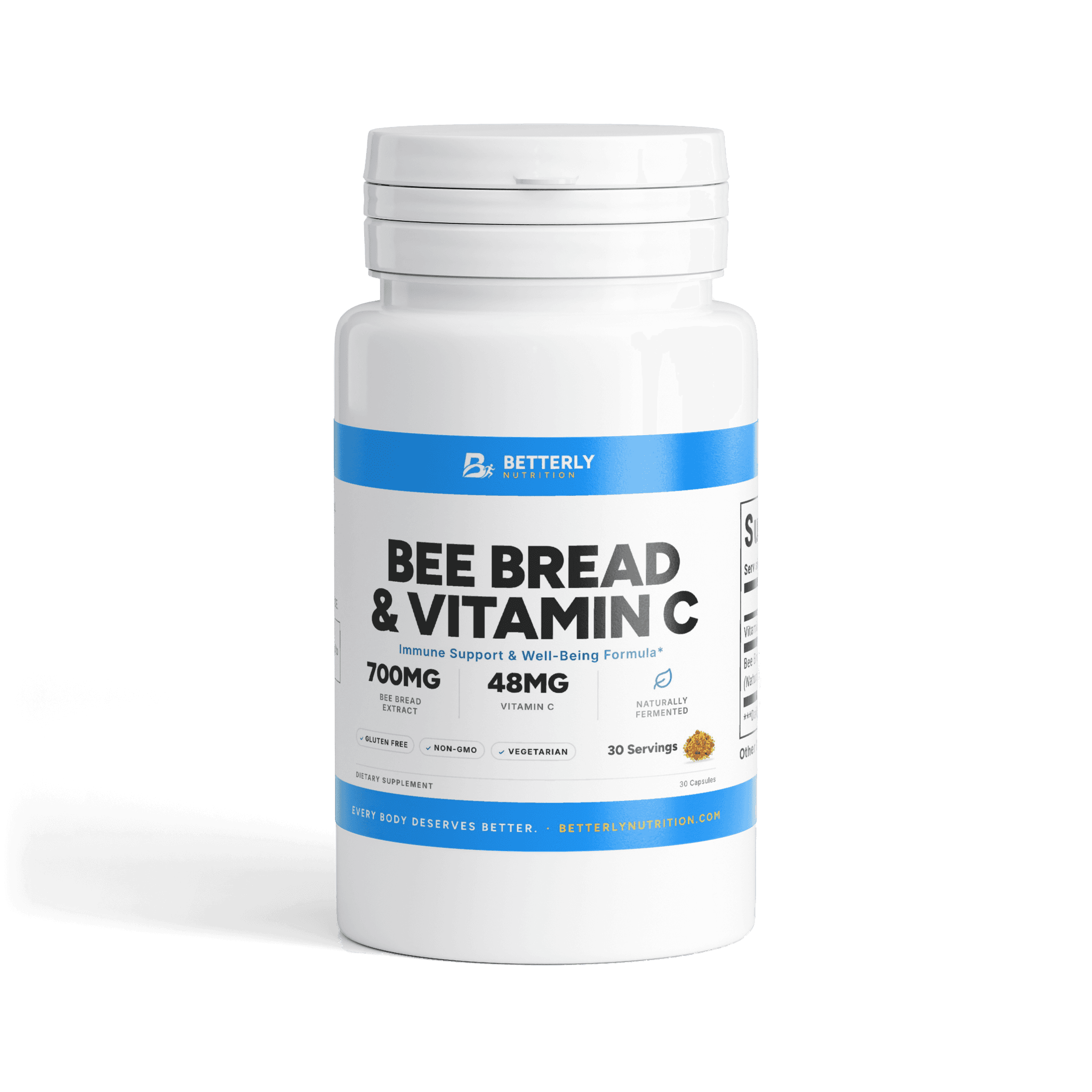
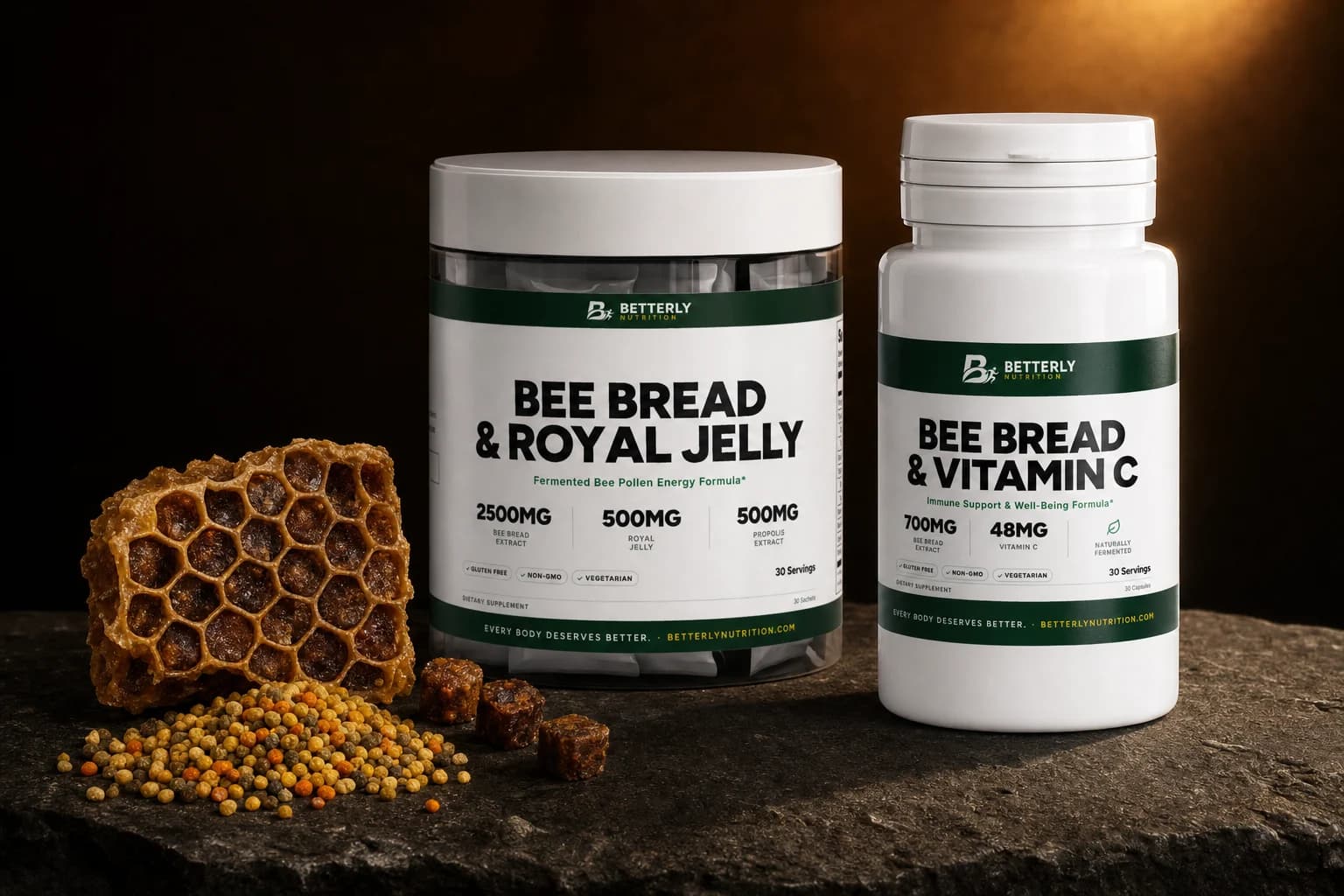
The short answer: Bee bread vs bee pollen comes down to one extra step inside the hive. Bee pollen is the pellet a worker bee carries home on her back legs. Bee bread is that same pollen after bees pack it into wax comb with nectar, where it sits and naturally ferments. Neither has strong human research behind it, so compare labels: our capsule lists 700 mg of bee bread extract per 1-capsule serving.
Key takeaways
- Bee bread and bee pollen start as the same flower pollen, and bee bread is the version bees store and ferment in the comb.
- A "fermented" label tells you how the pollen was stored, not that your body gets more out of it.
- A useful label gives the bee ingredient its own milligram amount instead of burying it in a blend.
- If pollen, honey or any bee product has ever caused you a reaction, check with a clinician before trying bee bread or bee pollen.
Betterly sells exactly three products with a bee ingredient: Bee Bread & Vitamin C Capsules, a bee bread sachet powder and a greens blend that lists bee pollen. We carry no plain bee pollen granules, so the pollen side of this comparison earns us nothing. That's a bias worth knowing about before you read on.
Is bee bread the same as bee pollen?
Bee bread and bee pollen come from the same flowers, but they aren't the same product, and even the FDA uses the names loosely.
The FDA's page Helping Agriculture's Helpful Honey Bees says pollen is "often called 'bee bread'" and calls it the bees' main source of protein.
Beekeepers and supplement makers draw a sharper line, using "bee bread" for the packed, stored form. You may also see it sold as perga or fermented bee pollen.
Our capsule's panel shows how a label can settle it. Its bee row reads "Bee Bread Extract (Naturally Fermented Pollen)." That phrase in parentheses tells you which of the two you're holding, so look for it on any label.
What's the difference between bee bread and bee pollen?
Bee bread and bee pollen split at the hive entrance: a trap there catches fresh pellets as bee pollen, and pellets that get past it can become bee bread.
A forager brushes pollen off flowers, moistens it with nectar and saliva, and presses it into the pollen baskets on her hind legs. The FDA notes that one bee can haul a pollen load of about 35 percent of her body weight.
A pollen trap at the entrance knocks some of those loads loose, and the pellets are dried and sold as bee pollen. Loads that make it inside are tapped into open wax cells, usually in a band between the brood and the honey. Bees pack each cell tight, mix in more nectar and honey, and leave the mass to sit. That stored mass is bee bread.
| Feature | Bee pollen | Bee bread |
|---|---|---|
| What it is | Fresh pellets of flower pollen | Pollen packed and stored in comb |
| Fermentation | None; sold dried or frozen | Ferments naturally in the cell |
| Texture | Dry, crumbly granules | Denser, slightly moist pieces |
| Common forms | Granules, capsules, blends | Comb pieces, extracts in capsules or powders |
| Allergy caution | Yes | Yes |
| Human research | Limited | Limited |
The bottom two rows matter most. Both carry the same allergy caution and neither has much human research, so your choice mostly comes down to form and label clarity.
Is bee bread more digestible than bee pollen?
Bee bread is often sold as easier to digest than bee pollen, but that claim isn't settled, and a hive study that tested it looked at bees, not people.
The pitch says microbes in the comb "predigest" pollen, crack its tough shell and turn it into a richer food. A 2014 study by researchers from the USDA's Carl Hayden Bee Research Center and the University of Arizona, published in Molecular Ecology, put that idea to the test. Its results pointed the other way:
- Bees preferred to eat pollen that had been stored for less than 3 days.
- Freshly collected pollen held few bacteria, and the count fell further once it had been stored more than 96 hours.
- Under the microscope, stored pollen grains didn't look broken down.
The authors concluded that stored pollen works mainly as a preserved food, kept stable by the honey, nectar and bee secretions mixed into it. They didn't study people, and they note that many earlier papers had assumed the opposite.
Acid-tolerant bacteria such as Lactobacillus kunkeei were the most common microbes in stored pollen. The authors suggest this microbe may make enough acid to help stored pollen keep. In that reading, fermentation helps preserve the pollen rather than predigest it, and "fermented" on a label doesn't prove your body gets more from bee bread than from plain pollen.
Bee bread vs bee pollen benefits: what does the research show?
We couldn't find human trials comparing bee bread vs bee pollen benefits, so ranking one above the other would be a guess, not a finding.
We also couldn't find a consumer fact sheet on either from the NIH Office of Dietary Supplements or the National Center for Complementary and Integrative Health.
What you can measure is the label. Our capsule pairs bee bread with vitamin C, the one ingredient here with a federal fact sheet behind it. The NIH Office of Dietary Supplements' vitamin C fact sheet says the body needs vitamin C to make collagen, and that it helps the immune system work properly. ODS lists 90 mg a day for adult men and 75 mg for adult women.
Per 1-capsule serving, the Bee Bread & Vitamin C Capsules panel lists 48 mg of vitamin C. Our bee bread powder lists 12 mg per 1-sachet (4 g) serving. Both sit far below the 2,000 mg daily upper limit ODS sets for adults, a limit that counts food, drinks and supplements together.
How do bee bread and bee pollen appear on supplement labels?
On our three labels, bee bread gets its own milligram row, while bee pollen is folded into a blend without a separate amount.
| Our product | Bee ingredients per serving | Serving size |
|---|---|---|
| Our capsule | 700 mg bee bread extract | 1 capsule |
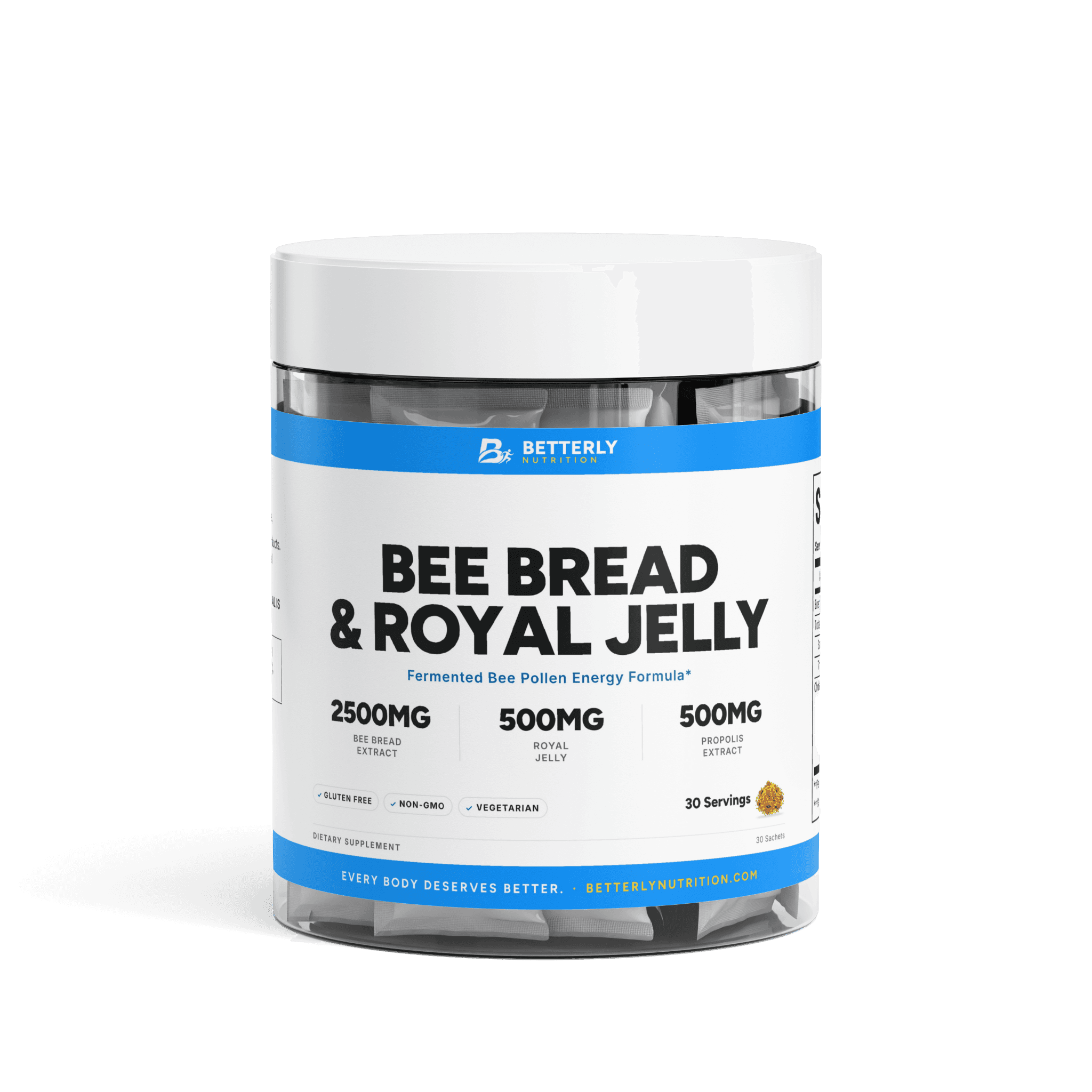
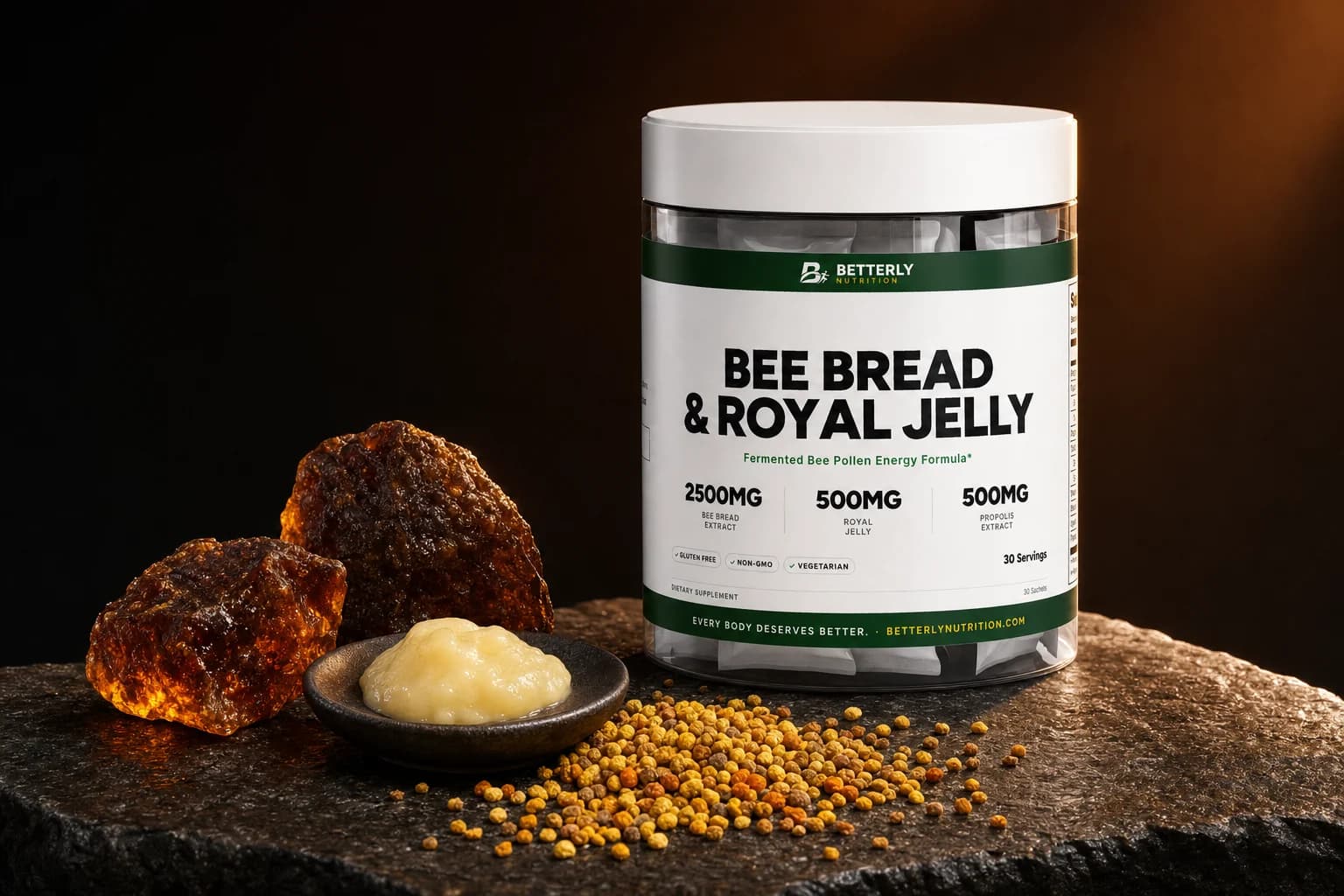
| Our bee bread sachet | 2,500 mg bee bread extract, 500 mg royal jelly, 500 mg propolis | 1 sachet (4 g) |
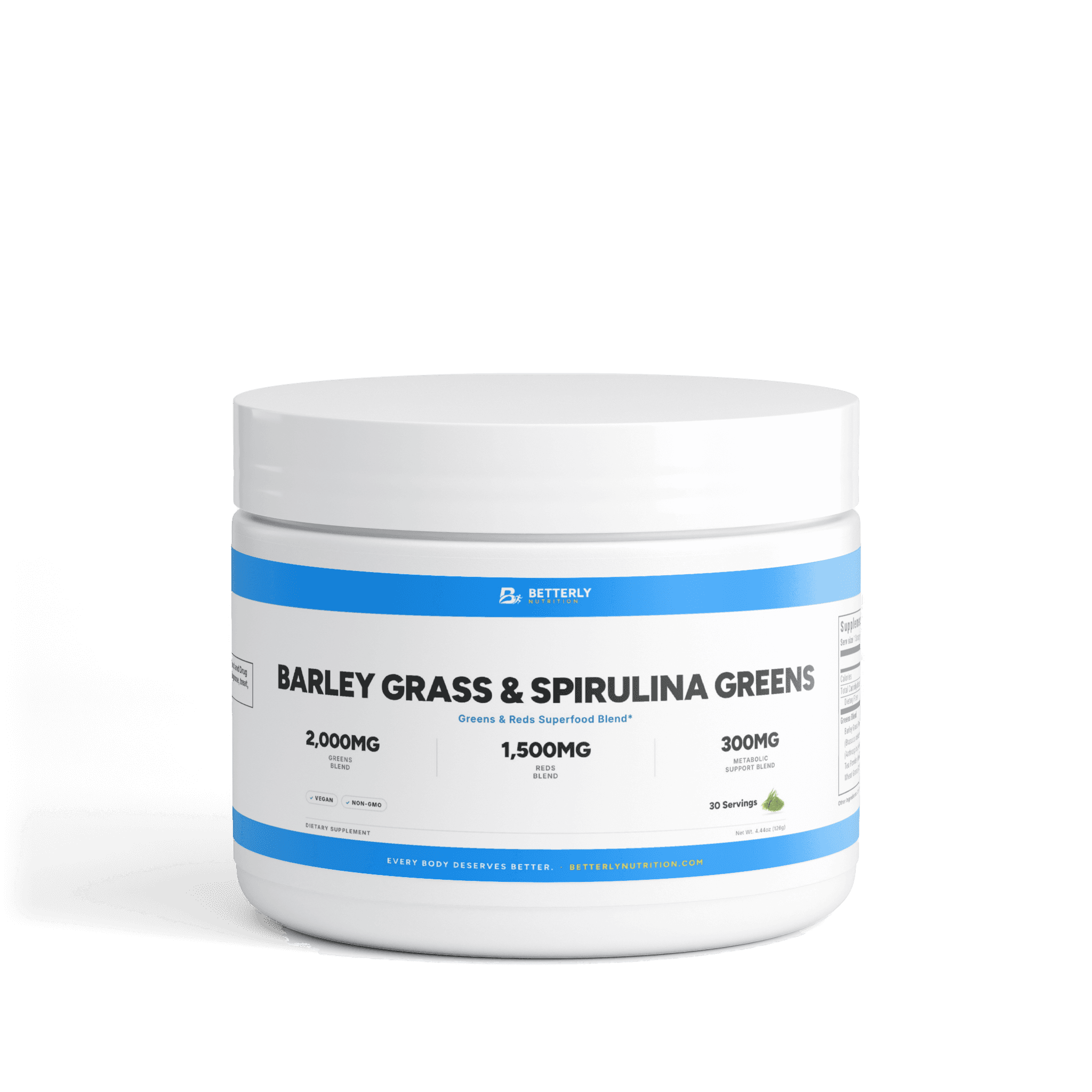
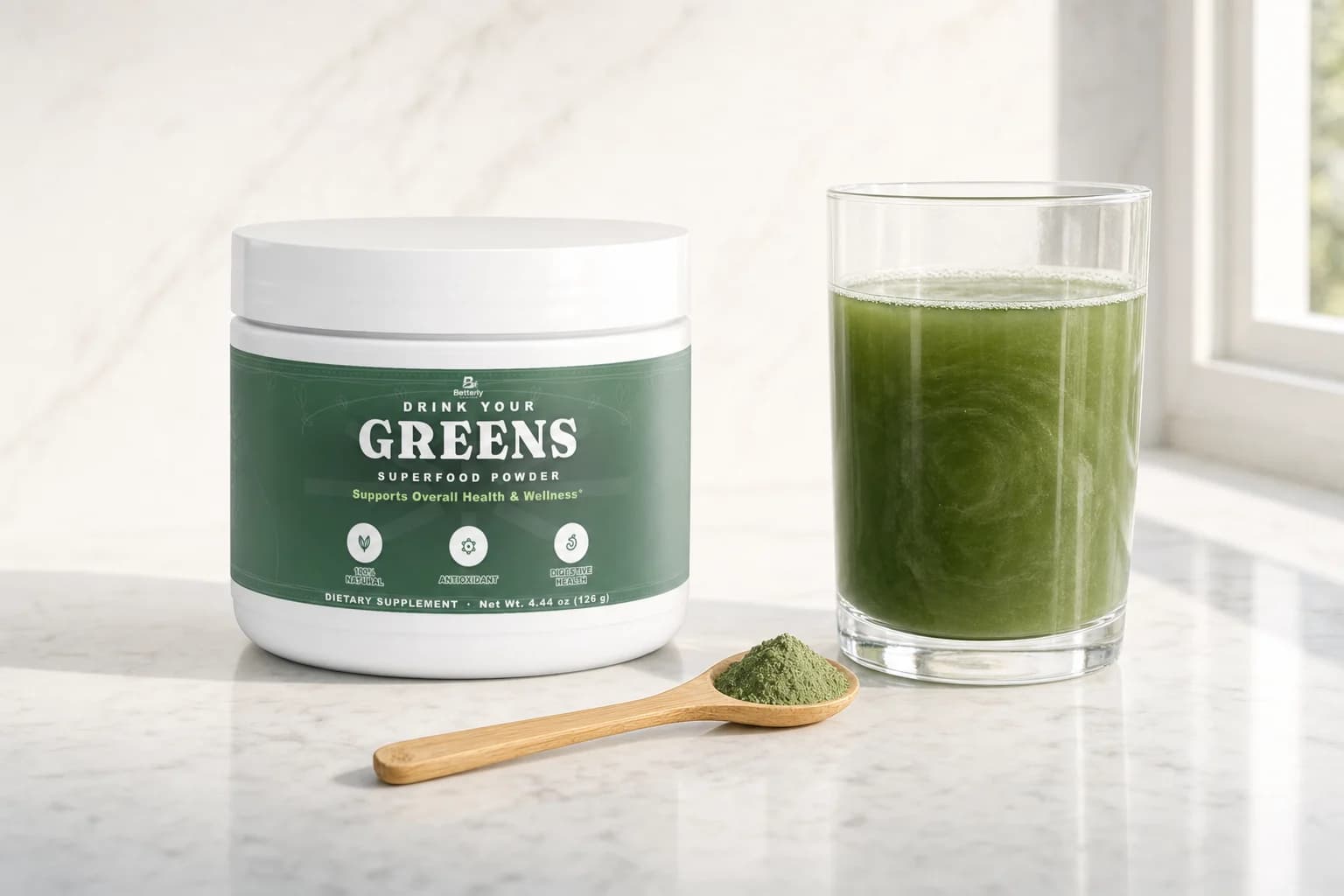
| Our greens powder | Bee pollen and royal jelly inside a 1 g Herbal Blend | 2 teaspoons (about 5 g) |
The two bee bread products tell you how much bee ingredient you're getting. The greens powder doesn't.
- The capsule has the plainest label: bee bread extract and vitamin C, with a hypromellose capsule as the only other ingredient.
- Bee Bread, Royal Jelly & Propolis Powder carries more than three times the capsule's bee bread. It adds lyophilized (freeze-dried) royal jelly and propolis extract powder, plus 8 kcal and less than 2 g of sugar per sachet.
- In Alfalfa & Chlorella Greens Powder, bee pollen powder is one of 16 ingredients sharing that 1 g blend, so its amount isn't shown.
Neither bee bread label says how the extract was made or how much raw bee bread went into it. So you can't turn our 700 mg into a spoonful of comb pieces.
On any bee label, ours included, check that the bee ingredient has its own amount and that the caution mentions bee products. Our greens powder misses the second: its caution has no "Contains bee products" line. If you're weighing greens blends for other reasons, how greens and reds powders compare covers taste and overlap.
From our shop: Bee Bread & Vitamin C Capsules — 700 mg of bee bread extract (naturally fermented pollen) and 48 mg of vitamin C per 1-capsule serving, labeled vegetarian, gluten free and non-GMO.
Bee bread vs honey and propolis: how are they different?
Bee bread is stored pollen, the hive's protein food, while honey is converted nectar, its carbohydrate food, and propolis is a sticky resin bees use to seal the hive.
The FDA's honey bee page lists six hive products: honey, pollen, royal jelly, beeswax, propolis and venom. It explains that bees convert nectar into honey, their main carbohydrate source, while pollen supplies the protein needed for young bees and hive growth.
Royal jelly starts with that stored pollen. The 2014 study describes nurse bees turning it into royal jelly in modified salivary glands and feeding it to growing larvae. Propolis is a different material again, gathered mostly from plant resins.
Bee bread sits right next to honey in the comb, but don't assume it's the low-sugar option. The same researchers note that bee-collected and hive-stored pollen are about 40 to 50 percent simple sugars, much of it from the honey and nectar mixed in.
Our powder combines three of these hive products in one sachet. Our guide to royal jelly vs propolis compares those two, and what bee bread is and how people use it covers bee bread on its own.
From our shop: Bee Bread, Royal Jelly & Propolis Powder — 2,500 mg of bee bread extract with 500 mg each of royal jelly and propolis extract powder per 4 g sachet, mixed into a smoothie or drink.
How do you take bee bread capsules or powder?
Take bee bread the way its label says: our capsule is one a day with a meal, and our powder is one sachet a day mixed into a drink.
- Bee Bread & Vitamin C Capsules: "Take one (1) capsule daily with a meal." A bottle holds 30 servings.
- Bee Bread, Royal Jelly & Propolis Powder: "Mix 1 sachet daily into a smoothie or beverage." A container holds 30 sachets.
- Alfalfa & Chlorella Greens Powder: "Adults mix two (2) teaspoons into 8 oz (237ml) of apple juice or other favorite liquid, or use as directed by a health care professional." The tub holds 50 servings.
All three cautions open with "Do not exceed recommended dose." The directions above stop at one serving, so don't add another.
Pick one bee product rather than stacking all three. Our greens powder already lists bee pollen and royal jelly, so pairing it with a bee bread product puts two bee sources into your day. And if you ever did react, you couldn't tell which product caused it.
If you take a multivitamin with breakfast, a mealtime capsule can sit beside it. Our daily routine built around meals shows one way to line supplements up with food.
When don't you need bee bread or bee pollen?
You don't need bee bread or bee pollen if you eat a varied diet; neither is an essential nutrient, and ODS says most Americans get enough vitamin C from food.
You can comfortably skip both if:
- You avoid all animal-derived foods.
- You mainly want vitamin C. ODS names citrus fruits, red and green peppers, kiwifruit, broccoli and strawberries among good sources.
- Your routine is already long. Our guide to keeping a supplement routine simple enough to stick has tips for trimming it.
The capsule sits on our single-job Targeted Support shelf. If nothing there fills a real gap in your diet, it's fine to buy nothing.
Who should skip bee bread or ask a doctor first?
Ask a healthcare provider before trying bee bread if you're allergic to pollen or bee products, pregnant, nursing, under 18, taking any medicine, or managing a health condition.
Both bee bread labels carry this caution: "Do not exceed recommended dose. Contains bee products. Consult a physician if pregnant, nursing, under 18, have a medical condition, or allergic reactions." That means a conversation with your provider comes first if:
- You've reacted to pollen, honey or any bee product before.
- You're pregnant or nursing, or the person taking it is under 18.
- You take any prescription or over-the-counter medicine. A pharmacist can check your list.
- You have an operation booked. Put bee bread on the supplement list you give the hospital or clinic.
If you notice itching, swelling or trouble breathing after any bee product, stop taking it and get medical help right away.
Where you buy matters too. One FDA public notification covers Prime Bee Pollen, a product promoted for weight loss. FDA laboratory analysis found two hidden ingredients in it, sibutramine and phenolphthalein. The agency adds that it can't test every product sold as a supplement, so be wary of any bee pollen product sold with weight-loss promises, however natural it claims to be.
FAQ: bee bread and bee pollen
Is bee bread safe to eat?
Bee bread is eaten as a food, but it isn't right for everyone. It's still pollen, so people allergic to pollen or bee products can react to it. Our bee bread labels flag "Contains bee products," and their cautions send anyone with a history of allergic reactions to a physician first. The same goes for pregnancy, nursing, anyone under 18, or an existing medical condition.
What does bee bread taste like compared with bee pollen?
Bee bread is usually described as tangier and a little sour next to bee pollen, which tastes sweeter and more floral. Its texture is denser and slightly moist, while pollen pellets are dry and crumbly. Flavor also shifts with the flowers the bees visited. In a capsule, you won't taste either one.
Is bee bread vegan?
No, bee bread isn't vegan, because bees make it from pollen, nectar and their own secretions. That's why our bee bread capsules and powder are labeled vegetarian rather than vegan. Both are also labeled gluten free and non-GMO. Our greens powder carries a vegetarian label too, and since it lists bee pollen and royal jelly, it isn't vegan either.
Can you take bee bread and bee pollen together?
You can take bee bread and bee pollen together, but there's rarely a reason to. They're the same flower pollen at two stages, so the pair mostly doubles one ingredient. It also doubles your exposure if pollen has ever given you a reaction. Neither of our bee bread labels suggests combining it with other bee products, and neither goes beyond one serving a day.
When is the best time to take bee bread?
The best time to take bee bread is whenever its label says. For our Bee Bread & Vitamin C Capsules, that's one capsule once a day with a meal. The Bee Bread, Royal Jelly & Propolis Powder label gives no mealtime rule, only one sachet a day mixed into a smoothie or beverage.
Sources
- Helping Agriculture's Helpful Honey Bees (U.S. Food and Drug Administration)
- Hive-stored pollen of honey bees: many lines of evidence are consistent with pollen preservation, not nutrient conversion (Molecular Ecology, 2014, via PubMed Central)
- Vitamin C: Fact Sheet for Consumers (NIH Office of Dietary Supplements)
- Public Notification: Prime Bee Pollen contains hidden drug ingredients (U.S. Food and Drug Administration)
If this left you looking for somewhere to start, read fermented bee bread capsules with vitamin C — its amounts per serving are listed on the page. For the practical questions this raises, how dosing, sourcing and subscriptions work is answered in one place.