On this page
- Key takeaways
- When is the best time to take probiotics?
- What do labels say about when to take probiotics?
- Should you take probiotics in the morning or at night?
- Do probiotics need to be taken with food or on an empty stomach?
- How do you take each of our probiotics, label by label?
- Can you take probiotics with coffee or other supplements?
- Do probiotics need to be taken every day?
- Can you skip probiotics altogether?
- Who should check with a healthcare provider before taking probiotics?
- FAQ: when to take probiotics
- Sources
The short answer: When to take probiotics has no single right answer, so the best time is the one your label allows and you'll repeat daily. Two of our three probiotic labels don't name a time of day, and the third splits its serving between day and evening. For Multi-Strain Probiotic Capsules, the label asks for 1 capsule a day with 6-8 oz of water.
Key takeaways
- No NIH page we checked names a best hour for probiotics, so any claim of one is a brand's opinion.
- Your label is the rulebook, so follow its serving and schedule and never take more than it says.
- Of our three probiotic labels, only Probiotic & Prebiotic Capsules gives times: one capsule during the day and one in the evening.
- None of our three probiotic labels says to take it with food or on an empty stomach.
- Tying your probiotic to a habit you never skip is more useful than chasing the perfect hour.
We sell all three probiotics in this guide, so we're not neutral. That's why we quote each label's directions word for word below, including the gaps in our own.
When is the best time to take probiotics?
The best time to take probiotics is whatever time your label allows and you can repeat every day, because federal health sources don't name a better hour.
The NIH Office of Dietary Supplements (ODS) probiotics fact sheet says no official recommendations cover probiotic use by healthy people. It suggests asking your healthcare provider which probiotic to choose, what dose to take and how long to use it. It doesn't set a time of day.
The National Center for Complementary and Integrative Health (NCCIH) doesn't either. Its probiotics page skips timing but makes a point that matters here: different types of probiotics may have different effects. A tip that holds for one strain may not hold for another.
That leaves the label. Its directions were written for that exact product, so they're the most specific instruction you'll get. When the label is silent on timing, the choice is yours.
What do labels say about when to take probiotics?
Our three probiotic labels all say daily, but only one names a time of day, and none mentions food.
| Product | Per serving | What the label says | What it leaves out |
|---|---|---|---|
| Multi-Strain Probiotic Capsules | 20 Billion CFU in 1 capsule | 1 capsule daily, with 6-8 oz of water | Time of day, food |
| Probiotic & Prebiotic Capsules | 40 Billion CFU in 2 capsules | 2 capsules once daily; for best results, 1 by day and 1 in the evening | Food, exact hours |
| 10 Billion CFU Probiotic Strips | 10 Billion CFU in 1 strip | 1 strip on the tongue daily, let it dissolve | Time of day, food, water |
The middle row stands out. It's the only label that tells you when, and even it leaves the exact hours to you.
CFU stands for colony-forming units, a count of live microbes. ODS notes that a higher CFU count alone doesn't necessarily mean greater benefit, so read these numbers as a description of each product, not a ranking. All three labels share one more line: "Do not exceed recommended dose."
Should you take probiotics in the morning or at night?
You can take probiotics in the morning or at night unless your label says otherwise, and two of our three labels leave that choice to you.
Some brands say mornings are better, and others push bedtime. No federal page we read backs either claim, so pick the time you'll actually hit.
- Morning suits you if you already take supplements with breakfast, or you drink a glass of water when you get up. That glass covers the Multi-Strain label's 6-8 oz.
- Evening suits you if your mornings are rushed, or dinner is the one meal you eat at about the same time each day.
Probiotic & Prebiotic Capsules take the question off the table. Their label's "for best results" line asks for one capsule during the day and one in the evening, so a breakfast capsule plus a dinner capsule follows it exactly.
Do probiotics need to be taken with food or on an empty stomach?
Probiotics don't need to be taken with food or on an empty stomach unless the label says so, and none of our three probiotic labels mentions either.
What the with-food vs empty-stomach debate can't settle
Search this and you'll find brands arguing both sides with equal confidence. Some brands claim an empty stomach gets a capsule through faster. Others claim a meal makes the trip easier on the microbes. Neither claim appears in the federal pages we read.
What the debate doesn't show is one rule for every probiotic. ODS says a product's benefits, if any, depend on its specific strains as well as its CFU count, which fits the NCCIH point above. So even if a brand cites a finding for one strain, it can't tell you how the 13-strain blend in a Multi-Strain capsule behaves.
Let the label break the tie:
- If your label names food or an empty stomach, follow it.
- If your label is silent, as ours are, either works. Pick the one you'll keep up.
- If a capsule doesn't sit well first thing, taking it with breakfast still fits both capsule labels.
How do you take each of our probiotics, label by label?
You take each of our probiotics by following its own label line: Multi-Strain with water, Probiotic & Prebiotic split across the day, and the strips dissolved on your tongue.
All three labels also close with the same storage line: "Store in a cool, dry place." Our guide on whether probiotics need to be refrigerated covers storage in more depth.
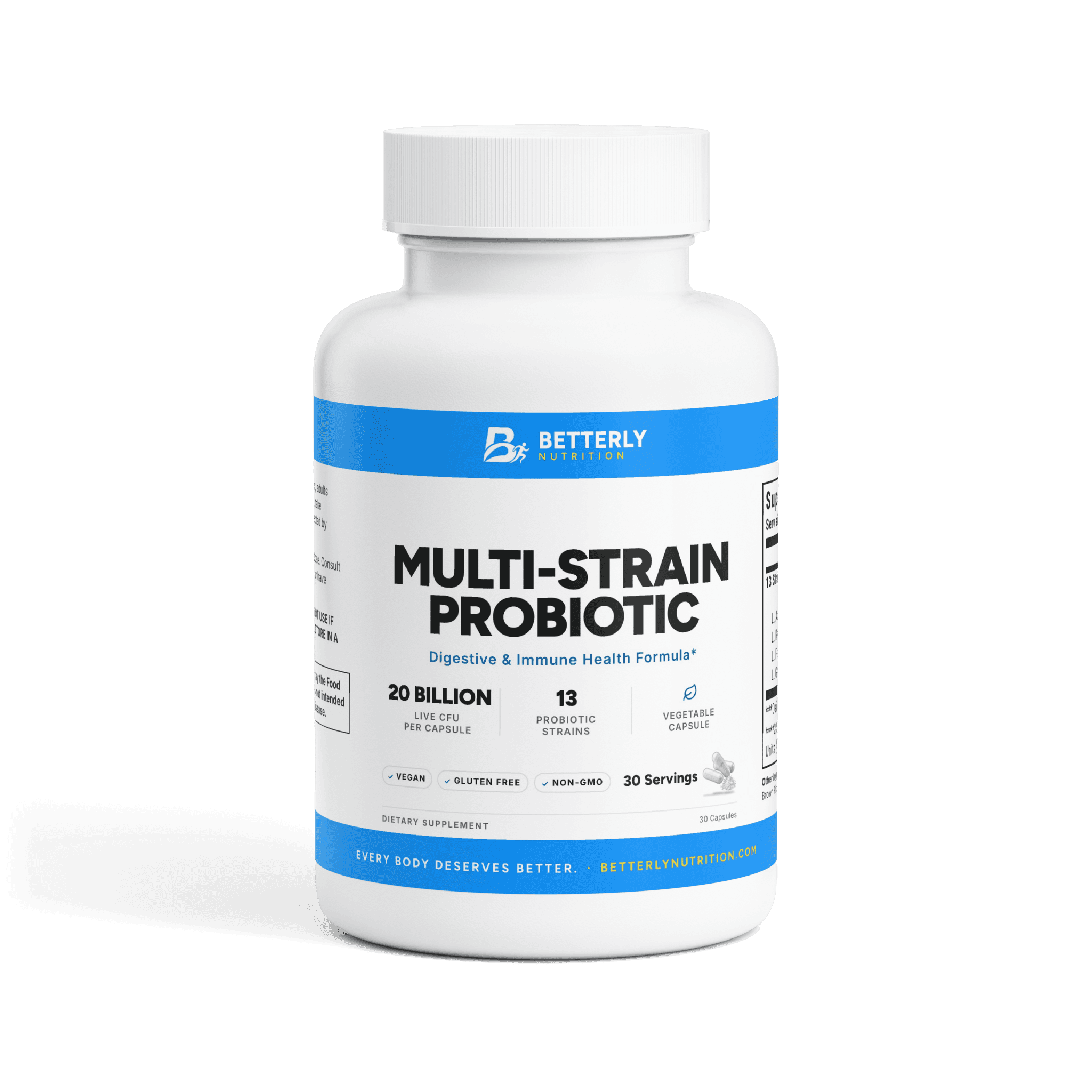
Multi-Strain Probiotic Capsules
The label's suggested use is: "adults take one (1) capsule daily. For best results, take with 6-8 oz (177-237ml) of water or as directed by healthcare professional." So pour the water first and swallow 1 capsule with it.
Per 1 Capsule serving, the panel lists a 13 Strain Probiotic blend at 317 mg (20 Billion CFU). A footnote says that count is "at the time of manufacture." The label lists vegan, gluten free and non-GMO.
That footnote is the honest limit of our label. ODS says CFU counts can decline over time, so the capsule you take may hold fewer than 20 Billion CFU. It also notes some experts favor products that state their count through the use-by date instead of at manufacture.
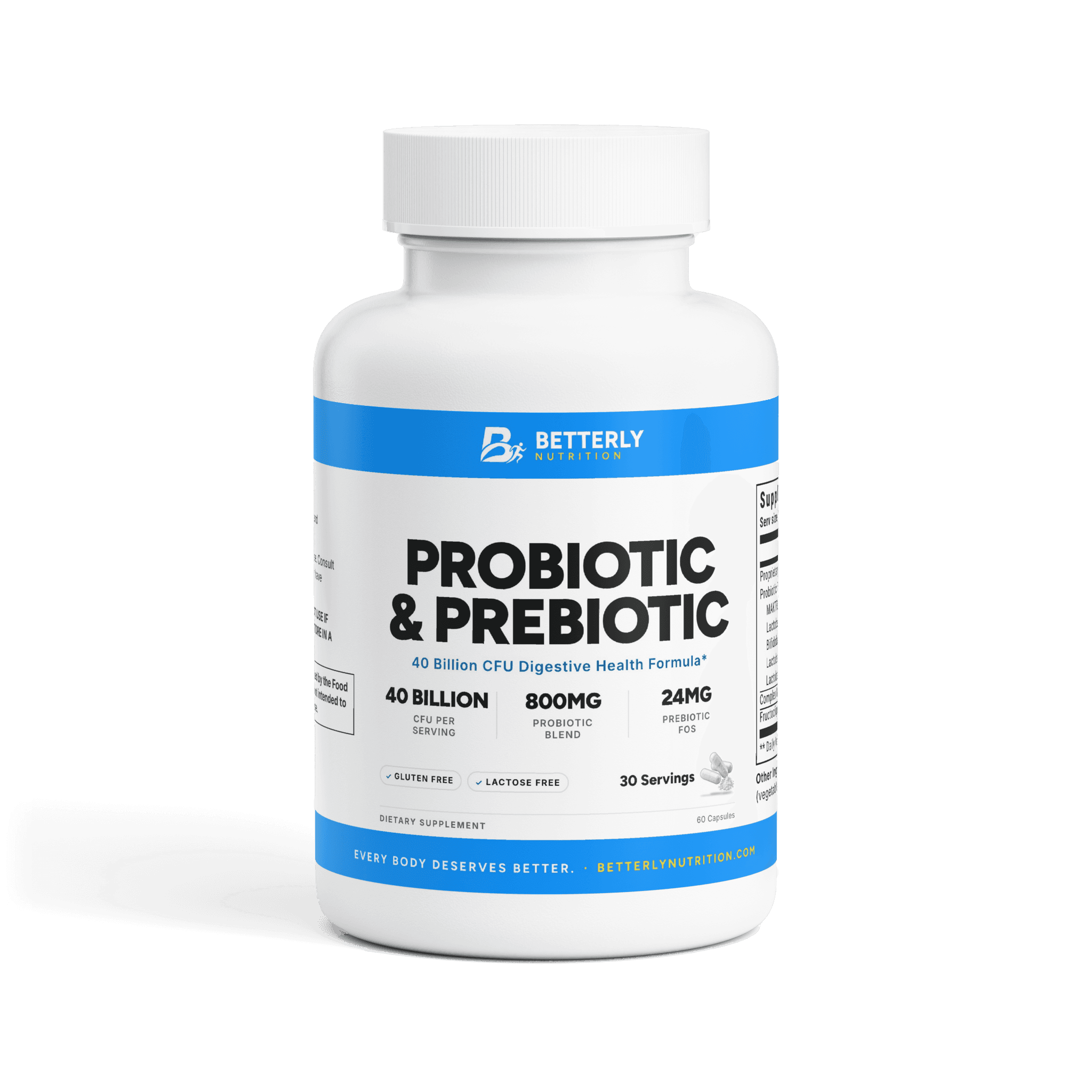
Probiotic & Prebiotic Capsules
The label's suggested use reads: "take two (2) capsules once daily. For best results, take one (1) capsule during the day and one (1) capsule in the evening."
Those sentences pull in slightly different directions. The daily total is 2 capsules either way. Taking both together follows the first sentence, and splitting them follows the "for best results" line. The label doesn't say why it prefers the split, and we won't guess.
Per 2 Capsules serving, the panel lists an 800 mg Proprietary Blend of Probiotic Bacteria (40 Billion CFU). Under it sit Lactobacillus acidophilus La-14, Bifidobacterium lactis Bl-04, Lactobacillus plantarum Lp-115 and Lactobacillus paracasei Lpc-37, plus MAKTREK® (Bi-Pass Technology), which the label doesn't explain.
The last two rows are complex marine polysaccharide (60 mg) and fructooligosaccharide, or FOS (24 mg), which the front of the bottle calls a prebiotic. NCCIH describes prebiotics as nondigestible food components that encourage the growth or activity of helpful microbes, and it calls a product with both a synbiotic.
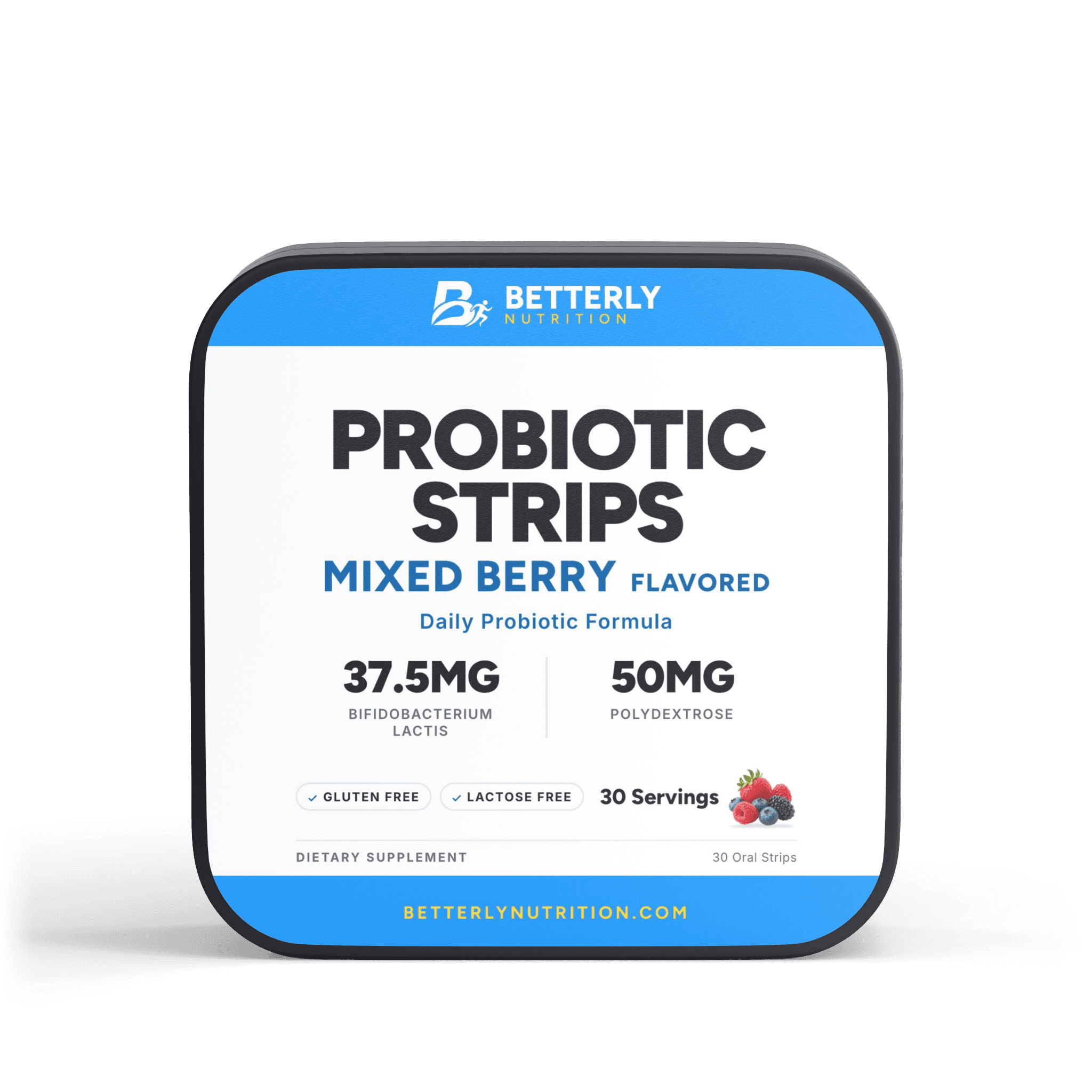
10 Billion CFU Probiotic Strips
The label's suggested use is: "Place 1 oral strip on the tongue daily and allow it to dissolve." That's all it says about taking one. Our own tip, not the label's: since the strips should be stored somewhere cool and dry, handle them with dry hands and close the container right after.
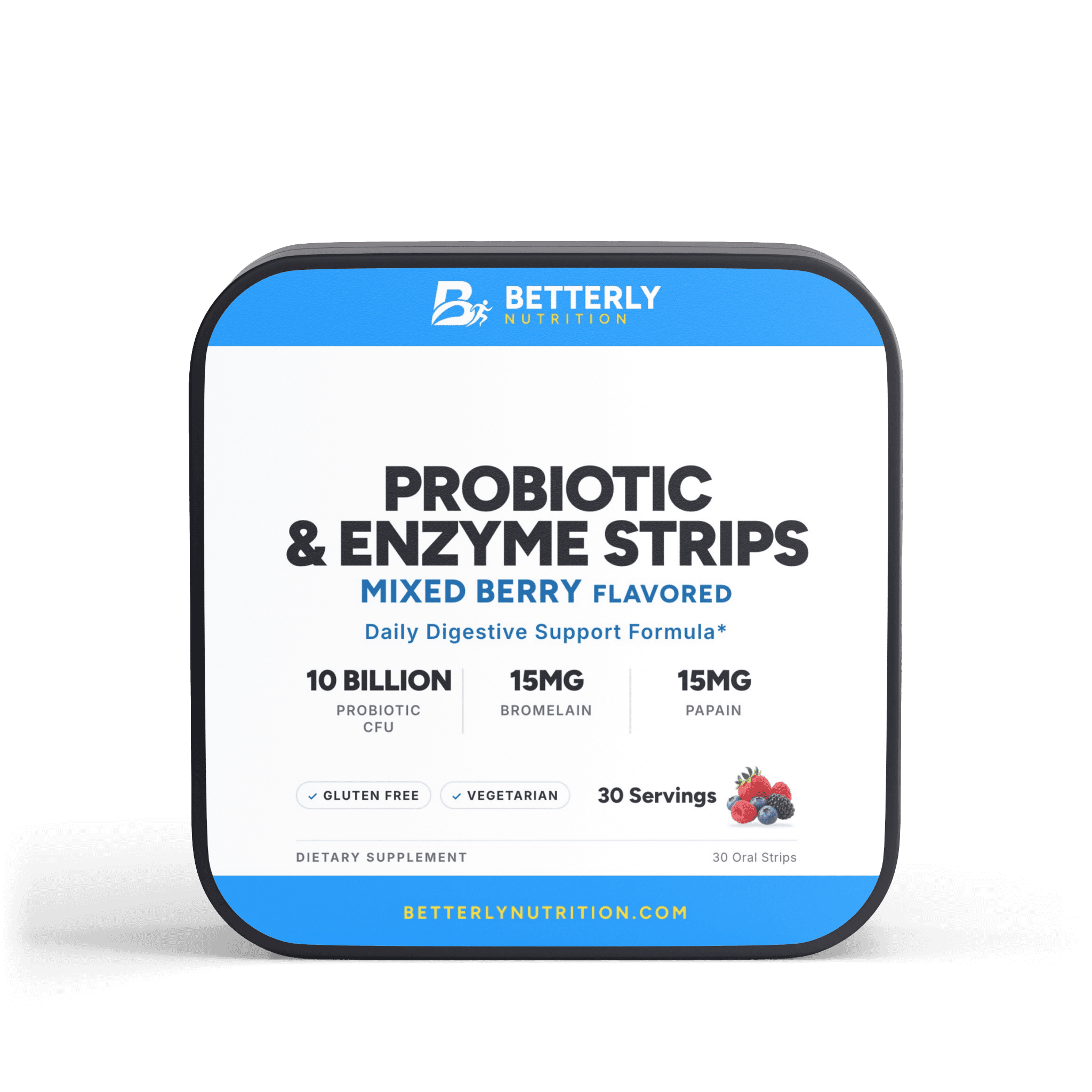
Per 1 Oral Strip (180 mg) serving, the panel has just two rows: 50 mg of polydextrose and 37.5mg (10 Billion CFU) of Bifidobacterium lactis. The strips are Mixed Berry flavored, and the other ingredients include monk fruit extract and erythritol.
From our shop: Multi-Strain Probiotic Capsules — a 13 Strain Probiotic blend at 317 mg (20 Billion CFU) per 1 Capsule serving, labeled for once-daily use with 6-8 oz of water.
Can you take probiotics with coffee or other supplements?
Our probiotic labels don't mention coffee or other supplements, so there's no label rule against either.
Online answers about coffee often warn that hot drinks harm live cultures. None of the federal pages we read covers probiotics and coffee, so we won't hand you a rule. Instead, swallow your capsule with the plain water the Multi-Strain label asks for, then drink your coffee as usual. With a strip, let it finish dissolving before your first sip.
For other supplements, the ODS guide to what you need to know about dietary supplements says you're most likely to have side effects at high doses or when you take lots of different supplements. It suggests keeping a record of each product, the dose and how often you take it.
- Add one new product at a time, so you can tell what's what.
- Read every Supplement Facts panel in your routine, because several gut products on our shelf also contain probiotics. Compare them in our gut health and digestion collection.
- If you also take a digestive enzyme, its label may tie it to meals. Our guide to digestive enzymes vs probiotics shows how the two schedules can share a day.
Do probiotics need to be taken every day?
Every one of our probiotic labels sets a daily serving, so taking yours every day is simply following the label.
That's a narrower point than "probiotics must be taken daily forever." As we noted above, ODS leaves how long to use a probiotic as a question for your provider.
Daily use still needs a plan for slip-ups. On Probiotic & Prebiotic Capsules, a forgotten evening capsule doesn't turn into three capsules tomorrow. Weekends and travel can throw a routine off, and the strips' no-water format packs easily.
If you're still choosing a product, our guide on how to read a probiotic label covers strain names and CFU wording in more depth.
From our shop: Probiotic & Prebiotic Capsules — labeled for one capsule during the day and one in the evening, for 40 Billion CFU and 24 mg of FOS per 2 Capsules serving.
Can you skip probiotics altogether?
Yes, many people can skip probiotics altogether, because for a healthy adult a probiotic is an option rather than a requirement.
A few honest reasons to skip one:
- Your digestion feels fine, and you're adding a probiotic only because everyone seems to take one.
- Working out the timing is causing more stress than the product seems worth.
- You'd rather start with food. ODS lists fermented foods such as yogurt, kimchi, sauerkraut and miso, though it notes that not every fermented food contains probiotics with shown health benefits.
Fiber-rich foods, steady sleep and regular movement are covered in our gut health basics guide, and none of them comes with a timing rule.
Who should check with a healthcare provider before taking probiotics?
Before starting a probiotic, talk to a healthcare provider if you're pregnant or nursing, under 18, on any medication, facing surgery or managing a medical condition.
Our three labels share one caution: "Consult a physician if pregnant, nursing, under 18, or have a medical condition." Beyond that label line, the NIH sources name a few more groups:
- People who are already very sick or whose immune systems are weak. ODS says probiotics might cause problems such as bacterial infections in these groups, and NCCIH says their risk of harmful effects is greater.
- Anyone taking prescription medicines. ODS says to get your provider's OK before taking supplements alongside prescribed medicines.
- Anyone with surgery coming up. ODS says to talk with your provider about every supplement you take.
- Babies and children. The shared caution above already covers anyone under 18, and only the Multi-Strain label says its directions are for adults. NCCIH notes the FDA has warned providers about serious infections in premature infants given probiotics.
NCCIH also says not to use probiotics as a reason to put off seeing a provider about a health problem. If digestive changes are new, severe or not going away, get them checked instead of adjusting your probiotic's timing.
FAQ: when to take probiotics
Should you take probiotics at the same time every day?
No, you don't have to take probiotics at the same time every day, since none of our three labels names a clock time. A steady slot is a memory aid, not a label rule. The closest thing to a schedule is the Probiotic & Prebiotic Capsules label, which suggests one capsule during the day and one in the evening. Those two can shift with your plans, as long as each lands in its half of the day.
Is it bad to miss a day of probiotics?
No, missing a day of your probiotic doesn't call for a catch-up dose, and none of our labels asks you to make one up. Take your next serving at your usual time and carry on, since all three of our probiotic labels say "Do not exceed recommended dose." If you miss days often, move your probiotic to a habit you rarely skip, like brushing your teeth.
How long should you take probiotics?
There's no official answer for how long healthy people should take probiotics. The NIH Office of Dietary Supplements lists length of use as something to ask your healthcare provider, along with which product to choose and what dose to take. Our labels give a daily serving but no end date.
Do probiotic strips need water?
No, our 10 Billion CFU Probiotic Strips don't need water. Their label says to place 1 oral strip on the tongue daily and allow it to dissolve, with no mention of a drink. Waiting until it's gone before you eat or sip anything is our own suggestion, not a label rule.
Is it safe to take probiotics every day?
For most healthy people taking probiotics within the label's daily serving, yes: NCCIH says probiotics have a long history of apparently safe use, though few studies have looked at their safety in detail. The NIH Office of Dietary Supplements adds that gas is a possible side effect for healthy people, while infections and other problems are rare. Anyone who is very sick or has a weak immune system faces more risk and should talk with a provider first.
Sources
- Probiotics: Fact Sheet for Consumers (NIH Office of Dietary Supplements)
- Dietary Supplements: What You Need to Know (NIH Office of Dietary Supplements)
- Probiotics: Usefulness and Safety (NCCIH)
If this left you looking for somewhere to start, read once-daily multi-strain probiotic capsules — its amounts per serving are listed on the page. For the practical questions this raises, how dosing, sourcing and subscriptions work is answered in one place.