On this page
- Key takeaways
- What is the best time to drink an energy drink?
- How long does an energy drink's caffeine stay in your body?
- How many hours before bed should you stop drinking energy drinks?
- Should you drink one scoop of energy powder or two?
- How do you split an energy drink across a long shift?
- When should you drink an energy drink before a workout?
- How should you take Betterly's energy powder, strips and gummies?
- When don't you need an energy drink at all?
- Who should check with a healthcare provider first?
- FAQ: energy drink timing
- Sources
The short answer: The best time to drink an energy drink is in the morning, about an hour before you need focus. Stop any caffeine at least 8 hours before bed, the NHLBI's figure for how long its effects can last, and finish a full 200 mg serving by late morning. That's because a double dose needs one more half-life, which a 2010 FDA memo puts at 2 to 6 hours, to fall as low.
Betterly sells the energy powder, strips and gummies below, so we'd like you to use one. Check our math anyway: every milligram comes off our labels, and the timing figures come from the FDA, the NHLBI and MedlinePlus.
Key takeaways
- Caffeine peaks in your blood within one hour, per MedlinePlus, so drink an energy drink shortly before you need to be sharp.
- The NHLBI says caffeine's effects can last up to 8 hours, so stop any energy drink, strips included, 8 hours before bed.
- A full 200 mg serving needs one more half-life to fall as low as a single scoop, so finish it by late morning.
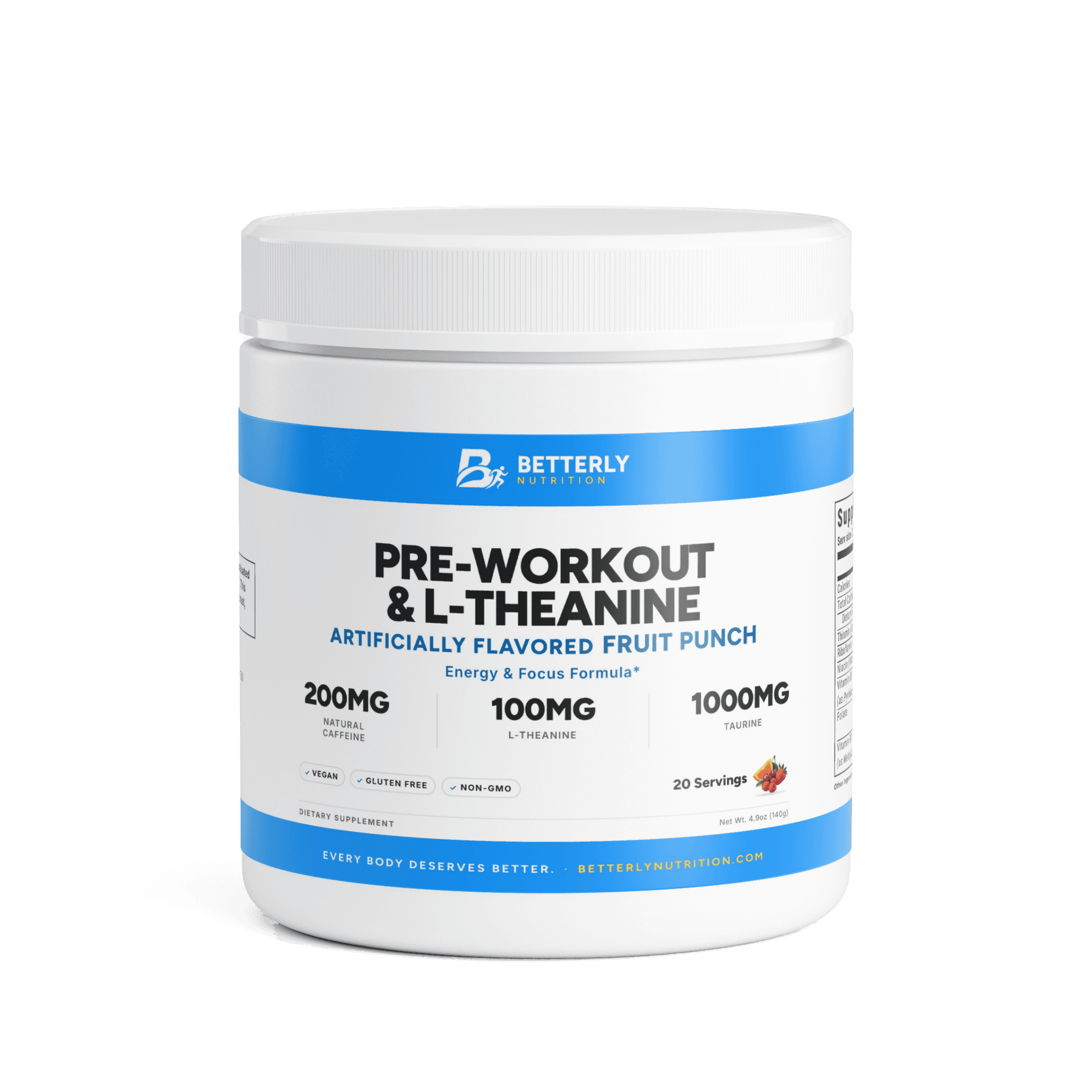
- Betterly's Pre-Workout Caffeine & L-Theanine Energy Powder (Fruit Punch) lists 200 mg of caffeine per 2-scoop (7g) serving, and its directions also allow a single 100 mg scoop.
- The tub's caution allows up to 5 scoops, or 500 mg of caffeine, a day, above the 400 mg the FDA cites for most adults, so we don't recommend that amount.
What is the best time to drink an energy drink?
Early in your waking day is the best time for an energy drink, about an hour before you need focus and as many hours as possible before sleep.
Think of two clocks. The first is short. MedlinePlus explains that caffeine hits its peak level in your blood within one hour, and that you may keep feeling it for four to six hours. So a drink at 8 a.m. is near full strength by 9 and easing off by early afternoon.
The second clock is long, and it's the one most "anytime" advice skips. Feeling the effect fade doesn't mean the caffeine is gone. Morning is simply where the bedtime math is most forgiving.
How long does an energy drink's caffeine stay in your body?
An energy drink's caffeine lingers for many hours, since the FDA memo puts its average half-life in healthy adults at 2 to 6 hours, and up to 12 for some.
Half-life is the time your body takes to clear half of what's there. After one, 200 mg becomes 100 mg; after two, 50 mg. That slow taper is why a mid-afternoon drink can still be around at bedtime.
The FDA's consumer page on caffeine notes wide variation in how sensitive people are to caffeine and how fast they eliminate it. The FDA's 2010 scientific memo adds that caffeine breaks down more slowly in later pregnancy and with long-term use of oral contraceptives.
How many hours before bed should you stop drinking energy drinks?
By the NHLBI's 8-hour figure and our half-life math, stop any energy drink at least 8 hours before bed, and finish a full 200 mg serving by late morning.
The 8 hours come from the National Heart, Lung, and Blood Institute's healthy sleep habits page, which says "The effects of caffeine can last up to 8 hours." We treat that as the floor for anything with caffeine, strips included, since it's about how long effects last, not dose size.
The earlier line for a full serving is our arithmetic, using one drink, an 11 p.m. bedtime and a 4- or 6-hour half-life, the slower part of the memo's range. A 100 mg scoop finished at the 8-hour line leaves 25 to 40 mg at bedtime, and that's our reference point. Doubling the dose takes one more half-life, another 4 to 6 hours, to fall that low, so a 200 mg serving's cut-off sits 12 to 14 hours before bed.
| Last sip (hours before 11 p.m.) | Strip (50 mg) | 1 scoop (100 mg) | 2 scoops (200 mg) |
|---|---|---|---|
| 9 a.m. (14 hours) | 4 to 10 mg | 9 to 20 mg | 18 to 40 mg |
| 11 a.m. (12 hours) | 6 to 13 mg | 13 to 25 mg | 25 to 50 mg |
| 3 p.m. (8 hours) | 13 to 20 mg | 25 to 40 mg | 50 to 79 mg |
| 6 p.m. (5 hours) | 21 to 28 mg | 42 to 56 mg | 84 to 112 mg |
A full serving stays at or under that band's 40 mg top at both half-lives only if you finish by 9 a.m. At 11 a.m. it leaves 25 to 50 mg, so we say late morning, or earlier if caffeine tends to stay with you. At the bottom right, a double finished at 6 p.m. can leave 84 to 112 mg, near the low end of the 95 to 200 mg MedlinePlus lists for an 8-ounce coffee.
This is arithmetic, not a blood test, and our band isn't a safe level. No federal page we used names a bedtime amount that's fine for sleep.
MedlinePlus's guide to changing your sleep habits includes avoiding drinks with caffeine or alcohol in the evening. With an 11 p.m. bedtime, the cut-offs land at 3 p.m. for a strip or a single scoop and 9 to 11 a.m. for a full serving. Earlier sleeper? Slide each one back.
Late caffeine is often one piece of a restless evening, and our routine for quieting a busy mind at bedtime covers the rest.
Should you drink one scoop of energy powder or two?
One scoop of Betterly's energy powder, 100 mg of caffeine, suits early afternoons and coffee days, while the full 200 mg serving fits a morning with no other caffeine.
The single scoop isn't a workaround. It's the first option on the Pre-Workout Caffeine & L-Theanine Energy Powder (Fruit Punch) label: "Mix 1 scoop with 6–10 fl oz (177–296 mL) of water, or to taste. Use 2 scoops with double the water."
For scale, one scoop matches the top of the 70 to 100 mg MedlinePlus gives for an 8-ounce energy drink. The full 2-scoop (7g) serving is half the 400 mg a day the FDA cites for most adults.
| Your day so far | Pick | Caffeine added | Why |
|---|---|---|---|
| Morning, no coffee yet | 2 scoops in 12–20 fl oz | 200 mg | Finish by late morning |
| Had a 12-oz brewed coffee | 1 scoop, or skip it | 0 to 100 mg | FDA: that cup holds 113 to 247 mg |
| Early afternoon | 1 scoop or 1 strip | 50 to 100 mg | Only if it's 8+ hours before bed |
| Late afternoon | A gummy, or nothing | 0 mg | Inside 8 hours of most bedtimes |
| Evening | Nothing with caffeine | 0 mg | MedlinePlus: skip it in the evening |
The pattern is plain: the later it gets, the smaller the dose, until it's none. A double scoop on top of a big brewed coffee reaches 313 to 447 mg, which can pass the FDA's daily figure before lunch.
The 100 mg of L-theanine in each 2-scoop serving doesn't reset that clock. We know of no federal source showing it offsets caffeine at bedtime.
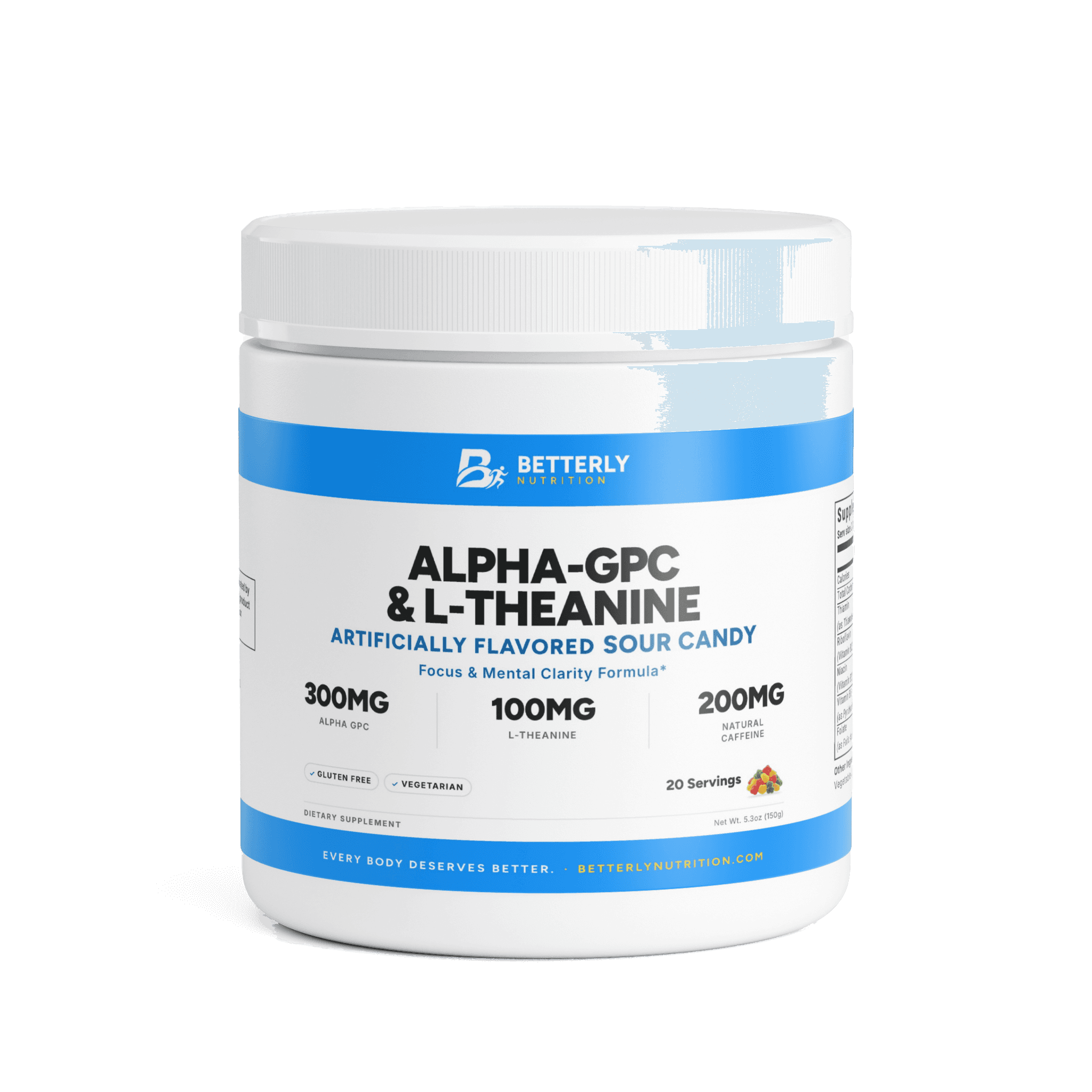
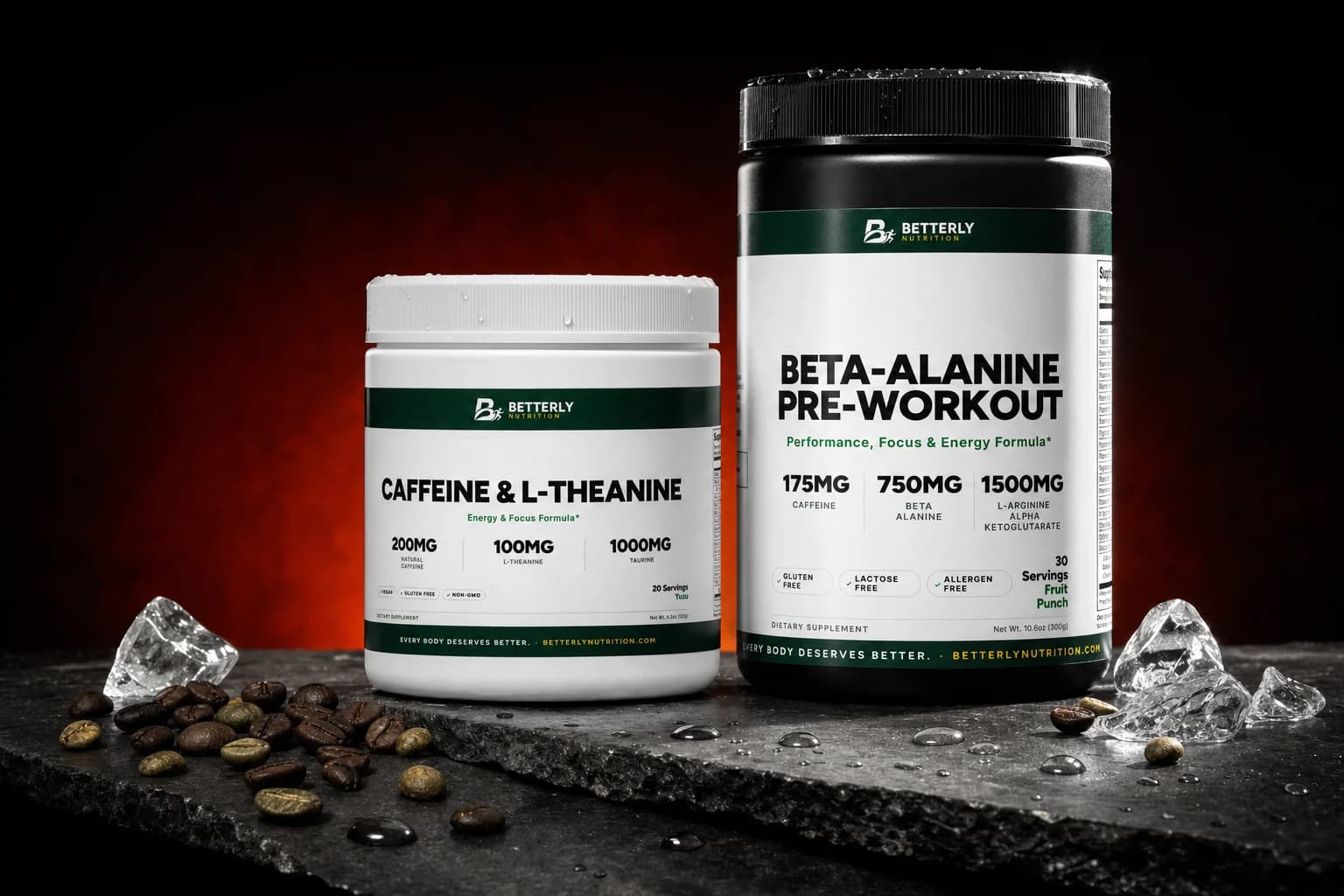
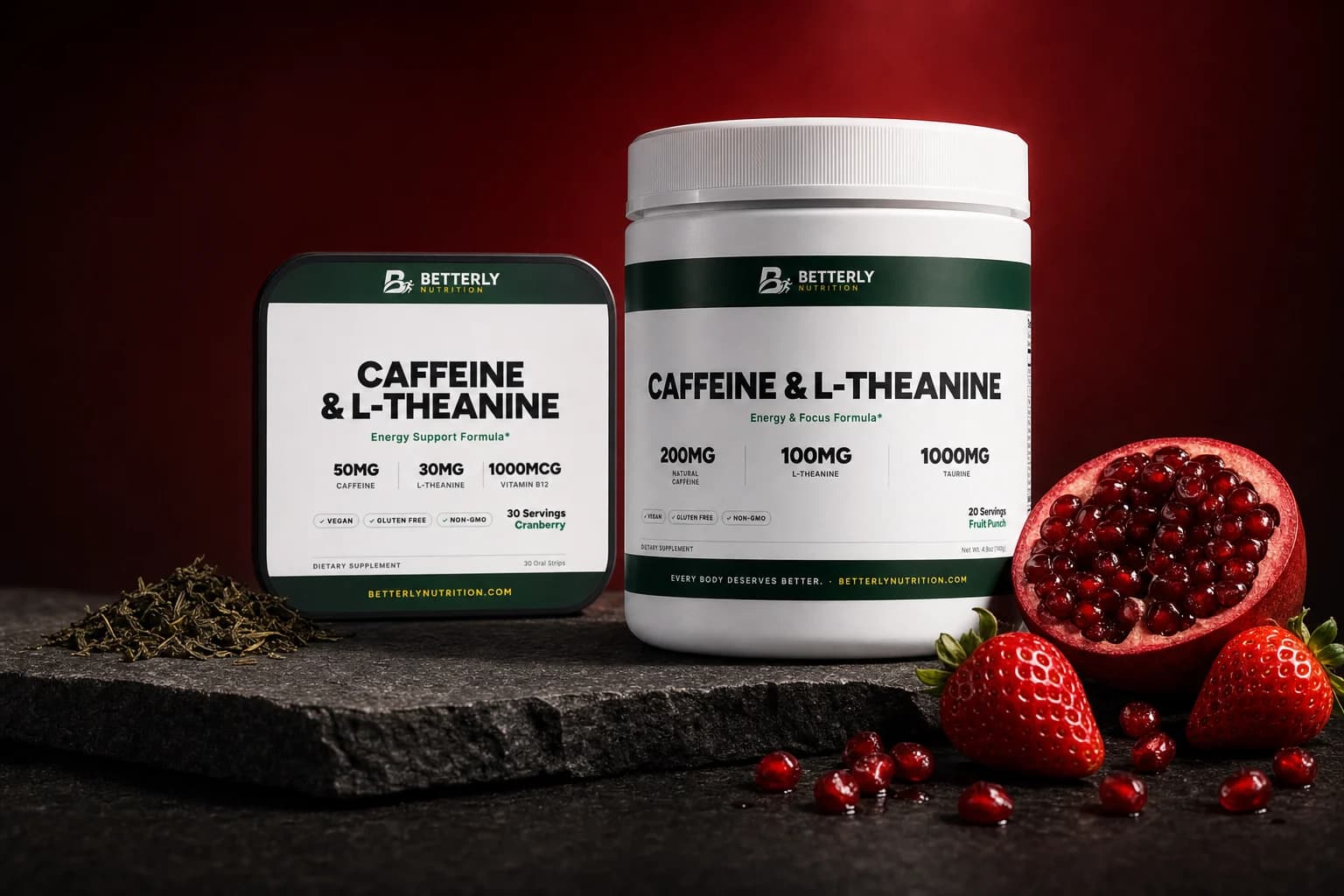
From our shop: Pre-Workout Caffeine & L-Theanine Energy Powder (Fruit Punch) — 200 mg of natural caffeine from green tea, 100 mg of L-theanine and 1000 mg of taurine per 2-scoop (7g) serving, with 20 servings per tub.
How do you split an energy drink across a long shift?
To stretch Betterly's energy powder across a long shift, mix the 2-scoop serving as two 1-scoop drinks a few hours apart, and finish both early in the shift.
The day's total stays at 200 mg, and MedlinePlus's four-to-six-hour window for feeling caffeine makes a sensible gap. The NHLBI's sleep page gives shift workers the same steer: limit caffeine to the first part of your shift. For a 7 a.m. to 7 p.m. shift and an 11 p.m. bedtime:
- Mix 1 scoop with 6 to 10 fl oz of water as the shift starts.
- Mix the second scoop around 11 a.m.
- Stop there, well ahead of the 3 p.m. cut-off.
By our math, that leaves about 19 to 41 mg at 11 p.m., less than a full serving finished at 11 a.m.
On nights, count back from when you'll actually sleep. Sleep at 8 a.m., and your 8-hour line is midnight. Scoops at 7 p.m. and 11 p.m. clear it, yet by our math leave 32 to 58 mg at 8 a.m., since the gap before sleep is shorter. One scoop at the 7 p.m. start leaves 11 to 22 mg.
Don't let splitting turn into stacking: two single scoops make one serving, not permission for four. Our Energy Support collection includes smaller doses and options with no caffeine on the label.
When should you drink an energy drink before a workout?
Before a workout, drink an energy drink a little ahead of your start, and only when that sip still lands at least 8 hours before bed.
Our powder's label gives no workout timing. For the NIH's pre-exercise window and how a true pre-workout differs, see our pre-workout vs energy drink comparison.
Evening sessions are the tricky case: a 6 p.m. double scoop lands in the table's bottom row. On late-training days, skip caffeine, since even a 50 mg strip falls inside the 8-hour window.
How should you take Betterly's energy powder, strips and gummies?
Take each Betterly energy product exactly as its label says: 1 or 2 scoops of powder in water, 1 strip a day, or 1 to 2 gummies a day.
- Energy powder. Mix 1 scoop with 6 to 10 fl oz of water, or 2 scoops with double the water.
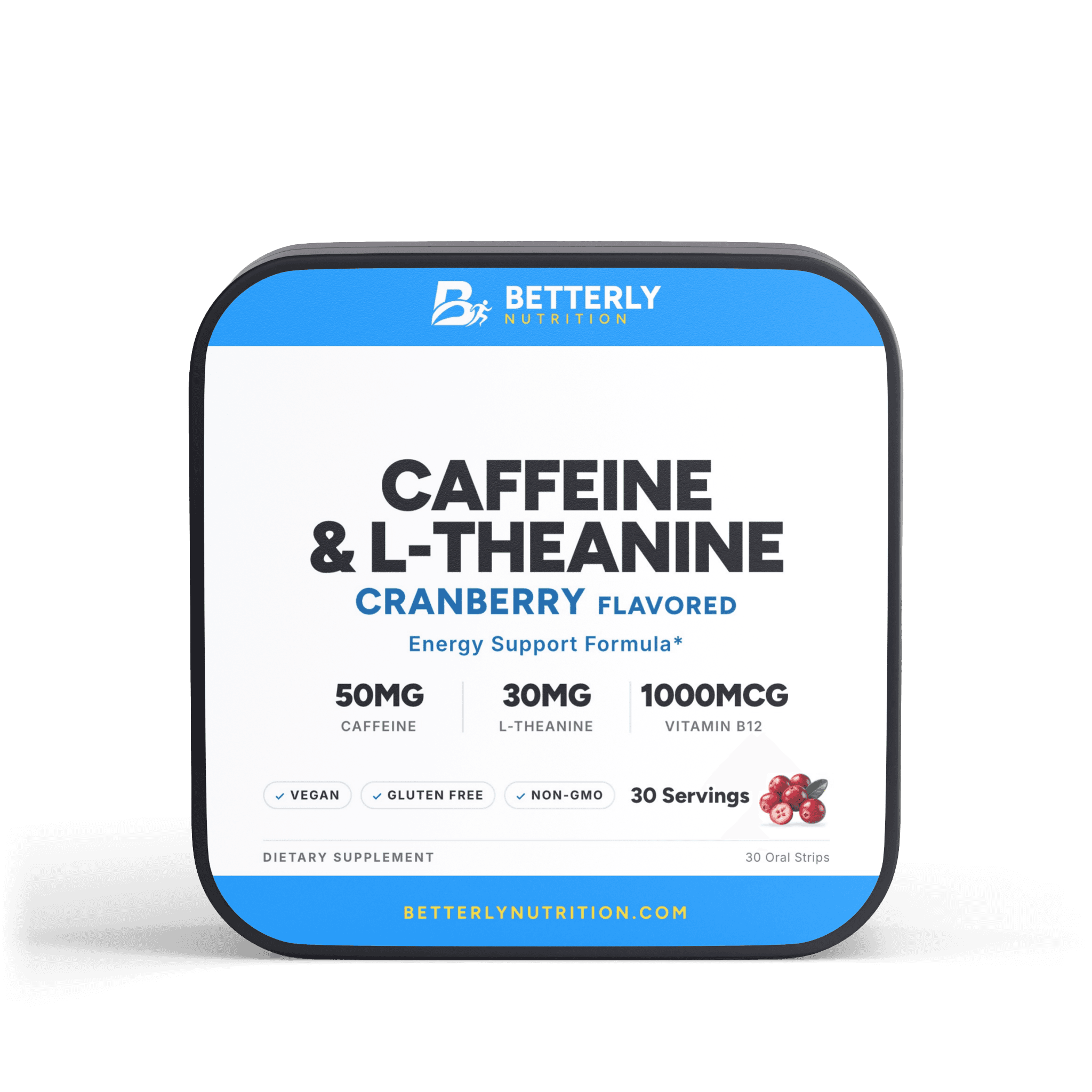
- Energy strips. The Caffeine & L-Theanine Energy Strips label says to place 1 oral strip on the tongue daily and let it dissolve. Each 1 oral strip (290mg) serving lists 50 mg of caffeine, 30 mg of L-theanine and 1000 mcg of vitamin B12, and our guide to whether 50 mg of caffeine is a lot puts that in context.
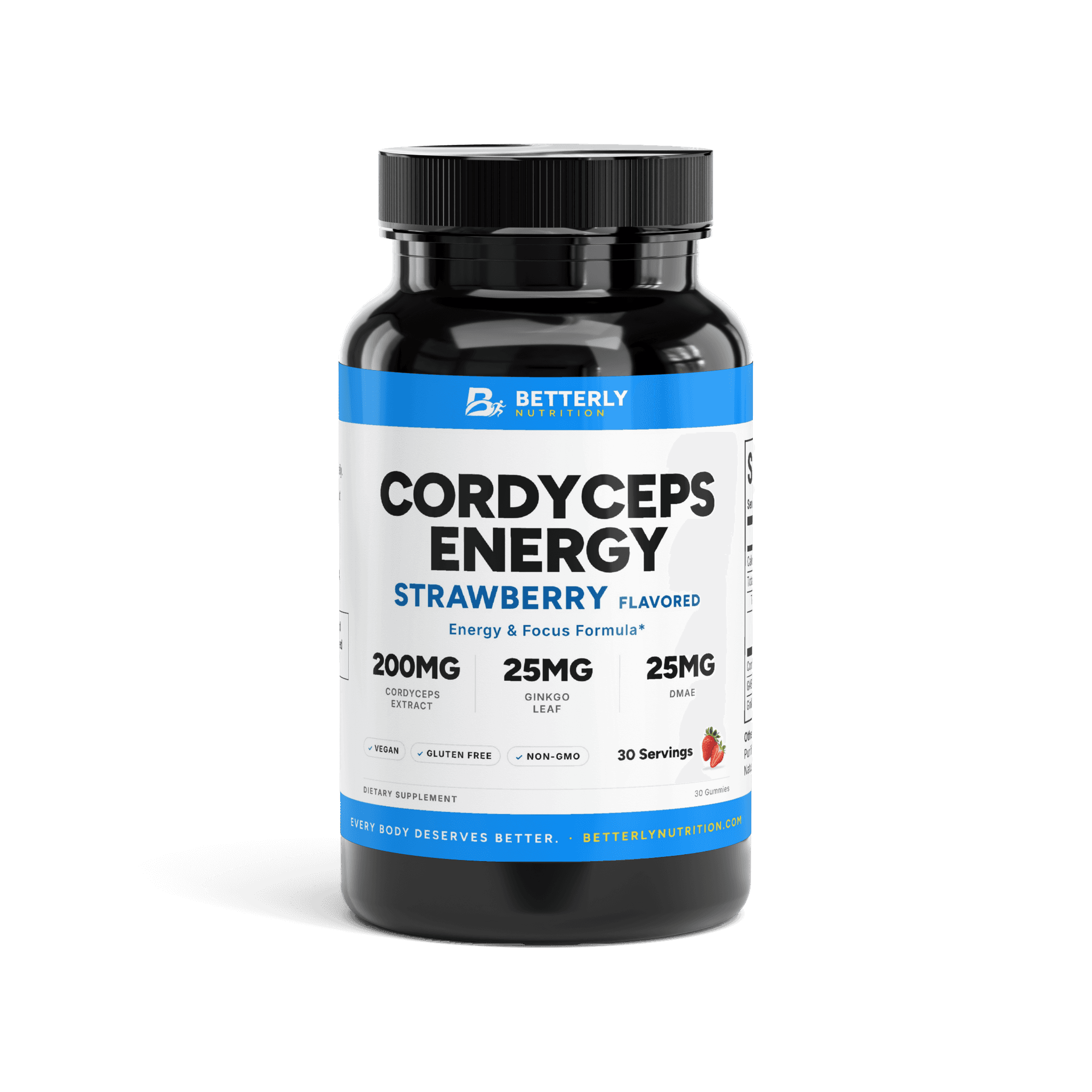
- Cordyceps gummies. The Cordyceps Mushroom Energy Gummies label says one to two gummies daily. Each 1-gummy serving lists 200 mg of cordyceps extract, 25 mg each of GABA, ginkgo leaf, L-glutamine and DMAE, and 2 g of added sugars.
The gummy's front label says "Energy & Focus Formula," but its panel lists no caffeine, so don't expect it to feel like a scoop. Its job here is narrow: it adds nothing to your bedtime total.
The tub's caution line says "Do not exceed 5 scoops daily." At 100 mg a scoop, that ceiling works out to 500 mg of caffeine, 25% above the 400 mg a day the FDA cites for most adults. We won't recommend a day at that level. If you're considering more than one 2-scoop serving in a day, talk with a healthcare provider first.
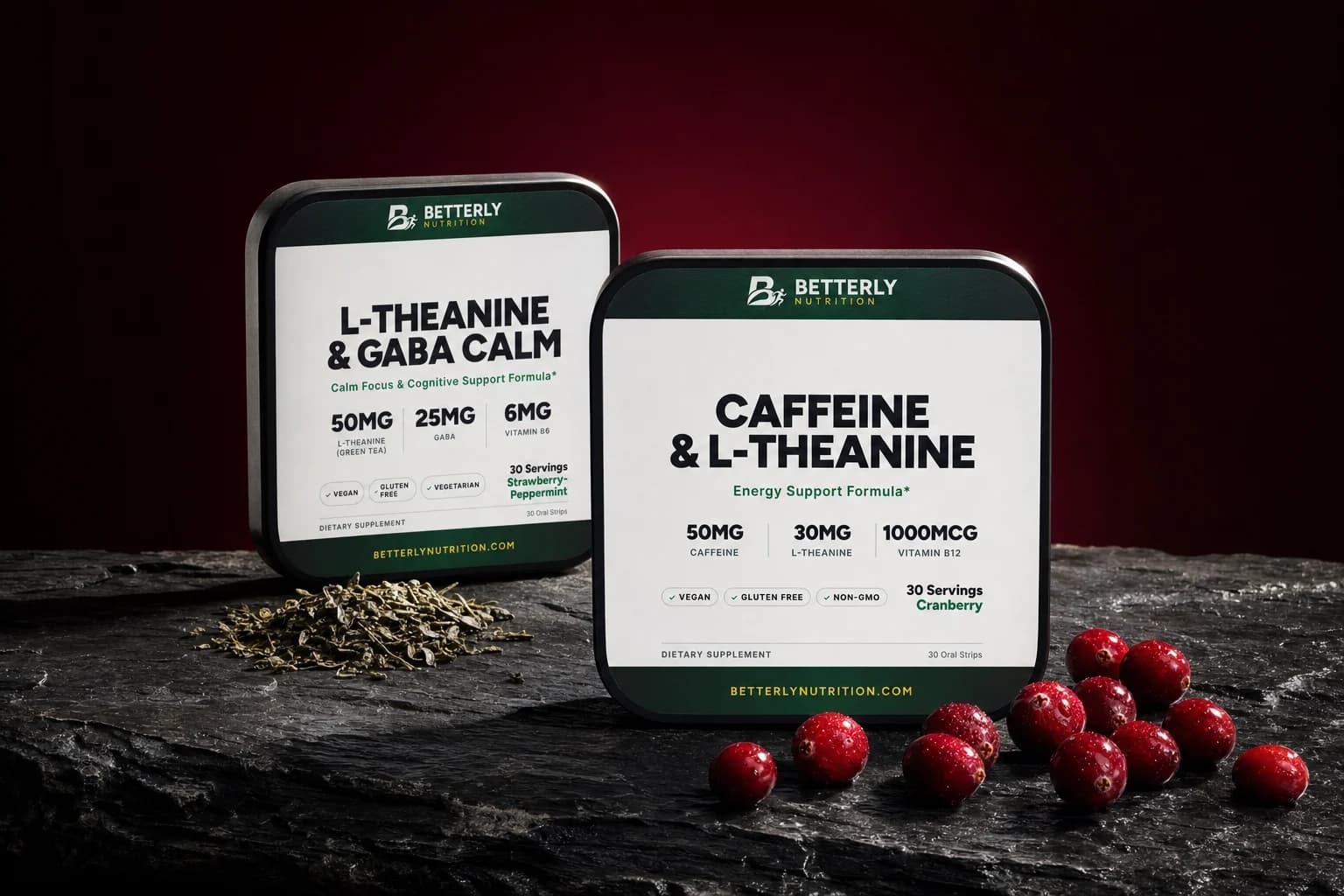
From our shop: Caffeine & L-Theanine Energy Strips — a cranberry-flavored oral strip listing 50 mg of caffeine, 30 mg of L-theanine and 1000 mcg of vitamin B12 per 1 oral strip (290mg) serving, with 30 strips per pack.
When don't you need an energy drink at all?
You don't need an energy drink when your usual coffee already covers you, when it's past your cut-off, or when a short night is why you're dragging.
- Your coffee does the job. The FDA puts a 12-ounce brewed coffee at 113 to 247 mg on its own.
- You slept badly. A drink can mask a short night for a few hours but can't repay it, and a late one risks tonight's sleep too.
- Small amounts make you jittery. Jitters are on the FDA's list of signs of too much caffeine.
If you'd rather cut caffeine than retime it, we compare energy options with no caffeine on the label instead.
Who should check with a healthcare provider first?
Talk to a healthcare provider before using any energy drink if you're pregnant or nursing, under 18, taking medication, managing a medical condition, or have surgery coming up.
The powder's caution names pregnancy, nursing, medication and medical conditions, and the strip and gummy labels add anyone under 18.
MedlinePlus says to ask your provider about caffeine if you take certain medicines or supplements, including stimulants, certain antibiotics and some heart medicines. The FDA notes that medical experts advise kids and teens to skip energy drinks. Having surgery? Tell your care team about every caffeine product you use.
If you notice signs of too much caffeine, which the FDA says include a faster heart rate, jitters, nausea and headache, stop and check in with a healthcare provider.
FAQ: energy drink timing
Is it bad to drink an energy drink at night?
Yes, for most people an energy drink at night works against sleep. The NHLBI says caffeine's effects can last up to 8 hours, and MedlinePlus's sleep-habits advice includes avoiding caffeinated drinks in the evening. By our half-life math, a 200 mg serving finished at 6 p.m. can leave 84 to 112 mg in your body at 11 p.m.
How long does an energy drink take to kick in?
An energy drink's caffeine reaches its peak level in your blood within one hour, according to MedlinePlus, and you may keep feeling it for four to six hours. The FDA notes wide variation in how sensitive people are to caffeine, so the same scoop can feel different to two people.
Can you drink an energy drink on an empty stomach?
Betterly's powder label names no meal timing, so it doesn't rule an empty stomach in or out. MedlinePlus notes that caffeine makes your stomach release more acid, which can upset some stomachs. If yours complains, the directions leave room for a smaller drink: 1 scoop, or 100 mg, in the full 10 fl oz of water. You can also split the 2-scoop serving into two single scoops a few hours apart, as in the shift plan above.
Can you drink an energy drink every morning?
Yes, a daily morning energy drink fits our labels, as long as your whole day's caffeine, coffee and tea included, stays at or under 400 mg, the FDA's figure for most adults. If you later want to stop, the FDA suggests cutting back gradually. MedlinePlus says quitting suddenly can bring headaches, drowsiness and irritability.
Sources
- U.S. Food and Drug Administration: Spilling the Beans: How Much Caffeine Is Too Much?
- U.S. Food and Drug Administration: Scientific Memorandum: Review of the Safety of Caffeine Added to Alcoholic Beverages (2010)
- National Heart, Lung, and Blood Institute: Sleep Deprivation and Deficiency: Healthy Sleep Habits
- MedlinePlus: Caffeine
- MedlinePlus Medical Encyclopedia: Changing Your Sleep Habits
If this left you looking for somewhere to start, read energy drink mix with 100 mg of caffeine per scoop — its amounts per serving are listed on the page. For the practical questions this raises, how dosing, sourcing and subscriptions work is answered in one place.