On this page
- Key takeaways
- Korean red ginseng vs Panax ginseng: are they the same plant?
- Red ginseng vs white ginseng: what does the color change?
- What are ginsenosides, and why do labels list a percentage?
- American ginseng vs Panax ginseng: what's the difference?
- Siberian ginseng vs Panax ginseng: is eleuthero a true ginseng?
- How do three of our ginseng labels compare?
- How should you take a Panax ginseng supplement?
- When don't you need a ginseng supplement?
- Who should check with a healthcare provider before taking ginseng?
- FAQ: Korean red ginseng and other ginseng types
- Sources
The short answer: Korean red ginseng vs Panax ginseng isn't a contest between two plants. Panax ginseng is the species, also sold as Asian or Korean ginseng. "Red" describes a root that was steamed, while white ginseng is simply dried. So every Korean red ginseng is Panax ginseng. American ginseng is a separate Panax species, and Siberian ginseng isn't a Panax at all.
Key takeaways
- Korean red ginseng, white ginseng, Asian ginseng and Korean ginseng are all names for one species, Panax ginseng, and the colors describe processing.
- American ginseng is Panax quinquefolius, a different species in the same genus, and the NIH says Siberian ginseng (eleuthero) isn't related to true ginseng.
- Ginsenosides are the compounds NCCIH says are thought to matter most in Asian ginseng, and a "standardized to 7%" line tells you their share of an extract.
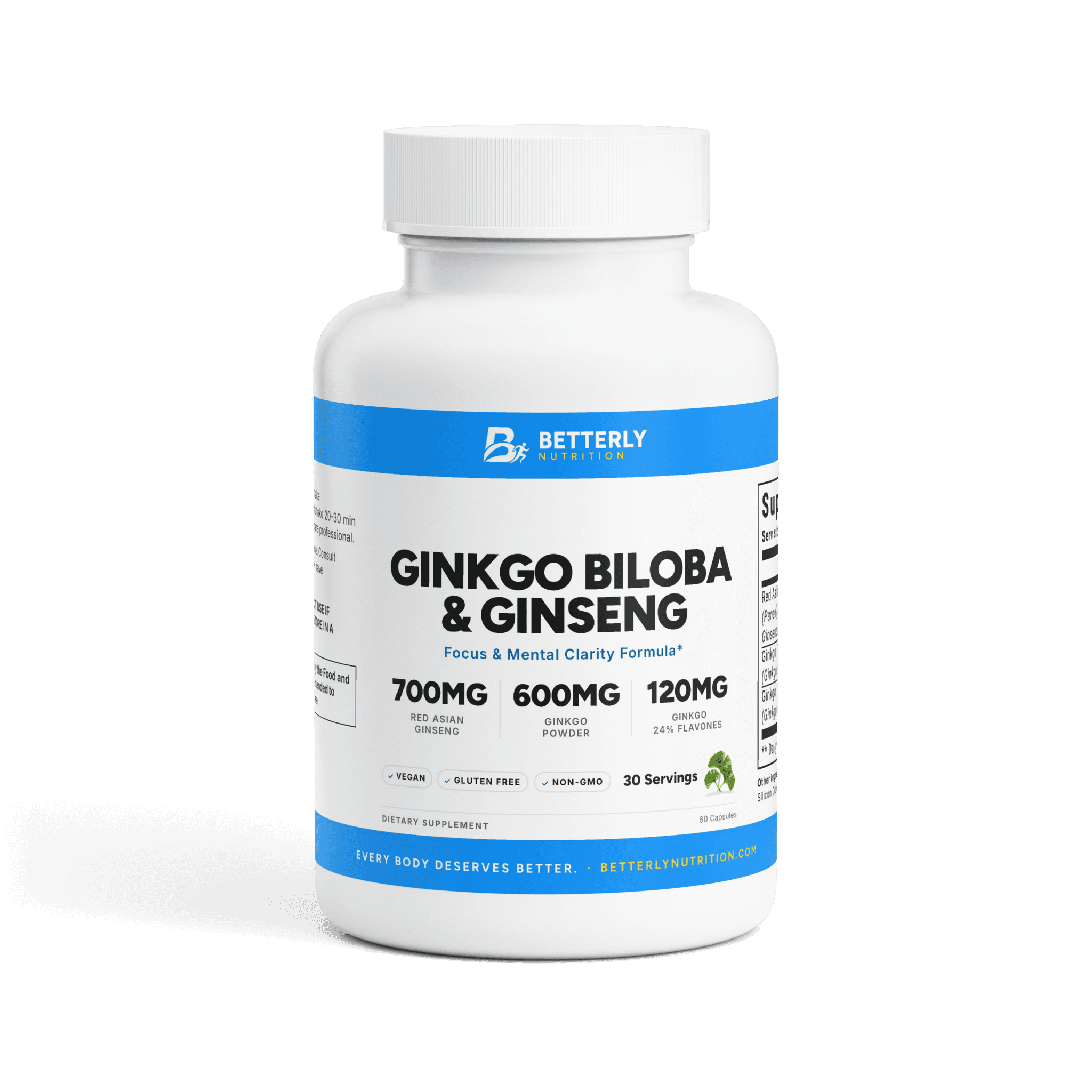
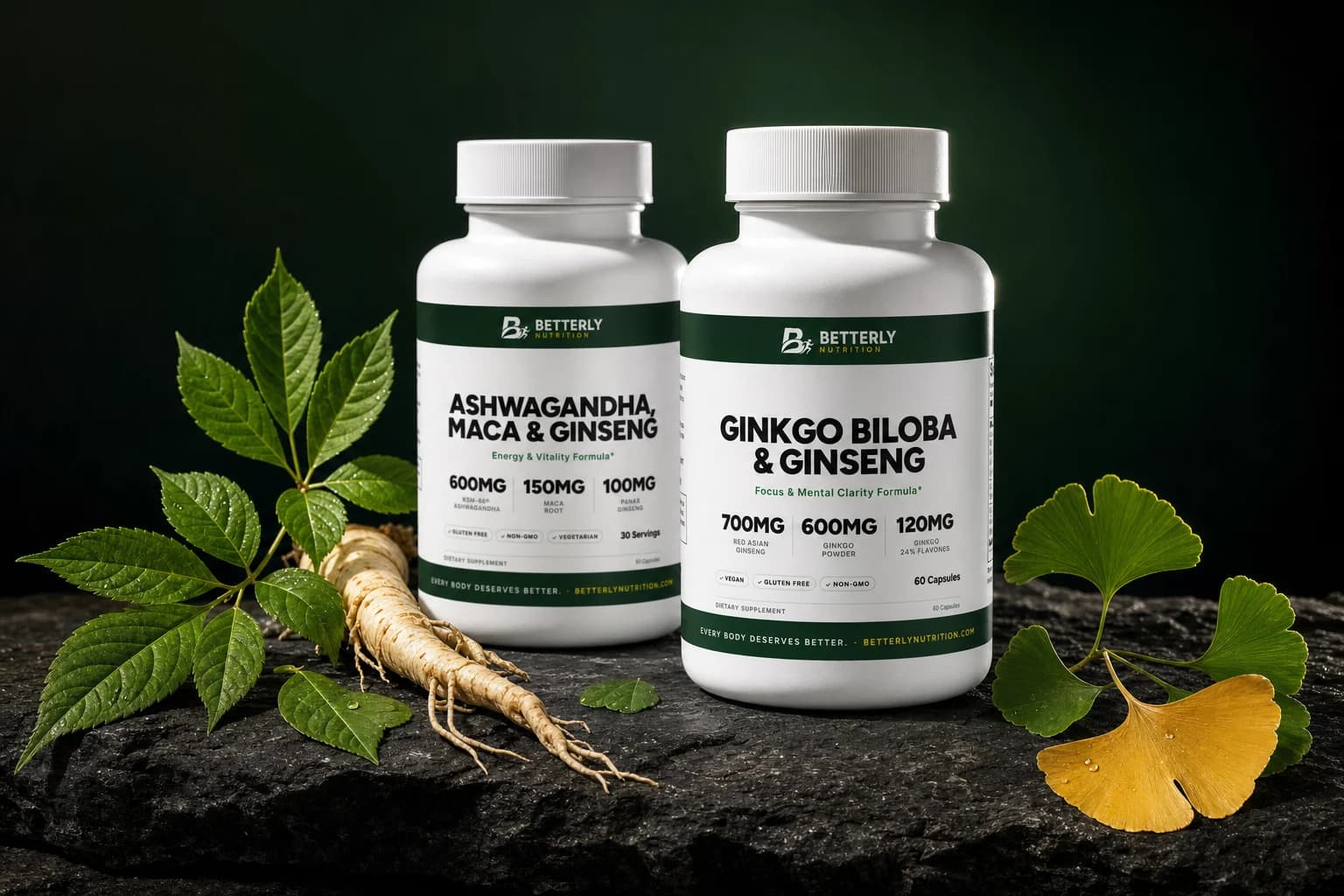
- Betterly's Ginkgo Biloba & Ginseng Capsules list 700 mg of red Asian ginseng extract, standardized to 7% ginsenosides, per 2-capsule serving, taken from stem and leaf rather than root.
Full disclosure: we sell ginseng in more Betterly formulas than you might expect, sometimes in the product name and sometimes as one small row in a blend. This guide reads three of those labels closely, with numbers copied from their Supplement Facts panels, vague spots included.
Korean red ginseng vs Panax ginseng: are they the same plant?
Yes. Korean red ginseng is Panax ginseng root that's been steamed, so it's one preparation of the species, not a rival to it.
The National Center for Complementary and Integrative Health (NCCIH) lists Asian ginseng, Chinese ginseng, Korean ginseng, red ginseng and white ginseng as common names for a single Latin name, Panax ginseng. The plant is native to Korea, northeastern China and far-eastern Siberia.
Each word on a package does its own job. "Panax ginseng" names the plant, "Korean" points to origin or tradition, and "red" or "white" tells you what happened to the root after harvest.
| Name on the package | Plant | What the name tells you |
|---|---|---|
| Panax ginseng, Asian ginseng | Panax ginseng | The species only |
| Korean red ginseng | Panax ginseng | Steamed after harvest |
| White ginseng | Panax ginseng | Dried without steaming |
| American ginseng | Panax quinquefolius | A different species |
| Siberian ginseng, eleuthero | Eleutherococcus senticosus | Not a Panax |
Only the last two rows change the plant itself. Everything above them is the same species, handled or marketed differently. If a label names Panax ginseng, you already know which ginseng you're getting.
Red ginseng vs white ginseng: what does the color change?
Red ginseng's name points to processing: the root is steamed after harvest, while white ginseng is simply dried. Both start as the same Panax ginseng root.
A 2018 Planta Medica review, listed among the NCCIH page's references, describes dried white ginseng and steamed red ginseng as the two most common traditional ways to handle the harvest. Its authors say large-scale growing created a need for long-term storage, which sped up the development of these methods.
The same review describes the two forms as having different chemical makeups. Red is often marketed as the stronger form, but a different chemical profile isn't proof of a bigger effect.
On a label, the color word tells you less than the plant part, the ginsenoside percentage and the amount per serving. A package can say "red" and skip all three.
What are ginsenosides, and why do labels list a percentage?
Ginsenosides are the natural compounds NCCIH names as the substances thought to matter most in Asian ginseng. You may also see them called panaxosides.
Because an extract is a concentrate, its maker can measure the ginsenoside share and print it. "Standardized to 7% ginsenosides" means they should make up 7% of the extract's weight.
Betterly's Ginkgo Biloba & Ginseng Capsules list 700 mg of red Asian ginseng extract per 2-capsule serving, standardized to 7% ginsenosides. Seven percent of 700 mg is 49 mg of ginsenosides per serving. The label's suggested use is two servings a day, which works out to 98 mg a day.
A plain root powder usually prints no percentage, so that math isn't possible. Ginsenosides have no Daily Value either, and a bigger number tells you what's in the capsule, not what it will do.
American ginseng vs Panax ginseng: what's the difference?
American ginseng is Panax quinquefolius, a separate species in the same Panax genus. Panax ginseng is the Asian species behind Korean red ginseng.
Both count as true ginsengs. The NIH Office of Dietary Supplements (ODS) consumer fact sheet on immune function describes ginseng as Panax ginseng or Panax quinquefolius.
Sharing a genus doesn't make them interchangeable, so research on one doesn't automatically carry over to the other. If a product just says "ginseng," find the Latin name first.
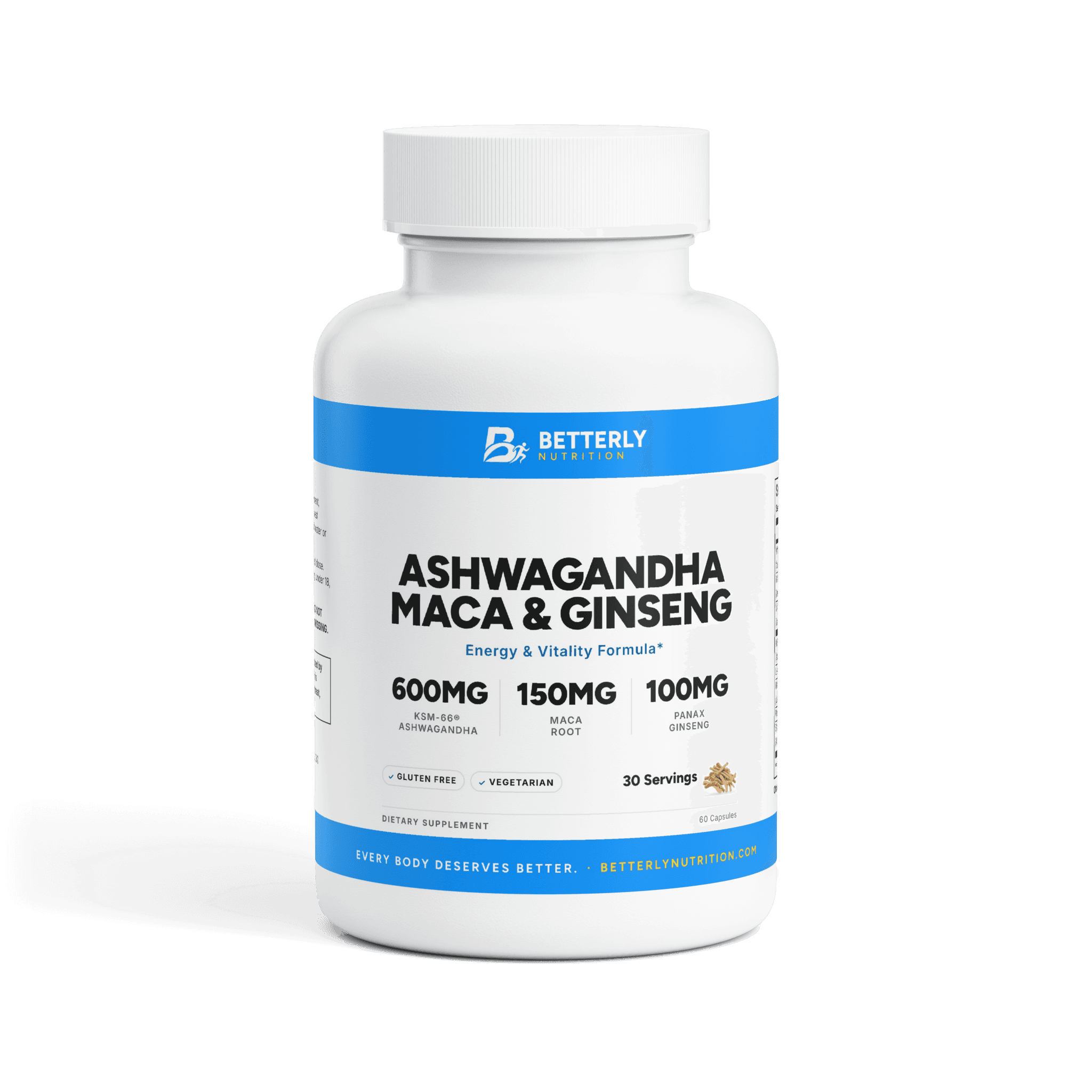
Here's a catch on our own label. The Ginkgo Biloba & Ginseng panel calls its extract "Red Asian Ginseng Extract (Panax)." The word "Asian" points to Panax ginseng, but the parentheses name only the genus. Our Ashwagandha, Maca & Ginseng panel is clearer and prints "Panax Ginseng" outright. None of our labels lists American ginseng.
Siberian ginseng vs Panax ginseng: is eleuthero a true ginseng?
No. Siberian ginseng, also sold as eleuthero, is Eleutherococcus senticosus, and ODS says it "is not related to true ginseng" despite the shared nickname.
So a bottle sold as Siberian ginseng holds a different herb, not a form of Panax ginseng, and its research and cautions are its own. Our adaptogens primer covers eleuthero alongside ashwagandha, rhodiola and holy basil.
Some blends mix the two. Our Tongkat Ali, Maca & Ginseng Capsules list a 125 mg "Ginseng Eleutherococcus Blend" per 2-tablet serving: Panax ginseng root plus eleuthero root, with no split shown. Despite the product name, the bottle holds 60 tablets, not capsules. From that panel, you can't tell how much of the 125 mg is true ginseng.
How do three of our ginseng labels compare?
Three of our ginseng labels differ in species, plant part and form, and the Ginkgo Biloba & Ginseng Capsules are the only Betterly label that states a ginsenoside percentage.
| Betterly product | Ginseng per serving | Species and part | Ginsenosides listed? |
|---|---|---|---|
| Ginkgo Biloba & Ginseng Capsules | 700 mg extract per 2 capsules | Panax; stem and leaf | Yes, 7% |
| Ashwagandha, Maca & Ginseng Capsules | 100 mg powder per 2 capsules | Panax ginseng; root | No |
| Tongkat Ali, Maca & Ginseng Capsules | 125 mg blend per 2 tablets | Panax ginseng and eleuthero; root | No |
If ginseng is the reason you're shopping, the ginkgo formula is the only one of the three built around a measured ginseng extract. In the other two, ginseng plays a supporting role.
Now the honest limits of that ginkgo formula. Its label calls the extract "red," yet it names stem and leaf as the plant parts and says nothing about steaming. NCCIH notes that the root is the part most often used. So our extract isn't the same material as a traditional steamed red root, and we won't claim it matches one.
It isn't ginseng alone, either. Each 2-capsule serving adds 600 mg of ginkgo leaf powder and a second 120 mg ginkgo leaf row listed at 24% flavones. Vegan, gluten free and non-GMO appear among its label claims, and the shell is hypromellose, a vegetable capsule.
From our shop: Ginkgo Biloba & Ginseng Capsules — 700 mg of red Asian ginseng extract standardized to 7% ginsenosides, plus 600 mg of ginkgo leaf powder and 120 mg of ginkgo (24% flavones), per 2-capsule serving.
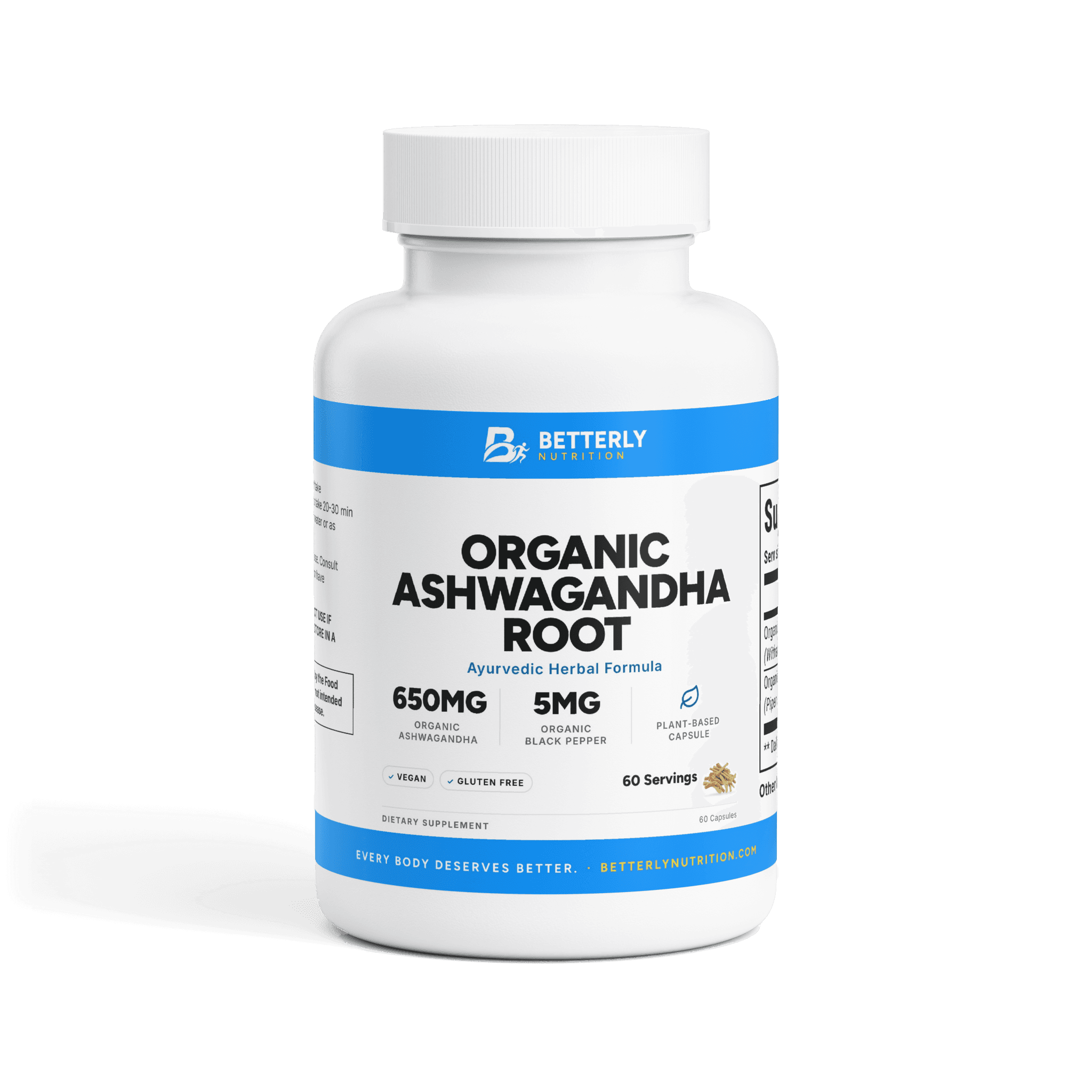
The Ashwagandha, Maca & Ginseng Capsules name the species and the root plainly: 100 mg of Panax ginseng powder per 2-capsule serving. Ginseng is a smaller row there, behind 600 mg of KSM-66® ashwagandha extract, 300 mg of L-arginine and 150 mg of maca root.
How should you take a Panax ginseng supplement?
Never take more of a Panax ginseng supplement than its label directs, and check every row against NIH limits, since one label here exceeds the zinc upper limit.
- Ginkgo Biloba & Ginseng Capsules: the label's suggested use is two capsules twice a day, 20 to 30 minutes before a meal. That's 1,400 mg of ginseng extract a day. The panel's 30 servings are 2-capsule servings, so at that pace a 60-capsule bottle lasts 15 days.
- Ashwagandha, Maca & Ginseng Capsules: the label asks adults to take two capsules daily with 6 to 8 oz of water, for 100 mg of ginseng powder a day.
- Tongkat Ali, Maca & Ginseng Capsules: the label says two tablets once a day. That serving also holds 50 mg of zinc (455% DV).
That zinc figure is a problem. The ODS zinc fact sheet sets the adult upper limit at 40 mg a day, counting food, drinks, supplements and medicines together. The label's own serving is 10 mg over that before you've eaten anything. We don't recommend taking it at the label's dose, and you should talk with a healthcare provider before using it at all.
A few more points apply to any ginseng label:
- ODS says ginseng above 2.5 g a day counts as a high dose. The ginkgo formula at its label use comes to 1,400 mg of extract, but extract and raw root don't compare gram for gram, so treat that as a rough check.
- Don't stack sources. Some greens and focus powders list ginseng too, ours included. Our guide to alpha-GPC and L-theanine reads one of those panels.
- NCCIH describes short-term use, up to 6 months in recommended amounts, as appearing safe for most people, and notes open questions about longer use.
Our guide on when to take ginseng covers timing.
When don't you need a ginseng supplement?
You probably don't need a ginseng supplement for athletic performance, since NCCIH says most research shows Asian ginseng doesn't improve it.
It's also reasonable to skip ginseng if:
- You're a young adult hoping for sharper thinking. NCCIH describes only a small amount of research on attention and reaction time, and it found no such effect in young adults.
- Your real issue is short sleep. No herb makes up for it, and NCCIH names trouble sleeping as ginseng's most common side effect.
- You want ginseng root on its own. None of our labels offers that: the ginkgo formula pairs a stem-and-leaf extract with ginkgo, and our other ginseng labels are multi-ingredient blends.
Keep expectations modest, too. NCCIH notes that most clinical trials of Asian ginseng have been small, with fewer than 200 people, and shorter than 3 months. If you'd rather compare formulas built on other herbs, our Adaptogens collection puts them side by side.
From our shop: Ashwagandha, Maca & Ginseng Capsules — 100 mg of Panax ginseng root powder alongside 600 mg of KSM-66® ashwagandha extract and 150 mg of maca root per 2-capsule serving, labeled vegetarian.
Who should check with a healthcare provider before taking ginseng?
Check with a healthcare provider before taking ginseng if you're pregnant or nursing, under 18, on any medication, facing surgery soon or managing a medical condition.
Our labels' caution line names most of these groups, and federal sources add detail:
- Pregnancy and nursing: NCCIH says some studies suggest Asian ginseng may be unsafe by mouth during pregnancy, and little is known about breastfeeding. Some experts advise against it for infants and children.
- Medications: NCCIH says Asian ginseng might interact with certain medicines. ODS names stimulants and drugs that suppress the immune system among them.
- Surgery: NCCIH says Asian ginseng may interfere with blood clotting, so tell your surgical team you take it.
- Side effects: ODS lists headache, trouble sleeping and digestive upset, plus a rapid heartbeat and nervousness at high doses.
- Rare reactions: NCCIH mentions uncommon reports of severe rash, liver damage and severe allergic reactions.
The other herbs on these panels carry their own cautions, so show your provider the whole panel, not just the ginseng row. Our guide on who shouldn't take ashwagandha covers the lead herb in the Ashwagandha, Maca & Ginseng Capsules.
The Tongkat Ali, Maca & Ginseng label adds "Contains: Shellfish (Oyster)," so skip it if you're allergic to shellfish. ODS lists nausea, dizziness, headaches and upset stomach among the signs of too much zinc. It adds that too much for a long time can lower your copper levels.
FAQ: Korean red ginseng and other ginseng types
Is Korean ginseng the same as Asian or Chinese ginseng?
Yes, Korean ginseng, Asian ginseng and Chinese ginseng are all common names for Panax ginseng, according to NCCIH. A regional name usually points to origin or tradition rather than a separate species. What can differ between products is the processing, the plant part, and whether you're buying a plain powder or a standardized extract.
Is red ginseng stronger than white ginseng?
Neither NCCIH nor the abstract of the 2018 Planta Medica review calls red ginseng stronger than white ginseng. NCCIH's safety notes, from possible medication interactions to pregnancy cautions, cover Asian ginseng in general and don't single out either color. So picking red over white doesn't change who should check with a healthcare provider first, or how closely to follow your label.
Is it safe to take Korean red ginseng every day?
Daily Korean red ginseng in recommended amounts appears safe for most adults in the short term, which NCCIH describes as up to 6 months. Questions remain about longer use, and trouble sleeping is the most common side effect. Never go past your product's label, don't combine several ginseng products, and talk with a healthcare provider first if you're pregnant, nursing, on any medication or managing a medical condition.
How can you tell which ginseng is in a blend?
You can tell which ginseng is in a blend only when the panel prints a Latin name beside it. Our Alfalfa & Chlorella Greens Powder lists Siberian ginseng (Eleutherococcus senticosus) root inside a 1 g herbal blend per 2-teaspoon (about 5 g) serving, so its "ginseng" is eleuthero, not Panax. That row has no milligram amount of its own, so the Latin name is the only ginseng detail you get.
Does ginseng have caffeine?
No, Panax ginseng isn't a caffeine source, but some ginseng products add caffeine. Our Alpha-GPC & L-Theanine Focus Powder (Sour Grape) lists 50 mg of Asian ginseng extract alongside 200 mg of natural caffeine per 2-scoop (7.5 g) serving, so count that caffeine in your day. NCCIH also names trouble sleeping as Asian ginseng's most common side effect, so notice how you sleep either way.
Sources
- National Center for Complementary and Integrative Health: Asian Ginseng: Usefulness and Safety
- NIH Office of Dietary Supplements: Dietary Supplements for Immune Function: Fact Sheet for Consumers
- NIH Office of Dietary Supplements: Zinc: Fact Sheet for Consumers
- He M, et al. The Difference between White and Red Ginseng: Variations in Ginsenosides and Immunomodulation. Planta Medica, 2018 (PubMed abstract)
If this left you looking for somewhere to start, read red Asian ginseng and ginkgo capsules with 7% ginsenosides — its amounts per serving are listed on the page. For the practical questions this raises, how dosing, sourcing and subscriptions work is answered in one place.